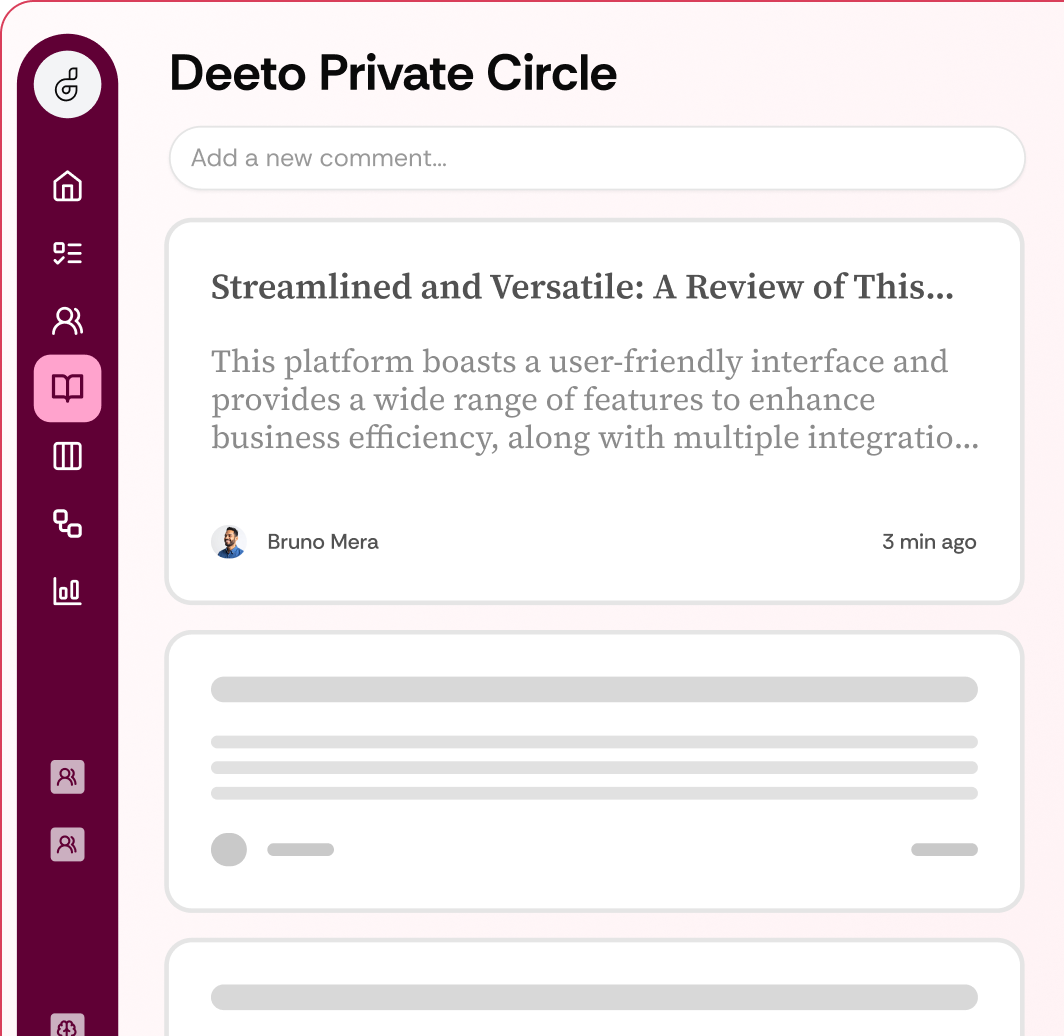
A resource and community space for modern marketers, sellers, and builders using customer voice to grow — together.
This hub is built for anyone who wants to do more with the voices of their customers. Whether you're scaling advocacy, building trust with proof, or rethinking how to go to market — you're in the right place.
How-to guides and playbooks for building with customer voice
Campaign-ready templates and swipe files
Benchmark reports and reference best practices
Event recordings, expert sessions, and community spotlights
Ask questions. Share ideas. Trade wins. This is your space.
You don’t have to figure this out alone. The Deeto community connects you with other leaders using customer voice to build better GTM motions, faster-growing brands, and smarter strategies. If you are interested in joining when it launches, sign up below.
Automate advocacy management workflows
Dynamically generate customer stories and social proof
Eliminate manual reference management
Track and report advocacy impact on revenue
Discover practical guides, templates, and tools to help your team close more deals, faster.
Sales hears one complaint. Support logs another. Product reads a third in a survey response no one else sees. Three teams, three records, one customer who feels ignored the second time they repeat themselves.
To centralize customer feedback is to collect input from every customer touchpoint, support tickets, sales calls, surveys, reviews, and in-product signals, into a single connected system that every team can search, tag, and act on. Instead of feedback living in six disconnected tools, it lives in one place with shared context. In this guide, you'll learn why scattered feedback quietly costs companies revenue, the most common breakdowns that cause it, and a practical framework for building a centralized system that actually gets used.
Centralizing customer feedback means routing every piece of customer input, regardless of source or team, into one connected system of record instead of leaving it siloed in individual tools. A support team's ticketing queue, a sales team's call notes, a product team's survey exports, and a CS team's renewal conversations all become part of the same searchable dataset.
A centralized feedback system includes three things a spreadsheet or shared inbox can't provide: consistent tagging so feedback from different sources can be compared, a single source of truth so teams aren't debating whose data is correct, and structured distribution so the right insight reaches the right team without someone manually forwarding it.
Centralized customer feedback is not the same as collecting more feedback. Most companies already have plenty of raw input, what's missing is the connective layer that turns scattered comments into a dataset teams can actually query and trust.
When feedback stays siloed, every team builds its own partial picture of the customer. Product thinks churn risk is a feature gap. CS thinks it's a support delay. Sales never hears about either until the renewal is already lost. None of them are wrong, they're just working from a fraction of the story.
Zendesk's research on data silos found that only 22 percent of business leaders say their teams share data well. Feedback follows the same pattern. The data exists, it just isn't connected.
That's the core argument for centralization; it's not a data hygiene project, it's a speed and accuracy problem. When feedback is scattered, decisions get made on incomplete information, and the gap between "a customer said something" and "the right team acted on it" stretches from days to months.
Centralizing customer feedback also protects institutional knowledge. When a CSM or sales rep leaves, their notes and context often leave with them. A shared system keeps that history intact and searchable long after any one person moves on.
Most teams don't lack feedback. They lack a system for making it usable. The most common breakdowns look like this:
Each of these is solvable individually. But solving them one at a time, a better tagging convention here, a new dashboard there, rarely fixes the underlying problem: feedback has no single home.
1. Standardize your taxonomy before you standardize your tools. Agree on a shared set of tags and categories across teams before you pick software. If sales calls it "churn risk" and support calls it "escalation," you'll never be able to compare the two datasets later, no matter what platform you choose.
2. Capture feedback at the source, not after the fact. Feedback captured in the moment, an in-product survey response, a live call note, an in-line support tag, is more accurate than feedback reconstructed from memory during a weekly recap meeting. Build capture into existing workflows instead of adding a new step people have to remember.
3. Make the system searchable by theme, not just by ticket. A support queue is searchable by ticket number. A centralized feedback system needs to be searchable by theme: every mention of a specific feature request, every instance of a particular objection, across every team and channel that logged it.
4. Route insights to the team that owns the decision, automatically. Feedback that only lives in a dashboard doesn't drive action. Product needs feature requests surfaced where they already work. Sales needs competitive objections surfaced before the next call. Build routing into the system instead of relying on someone to notice and forward it.
5. Close the loop back to the customer. Centralizing feedback internally is only half the system. When a customer's input leads to a change, telling them closes the trust gap and increases the odds they'll keep giving feedback in the future. This is the kind of connective work Deeto's platform is built to handle, so the loop closes without someone manually chasing it down.
The problem isn't collecting customer feedback. The problem is connecting it to decisions.
Building this doesn't require replacing every tool your teams already use. It requires a layer that connects them.
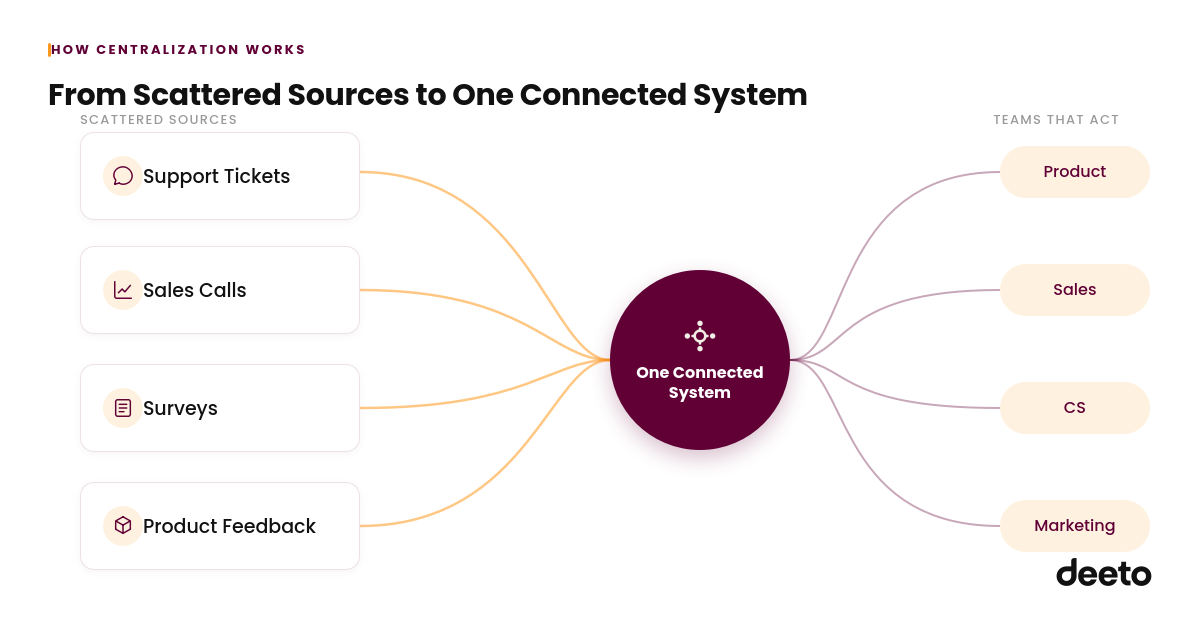
Deeto's platform is built around that same connective-layer idea: capture the signal once, organize it in one system of record, then get it to whichever team owns the decision, whether that's Listen surfacing a new theme, Learn keeping it searchable, or Activate, Analyze, and Orchestrate getting it into the workflows where sales, CS, product, and marketing actually work. That's what turns a folder of voice of customer interviews and survey exports into a shared system instead of a spreadsheet someone updates once a quarter.
In most companies, Customer Marketing (or whoever owns voice of customer) ends up closest to this system day to day, since they're already the ones pulling quotes for case studies, briefing sales on objections, and feeding product teams what customers are asking for. Customer Marketing teams that centralize feedback well treat it the same way revenue teams treat pipeline: reviewed on a set cadence, owned by someone specific, and too important to live in one person's inbox. Product benefits downstream once that system exists too. If you're mapping how centralized feedback should shape what gets built next, how to use customer feedback to build a product roadmap covers that next step.
What does it mean to centralize customer feedback?
Centralizing customer feedback means collecting input from every source, support, sales, surveys, reviews, and in-product signals, into one connected system instead of leaving it scattered across separate tools. It gives every team access to the same searchable, tagged dataset rather than a partial view.
Why is scattered customer feedback a problem?
When feedback stays siloed by team, each function only sees part of the customer's story. Decisions get made on incomplete information, patterns take longer to surface, and by the time a risk or opportunity is visible, it's often too late to act on it efficiently.
What tools do I need to centralize customer feedback?
You need a system that ingests feedback from your existing tools, CRM, support desk, survey platform, and review sites, rather than one more standalone tool teams have to update manually. Platforms like Deeto are built specifically to connect those sources instead of replacing them, which is what makes adoption easier across teams.
How is centralizing feedback different from collecting more feedback?
Most companies already collect plenty of feedback. Centralizing it means adding the connective layer, shared taxonomy, routing, and searchability, that turns scattered comments into a dataset teams can actually query and act on.
Which team should own centralized customer feedback?
Ownership varies by company, but someone needs to be accountable for the system itself: maintaining taxonomy, monitoring routing rules, and reviewing patterns on a set cadence. Without a clear owner, even a well-built system tends to drift back into silos.
How often should teams review centralized feedback?
Monthly reviews catch emerging patterns while they're still small. Quarterly business reviews are useful for strategic decisions, but waiting a full quarter to look at feedback data means smaller trends, an early churn signal or a recurring feature request, can go unnoticed for months.
Centralizing customer feedback isn't about adding another tool to the stack. It's about giving every team access to the same customer story instead of a fragment of it. Start with a shared taxonomy, connect your existing sources instead of replacing them, and build routing rules that get insight to the team that owns the decision. The companies that do this well don't just react to customer feedback faster, they build products, campaigns, and renewal strategies on a foundation of what customers actually said, not what one team assumed. If you're ready to see what that looks like connected end to end, Deeto's platform brings Listen, Learn, Activate, Analyze, and Orchestrate together into one system built for exactly this.


What does it take to centralize customer feedback? Learn the challenges, best practices, and steps to build one shared s
A customer spends ten minutes writing out exactly what's wrong with your onboarding flow. It lands in a support queue, gets skimmed for a one-line summary, and the rest never reaches anyone who could act on it.
An AI voice of customer platform is software that uses machine learning and natural language processing to automatically analyze and route customer feedback at scale. It reads full comments and conversations, structures them into themes and sentiment, and gets insight to the right team without anyone coding a spreadsheet by hand. This guide covers how these platforms work, how they differ from legacy VoC tools, and what to evaluate before you buy one.
An AI voice of customer platform captures feedback across channels, like surveys, reviews, support conversations, interviews, and in-product comments, and uses AI to read, tag, and structure it automatically. Instead of a team manually coding thousands of open-text responses, the platform identifies themes, sentiment, and emerging patterns on its own and keeps learning as new feedback comes in.
The "AI" distinction matters. A voice of customer program has always meant listening to customers. What's changed is the volume and speed at which that listening now happens. AI voice of customer platforms process unstructured, free-text feedback (the kind that used to get skimmed or ignored) at a scale no team could match manually, and they surface it in something close to real time.
Customer expectations have outpaced what manual feedback review can support. McKinsey's research found that 71 percent of consumers expect companies to deliver personalized interactions, and 76 percent get frustrated when that doesn't happen (McKinsey, "The value of getting personalization right, or wrong, is multiplying"). You can't personalize an experience based on feedback that nobody has read. AI makes it possible to actually process the volume of customer voice coming in, not just collect it.
Three shifts are driving the urgency:
Customer voice is not a program; it's the system that powers growth, retention, and innovation, and treating it that way requires infrastructure that can keep up with how much customers are actually saying.
The value of an AI voice of customer platform shows up differently depending on which team is using it. A few of the most common applications:
Not every VoC tool is AI-native, and the difference shows up in what a team actually has to do by hand.
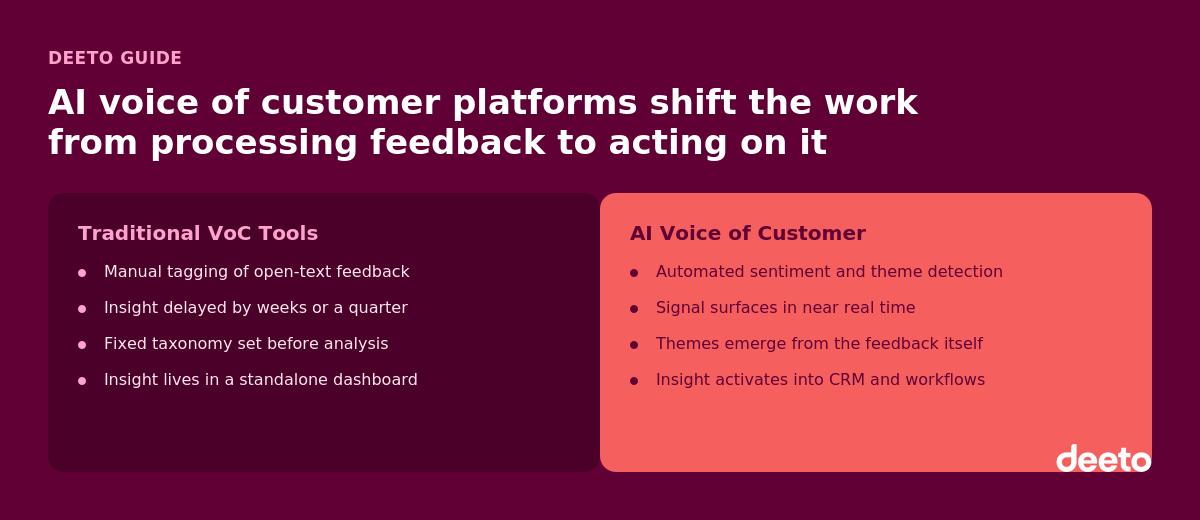
Traditional VoC tools collect feedback and report on structured metrics like NPS and CSAT well, but open-text analysis is largely manual. A researcher or analyst reads verbatims, tags themes by hand or with basic keyword rules, and builds reports on a delay, often weeks after the feedback came in.
AI voice of customer platforms apply natural language processing and machine learning to read every open-text response automatically. They detect sentiment, cluster feedback into themes without a predefined taxonomy, flag emerging issues as they appear, and route insight to the team that needs it, often within the same day feedback arrives.
The practical difference is what a team spends its time on. With a traditional tool, most of the effort goes into processing feedback. With an AI voice of customer platform, that effort shifts to acting on what the feedback already says.
AI makes VoC programs faster, but it doesn't remove every obstacle.
Fragmented sources are the most common one. Feedback lives in survey tools, support platforms, CRMs, review sites, and call recordings that don't talk to each other, so even a strong AI engine only sees part of the picture unless those sources are connected.
Accuracy and nuance are another challenge. Sarcasm, mixed sentiment in a single comment, and industry-specific language can trip up models that aren't tuned for your context, which is why it's worth looking for platforms that let you validate and refine categorization over time.
There's also the action gap. Collecting and analyzing feedback faster doesn't help if the insight still sits in a dashboard nobody checks. Insight needs to reach the person who can act on it, in the tool they already use.
Lastly, change management matters more than teams expect. Teams used to quarterly VoC reports need a different workflow to actually use real-time signals, and rolling out an AI voice of customer platform without adjusting how insights get reviewed and assigned limits the payoff.
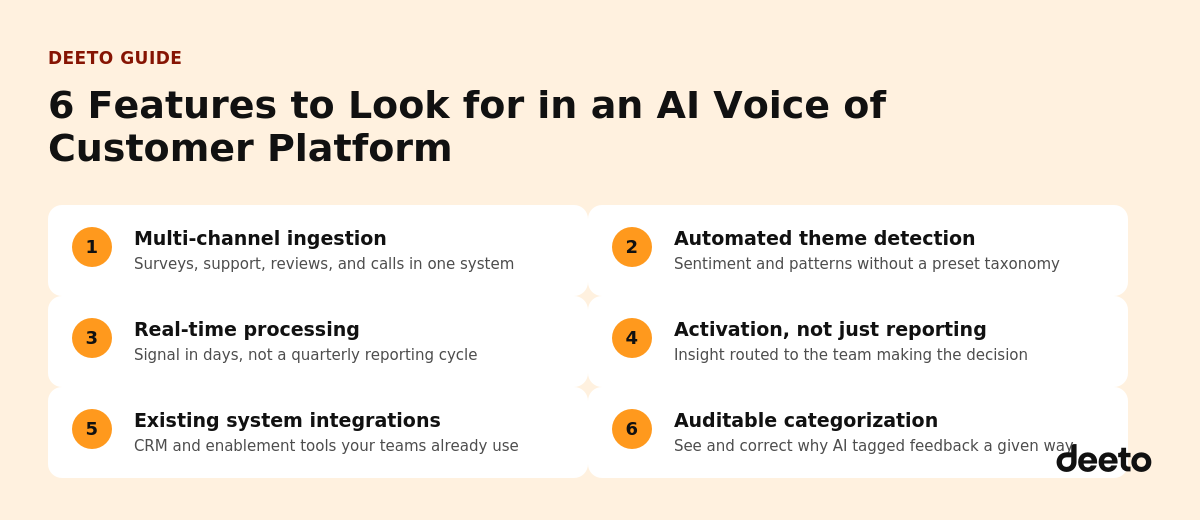
When evaluating platforms, prioritize:
Deeto is built around that last point. The goal isn't a better dashboard, it's making sure insight actually reaches the team that owns customer voice, whether that's customer research feeding a positioning decision or sentiment analysis flagging a churn risk before a renewal call.
What is an AI voice of customer platform?
An AI voice of customer platform is software that uses machine learning and natural language processing to automatically collect, analyze, and route customer feedback from channels like surveys, reviews, and support tickets. It identifies sentiment and themes in open-text feedback without manual coding, turning raw customer voice into structured, actionable insight.
How is an AI voice of customer platform different from a survey tool?
A survey tool collects structured responses like ratings and multiple-choice answers. An AI voice of customer platform goes further by analyzing open-text and unstructured feedback across many channels, using AI to detect sentiment and themes automatically rather than relying on a person to read and tag each response.
Can AI accurately analyze customer sentiment?
Modern AI voice of customer platforms are generally accurate at detecting sentiment and themes in customer feedback, though accuracy varies by vocabulary, industry, and language nuance. The best platforms let teams review and correct categorization, which improves accuracy over time and builds trust in the output.
Who should own an AI voice of customer program?
Ownership varies by company, but Customer Marketing, Product Marketing, and CX teams most commonly lead AI voice of customer programs, since they're closest to both the feedback and the decisions it informs. Successful programs usually have one team responsible for the system, with insight shared across sales, product, and support.
How long does it take to see value from an AI voice of customer platform?
Most teams see initial insight within weeks of connecting feedback sources, since AI analysis doesn't require the manual setup a traditional VoC program needs. Meaningful business impact, like faster response to emerging issues or better-informed product decisions, typically shows up over the following one to two quarters as workflows adjust to real-time signal.
Do AI voice of customer platforms replace human analysts?
No. AI handles the volume and speed of processing feedback, but people still decide what to do with the insight. The platforms that work best pair automated analysis with a clear owner who reviews signals and routes them to action.
An AI voice of customer platform doesn't change why listening to customers matters. It changes what's actually possible to do with everything customers are already saying. The teams getting ahead in 2026 aren't the ones running more surveys, they're the ones that can finally read all the feedback they already have, in time to act on it.
If you're on the team that owns customer voice at your company, see how customer insights translate into a real competitive advantage or book a demo to see Deeto in action.

What is an AI voice of customer platform? Learn how it works, key features, and how to choose the right one.
Customer feedback shows up everywhere except where you need it: a support ticket here, an NPS response there, a Slack message from your CSM about something a customer said on a call last week. A customer feedback platform is software that collects, organizes, and analyzes that feedback from multiple channels so your team can spot patterns and act on them instead of chasing quotes across five different tools. This guide compares 10 platforms so you can find the right fit for your team's channels, scale, and goals.
A customer feedback platform is a tool that captures customer input from surveys, support tickets, reviews, calls, and in-app prompts, then organizes it so teams can find patterns and prioritize action. Most platforms handle some mix of three jobs. They collect feedback, analyze it for themes and sentiment, and route it to the people who can act on it.
There's a useful dividing line in this category: a tool that only gathers survey responses is a collection tool. A true feedback platform connects direct feedback, like surveys and reviews, with indirect signals like support tickets and calls, then turns both into something a team can act on.
Not every tool on this list clears that bar the same way. Some are built for survey collection, some for text analytics, and some for product feedback tracking. Knowing which job you need done first will save you from buying more tools than you need, or less.
Companies that treat customer feedback as a system, not a folder of survey exports, grow faster. Forrester's 2024 US Customer Experience Index found that customer-obsessed organizations report 41% faster revenue growth, 49% faster profit growth, and 51% better customer retention than non-customer-obsessed organizations. The difference is whether anyone can find that feedback, connect it to an account, and act on it before the moment passes.
The cost of not doing this shows up on both sides of the business. Internally, product and CS teams waste hours searching Slack threads and ticket histories to answer a simple question: has a customer asked for this before? Externally, buyers are checking your credibility the same way. TrustRadius's 2026 B2B Buying Disconnect Report found that 74% of buyers use reviews to inform their purchase decisions, which means the feedback you collect, and how visibly you act on it, is doing double duty as your reputation.
These platforms exist to close the gap between hearing something and doing something about it.
Before comparing tools, it helps to know what actually separates a strong platform from a survey tool with a dashboard bolted on.
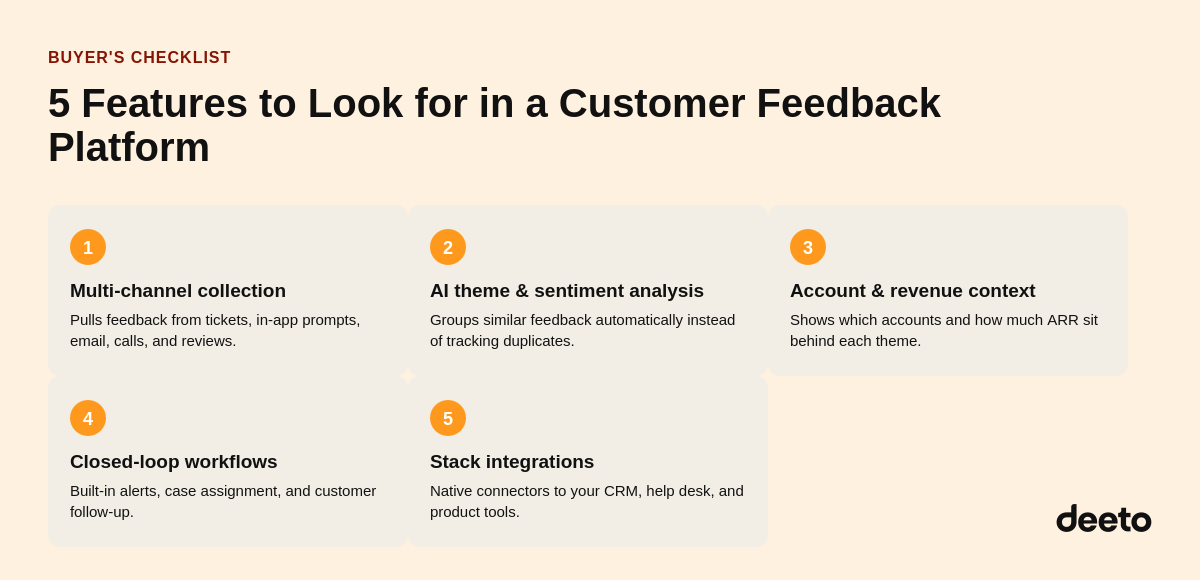
Here's how 10 established platforms stack up, organized by what each one does best.
Best for: Unifying feedback across channels with AI-driven analysis
Enterpret pulls feedback from more than 50 sources and uses an adaptive taxonomy that learns your product's language instead of requiring manual tagging. It suits teams that want continuous analysis tied to revenue, not a one-time report.
Best for: Enterprise CX teams with feedback already centralized
Chattermill applies AI sentiment and theme analysis to feedback from surveys, reviews, and support tickets. It's a strong fit for larger CX organizations that need deep text analytics more than collection.
Best for: Large-scale, survey-led voice of customer programs
Qualtrics is the enterprise incumbent in structured survey methodology and program management. Its analysis leans heavily on survey data, which is a limitation for teams whose feedback mostly lives outside surveys.
Best for: Multi-team CX orchestration at enterprise scale
Medallia combines survey, speech, and operational data across large, multi-brand programs. It carries real implementation weight, so it tends to suit teams with dedicated CX operations staff.
Best for: Multi-channel survey collection
Zonka covers more feedback channels than most survey tools, including SMS, WhatsApp, in-app SDK, and offline kiosk surveys, with closed-loop task assignment built in. It's a collection-first tool, so pair it with a dedicated analytics layer if you're processing high volumes of open-ended feedback.
Best for: Automating feedback analysis for mid-market teams
SurveySparrow's AI tools surface loyalty drivers and sentiment from survey responses across email, WhatsApp, and web channels, with automated CSAT follow-ups built in.
Best for: Website and in-product feedback programs
Survicate targets surveys at specific in-app or on-site moments and captures partial responses so incomplete feedback doesn't get lost. It measures NPS, CSAT, and CES out of the box.
Best for: Public feature request tracking
Canny gives customers a public board to submit and vote on feature requests, with a roadmap they can follow. It works well for community-driven products, but it runs separately from your support platform, so feedback that shows up in tickets or calls won't automatically land here.
Best for: B2B support teams that want feedback tied to support conversations
Pylon's Product Intelligence captures feature requests directly from support tickets, Slack, and calls, then clusters similar requests and shows how much ARR sits behind each one. It's built for teams that want feedback analysis inside their support platform instead of as a separate workflow.
Best for: Transparent, research-grade theme detection
Thematic specializes in text analytics with strong explainability. It shows how it derived each theme, which matters for research and insights teams that need to defend their findings, not just report them.
The right platform depends on which job you're actually hiring it to do. If you need feedback collection first, start with a survey-led tool like Zonka, SurveySparrow, or Survicate. You can layer analytics on top once volume grows. If feedback is already scattered across tools, prioritize a unification and analysis platform like Enterpret or Chattermill that can ingest what you already have.
If your feedback lives mostly in support conversations, a support-embedded tool like Pylon keeps that context intact instead of asking your team to re-log everything into a separate system. If you're running a structured, enterprise-wide VoC program, Qualtrics or Medallia bring the program management muscle that smaller tools don't. If product feedback and feature voting is the priority, a dedicated board like Canny fits better than a general feedback platform.
Whatever you choose, the platform is only half the system. The other half is what happens after feedback is collected: who sees it, how it gets connected to a customer or account, and whether it ever turns into a decision.
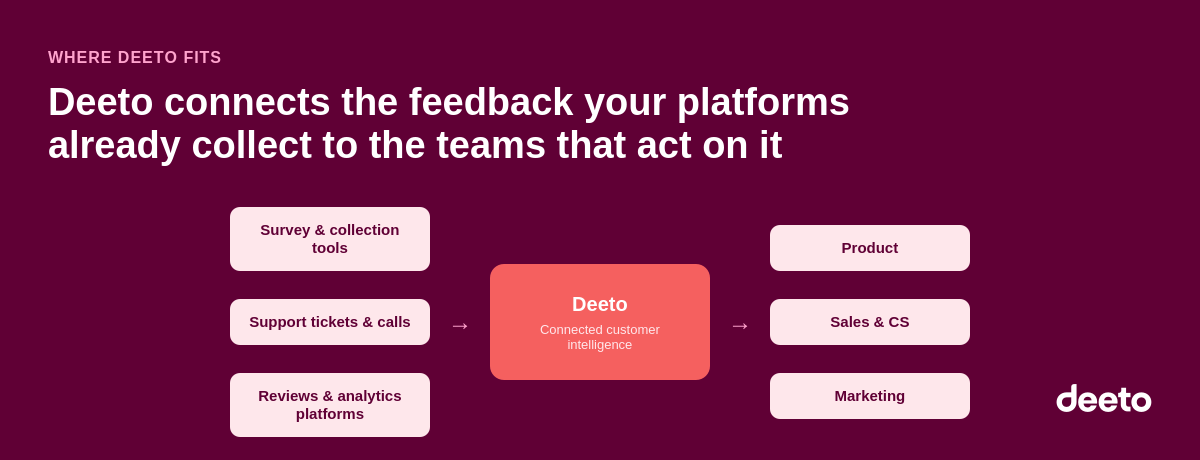
Most tools on this list are built to collect and analyze feedback. Deeto solves a different, related problem: what happens to that feedback once you've captured it.
Deeto is an AI-native customer orchestration platform that connects authentic customer voice to the people and workflows that act on it, across product, marketing, sales, and CS. It sits alongside your existing feedback or survey tool rather than replacing it, turning scattered customer signals into connected customer intelligence.
That distinction matters for teams that already collect plenty of feedback but struggle to do anything with it. If your product team is drowning in feature requests scattered across three tools, or your CS team can't tell whether customer sentiment is shifting until a renewal is already at risk, the gap usually isn't a lack of feedback tools. It's a lack of a system connecting what customers say to what the business does next.
Deeto doesn't compete with a survey platform or a text analytics tool. It completes them, by giving product teams and go-to-market teams a shared, continuously updated view of what customers are telling you, without anyone manually stitching together five different exports. Teams that connect feedback this way report up to a 25% improvement in prioritization accuracy once feedback stops living in silos.
The problem isn't a shortage of customer feedback platforms. It's picking the one built for the job you actually have, whether that's collection, analysis, product feedback tracking, or connecting feedback to revenue and action across your business. Start with what's broken today. If feedback isn't getting collected, fix that first. If it's collected but nobody acts on it, that's a different problem, and one worth solving before you buy another survey tool.
Want to see how Deeto connects customer feedback to decisions across your team? Book a demo to see it in action.
What is a customer feedback platform?
A customer feedback platform is software that collects customer input from surveys, support tickets, reviews, and other channels, then organizes and analyzes it so teams can spot patterns and prioritize what to fix or build next. The strongest platforms also connect that feedback to specific accounts and revenue.
What's the difference between a feedback collection tool and a feedback analytics platform?
Collection tools, like survey software, are built to gather responses. Analytics platforms interpret what's already been collected, surfacing themes and sentiment from open-ended feedback. Some platforms do both, but most specialize in one job or the other.
How much do customer feedback platforms cost?
Pricing varies widely based on features and scale. Survey-led tools often start under $50 per month, while enterprise analytics and VoC platforms typically require custom pricing based on feedback volume, seats, and integrations.
Do I still need a survey tool if I use a feedback analytics platform?
Usually yes. Surveys capture feedback from customers who choose to respond, while analytics platforms interpret feedback from all channels, including support tickets and calls. Most teams pair a collection tool with an analytics or intelligence layer rather than replacing one with the other.
How is a customer feedback platform different from a customer voice intelligence platform?
A customer feedback platform focuses on collecting and analyzing input. A customer voice intelligence platform, like Deeto, goes further by connecting that feedback to the people, workflows, and revenue context needed to act on it across product, sales, and CS.
What should I look for first when comparing customer feedback platforms?
Start with the channels where customers actually give feedback today. A platform that doesn't ingest from those channels natively will leave gaps no dashboard can fix. From there, prioritize AI-driven theme detection and closed-loop workflows over a long feature list.

What are customer feedback platforms? Compare 10 top tools, key features, and how to choose the right one.
Marketing usually focuses on getting new customers through the door. But what happens after they buy?
That's the part that gets overlooked.
Yet your existing customers are your most valuable asset. They've already said yes. They know your product. And if you do it right, they'll buy again, refer others, and become your loudest supporters.
Customer marketing is the way to nurture those relationships.
In today's guide, we'll break down what customer marketing is and how you can use it to grow faster, retain more customers, and turn your brand into a movement.
First, a quick definition:
Customer marketing is the practice of marketing to or with your existing customers, not just to sell more, but to build loyalty, increase retention, and turn happy customers into brand advocates.
It's different from traditional marketing, which focuses on acquiring new leads and closing sales. Customer marketing is about deepening relationships with people who already use your product or service.
It includes things like:
It's powerful because it taps into trust. Your customers already know you deliver. That makes it easier to cross-sell, upsell, or invite them to share their experience with others.
This is also what separates customer-based marketing from product-based marketing. Product-based marketing starts with features and positions them to a broad audience. Customer-based marketing starts with the customer relationship and lets their behavior, feedback, and lifecycle stage decide what gets built and communicated next. Most mature B2B programs end up running both, but customer marketing is the discipline that makes the customer-based half work.
Buying decisions are long, complicated, and full of noise. Prospects are bombarded with ads, sales pitches, and cold emails all day, every day.
But a warm referral or glowing testimonial? That cuts through.
According to data from Forrester, more than 90% of today's buyers trust their industry peers. The least trusted group? Salespeople. Less than one-third of study participants said they trusted sales reps at all.
Social proof is something you can use to drive more web conversions with your marketing content, and it's something your sales reps can use to become more credible.
On top of that, most B2Bs are retention-focused, either because they're a SaaS company with a recurring revenue model or another type of company with high-value, multi-year contracts.
Customer marketing provides a clear pathway for both customer-retaining engagement and customer-getting social proof, at scale.
Here's the short answer: Customer marketing should be owned by marketing, but powered by everyone.
Let's break that down.
Customer marketing is still marketing. It requires messaging, segmentation, campaigns, and content. That means it should live under the marketing team's umbrella, with a clear owner responsible for execution.
They're the ones best equipped to turn customer stories into case studies, build email nurture flows, launch referral programs, and manage brand experience post-sale.
Sales teams have direct lines into what prospects care about and what wins deals. That insight is gold for shaping customer marketing content.
Customer marketers can use that intel to craft high-impact campaigns that speak to future buyers using the voice of current customers.
CS is on the front lines. They know which accounts are thriving, who's ready for a case study, and where upsell opportunities exist. They're also the bridge to turning satisfied users into advocates, community members, and referral partners.
If they're looped into customer marketing efforts, they can flag champions before anyone even raises their hand.
Customer marketing isn't just about sending a few newsletters or posting a case study. It's a start, but the real focus is on how you can turn your existing customers into long-term growth drivers.
Keeping customers happy keeps revenue stable. And customer marketing reinforces the value of your product long after the sale. It helps you stay top of mind, share helpful resources, and build stronger relationships through personalization.
This is also a way to bring acquisition costs down. Retention is, on average, up to five times more cost-effective compared to acquisition.
Customers who feel emotionally connected to a brand are worth 306% more over their lifetime than customers who are merely satisfied. That gap is the entire argument for customer marketing: satisfaction alone doesn't compound, but a relationship does.
In SaaS, the longer someone stays subscribed, the more they're worth by default.
By consistently engaging users and educating them on new features and use cases, you prevent churn, which, by extension, makes every customer worth several times more.
Customer marketing gives you a way to generate those referrals at scale. When a happy client shares their story on LinkedIn or brings you up in a Slack group, it carries real weight. No ad can compete with that.
When a customer already trusts you, it's easier to expand that relationship. Customer marketing helps your CS team highlight new offerings and additional features that align with what they're already using.
You can't rely on 1:1 relationships forever. Customer marketing gives you the systems to engage hundreds (or thousands) of customers with the same level of care. Whether it's through automation, content, community, or all of the above, the right strategy lets you scale without sacrificing quality.
In general, a customer-led growth strategy yields growth, profitability, and long-term sustainability in a way other strategies cannot. Because your customer is at the center of both your marketing and your overall experience, you can innovate for them faster and differentiate yourself from the pack.
Customer-led marketing tactics are a critical aspect of this because (a) they engage your existing customers through personalization while (b) getting them more involved with your brand via advocacy and (c) making it easier to bring in and close new business.
There are several benefits to this:
Customer marketing also gives you a competitive moat. Anyone can copy features or undercut you on price. Nobody can easily replicate a loyal customer base that's actively talking about how much they love your product.
If you want results, you need structure. These five pillars are the operational backbone of high-performing customer marketing strategies:
Don't treat your entire customer base the same. Build segments based on behavior, product usage, lifecycle stage, industry, or account value. Then map specific marketing actions to each.
Use tools like your CRM, product analytics, and NPS responses to continuously refine your segments. Segmentation is useless if it doesn't drive specific action.
Use the data you have (purchase history, usage patterns, support tickets, product interest) to deliver 1:1-feeling messages at scale.
Examples:

Personalization is timing, relevance, and context. Creating triggers based on these kinds of identifiers makes your communication feel natural, even though it's going out to thousands at once.
Customer marketing listens as much as it speaks. Build feedback loops into your strategy:
The tooling matters here too. A dedicated customer feedback platform keeps signal from getting lost across support tickets, NPS surveys, and sales calls, and AI sentiment analysis can flag shifts in customer sentiment before they show up as churn.
Then act on the data.
Communities build trust and stickiness. Set up forums, user groups, or a Slack/Discord channel where your customers can connect with each other and your team.
To make it work:
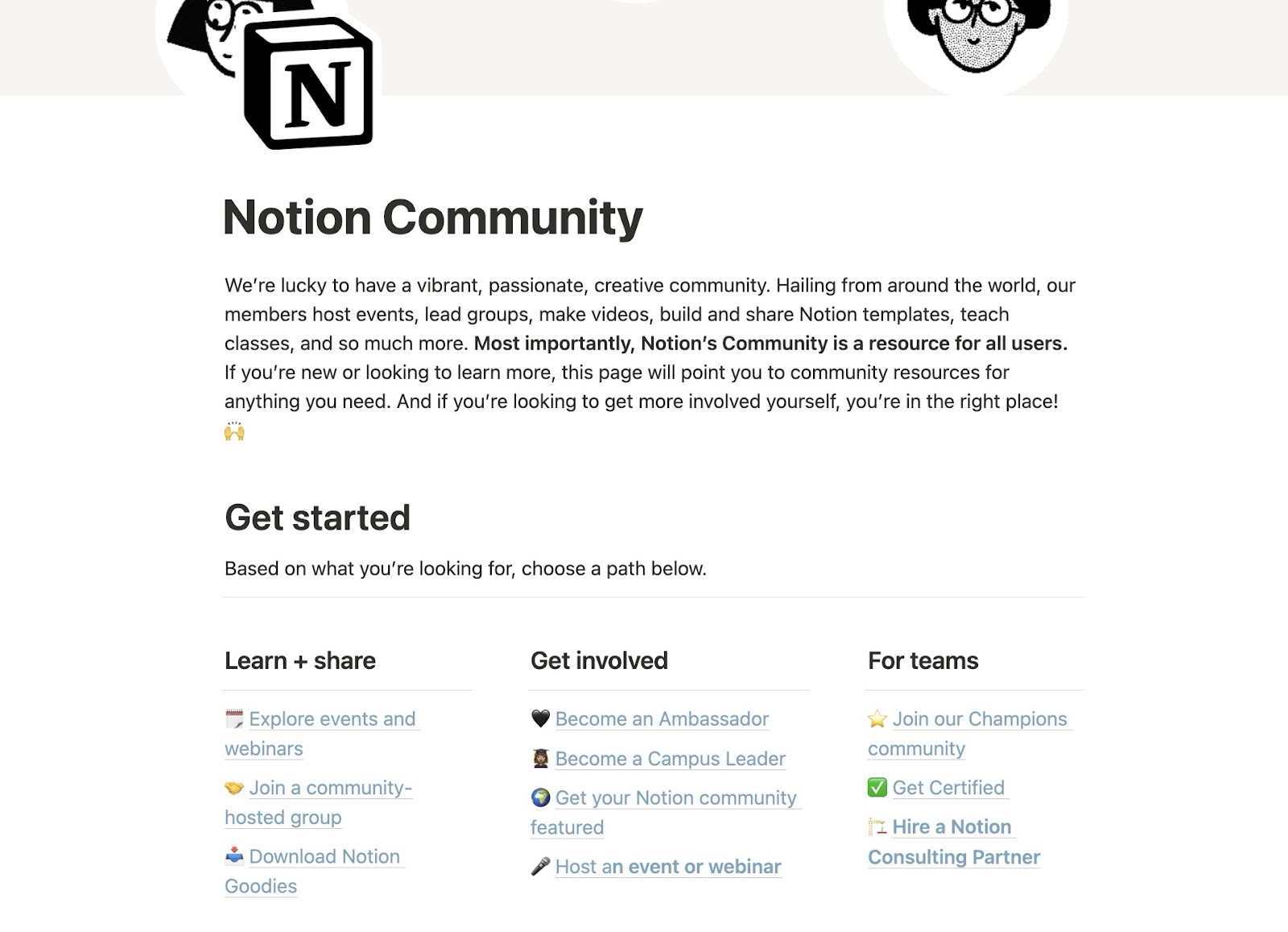
Notion is a great example of a company that does this better than its competitors. Their ambassador program, local meetups, online forums (Notion Communities), and content hubs increase product stickiness, generate organic UGC, and drive serious word-of-mouth.
Bonus: Customers will often answer each other’s questions faster than your support team can. That’s scalable support and marketing in one.
More education = more value = less churn. Don't assume customers know how to use everything they've paid for. Create a structured path to mastery.
Build content based on real usage patterns and friction points:
Tie every piece of education to business outcomes, and connect the how to the why.
Tactical execution across the right channels is how you win the customer marketing game. The best programs use a mix of personalized communication, educational content, and community to engage users and drive long-term value.
It should feel like a conversation, not a campaign. That means personalization at every level, especially when it comes to email and CRM.
Email remains one of the highest-leverage channels for customer engagement. But blasting everyone with the same newsletter won't move the needle. Instead, build sequences around key customer moments like onboarding, product milestones, inactivity triggers, or renewal windows.
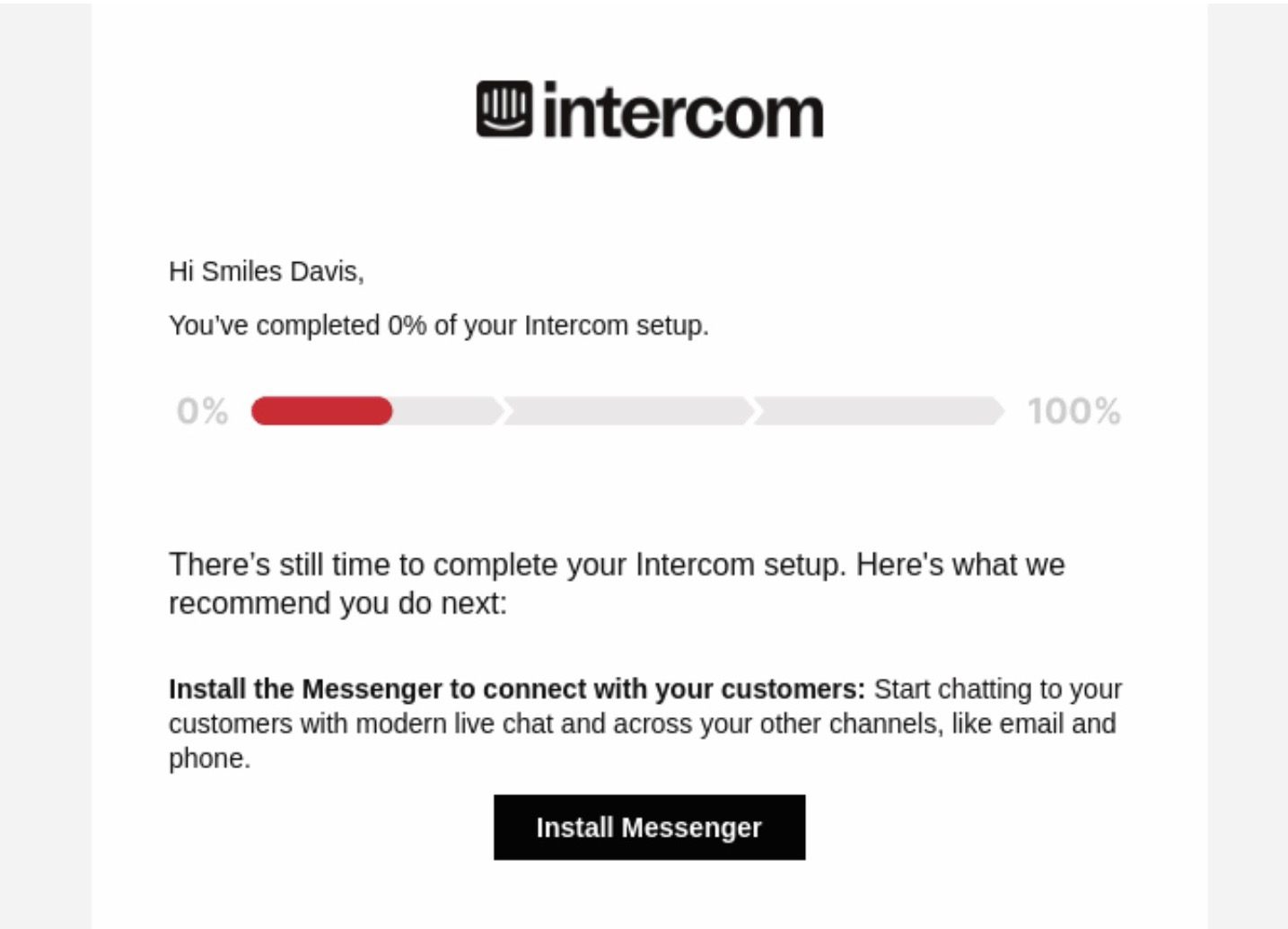
Your CRM already holds the insights you need: feature usage, support tickets, expansion readiness, satisfaction scores. Use that data to create meaningful interactions.
For example, if a customer is close to hitting their usage limit, trigger an upsell campaign before the friction. If someone gave you a 9/10 NPS score, invite them to join a referral or advocacy program right away (you can set this up with Deeto).
Most customers only use a fraction of your product. Close the gap with deep-dive guides and advanced strategies tied to real business problems.
For instance, a database/PM tool like Airtable might send vertical-specific playbooks that show exactly how to use it in marketing ops, product launches, or inventory tracking, depending on the user profile attached to the email.
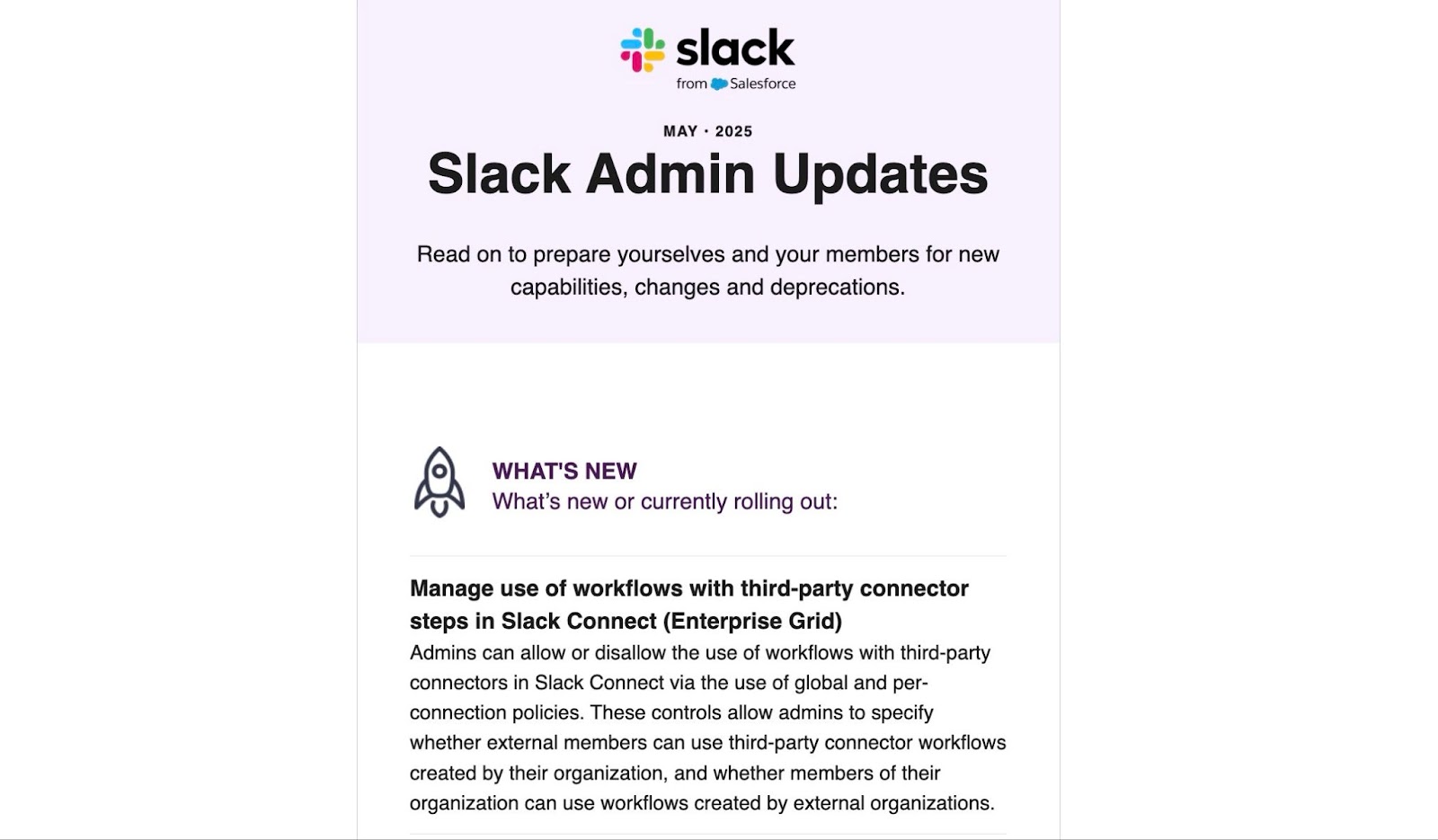
Product update announcements are another big one. Every month, Slack sends out an admin update talking about new features. For big changes, they send a notification out immediately.
And remember that your customers often create better content than you do. UGC is one of the most effective ways to drive deal closure, so you need to make it easy for them to share how they use your product.
The more you can get people talking about your product and using it in front of others, the better.
Online communities give users a place to ask questions, get feedback, and share ideas.
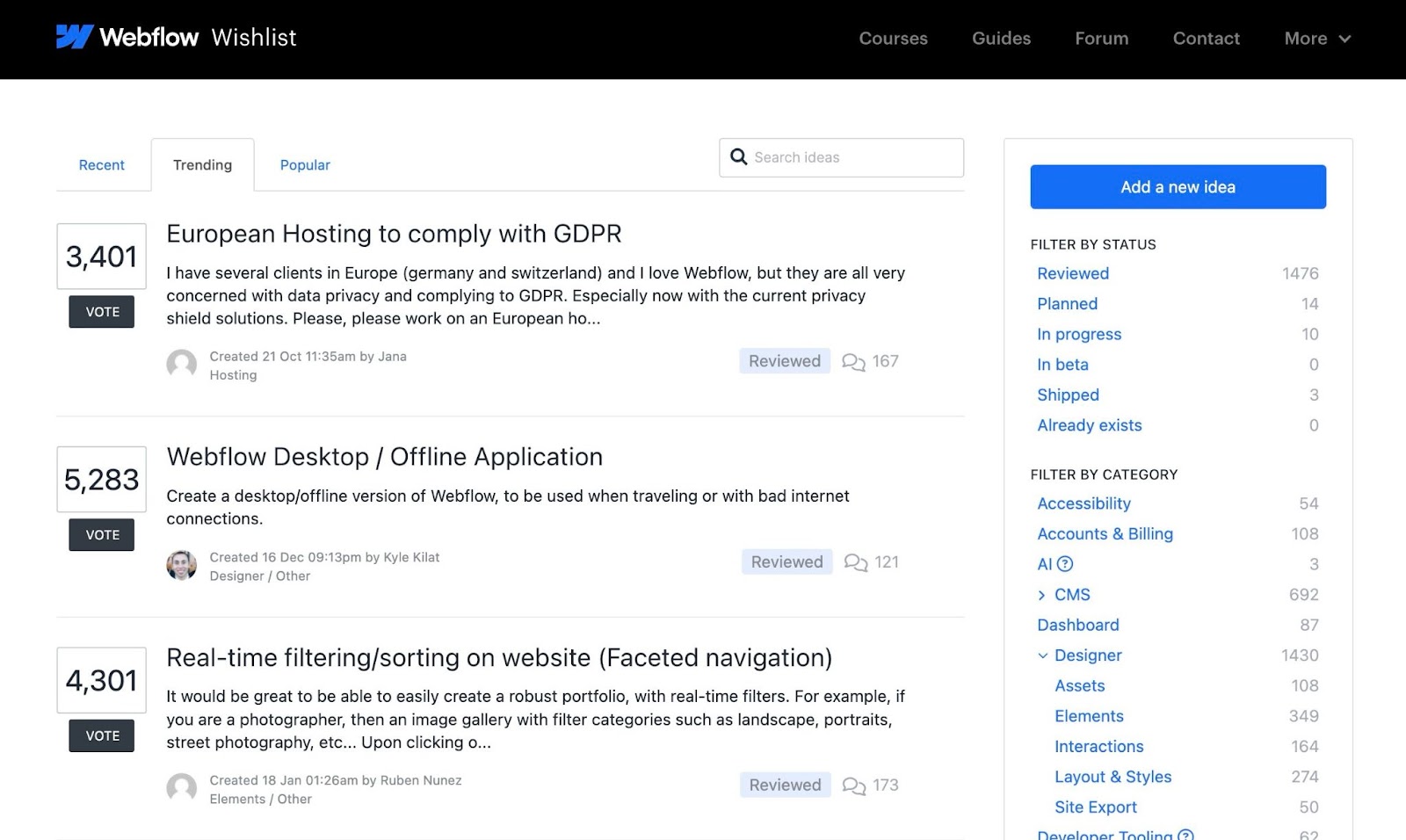
Webflow’s community forum integrates docs, discussions, and a wishlist voting board to make customers feel heard and involved.
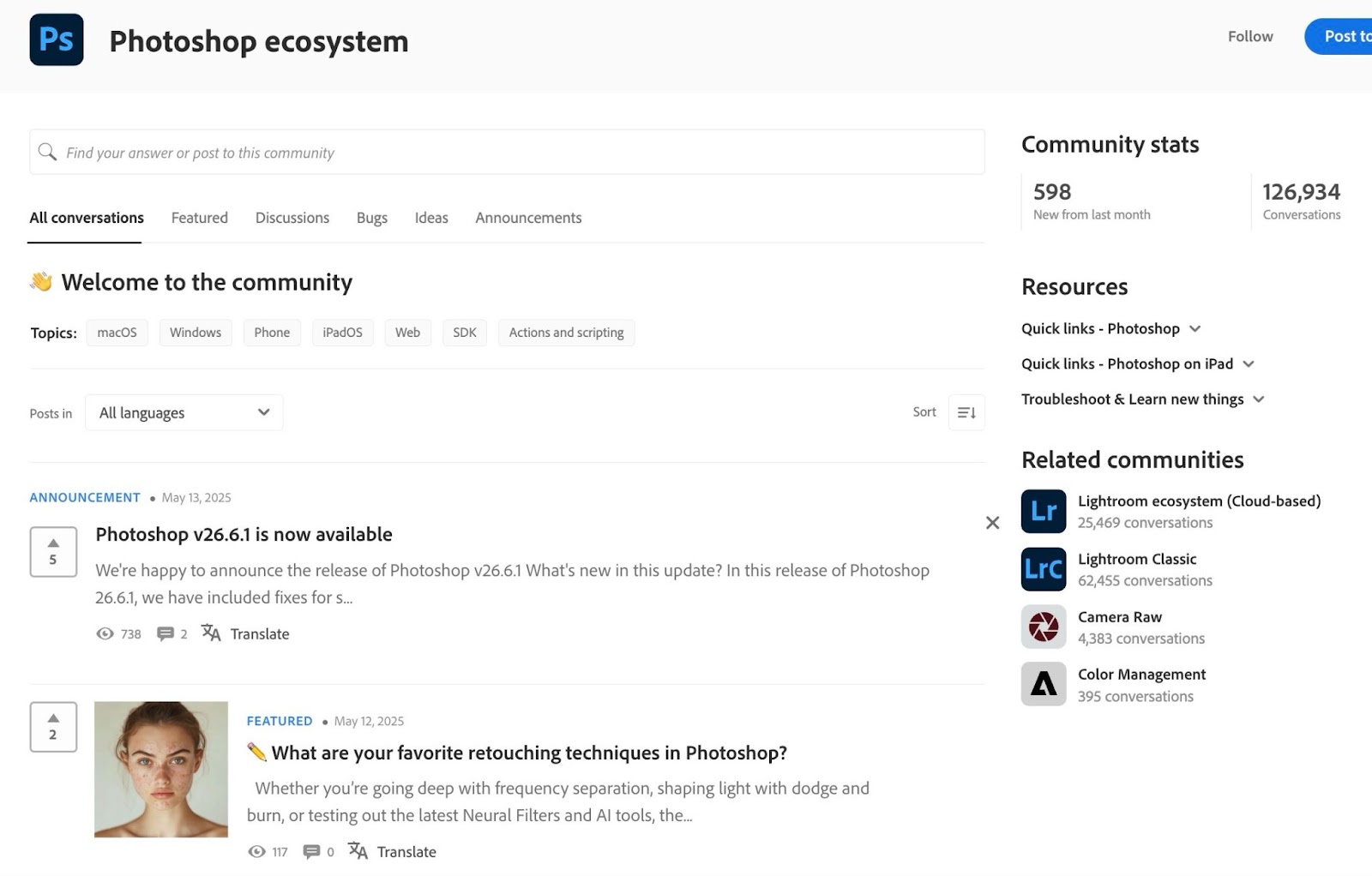
Adobe’s Creative Cloud hub mixes tutorials, peer content, and design showcases to inspire and educate.
Live events are another great idea, whether in-person or virtual. They create powerful loyalty loops because you're giving your customers a stage, not just a seat.
Gong hosts customer-led roundtables where revenue leaders share real-world tactics. And Atlassian goes even further: their “ACE” (Atlassian Community Events) program lets customers run events in their own cities, with Atlassian supporting behind the scenes.
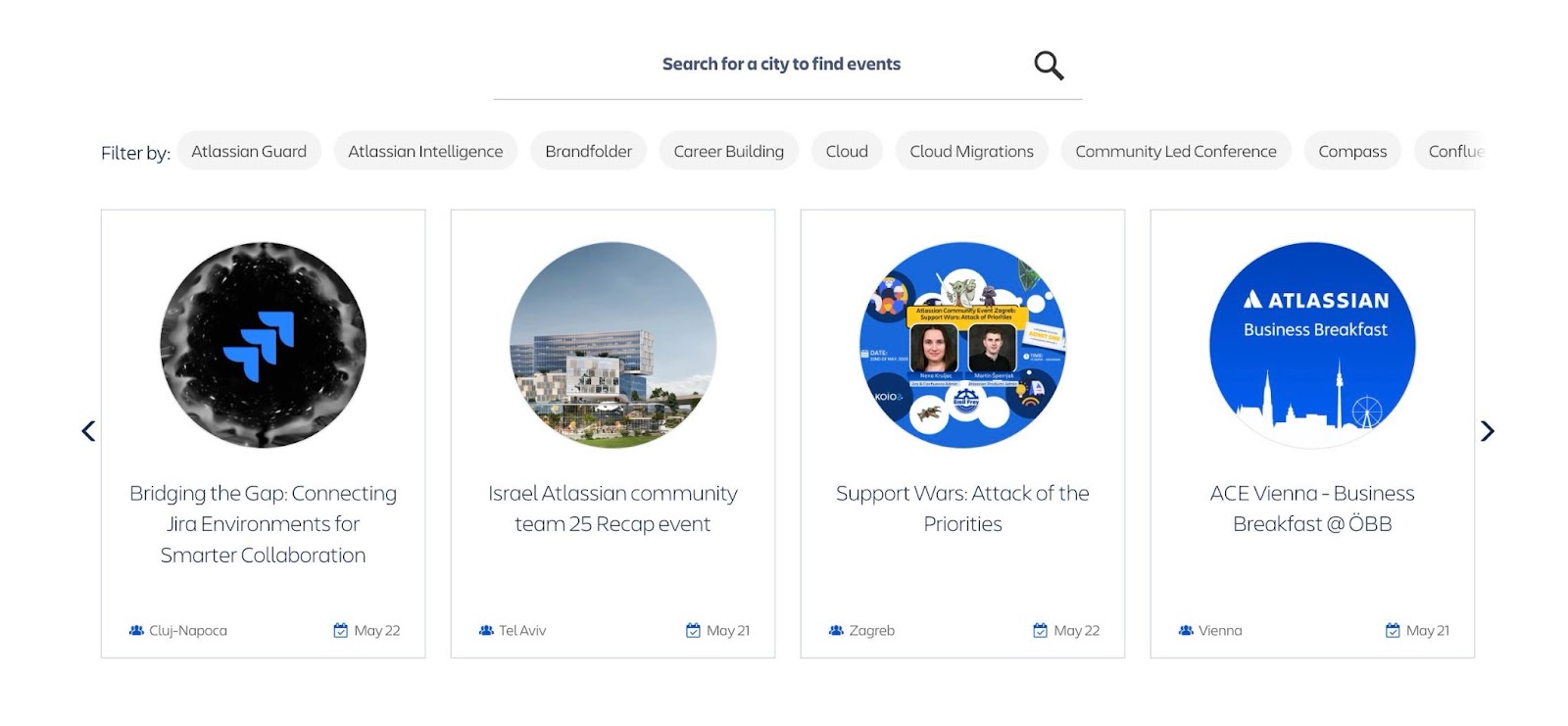
That’s community-led scale.
Maybe it goes without saying, but you can’t improve what you don’t measure. Tracking the right metrics guarantees your efforts are driving real value across retention, revenue, and advocacy.
NPS measures how likely a customer is to recommend your product to others. It's a direct indicator of satisfaction and loyalty and a strong predictor of organic growth.
A rising NPS usually means your customer marketing is resonating. A declining one signals gaps in value delivery or communication.
Retention is the backbone of customer marketing. It tells you how many customers are sticking around over a given period and how well your efforts are reinforcing product value.
Tie retention changes to marketing campaigns. Did a recent onboarding series reduce early churn or increase product adoption?
Then, break it down by segment to see where you're winning or losing.
This is the inverse of retention, and it's just as important to monitor. High churn often points to gaps in education, onboarding, or ongoing engagement.
If churn is creeping up, your customer marketing efforts aren't focused where they should be.
CLV tells you how much revenue the average customer generates over the course of their relationship with your business. Customer marketing is all about retaining users longer, increasing upsells, and keeping them engaged enough to stay and grow with you. All these things increase CLV.
Start by segmenting CLV by customer type to identify your most valuable personas. Then, use that insight to tailor content, rewards, and outreach where you see the biggest opportunities and which will have the biggest overall impact (e.g., "Basic" users upgrading to your "Pro" tier that's 2x the cost).
Your customers should be your best sales channel. These two metrics help you track how often that's actually happening.
With a platform like Deeto, it's easy to track your referral program's performance. Who's sending leads? What's the conversion rate? It'll tell you everything you need to optimize your referral strategy.
You should also measure how many customers are taking advocacy actions after key milestones (e.g., feature adoption or positive NPS).
In product-led growth, your product is the main driver of acquisition, activation, and expansion. But even the best product can't speak for itself, your customers have to.
In PLG, your most valuable growth asset is a happy, active user. Customer marketing helps identify those users and turn them into loud supporters through case studies, testimonials, reviews, social proof, and, most importantly, user-generated content.
Example: Figma's superusers are creators inside the Figma Community and on their own respective social media profiles. They share templates and show off designs that inspire others to sign up.
PLG relies on virality: one user gets value and brings in others. But this doesn't happen automatically.
Customer marketing accelerates word-of-mouth with:
Example: Notion turns everyday users into ambassadors by showcasing their workspace setups, templates, and productivity tips across YouTube, Reddit, and Twitter. They're even allowed to monetize their expertise by selling Notion templates on its marketplace.
Go-to-market is like any other sales strategy in the sense that advocates who've already proven your product's value are a critical driver across sales, onboarding, and expansion. In fact, with new products that haven't hit the market, even more so.
Customer marketing provides Sales with:
Example: Deeto's users use Deeto's AI-powered widgets and smart-matching algorithms to present prospects and sales reps with the most relevant references and social proof content at any point in the sales cycle.
Of all the things you can't miss, technology has to be the most critical. Manually managing these things will all but guarantee you stay disorganized and fail to execute consistently across hundreds (or thousands) of users.
These are your backbone. They hold all your customer data and communication workflows. You'll use them to centralize customer profiles and activity, trigger personalized campaigns based on behavior, and align Customer Success, Marketing, and Sales around a single source of truth.
Tools worth checking out: HubSpot, Salesforce, Customer.io
These are the platforms you'll need in order to track NPS, CSAT, and feature adoption. They're also how you'll identify promoters and churn risks and collect insights that shape campaigns and content.
Tools worth checking out: Pendo, Hotjar, Delighted, Mixpanel
You need consistent, personalized communication to stay top of mind and drive value post-sale. An email software will automate the process of sending lifecycle emails, feature tips, and upsell offers. You can create journeys based on user behavior, and even blend email, in-app messaging, and SMS if you need to (with the right platform).
Tools worth checking out: Klaviyo, Iterable, Customer.io
Advocacy is where customer marketing compounds. These tools help you turn satisfied users into active promoters.
Deeto is unique in this category because it helps you scale word-of-mouth by turning customers into on-demand advocates. You can invite users to share feedback, join reference programs, refer new leads, and take part in case studies, all from one dashboard.
That same platform presents segment-specific content to your marketing and CS teams and prospect-specific references to your sales team. And generative AI allows you to repurpose and share content across your entire ecosystem almost instantly.
Want to see it in action? Request a demo and we'll show you how it works.
What is customer marketing?
Customer marketing is the practice of marketing to and with your existing customers to build loyalty, increase retention, and turn happy customers into brand advocates. It differs from acquisition marketing, which focuses on winning new leads rather than deepening relationships with people who already use your product.
Who should own customer marketing?
Marketing typically owns customer marketing strategy and execution, but it works best when powered by Sales and Customer Success. Sales contributes insight into what resonates with buyers, and CS surfaces which accounts are ready to become advocates.
What's the difference between customer marketing and customer-led marketing?
Customer marketing is the broader discipline of engaging existing customers through content, community, and advocacy programs. Customer-led marketing is a specific approach within that discipline, where customer insight and behavior directly shape what gets built and communicated, rather than marketing deciding first and validating with customers after.
What's the difference between customer-based and product-based marketing?
Product-based marketing starts with a product's features and positions them to a broad audience. Customer-based marketing starts with the customer relationship and lets behavior, feedback, and lifecycle stage guide what gets built and communicated. Most effective B2B strategies combine both.
How is customer marketing different from customer success?
Customer success focuses on onboarding, support, and retention at the account level. Customer marketing focuses on turning that healthy relationship into scalable proof, content, and advocacy that benefits the whole business, not just the individual account.

What is customer marketing? Learn how it drives retention, advocacy, and growth from the customers you already have.
Collecting customer feedback is the easy part. Reading all of it is where teams drown. Support tickets, survey responses, reviews, call transcripts, it all piles up faster than any team can read it manually. Organizing and analyzing all of this customer feedback is the difficult part.
AI sentiment analysis tools are software platforms that use natural language processing and machine learning to automatically detect emotion, tone, and opinion in customer feedback, then classify it as positive, negative, or neutral. Instead of a person reading every review or ticket, the software scores sentiment at scale and surfaces the patterns underneath it. In this guide, you'll learn what these tools actually do, the features that separate the useful ones from the noisy ones, and how the top platforms compare.
AI sentiment analysis is the process of using machine learning models to read unstructured text (or voice, once transcribed) and determine the emotional tone behind it. The output is usually a sentiment score, a category (positive, negative, neutral, or mixed), and increasingly, an emotion label like frustration, delight, or confusion.
Modern AI sentiment analysis tools go further than early keyword-matching systems. They use large language models to understand context, sarcasm, and intensity, not just individual words. A comment like "the onboarding took forever but support was incredible" gets parsed into two distinct sentiment signals instead of one flat score.
Sentiment analysis systems typically pull from a mix of sources: support tickets, NPS and CSAT surveys, product reviews, call transcripts, social mentions, and in-app feedback. The best tools connect that sentiment back to specific themes, features, or moments in the customer journey, so a team doesn't just know sentiment dropped, they know why.
Manual feedback review doesn't scale. A mid-size company can generate thousands of feedback data points a month across channels, and reading all of it consistently is not realistic for any team.
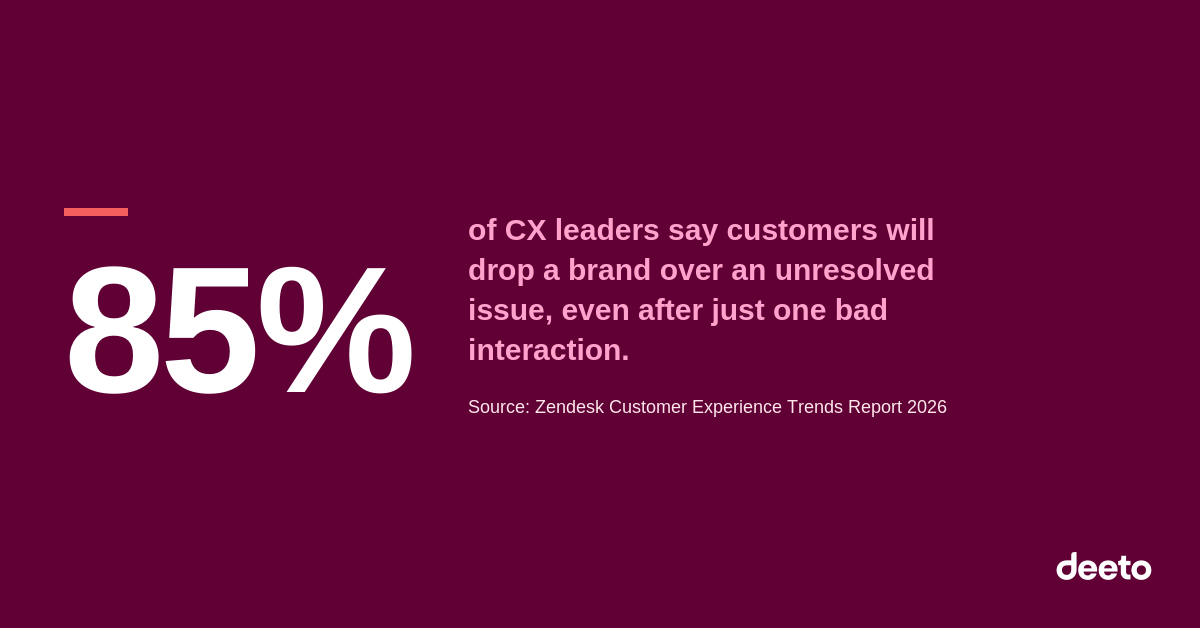
According to the Zendesk Customer Experience Trends Report 2026, 85 percent of CX leaders say customers will abandon a brand over unresolved issues, even after just one bad interaction. That is a narrow margin for error, and it only gets narrower without a system that flags negative sentiment before it becomes churn. A single dashboard number does not fix that. What closes the gap is sentiment data that is connected to the account, the rep, and the next action, so a flagged interaction turns into a follow-up instead of a missed signal.
The same report found that 61 percent of customers now expect more personalized service because AI can analyze their past interactions. Sentiment analysis is part of how that expectation gets met. It gives teams the ability to spot a shift in tone early, whether that's a champion going quiet before renewal or a spike in complaints about a specific feature, and respond before it shows up in the numbers.
Sentiment analysis tells you how customers feel. Connected to the right workflow, it tells you what to do about it.
Not every sentiment analysis tool is built for the same job. Before comparing platforms, it helps to know which capabilities actually move the needle:
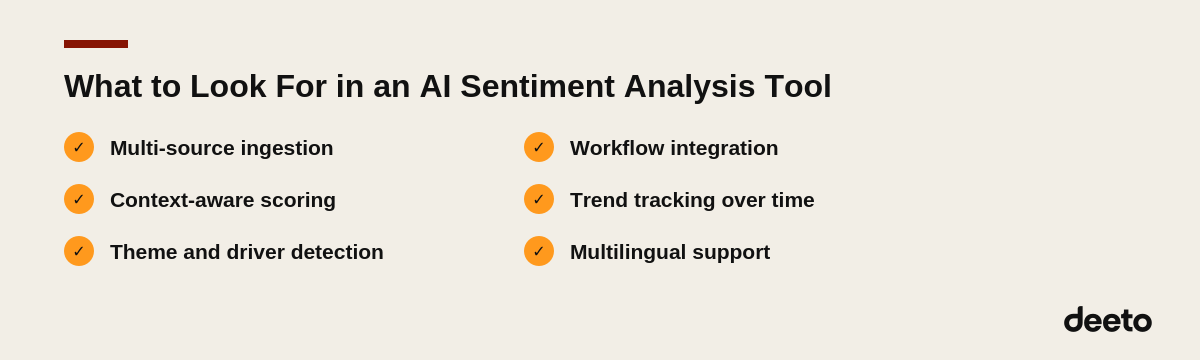
Here's how the leading platforms compare on data sources, scoring approach, and where each one fits best.
Most of the tools above are built to score sentiment. Few are built to connect that score to the actual customer behind it, and fewer still route the insight to the team that can act on it. That's the gap Deeto is built to sit in, not one more sentiment tool, but the layer that ties sentiment scoring to real customer voice collected through interviews, surveys, and in-product feedback, then activates it across sales, marketing, and CS. A negative sentiment spike comes with the actual context behind it, and reaches the person who can do something about it.
Even the strongest sentiment analysis tools hit the same walls.
A few questions narrow the list fast:
Teams evaluating options for customer success and retention workflows often find that the biggest gap isn't detection accuracy, it's whether sentiment data actually reaches the person who can act on it before the moment passes.
What is an AI sentiment analysis tool?
An AI sentiment analysis tool is software that uses natural language processing and machine learning to automatically detect the emotional tone in customer feedback, classifying it as positive, negative, or neutral. Modern tools also detect specific emotions and tie sentiment to themes or topics.
How accurate are AI sentiment analysis tools?
Accuracy varies by tool and data type, but modern large language model-based systems handle context, sarcasm, and mixed sentiment far better than older keyword-based systems. Accuracy typically improves when a tool is trained on domain-specific feedback rather than generic text.
What data sources can AI sentiment analysis tools use?
Most platforms can analyze support tickets, survey responses, product reviews, call transcripts, social media mentions, and in-app feedback. The strongest tools combine multiple sources into one unified sentiment view instead of scoring each channel separately.
Can AI sentiment analysis predict customer churn?
Sentiment analysis alone doesn't predict churn, but a sustained negative sentiment trend is one of the earliest and most reliable churn signals available. Tools that connect sentiment to account-level data and route alerts to CS teams turn that signal into an actionable retention workflow.
Is AI sentiment analysis different from Voice of Customer software?
Sentiment analysis is a capability, while Voice of Customer (VoC) software is a broader category that includes sentiment analysis alongside feedback collection, theme detection, and insight activation. Many VoC platforms, including Deeto, use sentiment analysis as one layer of a larger customer intelligence system.
Sentiment scores by themselves are just numbers. What makes AI sentiment analysis tools worth the investment is what happens after the score gets generated, whether the insight reaches the right team, comes with enough context to act on, and connects back to a real customer rather than an anonymized data point.
The right tool depends on the channels a business needs covered and how deeply sentiment needs to connect to daily workflows. For teams that want sentiment tied directly to authentic customer voice and activated across sales, marketing, and customer success, Deeto's platform is built to turn that signal into a decision, not just a dashboard. See how customer feedback becomes a product roadmap input, or book a demo to see sentiment analysis connected to real customer stories in action.

What are AI sentiment analysis tools? Compare the top platforms, key features, and how to choose the right one.
Every support ticket, chat transcript, and call recording holds a signal about why customers stay or leave. Most teams just never see it in time.
Customer service analytics tools collect and analyze data from support interactions, including tickets, calls, chats, and post-interaction surveys, to reveal patterns in sentiment, resolution speed, and recurring issues. They turn scattered conversations into a picture of what's actually happening between your team and your customers.
Eight of the top options are broken down next, along with the categories they fall into and how to figure out which one actually fits the problem you're trying to solve.
Customer service analytics tools capture data from every customer support interaction and organize it into metrics teams can act on: sentiment trends, first-response time, resolution rate, repeat contact reasons, and agent performance. Instead of relying on a supervisor spot-checking calls or a CSAT score in isolation, these platforms give a full view of what's driving customer satisfaction or frustration.
Most customer service analytics software falls into one of a few buckets. Some are built into helpdesk platforms and track ticket-level metrics. Others analyze the actual language of a conversation for sentiment and intent. Some are pure survey tools that measure how customers felt after the fact. And a smaller group connects all of it, along with data from CRM, sales, and product systems, into one place so the insight actually reaches the people who can act on it.
The right fit depends less on which tool has the longest feature list and more on what question you're trying to answer. That might mean figuring out why resolution times are slipping, tracing whether a specific product issue is driving repeat contacts, or catching a support pattern that's already signaling churn risk in an account your CS team hasn't flagged yet.
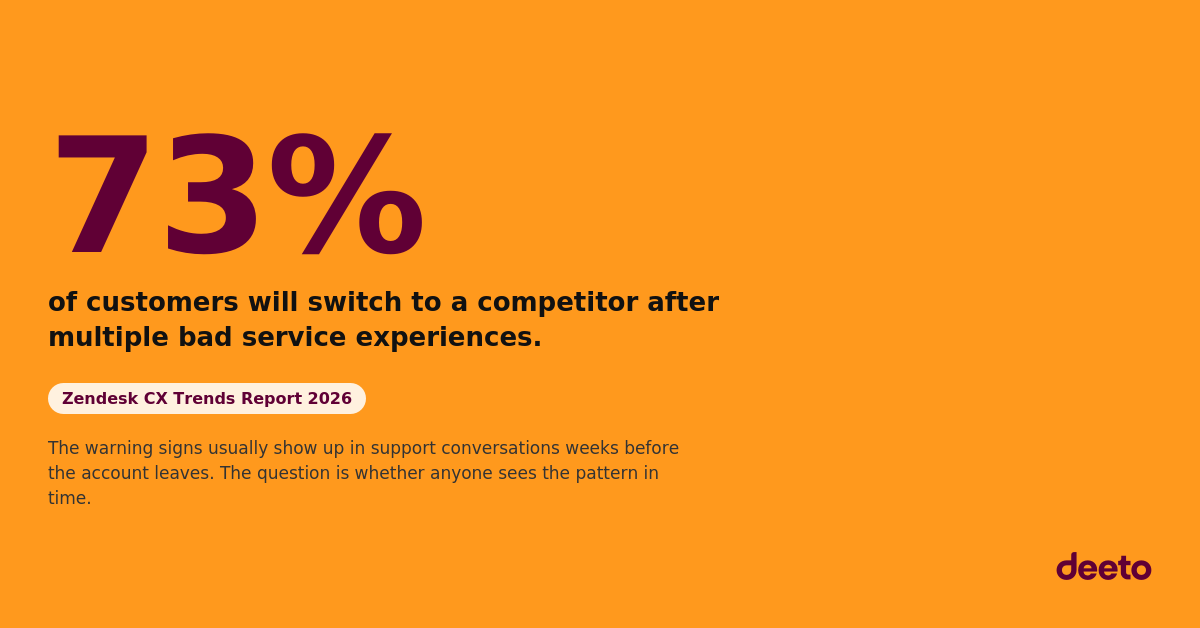
Support interactions are one of the richest, least examined sources of customer truth a company has. Nearly three in four customers say they'll leave a company after a handful of bad experiences, according to Zendesk's 2026 CX Trends Report. That's rarely one dramatic failure. It's usually a pattern that shows up across tickets weeks before a renewal conversation goes sideways.
Support data usually lives in one system, sales context lives in another, and nobody connects the two until a deal or renewal is already at risk. The data exists. It just doesn't talk to itself.
That gap is exactly where customer service analytics earns its keep. When support conversations are analyzed for sentiment, churn signals, and root cause, teams stop reacting to complaints after the fact and start catching the pattern while there's still time to act.
Before comparing individual platforms, it helps to know which category actually matches your problem.
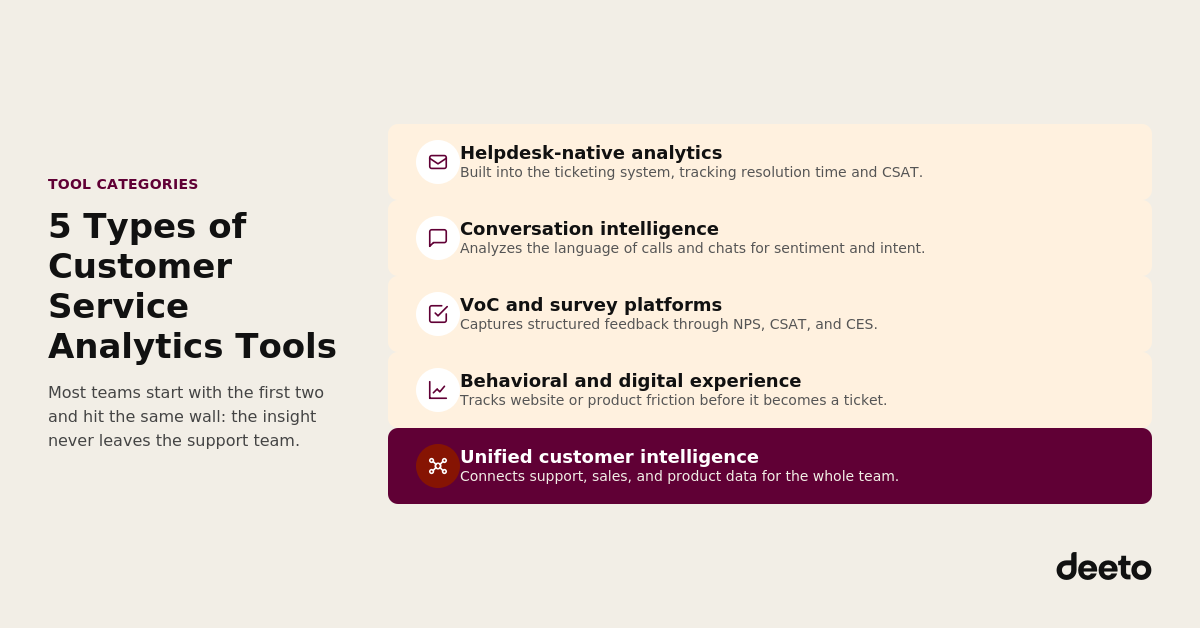
Most companies start with the first two categories and hit a wall at the same point: the insight stays inside the support team. A pattern that would matter enormously to product or customer success never leaves the helpdesk dashboard, even though support is just one stop on a much longer customer journey.
That gap has a real cost, and it shows up in specific ways. A CSM finds out an account is frustrated on the renewal call instead of three tickets earlier, when there was still room to fix it. A support lead loses an afternoon exporting tickets into a spreadsheet to manually prove a pattern a system should have flagged on its own. A product roadmap gets built on the two loudest complaints in a Slack channel instead of the fifty quieter ones already sitting in the helpdesk, because nobody had time to pull them. Each of those is a routing failure dressed up as a data problem, and it's exactly what separates the tools below.
Here's how the leading options compare across category, best-fit use case, and standout capability, and where each one leaves that gap open or closes it.
Zendesk is best known as a helpdesk platform, and its analytics are built directly into that workflow. Pre-built dashboards track ticket volume, resolution time, and CSAT without needing a separate tool. Post-interaction surveys capture satisfaction shortly after a ticket closes, and support trend reports show how human and AI agent performance shifts over time.
Zendesk doesn't analyze behavior outside the helpdesk or unify data with CRM and sales systems on its own. For teams that manage support entirely inside Zendesk and don't need that data connected elsewhere, the built-in analytics cover the basics well.
Fullstory analyzes digital behavior, capturing how customers move through a website or product before, during, and after they contact support. Its autocapture technology logs interactions automatically, so teams can go back and review friction points like rage clicks or abandoned flows without having to define what to track in advance.
Fullstory is a strong fit for product and UX teams trying to catch the friction that generates support tickets in the first place. It's less suited to analyzing the language or sentiment inside an actual support conversation.
Qualtrics focuses on structured feedback collection at enterprise scale. Its survey infrastructure supports NPS, CSAT, and CES programs across digital, in-person, and contact center touchpoints, with AI-powered follow-up questions that push past shallow responses to get more useful detail.
Qualtrics's core strength is structured survey data, not conversation analysis. It has added contact center intelligence that tags call transcripts and chat logs with topic and sentiment data, but that's a newer, more limited layer sitting on top of the platform rather than its specialty, and connecting any of it to CRM or performance data still takes additional integration work.
Medallia combines survey feedback with passively collected signals like time on page and basic behavioral data, giving a broader view of experience across brands and channels. Its text analytics surface recurring themes across open-ended survey responses, reviews, and chat transcripts.
Medallia works well for large, multi-brand organizations consolidating feedback across many touchpoints. It requires more setup and doesn't include the deeper conversation intelligence found in dedicated contact center analytics tools.
CallMiner is built around omnichannel interaction analysis, covering voice, chat, email, and SMS for sentiment, topics, and compliance patterns. Its RealTime feature provides live agent guidance during calls based on conversation context.
CallMiner is built for enterprise contact centers with dedicated analysts who can configure categories and interpret conversation data. It doesn't provide CCaaS infrastructure or workforce management on its own, so it works best layered into an existing stack.
AmplifAI unifies survey feedback, conversation data, QA evaluations, and performance metrics into role-specific dashboards, connecting customer sentiment directly to agent coaching. Its survey-to-performance correlation ties NPS and CSAT scores back to the specific behaviors and call reasons that produced them.
AmplifAI works best for contact centers focused on turning customer insight into coaching action. It's built for internal performance management rather than surfacing customer intelligence to sales, marketing, or product teams.
Salesforce approaches customer service analytics through data unification rather than a single purpose-built tool. Data 360 pulls information from CRM, support, and marketing systems into one place, while Tableau turns that combined dataset into custom dashboards and visualizations.
This combination gives technical teams a flexible way to build exactly the reporting they need, but it requires configuration and ongoing maintenance. There's no out-of-the-box view of support sentiment or churn signals until someone builds it.
The seven tools above analyze customer service data, each within its own channel or category. Deeto takes a different starting point. It takes what those tools surface, and what support conversations reveal on their own, and routes it to the teams positioned to act on it.
A helpdesk tool tracks resolution time. A conversation intelligence platform flags call sentiment. Both stop at the edge of the support team. Deeto's Analyze module picks up from there, identifying sentiment, patterns, and churn signals across every customer touchpoint, including support conversations, and connecting them to the sales, customer success, and product context already sitting in the platform. It isn't a ninth analytics dashboard competing for the same shelf space. It's the layer that decides where a signal goes once it exists.
A support ticket that mentions frustration with a specific feature doesn't just get logged. It surfaces as a customer sentiment signal that a CS manager can see next to renewal timing, or a churn risk indicator that reaches the right person while there's still time to intervene, before momentum is lost and the account is already gone.
Deeto is built for teams on the customer success side who need support sentiment connected to the rest of the customer story, not filed away in a support dashboard only the support team ever opens. Pick any tool above to capture the signal. Deeto is what makes sure it actually reaches someone.
Once you've narrowed down which category fits your problem, evaluate individual tools against these capabilities.
Start with the question you're trying to answer, not the feature list. A tool with dozens of capabilities is wasted if it doesn't answer the specific question keeping you up at night, whether that's declining CSAT, rising churn, or agents spending too long on repeat issues.
Map where your customer data currently lives. Support tickets in one system, survey responses in another, CRM data in a third. The more of that a tool can connect natively, the less manual work your team does stitching reports together later.
Confirm the insight actually reaches the right team. A pattern buried in a support dashboard doesn't help a CS manager preparing for a renewal call. Ask whether the tool delivers insight to sales, CS, and product, or whether that handoff is still manual.
Run a real pilot before committing. Test the tool against a specific use case, like flagging at-risk accounts or identifying a recurring product complaint, and measure whether it actually surfaced something your team would have missed otherwise.
The most common failure point is fragmentation, not a lack of data. Support data sits in a helpdesk, survey data sits in a VoC tool, and CRM data sits somewhere else entirely, and nobody owns connecting them.
The second failure point is timing. A churn signal buried in a support ticket is only useful if someone sees it before the renewal conversation, not during the post-mortem after the account leaves.
The problem isn't collecting customer service data. The problem is connecting it to the decisions it's supposed to inform, before those decisions get made without it.
What are customer service analytics tools?
Customer service analytics tools capture and analyze data from support interactions, including tickets, calls, chats, and surveys, to reveal sentiment trends, resolution performance, and recurring issues. They help teams understand what's driving customer satisfaction or frustration instead of relying on isolated metrics like average handle time.
How is customer service analytics different from customer experience analytics?
Customer service analytics focuses specifically on support interactions, like tickets, calls, and chats. Customer experience analytics looks more broadly at behavior across a website, app, or product. Many companies need both, since a support pattern often traces back to a friction point in the product itself.
Can customer service analytics tools predict churn?
Some can. Unified customer intelligence platforms that connect support sentiment to account and renewal data can flag churn risk earlier than a support ticket volume alone would suggest. Tools that only track helpdesk metrics in isolation typically can't make that connection without additional integration.
What features matter most when choosing a customer service analytics tool?
Sentiment analysis, cross-channel coverage, real-time alerts, and integration with CRM or CS systems matter most. Just as important is whether the tool delivers insight to the teams who can act on it, rather than leaving it inside a support dashboard only the support team sees.
How much do customer service analytics tools cost?
Pricing varies widely by category. Helpdesk-native analytics are often included in existing support software. Enterprise VoC and conversation intelligence platforms usually price per agent or per usage, scaling with team size. Unified customer intelligence platforms are usually priced based on the number of connected data sources and users.
Support conversations tell you more about customer health than almost any other data source, but only if that signal reaches the people who can act on it. The right customer service analytics tool depends on the specific problem in front of you, whether that's diagnosing friction, tracking sentiment, or coaching agents.
For teams that need support sentiment connected to the sales, CS, and product context that turns a signal into a decision, that's exactly where Deeto was built to help. See how Deeto connects customer signals to action.

What are customer service analytics tools? Learn the top options, key features, and how to choose the right fit.
A CX team can run six tools and still not know why one customer almost left. That gap is what customer experience technology is supposed to close, and most stacks only close it halfway. Customer experience technology is the set of platforms and tools that collect customer data, automate interactions, and turn feedback into action across every touchpoint in the customer journey. It spans CRM systems, AI and automation, analytics, and increasingly, tools built specifically to capture and act on what customers say. This guide breaks down the core categories, why the category is growing so fast, the gap most CX stacks still have, and how to choose a stack that actually holds up.

Customer experience technology includes any tool that helps a company manage, measure, or improve how customers experience the brand, from the first interaction through renewal. That covers CRM and customer data platforms, omnichannel engagement tools, AI-driven automation, analytics platforms, and customer feedback and intelligence systems.
The category exists because customer experience stopped being a single team's job. Sales, marketing, product, and customer success all touch the same customer at different points, and CX technology is what keeps that handoff coherent instead of chaotic. Without it, every team is working from a different, partial picture of the same person.
Most CX technology stacks are built from six categories, layered together rather than bought as one tool.
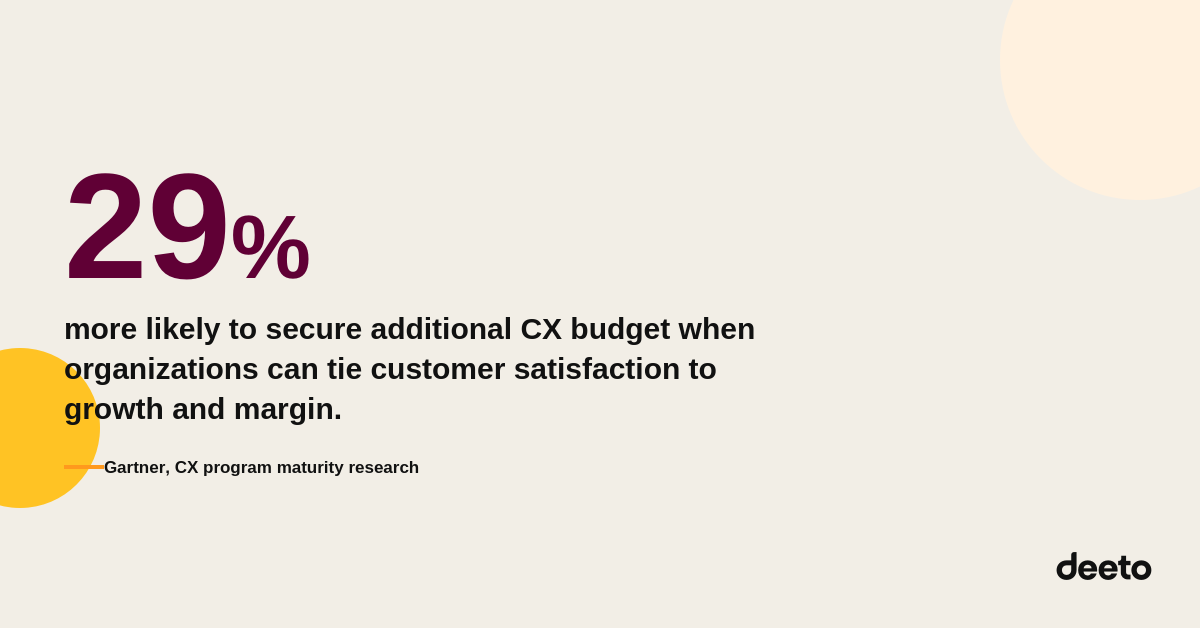
Organizations that can show a clear link between customer satisfaction and business outcomes like growth and margin are 29% more likely to secure additional CX budget, according to Gartner research on CX program maturity. That number says something important. CX technology only earns its keep when it can be tied to a result, not just a dashboard.
Gartner's own definition of a modern voice-of-customer platform reflects the same shift. Rather than treating feedback as a survey exercise, the category is now defined by whether a platform can connect feedback collection, analysis, and action into a single workflow. Collecting feedback was never the hard part. Getting it into the hands of the person who can act on it, before the moment passes, is what most stacks still get wrong.
Customer experience technology is only as good as the decisions it changes. A platform that reports on sentiment without routing it to sales, product, or marketing is a reporting tool, not a CX system.
Walk through a typical CX stack and you'll usually find a CRM, a support platform, an analytics tool, and maybe a survey tool bolted on the side. What's often missing is a system built to carry authentic customer voice, real quotes, real stories, real sentiment, out of wherever it was captured and into the workflows where people make decisions.
The same three problems show up again and again.
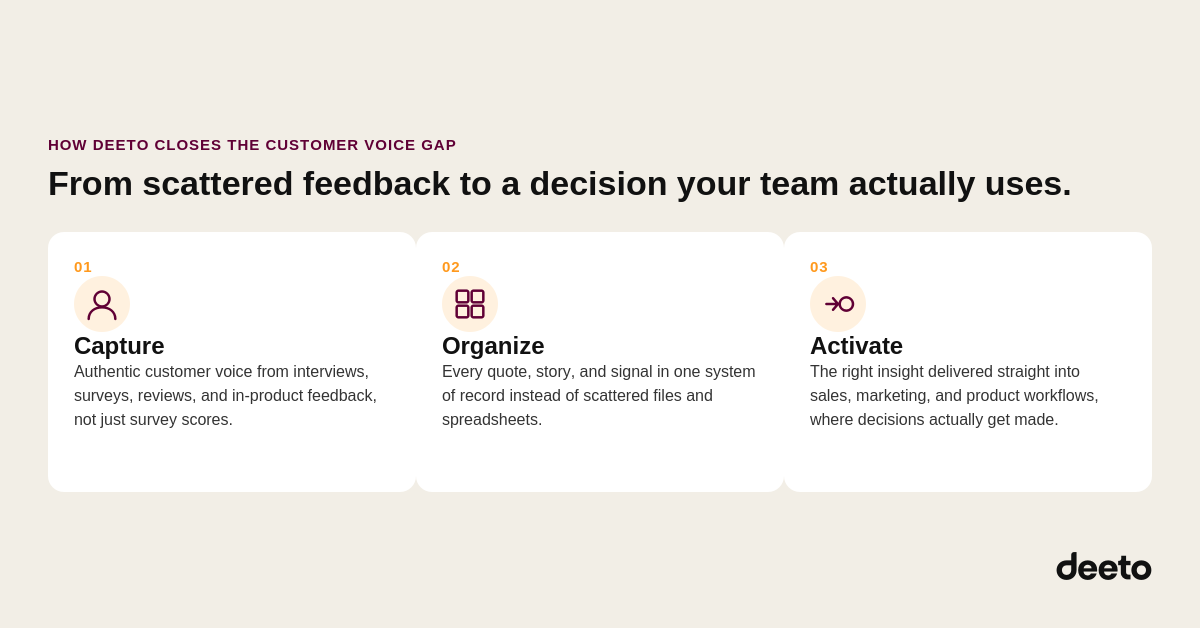
This is the specific problem customer voice intelligence is built to solve. Deeto is a customer orchestration platform that sits in this exact layer of the CX stack. It captures authentic customer voice through interviews, surveys, reviews, and in-product feedback, organizes it into a single system of record instead of scattered files, and identifies the patterns and sentiment inside it. From there, it delivers the right quote, insight, or story straight into the tools sales, marketing, and product already use, so a rep pulling up an account sees the same verified customer voice a PMM is using to write positioning. That end-to-end path runs through five connected steps: Listen, Learn, Activate, Analyze, and Orchestrate. The point is putting the sales rep, the PMM, and the product manager on the same real customer signal, at the moment they need it, instead of another dashboard nobody opens.
Teams using this layer alongside their existing CX stack tend to see faster deal cycles, since reps stop hunting for proof and start pulling it from a system that already has it. Sentiment and churn signals also surface earlier when customer sentiment analysis is connected directly to account context, rather than sitting in a separate report nobody checks until renewal season.
Buying more CX tools doesn't automatically produce a better customer experience. Most of the friction comes from a handful of recurring issues.
Data fragmentation. Customer information gets scattered across CRM, support, product analytics, and marketing tools, and no one has the full picture. Teams often underestimate the integration work needed to fix this until a project is already three months behind schedule.
Automation without judgment. Automating everything without deciding what still needs a person creates the exact impersonal experience CX technology was supposed to prevent. Some interactions need speed. Others need a human who can read the room.
Feedback that never leaves the tool that collected it. Surveys get sent, NPS scores get reported in a quarterly deck, and the actual quotes and context disappear. The insight exists. It just never reaches the customer success team or product manager who needed it.
Privacy and trust expectations. Customers are more willing to share data when they understand how it's used and trust that it's protected. Skipping clear communication about data handling erodes the personalization gains CX technology is supposed to deliver.
There's no single tool that covers every category above, and trying to force one to do so usually produces a bloated, half-used platform. A more reliable approach is to evaluate each layer against the outcome it needs to drive.
What is customer experience technology?
Customer experience technology is the set of platforms and tools companies use to manage, measure, and improve interactions across the customer journey. It typically includes CRM systems, omnichannel engagement tools, AI and automation, analytics, personalization platforms, and customer voice and feedback intelligence systems.
What are the main categories of CX technology?
The core categories are CRM and customer data platforms, omnichannel engagement, AI and automation, analytics and sentiment tools, personalization and marketing platforms, and customer voice and feedback intelligence. Most CX stacks combine several of these rather than relying on a single tool.
Why do CX technology projects often underdeliver?
Most underdeliver because of fragmented data across systems, automation applied without judgment about where a human is still needed, and customer feedback that gets collected but never reaches the team that could act on it.
How is customer voice intelligence different from a survey tool?
A survey tool collects responses and reports scores. Customer voice intelligence platforms connect what customers actually say to specific workflows in sales, marketing, and product, so a quote or insight becomes something a team can act on immediately instead of a static report.
What should a company evaluate before buying new CX technology?
Start by naming the specific breakdown, whether that's fragmented data, weak automation, or feedback that never reaches decision-makers. Then check whether a new tool actually integrates with the systems already in place, since a tool that creates a new silo makes the underlying problem worse.
Customer experience technology has expanded well past the CRM and the support ticket. The companies getting real value from it are the ones that closed the gap between collecting customer signal and acting on it, especially the authentic voice that usually gets stuck in a survey tool or a slide deck. Deeto closes that gap directly. It captures customer voice at the source, organizes it into one system instead of scattered files, and activates it inside the workflows sales, marketing, and product already run on, so verified customer proof shows up in a deal, a launch, or a roadmap decision instead of a quarterly report nobody reads. If your stack is strong on data but thin on turning real customer voice into decisions your teams actually use, see how Deeto works or explore how teams use it to build a connected view of the customer journey.

What is customer experience technology? Learn the core categories, benefits, and how to choose your stack.
Sales leaders no longer have to choose between fast feedback and a full understanding on why deals are won or lost. AI win/loss analysis software is a category of tools that use AI-moderated interviews, call transcript analysis, or CRM signal detection to explain why deals are won or lost, replacing the batched consultant report with findings that update after every closed deal. This guide compares 8 of the leading platforms.
AI win/loss analysis software is a category of revenue intelligence tools that use artificial intelligence, rather than a fully manual process, to capture and interpret why buyers chose you, chose a competitor, or walked away with no decision at all. Instead of a research firm scheduling a handful of calls each quarter, these platforms run structured interviews, mine sales conversations, or pattern-match CRM data across every deal that closes.
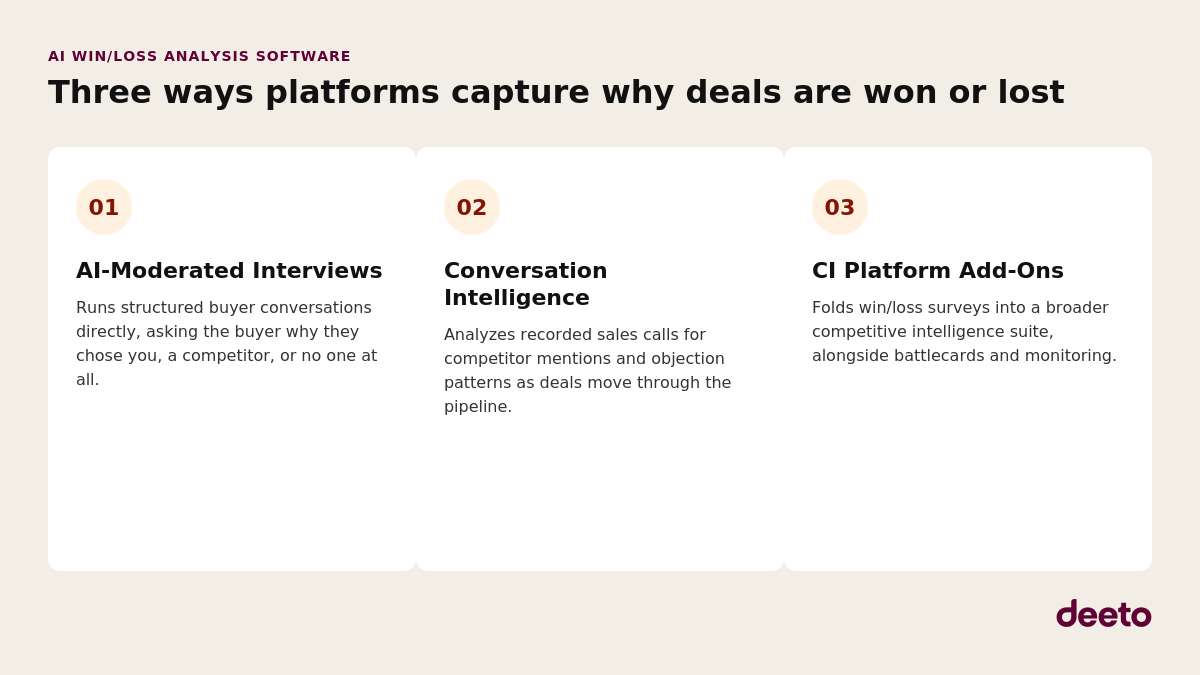
The category splits into a few distinct approaches. Some platforms run AI-moderated buyer interviews directly. Others analyze recorded sales calls for competitor mentions and objection patterns. A third group folds win/loss into a broader competitive intelligence suite. Each approach answers a slightly different question, and most revenue teams end up needing more than one.
Win/loss analysis software helps teams move past the internal guesswork that fills so many loss reason fields in the CRM. Sales reps and the buyers they lost to often disagree on what actually happened, which is exactly why direct buyer feedback matters more than internal notes.
For years, win/loss programs meant hiring a research firm, waiting six weeks for a batched report, and hoping the findings were still relevant by the time anyone acted on them. That model works, but it only covers a sample of deals and it arrives too late to change the deals already in flight.
Sales reps and buyers frequently see the same lost deal differently. Corporate Visions, based on an analysis of more than 100,000 B2B purchase decisions, found that sellers and buyers give different reasons for a deal's outcome 50 to 70 percent of the time. A CRM dropdown filled in by a rep is a guess wearing a data field's clothes. AI-moderated interviews close that gap by asking the buyer directly, at a fraction of the cost of a human-led program.
That shift also changed the economics of coverage. User Intuition, an AI interview platform, prices its win/loss conversations at roughly $20 each. Dedicated firms like Clozd and Primary Intelligence don't publish per-interview pricing, but structure programs as annual engagements instead, typically estimated at $50,000 or more a year. That structural difference, not just the sticker price, is why teams that used to sample 10 or 15 losses a quarter can now analyze every single deal that closes.
AI win/loss analysis software includes automated data capture, so no deal depends on a rep remembering to fill out a form. It includes pattern recognition across dozens or hundreds of deals instead of one-off anecdotes, and it includes a way to route findings into the tools sales, marketing, and product teams already use.
Before comparing specific platforms, it helps to know which criteria actually separate a good fit from an expensive mistake.
Deeto is an AI-native customer orchestration platform that runs continuous win/loss interviews on every closed deal, won or lost, and treats the resulting buyer voice as part of one connected system rather than a standalone report. Where most of the tools below live inside a single team's workflow, Deeto routes win/loss findings into the same intelligence layer that also powers customer advocacy, product feedback, and competitive insight. This is important because win/loss findings rarely stay useful to sales alone. A pricing objection that shows up in lost deals is also a product marketing problem and, often, a roadmap signal. Deeto has a 4.8 out of 5 star rating in G2.
Deeto's Listen module captures the interview, Learn organizes it alongside every other deal in one system of record, Activate pushes the relevant finding to the rep, marketer, or product manager who needs it, Analyze surfaces the patterns across all of them, and Orchestrate keeps that workflow running without anyone having to go looking for a quarterly deck.
Clozd is the most recognized dedicated win/loss brand in the category, pairing a technology platform with a managed team of human interviewers. It holds a 4.8 out of 5 rating on G2. Clozd doesn't publish pricing, but third-party estimates place managed programs in the $50,000 to $150,000-a-year range with a 4 to 6 week turnaround per batch, which puts Clozd firmly in enterprise territory. It's the right call for large organizations that want to outsource the entire function and have the budget to do it well, but it's not built for teams that want insight the same week a deal closes.
Klue built its reputation in competitive enablement, then added win/loss capability by acquiring DoubleCheck Research, an established win-loss analysis provider, in January 2023. The Klue Win-Loss listing on G2 holds a 4.7 out of 5 rating. The advantage is workflow integration. Win/loss data lives next to the same battlecards reps already use for competitive deals. The tradeoff is that win/loss is one module inside a larger CI suite rather than the core product, so teams that want win/loss as their primary use case may find the depth thinner than a dedicated platform.
Crayon is a broader competitive intelligence platform that has added win/loss capture alongside its core competitor-tracking features. It carries a 4.6 out of 5 rating on G2, with users consistently praising its ease of use and onboarding support. Crayon fits teams that want one place for competitor news, battlecards, and win/loss signals, but like Klue, win/loss is an add-on to a wider CI product rather than the primary focus.
Gong is the category-defining conversation intelligence platform, and many revenue teams already lean on it for win/loss signal even though that's not its primary purpose. It holds a 4.7 out of 5 rating on G2 and is used by companies including LinkedIn, ADP, Nasdaq, and Dropbox. Gong analyzes what happened on recorded calls, which is genuinely useful for spotting competitor mentions and objection patterns in flight. What it doesn't do is ask the buyer directly why they chose someone else, which is a different and often more candid source of truth than a transcript of the sales conversation alone.
User Intuition runs AI-moderated win/loss interviews at scale, drawing on a global panel of more than 4 million respondents to conduct interviews across 50-plus languages at roughly $20 per conversation. That price point is what makes it realistic to interview every closed deal instead of a sample, which is the core promise of AI-moderated win/loss in general. The tradeoff against a fully managed program like Clozd is that the depth of any single interview depends on how well the AI probes follow-up answers, rather than a trained human interviewer reading the room.
Perspective AI positions itself around AI-moderated buyer interviews that aim to match the depth per conversation that traditional win/loss agencies built their reputations on, without the price tag or turnaround time. It fits teams that have outgrown a CRM dropdown but aren't ready for a five- or six-figure managed program. As with User Intuition, the category is new enough that a large, independently verified G2 review base is still building.
Primary Intelligence is one of the longer-standing names in traditional, human-led win/loss research, and it's usually named alongside Clozd and DoubleCheck Research as one of the dedicated win/loss firms serving enterprise clients. It suits organizations that want a fully managed, consultant-style program and are comparing it directly against Clozd on service quality and account team fit rather than software features.
What is AI win/loss analysis software?
AI win/loss analysis software uses AI-moderated interviews, transcript analysis, or CRM signal detection to explain why deals are won or lost, without requiring a fully manual, consultant-led research program. It lets revenue teams analyze every closed deal, not just a small sample, and surface patterns across dozens of deals instead of relying on a single rep's account of what happened.
How is AI win/loss analysis different from traditional win/loss consulting?
Traditional win/loss consulting relies on human interviewers and produces batched reports every quarter. AI win/loss analysis software automates data capture and interviews so every closed deal, not just a sample, generates insight in near real time.
How much does AI win/loss analysis software cost?
Pricing spans a wide range. AI-moderated interview platforms can cost roughly $20 per conversation. Dedicated human-moderated firms like Clozd and Primary Intelligence don't publish per-interview pricing, structuring programs as annual engagements instead, typically estimated at $50,000 or more per year, while CI suites with win/loss modules are usually custom-quoted.
Can AI win/loss software fully replace human-moderated interviews?
For most B2B teams, no. AI-moderated interviews are strong for coverage and speed across every deal, but high-stakes enterprise losses often still benefit from a skilled human interviewer who can probe political and relationship dynamics AI may miss.
What's the difference between win/loss software and competitive intelligence platforms?
Competitive intelligence platforms like Klue and Crayon center on tracking competitors and arming reps with battlecards, with win/loss as one input among several. Dedicated win/loss software centers on structured buyer feedback as the primary source of truth, and goes deeper on the reasoning behind each deal instead of just tracking what competitors are doing in the market.
Does Deeto offer AI win/loss analysis?
Yes. Deeto runs continuous, AI-led buyer interviews on every closed deal and connects the resulting win/loss intelligence to the same system that powers customer advocacy, product feedback, and competitive insight, so the findings reach every team that needs them.
The right AI win/loss analysis software depends less on which tool has the longest feature list and more on where win/loss fits into how your revenue and sales enablement team already works. If competitive intelligence is already the job, a module inside Klue or Crayon may be enough. If you need agency-level depth on a handful of strategic enterprise losses, Clozd or Primary Intelligence still make sense. If the goal is coverage across every closed deal, without the finding getting stuck in a slide deck sales never opens again, that's where a connected system like Deeto is built to help.
Read more on how win/loss analysis works in our complete guide to win/loss analysis, or see how to evaluate a customer intelligence platform if win/loss is one of several use cases you're solving for at once.

Comparing AI win/loss analysis software? See how 8 top platforms stack up on coverage, depth, and cost.
Overview:
Most people don't get more valuable solely by working harder. They get more valuable when their expertise reaches more of the company, without having to manually re-explain it in every meeting, tool, and channel.
In this session, we'll make the case for AI as "octopus arms" for your role: a way to take one person's data and knowledge and spread it into every other team's workflow, live, in the tools they already use. The more visibly your work touches product, sales, exec, and every other function, the more the company sees your value.
You’ll learn:
Location: Live virtual event on Zoom (link sent upon registration)
Speakers:

Nick Cadigan, Host, Deeto

AI turns one person's data into every team's workflow, live, without extra manual work. Join us September 15

See how Deeto helps you turn customer voice into a GTM advantage.