How to Build a Voice of the Customer Program



Tuesday, September 1, 2026


How to Build a Voice of the Customer Program


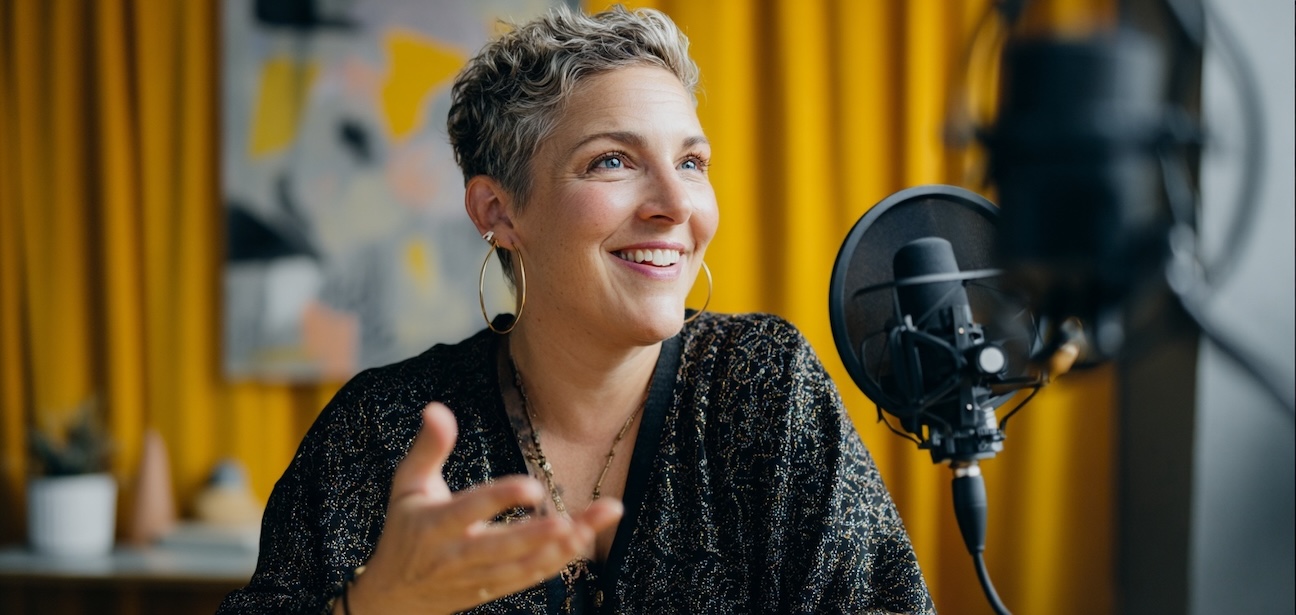
View the podcast on Youtube

Voice of the customer programs rarely fail because a team can't collect feedback. They fail because nobody owns turning that feedback into decisions, and the program quietly stalls at "we send an NPS survey."
Building a voice of the customer program means defining who owns it, choosing how you'll collect and centralize feedback, rolling it out in phases instead of all at once, and setting a governance model that keeps feedback connected to action as the program grows. The goal is having a system that routes customer input to the team that can act on it, every time.
This guide walks through the operational side of that build: ownership, a phased rollout timeline, budget and tooling tradeoffs, and the governance model that keeps a VoC program alive past quarter one. For the underlying definition, methods, and KPIs, see Deeto's guide to what voice of the customer is.
What is a voice of the customer program, exactly
A voice of the customer program is the ongoing operational system, not a single survey or dashboard, that a company runs to capture customer feedback, route it to the right team, and track whether it changed a decision. It includes the collection channels, the ownership structure, the routing rules, and the reporting cadence that connects feedback to outcomes.
A VoC program is not the same thing as a VoC survey. A survey is one input. The program is the machinery around it: who reads the responses, who's accountable for acting on them, and how the business knows whether anything changed as a result.
Why most VoC programs stall before they scale
The technical part of VoC, standing up a survey or a feedback inbox, is the easy part. The Qualtrics XM Institute's 2024 State of CX Management study found that 71% of CX practitioners rate their own organization's CX maturity at the earliest two stages, meaning most programs never get past the "collecting" phase into the "acting" phase. That gap is almost always structural, not technical.
Three patterns show up repeatedly in stalled programs:
- No single owner. Feedback gets collected by CS, product, and marketing separately, and nobody is accountable for connecting the three.
- No routing logic. Feedback lands in a spreadsheet or a Slack channel and dies there because there's no defined path from "customer said X" to "team Y decided Z."
- No feedback loop back to the customer. Customers stop responding once they notice nothing changes after they give input.
A voice of the customer program fixes this by design, not by hoping people remember to check the dashboard. That means assigning ownership before you pick a tool.
Who should own your voice of the customer program
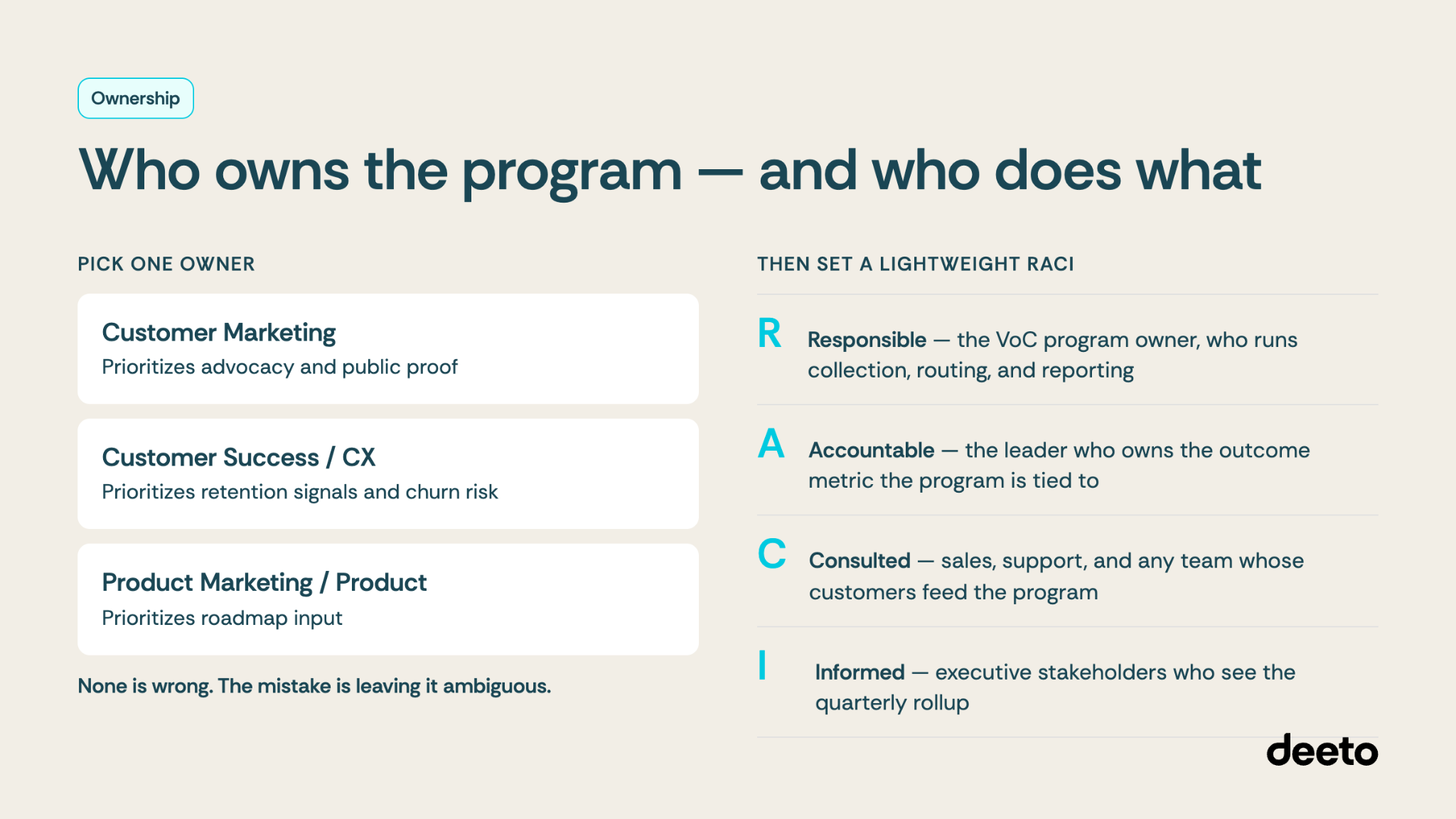
Ownership is the single decision that matters most in the build, and it's the one most teams skip. VoC programs typically report into one of three places, and each comes with a different bias.
- Customer Marketing tends to prioritize advocacy and public proof, which pairs well if a goal of the program is fueling customer stories and social proof.
- Customer Success / CX tends to prioritize retention signals and churn risk, which fits if the primary driver is reducing churn.
- Product Marketing or Product tends to prioritize roadmap input, which fits if the primary driver is feature prioritization.
None of these is wrong. The mistake is leaving it ambiguous. Once you've picked an owner, define a lightweight RACI across the teams that will touch the program:
- Responsible: the VoC program owner, who runs collection, routing, and reporting
- Accountable: a CS, marketing, or product leader who owns the outcome metric the program is tied to
- Consulted: sales, support, and any team whose customers feed the program
- Informed: executive stakeholders who see the quarterly rollup
If your program supports advocacy work specifically, Deeto's customer marketing solutions page covers how that team typically structures the workflow.
How to build a voice of the customer program: a 90-day rollout
Programs that try to launch fully formed, every channel, every team, every KPI, on day one tend to collapse under their own weight. A phased rollout gets a working system live fast and expands it once it's proven.
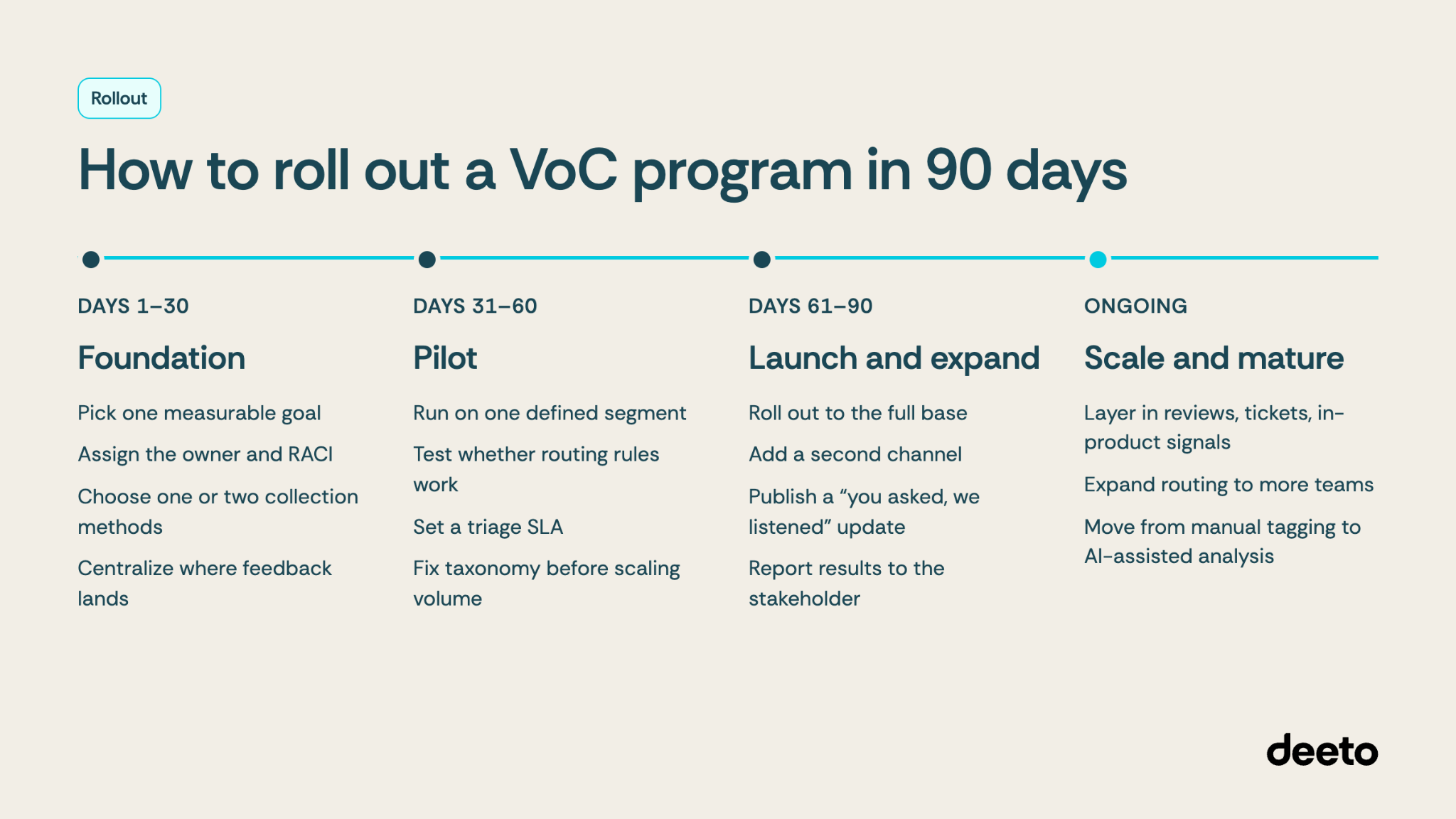
Days 1–30: Foundation
Pick one measurable goal (reduce churn by a set percentage, improve product prioritization accuracy, grow the volume of citable customer proof). Assign the owner and RACI. Choose one or two initial collection methods, not five. Centralize wherever feedback will land from day one so it isn't scattered across inboxes before the program even starts.
Days 31–60: Pilot
Run the program with a defined customer segment, not your entire base. Test routing rules: does feedback about pricing actually reach the person who owns pricing? Set a response SLA for how fast feedback gets triaged, even if the fix takes longer. Fix routing and taxonomy issues before scaling volume.
Days 61–90: Launch and expand
Roll out to the full customer base. Add a second collection channel now that routing is proven. Publish the first "you asked, we listened" update to close the loop with customers who gave feedback. Report the pilot's results to the accountable stakeholder to secure continued budget and headcount.
Ongoing: Scale and mature
Layer in additional channels (reviews, support tickets, in-product signals) once the core loop is working. Expand routing to more teams. Move from manual tagging to AI-assisted analysis and pattern detection as volume grows past what a person can read by hand.
Choosing your VoC tooling and budget
Budget conversations for VoC programs usually come down to one tradeoff: how much manual effort you're willing to trade for centralization. Three approaches cover most teams.
The DIY approach is the right starting point for the 30-day foundation phase. It's the wrong place to still be a year in. Deeto's platform, starting with Listen, centralizes capture and routes it to the teams that act on it, without re-platforming every time a new channel gets added.
Governance: the model that keeps a VoC program alive
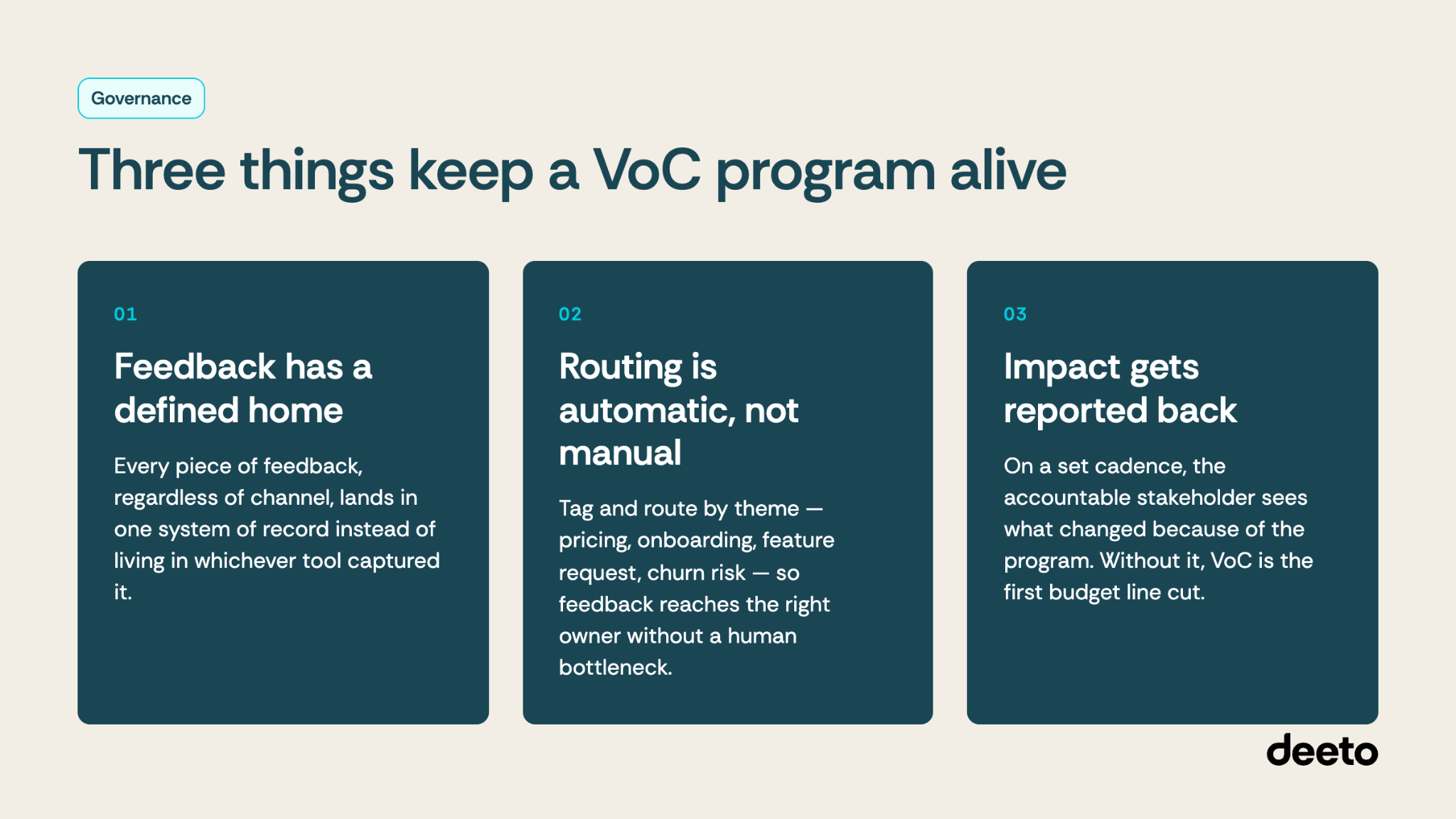
A rollout plan gets a program launched. Governance is what keeps it running after the initial excitement fades. Three things need to be true on an ongoing basis.
Feedback has a defined home. Every piece of feedback, regardless of channel, lands in one system of record instead of living in whichever tool captured it.
Routing is automatic, not manual. As volume grows, a person manually forwarding feedback to the right team doesn't scale. Tag and route by theme (pricing, onboarding, feature request, churn risk) so it reaches the right owner without a human bottleneck.
Impact gets reported back. The accountable stakeholder should see, on a set cadence, what changed because of the program. Without that reporting loop, VoC becomes the first budget line cut when priorities shift.
Programs that reach this stage are the ones equipped to feed customer voice into lifecycle automation and other workflows, so feedback doesn't just get reported. It triggers action.
Common pitfalls when building a VoC program
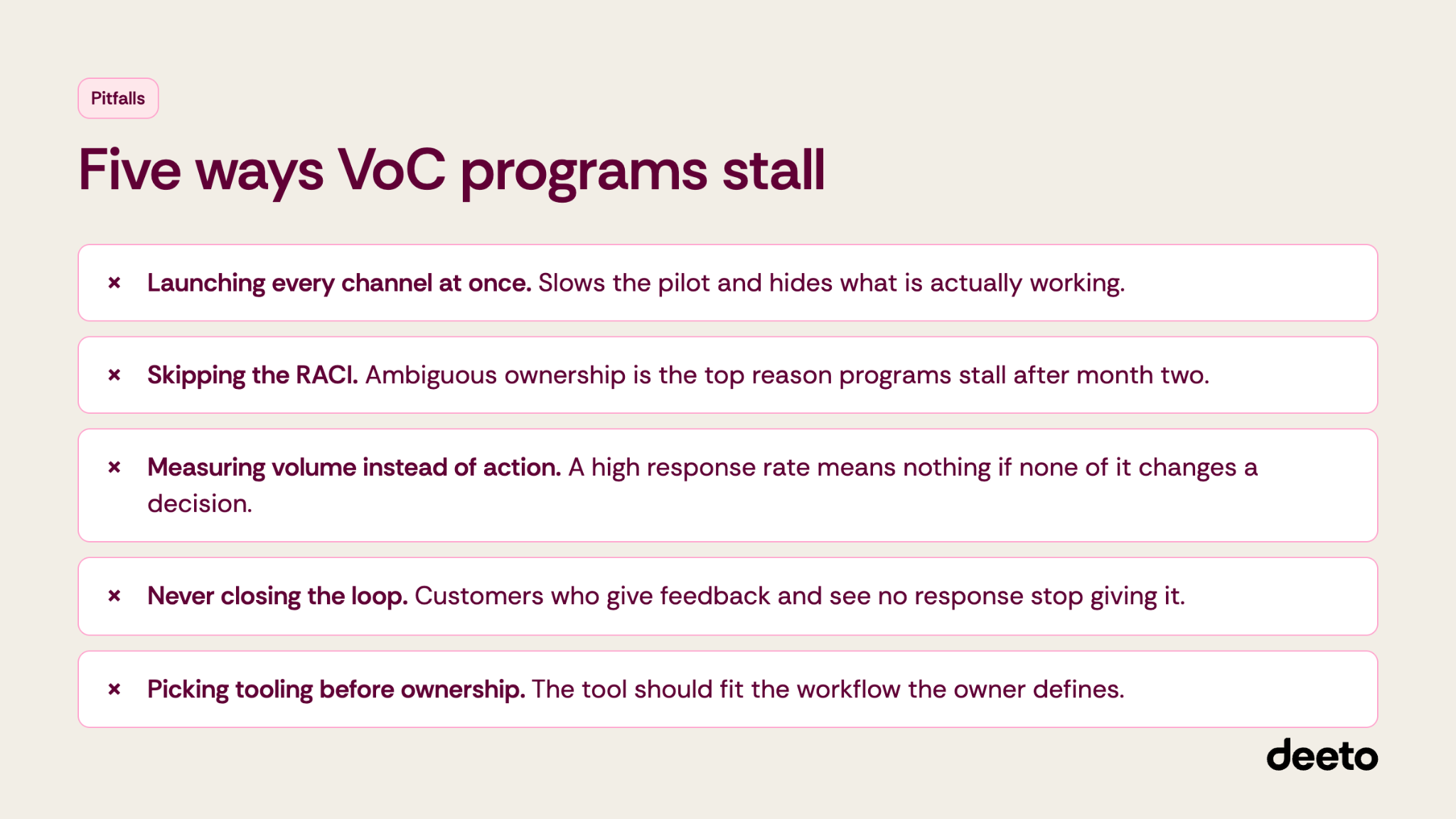
- Launching every channel at once. Slows the pilot and makes it harder to isolate what's actually working.
- Skipping the RACI. Ambiguous ownership is the top reason programs stall after month two.
- Measuring volume instead of action. A high response rate means nothing if none of it changes a decision.
- Never closing the loop. Customers who give feedback and see no response stop giving it.
- Picking tooling before ownership. The tool should fit the workflow the owner defines, not the other way around.
Key Takeaways
- A voice of the customer program is the operational system around feedback, not a single survey.
- Assign a single owner and a lightweight RACI before choosing a tool.
- Roll out in phases: a 30-day foundation, a 30-day pilot on a defined segment, then a full launch by day 90.
- Budget tradeoffs come down to manual effort versus centralization. DIY tools work early. A unified platform pays off once volume grows past what a person can tag by hand.
- Governance, a defined home for feedback, automatic routing, and reported impact, is what keeps a program running past its first quarter.
FAQs
How long does it take to build a voice of the customer program?
A working pilot can launch in 30 to 60 days with one collection method and a defined customer segment. A full rollout across the customer base and multiple teams typically takes 90 days, with governance and scale work continuing after that.
Who should own a voice of the customer program?
Ownership usually sits with Customer Marketing, Customer Success, or Product Marketing, depending on the program's primary goal, whether that's advocacy, retention, or roadmap input. What matters more than which team owns it is that exactly one team does, with a clear RACI across the others.
Do I need a dedicated VoC platform to get started?
No. A DIY approach with a single survey tool and a shared inbox is a reasonable way to run the first 30-day pilot. A dedicated platform becomes worth the investment once feedback volume outpaces what a person can tag and route by hand.
What's the biggest reason VoC programs fail?
Unclear ownership. Feedback gets collected but nobody is accountable for routing it to a decision-maker or reporting back on what changed, so the program stalls at collection instead of reaching action.
How is building a VoC program different from running one?
Building it is the one-time work of defining ownership, collection methods, and a rollout timeline. Running it is the ongoing governance: routing, reporting, and closing the loop with customers, which is what keeps the built program from decaying back into an ignored survey tool.
Deeto turns voice of the customer from a project into a system
Most of the work of building a VoC program isn't collecting feedback. It's making sure that feedback reaches the right person and that something changes because of it. Deeto centralizes customer voice from interviews, surveys, and in-product moments into one system, then routes it to sales, marketing, product, and CS automatically, so the program you build in the first 90 days is still running, and still connected to outcomes, a year later.
Request a demo to see how Deeto handles the routing and reporting layer of a VoC program.
🎉 Save your spot
Register for the event
Once your spot is secured, we’ll send your confirmation details.
Subscribe to our newsletter
Subscribe to receive the latest blog posts to your inbox every week.
By subscribing, you agree to our Privacy Policy
Subscribe to our newsletter
Get the latest news and updates from our team.
By subscribing, you agree to our Privacy Policy
Related posts

Omnichannel Customer Engagement Tools: 8 Platforms Compared

Compare 8 omnichannel engagement platforms on channels, AI, and pricing, plus the gap automation can't fill.
How to Use Sentiment Analysis to Improve Customer Experience
What is sentiment analysis? Learn how it compares to NPS, where it catches churn, and how to put it to work.

Call Intelligence Software That Spots Your Next Reference
What is call intelligence software? Learn how it scores every call automatically and surfaces advocacy-ready customers.