10 Win/Loss Analysis Best Practices to Turn Customer Feedback Into Revenue



Friday, September 4, 2026


10 Win/Loss Analysis Best Practices to Turn Customer Feedback Into Revenue


View the podcast on Youtube

Win/loss analysis is one of the most direct ways to understand how your company is really performing in the market.
But most teams don’t struggle with whether to do win/loss analysis. They struggle with doing it in a way that actually drives decisions.
The difference comes down to execution.
If you’re new to the concept, start with our guide on what win/loss analysis is and why it matters. This post will teach you how to do a win/loss analysis well, and how to turn customer conversations into repeatable growth signals.
What Are Win/Loss Analysis Best Practices?
Win/loss analysis best practices are the structured methods companies use to consistently collect, analyze, and act on feedback from buyers after a deal is won or lost.
At a high level, strong win/loss programs:
- Capture feedback directly from customers (not just internal opinions)
- Identify patterns across deals, not one-off anecdotes
- Translate insights into changes across product, marketing, and sales
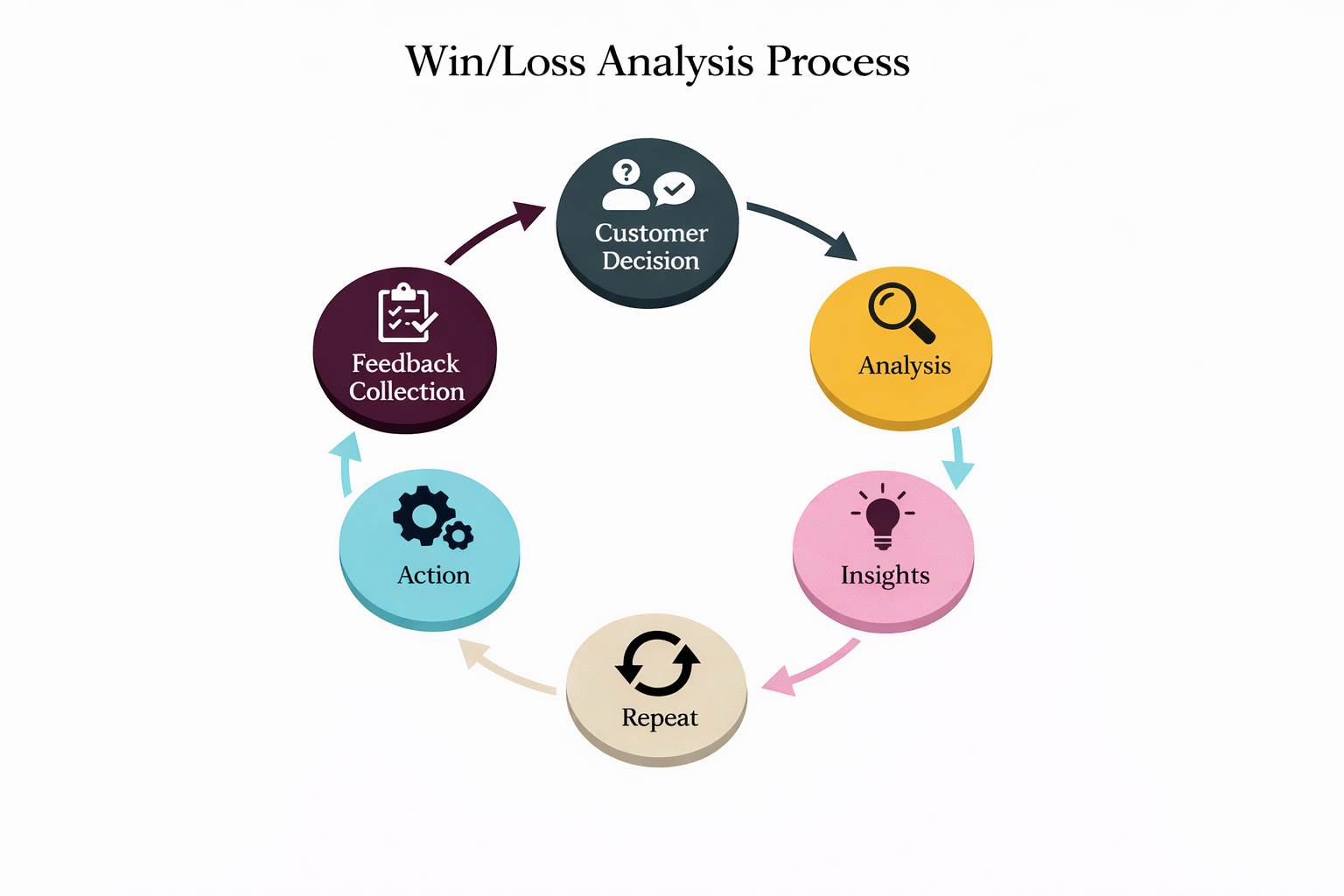
The goal isn’t more data. It’s better decisions.
Why Most Win/Loss Analysis Fails
Most win/loss efforts break down for a few predictable reasons:
- Feedback lives in silos (sales notes, scattered surveys)
- Data is biased or incomplete
- Insights don’t reach the teams that need them
- Nothing operational happens after insights are gathered
In other words, companies collect feedback but don’t operationalize it.
The deeper issue is that win/loss analysis is often treated as a reporting exercise, not a system. Teams run a set of interviews, compile a slide deck, share a few takeaways, and then move on. The insight fades, and nothing meaningfully changes.
Even when the feedback is strong, it’s rarely structured in a way that compounds over time. There’s no consistent taxonomy, no shared source of truth, and no way to connect one deal’s feedback to the next. Without that, patterns stay hidden and decisions stay reactive.
Ownership is another common failure point. Win/loss analysis typically sits loosely between sales, marketing, and product, which means no one is truly accountable for driving it forward. As a result, insights get acknowledged but not acted on.
And when insights aren’t tied to clear business outcomes like win rate, deal velocity, or expansion, they’re easy to deprioritize.
The companies that get this right treat win/loss analysis differently. They don’t just collect feedback, they build a system around it. One that continuously captures customer voice, connects it across deals, and feeds it directly into how the business operates.
That’s when win/loss analysis stops being a retrospective exercise and starts becoming a growth lever.
Win/Loss Analysis Maturity: Where Does Your Program Stand?
Not every win/loss program is doing the same job. Some teams are barely capturing feedback. Others have turned it into a system that shapes every deal. The table below breaks down the four stages most B2B teams move through.
Most teams get stuck at Stage 2. They run interviews when someone remembers to, then let the findings sit in a slide deck. Moving from Stage 2 to Stage 3 is less about better questions and more about consistency. Getting to Stage 4 usually means automating parts of the workflow so feedback capture doesn't depend on someone remembering to send a survey.
The practices below will help you move up a stage, whichever one you're on.
10 Best Practices for Effective Win/Loss Analysis
1. Talk to Customers, Not Just Your Sales Team
Internal perspectives are helpful, but they’re inherently filtered. Sales teams interpret what they hear through the lens of the deal, the relationship, and their own incentives. Customers will tell you what actually drove the decision including what stood out, what created doubt, and what ultimately tipped the scale. If you want real signal, you have to go directly to the source.
You’ll uncover things like:
- Why a competitor felt like the safer choice
- What nearly blocked the deal (even if you won)
- What didn’t land in your messaging
Direct feedback ensures insights are grounded in the customer’s experience, not internal perception.
2. Standardize Your Questions
If every interview or survey is slightly different, your data won’t scale. Standardization ensures responses can be compared across deals and over time, turning scattered feedback into a dataset that reveals real patterns. Without it, your win/loss analysis risks being anecdotal instead of strategic.
A consistent framework also reduces bias and ensures you’re asking questions that uncover the true drivers of decisions. At a minimum, every interaction should cover:
- Key decision criteria
- Alternatives considered
- Drivers behind the final choice
To take it further, think about how win/loss questions can align with broader customer research practices. For example, structured questions from your surveys, interviews, and usage data can feed into the same system, giving you a single source of truth for understanding your customers. Consistency across research types such as combining sales win/loss interviews with ongoing customer research insights, allows you to compare patterns over time and connect why buyers make decisions with what they need and value.
For more on creating repeatable and operationalized customer research systems, check out our guide on how to do customer research. Using the same principles in your win/loss program ensures insights don’t just sit in a spreadsheet, but rather inform product, marketing, and sales decisions in a way that scales.
3. Capture Feedback Close to the Decision Moment
Timing directly impacts accuracy. The closer you are to the deal’s closure, the more honest and detailed the feedback will be. Wait too long, and responses become vague or reconstructed, filtered by hindsight. Collecting feedback promptly ensures you capture the real reasons behind a buyer’s decision.
The goal is to build a repeatable process that triggers outreach automatically after a deal closes. Strong programs typically:
- Reach out within 1–2 weeks of a decision, while the experience is still fresh
- Capture both wins and losses consistently, not just high-profile deals
- Avoid relying on memory months later, which can distort insights
Prompt collection also helps identify early patterns. For example, if several buyers mention similar friction points immediately after closing, you can flag and address them in real time rather than waiting for quarterly reports.
4. Go Beyond Surface-Level Reasons
“Price” and “features” are rarely the full story, they’re just the easiest answers for buyers to give. Real product insight comes from understanding the context behind those answers: what made one vendor feel trustworthy, where uncertainty arose, or which moments created hesitation. Without digging deeper, you risk misinterpreting why a deal was won or lost.
To uncover meaningful insight, probe with follow-ups such as:
- “What made that factor important to you?”
- “What almost changed your decision?”
- “Where did concerns arise internally?”
You can also tie these answers to broader customer research signals. For instance, aligning your win/loss follow-ups with ongoing survey or interview insights creates a richer picture of customer priorities, allowing teams to act on recurring patterns rather than isolated anecdotes.
5. Analyze Trends, Not Individual Deals
It’s easy to over-index on a single deal, particularly a high-stakes loss, but isolated feedback rarely provides actionable guidance. The real value emerges when you look across multiple deals and identify patterns that repeat consistently. These patterns are the signals that indicate what’s really influencing decisions.
Look for recurring themes such as:
- Objections that come up repeatedly across deals
- Competitors mentioned in multiple situations
- Messaging gaps tied to specific personas, segments, or use cases
By focusing on trends, you can move from reactive fixes to strategic improvements. Instead of treating each loss or win as a one-off event, you build a system that highlights where to adjust messaging, positioning, or sales tactics to drive measurable impact across the business.
6. Segment Your Data
Not all deals are created equal, and analyzing them as if they are will blur your insights. When you look at win/loss feedback in aggregate, you often end up with conclusions that are technically true, but not useful. Segmentation is what turns broad feedback into specific, actionable insight.
Different types of deals have different dynamics. Enterprise buyers evaluate risk differently than SMB buyers. A technical stakeholder cares about different things than an executive. A use case tied to cost savings will be evaluated differently than one tied to growth. If you don’t separate these contexts, you miss what’s actually driving decisions.
Start by breaking your data into meaningful slices, such as:
- Industry or vertical (e.g., fintech vs. healthcare)
- Deal size (SMB, mid-market, enterprise)
- Buyer persona (economic buyer vs. end user vs. technical evaluator)
- Primary use case or pain point
- Competitive set (which vendors you were up against)
Once segmented, patterns become much clearer. You might find that:
- You win consistently in one segment but lose in another for the same reason
- A competitor is only a threat in specific deal sizes or industries
- Messaging that works for one persona completely misses for another
This is where win/loss analysis starts to influence real decisions. Instead of making broad changes, you can refine segment-specific messaging and positioning, targeting and qualification criteria, and sales strategies based on deal type.
Segmentation doesn’t just improve accuracy, it increases relevance. It ensures that the insights you generate actually map to how your business operates, making them far easier for teams to act on.
7. Close the Loop With Internal Teams
Insights don’t create value on their own, distribution does. If win/loss findings sit in a single team’s report or a static spreadsheet, they won’t drive meaningful change. The goal is to make customer feedback visible, actionable, and integrated across the organization.
Each team should get insights tailored to what matters most for their role:
- Product → recurring gaps, feature requests, or usability issues
- Marketing → messaging clarity, positioning, and differentiation opportunities
- Sales → real-world objection handling, competitive narratives, and success patterns
Sharing insights systematically ensures teams aren’t acting on assumptions. For example, if multiple losses highlight a particular competitor's strength, both sales and marketing can proactively address it in messaging, while product teams can explore whether a feature or experience gap needs prioritization. Closing the loop transforms customer feedback from static data into operational decisions that improve future win rates.
8. Connect Feedback to Revenue Impact
Not all feedback is equally important. To be actionable, insights should be tied to measurable business outcomes. Feedback that influences revenue, deal velocity, or retention becomes impossible to ignore and easier to prioritize.
Focus on signals that:
- Appear in high-value or strategic deals
- Directly impact win rate or shorten the sales cycle
- Show up in expansion, renewal, or churn-related conversations
Connecting feedback to revenue also helps leadership make better strategic decisions. For instance, understanding that a recurring objection in enterprise deals is costing millions annually can justify investments in product improvements, new features, or enhanced sales enablement, turning customer voice into a lever for measurable growth.
9. Build a Continuous Program, Not a One-Off Project
Win/loss analysis isn’t a one-time task, it’s a system. A single round of interviews or surveys provides a snapshot, but markets, competitors, and customer expectations evolve. A continuous program ensures you’re always working with up-to-date insights.
A mature program should:
- Collect feedback consistently over time, across wins and losses
- Build a growing dataset that reveals trends rather than isolated events
- Adapt as your product, buyers, and market dynamics change
By treating win/loss as an ongoing program, insights compound. You don’t just react to one deal. You see recurring patterns, anticipate competitor moves, and make decisions that improve conversion rates and customer satisfaction continuously.
10. Operationalize Customer Voice Across the Funnel
The ultimate value of win/loss analysis isn’t insight, it’s execution. Insights are only as useful as the decisions they influence. Customer feedback should actively shape:
- How you position your product and messaging
- How your sales team engages prospects and handles objections
- How your product roadmap prioritizes features and improvements
When customer voice is operationalized, it shifts from reactive observation to proactive guidance. Teams make decisions informed by evidence rather than assumptions, which improves alignment across sales, marketing, and product. Platforms like Deeto help make this process repeatable and scalable, turning scattered feedback into actionable insights that every team can use.
This is where most companies fall short and where the biggest competitive opportunity lies. By making customer voice a system rather than a one-off exercise, you create a strategic feedback loop that drives measurable growth across the business.
Turning Win/Loss Analysis Into a Competitive Advantage
Win/loss analysis isn’t just about understanding past deals, it’s about shaping future ones.
When done right, it becomes:
- A source of truth for positioning
- A feedback loop for product decisions
- A system for improving conversion and retention
The companies that grow fastest don’t guess what customers want.
They build systems to hear it, understand it, and act on it, continuously.
Frequently Asked Questions About Win/Loss Analysis
What is the goal of win/loss analysis?
The goal of win/loss analysis is to understand why deals are won or lost directly from the customer’s perspective, and to use those insights to improve messaging, product strategy, and sales execution. For a deeper breakdown, see our guide on what win/loss analysis is and how it works.
How do you conduct a win/loss analysis?
Win/loss analysis typically involves interviewing customers after a deal closes, asking structured questions, and analyzing responses for patterns across deals. The goal is to move beyond individual feedback and identify trends that can improve win rates and positioning. A win/loss analysis typically involves:
- Interviewing customers after a deal closes
- Asking structured, consistent questions
- Analyzing responses for patterns
- Sharing insights across teams
- Acting on findings to improve outcomes
What questions should you ask in a win/loss interview?
Effective win/loss questions include:
- What problem were you trying to solve?
- What alternatives did you consider?
- What made you choose (or not choose) us?
- What nearly changed your decision?
- What could we have done differently?
How many win/loss interviews do you need?
You can start seeing patterns with 10–15 interviews, but stronger insights typically emerge with 30–50+ data points, especially when segmented by deal type or customer profile.
What teams should use win/loss insights?
Win/loss insights should be shared across:
- Product teams (to inform roadmap decisions)
- Marketing teams (to refine positioning and messaging)
- Sales teams (to improve conversion rates)
Customer feedback is most valuable when it’s not siloed.
What is the difference between win/loss analysis and customer research?
Win/loss analysis focuses specifically on buying decisions—why a customer chose or rejected your solution.
Customer research is broader and can include behavior, needs, and satisfaction across the entire customer journey.
How often should you run win/loss analysis?
Win/loss analysis should be continuous. High-performing teams collect and analyze feedback on an ongoing basis rather than treating it as a one-time project.
How can you scale win/loss analysis?
To scale win/loss analysis you should:
- Standardize your questions
- Use systems to collect feedback consistently
- Centralize insights
- Make findings accessible across teams
This is where operationalizing customer voice becomes critical.
Final Thoughts
Win/loss analysis is one of the clearest paths to understanding your market, but insight alone isn’t enough.
The real advantage comes from what you do with it, including how quickly you turn feedback into action, and how consistently you bring customer voice into every decision.
If you’re looking to move beyond one-off interviews and build a system for capturing and activating customer insights, that’s exactly what Deeto is designed to do.
🎉 Save your spot
Register for the event
Once your spot is secured, we’ll send your confirmation details.
Subscribe to our newsletter
Subscribe to receive the latest blog posts to your inbox every week.
By subscribing, you agree to our Privacy Policy
Subscribe to our newsletter
Get the latest news and updates from our team.
By subscribing, you agree to our Privacy Policy
Related posts

Customer Testimonial Software Platforms Compared

What is customer testimonial software? Compare 7 platforms, see how they stack up, and learn how to choose the right one

Customer Proof Marketing: How B2B Companies Build Trust with Buyers
What is customer proof marketing? Learn the proof types, frameworks, and software that build B2B buyer trust.

How to Build a Customer Churn Model: A Guide for Businesses
What is a customer churn model? Learn how to build one, spot churn early, and win back at-risk customers.