8 Best Case Study Software Tools for Customer Marketers


Tuesday, September 8, 2026


8 Best Case Study Software Tools for Customer Marketers


View the podcast on Youtube

A rep asks for a case study from a specific industry, for a specific use case, featuring a specific type of buyer. You know the one they need exists somewhere. You also know it's going to take three days, two Slack threads, and a favor from legal to find it, if it exists at all.
Case study software exists to close that gap. It's the category of tools that help go-to-market teams collect customer feedback, manage approvals and usage rights, and get proof in front of sales and marketing without a spreadsheet holding the whole system together. Some case study platforms focus on collection. Others manage reference workflows or run advocacy programs. This guide compares eight of them, so you can match the tool to where your program is actually stuck, not where a vendor's homepage says it should be.

What is case study software?
Case study software is a category of platforms that help B2B teams collect customer feedback, manage the approval process for quotes and logos, and distribute finished proof to sales, marketing, and the website. It isn't one specific product type. It's a job to be done, and different case study platforms tackle different parts of it.
A case study platform typically covers more of the full workflow: sourcing the customer, running the interview, routing legal approval, publishing the asset, and tracking whether anyone downstream actually used it. A narrower tool might only handle one of those steps, like collecting a written quote or recording a video testimonial. Both get called "case study software" in practice, which is part of why shopping for one can become confusing.

Why case study software matters right now
Case studies are in high demand. Case studies and customer stories were used by 75% of B2B marketers in the past year, according to Content Marketing Institute's 2025 B2B benchmarks report, making them one of the most widely used content types in the B2B toolkit. Supplying case studies, including producing and maintaining that proof at the pace deals actually move, is the challenging part.
The cost of getting this wrong shows up directly in pipeline. 53% of B2B sellers say deals were slowed down or lost in the past year because they didn't have the right customer evidence on hand, per UserEvidence's 2025 Evidence Gap report, a survey of 811 B2B buyers, sellers, and marketers. The same report found that 58% of buyers now start their research with AI tools, and that blind-but-verified testimonials, where a customer's identity is confirmed but not published, are trusted by 60% of buyers, close to the 64% who trust named testimonials.

This means that teams in cybersecurity, financial services, and healthcare, where named case studies are often off the table, don't have to skip proof entirely. It also means the AI tools now sitting between your buyer and their first vendor search need something structured and citable to find, not a PDF locked behind a form. That's the AEO argument for case study software: a searchable, well-tagged proof library isn't just easier for your sales team to use, but it’s easier for AI search to surface. Deeto's customer stories and social proof use case is built around that same idea: proof that stays structured enough to be found, not just published once and forgotten.
How to evaluate case study software
Not every case study platform is solving the same problem. Before comparing vendors, get clear on which part of the workflow is actually broken for your team.
Does it manage approvals and support verified anonymous proof?
Legal sign-off on a customer quote or logo can take anywhere from a day to a month. Without a system tracking who approved what, and where it's allowed to run, teams either move too slowly or take on risk by reusing an expired approval. A platform that also supports verified-but-anonymous proof gives you coverage in regulated industries where a named case study will never happen.
Does it push proof into the tools sales already uses?
A case study library that nobody opens isn't a library, it's an archive. Reps default to whatever they already have saved, usually the same three-year-old deck, unless proof shows up inside Salesforce, Highspot, or Seismic without a manual export step. Deeto's integrations work on this same principle: proof should move to where the seller already is, not the other way around.
Can it match references and prevent burnout?
Reference programs quietly fail when the same five happy customers get asked for a call every month until they stop answering. Software that tracks who's been contacted, how recently, and for what deal turns reference matching from a Slack message asking "who do we have in fintech?" into something a rep can self-serve.
Does it show usage and revenue impact, not just content volume?
"Did you make content?" is the wrong question. "Who used it, and did it move a deal?" is the one leadership actually asks. Case study software that connects specific assets back to CRM outcomes gives customer marketing something a budget conversation can stand on. This is close to what Deeto's Analyze and Activate modules are built to answer: not just what proof exists, but what it's doing.

8 best case study software tools, compared
These eight platforms split roughly into three groups: full-workflow evidence and orchestration platforms, point solutions for a specific format like video or reference calls, and done-for-you production services. None of them is wrong to pick. The right one depends on where your bottleneck sits.
At a glance:
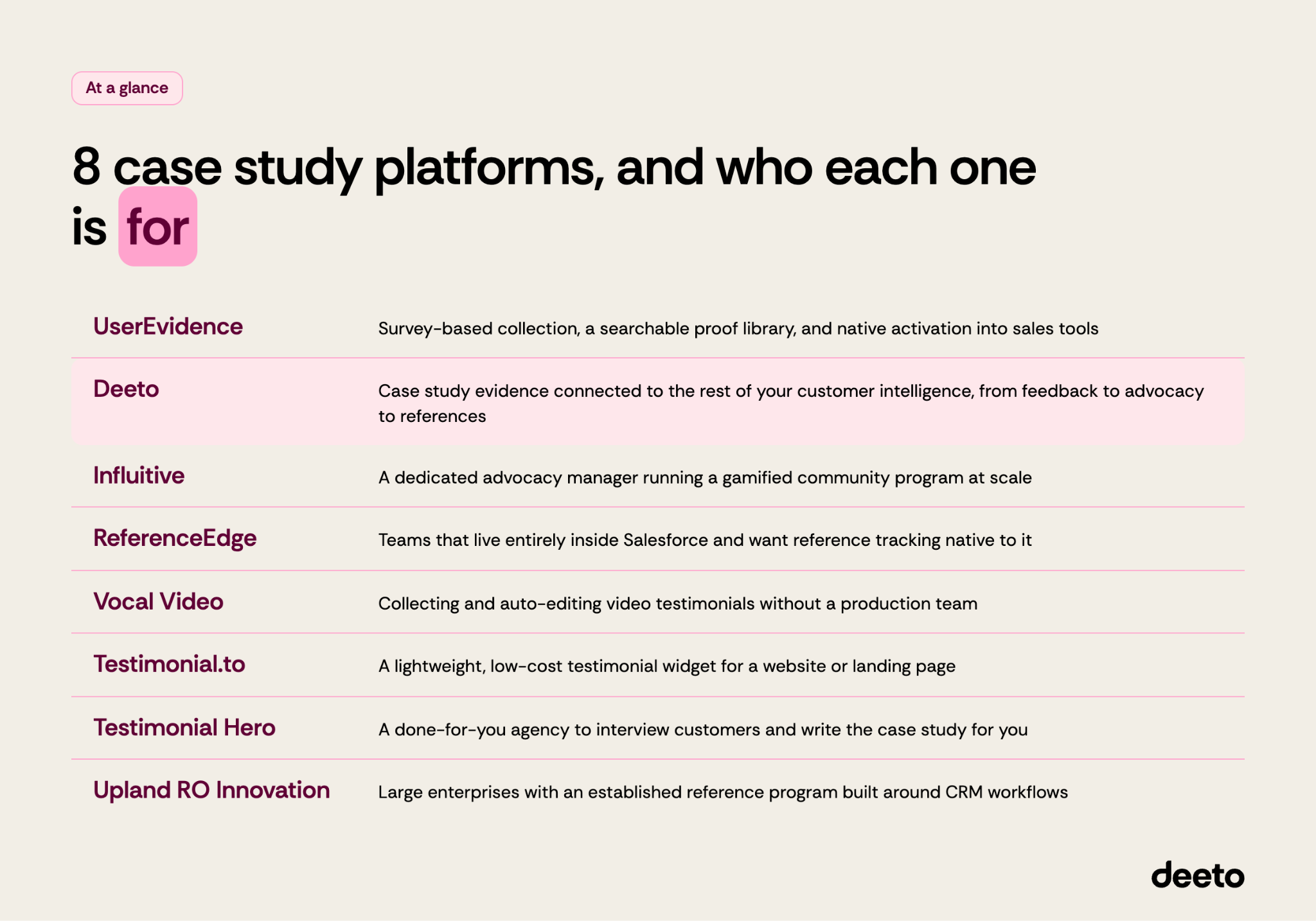
- UserEvidence: Best for teams that want survey-based collection, a searchable proof library, and native activation into sales tools in one platform.
- Deeto: Best for teams that want case study evidence connected to the rest of their customer intelligence, from feedback to advocacy to reference management.
- Influitive: Best for a dedicated advocacy manager running a gamified community program at scale.
- ReferenceEdge: Best for teams that live entirely inside Salesforce and want reference tracking native to that environment.
- Vocal Video: Best for collecting and auto-editing video testimonials without a production team.
- Testimonial.to: Best for a lightweight, low-cost testimonial widget for a website or landing page.
- Testimonial Hero (formerly Case Study Buddy): Best for teams that want a done-for-you agency to interview customers and write the case study for them.
- Upland RO Innovation: Best for large enterprises with an established reference program already built around CRM workflows.
1. UserEvidence: survey-based evidence collection with sales activation
UserEvidence collects customer feedback through surveys and imports reviews from G2 and TrustRadius, then organizes it into a library sortable by industry, company size, and use case. Its AI assistant, Evi, lets sales reps ask natural-language questions like "give me proof from mid-market fintech customers" instead of digging through folders. UserEvidence sits at a 4.8 out of 5 on G2 from 40 reviews, and the company doesn't publish list pricing publicly.
Choose UserEvidence when your bottleneck is collection at scale and you want proof to route into Salesforce, Highspot, or Seismic without manual work. Look elsewhere when you need deeper advocacy or reference-matching capability baked into the same system your customer marketing team already runs.
2. Deeto: case study evidence connected to your full customer intelligence system
Deeto's Evidence capability runs AI-led interviews that capture customer stories in their own words, rather than a scripted quote pulled from a form. What sets it apart from a point solution is that those stories feed into the same system tracking product feedback, sentiment, and advocacy. This way, a case study isn't an isolated asset sitting in a folder, but a study that’s connected to who said it, what they're using, and whether they're a fit for a reference call down the line. Surgimate, a healthcare technology company, used Deeto to replace a manual, spreadsheet-based process for managing customer references and testimonials with a system that made proof easy to find and share across sales and marketing.
Choose Deeto when your team wants case study evidence tied to the rest of your customer voice program, not managed as a separate workstream. Look elsewhere when all you need is a single-purpose collection widget and nothing more.
3. Influitive: gamified advocacy communities
Influitive runs advocacy programs where customers earn points and rewards for completing challenges like writing a review or joining a reference call. It's a strong fit for teams with a dedicated advocacy manager and the bandwidth to run an ongoing community.
Choose Influitive when you're building a structured, long-term advocacy community and have the headcount to run it. Look elsewhere when your main need is getting sales-ready case studies into enablement tools quickly, since native delivery into Highspot or Seismic isn't part of the platform.
4. ReferenceEdge: Salesforce-native reference management
ReferenceEdge lives entirely inside Salesforce, managing reference matching, call tracking, and asset storage on Salesforce records themselves. It's a reference operations tool first, not a content generation platform. It posts a 4.6 out of 5 on G2, with reviewers consistently pointing to Salesforce-native setup as its biggest strength and implementation complexity as the tradeoff.
Choose ReferenceEdge when your reference program needs to run entirely inside Salesforce and you have an admin who can support it. Look elsewhere when you need multi-source collection, web publishing, or an advocacy program that lives outside the CRM.
5. Vocal Video: video testimonials without a production team
Vocal Video handles video testimonial collection with automatic editing, subtitles, and branding applied without manual work. Plans start at $99 per month billed annually, with a free tier capped at five watermarked videos. It scores roughly 4.8 out of 5 on G2 from a small but consistently positive review base, and connects to Highspot and Seismic through Zapier rather than a native integration.
Choose Vocal Video when video is your primary proof format and your team can manage a Zapier-based workflow. Look elsewhere when you need verified anonymous proof, since video is inherently identifiable, or enterprise-grade approval routing.
6. Testimonial.to: lightweight testimonial widget
Testimonial.to collects written and video testimonials through a shareable link, with no login required from the customer, and displays them through an embeddable widget. It rates a solid but modest 4.2 out of 5 on G2, and Salesforce connectivity runs through Zapier rather than a native integration.
Choose Testimonial.to when you need a simple, affordable testimonial widget for a website or landing page. Look elsewhere when you need approval workflows, sales enablement integration, or verified proof for a regulated industry.
7. Testimonial Hero (formerly Case Study Buddy): done-for-you case study production
Case Study Buddy built a reputation as a boutique agency handling end-to-end written case study production, from customer interviews to final copy. It was acquired by Testimonial Hero in 2024 and now operates as part of that broader video and written case study service. Testimonial Hero holds a 4.9 out of 5 on G2 from 67 reviews, with plans starting at $7,800 per year.
Choose Testimonial Hero when you want a professional team to run interviews and write the case study for you, and your budget supports a service model rather than self-serve software. Look elsewhere when you need an ongoing system for managing dozens of assets rather than a handful of flagship stories per year.
8. Upland RO Innovation: enterprise reference operations
Upland RO Innovation manages reference contacts, request workflows, and asset storage with deep CRM integration, plus custom microsites for sharing proof with specific buyers. It carries a 4.1 out of 5 on G2 and is most often deployed at large organizations with an already-established reference program.
Choose RO Innovation when you're running a large enterprise reference program and need structured workflow management inside an existing Upland stack. Look elsewhere when your team needs fast onboarding or a more modern interface that sales will actually adopt without training.
Case study software vs. case study platform: is there a difference?
Not really, in practice. Case study software and case study platform are used interchangeably across most vendor sites and review pages. If there's a soft distinction, it's this: "case study software" more often describes a point solution built around one step, like collecting a testimonial or editing a video, while "case study platform" tends to imply something broader that covers collection, approval, and distribution in one system.
The category name matters less than the question you should be asking, which is, “does this tool solve the specific part of the workflow where your program is actually stuck?” A searchable case study platform that nobody in sales opens is no better than a folder of quotes nobody can find.
How to choose the right case study platform for your team
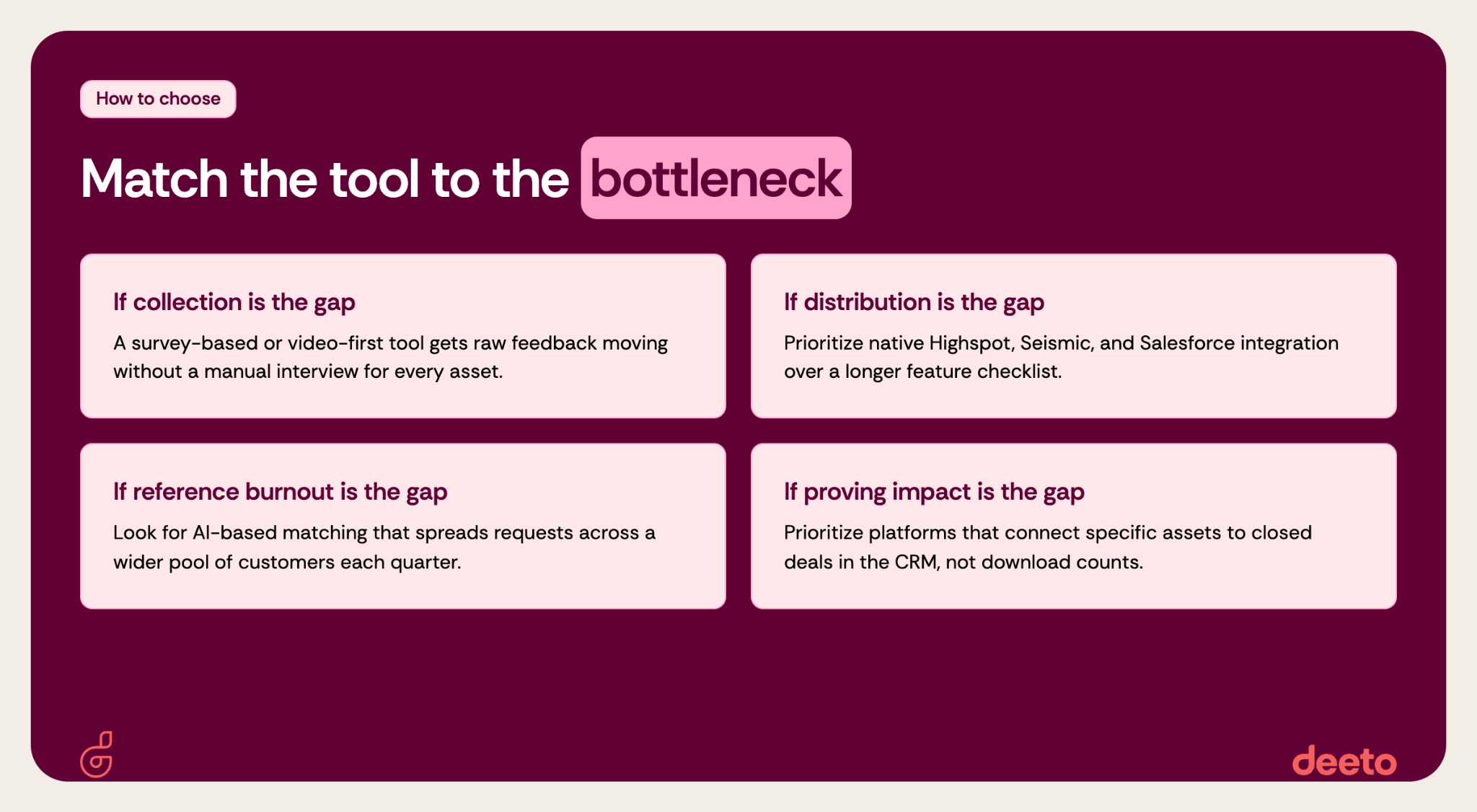
Match the tool to the bottleneck, not the vendor with the longest feature list.
- If collection is the gap, a survey-based tool or a video-first platform gets raw customer feedback moving without a manual interview process for every asset.
- If distribution is the gap, prioritize native integration with Highspot, Seismic, or Salesforce over a longer checklist of features nobody on the sales side will use.
- If reference burnout is the gap, look for AI-based matching that spreads requests across a wider pool instead of the same five customers every quarter.
- If proving impact is the gap, prioritize platforms that connect specific assets to closed deals in the CRM, not just download counts.
Customer marketing teams evaluating this decision often find the real fix isn't a single point solution, but a system where evidence, advocacy, and reference management share the same customer data instead of living in three disconnected tools. That's the problem Deeto's customer marketing solution is built to solve.
Key takeaways
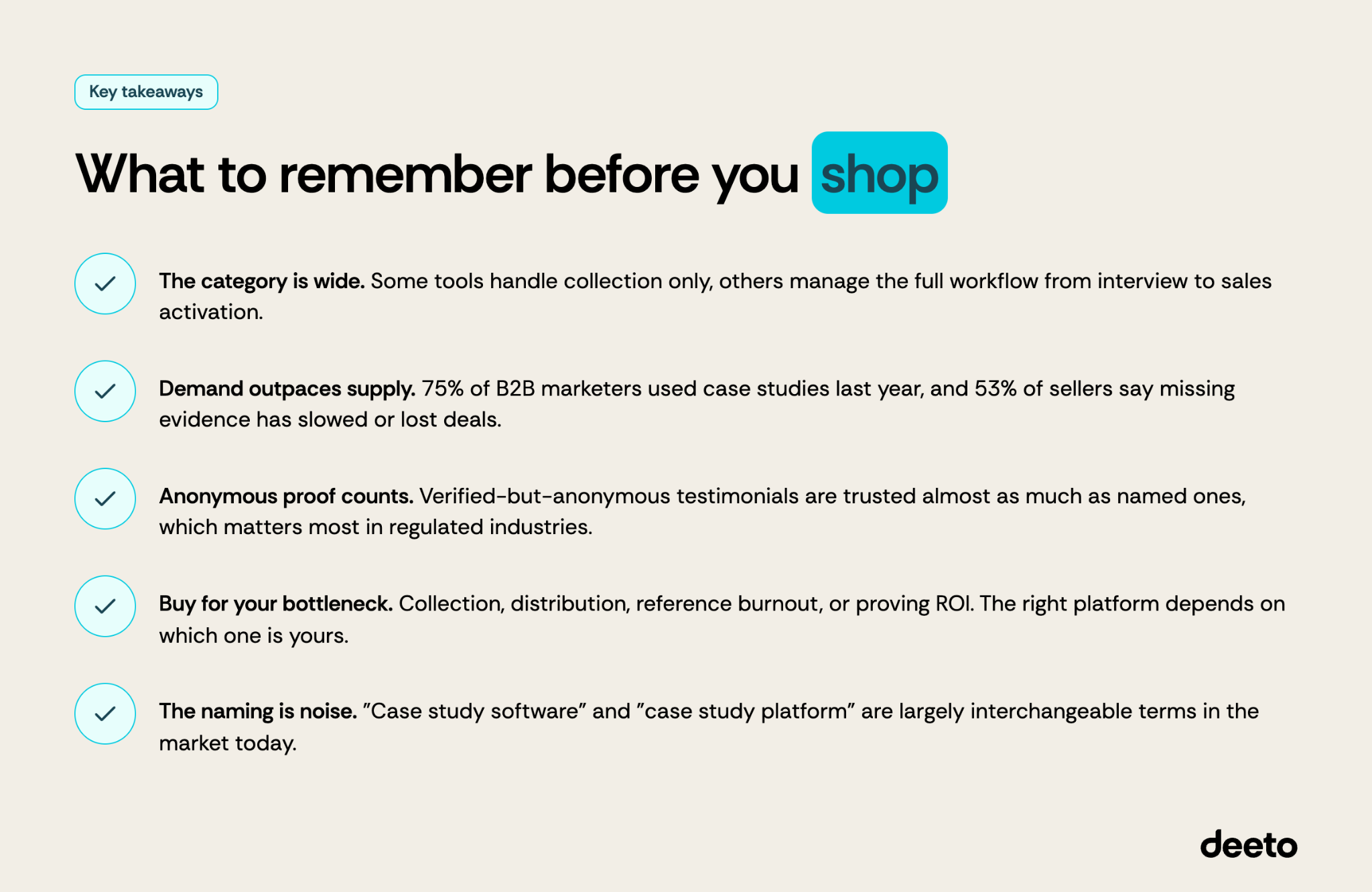
- Case study software spans a wide range: some tools handle collection only, others manage the full workflow from interview to sales activation.
- 75% of B2B marketers used case studies or customer stories in the past year, and 53% of sellers say missing evidence has slowed or lost deals.
- Verified-but-anonymous proof is trusted almost as much as named testimonials, which matters most in regulated industries.
- The right platform depends on your actual bottleneck: collection, distribution, reference burnout, or proving ROI.
- Case study software and case study platform are largely interchangeable terms in the market today.
FAQs
What is case study software?
Case study software helps B2B teams collect customer feedback, manage approval workflows for quotes and logos, and distribute finished case studies to sales and marketing. It ranges from single-purpose collection tools to full platforms covering the entire process from interview to activation.
Is case study software different from a testimonial widget?
A testimonial widget typically collects and displays short quotes on a website. Case study software usually covers more ground, including approval tracking, sales enablement integration, and reporting on how proof gets used. Some tools do both, depending on the plan.
How much does case study software cost?
Pricing ranges widely by category. Lightweight testimonial widgets start around $25 to $50 a month, video testimonial tools run roughly $100 to $1,000 a month depending on volume, and full evidence or advocacy platforms are typically quoted individually based on team size, with enterprise reference tools often running into five figures annually.
Can case study software handle regulated industries like healthcare or finance?
Yes, if it supports verified-but-anonymous proof, where a customer's identity is confirmed internally but not published externally. This lets teams in cybersecurity, financial services, and healthcare use real customer outcomes without a named case study.
What integrations matter most when choosing a case study platform?
Native integrations with Salesforce, Highspot, and Seismic matter most, since they push proof directly into the tools sales reps already use daily. Zapier-based connections work for basic automation but tend to break down when real-time sync or two-way data flow is required.
Conclusion
The tools compared here solve different pieces of the same problem: getting real customer proof in front of the people who need it, before the deal moves on without it. A survey-based collector, a Salesforce-native reference tool, and a done-for-you agency aren't competing for the same job, even though they all get filed under "case study software." Start with where your program is actually stuck, not the platform with the most features on its homepage.
If the real gap on your team is proof that's disconnected from everything else you know about your customers, from feedback to advocacy to reference readiness, see how Deeto connects the whole system.
🎉 Save your spot
Register for the event
Once your spot is secured, we’ll send your confirmation details.
Subscribe to our newsletter
Subscribe to receive the latest blog posts to your inbox every week.
By subscribing, you agree to our Privacy Policy
Subscribe to our newsletter
Get the latest news and updates from our team.
By subscribing, you agree to our Privacy Policy
Related posts

Best customer intelligence tools for B2B teams

What are customer intelligence tools? Compare 8 B2B options, collection methods, and how to pick the right fit.

Omnichannel Customer Engagement Tools: 8 Platforms Compared
Compare 8 omnichannel engagement platforms on channels, AI, and pricing, plus the gap automation can't fill.

Voice of the Customer Strategy for SaaS Companies
What is VoC for SaaS? Learn how to capture customer voice and turn it into decisions that drive renewals.