Customer Proof Marketing: How B2B Companies Build Trust with Buyers



Friday, September 18, 2026


Customer Proof Marketing: How B2B Companies Build Trust with Buyers


View the podcast on Youtube

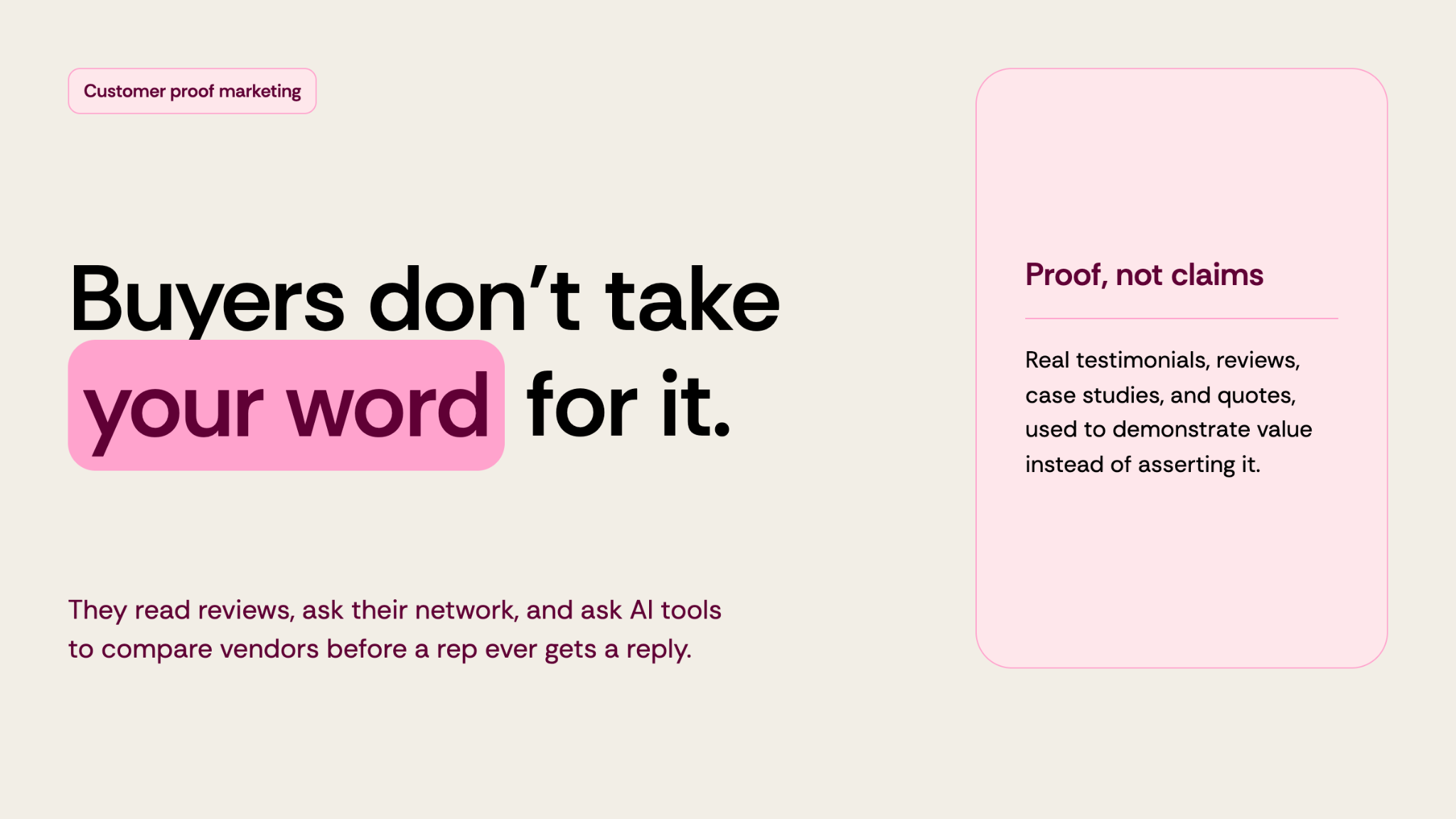
B2B buyers stopped taking vendor claims at face value a while ago. They read reviews, ask people in their network, and increasingly ask AI tools to compare vendors before a sales rep ever gets a reply.
Customer proof marketing is the practice of using real customer testimonials, reviews, case studies, and quotes, instead of vendor-written claims, to demonstrate a product's value to prospective buyers. It replaces "trust us" messaging with evidence buyers can verify for themselves.
This guide covers why customer proof marketing matters, the proof types that actually convert, how to build a repeatable system for collecting and using it, and where social proof marketing software fits into that system.
What is customer proof marketing
Customer proof marketing is the discipline of collecting authentic customer feedback, quotes, reviews, case studies, video testimonials, and using it across the buyer journey to prove a product's value instead of asserting it.
Unlike traditional marketing copy, customer proof marketing sources its claims from the people actually using the product, not from a vendor's own messaging team. That distinction carries more weight than it used to. Buyers discount almost anything a company says about itself and weigh peer input far more heavily.
Customer proof marketing typically includes:
- Testimonials and quotes pulled from calls, surveys, or reviews
- Case studies documenting a customer's challenge, approach, and result
- Third-party reviews on sites like G2, Capterra, or TrustRadius
- Reference customers willing to speak directly with prospects
- Usage stats and outcome data aggregated across the customer base
Some marketers use "customer proof" and "social proof" interchangeably. They overlap, but social proof is the broader category, covering follower counts, awards, and media mentions, while customer proof marketing specifically draws from the direct voice and outcomes of paying customers.
Why customer proof marketing matters for B2B buyers
Modern B2B buyers do most of their homework before a rep gets involved. According to WBR research, buyers complete 57% to 70% of their evaluation before contacting a vendor directly. During that window, a company's own marketing carries less weight than what other customers are saying in reviews, forums, and side conversations.
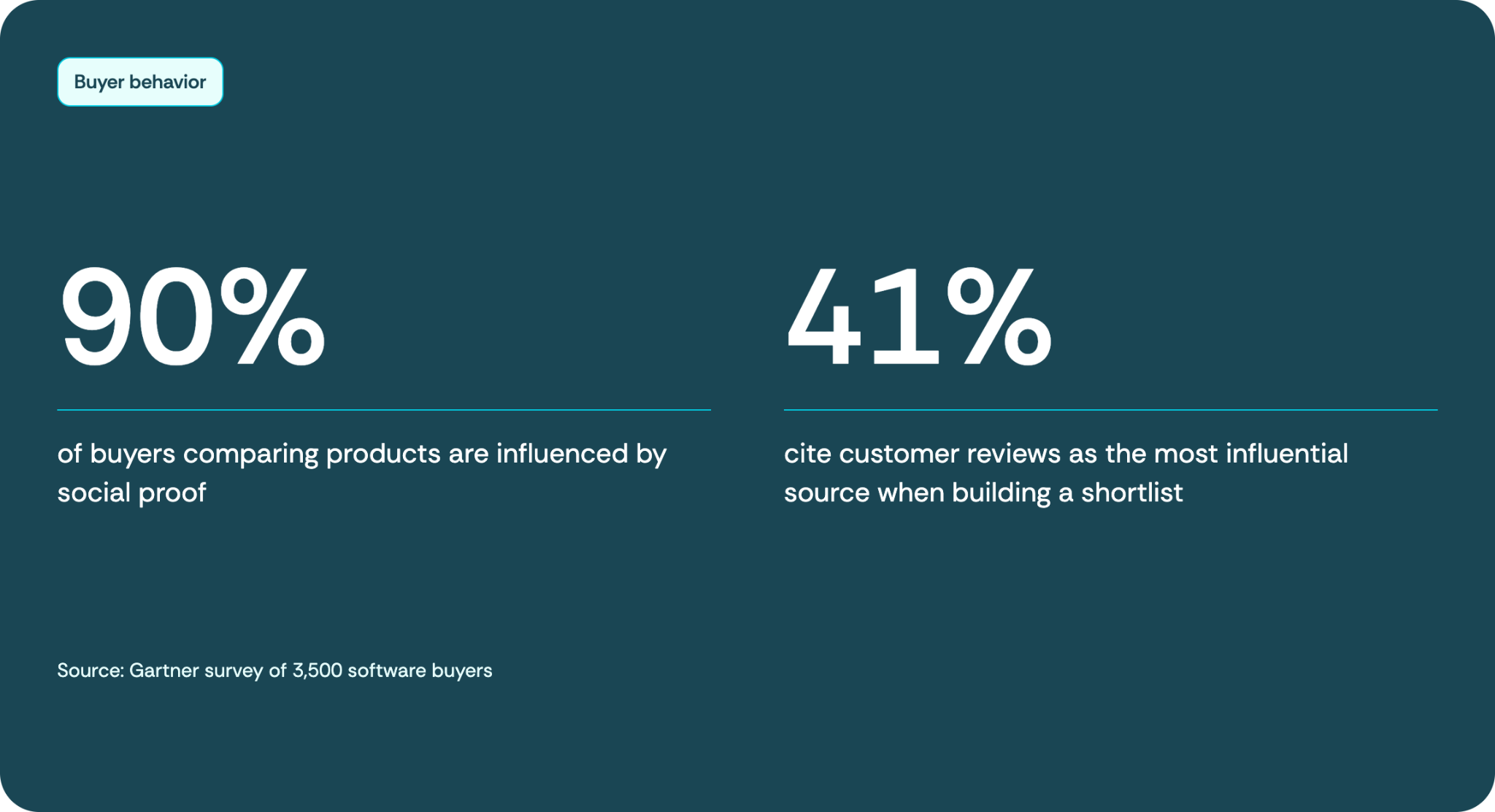
The scale of that influence is measurable. A Gartner survey of 3,500 software buyers found that social proof influences 90% of buyers comparing products, with customer reviews the single most influential source, cited by 41%, when building a vendor shortlist.
That's the gap customer proof marketing closes. It's also why Deeto treats customer voice as infrastructure rather than a marketing nice-to-have. Proof that lives in one connected system, tagged and searchable, reaches buyers and sales reps at the exact moment they need it, instead of surfacing after a deal has already stalled.
B2B deals also rarely come down to one decision-maker. Most run through a buying committee with several stakeholders, each measuring success differently. A CFO wants risk mitigation. An end user wants proof the product works day to day. A generic testimonial rarely satisfies either one, which is why proof needs to be organized by who's reading it, not just what it says.
The types of customer proof that build trust
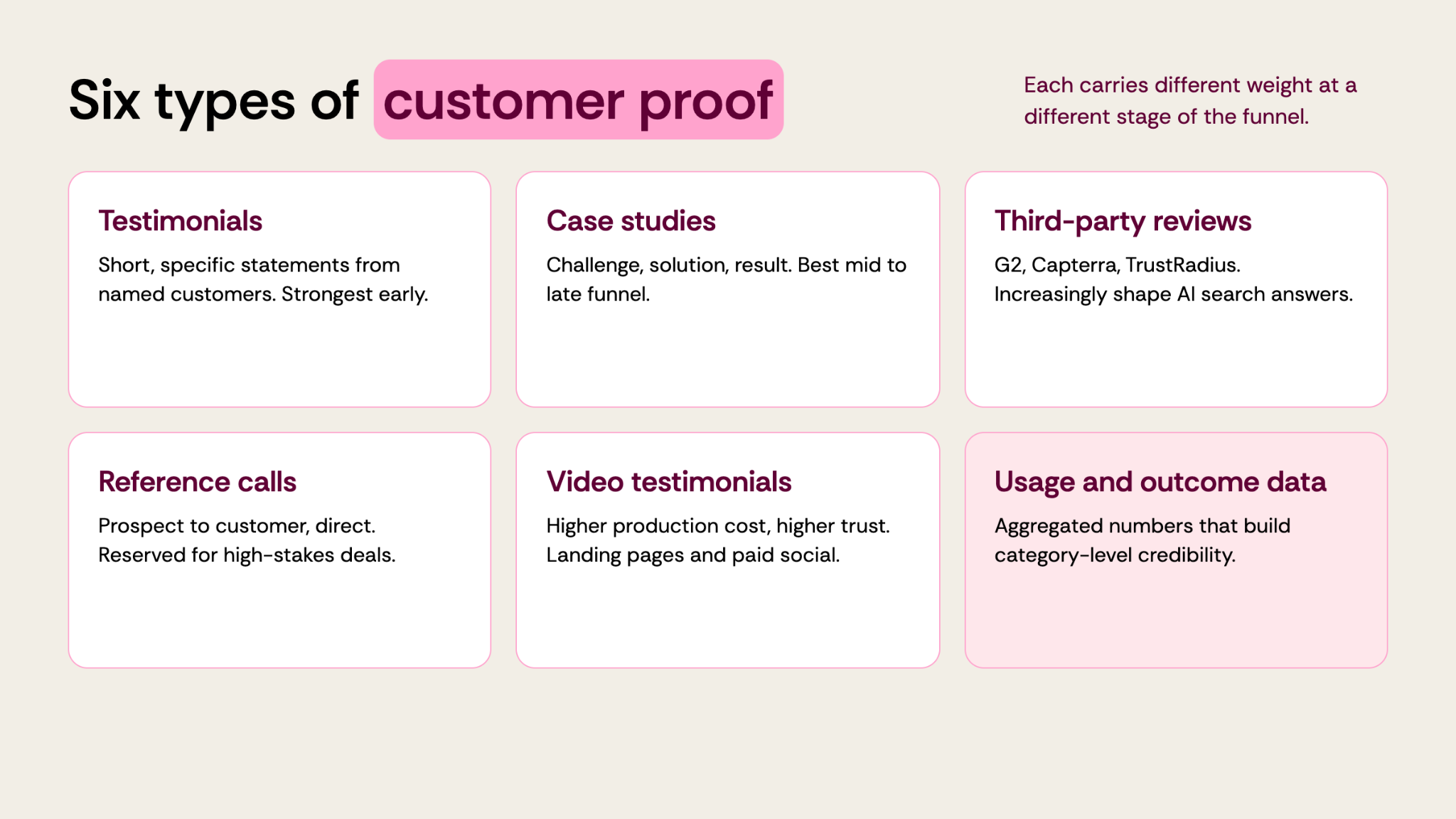
Not all proof carries the same weight at every stage. Peerbound's analysis of the proof B2B teams collect breaks down into a handful of consistent categories:
- Testimonials and quotes: Short, specific statements from named customers. Strongest early in the funnel and on the website homepage.
- Case studies: Full challenge-solution-result narratives. Best for mid-to-late funnel deals and long-form content.
- Third-party reviews: Listings on G2, Capterra, and TrustRadius that buyers check independently of anything the vendor publishes. Reviews increasingly shape what surfaces when buyers ask ChatGPT or Perplexity to compare vendors, according to G2's 2025 Buyer Behavior Report.
- Reference calls: Direct conversations between a prospect and an existing customer. Reserved for late-stage, high-stakes deals.
- Video testimonials: Higher production cost, higher trust. Effective on landing pages and in paid social.
- Usage stats and outcome data: Aggregated numbers, such as "2,600+ companies" or "20% faster time to value," that build category-level credibility.
The strongest proof isn't the proof that sounds the most impressive. It's the proof that matches what the specific buyer in front of you actually cares about.
Common challenges in customer proof marketing
Most teams don't struggle to create proof. They struggle to keep it organized and current:
- Sales can't find it fast enough. If a rep can't locate relevant proof in a couple of minutes, they'll stop asking and wing it instead.
- Proof goes stale. A stat from two product versions ago can undercut trust rather than build it.
- Approval creates bottlenecks. Legal and customer sign-off slows down the exact content that's supposed to move deals faster.
- Proof isn't mapped to a persona or use case. A quote about ease of use won't land with a CFO evaluating risk, and a quote about ROI won't land with an end user asking if the tool is painful to adopt.
- It's scattered across tools. Proof buried in a shared drive, a Slack thread, and a sales deck isn't a system. It's a scavenger hunt.
How to build a customer proof marketing strategy
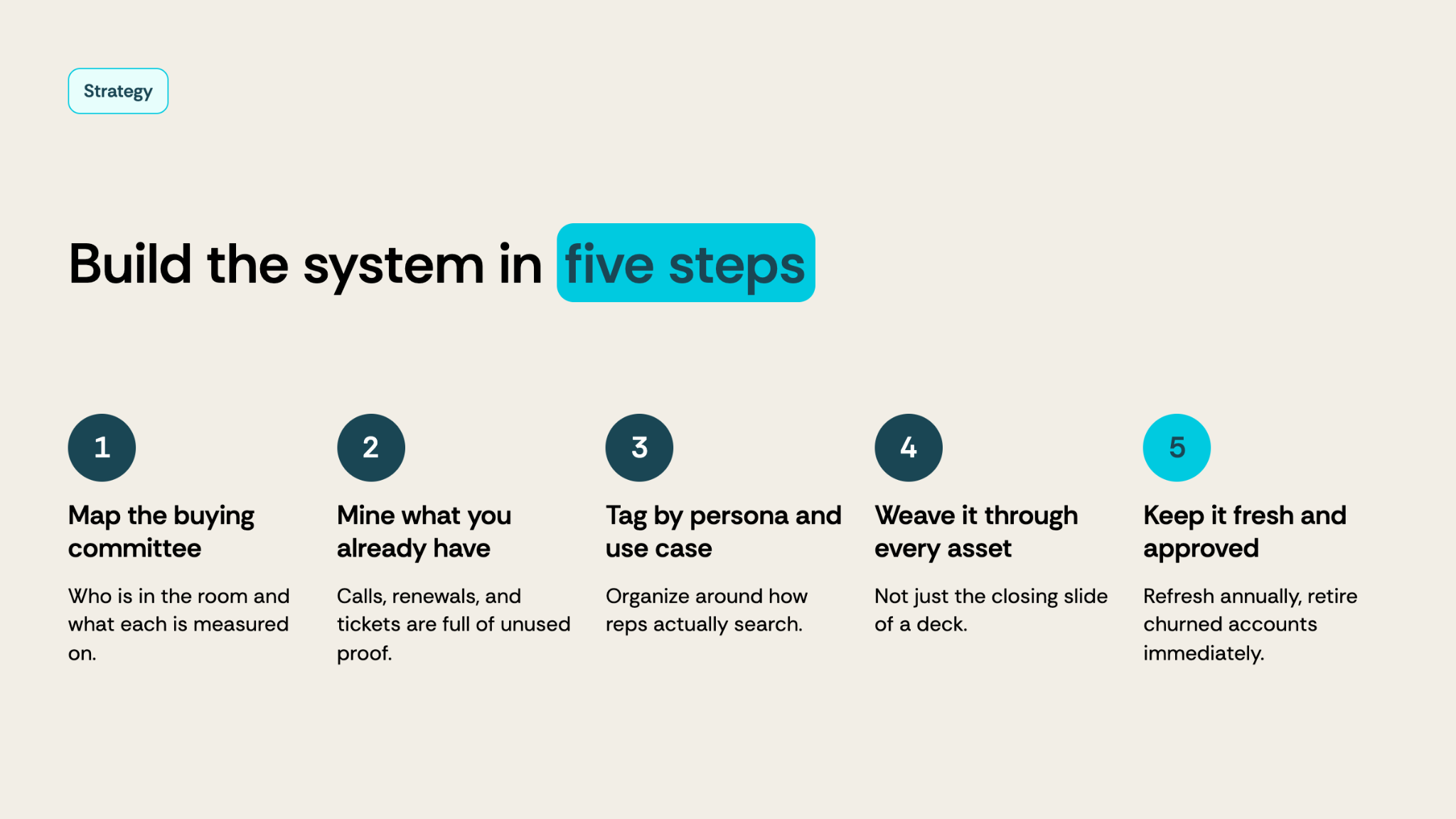
A working strategy comes down to five steps, whether you're starting from a blank folder or trying to fix a messy one.
1. Map proof to your buying committee, not just your product. Document who's in the room, what each person is measured on, and what kind of proof would move them. A buyer research process that captures this upfront saves you from guessing later.
2. Mine what you already have before collecting more. Sales calls, renewal conversations, and support tickets are usually full of proof that's never been extracted. Teams may sit on months of usable evidence before they ever launch a new survey.
3. Tag and organize by persona, industry, and use case. A rep thinks in terms of "I need something for a healthcare CFO worried about implementation time," not "testimonial number 47." Build your library around how your team actually searches, not how it was collected.
4. Weave proof throughout every asset, not just a closing slide. Open a pitch with a customer quote instead of saving all your evidence for the end. Back every feature claim with an adoption stat. Pair every objection with a proof point from a similar deal.
5. Keep it fresh, and get approval before it goes out the door. Refresh proof at least annually, retire anything from a churned account immediately, and never publish a customer's name or quote without their sign-off.
Customer proof marketing vs. social proof marketing software: comparing your options
Social proof marketing software is the category of tools built to collect, organize, and distribute customer proof automatically, instead of relying on manual folders, spreadsheets, or one-off requests to happy customers. Most B2B teams land on one of three approaches:
How Deeto powers customer proof marketing
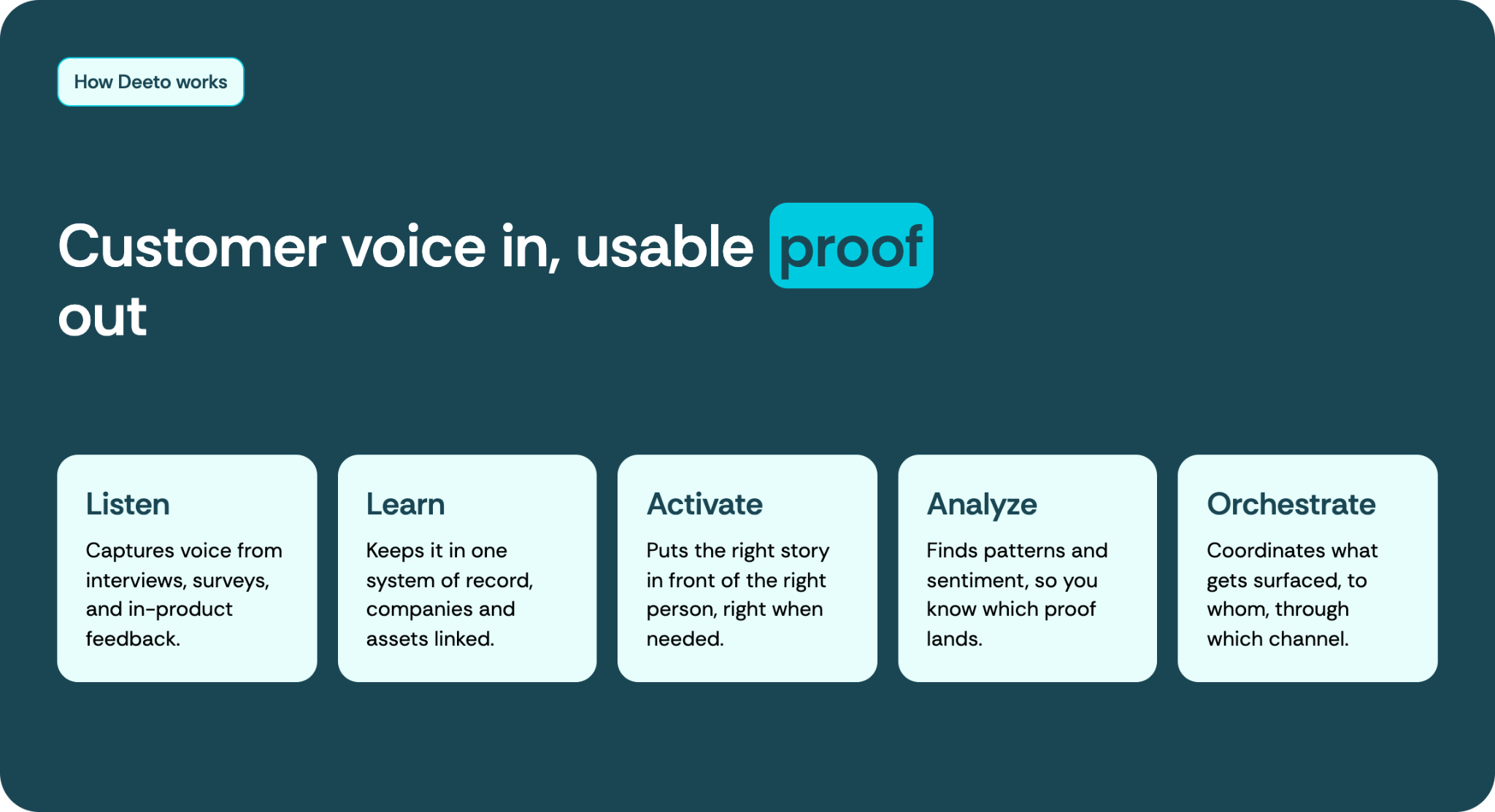
Deeto is a voice of the customer platform built to fix this specific problem: customer voice goes in one end, and usable proof comes out the other, instead of sitting in someone's inbox.
The system breaks into five parts. Listen captures customer voice from interviews, surveys, and in-product feedback as it happens, so nobody's scrambling for quotes the week before a launch. Learn keeps all of it in one system of record instead of scattered across a shared drive, with companies, people, and assets linked together. Activate puts the right customer story and social proof in front of the right person, whether that's a sales rep mid-call or a campaign landing page, right when it's needed. Analyze looks for patterns and sentiment in that voice, so a marketer can tell which proof points are actually landing versus which just sound good on paper. Orchestrate ties the other four together, coordinating what gets surfaced, to whom, and through which channel, so proof moves as one connected system instead of four disconnected tools.
That matters most for teams running a customer marketing function, where the same proof point has to work for a website visitor, a sales rep, and a renewal conversation without three separate manual processes. It also strengthens customer advocacy programs, since advocates who see their story activated across channels are more likely to keep participating.
Teams using this kind of connected approach to customer voice see the difference in the numbers: 15-20% faster deal cycles and 10-15% higher win rates when reps have contextual proof on hand instead of searching for it mid-call.
Frequently asked questions
What is customer proof marketing?
Customer proof marketing is the practice of using authentic customer feedback, testimonials, case studies, reviews, and quotes, to demonstrate a product's value to prospective buyers, rather than relying on vendor-written claims.
How is customer proof marketing different from social proof marketing?
Social proof marketing is the broader category, including follower counts, media mentions, and awards. Customer proof marketing specifically uses evidence sourced directly from paying customers, such as quotes, reviews, and case studies.
What is social proof marketing software?
Social proof marketing software refers to tools built to collect, organize, and distribute customer proof at scale. Some tools focus on a single format, like reviews or testimonials, while AI-native platforms connect proof across the entire customer lifecycle.
What types of customer proof work best for B2B companies?
Testimonials and quotes tend to work earliest in the funnel, case studies and reference calls carry more weight mid-to-late funnel, and third-party reviews influence buyers throughout, including in AI search results.
How often should customer proof be refreshed?
Most proof should be reviewed at least annually. Outdated stats or references to old product versions can undercut trust rather than build it, and proof from churned customers should be archived immediately.
Do you need customer approval to use a quote or case study?
Yes. Always get written approval before publishing a customer's name, logo, or quote. Internal use, like sales training, may fall under different terms depending on your customer contracts.
Key takeaways
- Customer proof marketing uses real customer evidence, not vendor claims, to build trust with B2B buyers.
- Social proof influences 90% of buyers comparing products, and reviews are the single most influential factor in shortlisting.
- B2B buying committees average 5 to 6 stakeholders, so proof needs to be mapped by persona, not treated as one-size-fits-all.
- The biggest failure point isn't collecting proof, it's organizing it so sales and marketing can actually find and use it.
- Social proof marketing software ranges from manual folders to AI-native platforms that connect proof across the entire customer lifecycle.
Conclusion
Customer proof marketing works because it replaces a vendor's word with a customer's. In a market where buyers complete most of their research before ever talking to sales, that shift decides whether a company makes the shortlist at all.
The teams that do this well don't treat proof as a one-time asset. They treat it as a living system: collected continuously, organized by who's going to read it, and activated at the moment a buyer or a rep actually needs it. That's the difference between a folder of old case studies and a customer reference program that keeps paying off deal after deal.
See how Deeto turns authentic customer voice into connected proof your team can actually use. Book a demo.
🎉 Save your spot
Register for the event
Once your spot is secured, we’ll send your confirmation details.
Subscribe to our newsletter
Subscribe to receive the latest blog posts to your inbox every week.
By subscribing, you agree to our Privacy Policy
Subscribe to our newsletter
Get the latest news and updates from our team.
By subscribing, you agree to our Privacy Policy
Related posts

How to Build a Customer Churn Model: A Guide for Businesses

What is a customer churn model? Learn how to build one, spot churn early, and win back at-risk customers.

How to Adapt Business Strategy to Changing Customer Behavior
What does it take to adapt business strategy to changing customer behavior? Learn the signals, the framework, and the ne

How to Build a Voice of the Customer Program
How do you build a voice of the customer program? Learn who should own it, a 90-day rollout, and how to budget for it.