Customer Testimonial Software Platforms Compared



Tuesday, September 22, 2026


Customer Testimonial Software Platforms Compared


View the podcast on Youtube

If your company collects testimonials the same way it collects junk mail, meaning something arrives, someone forwards it, and it sits in a folder nobody opens again, then it’s worth asking what testimonial software could do for you.
Customer testimonial software is any tool built to request, collect, organize, and publish customer feedback, including written quotes, star ratings, and video testimonials, usually through a hosted collection form and embeddable widgets. This article compares the leading platforms on the market, from lightweight widget builders to full testimonial management software, and looks at where each one runs out of road once testimonials need to do more than sit on a landing page.
What Is Customer Testimonial Software?
Customer testimonial software makes turning customer feedback into visible proof easier. Many customer testimonial platforms include a shareable collection form or link, a dashboard for tagging and approving submissions, and embeddable widgets like walls, carousels, or badges that publish testimonials on a website without a developer.
You'll see this category marketed under a few overlapping names: testimonial management software, testimonial collection tools, and customer testimonial apps. The core workflow is the same across all of them:
- Collecting testimonials through branded forms, shareable links, or automated email and SMS sequences
- Tagging, filtering, and approving submissions before they go live
- Embedding testimonials on a website, landing page, or app through customizable widgets
For a solo founder collecting their first ten reviews, that workflow is often enough. For a B2B marketing team trying to prove ROI across sales, marketing, and customer success, it usually isn't. That gap is where most of the platforms below start to show their limits.
Why Testimonial Management Software Matters for B2B Teams
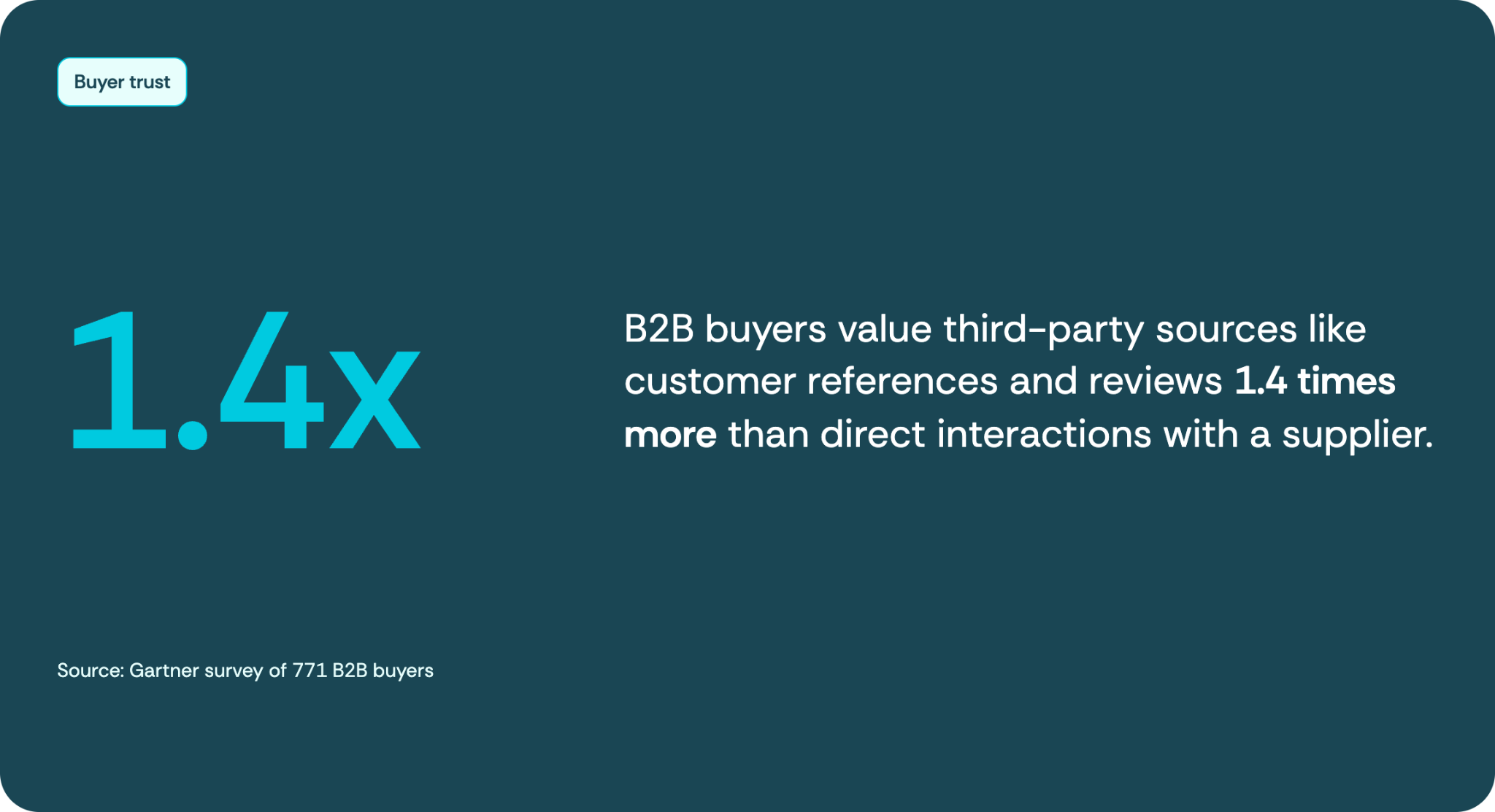
Buyers don't trust vendors to describe their own products accurately, and they haven't for a long time. A Gartner survey of 771 B2B buyers found that third-party sources like customer references and reviews are valued 1.4 times more than direct interactions with a supplier when it comes to building purchase confidence. That is exactly why testimonials can't stay a marketing side project. They're one of the few assets a buyer actually trusts more than anything the vendor says directly.
Content Marketing Institute's 2025 B2B benchmark report found that case studies and customer stories rank among the most effective content formats B2B marketers use, trailing only video. The two are converging fast: a strong video testimonial is often a case study that takes 90 seconds to watch instead of five minutes to read.
The problem isn't collecting customer feedback. The problem is connecting it to the moment a buyer or renewal decision actually gets made.
Common challenges in managing customer testimonials at scale
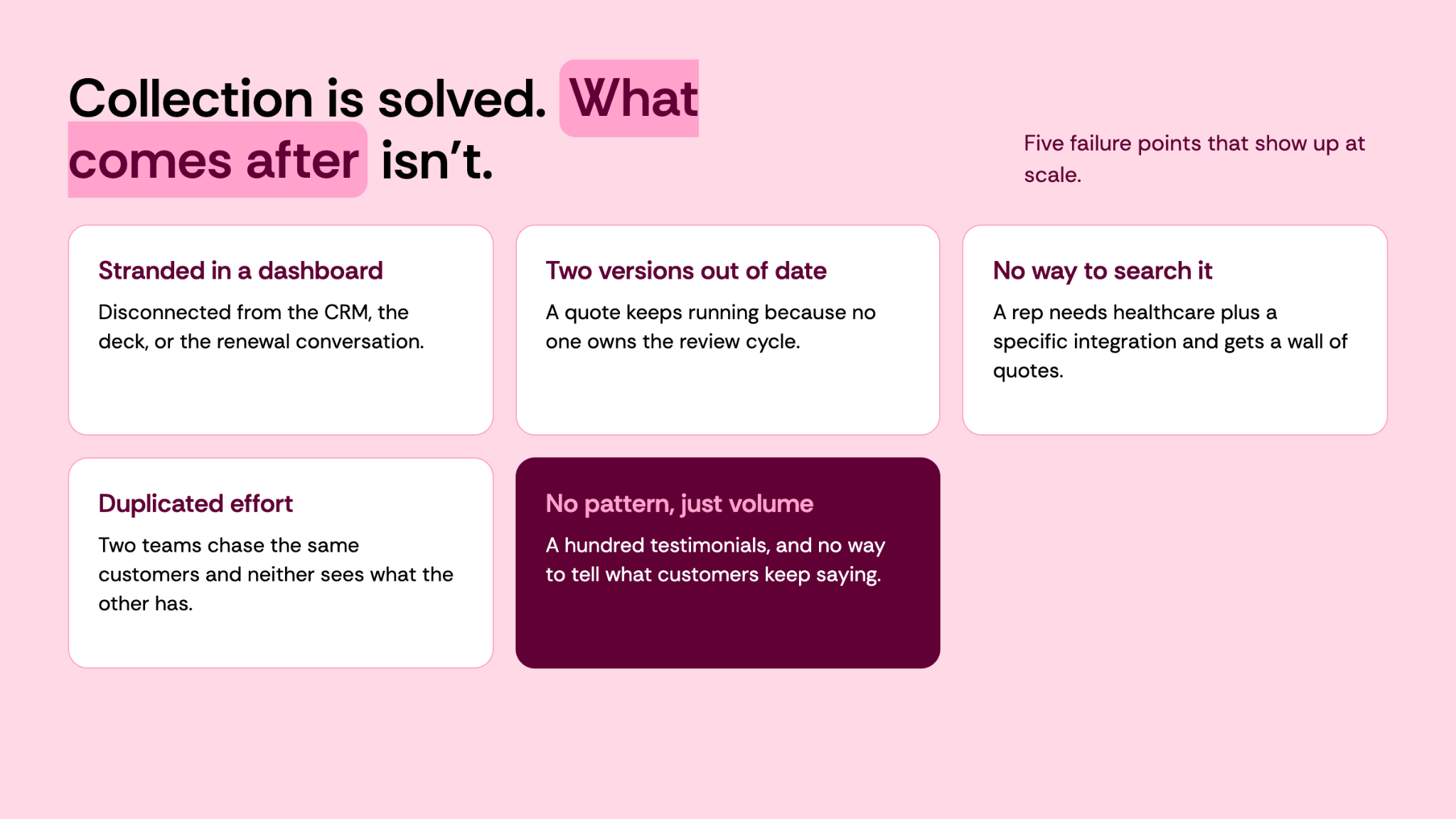
Testimonial management software solves the collection problem well. It rarely solves what comes after:
- A quote sits in a widget dashboard, disconnected from the CRM, the sales deck, or the renewal conversation where it would actually help.
- A testimonial collected two product versions ago keeps running because no one owns the review cycle.
- A rep needs proof from a healthcare company using a specific integration, and the only search option is scrolling a wall of quotes.
- Marketing and customer marketing teams end up duplicating effort: one collects reviews for the website while another chases the same customers for case studies, and neither sees what the other has.
- A hundred testimonials sit in a dashboard with no way to tell what customers actually keep saying about the product.
Customer testimonial software platforms compared
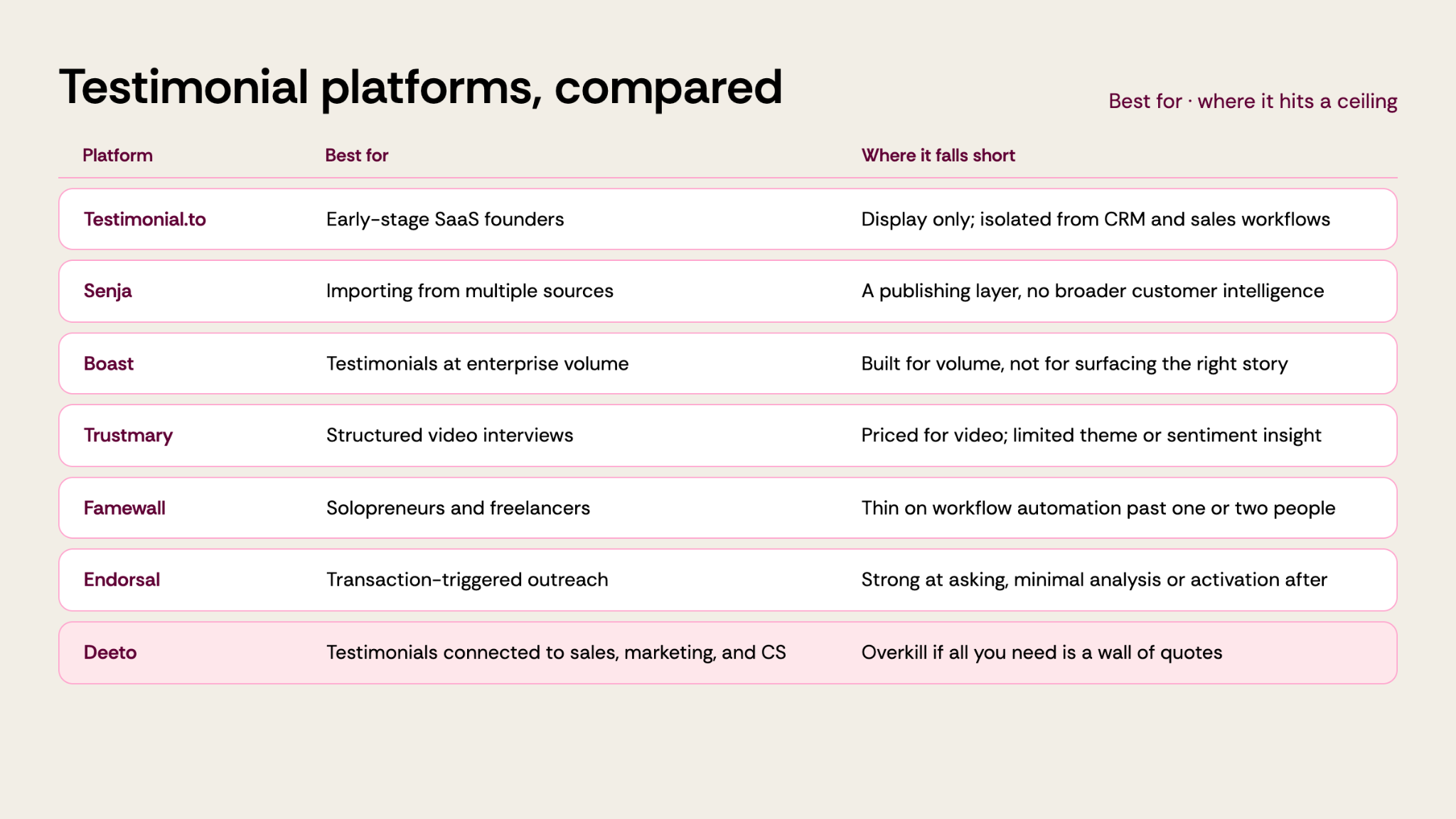
Here's how the most-used platforms in this space compare on collection, display, and where each one tends to hit a ceiling.
Most of these platforms do one part of the job very well: getting a customer to say something nice and putting it somewhere visible. Deeto starts from a different question. Once you have that customer voice, how does it reach a rep mid-deal, a marketer building a campaign, or a product team deciding what to fix next? That's the difference between customer stories and social proof that sit on a page and customer intelligence that moves through an organization.
Testimonial.to
Testimonial.to built its reputation on the Wall of Love, a masonry-style widget that displays a scrolling grid of text and video quotes. Collection happens through a single shareable link, with little setup required on either side. That simplicity has made it a default choice for early-stage SaaS founders who want a first wall of proof live within an afternoon. The tradeoff is that testimonials stay exactly where they're collected. There's no path from a quote into a CRM, a sales deck, or a nurture campaign.
Senja
Senja goes a step further than a shareable link by auto-importing existing reviews from sources like Google, X, and app stores, then letting a team customize how each one displays through a widget builder. It also includes an AI-powered analysis feature that surfaces common phrases across collected testimonials, which is more than most tools in this category offer. That makes it a solid fit for marketing teams that already have praise scattered across the web and want one place to manage and understand it. Its ceiling is what happens after the analysis. Senja can tell a marketer which phrases show up most often, but it has no way to route a specific testimonial to the rep or campaign that needs it.
Boast
Boast is built for volume. Its guided video collection flows are designed for sales and customer success teams running dozens or hundreds of requests through structured prompts, and testimonials can be tagged by product, location, or staff member with reporting to track trends. That makes it a reasonable fit for enterprise teams building out a large testimonial library. What Boast doesn't solve is getting that testimonial out of its own dashboard. A rep still has to log into Boast and search, rather than finding the right story already sitting inside their CRM record.
Trustmary
Trustmary leans furthest into feedback analytics of any platform on this list, with built-in sentiment analysis and survey-based flows built specifically for structured customer interviews. Teams already running NPS or CSAT programs get a more complete feedback and testimonial workflow here than anywhere else in this list, but the pricing and setup reflect that broader scope. For a team that just needs a handful of quick text testimonials, Trustmary is likely more platform than the job calls for.
Famewall
Famewall keeps things simple. A browser-based recorder lets a customer submit a testimonial in a few clicks, with no coding and no developer needed, and its AI Composer helps customers draft feedback faster. That's an advantage for solopreneurs and freelancers just getting started. Once a team grows past one or two people running the review process by hand, Famewall's limited workflow automation becomes the bottleneck.
Endorsal
Endorsal's whole model is automation on the ask. It connects to transaction data and fires timed email sequences requesting a testimonial from recent customers, without anyone manually tracking who's been asked. What it lacks is anything on the other side of that process. Once a testimonial lands, there's minimal analysis of what it actually says or where it should go next.
Deeto
Deeto approaches the category from a different angle. Instead of treating testimonials as a standalone asset to collect and display, Deeto captures customer voice continuously through interviews, surveys, and in-product feedback, then routes the right story to the right person: a rep mid-deal, a marketer building a campaign, or a CS lead prepping a QBR. That makes Deeto overkill for a team that only needs one wall of quotes on a landing page, and the right fit for a B2B team that wants testimonials working across sales, marketing, and customer success instead of sitting in a folder.
What to look for in testimonial management software
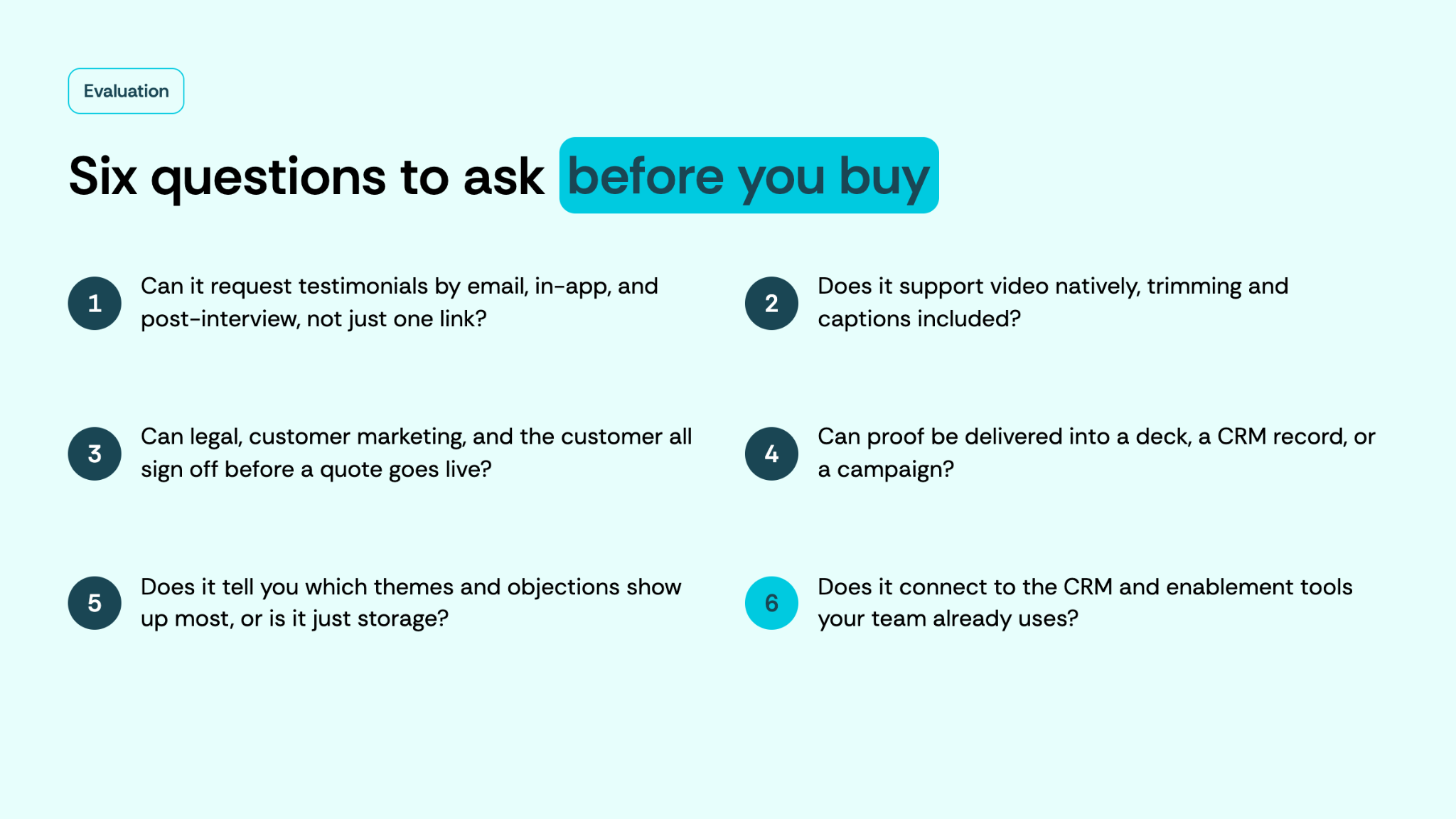
Before choosing a platform, match the tool to what your team needs it to do:
- Can it request testimonials through email, in-app prompts, and post-interview follow-ups, not just a single shareable link?
- Does it support video testimonials natively, including trimming and captions, or does that require a separate tool?
- Can legal, customer marketing, and the customer all sign off before a quote goes live?
- Do testimonials stay in a widget, or can they be delivered directly into a sales deck, a CRM record, or a campaign?
- Can the tool tell you which themes, objections, or use cases show up most often across everything you've collected, or is it just storage?
- Does it connect to the CRM and enablement tools your customer marketing team already uses, or does someone have to move data by hand?
A tool that nails collection and display but fails on the last couple of questions will always feel like it's missing something. That missing piece is usually the reason testimonial projects stall after the first few months.
How to build a testimonial system that scales
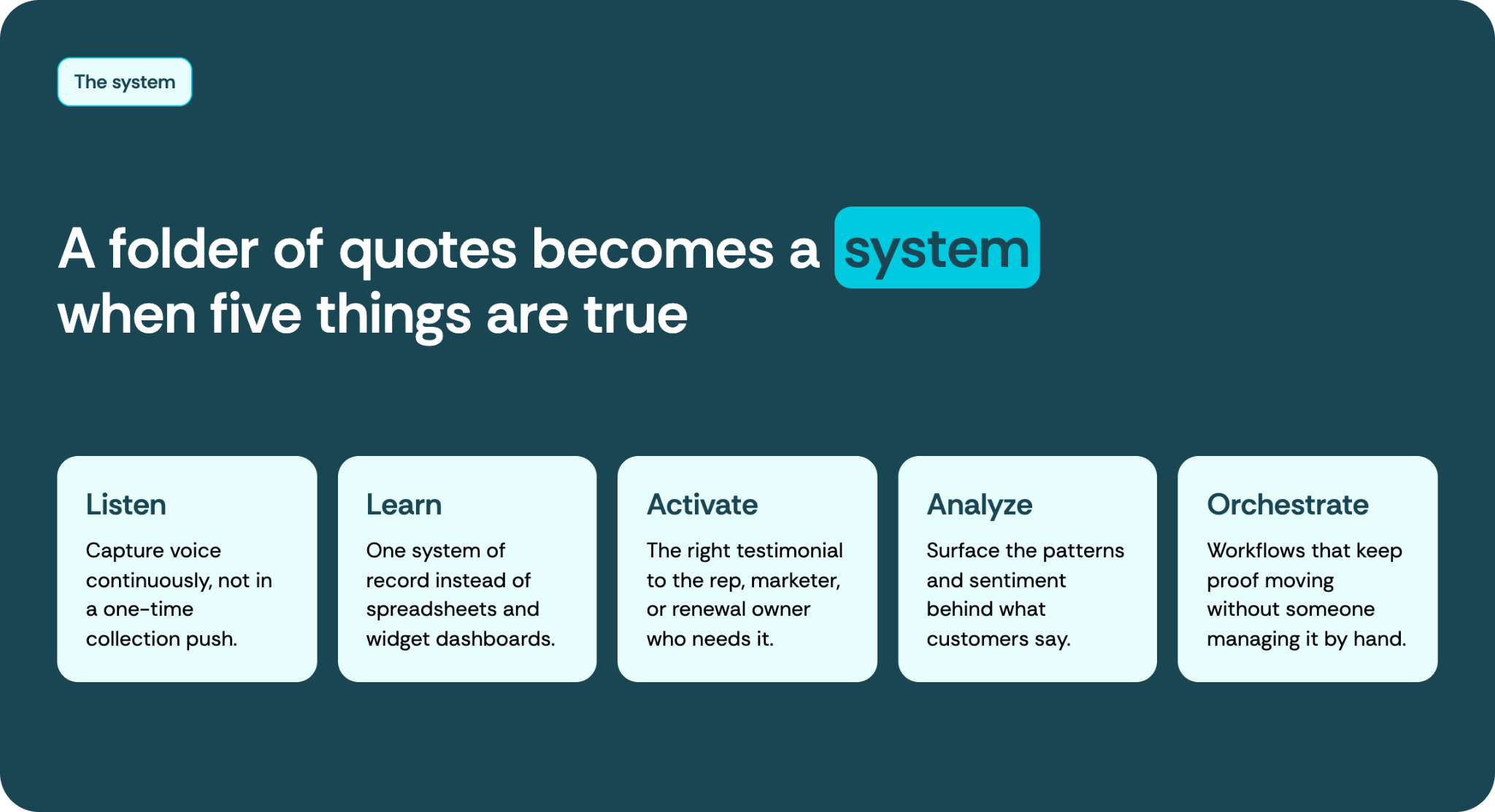
Testimonial management software becomes a system, not a folder of quotes, when four things are true at once. It needs to listen, capturing customer voice continuously through interviews, surveys, and in-product micro-feedback instead of a one-time collection push. It needs to learn, keeping every testimonial, quote, and story in one system of record instead of scattered across spreadsheets and widget dashboards. It needs to activate, getting the right testimonial to the right person, whether that's a rep mid-deal, a marketer drafting a case study, or a renewal owner building a QBR. It needs to analyze, surfacing the patterns and sentiment behind the testimonials so a marketing team knows which themes actually resonate before building the next campaign. And it needs to orchestrate, running the workflows and automations that keep every testimonial moving to the right place without someone managing it by hand.
That five-part model is what Deeto's platform is built around; take customer feedback that would otherwise sit in a folder and turn it into something sales, marketing, and product teams can actually use. If your team already has a customer reference program in place, the same infrastructure that powers references can power testimonials, case studies, and reviews without building three separate systems.
Key takeaways
- Customer testimonial software collects, organizes, and displays customer feedback, usually through forms and embeddable widgets.
- B2B buyers trust third-party proof like customer references 1.4 times more than direct supplier claims, per Gartner.
- Most platforms handle collection and display well but leave testimonials disconnected from sales, marketing, and CS workflows.
- The right platform depends on whether you need a simple wall of quotes or a system that puts customer voice to work across the business.
- Testimonial management software works best connected to a broader system of customer intelligence, not run as a standalone tool.
FAQs
What is customer testimonial software?
Customer testimonial software is a tool that helps businesses request, collect, organize, and publish customer feedback such as written quotes, star ratings, and video testimonials. Most platforms include a collection form, a management dashboard, and embeddable widgets for displaying testimonials on a website.
Is testimonial management software the same as testimonial software?
The terms are used interchangeably in the market. "Testimonial management software" tends to describe platforms with more robust organization features, like tagging, approval workflows, and multi-source imports, while "testimonial software" is often used more broadly, including simple display-only tools.
Do I still need testimonial software if I already collect reviews on G2 or Capterra?
Yes, in most cases. Third-party review sites are valuable for discovery and trust, but testimonial software lets you collect feedback tailored to your own use cases, display it on your own site, and route it to sales or marketing where a G2 review can't reach.
How much does customer testimonial software typically cost?
Pricing varies widely by category. Lightweight widget tools often start with a free tier and move into the tens of dollars per month. Video-first and enterprise-focused platforms typically run into the hundreds of dollars per month, reflecting the added infrastructure for recording, hosting, and workflow automation.
Can testimonial software integrate with a CRM?
Some can. Integration depth is one of the biggest differentiators in this category. Widget-focused tools often stop at basic exports, while platforms built around customer intelligence, like Deeto, are designed to surface testimonials directly inside CRM records and sales workflows.
What's the difference between testimonial software and a voice of the customer platform?
Testimonial software is built to collect and display one type of asset. A voice of the customer platform captures customer voice across formats, including testimonials, interviews, and feedback, then analyzes it and routes it to the teams and moments where it drives a decision.
Conclusion
Customer testimonial software solves a real problem: getting a customer to say something good and putting it where a prospect can see it. For a team with one landing page and a handful of quotes, that's often enough.
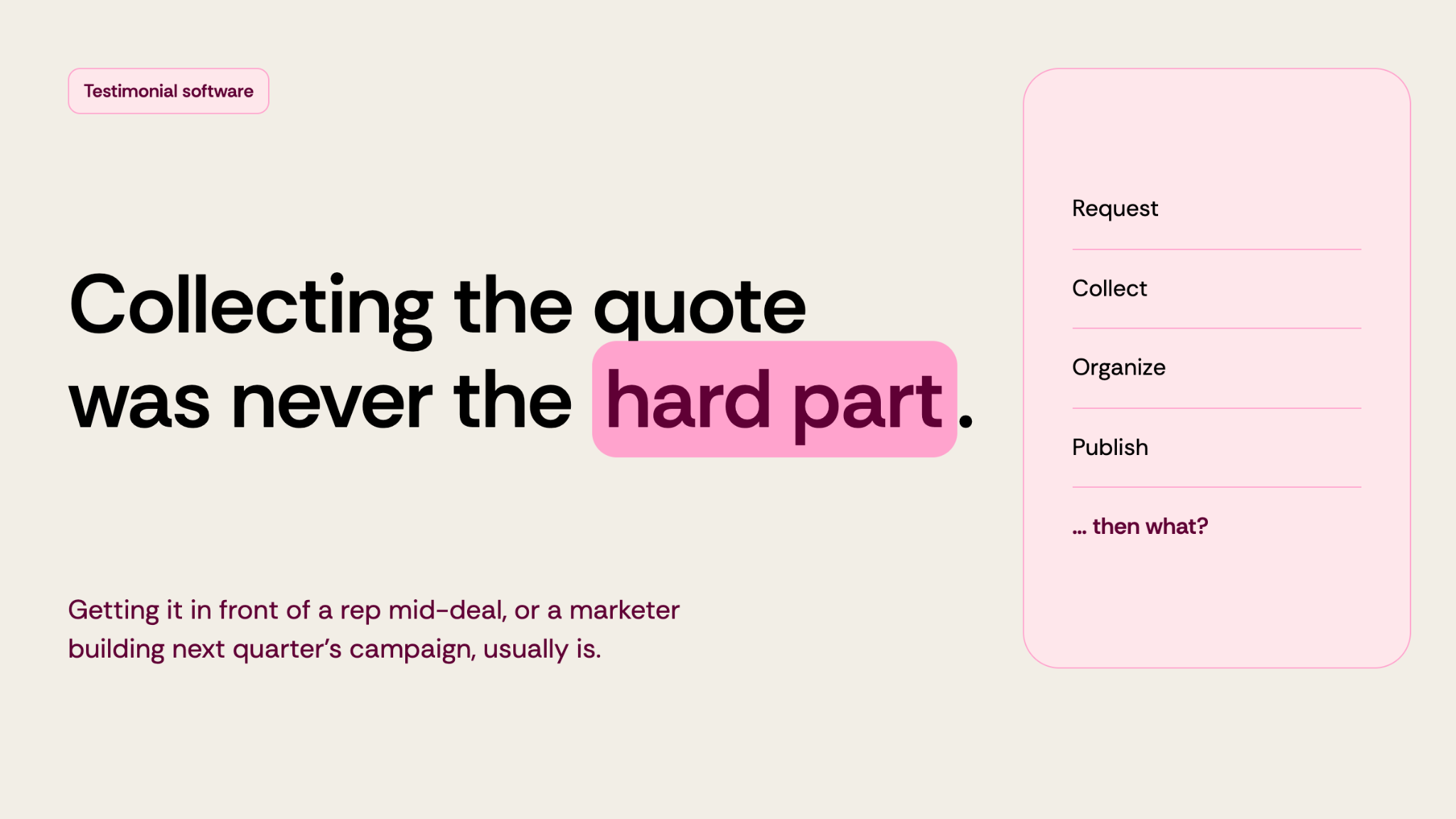
B2B teams juggling testimonials alongside case studies, reviews, and reference requests run into a different question. Collecting the feedback was never the hard part. Getting it in front of a rep at the right moment, or a marketer building next quarter's campaign, without someone digging through a widget dashboard, usually is.
That's the gap Deeto is built to close. If your team is ready to move past a wall of quotes, see how Deeto works.
🎉 Save your spot
Register for the event
Once your spot is secured, we’ll send your confirmation details.
Subscribe to our newsletter
Subscribe to receive the latest blog posts to your inbox every week.
By subscribing, you agree to our Privacy Policy
Subscribe to our newsletter
Get the latest news and updates from our team.
By subscribing, you agree to our Privacy Policy
Related posts

How to Build a Customer Churn Model: A Guide for Businesses

What is a customer churn model? Learn how to build one, spot churn early, and win back at-risk customers.

How to Adapt Business Strategy to Changing Customer Behavior
What does it take to adapt business strategy to changing customer behavior? Learn the signals, the framework, and the ne

How to Build a Voice of the Customer Program
How do you build a voice of the customer program? Learn who should own it, a 90-day rollout, and how to budget for it.