What Is Customer Churn? Definition, Causes, and How to Reduce It



Thursday, April 23, 2026


What Is Customer Churn? Definition, Causes, and How to Reduce It


View the podcast on Youtube

Losing customers is expensive. But most companies only realize how expensive after the damage is already done.
Customer churn is the percentage of customers who stop doing business with a company over a given period. It is one of the most closely watched metrics in SaaS and subscription businesses because even a modest increase in churn can quietly erase months of growth.
This guide covers what customer churn is, why it happens, how to calculate it, and what it actually takes to reduce it.
What Is Customer Churn?
Customer churn, also called customer attrition, is the rate at which customers cancel, stop renewing, or otherwise stop purchasing from a company within a specific time period. It is typically expressed as a percentage and measured monthly, quarterly, or annually.
Churn is the direct opposite of customer retention. High retention means customers are staying. High churn means they are leaving, and your revenue base is shrinking under the surface even while new customers continue to come in.
For SaaS companies, the stakes are especially high. Subscription revenue depends on customers continuing to pay month after month. Customer churn is not a lagging signal of a problem that already happened. It is usually a leading signal of a problem that was never addressed.
Why Customer Churn Matters for SaaS Businesses
Customer churn affects nearly every part of a SaaS business, from forecasting to fundraising.
Here is why it matters more than most companies acknowledge.
It erodes recurring revenue. In a subscription model, every customer who churns takes their recurring revenue with them. A 5% monthly churn rate means you are replacing roughly half your customer base every year just to stay flat.
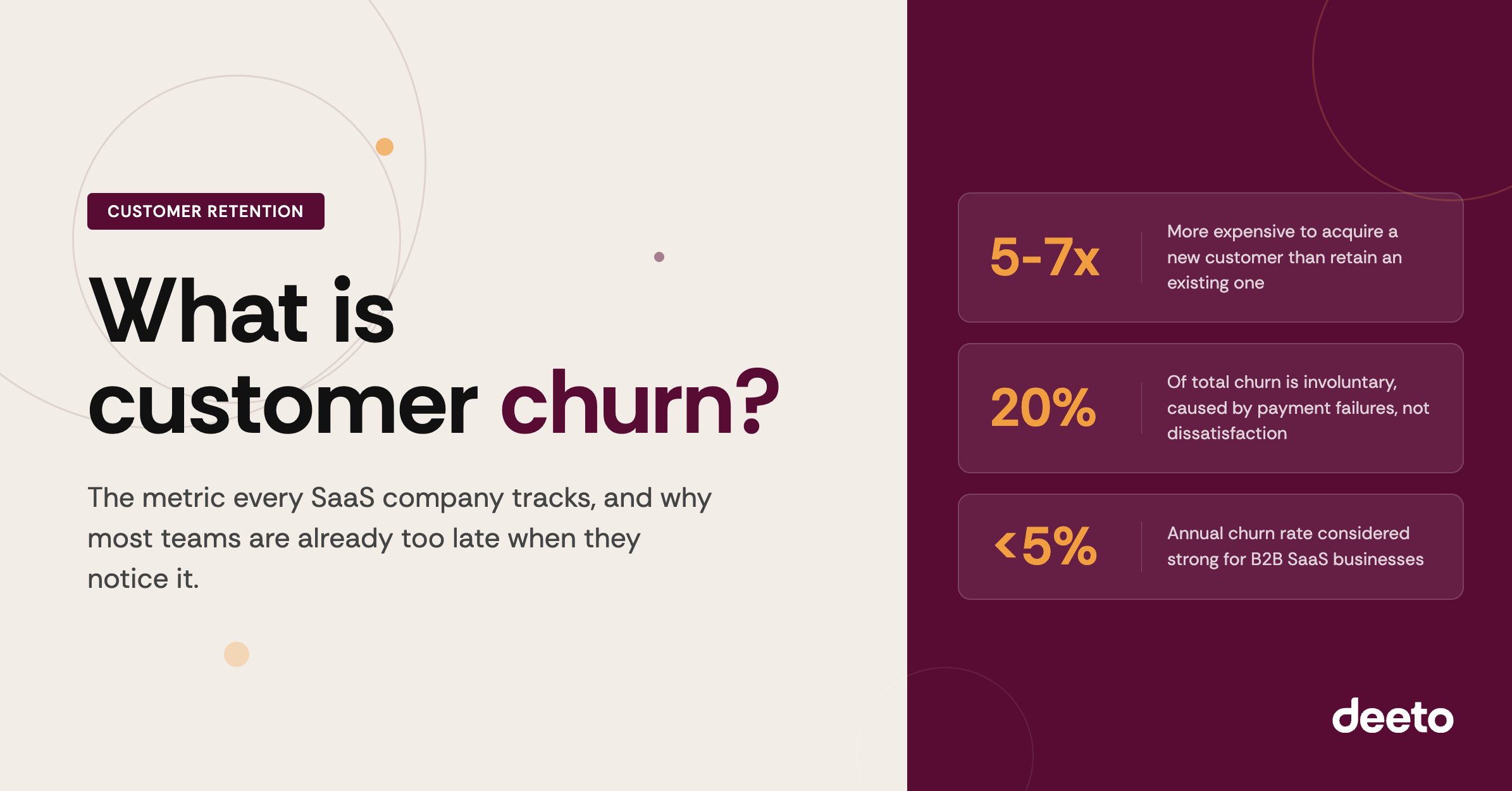
It inflates acquisition costs. According to research from Bain & Company, acquiring a new customer can cost five to seven times more than retaining an existing one. When churn is high, the cost of backfilling lost revenue from new customers compounds quickly.
It signals product or experience problems. Customers rarely churn randomly. They churn because something was not working: onboarding was confusing, the product stopped delivering value, support was slow, or a competitor offered something better. Churn is a symptom. The disease is usually further upstream.
It affects company valuation. Investors in SaaS businesses treat net revenue retention (NRR) as one of the most important metrics. High churn suppresses NRR and can significantly reduce valuation multiples.
Customer churn is not just a customer success problem. It is a whole-company signal.
Types of Customer Churn
Customer churn falls into two categories:
Voluntary churn happens when a customer actively decides to leave. This includes cancellations, non-renewals, and account closures driven by dissatisfaction, price sensitivity, a shift to a competitor, or simply no longer needing the product.
Involuntary churn happens when a customer loses access for reasons outside their intent. Failed credit card payments, expired cards, and billing system errors are the most common culprits. Involuntary churn is often underreported, but it typically accounts for 20 to 40% of all churn in subscription businesses.
Understanding the split between voluntary and involuntary churn matters because the interventions are completely different. You cannot solve a payment failure with an onboarding improvement, and you cannot solve a dissatisfied customer with a dunning email sequence.
How to Calculate Customer Churn Rate
The standard customer churn rate formula is:
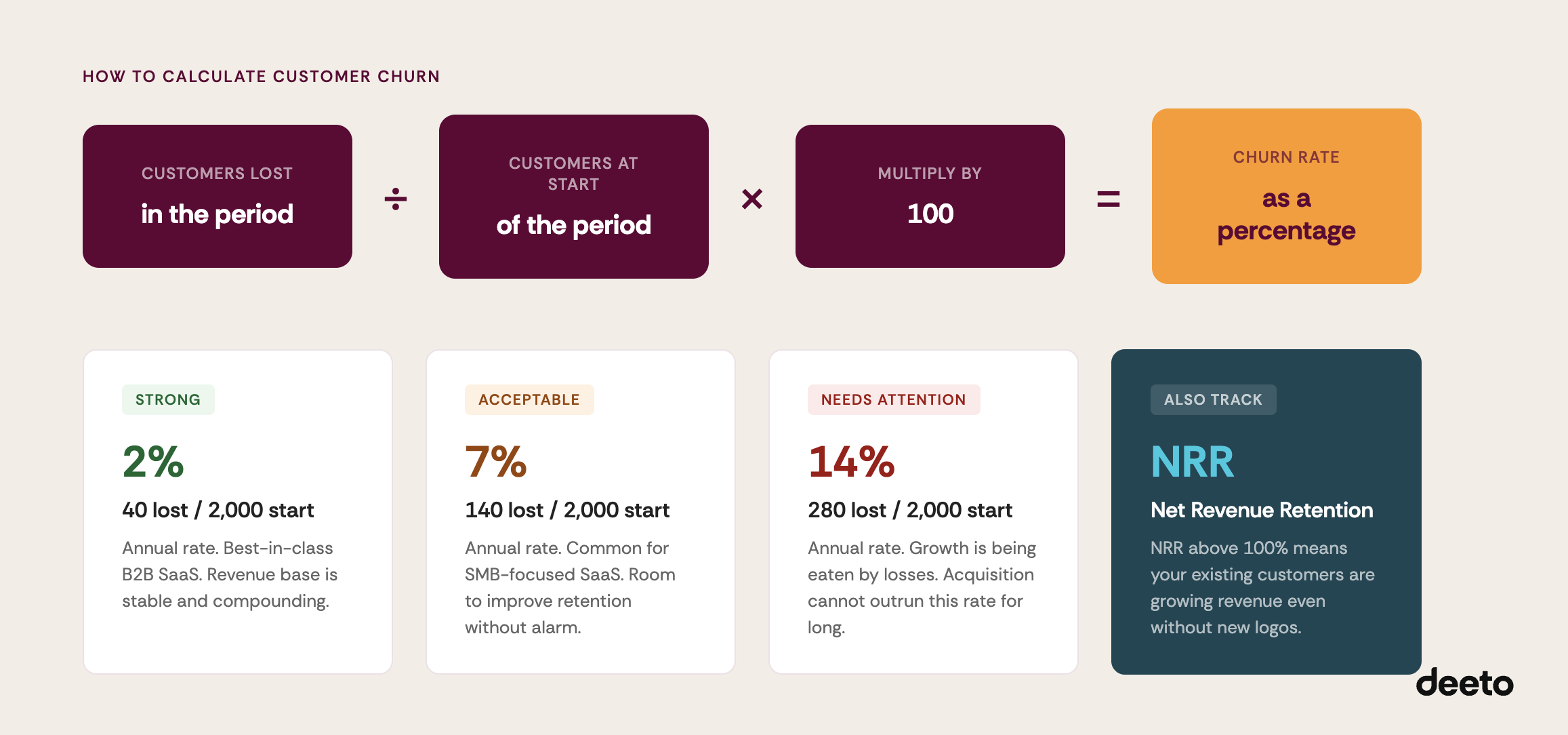
Customer Churn Rate = (Customers Lost in Period / Customers at Start of Period) x 100
For example: A company starts the month with 2,000 customers and ends with 1,880. They lost 120 customers.
120 / 2,000 x 100 = 6% monthly churn rate
That might not sound alarming. But a 6% monthly churn rate means roughly 54% of the customer base turns over every year.
Revenue Churn Rate
Customer churn counts customers. Revenue churn measures dollars. For companies with customers of different sizes, revenue churn is often more important.
Revenue Churn Rate = (MRR Lost to Churn in Period / MRR at Start of Period) x 100
A company churning 10 small accounts and one enterprise account in the same month may show a low customer churn rate but a significant revenue churn rate. Tracking both gives a more complete picture.
Gross vs. Net Revenue Retention
Gross revenue retention (GRR) captures revenue lost to churn and contraction, without counting expansion. Net revenue retention (NRR) includes expansion revenue from existing customers through upsells and cross-sells.
An NRR above 100% means the existing customer base is growing even without new customer acquisition. Many best-in-class SaaS businesses target NRR of 110 to 130%.
What Causes Customer Churn?
Most churn does not come from one single event. It builds over time. These are the most common drivers:
Poor onboarding. Customers who do not reach their first meaningful outcome quickly are far more likely to churn in the first 90 days. If they cannot see the value of the product early, they will not believe in it later.
Low product engagement. Customers who are not actively using the product are quietly pre-churned. They are still paying, but they are not invested. Any friction, price increase, or competitive alternative can tip them out.
Unresolved friction. Support tickets that go unanswered, bugs that recur, integrations that break. Small frustrations compound over time into a decision to leave.
Price-to-value misalignment. Customers leave when they feel they are paying more than they are getting. This is often a perception problem as much as a pricing problem. If customers cannot articulate what the product is doing for them, the price will always feel too high.
Competitive displacement. A better option at a lower price point, or a competitor that does one specific thing significantly better, can trigger churn even among otherwise satisfied customers.
Changing business needs. In B2B, organizational changes like layoffs, pivots, or budget cuts often drive churn that has nothing to do with product quality.
The common thread across most churn reasons is a failure of listening. Companies that know what their customers are experiencing, what they need, and where frustration is building are the ones that can act before a customer decides to leave. Deeto's churn prediction use case is built specifically around surfacing these early warning signals from customer voice data.

Churn Rate Benchmarks by SaaS Segment
Benchmarks vary widely, but here are ranges commonly cited across the industry:
Annual B2B SaaS churn rate:
- Below 5%: strong
- 5 to 10%: acceptable, with room to improve
- Above 10%: requires immediate attention
Monthly B2B SaaS churn rate:
- Below 0.5%: excellent
- 0.5 to 1%: healthy
- Above 2%: a growth problem that compounds fast
SMB-focused SaaS products typically see higher churn than enterprise-focused ones because smaller companies go out of business, change tools more freely, and have less contract lock-in. Enterprise churn rates tend to be lower but the revenue impact per churned account is significantly higher.
There is no universal "good" churn rate. The right benchmark depends on your market segment, contract lengths, and pricing model.
How to Reduce Customer Churn
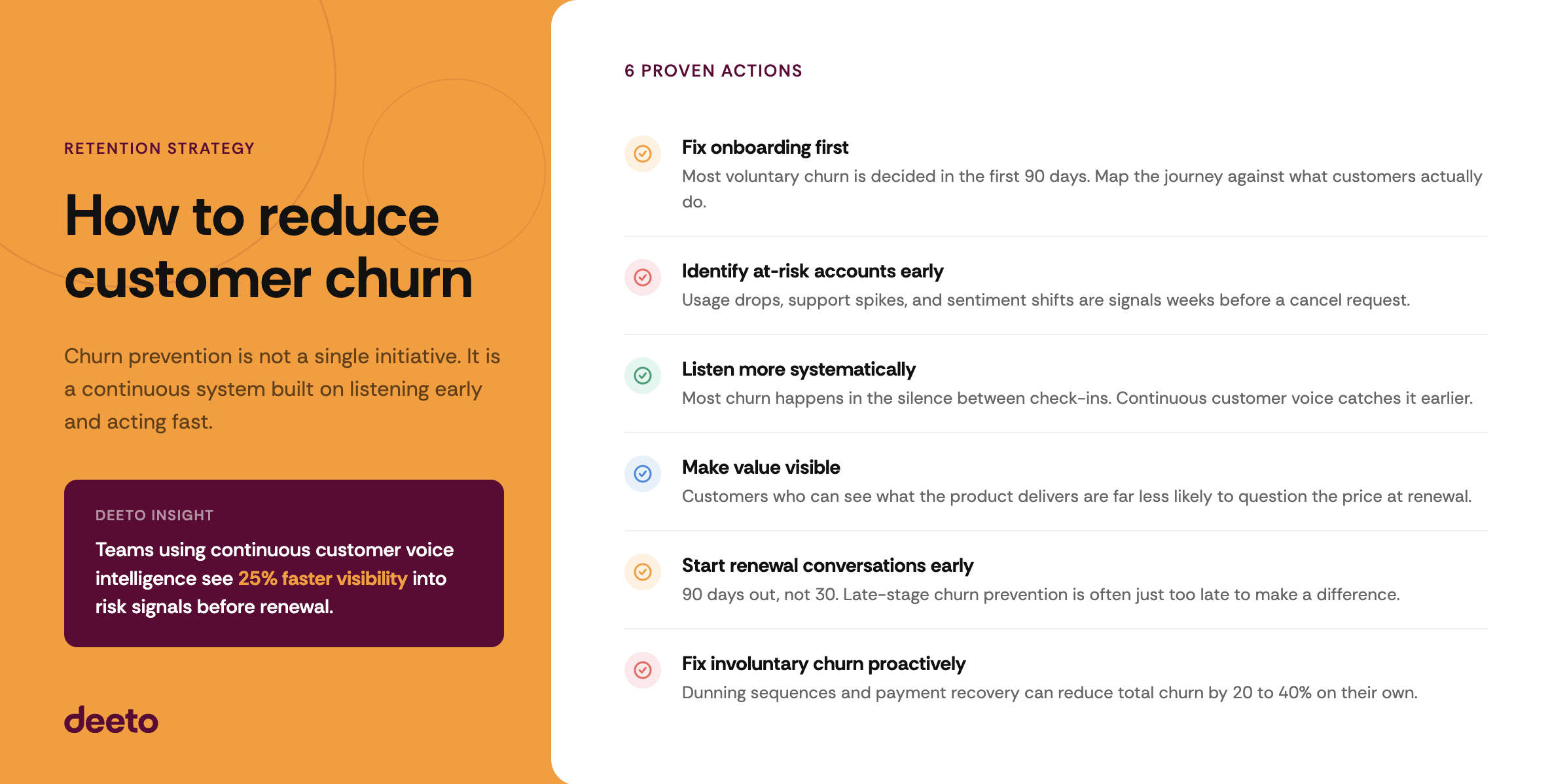
Reducing customer churn is not a single initiative. It is a continuous system.
Fix onboarding first. The first 30 to 90 days are when most voluntary churn is decided, even if it does not show up in the data for months. Customers who reach their first meaningful outcome quickly are significantly less likely to leave. Map the onboarding journey against actual customer behavior, not what you hope customers do.
Identify at-risk accounts early. Do not wait for the cancellation email. Use product usage data, support ticket patterns, NPS scores, and customer sentiment signals to flag accounts before they make the decision. Customers who stop using a product but have not yet cancelled are already at risk. Deeto's customer sentiment analysis capability helps customer success teams see these signals continuously, not just at renewal time.
Listen more systematically. Most churn happens in the silence between check-ins. Companies that have ongoing conversations with customers, through interviews, in-product feedback, and structured touchpoints, understand problems before they compound. The customer success team at companies using Deeto report 25% faster visibility into risk signals compared to reactive approaches.
Make value visible. Customers who can see what the product is delivering are far less likely to leave. Quarterly business reviews, product ROI summaries, and regular communication about what is working all reinforce the relationship and make the renewal conversation easier.
Improve renewal processes. Start renewal conversations 90 days out, not 30. Give customer success teams visibility into account health, product engagement, and open issues before the renewal date arrives. Late-stage churn prevention is often too late.
Address involuntary churn proactively. Set up automated dunning sequences, card update reminders, and failed payment recovery workflows. Some estimates suggest that fixing involuntary churn alone can reduce total churn by 20 to 40%.
Close the loop on feedback. When customers give feedback, tell them what you did with it. Customers who see their input reflected in the product or in how they are served are more likely to stay and more likely to advocate. Deeto's customer voice intelligence platform connects feedback directly to the teams who can act on it.
The Relationship Between Customer Churn and Customer Voice
There is a pattern inside most high-churn SaaS businesses: nobody is actually listening to customers until they leave.
Exit interviews capture what went wrong after the decision is made. Annual NPS surveys produce a score with no clear line of sight to action. Feedback goes into a spreadsheet that nobody owns.
The companies that consistently keep churn low do something different. They treat customer voice as continuous intelligence, not a periodic event. They know which accounts are frustrated before those accounts cancel. They know what features are not landing before product builds more of them. They know which customer success conversations are high risk before the renewal date arrives.
Deeto is built around this model. Customer voice goes in through Listen. Intelligence is organized through Learn and Analyze. Insights are delivered to the teams who need them through Activate. The output is not just better reporting. It is faster action on the signals that predict churn before it happens.
The problem is not that companies lack customer data. Most have too much of it, scattered across CRMs, support platforms, survey tools, and email inboxes. The problem is connecting that data to decisions.
Key Takeaways
- Customer churn is the rate at which customers stop doing business with a company over a given period, expressed as a percentage.
- Churn has two types: voluntary (customers choosing to leave) and involuntary (customers lost due to payment failures or external factors).
- The standard churn rate formula is: (Customers Lost / Customers at Start of Period) x 100.
- Most churn is caused by poor onboarding, low engagement, unresolved friction, or price-to-value misalignment, not a single trigger.
- Reducing churn requires catching risk signals early, not waiting for the cancellation notice.
- Companies that treat customer voice as continuous intelligence, not a periodic survey, consistently outperform on retention.
Conclusion
Customer churn is one of those metrics that is easy to rationalize in the short term and very hard to unwind once it compounds. A 1% improvement in monthly churn has a larger impact on long-term revenue than most acquisition campaigns.
The companies that win on retention are not doing something exotic. They are listening to their customers more consistently, acting on what they hear faster, and making customer voice part of how every team makes decisions.
That is the model Deeto is built on. If you want to see how it works in practice, book a demo.
Frequently Asked Questions
What is customer churn in simple terms?
Customer churn is the percentage of customers who stop paying for or using a product within a given time period. If a company starts the month with 1,000 customers and ends with 950, the churn rate is 5%. High churn means the business is losing customers faster than it would like, which directly reduces recurring revenue.
What is a good customer churn rate for SaaS?
For annual B2B SaaS, a churn rate below 5% is generally considered strong. Monthly churn below 0.5% is excellent. Benchmarks vary significantly by segment: SMB-focused products typically have higher churn than enterprise products because smaller businesses change tools more readily and have less contractual lock-in.
What is the difference between customer churn and revenue churn?
Customer churn measures the number of customers lost. Revenue churn measures the monthly recurring revenue (MRR) lost. For businesses with customers of different sizes, revenue churn is often more meaningful. A company can have low customer churn but high revenue churn if the accounts being lost are its largest ones.
What is the most common reason customers churn?
Poor onboarding is the single most common driver of early-stage churn. Customers who do not reach a meaningful outcome quickly lose confidence in the product before they fully use it. Longer-term churn is more often driven by low engagement, unresolved product friction, or a competitor offering a better alternative.
What is the difference between voluntary and involuntary churn?
Voluntary churn happens when a customer actively decides to cancel or not renew. Involuntary churn happens when access is lost due to failed payments or billing errors, not by choice. Involuntary churn can account for 20 to 40% of total churn and is often overlooked because it looks like it is being handled by billing systems when it actually requires a proactive recovery strategy.
How do you predict customer churn before it happens?
The most reliable early signals of churn include declining product usage, reduced login frequency, unresolved support issues, low NPS or CSAT scores, and negative sentiment in customer conversations. Companies that monitor these signals continuously, rather than waiting for renewal conversations, are able to intervene earlier and retain accounts that would otherwise quietly decide to leave.
🎉 Save your spot
Register for the event
Once your spot is secured, we’ll send your confirmation details.
Subscribe to our newsletter
Subscribe to receive the latest blog posts to your inbox every week.
By subscribing, you agree to our Privacy Policy
Subscribe to our newsletter
Get the latest news and updates from our team.
By subscribing, you agree to our Privacy Policy
Related posts

Best customer intelligence tools for B2B teams

What are customer intelligence tools? Compare 8 B2B options, collection methods, and how to pick the right fit.

Omnichannel Customer Engagement Tools: 8 Platforms Compared
Compare 8 omnichannel engagement platforms on channels, AI, and pricing, plus the gap automation can't fill.

Voice of the Customer Strategy for SaaS Companies
What is VoC for SaaS? Learn how to capture customer voice and turn it into decisions that drive renewals.