8 Best Customer Proof Platforms for B2B Teams in 2026


Thursday, September 3, 2026


8 Best Customer Proof Platforms for B2B Teams in 2026


View the podcast on Youtube

A rep is three days from quarter close. A buyer asks for proof from a company like theirs. The rep opens Slack, pings customer marketing, and waits. That gap, between the moment proof is needed and the moment it shows up, is what a customer proof platform is built to close.
A customer proof platform collects real customer feedback, quotes, and outcomes, then organizes that evidence into a searchable library that sales, marketing, and customer success can pull from directly inside the tools they already use. This guide covers the 8 best customer proof platforms on the market, how each one approaches the problem differently, and how to choose the one that fits where your program actually breaks down.
What is a customer proof platform
A customer proof platform is software that captures customer feedback, quotes, and measurable results, then makes that proof searchable and deliverable across sales, marketing, and customer success workflows. Customer proof platforms typically pull from surveys, reviews, and interviews, then tag each piece of evidence by industry, use case, and competitor so a rep can find the right story in minutes instead of digging through a shared drive.
Customer proof is different from customer evidence collection in one important way: proof only counts once it reaches the person who needs it. A quote sitting in a spreadsheet is not proof. A quote surfaced in Salesforce during an active deal is.
Most B2B companies already have plenty of happy customers. The harder problem is connecting that goodwill to a system that verifies it, organizes it, and gets it in front of the right person at the right moment. That's the gap a voice of customer platform like Deeto is built to close, for sales proof and for every other team that depends on what customers actually say.
Why customer proof matters right now
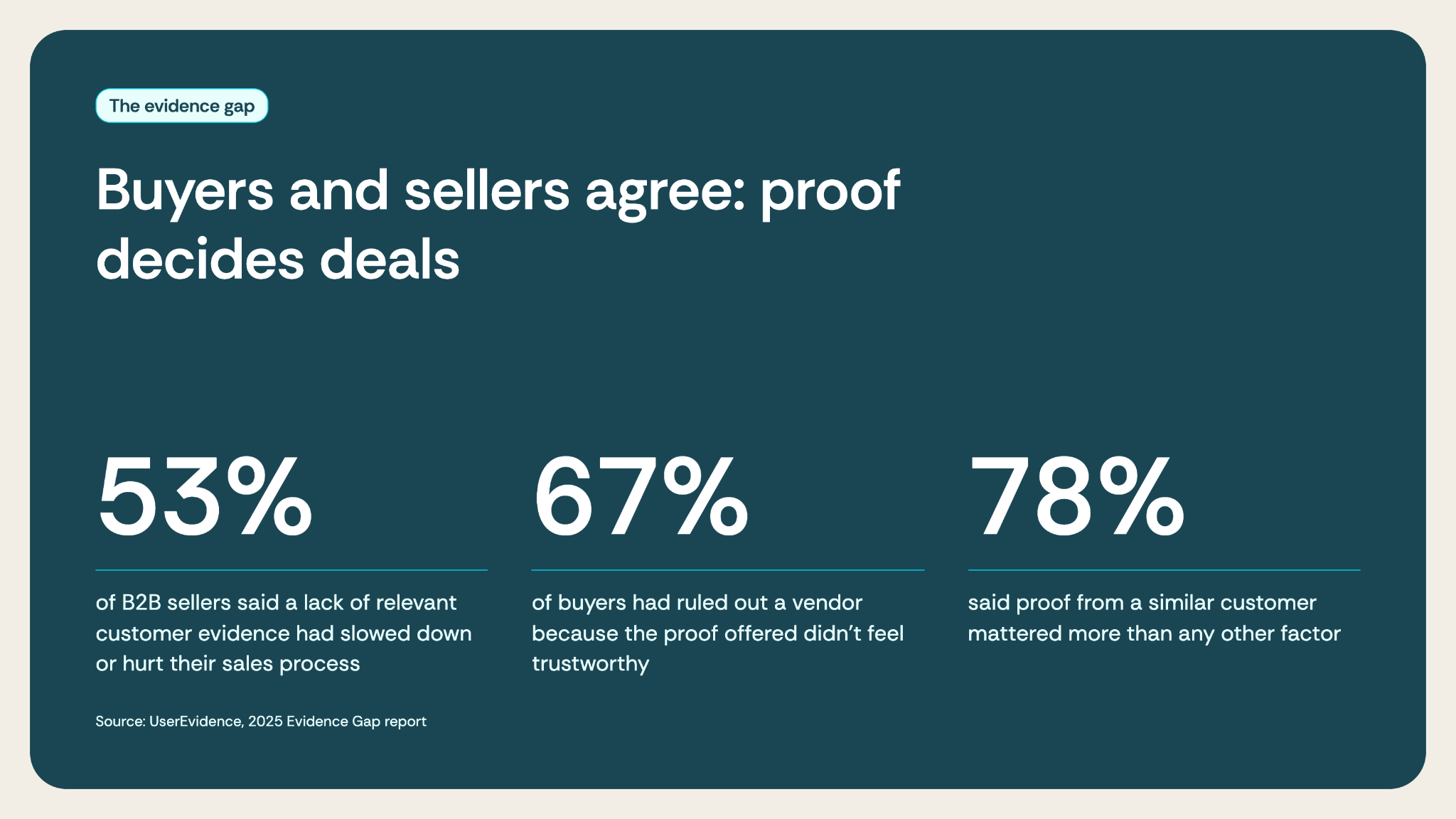
According to UserEvidence's 2025 Evidence Gap report, 53% of B2B sellers said a lack of relevant customer evidence had slowed down or hurt their sales process. The same research found that 67% of buyers had ruled out a vendor because the proof offered didn't feel trustworthy, and 78% said proof from a similar customer, same industry, same size, same role, mattered more than any other factor.
The pattern holds up in how sales reps actually search. Peerbound's analysis of more than 6,000 Slack queries from sales reps found that industry-specific proof, case studies, and similar-customer examples made up two out of every three requests. Reps aren't looking for more content. They're looking for the one piece of proof that matches their exact deal.
That's a data problem before it's a content problem. Companies that treat customer proof as a byproduct of case studies, rather than a continuous stream of customer voice connected to sales, product, and marketing decisions, end up with the same handful of stale logos doing all the work. Customer voice should power every decision your GTM team makes, not sit in a quarterly report.
How to evaluate a customer proof platform
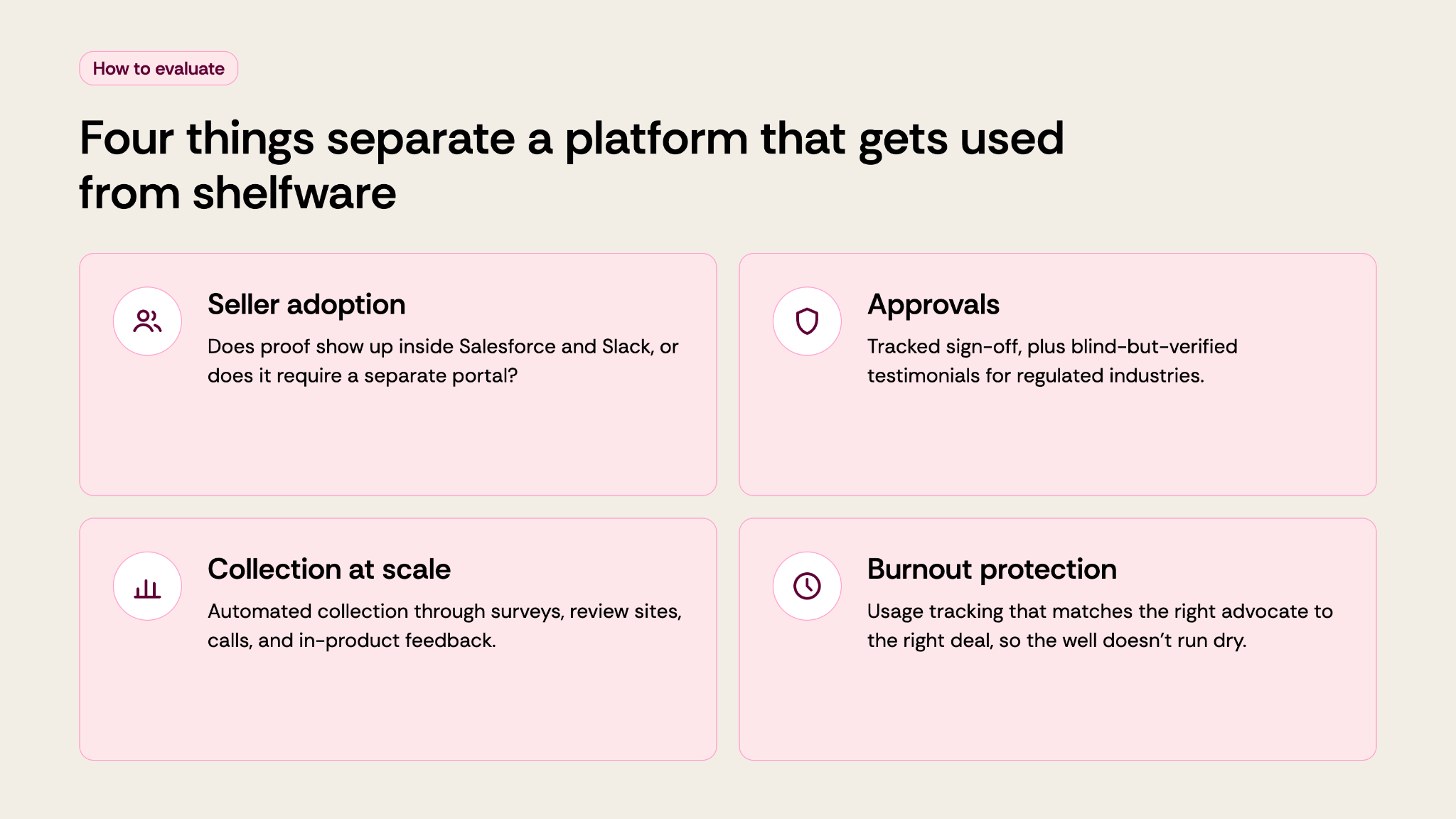
Four things separate a customer proof platform that gets used from one that becomes shelfware.
Seller adoption comes first. Does proof show up inside Salesforce, Slack, or sales enablement tools reps already open every day, or does it require logging into a separate portal? Reps default to their old favorite case study if the new system adds a step.
Approvals matter too, especially for anonymous proof. Legal sign-off on a customer quote can take anywhere from a day to a month. Platforms that track who approved what, and that support blind-but-verified testimonials for industries like cybersecurity and financial services, remove that bottleneck.
Then there's collection at scale. Manually chasing customers for quotes doesn't scale past a handful of accounts a quarter, so the platforms worth considering automate collection through surveys, review sites, calls, and in-product feedback.
Finally, watch for reference and burnout protection. The same three advocates get asked for reference calls until they stop answering. A platform that tracks usage and matches the right advocate to the right deal keeps the well from running dry, and connects reference activity back to revenue.
The 8 best customer proof platforms
1. Deeto: best overall for connected customer voice and proof
Most customer proof tools stop at the library. They collect quotes, tag them, and hand them to sales. Deeto starts a step earlier: it captures customer voice continuously, through interviews, surveys, and in-product feedback, then turns that voice into customer stories and social proof, reference activity, sentiment data, and product signal, all from the same underlying system.
That matters because proof, references, sentiment, and product feedback usually get collected by different teams using different tools, which means none of them talk to each other. Deeto's Listen, Learn, Activate, Analyze, and Orchestrate modules run on one dataset, so a quote a customer gives in a survey can also flag renewal risk for customer success and inform positioning for product marketing. Sales gets customer advocacy and reference matches surfaced directly in their workflow, without waiting on a separate portal.
Companies using Deeto's connected customer intelligence report 20 to 30% faster sales cycles, 10 to 15% higher win rates, and 15 to 25% higher renewal and expansion rates when Deeto is active in a deal.
Choose Deeto when you want customer proof connected to the rest of your customer intelligence, not a separate library your CS, product, and marketing teams have to duplicate. Consider a narrower tool if all you need is a standalone reference request queue with no connection to broader customer voice.
2. UserEvidence: strong end-to-end evidence and enablement suite
UserEvidence covers four pieces of the proof problem in one product: evidence collection, references, advocacy, and research. Evidence comes in through surveys, G2 and TrustRadius review ingestion, and Gong call transcript mining, then gets organized by industry, company size, and competitor. An AI assistant lets reps ask plain-language questions and get a matching quote back in seconds.
The platform integrates with Seismic, Highspot, Salesforce, and Slack, and its reference matching includes burnout scoring so the same advocates don't get asked on repeat.
Choose UserEvidence when you want a dedicated, feature-rich evidence and reference tool and don't need it tied into broader customer voice or product feedback data. Consider an alternative if you'd rather not run a separate system alongside your existing voice-of-customer or CS tooling.
3. Peerbound: AI-native proof mining from sales calls
Peerbound's premise is that proof already exists in your call recordings. It connects to Gong and Chorus, uses AI to pull quotes, success metrics, and champion mentions out of past calls, and delivers them to reps through a Slack bot, so a rep can ask for a healthcare customer example and get one back without filing a request.
The Slack-first model fits sales teams that live there already. Peerbound's own product documentation notes that AI-generated outputs may be inaccurate or incomplete, so someone still needs to review a quote before it goes external. The platform is lighter on web-native publishing and blind-but-verified proof mechanics than full evidence platforms.
Choose Peerbound when your biggest gap is mining calls you've already recorded and getting proof to reps fast. Consider an alternative if you need a governed, multi-source library with legal approval tracking built in.
4. SlapFive: customer marketing and advocacy workflow hub
SlapFive positions itself as a system of record for customer marketing, built around content capture, advocate segmentation, and reference workflow automation, with AI features for drafting case studies and social posts from customer input.
It runs primarily as a backend workflow tool rather than a customer-facing hub, and it doesn't integrate directly with review sites, so pulling in a G2 or TrustRadius quote means copying it over by hand. Custom reporting outside the built-in dashboards requires a separate tool like Google Data Studio.
Choose SlapFive when your team needs structured reference and advocate workflow automation and is comfortable managing reporting outside the platform. Consider an alternative if review site integration and advocate-facing experience are priorities.
5. ReferenceEdge: Salesforce-native reference operations
ReferenceEdge, built by Point of Reference, lives entirely inside Salesforce. Reference data, search, and workflows run as native Salesforce automations, which matters for enterprise IT teams that require data residency inside their CRM. It includes a Slack app for peer-to-peer reference requests and comes with more than 50 pre-built reports.
The tradeoff is that it's built and bounded by the Salesforce object model, so teams that need multi-source evidence collection or web publishing outside Salesforce will hit its edges.
Choose ReferenceEdge when your reference program needs to live entirely inside Salesforce and your admin team can support it. Consider an alternative if you need evidence collection or advocacy features beyond reference management.
6. RO Innovation: enterprise-scale reference ops
Upland's RO Innovation is a long-standing reference management platform built for large organizations that need multi-language support and personalized reference content across regions. It handles the core reference workflow at enterprise scale and has a long deployment history with complex, multi-team programs.
Product update activity has been quieter in recent years compared to newer AI-native entrants, which is worth asking about directly in any evaluation if your team wants active investment in AI-driven collection and matching. We didn't find a public roadmap or release log to confirm the current pace one way or the other, so treat this as a question to raise with their team rather than a settled fact.
Choose RO Innovation when you're running a large, established enterprise reference program with multi-language needs. Consider an alternative if you want a platform actively building modern AI collection and proof-matching capability.
7. Influitive: gamified advocacy community
Influitive's AdvocateHub is built around community engagement: challenges, points, badges, and leaderboards that keep customers participating in advocacy activities over time. It connects to Salesforce, Marketo, and HubSpot, and includes a mobile app for advocates.
The gamification model requires ongoing content and challenge operations to stay active, which is real, continuous work for whoever owns the program. Influitive is built to mobilize advocates for a range of activities, not to generate and refresh sales-ready proof at scale on its own.
Choose Influitive when you have the team capacity to run an active advocate community and participation volume itself is a goal. Consider an alternative if your main need is proof generation rather than community engagement.
8. Laudable: automated video testimonial production
Laudable connects to Gong, Chorus, and Zoom to pull customer quotes out of existing call recordings, then uses AI to draft written case studies and G2 reviews, with done-for-you video editing for teams that want polished testimonial videos without building a production process in-house.
Because it's built around existing call recordings, output quality depends on how good those recordings already are. Video production timelines typically run one to three weeks from customer approval to final delivery, and the service-heavy model shows up in the pricing.
Choose Laudable when video testimonials are your primary format and you want production support included. Consider an alternative if you need high-volume, self-serve proof across multiple formats.
Customer proof platform comparison
How to choose the right platform for your team
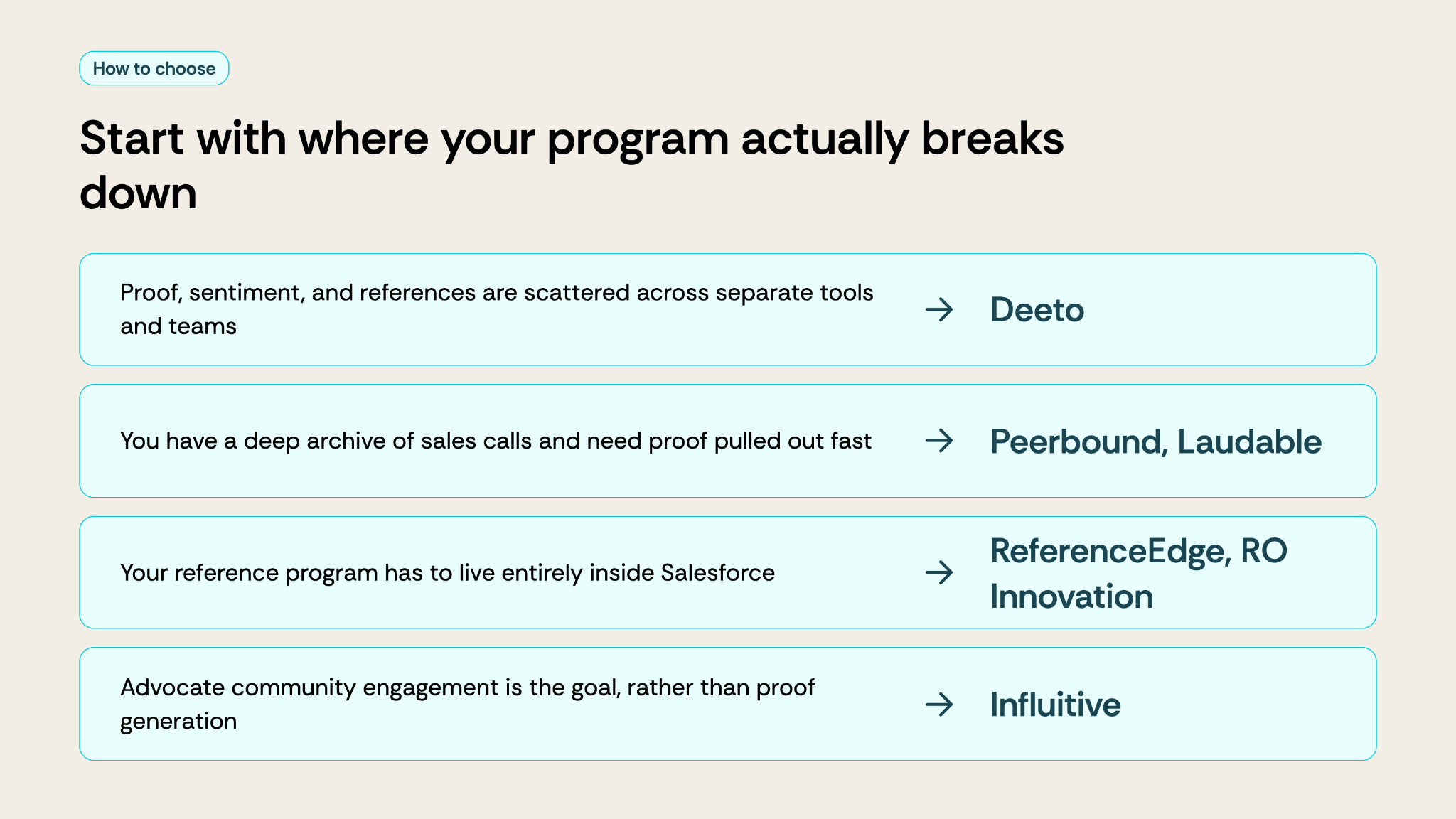
Start with where your program actually breaks down, not with the longest feature list.
- If proof, sentiment, and references are scattered across separate tools and teams, look at a connected platform like Deeto.
- If you already have a deep archive of sales calls and just need proof pulled out fast, Peerbound or Laudable solve that specific gap.
- If your reference program has to live entirely inside Salesforce, ReferenceEdge or RO Innovation fit that constraint.
- If advocate community engagement is the goal rather than proof generation, Influitive is built for that.
Key takeaways
- A customer proof platform turns scattered customer feedback into a searchable library that sales and marketing can act on inside their existing tools.
- 78% of buyers say proof from a similar customer matters most, according to UserEvidence's Evidence Gap report, which means tagging by industry and company size matters more than volume.
- Two out of three sales rep requests for proof fall into three buckets: industry-specific stories, case studies, and similar-customer examples, per Peerbound's analysis of Slack queries.
- The platforms that win adoption surface proof inside Salesforce, Slack, or sales enablement tools reps already use, rather than a separate portal.
- Deeto connects proof to the rest of your customer intelligence, including sentiment and product feedback, instead of treating it as an isolated library.
FAQs
What is a customer proof platform?
A customer proof platform is software that collects customer feedback, quotes, and results, then organizes and delivers that evidence inside the tools sales and marketing teams already use. It replaces scattered spreadsheets and one-off case studies with a searchable, tagged library built for speed.
How is a customer proof platform different from review or advocacy software?
Review software like G2 publishes ratings on third-party sites buyers already visit. Advocacy software focuses on community engagement and gamification to keep customers participating over time. A customer proof platform pulls from both, plus surveys and calls, and activates that evidence directly inside sales workflows.
Who should own a customer proof platform?
Customer marketing typically owns the platform day to day, though product marketing often runs it in the early stages since collection and tagging are largely automated. Deciding who the primary stakeholder is before launch shapes every survey question and library filter that follows.
How fast can a team see value from a customer proof platform?
Most teams reach initial usability in four to six weeks. Starting with proof collection before layering on references and advocacy programs keeps early scope manageable and gives sales something usable sooner.
How do you prevent burning out your best customer advocates?
Platforms with burnout scoring track how often each advocate gets asked and lower their ranking as usage climbs, which surfaces new advocates before the usual few stop responding. Matching by deal parameters, rather than defaulting to the same names, protects those relationships.
Does a customer proof platform replace case studies?
No. Case studies are one format a customer proof platform can generate and organize, alongside quotes, ROI stats, and video. The platform's job is making sure the right format reaches the right person for the right deal, not replacing any single asset type.
Conclusion
The gap between having happy customers and having usable proof is a systems problem, not a content problem. The platforms above solve different pieces of it, from call mining to Salesforce-native reference ops to gamified advocacy, and the right one depends on exactly where your program stalls today.
If that gap is less about any single feature and more about connecting customer voice across proof, sentiment, and product feedback so every team is working from the same evidence, that's the problem Deeto was built to solve. See how Deeto works with your GTM stack.
🎉 Save your spot
Register for the event
Once your spot is secured, we’ll send your confirmation details.
Subscribe to our newsletter
Subscribe to receive the latest blog posts to your inbox every week.
By subscribing, you agree to our Privacy Policy
Subscribe to our newsletter
Get the latest news and updates from our team.
By subscribing, you agree to our Privacy Policy
Related posts

Best customer intelligence tools for B2B teams

What are customer intelligence tools? Compare 8 B2B options, collection methods, and how to pick the right fit.

Omnichannel Customer Engagement Tools: 8 Platforms Compared
Compare 8 omnichannel engagement platforms on channels, AI, and pricing, plus the gap automation can't fill.

Voice of the Customer Strategy for SaaS Companies
What is VoC for SaaS? Learn how to capture customer voice and turn it into decisions that drive renewals.