How to Adapt Business Strategy to Changing Customer Behavior



Friday, September 11, 2026


How to Adapt Business Strategy to Changing Customer Behavior


View the podcast on Youtube

Customer behavior does not wait for your planning cycle. It shifts every quarter, and most strategies are still built on last year's assumptions.
Adapting business strategy to changing customer behavior means continuously collecting evidence of how customers actually research, buy, and evaluate value, then updating pricing, messaging, and go-to-market decisions around that evidence instead of around internal opinion. It is not a one-time pivot, but a system that treats customer behavior as a continuous live input.
In this article, you will learn why customer behavior is changing faster than most strategy cycles can track, a practical framework for adapting to it, where behavioral targeting in digital marketing fits into that response, and how to build the muscle to keep pace going forward.
What It Means to Adapt Business Strategy to Changing Customer Behavior
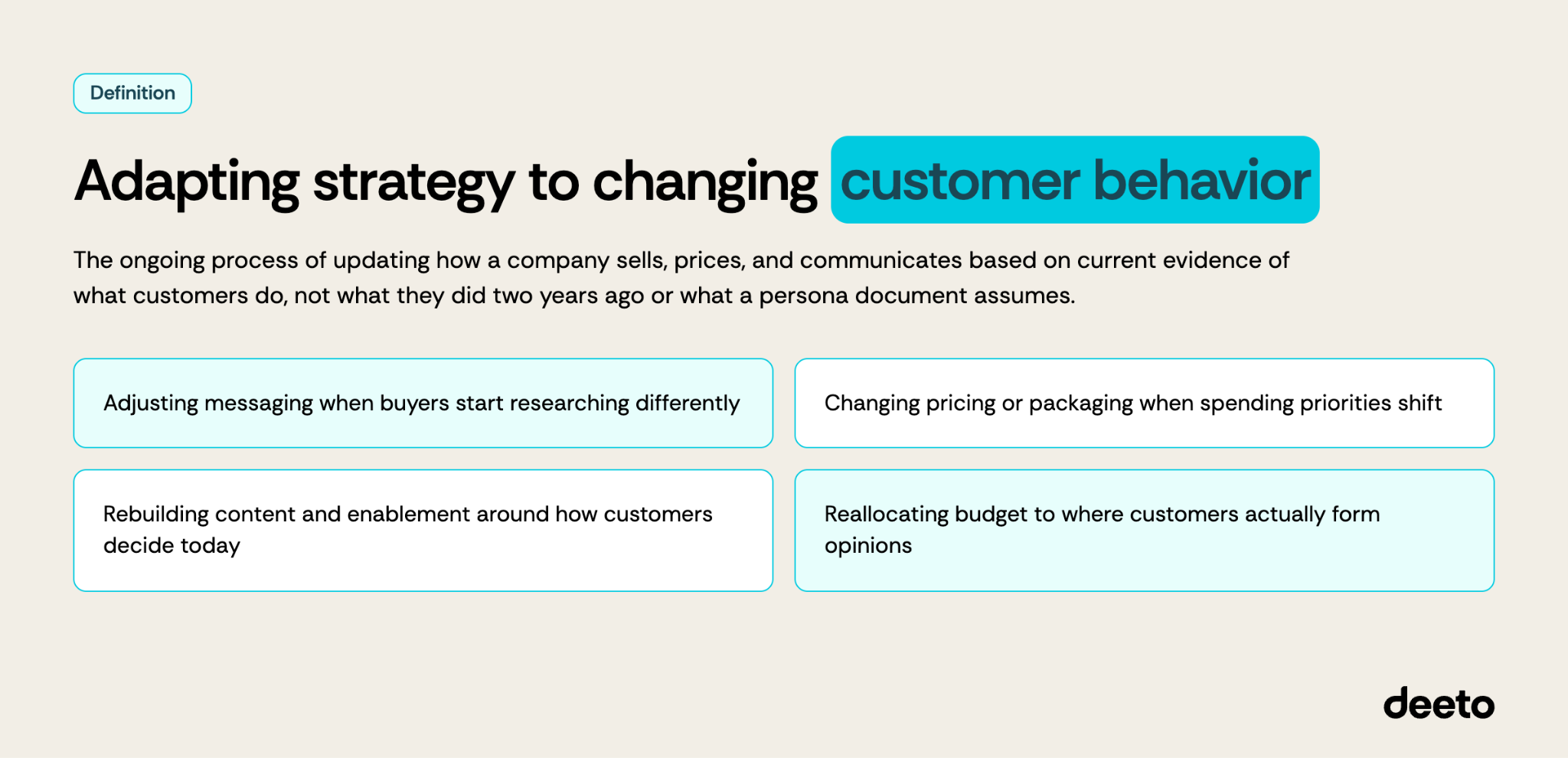
Adapting business strategy to changing customer behavior is the ongoing process of updating how a company sells, prices, and communicates based on current evidence of what customers do, not what they did two years ago or what a persona document assumes.
This includes:
- Adjusting messaging when buyers start researching differently
- Changing pricing or packaging when spending priorities shift
- Rebuilding content and sales enablement around how customers actually make decisions today
- Reallocating budget toward the channels and moments where customers are actually forming opinions
Business strategy adaptation systems pull signal from support tickets, sales calls, win-loss interviews, product usage, and customer conversations, then route that signal to the teams who can act on it. The goal is having a shorter distance between a customer behavior shift and a strategy change.
Why Customer Behavior Is Changing Faster Than Most Strategies Can Track
Three major factors are currently changing the importance of bridging the gap between how customers behave and how quickly a company needs to respond.
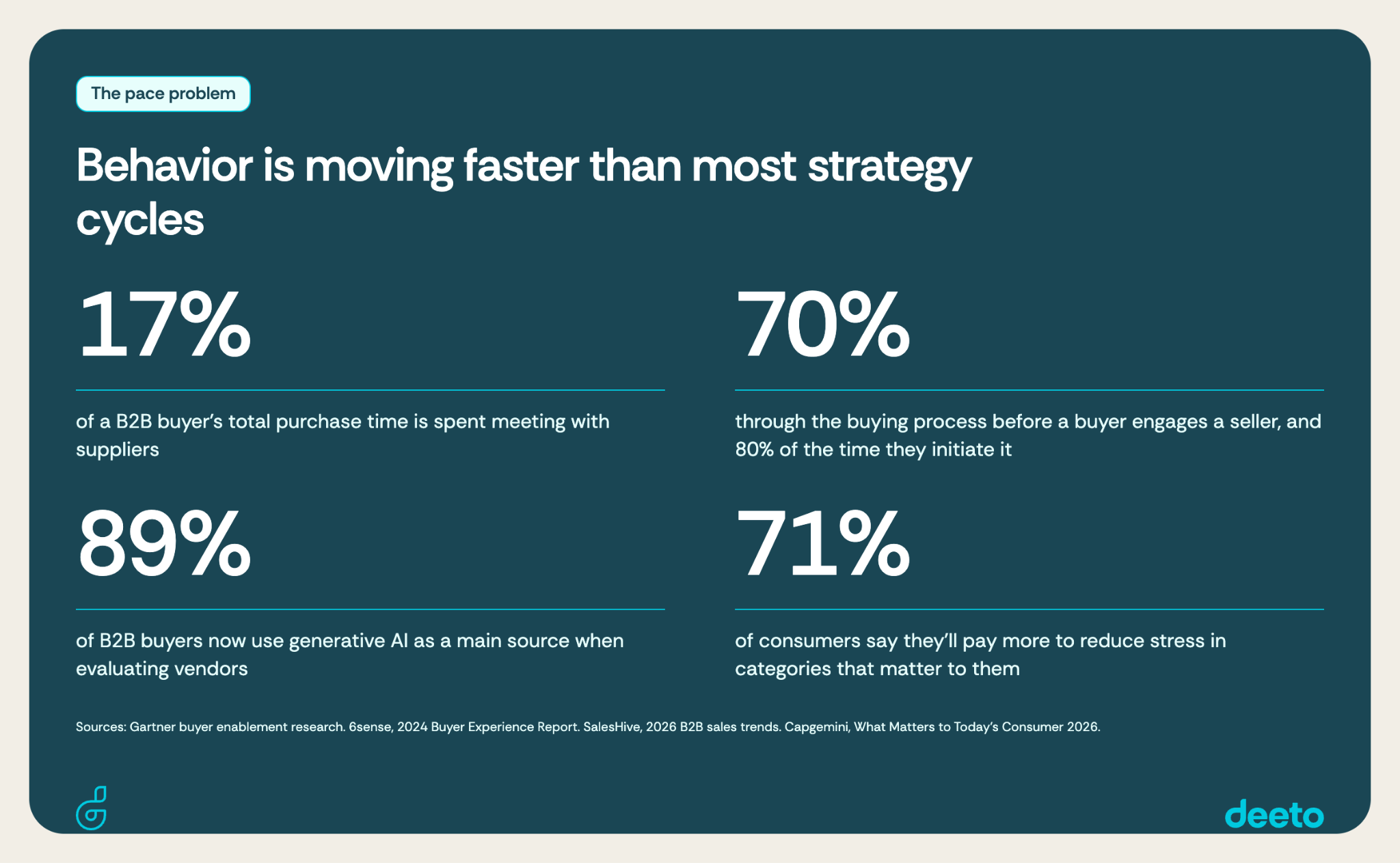
Buyers are doing more of the decision-making before anyone from your company hears about it. Gartner's own research shows B2B buyers spend only 17% of their total purchase time meeting with suppliers, meaning roughly 83% of the journey now happens without a sales conversation in the room. 6sense's 2024 Buyer Experience Report found buyers are typically 70% through their purchasing process before engaging a seller, and 80% of the time it's the buyer who initiates that first contact. If your strategy assumes sales controls the early narrative, it no longer does.
AI has become a primary research tool, and it changes what gets surfaced. An estimated 89% of B2B buyers now use generative AI as a main source of information while evaluating vendors, which has also compressed buying cycles to roughly ten months, according to SalesHive's 2026 B2B sales trends research. A company's content now has to work for a human reader and for an AI system summarizing that content on the buyer's behalf.
Trust and spending priorities are shifting under economic pressure. Consumer research from Euromonitor found 58% of respondents report moderate to extreme daily stress, which changes how people spend even when budgets haven't changed. Capgemini research found 71% of consumers say they'll pay more to reduce stress in categories that matter to them, even while cutting back elsewhere. Customers are being more selective about where their money goes, and the categories they'll pay a premium for keep shifting.
The buying journey isn’t getting longer, it’s getting quieter, and most companies are still designed to respond to the loud part.
Common Challenges When Adapting Business Strategy to Customer Behavior Shifts
It’s easy to notice when customer behavior changes, but it’s harder to connect the signal to a decision. The most common challenges include:
- Signal lives in one team's inbox. Support hears the complaints, sales hears the objections, and product hears the feature requests, but none of it reaches the people who set strategy.
- Feedback gets collected but not revisited. Surveys and interviews get archived after a single report instead of feeding an ongoing view of what's changing.
- Strategy updates require a full planning cycle. By the time a quarterly review surfaces a shift, competitors who noticed it in week two have already adjusted.
- Personas go stale. A persona built two years ago from ten interviews doesn't reflect a buyer who now discovers vendors through an AI assistant instead of a search engine.
A Framework for Adapting Business Strategy to Changing Customer Behavior
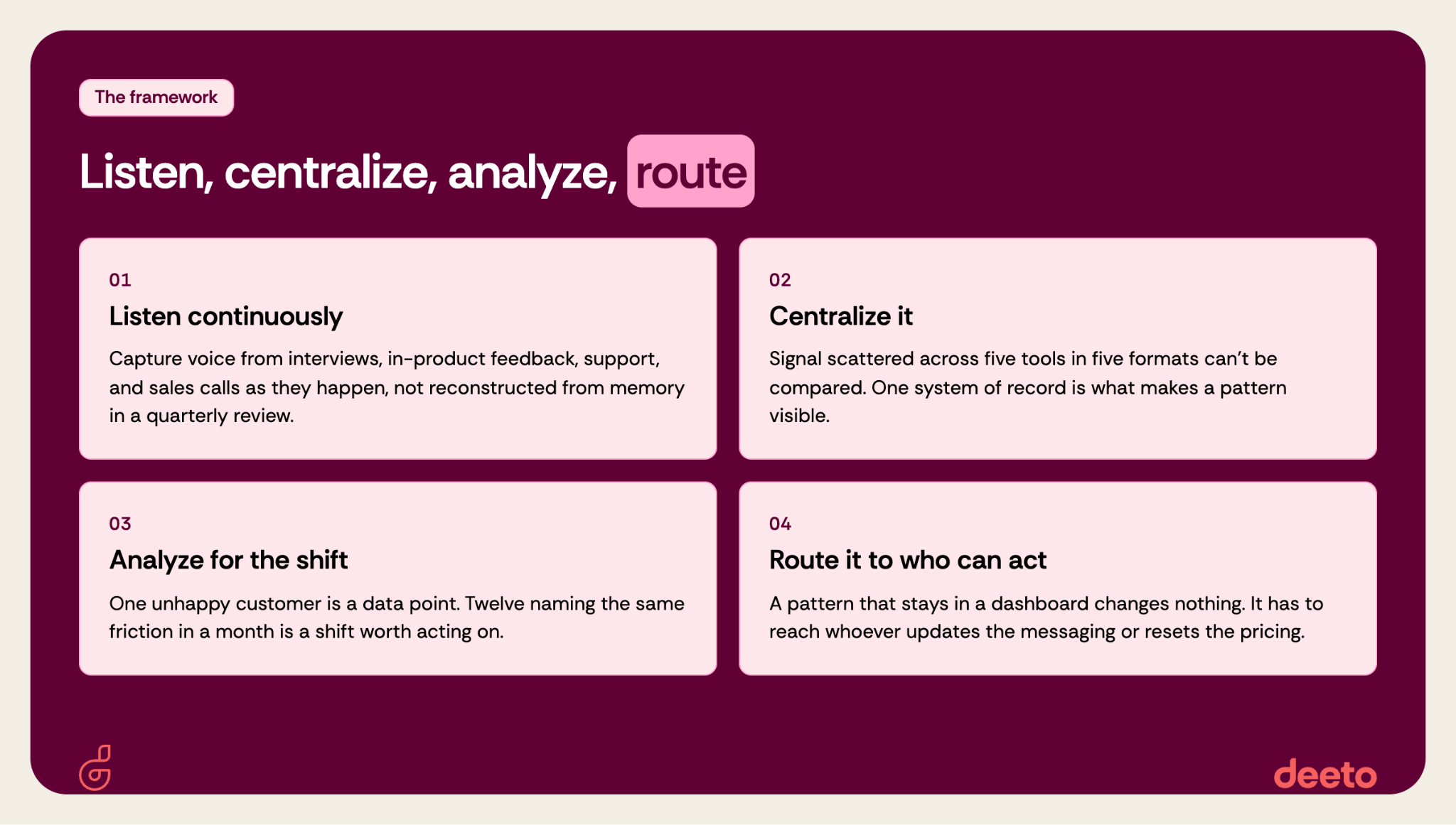
A working framework has four parts. Skipping any one of them is usually why "customer-centric" strategy work stalls out as a slide deck instead of a change in the business.
1. Listen continuously, not periodically
Replace the annual survey with an always-on system that captures customer voice from interviews, in-product feedback, support conversations, and sales calls as they happen. This is the same principle behind Deeto's Listen module: authentic voice has to be captured at the moment it happens, not reconstructed from memory in a quarterly review.
2. Centralize it so patterns are visible
Signal scattered across five tools in five formats can't be compared. Bringing customer voice into one system of record, the way Deeto's Learn module organizes companies, people, and evidence together, is what makes it possible to see a pattern instead of five disconnected anecdotes.
3. Analyze for the shift, not just the sentiment
A single unhappy customer is a data point. Twelve customers mentioning the same friction in the same month is a shift worth acting on. This is where pattern and sentiment analysis earns its place in the stack: it turns raw voice into a signal strong enough to justify a strategy change.
4. Route the signal to the people who can act
A pattern that stays in a dashboard doesn't change anything. It needs to reach whoever updates the messaging, resets the pricing tiers, or rebuilds the next campaign for the growth marketing team. Deeto's Activate module exists specifically to close that gap between insight and action.
Behavioral Targeting in Digital Marketing: Where Strategy Meets Execution
Behavioral targeting in digital marketing is the practice of using data about what a person has browsed, searched, clicked, or purchased to serve more relevant ads and content. It's the mechanism that turns a strategic read on customer behavior into an actual campaign a customer sees.
Behavioral targeting in digital marketing includes retargeting site visitors, personalizing email based on past purchases, and building lookalike audiences from existing customer behavior. Personalized targeting can cut ad spend waste by as much as 50% compared with untargeted campaigns, because budget goes toward people already showing intent instead of a broad, unqualified audience.
But the ground under behavioral targeting is shifting too. More than 20 U.S. states now have comprehensive consumer privacy laws as of January 2026, and Google has ended its Privacy Sandbox initiative after years of trying to replace third-party cookies. Pew Research Center found 81% of U.S. adults believe the potential risks of company data collection outweigh the benefits, and the same survey found most adults feel they have little to no control over how that data gets used.
This is the practical link back to strategy: behavioral targeting only works if the signal feeding it is accurate and current. A campaign built on stale behavioral assumptions wastes budget the same way a strategy built on a stale persona wastes a quarter. The fix for both is the same: track customer behavior continuously instead of assuming you got it right once.
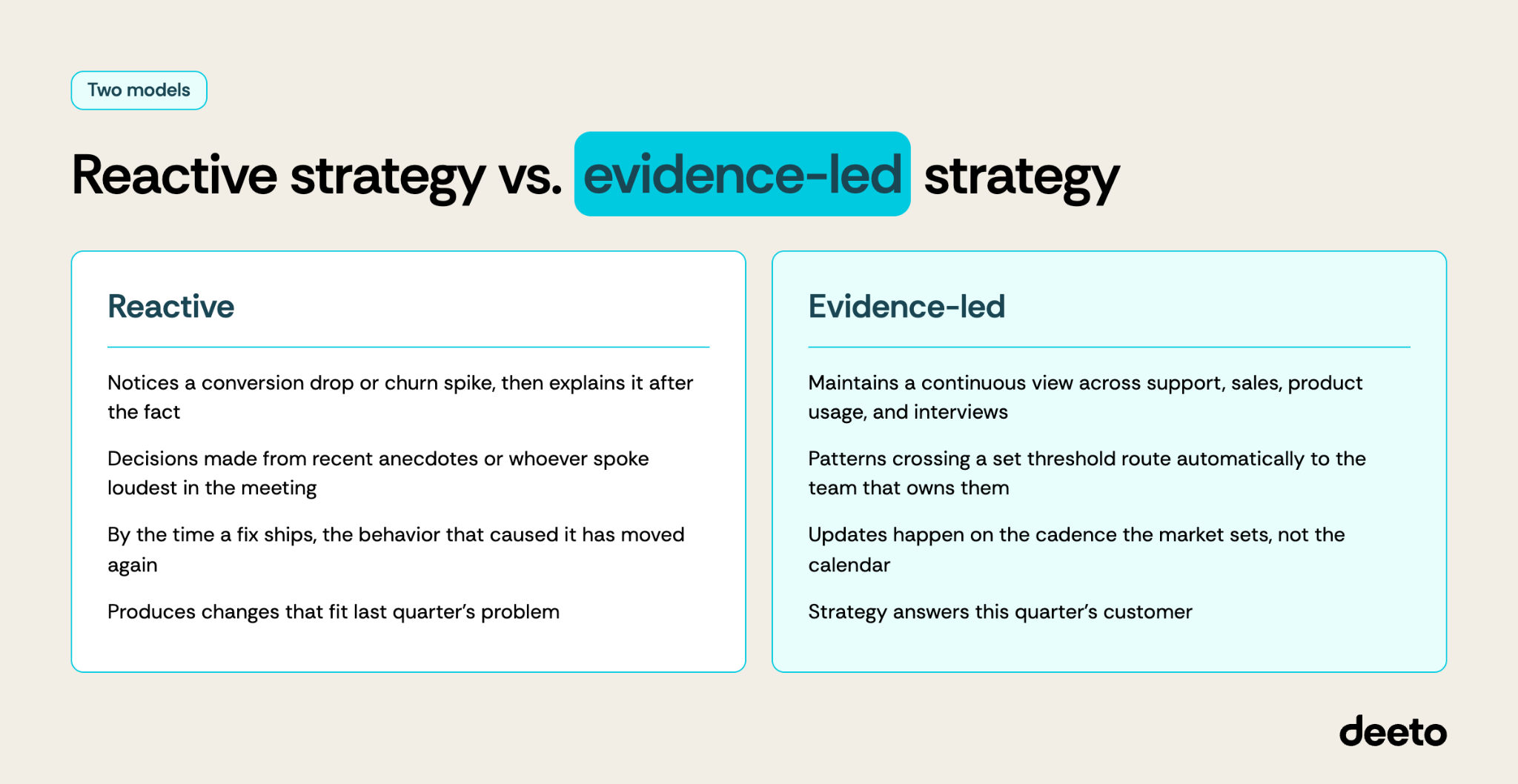
Reactive Strategy vs. Evidence-Led Strategy
Reactive strategy adaptation
A team notices a drop in conversion or a spike in churn, then scrambles to explain it after the fact. Decisions get made from a handful of recent anecdotes or whoever spoke loudest in the meeting. By the time a fix ships, the customer behavior that caused the problem has often already moved again. This approach is slow, and it tends to produce strategy changes that fit last quarter's problem rather than this quarter's customer.
Evidence-led strategy adaptation
A team maintains a continuous view of customer voice across support, sales, product usage, and direct interviews. When a pattern crosses a meaningful threshold, whether that's a recurring objection or a new reason customers cite for choosing a competitor, it routes automatically to the team that owns that part of the business. Strategy updates happen on the cadence the market sets, not the cadence the calendar sets. This is the model Deeto's voice of the customer platform is built to support: authentic voice flowing continuously into the decisions that depend on it.
How to Implement This in Your Business
- Audit where customer signal already exists. Support tickets, sales call notes, churn interviews, and product analytics are usually already being collected. Most companies have more signal than they realize; they just haven't connected it.
- Pick one recurring decision to attach evidence to first. Don't try to overhaul strategy planning all at once. Start with something concrete, like quarterly messaging updates or a pricing review, and require it to cite current customer evidence.
- Set a threshold for what counts as a signal worth acting on. A single comment isn't a trend. Define what volume or consistency of feedback justifies a strategy change so the process doesn't run on gut feeling.
- Assign ownership for routing, not just collecting. Someone needs to be responsible for getting a pattern in front of the team that can act on it. Collection without routing is where most customer feedback programs quietly die.
- Review the customer journey map at least twice a year. A journey map built once and never revisited becomes exactly the kind of stale assumption this whole approach is meant to prevent.
Key Takeaways
- Adapting business strategy to changing customer behavior means treating customer evidence as a continuous input, not an annual research project.
- B2B buyers now complete the majority of their evaluation before a sales conversation, often assisted by AI, so strategy has to respond to signals that show up earlier than a sales call.
- Behavioral targeting in digital marketing only stays effective when it's built on current, accurate signal, not last year's assumptions, and privacy regulation is making stale, broad targeting riskier by the month.
- A framework of listen, centralize, analyze, and route turns scattered feedback into strategy decisions instead of a dashboard nobody checks.
- Companies that track customer trends over time can update pricing, messaging, and go-to-market decisions on their own schedule, without waiting on the next planning cycle.
FAQs
What does it mean to adapt business strategy to changing customer behavior?
It means updating pricing, messaging, and go-to-market decisions based on current evidence of how customers research and buy, rather than relying on assumptions from a prior planning cycle. It's an ongoing process, not a single pivot made once a year.
How often should a business review customer behavior data?
Continuously, if the infrastructure allows it, with a formal review at least quarterly. Waiting for an annual survey means acting on customer behavior that may already be a year out of date by the time the report is finished.
What's the difference between customer behavior analysis and behavioral targeting?
Customer behavior analysis informs internal strategy decisions like pricing and messaging. Behavioral targeting in digital marketing is the execution layer, using behavioral data to personalize ads and content for individual customers. Both depend on accurate, current signal to work well.
Why do most businesses struggle to keep up with changing customer behavior?
Signal is usually scattered across support, sales, and product teams with no process for routing it to the people who set strategy. The problem is rarely a lack of data. It's the absence of a system connecting that data to a decision.
Does behavioral targeting still work with today's privacy regulations?
Yes, but its reach is narrowing. Over 20 U.S. states now have comprehensive privacy laws, and major browsers have phased out third-party cookies, which is pushing marketers toward first-party data and clearer consent. Businesses that already collect direct customer voice have a real advantage here.
Conclusion
The businesses that adapt fastest to changing customer behavior aren't the ones with the biggest research budgets. They're the ones with the shortest distance between a customer saying something and a team acting on it. That distance is closed by customer research programs that run continuously instead of once a year, and by a clear owner for turning patterns into decisions.
Deeto's voice of the customer platform exists to close exactly this gap. It captures customer voice, organizes it into intelligence, and puts it in front of the teams setting pricing, messaging, and go-to-market strategy, before the moment passes. If your strategy reviews are still built on what customers wanted last year, that's the fastest place to start closing the gap.
🎉 Save your spot
Register for the event
Once your spot is secured, we’ll send your confirmation details.
Subscribe to our newsletter
Subscribe to receive the latest blog posts to your inbox every week.
By subscribing, you agree to our Privacy Policy
Subscribe to our newsletter
Get the latest news and updates from our team.
By subscribing, you agree to our Privacy Policy
Related posts

8 Best Case Study Software Tools for Customer Marketers

What is case study software? Compare 8 case study platforms for collecting, managing, and activating customer proof.

8 Best Customer Proof Platforms for B2B Teams in 2026
What is a customer proof platform? See the top 8 options, how they differ, and how to pick the right one for your team.

7 Market Research Trends You Need to Know in 2026
What's changing in market research for 2026? See AI adoption, data quality risks, and privacy shifts to plan for.