How to Build a Customer Churn Model: A Guide for Businesses



Tuesday, September 15, 2026


How to Build a Customer Churn Model: A Guide for Businesses


View the podcast on Youtube

Instead of finding out that a customer is unhappy when a customer cancels, a customer churn model can tell you weeks or months earlier instead.
A customer churn model is a system, usually built on historical account data, that scores how likely each customer is to cancel or not renew. It pulls in signals like usage drop-off, support ticket volume, and contract dates, then ranks accounts by risk so your team can act before the account is gone. This guide covers how to build one, what signals predict churn, and how to catch the problem in time to fix it.
What Is a Customer Churn Model?
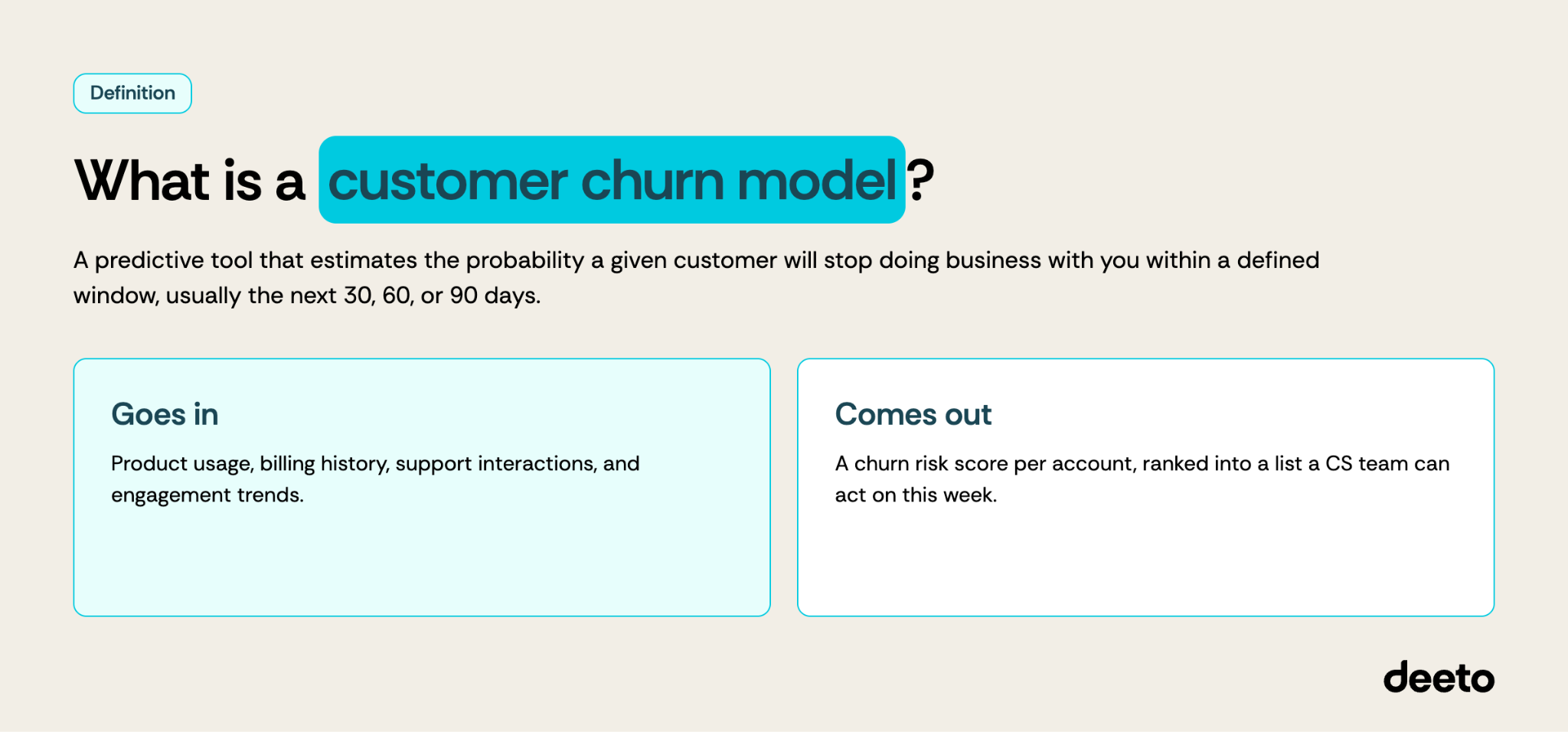
A customer churn model is a predictive tool that estimates the probability a given customer will stop doing business with you within a defined window, usually the next 30, 60, or 90 days. It takes in variables like product usage, billing history, support interactions, and engagement trends, then outputs a churn risk score for each account.
Churn models range from simple rule-based systems ("flag any account with usage down 40% month over month") to machine learning models trained on years of historical churn data. Both approaches share the same goal: turn scattered account signals into a ranked list your Customer Success team can act on.
Why Businesses Need a Churn Model
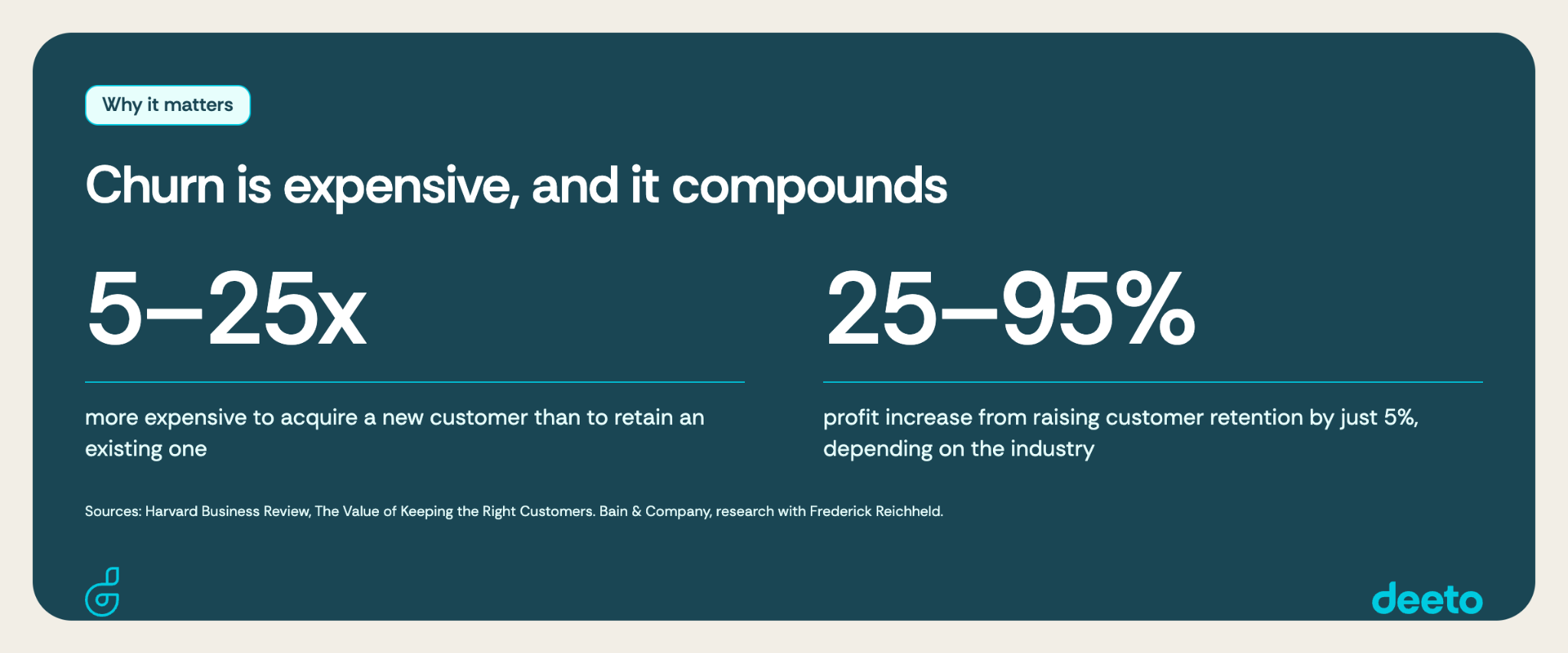
Churn is expensive, and it compounds. According to Harvard Business Review, acquiring a new customer can cost five to twenty-five times more than retaining an existing one. Bain & Company's research with Frederick Reichheld found that increasing customer retention by just 5% can increase profits by 25% to 95%, depending on the industry.
Those numbers explain why reactive retention doesn't work. By the time a customer submits a cancellation request, the decision was usually made weeks earlier, after a bad support experience, a missed renewal conversation, or a slow realization that the product wasn't delivering value. A churn model gives you visibility into that window, before the decision is final.
For a Customer Success team managing hundreds of accounts, a model does the triage work a human can't do at scale: it tells you which ten accounts, out of three hundred, need attention this week.
How to Identify Customer Churn
Before you can predict churn, you need to know what it looks like in your data. For a full breakdown of churn types and root causes, read our blog post, What Is Customer Churn?. For building a model specifically, the signals that matter most are the ones that are both measurable and consistent enough to score: usage decline, unresolved support tickets, negative sentiment in customer conversations, and delayed payments or downgrade requests.
The signal most churn models miss entirely is conversational. A usage dashboard shows that an account went quiet. It doesn't show why, and it rarely shows the frustration a customer voiced on a call three weeks before they went quiet. Identifying customer churn early means tracking signals continuously, not just at renewal time. It also means treating call and chat data as a primary input, not an afterthought, since it's often where risk shows up first. This is exactly the kind of signal Deeto is built to surface in real time.
How to Build a Customer Churn Model: A Framework
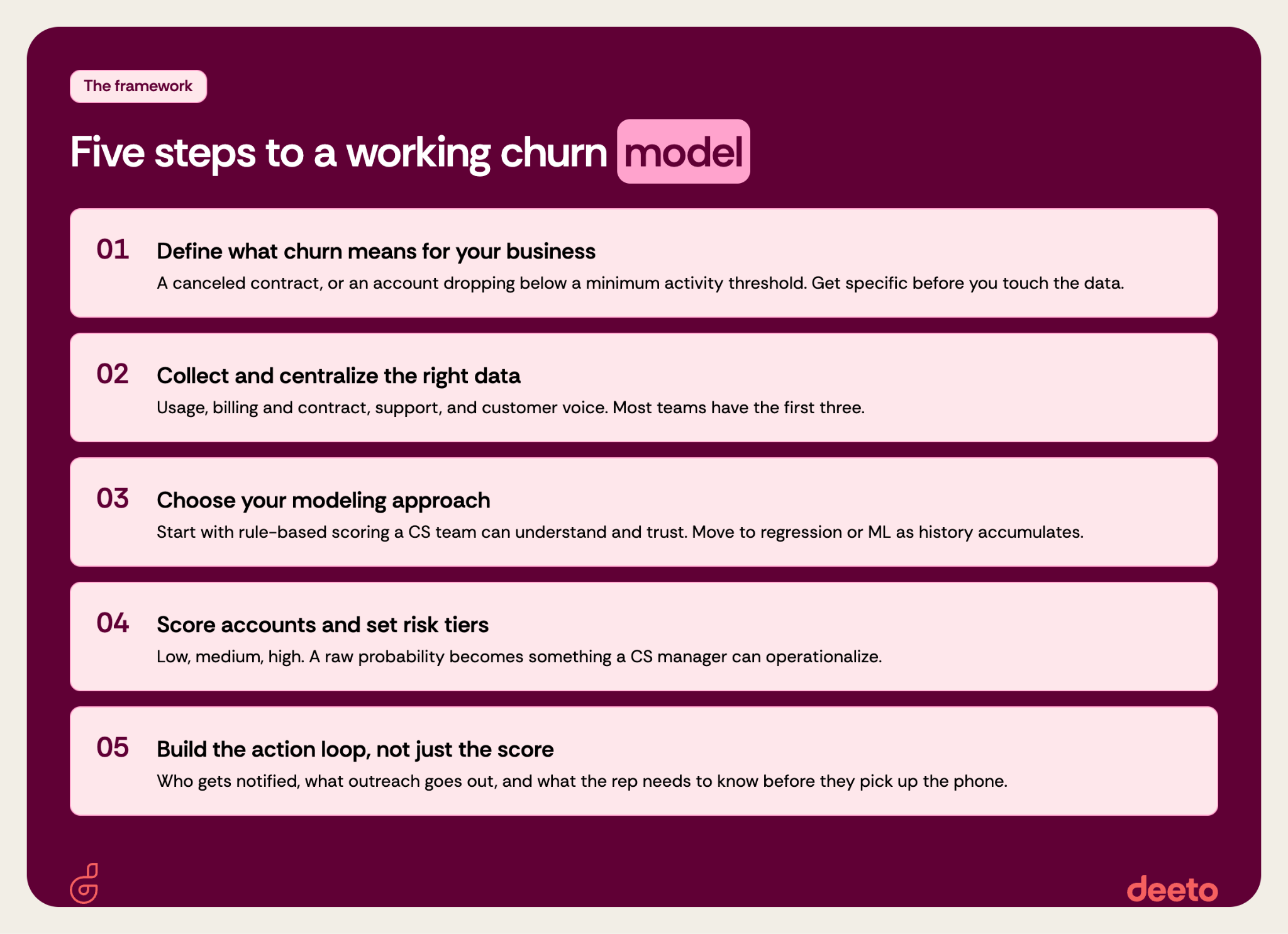
Building a working churn model comes down to five steps.
1. Define what "churn" means for your business
Churn looks different depending on your business model. A subscription SaaS company might define it as a canceled contract. A usage-based business might define it as an account that drops below a minimum activity threshold. Get specific about your situation before you start to play with the data so that you can produce a trustworthy model.
2. Collect and centralize the right data
Your model is only as good as the data feeding it. Pull together:
- Product usage data (logins, feature adoption, seat activity)
- Billing and contract data (renewal dates, payment history, plan tier)
- Support data (ticket volume, resolution time, CSAT)
- Customer voice data (call transcripts, chat logs, survey responses, sentiment)
It’s not uncommon for companies to have the first three. Far fewer systematically capture the fourth, which is a problem because customer voice data often contains the earliest and clearest churn signal of all: the customer telling someone, directly, what's wrong.
3. Choose your modeling approach
Start simple. A rule-based scoring system that assigns point values to risk factors like "no login in 30 days" or "two unresolved tickets" gets you a working model fast and is easy for a CS team to understand and trust. As you accumulate more historical churn data, you can move to a logistic regression or machine learning model that weighs signals automatically and improves as it learns from outcomes.
4. Score accounts and set risk tiers
Once the model is running, group accounts into risk tiers, typically low, medium, and high. This turns a raw probability score into something a CS manager can operationalize: high-risk accounts get an immediate outreach play, medium-risk accounts get monitored, low-risk accounts stay on the standard cadence.
5. Build the action loop, not just the score
For every risk tier, define exactly what happens next including who gets notified, what outreach goes out, and what the CS rep needs to know about why the account is flagged before they pick up the phone. This is one of the most important steps and one that most churn models miss.
Common Challenges in Churn Modeling
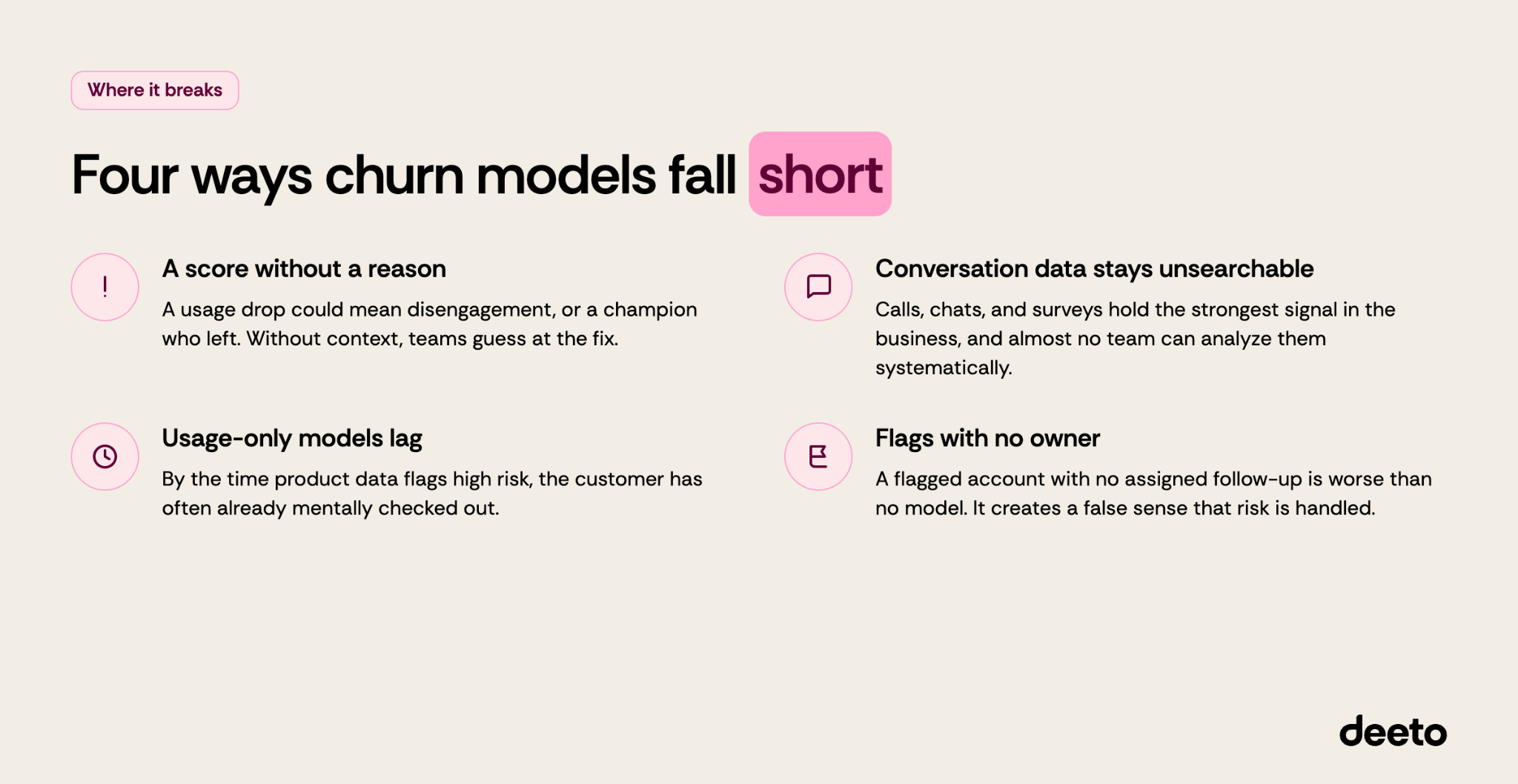
Knowing a customer is at risk isn't the same as knowing why. A usage drop could mean disengagement, or it could mean a champion left the company. Without that context, teams end up guessing at the fix.
Call recordings, support chats, and survey responses hold some of the strongest churn signal in the business, but they're rarely structured or searchable. Most teams simply don't have the infrastructure to analyze them systematically, which is the specific gap a platform like Deeto is built to close.
By the time a model flags high risk based on usage alone, the customer has often already mentally checked out. Models that only watch product data lag behind models that also listen to what customers are saying in real time.
A flagged account with no assigned follow-up is arguably worse than no model at all. It creates a false sense that risk is being managed when nobody's actually managing it.
How to Win Back Churned Customers
Not every at-risk account can be saved before it churns, and some customers cancel anyway. Winning back churned customers takes a different playbook than preventing churn in the first place.
- Find out the real reason they left. Exit surveys have low response rates and shallow answers. A structured post-churn conversation, run consistently across every canceled account (something an AI-driven interview can do without adding to your team's workload), surfaces the actual reason, not the polite one.
- Segment by win-back likelihood. Customers who left because of price are having a different conversation than customers who left because a feature never shipped. Don't run the same outreach for both.
- Fix the root cause before you re-engage. Reaching back out with a discount doesn't work if the underlying product gap that caused the churn is still there. Address the issue, then make the offer.
- Time the outreach. Customers are often more open to a win-back conversation 60 to 90 days after canceling, once the immediate frustration has faded and they've had time to notice what they're missing.
The businesses that win back the most customers are the ones that actually know why each one left, not the ones handing out the biggest discount.
How Deeto Helps You Get Ahead of Churn
Most churn models are built entirely on product and billing data, which means they're always working with a partial picture. The conversations customers have with your team, on support calls, in chat, during QBRs, contain churn signal that a usage dashboard will never catch such as frustration, hesitation, a comment about a competitor, or a mention that "the team upstairs isn't happy."
Deeto is a voice of the customer platform built to close that gap. Deeto's Listen module continuously captures customer voice across calls, chats, and AI interviews, instead of relying on a quarterly survey that most customers ignore. Deeto's Analyze module then applies sentiment analysis to those conversations to flag churn indicators as they happen, not weeks later when the usage data finally catches up.
Here's where it goes further than a standard churn model: when Deeto flags an account as at-risk, it can automatically send the customer a short, targeted AI interview to find out exactly what's wrong, in the customer's own words, before the CS team even makes the call. Instead of a rep guessing at the cause from a risk score, they walk into the conversation already knowing whether the issue is a missing feature, a pricing concern, a support gap, or a champion who's lost buy-in.
Continuous signal capture plus direct customer input is what turns churn prediction from a lagging indicator into an early one. Deeto customers see 15 to 25% higher renewal and expansion rates with this kind of early insight, because the team ends up solving the actual problem instead of reacting to a cancellation notice after the fact. That's really the core of what Deeto brings to Customer Success and Experience teams: it connects the voice customers are already giving you to the action that keeps them around.
Key Takeaways
- A customer churn model scores accounts by cancellation risk using usage, billing, support, and engagement data.
- Retention has an outsized impact on profit. A 5% increase in retention can lift profits 25% to 95%, per Bain & Company.
- Building a model takes five steps: define churn, centralize data, choose an approach, score accounts, and build the action loop.
- Call and chat data often contains churn signals earlier than usage data does, but most companies aren't capturing it.
- Winning back churned customers works best when you know the specific reason each one left, not a generic guess.
FAQs
What is a customer churn model?
A customer churn model is a predictive tool that scores how likely a customer is to cancel or not renew, based on data like product usage, billing history, support tickets, and engagement trends. It helps businesses rank accounts by risk so Customer Success teams can prioritize outreach.
What data do I need to build a churn model?
At minimum, you need product usage data, billing and contract data, and support ticket history. The strongest models also include customer voice data from calls, chats, and surveys, since conversational signals often predict churn earlier than usage metrics.
How accurate are churn prediction models?
Accuracy depends heavily on data quality and the range of signals included. Models built only on usage data tend to lag behind churn events. Models that also incorporate real-time conversation and sentiment data catch risk earlier and more accurately.
How do I identify customer churn before it happens?
Track usage decline, drop-off in engagement, spikes in support tickets, negative sentiment in customer conversations, and delayed payments. These signals typically appear weeks before a customer formally cancels.
How do you win back a churned customer?
Start by finding out the specific reason they left through a structured post-churn conversation, not a generic exit survey. Segment win-back outreach by reason, fix the underlying issue where possible, and time re-engagement around 60 to 90 days after cancellation.
Can AI help predict and prevent churn?
Yes. AI can continuously analyze usage patterns and customer conversations to flag risk in real time, and can trigger targeted follow-up, like an AI-driven interview, to surface the root cause before a human even joins the conversation.
Conclusion
A customer churn model turns scattered account signals into a ranked, actionable view of risk. But the model itself is only half the job. The businesses that actually reduce churn pair prediction with understanding, they know an account is at risk, and they know why, in time to fix it. That means expanding beyond usage and billing data into the conversations customers are already having with your team.
Deeto helps Customer Success teams do exactly that. It flags churn signals across calls and chats as they happen, then follows up with AI-driven interviews that get to the real issue before it becomes a cancellation. Book a demo to see how Deeto connects customer voice to retention action, or read how to build a customer journey map to see where churn risk tends to build up across the customer lifecycle.
🎉 Save your spot
Register for the event
Once your spot is secured, we’ll send your confirmation details.
Subscribe to our newsletter
Subscribe to receive the latest blog posts to your inbox every week.
By subscribing, you agree to our Privacy Policy
Subscribe to our newsletter
Get the latest news and updates from our team.
By subscribing, you agree to our Privacy Policy
Related posts

How to Adapt Business Strategy to Changing Customer Behavior

What does it take to adapt business strategy to changing customer behavior? Learn the signals, the framework, and the ne

8 Best Case Study Software Tools for Customer Marketers
What is case study software? Compare 8 case study platforms for collecting, managing, and activating customer proof.

8 Best Customer Proof Platforms for B2B Teams in 2026
What is a customer proof platform? See the top 8 options, how they differ, and how to pick the right one for your team.