How to Build a Customer Testimonial Strategy That Converts



Thursday, September 24, 2026


How to Build a Customer Testimonial Strategy That Converts


View the podcast on Youtube

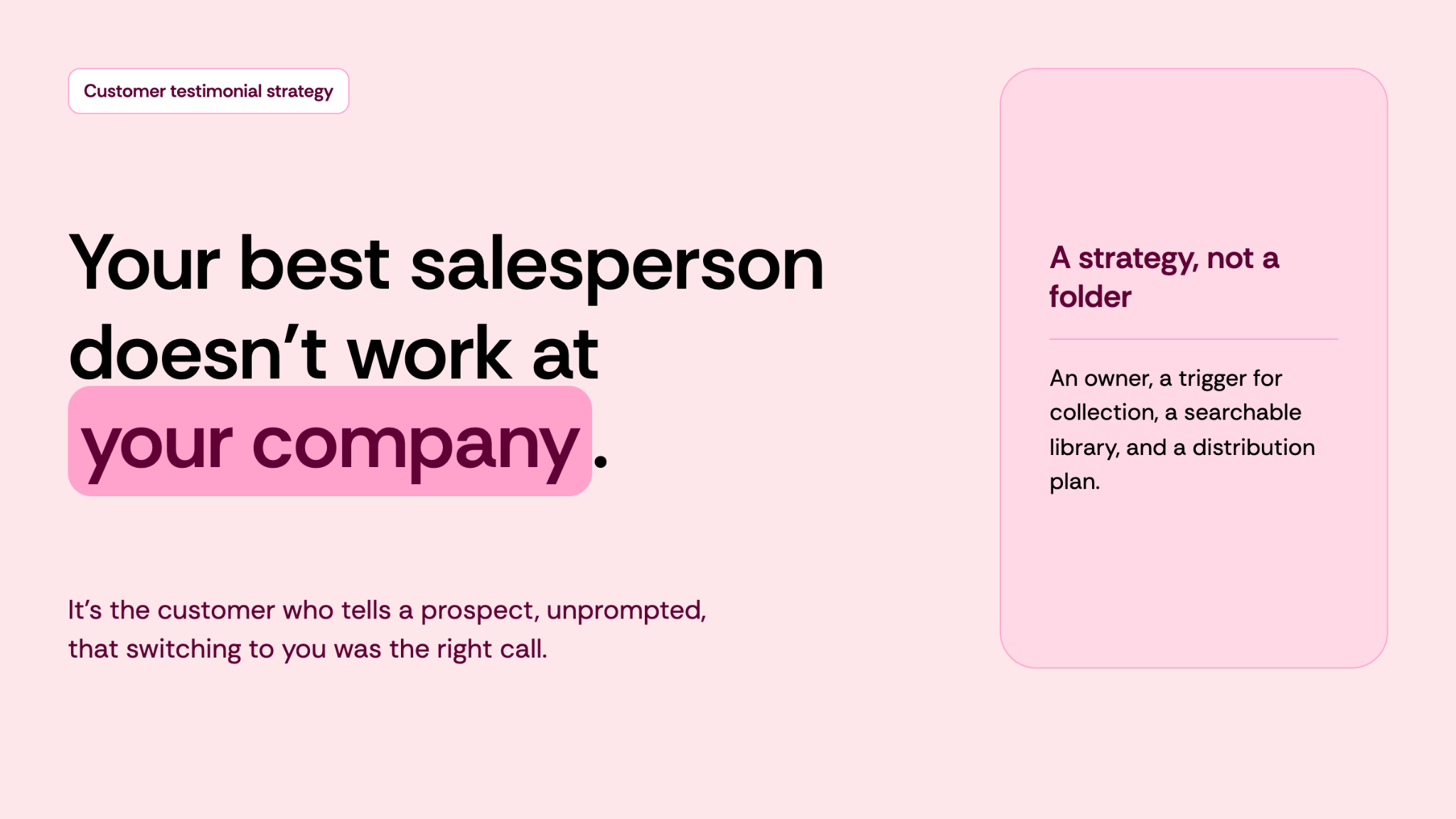
Your best salesperson doesn't work at your company. It's the customer who tells a prospect, unprompted, that switching to you was the right call.
A customer testimonial strategy is the system a company uses to collect, organize, and place customer proof in front of the right buyer at the right stage of the deal. That includes written quotes, video testimonials, case studies, and review site content. Done well, it turns scattered praise into a repeatable source of pipeline and revenue. This article covers what that system looks like, the types of testimonials worth collecting, and how to build one your sales and marketing teams will actually use.
What Is a Customer Testimonial Strategy
A customer testimonial strategy is a defined process for identifying which customers have a story worth telling, capturing that story in a usable format, and routing it to the sales reps, marketers, and campaigns that need it. It is not a folder of quotes someone collects after a happy support ticket. A customer testimonial strategy includes ownership, a repeatable capture process, a system of record, and a way to measure whether the proof is actually influencing deals.
Customer testimonial strategies include four parts: a trigger for when to ask (renewal, NPS spike, support win, expansion), a structured way to capture the story, a searchable library organized by industry, persona, and use case, and a distribution plan that gets proof onto the pages, decks, and calls where it matters.
Why a Customer Testimonial Strategy Matters
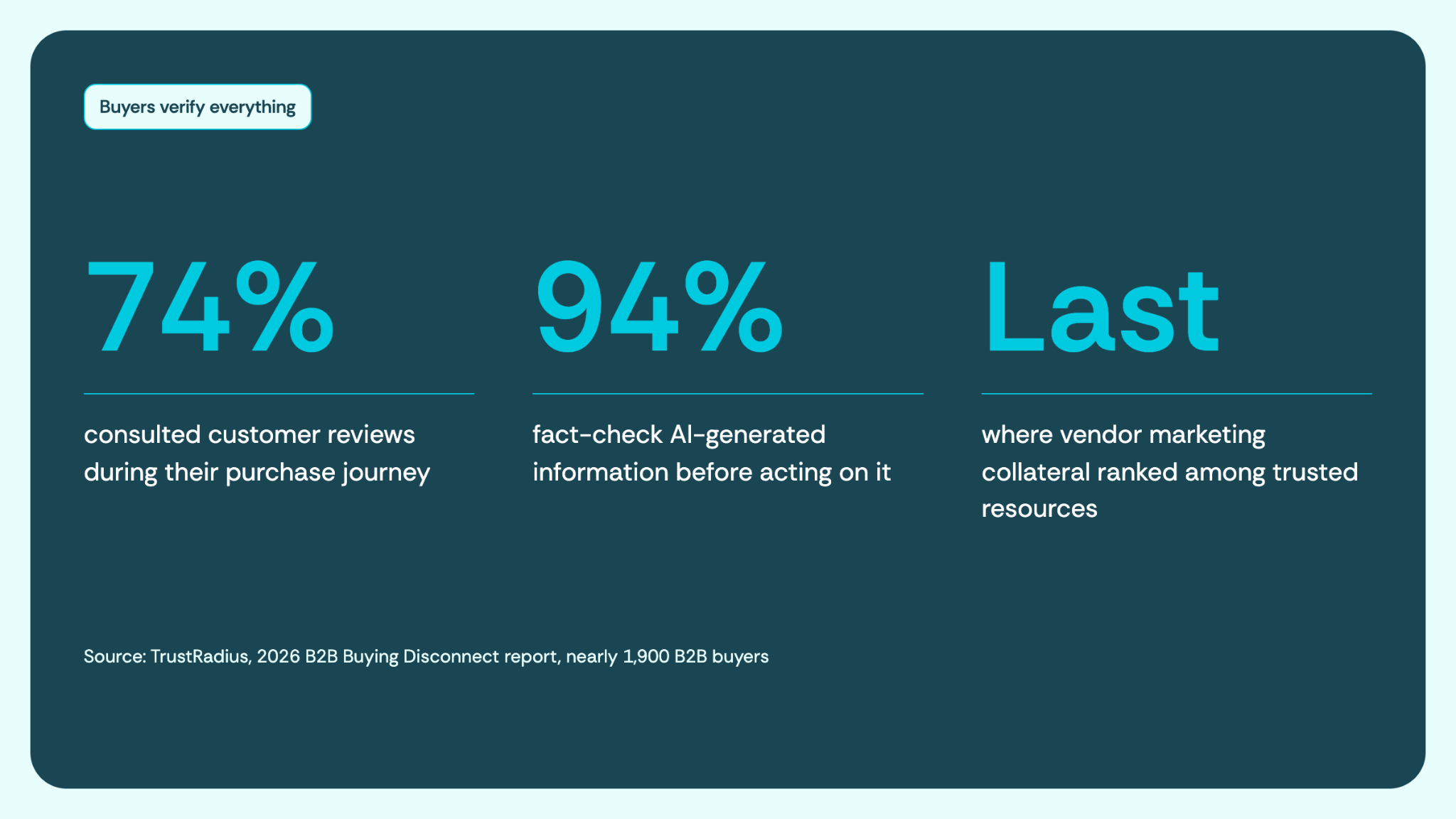
Buyers are done taking vendors at their word. According to the 2026 B2B Buying Disconnect report from TrustRadius, which surveyed nearly 1,900 B2B buyers, 74% consulted customer reviews during their purchase journey, and vendor marketing collateral ranked dead last among the resources buyers said they actually trust. Nearly half of buyers said they trust online resources less than they did a year ago.
That skepticism is not going away. It's the reason a testimonial strategy has to be more deliberate than "post a quote on the homepage." Buyers are cross-referencing everything, including what shows up in AI-generated summaries, and the same report found that 94% of buyers fact-check AI-generated information before acting on it. If your customer voice isn't documented, organized, and discoverable, it isn't influencing how buyers decide about your product, whether they're searching Google or asking an AI tool.
Deeto is built on the idea that authentic voice is an input, not a marketing afterthought. A customer testimonial strategy is one of the clearest ways to put that principle into practice: it turns real customer language into social proof that holds up under the scrutiny buyers now apply to every claim a vendor makes.
Common Challenges in Collecting and Using Customer Testimonials
Your company doesn’t lack happy customers, it lacks a system. The usual failure points include:
- No clear owner. Testimonials get collected ad hoc by whoever happens to be on the call when a customer says something great, then they disappear into a Slack channel or a single marketer's inbox.
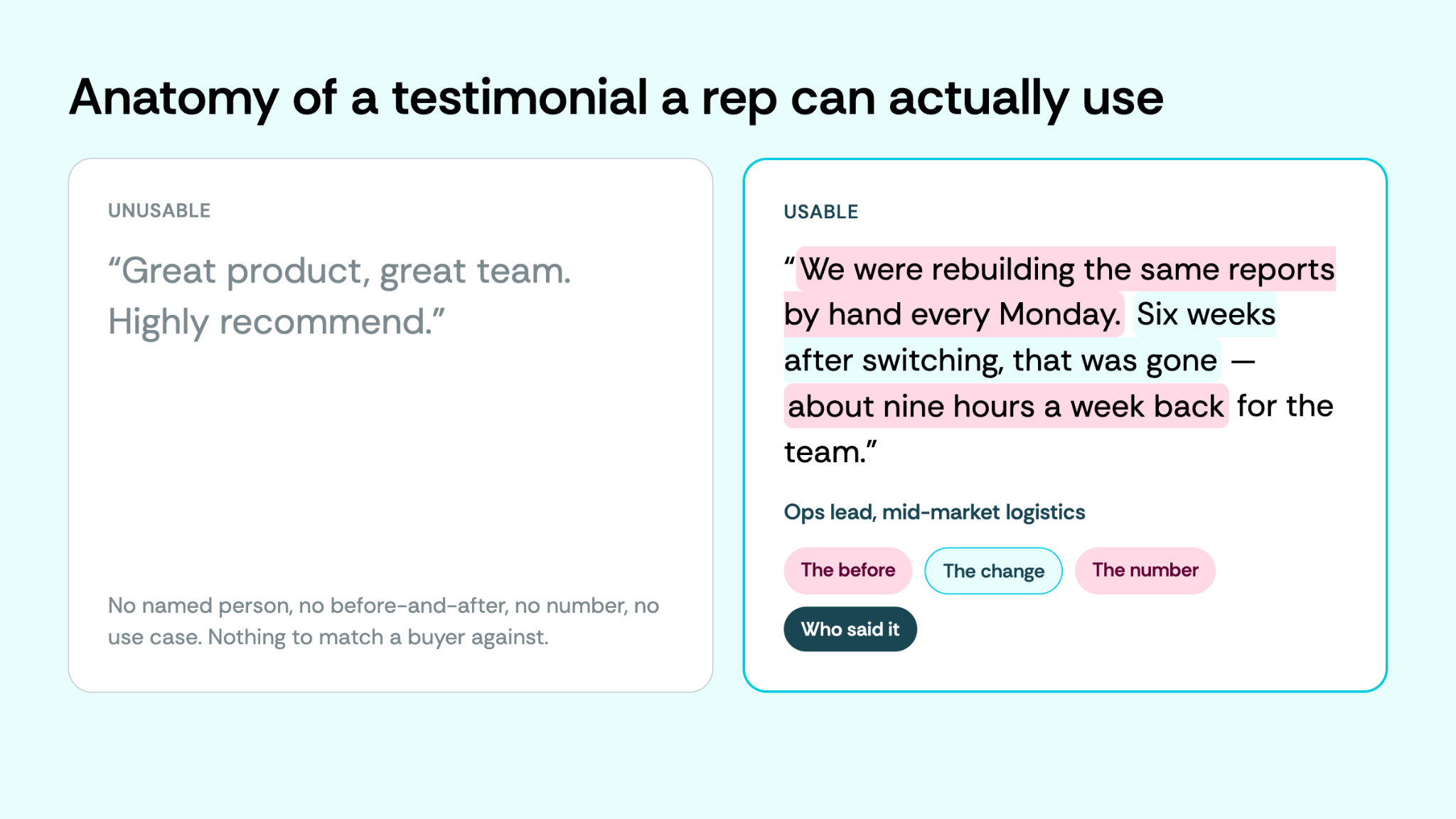
- Generic, unusable quotes. "Great product, great team" doesn't move a buyer. Testimonials need specifics: a number, a before-and-after, a named use case.
- Legal and approval bottlenecks. Without a standard release process, usable quotes sit unapproved for months.
- No connection to the sales cycle. A testimonial that lives in a PDF case study on a resources page rarely reaches the rep who needs it mid-negotiation.
- Staleness. A logo wall from three years ago signals that a company stopped growing its customer base, not that it's thriving.
Types of Customer Testimonials and When to Use Them
Not every testimonial format does the same job:
- Written quote: A short, attributed statement, usually 1 to 3 sentences. Fastest to collect, easiest to place on a website or in a deck. Best for top-of-funnel trust signals and landing pages.
- Video testimonial: A customer speaking on camera about their experience. Higher production effort, but carries more weight because it's harder to fake and easier to relate to. Best for late-stage sales enablement and video testimonials on high-intent pages.
- Case study or customer story: A longer narrative walking through the problem, the switch, and the measurable result. Takes the most effort to produce. Best for consideration-stage buyers comparing vendors and researching ROI.
- Review site testimonial (G2, Capterra, TrustRadius): Third-party-hosted feedback outside your control, which is exactly what makes it credible. Best for buyers doing independent research before they ever talk to sales.
- Social proof snippet: A single stat or quote pulled from a longer testimonial and reused in ads, sales decks, or LinkedIn posts. Low effort once the source material exists. Best for repeated exposure across a long buying cycle.
The strongest testimonial strategies use all five, matched to where the buyer actually is, rather than betting everything on one format.
How to Build a Customer Testimonial Strategy
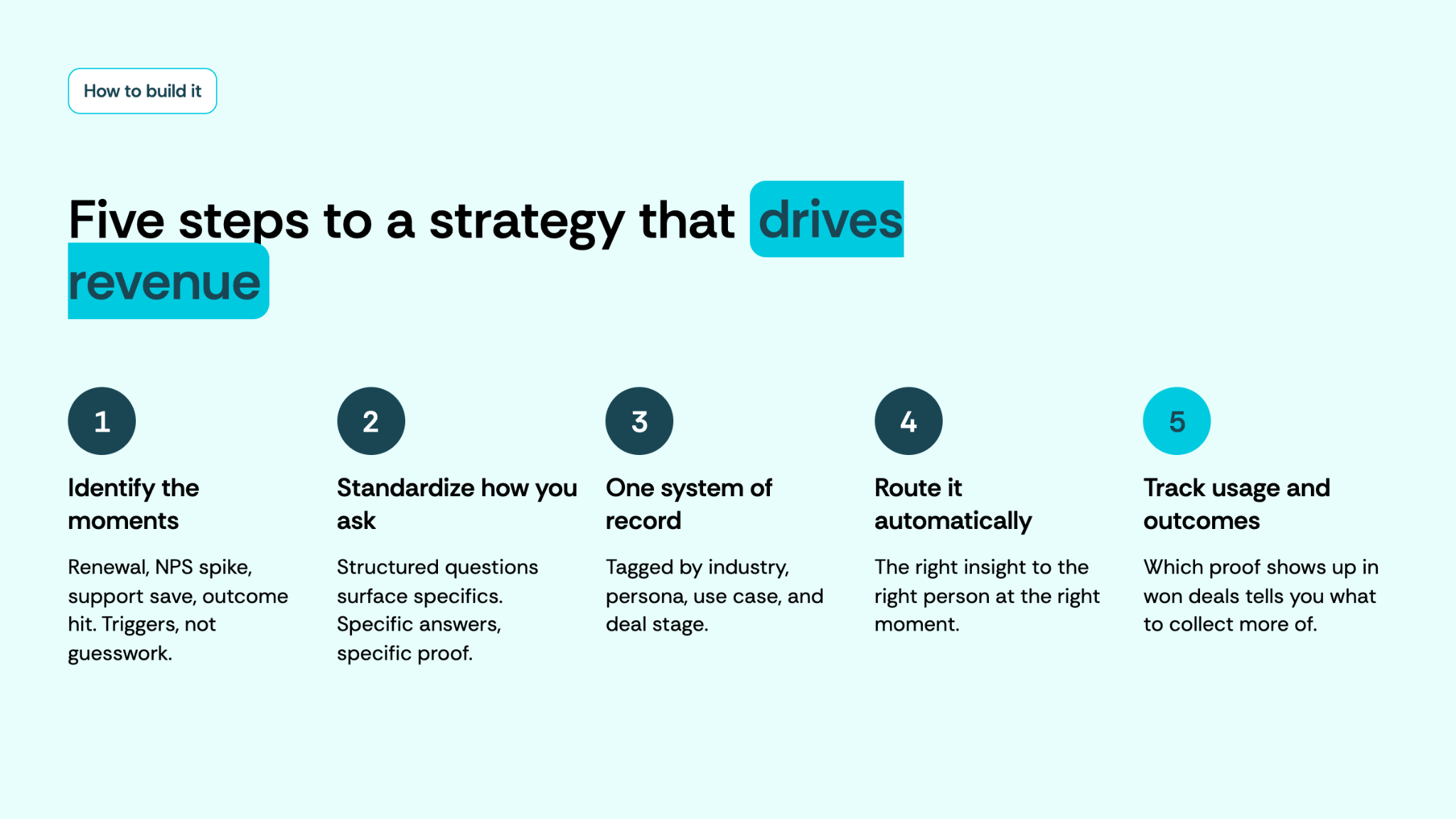
Five steps build a customer testimonial strategy that actually drives revenue.
- Identify the moments worth capturing. Set triggers, not guesswork: a renewal, an NPS score above a threshold, a support save, a measurable outcome hit. This is where a system that can capture authentic customer voice continuously, rather than relying on a marketer remembering to ask, changes the volume and quality of what gets collected.
- Standardize how you ask. Replace "can we quote you?" with structured questions that surface specifics: What changed? What would you tell someone considering us? What almost stopped you from buying? Specific answers make specific testimonials.
- Store everything in one system of record. Tag by industry, persona, use case, and deal stage so anyone on the team can find the right proof in seconds instead of searching old decks.
- Route proof to where it's needed, automatically. A testimonial sitting in a folder does nothing. The goal is delivering the right customer insight to the right person at the right moment, whether that's a rep prepping for a call or a marketer building a campaign.
- Track usage and tie it to outcomes. Measure which testimonials get pulled into deals, which ones show up in won opportunities, and which ones never get touched. That data tells you what to collect more of.
Deeto's Analyze module supports the last step directly, surfacing which stories and stats are actually correlating with faster-moving deals, so the strategy improves over time instead of staying static.
Best Practices for Activating Testimonials Across Revenue Teams
Collecting testimonials is only half the job. Getting them in front of the right person, consistently, is what makes the difference between a nice-to-have library and a revenue driver. Ownership matters here. In most organizations, the customer marketing team is best positioned to run this program, since they already sit between customer success, product marketing, and sales.
- Match specificity to funnel stage. Broad trust signals early, detailed ROI proof late. A prospect three touches into a campaign doesn't need a 10-minute case study video yet.
- Give sales a searchable library, not a shared drive. Reps close more deals when they can find the exact customer story that matches a prospect's industry and objection in under a minute.
- Refresh quarterly. Set a standing cadence to retire outdated testimonials and capture new ones, especially after major product releases or expansion wins.
- Pair narrative with numbers. A story about why a customer switched, paired with the specific result they saw, is more persuasive than either one alone.
- Build a reference and advocacy layer on top of the library. Some deals need more than a quote. Having a documented customer advocacy program and a formal reference management process means sales isn't cold-calling happy customers every time a prospect asks to speak with a reference.
Companies that treat customer testimonials as connected intelligence, rather than isolated marketing assets, are the ones seeing it show up in win rates. Deeto customers using activated customer proof in active deals have reported 10 to 15% higher win rates, a gap that tends to widen as the testimonial library and its usage data mature.
Key Takeaways
- A customer testimonial strategy is a system, not a folder. It needs an owner, a trigger for collection, a searchable library, and a distribution plan.
- Buyers now trust peer reviews and customer proof over vendor content. 74% consulted customer reviews during their purchase journey, according to TrustRadius's 2026 B2B Buying Disconnect report.
- Different testimonial formats (written quotes, video, case studies, review sites, social snippets) serve different funnel stages. Use more than one.
- The five-step build process: identify moments, standardize collection, centralize storage, automate distribution, and track usage against outcomes.
- Testimonials that reach the right person at the right moment in a deal outperform testimonials that just sit on a webpage.
FAQs
What is a customer testimonial strategy?
A customer testimonial strategy is a defined system for identifying which customers have a story worth capturing, collecting that story in a usable format, and delivering it to the sales reps, marketers, and campaigns that need it. It includes ownership, a repeatable capture process, and a way to measure business impact.
How do you get customers to give testimonials?
Ask at the right moment, not randomly. Renewal conversations, high NPS scores, support wins, and measurable milestones are natural trigger points. Use structured questions that surface specifics instead of a generic "would you write us a review" ask.
What's the difference between a testimonial and a case study?
A testimonial is a short, attributed statement, often a sentence or two. A case study is a longer narrative that walks through the customer's problem, the switch, and the measurable outcome. Case studies take more effort to produce but carry more weight with buyers comparing vendors.
How many customer testimonials should a company collect?
There's no fixed number. The goal is coverage: enough testimonials across your key industries, personas, and use cases that a rep or marketer can always find one relevant to the buyer in front of them, rather than reusing the same two quotes for every deal.
Do video testimonials work better than written ones?
They serve different purposes. Video testimonials tend to carry more weight because they're harder to fabricate and easier for a prospect to relate to, which makes them well suited to late-stage sales conversations. Written quotes are faster to produce and easier to place broadly, which makes them better for top-of-funnel trust signals.
How do you measure the ROI of a customer testimonial strategy?
Track which testimonials get pulled into active deals, which ones appear in won opportunities, and which ones never get used. Tying testimonial usage to deal velocity and win rate turns a testimonial library from a marketing asset into a measurable part of the revenue engine.
Conclusion
A pile of quotes isn't a strategy. A customer testimonial strategy works when it has an owner, a repeatable way to collect stories, a system that makes them findable, and a path that gets the right proof to the right person before a deal is lost to doubt. Buyers are verifying everything now, and the vendors who win are the ones whose customers are already doing the talking.
If your customer proof is scattered across drives, decks, and someone's inbox, it's worth seeing what it looks like organized into one connected system. Pair this with a customer reference program and the two work together instead of competing for the same customers' time. See how Deeto helps teams turn customer voice into activated proof.
🎉 Save your spot
Register for the event
Once your spot is secured, we’ll send your confirmation details.
Subscribe to our newsletter
Subscribe to receive the latest blog posts to your inbox every week.
By subscribing, you agree to our Privacy Policy
Subscribe to our newsletter
Get the latest news and updates from our team.
By subscribing, you agree to our Privacy Policy
Related posts

How to Build a Customer Churn Model: A Guide for Businesses

What is a customer churn model? Learn how to build one, spot churn early, and win back at-risk customers.

How to Adapt Business Strategy to Changing Customer Behavior
What does it take to adapt business strategy to changing customer behavior? Learn the signals, the framework, and the ne

7 Market Research Trends You Need to Know in 2026
What's changing in market research for 2026? See AI adoption, data quality risks, and privacy shifts to plan for.