A resource and community space for modern marketers, sellers, and builders using customer voice to grow — together.
This hub is built for anyone who wants to do more with the voices of their customers. Whether you're scaling advocacy, building trust with proof, or rethinking how to go to market — you're in the right place.
How-to guides and playbooks for building with customer voice
Campaign-ready templates and swipe files
Benchmark reports and reference best practices
Event recordings, expert sessions, and community spotlights
Ask questions. Share ideas. Trade wins. This is your space.
You don’t have to figure this out alone. The Deeto community connects you with other leaders using customer voice to build better GTM motions, faster-growing brands, and smarter strategies. If you are interested in joining when it launches, sign up below.
Automate advocacy management workflows
Dynamically generate customer stories and social proof
Eliminate manual reference management
Track and report advocacy impact on revenue
Discover practical guides, templates, and tools to help your team close more deals, faster.
Six in ten B2B buyers would rather not talk to your sales team at all. That puts more weight on every email, in-app message, and text you send, and on what those messages actually say.
Omnichannel customer engagement tools are platforms that unify customer data and coordinate personalized messages across email, SMS, push, in-app, web, and messaging apps from one place. They decide who gets what message, on which channel, and when. The best ones now use AI agents to build and optimize campaigns with less manual work.
This guide compares eight leading platforms on channels, AI, data, and pricing models. It also covers the gap none of them fill, which is authentic customer proof that makes each message credible.
Omnichannel customer engagement tools are software platforms that connect every channel a customer uses into one coordinated program. Instead of running email in one tool and SMS in another, a team builds a single customer profile and triggers messages from it wherever the customer is most likely to respond.
Omnichannel engagement software typically has four layers:
The difference between multichannel and omnichannel is coordination. Multichannel means you're present on many channels. Omnichannel means those channels share context, so a customer who just replied on WhatsApp doesn't get a generic email ten minutes later.
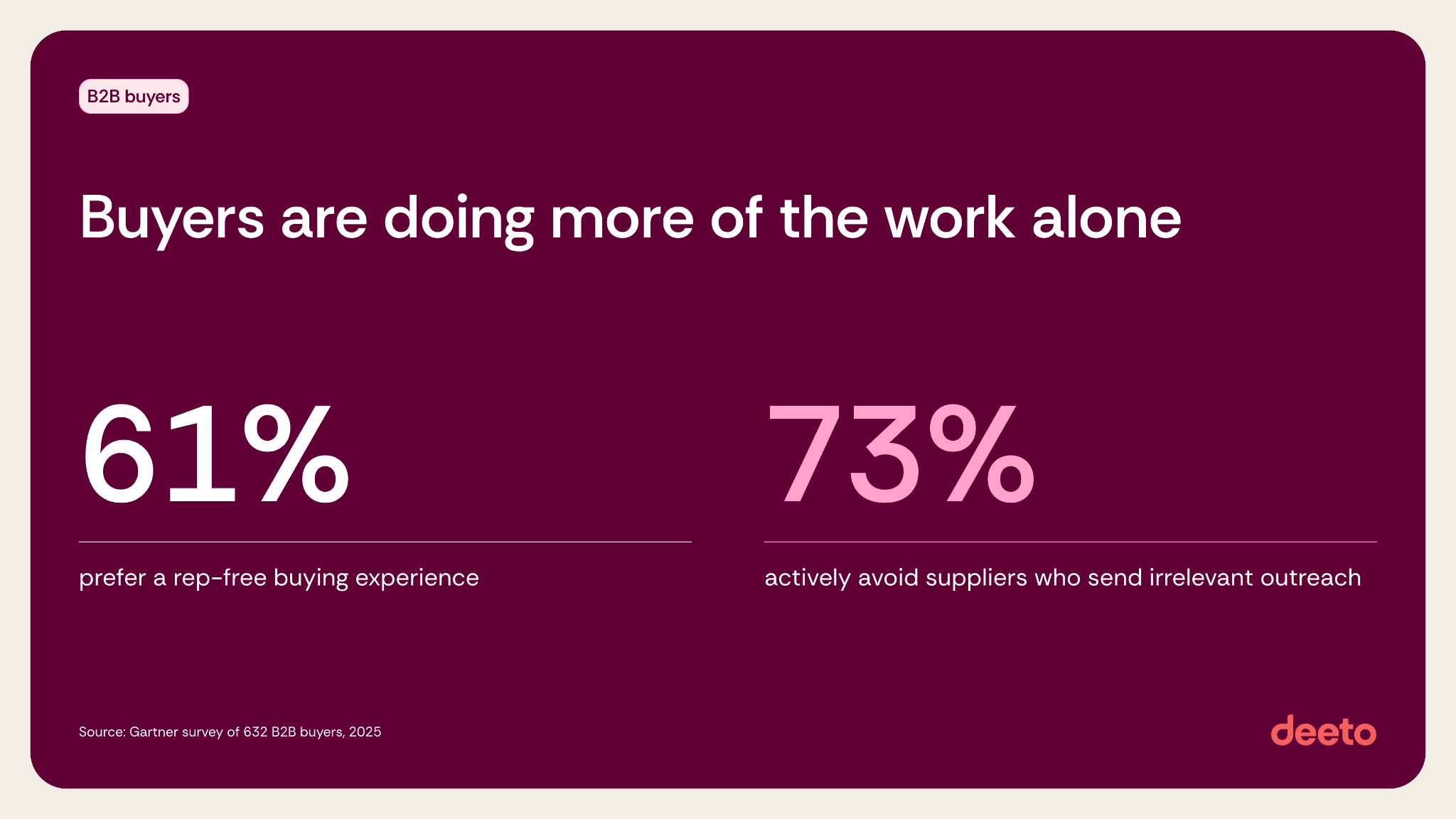
Buyers are doing more of the work alone. A Gartner survey of 632 B2B buyers found that 61% prefer a rep-free buying experience, and 73% actively avoid suppliers who send irrelevant outreach.
That second number is the one customer marketing leaders should sit with. Irrelevant outreach costs you the buyer. A message has to be timely and it has to be credible, and engagement platforms only handle the first part.
Buyers are also checking your claims somewhere else first. In G2's 2025 Buyer Behavior Report, enterprise buyers named review sites (56%) and AI search (55%) as their top two research sources. Both run largely on what other people say about you, not what you say about yourself.
Engagement automation decides when a buyer hears from you, while customer voice decides whether they believe you.
We used each vendor's own product and pricing pages as the primary source and looked at six things: the company type and use case each platform is built around, the owned and paid channels it supports natively, its AI and automation features (agents, decisioning, content generation), how it unifies customer data, its pricing model, and its placement in the 2026 Gartner Magic Quadrant for Multichannel Marketing Hubs.
Gartner published that report on September 22, 2026, and evaluated 12 vendors. According to Braze's summary of the results, Braze, Salesforce, and Adobe were named Leaders. Klaviyo and Insider One were Challengers, Bloomreach was a Visionary, and Iterable was a Niche Player. HubSpot wasn't among the vendors evaluated.
A Gartner Magic Quadrant scores vendors on two measures, ability to execute today and completeness of vision for where the market is going. Leaders score high on both. Challengers execute well with a narrower vision, Visionaries have strong strategy but less proven delivery, and Niche Players often focus on a specific segment. A Niche Player can still be the best fit for your team.
The first three platforms fit B2B customer marketing programs, where you're engaging accounts, buying committees, and existing customers over long cycles. The last five are built mainly for high-volume consumer messaging.
HubSpot Marketing Hub is the most accessible option here for B2B teams. It's CRM-native, so marketing, sales, and service data live in one place without a separate integration project.
It covers email, SMS, WhatsApp, social publishing and inbox, ads, personalized web content, and live chat. The Breeze Assistant and a set of AI agents (Content, Nurture, Campaign, Customer, and Prospecting) handle content creation and lead nurturing.
For customer marketing, that shared record is the point. Onboarding sequences, renewal nurtures, and expansion campaigns can all key off lifecycle stage and deal data that sales and CS already keep up to date, so you're not working from a stale export.
HubSpot has a free plan with automated email, forms, and live chat, plus paid tiers. Teams with complex, high-volume consumer messaging usually outgrow it, but for mid-market B2B it covers most engagement automation needs.
Salesforce Marketing Cloud is the obvious choice for companies already running sales and service on Salesforce. Its newer product, Marketing Cloud Next, builds Agentforce AI agents into email, SMS, and web, and adds paid advertising activation and cross-channel analytics.
The Campaign Agent generates channel-ready content and optimizes sends from your goals and guardrails. Salesforce also pitches agentic demand generation, with agents that prospect target accounts, qualify inbound demand, and nurture buyers. That makes it one of the few tools on this list with an explicit B2B motion.
For enterprise customer marketing teams, the draw is shared account context. A renewal or advocacy campaign can draw on the same account, opportunity, and service history that sales and support see. Pricing isn't published on the product page.
Adobe Journey Optimizer is a real-time orchestration engine built on Adobe Experience Platform. It covers email, push, in-app, SMS and MMS, and web personalization, with AI decisioning for next best actions and a Journey Agent that helps build and analyze programs.
Its strength is depth. Real-time profiles, streaming data, and governance controls come from Experience Platform, which suits large enterprises with strict data requirements. That depth is also the trade-off. Journey Optimizer pays off most for teams already invested in the Adobe stack. Pricing isn't published.
Braze is built for consumer brands in retail, travel, media, gaming, and on-demand services, and was named a Gartner Leader for the fourth year in a row. Its pricing page lists email, push, SMS, RCS, WhatsApp, in-app, and more in every edition, with quote-based pricing tied to monthly active users. There's no free plan.
Klaviyo calls itself an autonomous B2C CRM and says it powers more than 205,000 brands across 100 countries. Its Composer agent builds campaigns from a prompt, and you can start on Klaviyo for free.
Insider One, which rebranded from Insider in December 2025, covers web, email, SMS and RCS, mobile app, WhatsApp, and web push. Its Agent One feature plans and optimizes campaigns, and the industries it lists lean toward retail, beauty, automotive, travel, financial services, and telecom.
Bloomreach Engagement pairs real-time customer and product data with Loomi AI decisioning across 13+ channels. It cites more than 1,400 brands and enterprises as customers, and predictions for purchase, churn, and returns make it especially useful for commerce teams.
Iterable is a cross-channel platform for consumer brands in fintech, marketplaces, retail, media, and streaming. Its support documentation lists nine channels, and its Nova layer adds AI agents and next-best-action decisioning. Pricing runs through sales.
Every platform above is good at timing and targeting. None of them can make the message itself credible. They'll personalize a subject line in milliseconds, but they can't produce a customer quote or a peer reference your buyer will trust.
That's where most programs break down. The proof usually lives somewhere else: testimonials, case studies, and reference customers sit in slide decks, Slack threads, and someone's inbox. The same few happy customers get every reference request because nobody can see who else is willing, and they burn out. And what customers say in interviews and surveys rarely reaches the person building the campaign in a form they can use.
Sending faster won't fix a message nobody believes.
Engagement tools decide when to reach someone. Deeto decides what's worth saying when you do.
Deeto is a voice of the customer platform. It turns authentic customer voice into intelligence and routes it into the tools your team already uses, including Salesforce, HubSpot, and Slack. It works alongside your engagement platform rather than replacing it.
Picture a nurture sequence in HubSpot. A director of operations at a mid-sized fintech company downloads your compliance guide and enrolls in a five-email track. Email three is where proof usually goes, and it's usually a logo bar or a stat lifted from your homepage.
With Deeto in the mix, that slot carries a short customer quote from an operations leader at another fintech customer, captured in an AI interview a few weeks after their rollout. Deeto's AI Match Agent picks the customer whose situation looks most like the prospect's. When the deal reaches sales, that same customer is ready as a reference, and nobody has to dig through old decks to find them.
The email is just as timely as before. Now it's believable too.
For customer marketing teams, that's the shift. Your engagement platform keeps handling timing and delivery. Deeto keeps it stocked with fresh, relevant customer voice, and spreads asks across a wider customer advocacy bench so the same few customers don't burn out.
Back to the Gartner number from earlier. When 73% of buyers avoid suppliers who send irrelevant outreach, a message carrying a real peer's words has a better shot than one carrying yours. If you're comparing proof tools too, our breakdown of customer testimonial software platforms covers that side of the stack.
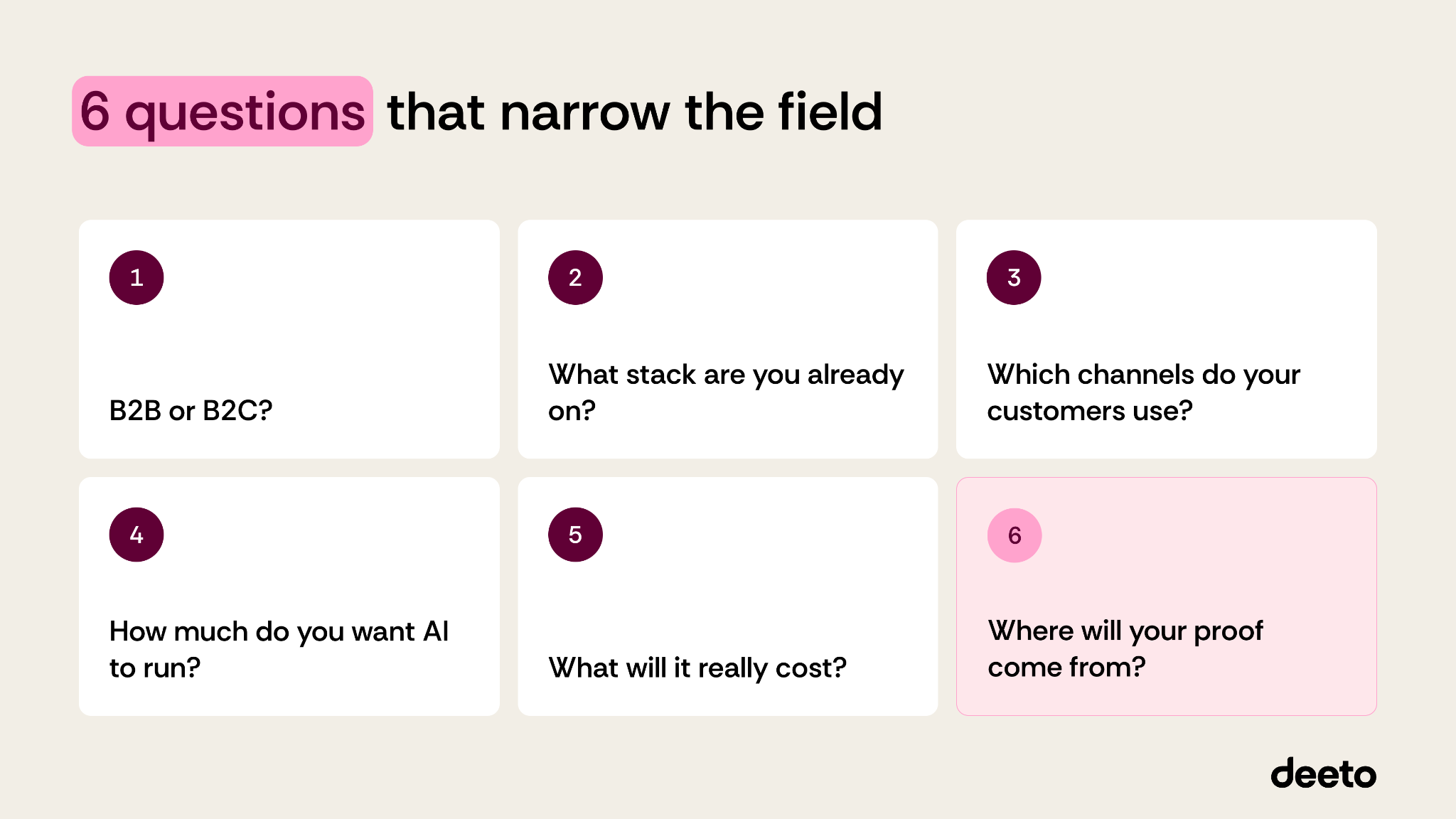
Start with your business model, then work down to features. A few questions narrow the field fast:
What are omnichannel customer engagement tools?
Omnichannel customer engagement tools are platforms that unify customer data and coordinate personalized messages across channels like email, SMS, push, in-app, web, and WhatsApp. They use one customer profile to decide who gets which message, on which channel, and when. Examples include Braze, Salesforce Marketing Cloud, Adobe Journey Optimizer, HubSpot, and Klaviyo.
What is the difference between omnichannel and multichannel engagement?
Multichannel engagement means a brand is present on several channels, often managed in separate tools. Omnichannel engagement connects those channels so they share data and context. A customer's action on one channel changes what they see on the next, which avoids repeated or conflicting messages.
Which omnichannel engagement software is best for B2B companies?
For B2B companies, HubSpot Marketing Hub and Salesforce Marketing Cloud Next are the strongest fits because they're built around CRM data, accounts, and pipeline. HubSpot suits mid-market teams that want fast setup and a free starting plan. Salesforce suits larger companies already running sales on Salesforce.
What is engagement automation?
Engagement automation is the use of software to trigger and sequence customer messages based on behavior, timing, and profile data instead of manual sends. It includes onboarding flows, renewal reminders, re-engagement campaigns, and advocacy requests. Modern platforms add AI agents that build and optimize these programs within guardrails a team sets.
How much do omnichannel customer engagement platforms cost?
Pricing varies widely. HubSpot and Klaviyo offer free starting plans with paid tiers. Braze, Salesforce, Adobe, Insider One, Bloomreach, and Iterable use quote-based pricing tied to factors like active users, contacts, message volume, and channels. Ask vendors for a multi-year total cost that includes implementation.
Do omnichannel engagement tools replace customer advocacy platforms?
No. Engagement tools manage when and where messages reach customers. Customer advocacy and voice of the customer platforms like Deeto capture the testimonials, references, and feedback that make those messages credible. Connecting the two lets customer proof flow into every channel you run.
Engagement platforms have gotten very good at timing. Braze, Salesforce, Adobe, HubSpot, and the rest can now plan and run campaigns with AI agents doing much of the work.
The harder problem is trust. Buyers research on their own and lean on peers, and most will walk away from a vendor that sends them noise. A perfectly timed message with nothing credible inside it still gets ignored.
Pick the engagement platform that fits your business model and stack. Then make sure what flows through it carries your customers' voices, not just your own. See how Deeto works to put authentic customer proof into every channel you run.


Compare 8 omnichannel engagement platforms on channels, AI, and pricing, plus the gap automation can't fill.
Your customers decide to renew, expand, or churn based on things they told someone on your team months ago. Chances are, nobody did anything with that information.
Voice of the Customer for Software as a Service companies, shortened as VoC for SaaS, is the practice of continuously capturing what customers say across the subscription lifecycle, from first demo to renewal, and turning it into decisions about product, messaging, sales, and retention. A strong voice of the customer strategy connects each piece of feedback to the team that can act on it while the account is still active.
This guide covers what a SaaS VoC strategy includes, where it usually breaks, how the main VoC methods compare, and a five-step plan to build one.
Voice of the customer (VoC) is a structured way to collect, organize, and act on what customers need and expect. In SaaS, it carries extra weight. Revenue arrives in installments, so every customer decides again at every renewal whether the product is still worth paying for.
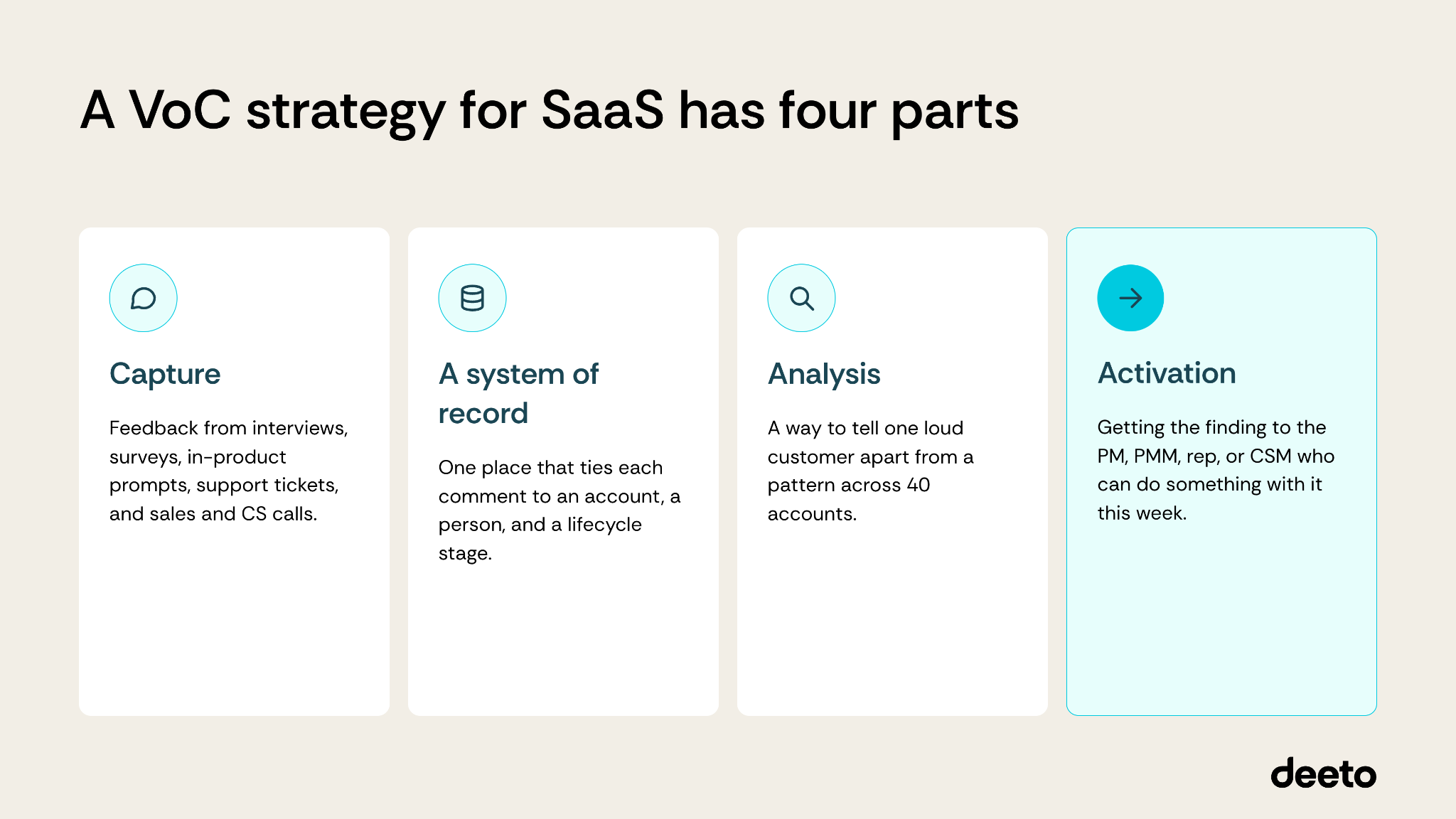
A VoC strategy for SaaS includes four parts:
Done well, a VoC program tells you why you lost the deal, which features your best accounts can't live without, and the words buyers actually use for the problem you solve.
A one-time purchase gives you one shot at the sale. A subscription gives the customer a vote every billing cycle.
Forrester's B2B research found that customer-obsessed companies grow revenue 28% faster, with 33% higher profitability growth and 43% better customer retention than companies without that focus. Customer obsession sounds like a culture slogan, but in practice it comes down to one main question, does customer feedback reach the people making decisions, fast enough to change them?
Retention is where SaaS economics live. Fred Reichheld's research at Bain found that in financial services, a 5% increase in customer retention produces more than a 25% increase in profit, because returning customers buy more over time and cost less to serve. Subscription software runs on the same math where every renewal you protect compounds.
For customer marketing and advocacy teams, VoC is the best source of proof you'll ever have. Every interview, QBR note, and renewal conversation tells you who's getting value, what result they got, and how they describe it.
That's your reference pool, your next case study, and your shortlist of advocates, already sitting in what customers have said. Most customer marketers still find them the hard way, by asking CSMs for names and chasing busy champions for a quote. A connected VoC program flips that. The customer who just told a CSM they cut onboarding time in half shows up as a story candidate the same week, with their own words attached. That's how customer advocacy scales without burning out the same five customers.
The same evidence protects the rest of the business. Pendo analyzed usage across 615 software products and found that 80% of features in the average product are rarely or never used. Someone built each of those features believing customers wanted it. A working VoC program would have tested that belief before engineering spent a quarter on it.
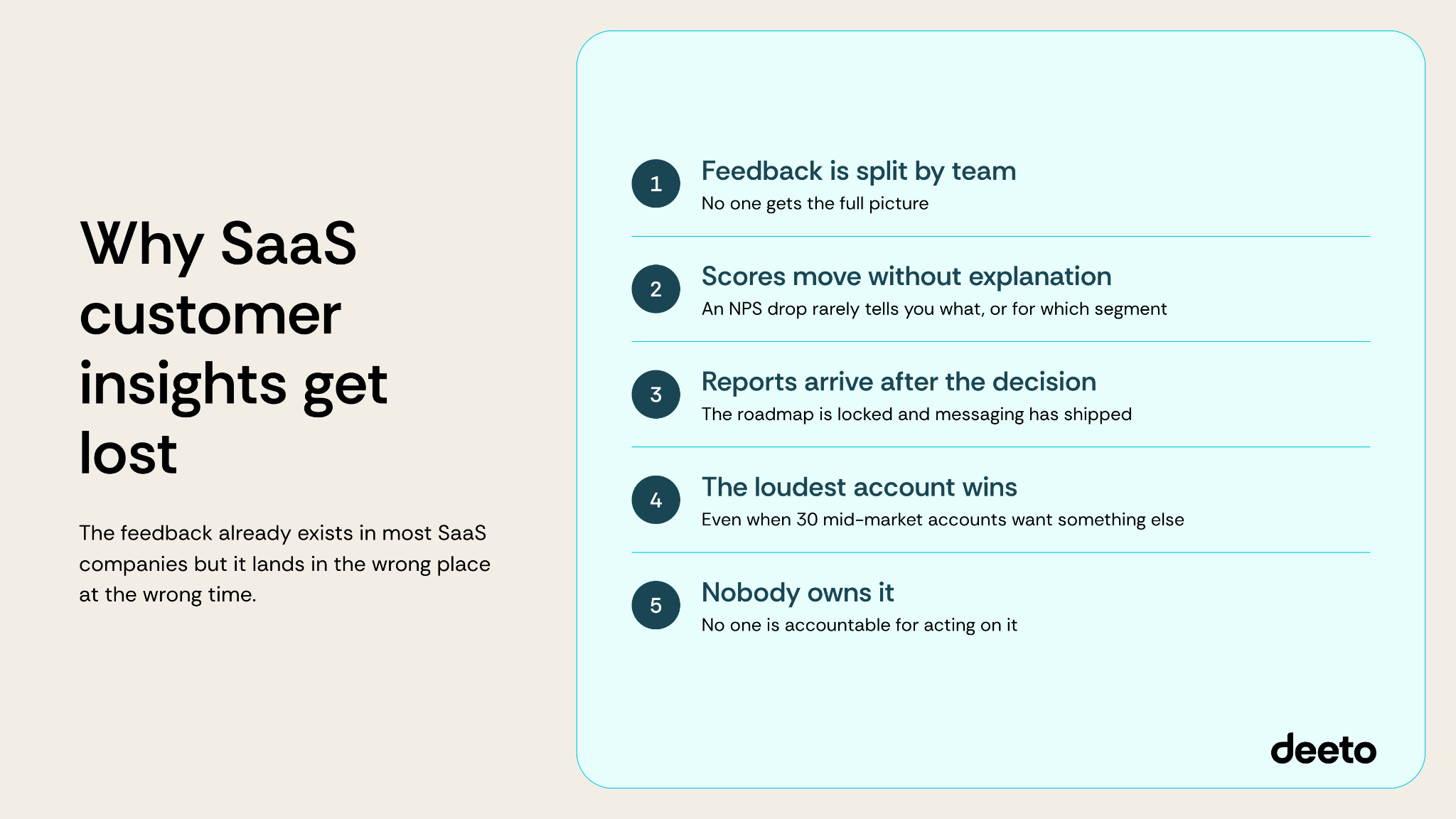
The feedback already exists in most SaaS companies but it lands in the wrong place at the wrong time.
Here is where it usually breaks down:
Each of these is a routing problem more than a collection problem. Adding another survey tool won't fix it. What fixes it is one system that turns customer voice into intelligence and sends it to the right team. That's the gap Deeto was built to close, and it shapes how you should build the program.
Most SaaS companies already run three or four of the methods below, but they don't talk to each other, and none of them were built to carry the customer's own words from first demo to renewal.
Gong records the calls your reps and CSMs were already having. Pendo collects usage data, in-app polls, and NPS from the people using your product, mostly to inform the roadmap. Both do those jobs well. Neither is built to go interview the economic buyer about why they almost churned, or to turn a champion's story into a reference a rep can use in a late-stage deal.
Deeto doesn't replace either of them. It pulls their signals together with direct customer conversations, then ties everything to the account and routes it to the team that needs it.
Start with the decisions you need to make and work backward. Most teams do it the other way around: buy a survey tool, collect a pile of responses, then try to work out what they're for.
Pick three to five decisions coming up in the next two quarters. Examples: positioning for the Q1 launch, renewal risk across your top 50 accounts, the next two roadmap bets. Every listening activity should map to at least one of them. If it doesn't, cut it.
SaaS customers say different things at different stages. List the moments that matter for your business: the closed-lost deal, onboarding week three, the first QBR, 90 days before renewal, the expansion conversation. A customer journey map makes the gaps obvious. Pre-sale signals belong here too. A structured win/loss analysis is often the fastest way to learn what buyers compare you against.
Annual surveys produce a snapshot. Continuous capture produces a trend line. Short, conversational check-ins tied to lifecycle moments get higher response rates and richer answers than a 30-question survey. Deeto runs AI-led customer interviews at each of those moments, so the feedback arrives with context and in the customer's own language.
SaaS customer insights are only useful if people can find them. Store every interview, quote, score, and story against the account and contact it came from. Connect it to the tools your teams already work in through CRM and Slack integrations. A rep should be able to see what a customer said six months ago without filing a request.
This is where most programs stall. Decide in advance who gets what:
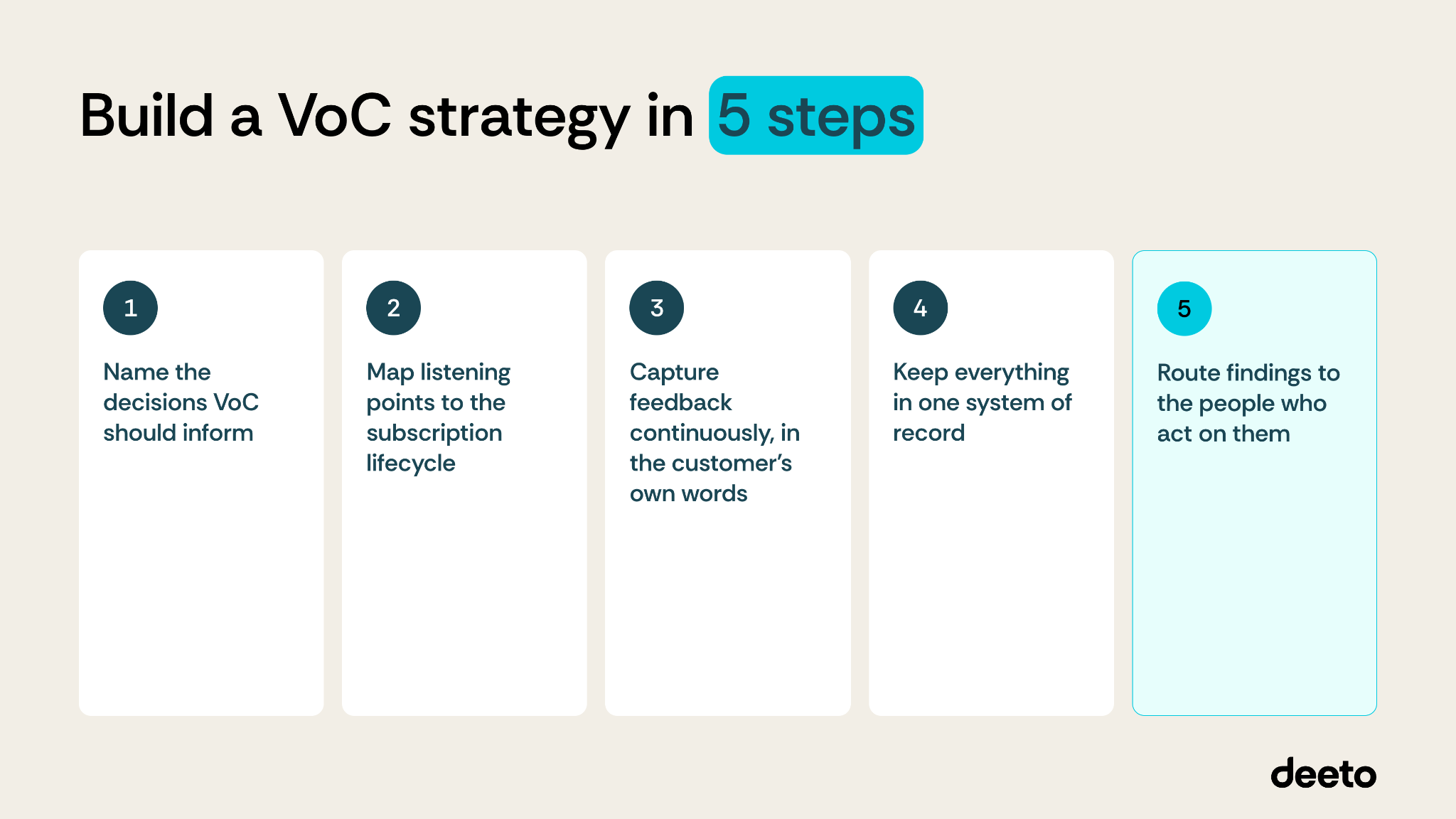
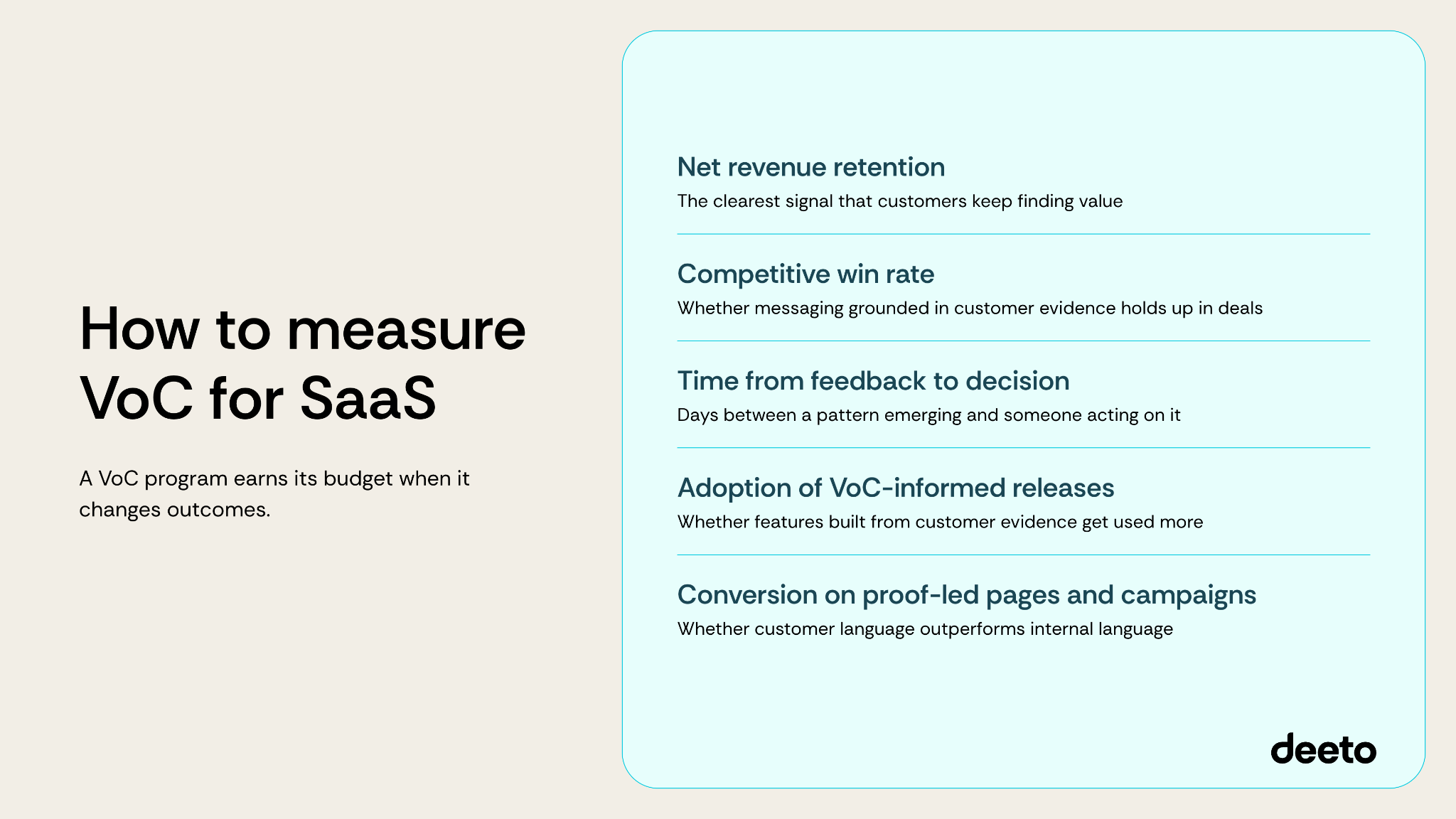
A VoC program earns its budget when it changes outcomes. Track a small set of metrics tied to the decisions you named in step one:
Deeto customers see sales cycles 20 to 30% shorter when reps have customer proof inside the deal, not buried in a quarterly deck.
What is VoC for SaaS?
VoC for SaaS is a structured approach to capturing what customers say across the subscription lifecycle, from evaluation through onboarding, adoption, and renewal. It turns that feedback into decisions about product priorities, positioning, sales proof, and retention. The goal is to get customer evidence to the team that can act on it while the account is still active, rather than in a quarterly report.
How is a voice of the customer strategy different from collecting customer feedback?
Collecting feedback is one activity. A voice of the customer strategy is the system around it. It defines which decisions feedback should inform, where to listen in the customer lifecycle, how to store and analyze what you hear, and who is responsible for acting on it. Many SaaS companies collect plenty of feedback but have no strategy, so it sits unused in survey tools and call recordings.
What are the best sources of SaaS customer insights?
The strongest SaaS customer insights come from combining sources. Customer interviews explain the reasons behind behavior. Product analytics show what users actually do. Conversation intelligence captures what comes up in sales and CS calls. Surveys like NPS and CSAT track sentiment over time. Review sites show how customers describe you in public. No single source gives the full picture on its own.
Who should own a VoC program in a SaaS company?
Ownership varies, but the program works best with one accountable owner and clear consumers. Product marketing, customer marketing, or customer experience often own it day to day. Product, sales, and customer success are the main consumers. What matters most is that someone is responsible for routing findings to those teams and tracking whether they acted on them.
How often should SaaS companies collect voice of the customer data?
Continuously, tied to lifecycle moments rather than a calendar. Trigger short check-ins after onboarding, after key feature launches, before renewals, and after closed-won or closed-lost deals. An annual survey can still serve as a benchmark, but it's too infrequent to catch churn risk or shifts in buyer priorities in a market that changes every quarter.
How does AI change VoC for SaaS?
AI makes continuous VoC practical at scale. It can run conversational interviews, transcribe and tag responses, detect sentiment shifts, and group feedback into themes across thousands of comments. The bigger change is speed. AI can surface a pattern the week it appears and push it to the right person, instead of waiting for an analyst to compile a quarterly readout.
Most SaaS companies have plenty of customer feedback. What they're missing is a reliable path from what customers say to what teams decide. A good VoC strategy for SaaS starts with the decisions that matter most this year, listens at the lifecycle moments that shape them, keeps everything in one place, and routes findings to the people who can act.
Get that right and you'll see it in renewals and win rates first. The roadmap takes longer to change, but it's how you stop building the features nobody uses.
Deeto is a voice of the customer platform built for this, used by SaaS and technology companies to capture customer voice continuously and put it to work across product, marketing, sales, and CS. See how Deeto works.

What is VoC for SaaS? Learn how to capture customer voice and turn it into decisions that drive renewals.
Less than a third of consumers give feedback directly to a company, according to Qualtrics' 2025 Consumer Trends report. Everyone else leaves clues in support tickets, call recordings, reviews, and renewal conversations.
So how can sentiment analysis be used to improve customer experience? Sentiment analysis uses AI to read that language and classify the emotion behind it, down to the specific topic. For CX teams, that means finding out why a score dropped and which accounts are drifting, usually well before either shows up at renewal. Customer marketing teams get the other half of the picture: the happy customers who are ready to become references and advocates.
This guide covers what sentiment analysis measures, how it compares to survey scores, and six ways to put it to work.
Sentiment analysis in customer experience is the process of using natural language processing (NLP) to measure how customers feel about a company, product, or interaction based on what they say and write. It turns unstructured feedback (open-text survey answers, support chats, interview transcripts) into structured data a team can track over time.
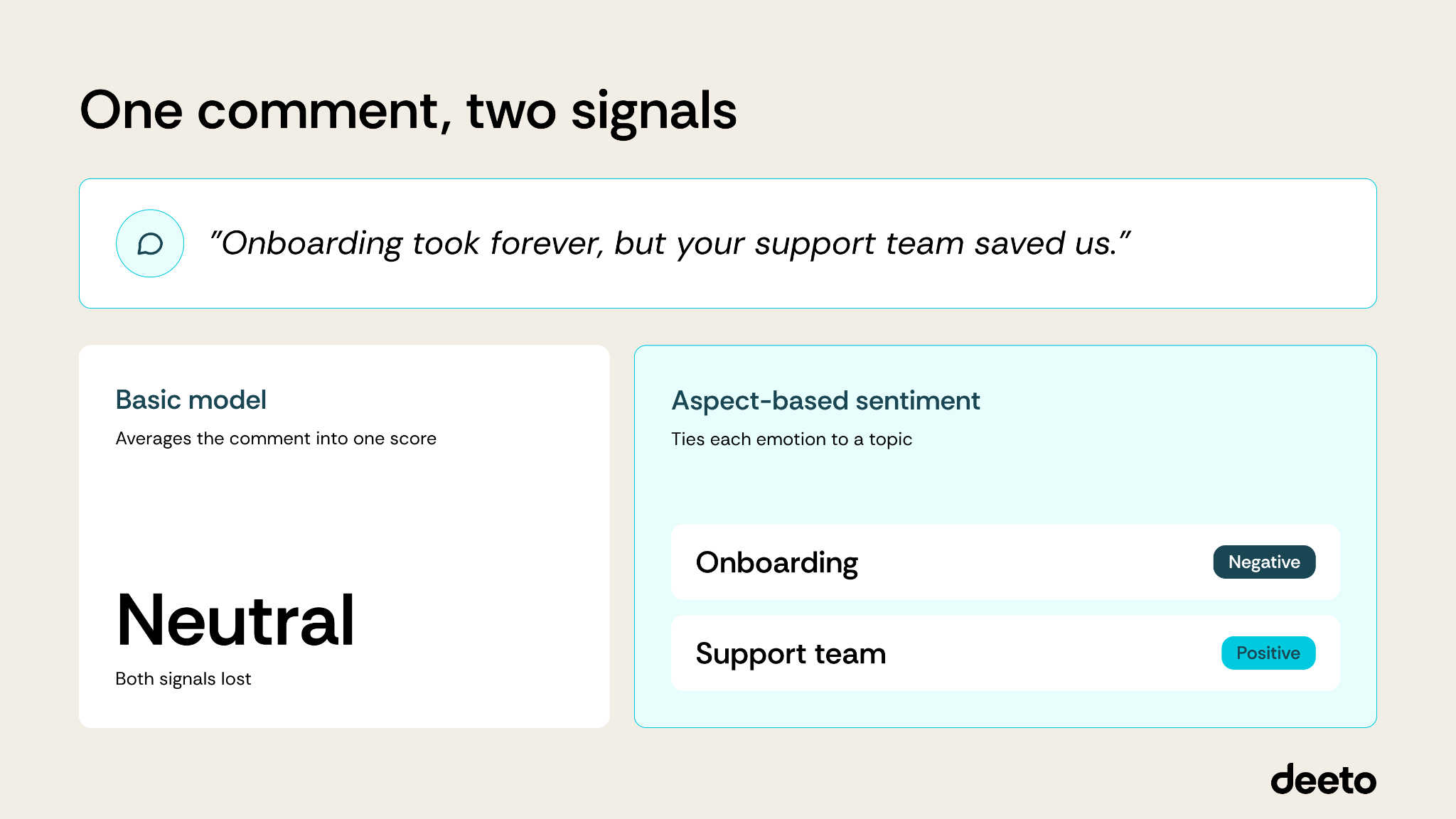
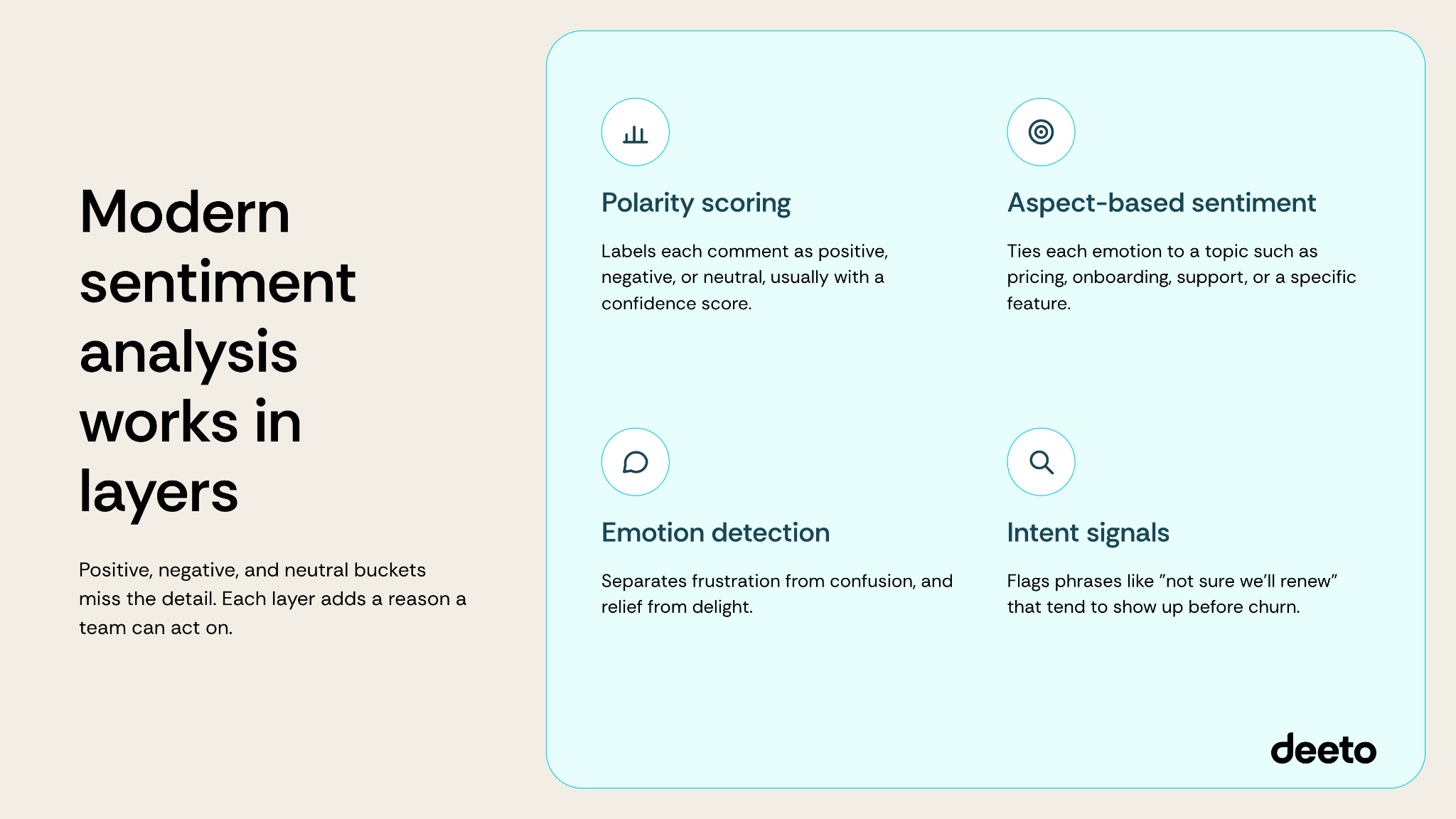
Early tools sorted comments into three buckets: positive, negative, or neutral. Unfortunately, these buckets don’t tell you much. Take a comment like "onboarding took forever, but your support team saved us." A basic model averages it into something close to neutral, and you lose both signals.
Modern customer sentiment analysis works in layers:
In PwC's 2025 Customer Experience Survey, about nine in ten executives said customer loyalty had grown in recent years. Only four in ten consumers agreed.
Part of that gap comes from using scores rather than a true sentiment analysis. An NPS of 42 could either mean that customers are mildly annoyed about pricing or furious about a broken integration. The average hides the reason, and the reason is what you'd actually fix.
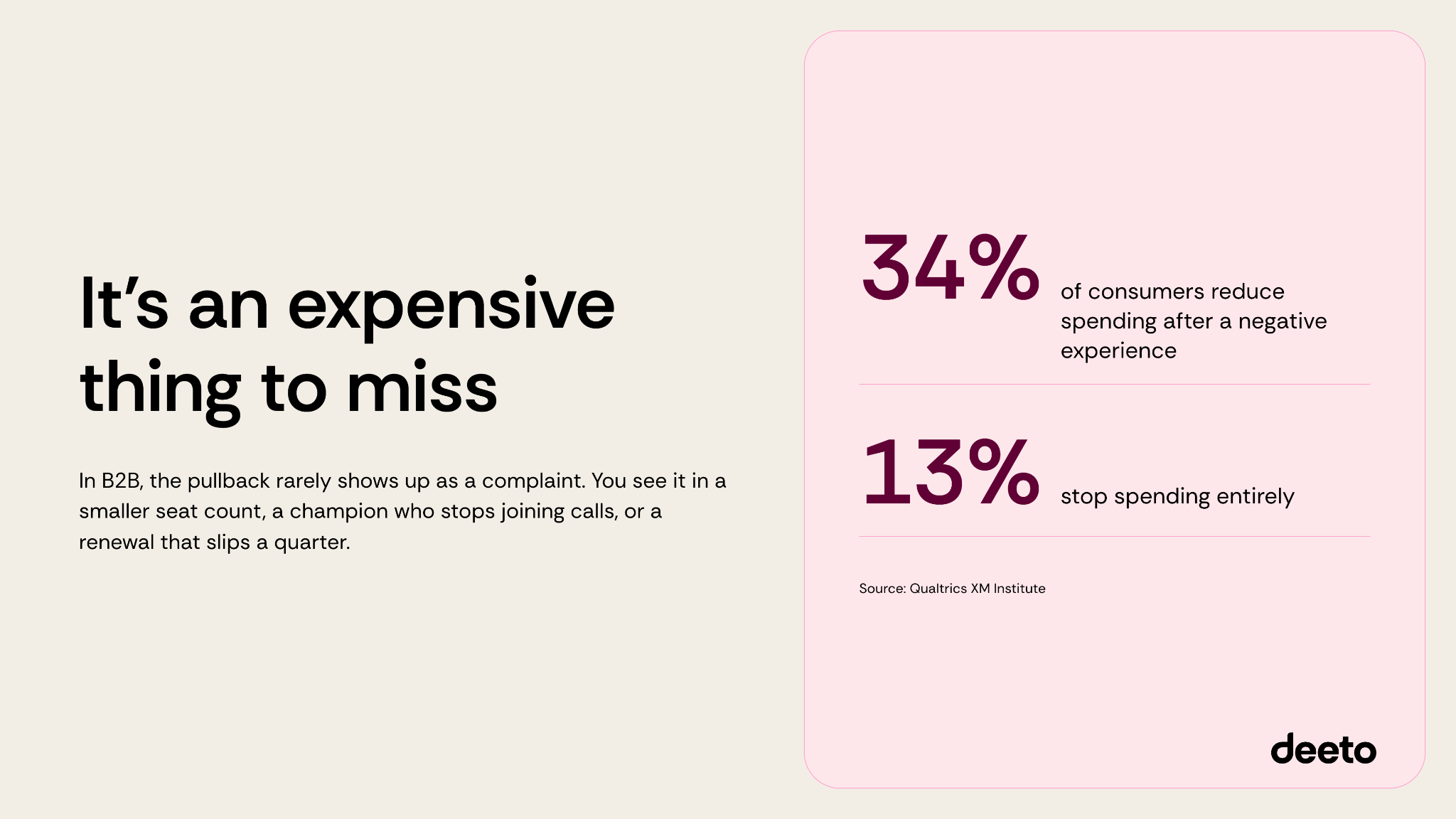
It's an expensive thing to miss. Qualtrics XM Institute found that 34% of consumers reduce spending after a negative experience and 13% stop spending entirely. In B2B, the pullback rarely shows up as a complaint. You see it in a smaller seat count, a champion who stops joining calls, or a renewal that slips a quarter without much explanation.
Customers rarely say they're leaving, but they'll hint at it in tickets and call notes long before the renewal date. Sentiment analysis is how you catch those hints while there's still time to respond.
Catching them is only half the job, though. In most companies, customer voice is scattered. Support owns the tickets, CS owns the call notes, product owns the survey verbatims, and customer marketing rarely sees any of it. Sentiment improves the experience only when what it finds reaches the person who can act on it.
Survey scores and sentiment analysis answer different questions. Scores like NPS, CSAT, and CES measure how customers rate an experience. Sentiment analysis explains why they rated it that way, using language customers already produce without being asked.
The bigger practical difference is that sentiment analysis doesn't need anyone to fill out a survey. As response rates fall, any score that depends on a response gets noisier. Sentiment analysis runs on the tickets, calls, and conversations that happen anyway.
In practice, you want both. Survey scores give you the trend, and sentiment analysis on the verbatims and support conversations tells you what moved it.
Sentiment analysis improves customer experience when it ties a feeling to a cause and to someone responsible for fixing it. Here are six ways B2B teams use it.
When NPS drops, leadership wants to know why. Aspect-based sentiment can answer that in hours rather than weeks of research. Tag every detractor comment by topic, and you might find that most mention implementation delays while pricing complaints haven't moved.
Then map those topics against your customer journey map to see which stage is causing the friction. A dip in the first 90 days needs a different fix than a dip at renewal.
Most teams use sentiment analysis defensively, to find problems. The positive side deserves the same attention, especially for customer marketing. Every comment that praises a specific outcome is a potential reference, case study, or review, and most of them sit unnoticed in support threads and call notes.
For customer marketing and customer advocacy leaders, positive sentiment tagged by topic becomes a shortlist of advocates. A customer who wrote "we cut onboarding time in half" is a ready candidate for your reference program, and their own words are the first draft of customer stories and social proof. The same tags show which outcomes customers mention most, so campaigns are built on what customers value rather than what the team assumes.
Timing changes the ask, too. Inviting a customer to speak right after they praised your team lands very differently than a cold reference request at quarter end.
Tone changes before behavior does. If a customer wrote "love the new dashboard" in March and "still waiting on a fix" in June, that's a signal, and it arrives well before usage drops.
Sentiment trends across tickets, call notes, and QBR transcripts add context to churn prediction models that usage data can't provide on its own. For customer success teams, the useful output is simple: a list of accounts to call this week, ranked by risk, with the reason attached.
Ticket volume is a poor proxy for impact. Two hundred tickets about a confusing button might matter less than twenty angry billing complaints from your largest accounts.
When you weight topics by how often they come up and how strongly customers feel about them, product teams get a more honest ranking. They also get the customer's own words to back it up, which tends to shorten roadmap debates. Our guide on how to use customer feedback to build a product roadmap walks through that process step by step.
A frustrated comment doesn't help anyone if it stays in the support tool. Send sentiment alerts to where account owners already work, whether that's the CRM or Slack.
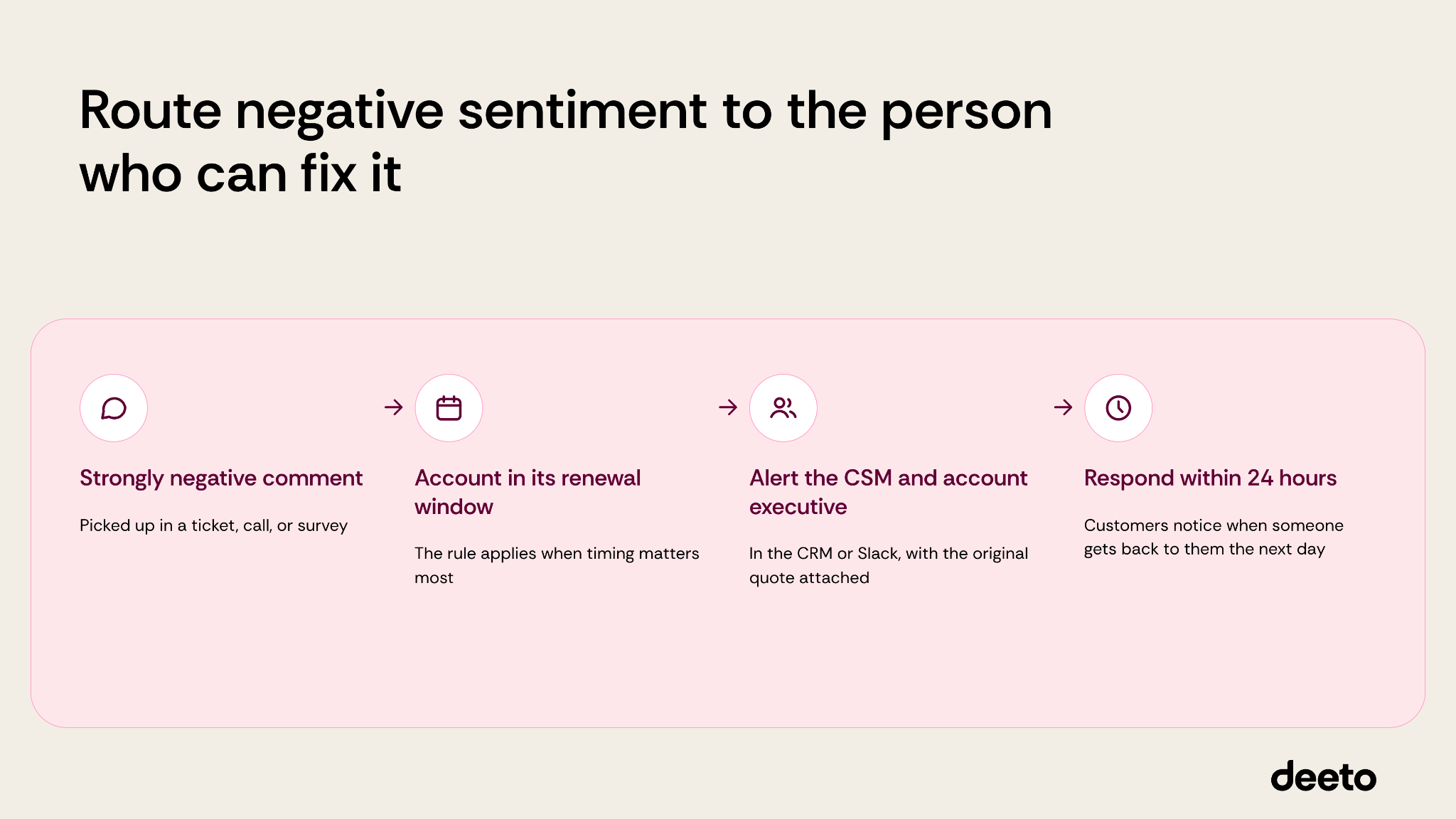
Then set a rule people can follow. For example, any strongly negative comment from an account in its renewal window goes to the CSM and the account executive within 24 hours, with the original quote attached. Customers notice when someone gets back to them the next day.
Conversation-level sentiment shows you where calls go wrong. If sentiment keeps dropping at the moment agents explain a policy or transfer a case, you have a script or process problem, and those can be fixed.
Managers can also pull calls that started badly and ended well, then use them for training. Real conversations with your own customers teach more than a generic soft-skills course.
"Great, another outage" reads as positive to a basic model. B2B language adds more traps, since words like "aggressive" or "critical" can be neutral or even positive in a technical conversation. Use models tuned on business conversations, and have someone spot-check a sample of scored comments each month.
Sentiment analysis can only read what customers actually say. If most of them stay quiet, the model works from a thin, skewed sample, usually your angriest and happiest customers. The fix is to give the middle more chances to speak up, through short in-product questions and AI-led customer interviews that pick up detail surveys miss.
A sentiment dashboard with no owner turns into wallpaper. Every tracked topic needs a team responsible for it and a threshold that triggers action. If nobody would change a decision based on a metric, stop tracking it.
This is the scattered-voice gap from earlier, and it's the most common reason sentiment programs stall. Each team sees its own slice of the customer, and nobody sees the whole account.
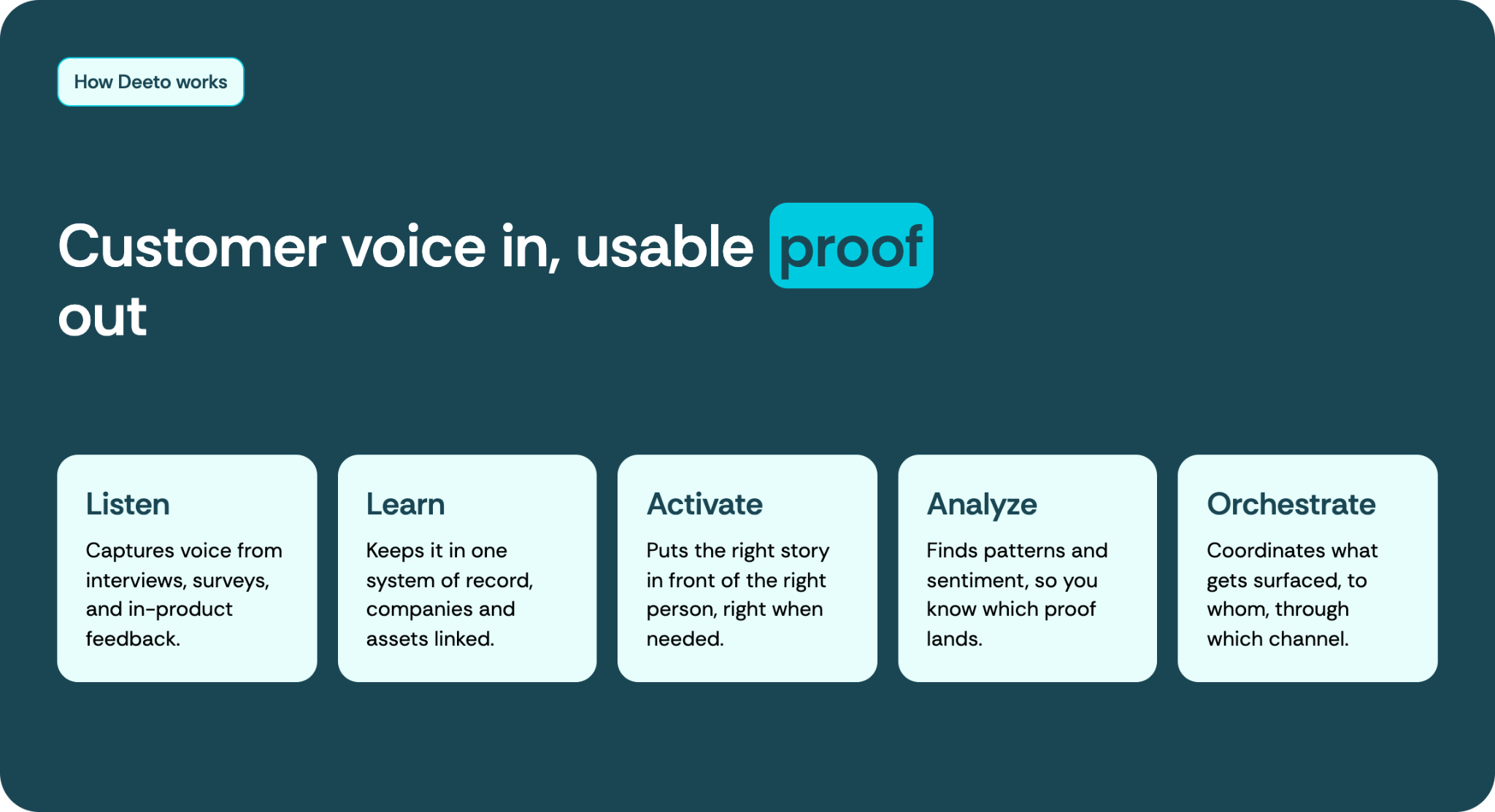
Closing it takes one system that turns customer voice into intelligence and routes it to the teams that can act. Deeto, a voice of the customer platform, is built that way. Listen captures customer voice from interviews, surveys, and in-product questions. Learn organizes it in one system of record tied to each account. Activate delivers the right signal to CS, product, or customer marketing in the tools they already use. Analyze applies AI sentiment analysis to every response and tracks patterns over time. Orchestrate runs the workflows that connect it all, so a frustrated comment becomes a CSM alert and a glowing one becomes an advocacy invitation.
For customer experience and success teams using Deeto this way, results include 10 to 15% higher renewal rates and 25% faster visibility into risk signals.
How can sentiment analysis be used to improve customer experience?
Sentiment analysis improves customer experience by showing how customers feel about specific topics, such as onboarding, pricing, or support, across every channel they use. Teams use it to find the cause behind falling scores, flag at-risk accounts before renewal, prioritize product fixes by emotional impact, and route negative feedback to the right owner quickly.
Does sentiment analysis replace NPS and CSAT?
No. Sentiment analysis works best alongside survey scores. Surveys give you a consistent benchmark to track over time, but they depend on customers responding and rarely explain why a score changed. Sentiment analysis reads tickets, calls, interviews, and open-text answers to show what's behind a score moving up or down.
What data sources work best for customer sentiment analysis?
The best sources are the ones where customers explain themselves in their own words: support tickets, call and meeting transcripts, open-text survey answers, customer interviews, CSM notes, and product reviews. Combining several sources per account gives a more accurate picture than any single channel, since each one captures a different moment in the relationship.
Can sentiment analysis predict customer churn?
Sentiment analysis can surface early warning signs of churn. A steady decline in tone, rising frustration about one topic, or phrases like "evaluating alternatives" often appear before usage drops. Combined with product usage and account data, sentiment trends give churn models context that usage alone misses, and they give customer success teams a specific reason to reach out.
What is aspect-based sentiment analysis?
Aspect-based sentiment analysis ties each emotion in a piece of feedback to a specific topic. Instead of scoring a whole comment as neutral, it separates "setup was painful" from "the support team was excellent" and records both. CX and product teams can then see which parts of the experience drive satisfaction and which cause frustration.
How accurate is AI sentiment analysis?
It depends on the model and the data it was trained on. Modern models handle straightforward feedback well but can struggle with sarcasm, mixed opinions, and industry jargon. Teams get better results by using models tuned to business conversations, scoring sentiment by topic rather than by whole comment, and having a person review a sample of results each month.
So how can sentiment analysis be used to improve customer experience? Mostly by telling teams what to fix and who owns it, based on the language customers already produce.
You don't need to start big. Pick one outcome, connect the feedback you already collect, and give every topic an owner. Teams that get value from sentiment use it to decide who to call this week. Teams that don't end up with a monthly report nobody opens.
Deeto brings customer voice from interviews, surveys, and conversations into one place, then turns sentiment into alerts and next steps for CS, product, and marketing. To see how that works for your team, book a demo.

What is sentiment analysis? Learn how it compares to NPS, where it catches churn, and how to put it to work.
Buyers check your claims before they trust them. Social proof in marketing is evidence that other people have bought your product and gotten value from it. It includes reviews, customer stories, ratings, video testimonials, and endorsements. It works because buyers use the choices of people like them as a shortcut when a decision feels risky.
Here are four ways to put social proof to work, along with the data behind each one and a simple way to measure whether it is paying off.

Social proof is the tendency to treat other people's choices as evidence of what is safe, correct, or worth buying. In marketing, social proof is any signal that real customers chose you and were glad they did. It includes reviews, testimonials, case studies, customer logos, ratings, awards, user-generated content, and word of mouth.
Psychologist Robert Cialdini lists social proof as one of six principles of persuasion, and his research adds a detail marketers should use. According to W. P. Carey School of Business at Arizona State University, the effect grows when the proof comes from multiple people and from people similar to the buyer. That is why a quote from someone in your prospect's exact role and industry often carries more weight than a bunch of anonymous five-star ratings.
The table below compares the six most common types of social proof and where each one fits best.
Teams often collect several of these types and store them in different places, which makes the right proof hard to find when a buyer needs it. Deeto gets the right customer story or piece of social proof to the right buyer at the right moment, instead of leaving it to sit in a folder until someone remembers to look.
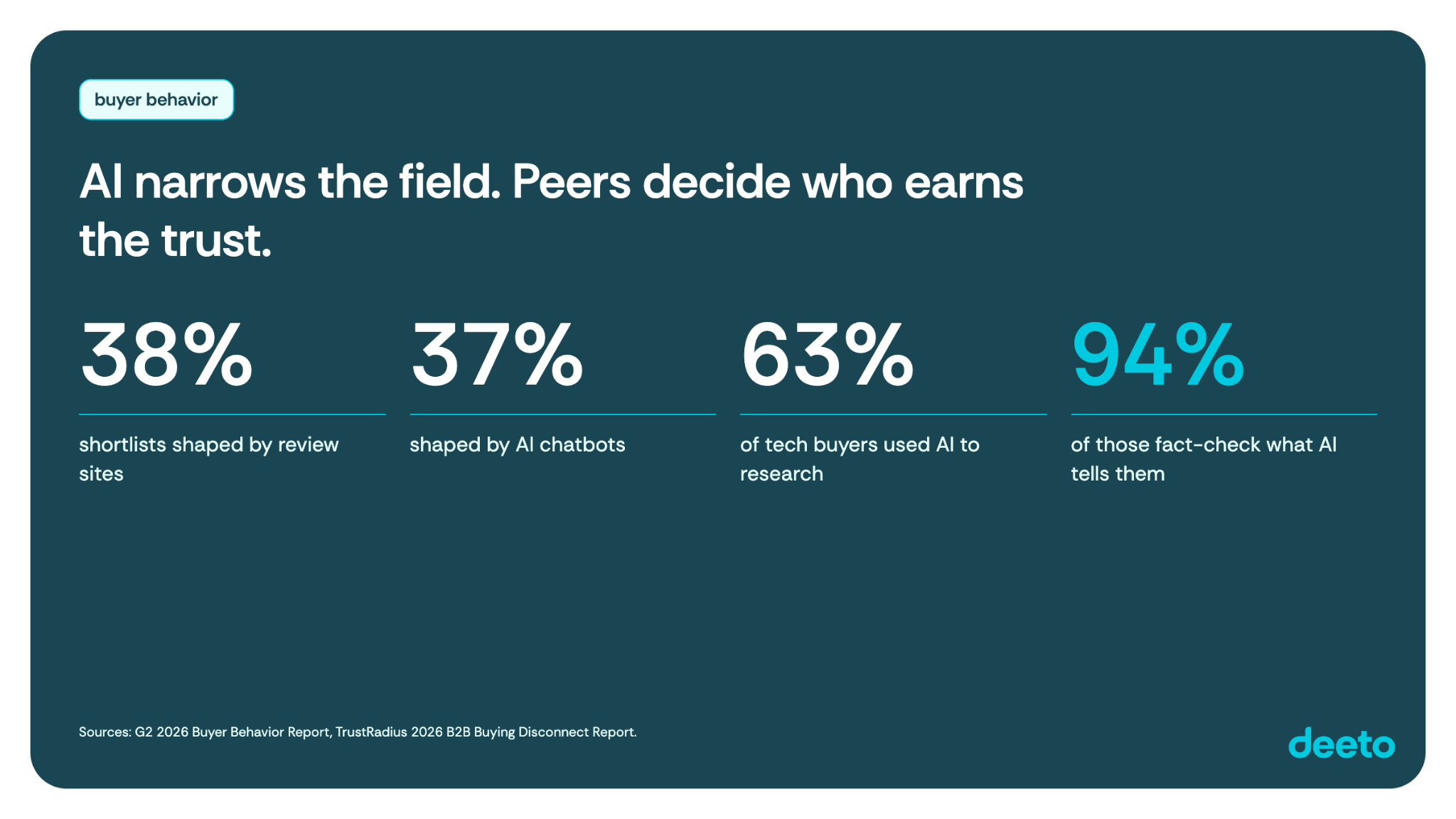
Buyers now verify before they commit, and they verify with other customers. G2's 2026 Buyer Behavior Report found that review sites (38%) and AI chatbots (37%) are the two biggest sources shaping software shortlists. Buyers let AI narrow the field, then lean on peer proof to decide which vendors earn their trust. Your customers' words now influence the shortlist twice, once directly and once through the AI tools that summarize them.
TrustRadius tells a similar story. Its 2026 B2B Buying Disconnect Report found that 63% of technology buyers used AI during their purchase process and that 94% of the AI users fact-check its answers at least some of the time. AI helps buyers find options, and other customers help them trust one.
Social proof helps marketing teams in four concrete ways.
Four approaches cover most of what works, and they build on each other. Start with the one your buyers meet first.
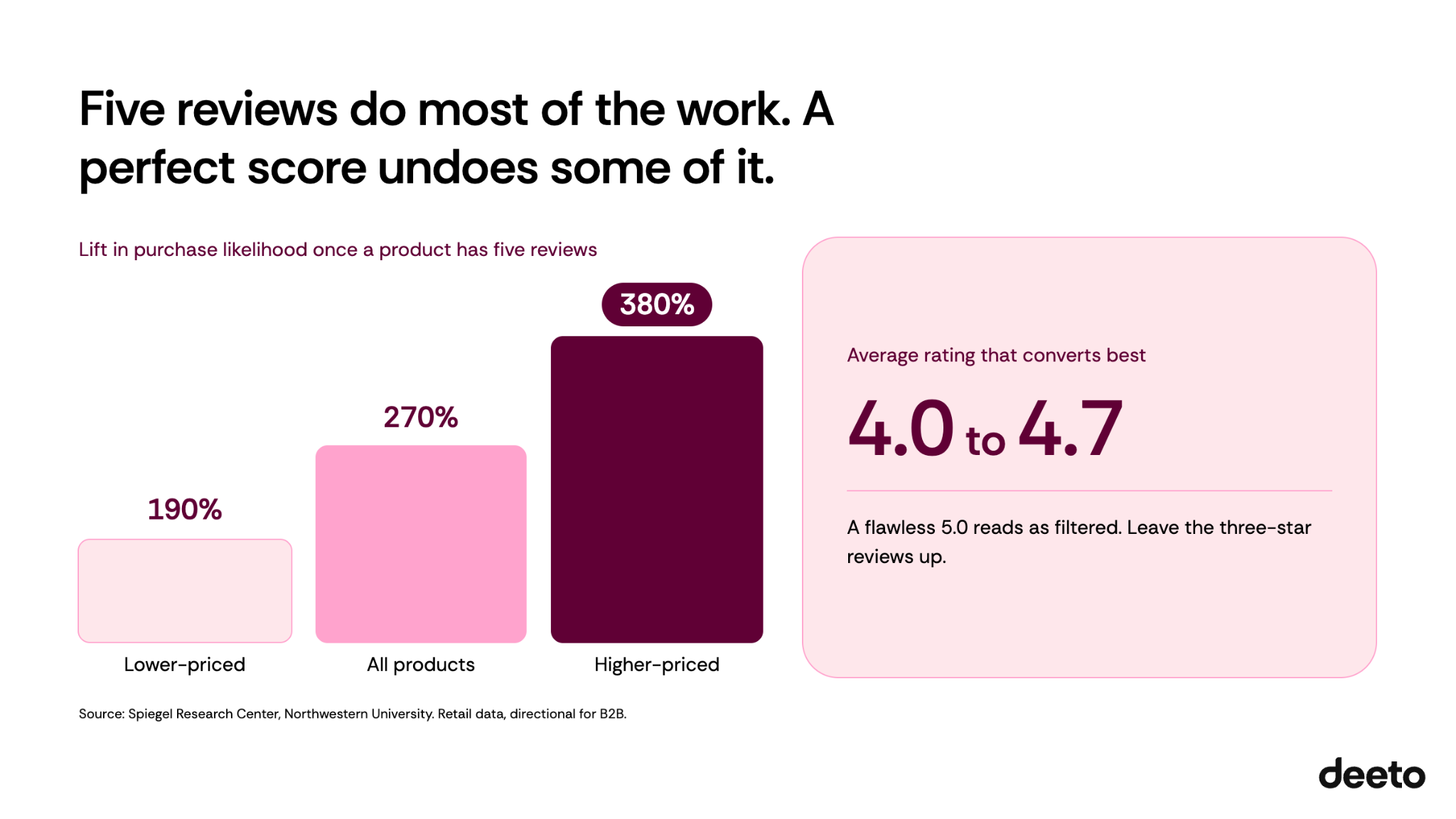
Reviews are a well-researched form of social proof. Northwestern University's Spiegel Research Center found that a product with five reviews had a purchase likelihood 270% greater than a product with none. The lift was bigger for pricier items, with conversion rising 380% for higher-priced products and 190% for lower-priced ones. The study looked at retail purchases, so read the exact percentages as directional for B2B. The direction matches what software buyers say about review sites.
There are two main details in the data that stand out. The benefit of extra reviews shrinks quickly after the first five, and purchase likelihood peaks when average ratings sit between 4.0 and 4.7, because a perfect 5.0 looks too good to be true.
Reviews also feed the AI answers buyers read first. When G2 asked what would raise buyers' confidence in a chatbot's answer, the top response was a citation from a review site. Reviews now convince the person reading them and shape the answer that person sees before they ever visit your site.
A generic testimonial can let potential clients know that your product works, but a matched story says it worked for someone like the person reading it. Picture a VP of Finance at a 500-person fintech reading a success story from a 20-person retail startup. The result might be impressive, but it doesn't answer her real question, which is whether this will work at a company like hers.
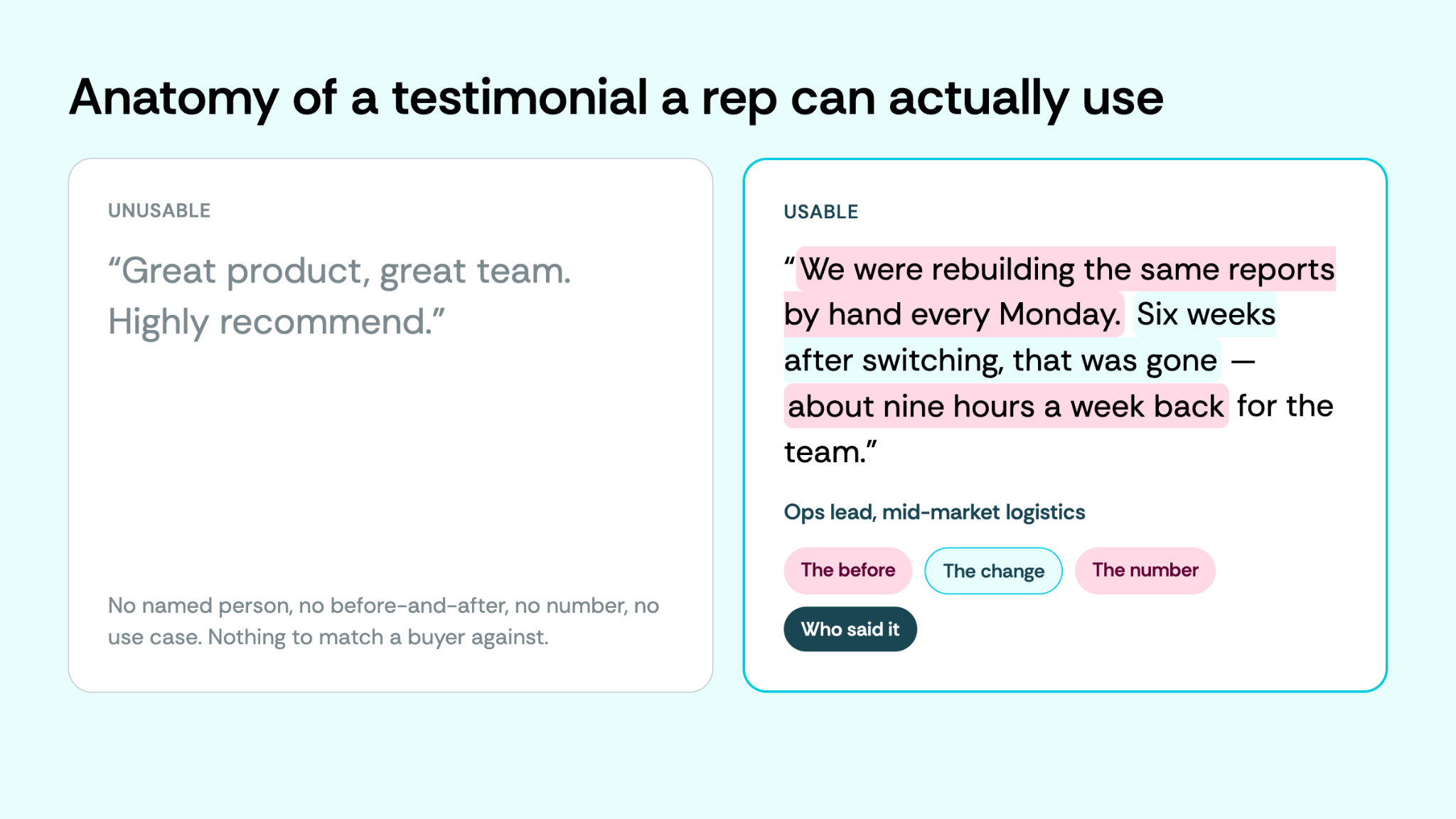
The Cialdini research above explains why the mismatch hurts. Build each story around the details buyers use to judge similarity, which are industry, company size, the role of the person quoted, and the problem being solved. Then include the parts that make a story evidence instead of a brochure:
Pairing each story with a measured result, the kind captured in ROI and impact studies, turns an anecdote into something a CFO will accept. Video testimonials add another layer, because buyers can see and hear a real person. Keep them short and tied to a single outcome.
Product marketing teams usually own the story library as part of their product marketing strategy. The library only pays off if a rep or campaign manager can find the right story in seconds, filtered by industry, company size, and use case.
Social proof tends to live on a website, while a lot of the deciding happens in calls, emails, and shared docs where the website is not in the room. A champion inside the buying group needs something to forward to a skeptical CFO or security lead, and it has to arrive at the right moment.
Deeto helps sales teams put matched customer evidence in front of a champion at the right stage, and customers see 20% to 30% faster sales cycles from that kind of contextual customer intelligence.
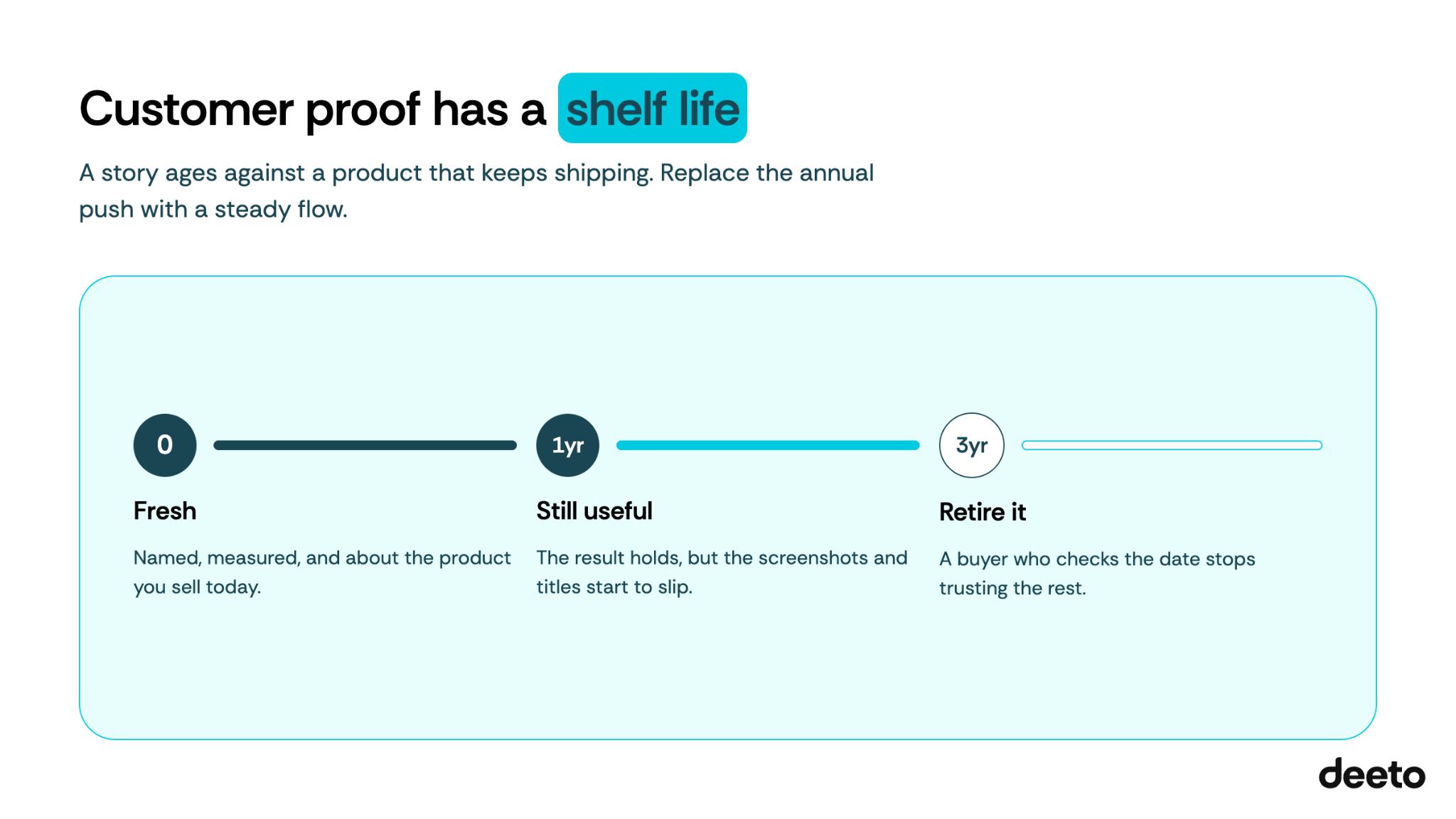
The simple fact is that customer proof goes stale. A story from three years ago about a product that has since changed loses credibility with every release. The fix is a steady flow of new customer voices instead of one yearly push for testimonials.
Advocates also create proof you cannot write yourself, including unprompted posts, referrals, and conference talks. Deeto helps teams capture customer feedback continuously and route the best voices to the teams that need them.
Social proof fails in predictable ways.
Measure social proof by tying each type to a behavior it should change. Track how much proof you have, whether buyers see it, and whether deals move when they do.
What is social proof in marketing?
Social proof in marketing is evidence that other people have bought your product and gotten value from it, shown through reviews, ratings, testimonials, case studies, logos, and endorsements. It works because buyers treat the choices of similar people as a shortcut when a decision feels risky, which lowers perceived risk and builds trust before a sales conversation.
What are the main types of social proof?
The main types are reviews and ratings, customer stories and case studies, video testimonials, customer logos, peer references, and social mentions or user-generated content. Reviews and logos help early shortlisting, stories and video help mid-funnel evaluation, and live references help late-stage risk reduction. Match each type to the moment a buyer needs it.
Why does social proof work?
Social proof works because people look to others when a choice feels uncertain. Psychologist Robert Cialdini lists it as one of six principles of persuasion, and his research shows the effect grows when the proof comes from multiple people who resemble the buyer. In B2B, that means peers in the same role or industry.
How many reviews do you need for social proof to work?
Fewer than most teams expect. Northwestern's Spiegel Research Center found that purchase likelihood rose sharply once a product had five reviews, then gained less from each additional review. More reviews still help credibility, but the first five do the most work. Average ratings between 4.0 and 4.7 performed best.
How do you use social proof in B2B marketing?
Publish reviews on the sites buyers use, match customer stories to each prospect's industry and role, and put proof inside the sales process through tagged libraries, live references, and CRM delivery. Then keep it fresh with ongoing advocacy and feedback. B2B buyers verify claims with peers, so proof from similar customers carries the most weight.
How do you measure social proof?
Track review volume and ratings, conversion on pages with and without proof, how often reps use proof in active deals, win rate when proof was shared, and mentions of your brand in AI answers. Pair win-rate data with win/loss interviews, because deals where reps share proof may already be stronger deals.
Buyers still want to hear from someone like them, and now they check what AI tells them against what customers actually say. Social proof in marketing works when it reaches the right buyer, in the right format, at the right moment. That means reviews where buyers look, stories matched to the reader, proof inside the deal, and a steady supply of new customer voices.
Start with one question: what are your customers already saying that your buyers never hear?
Deeto is a voice of the customer platform that helps teams capture, organize, and deliver authentic customer proof across marketing, sales, and success. To see how it works with your own customer evidence, book a demo.

What is social proof in marketing? Learn 4 ways to use reviews, stories, and advocacy to build buyer trust.
A customer marketing team needs three new case studies for a launch. They pull a list of thirty accounts, send the ask, and wait. Two weeks later they have three replies. Meanwhile, on calls that already happened last month, at least four customers said something that would have made a great quote. Nobody heard it, because nobody was listening for it.
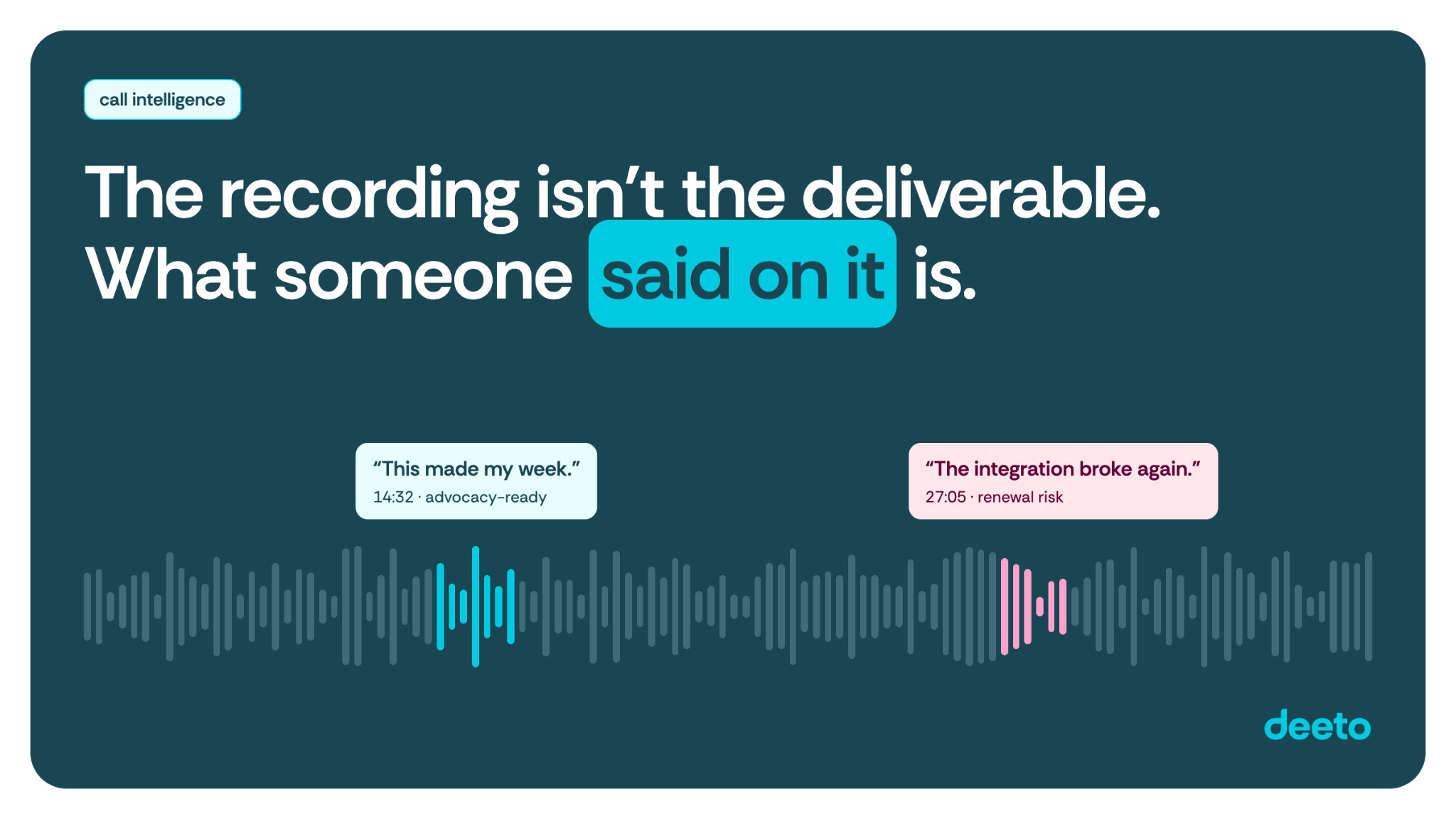
Call intelligence software analyzes sales and customer calls automatically to pull out sentiment, intent, and specific moments worth acting on, without tagging or re-listening to a recording after the fact. It runs on every call a company has, not just the ones someone remembered to flag, and it treats a good moment with the same attention as a bad one.
That's what Deeto Signals does. It's the part of Deeto that turns what customers actually say on a call into intelligence that reaches marketing, customer success, product, and sales, instead of staying locked in a recording only one person ever heard.
Here's what that changes.
Most teams already record their calls. Almost none of them get read back.
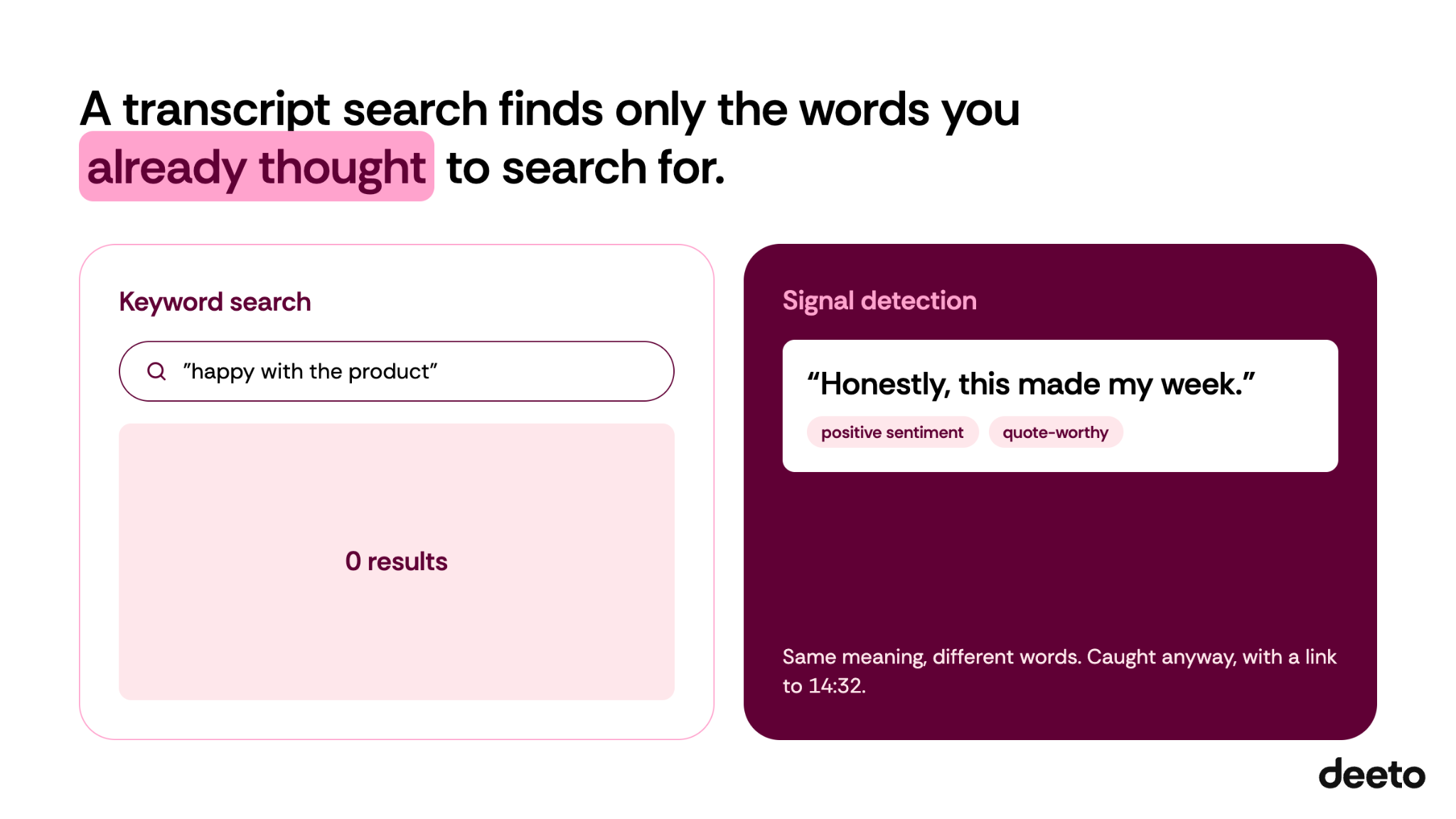
A transcript search only finds the words you already thought to search for. If a customer says "this made my week" instead of "I'm happy with the product," a keyword search misses it entirely. Sentiment doesn't live in the words on the page. It lives in tone, emphasis, the moment right before someone says something honest, and none of that survives a transcript dump into a shared drive.
So the calls pile up. Reps move to the next deal. CS moves to the next renewal. The thing a customer said that would have made a perfect testimonial sits in a recording nobody opens again.
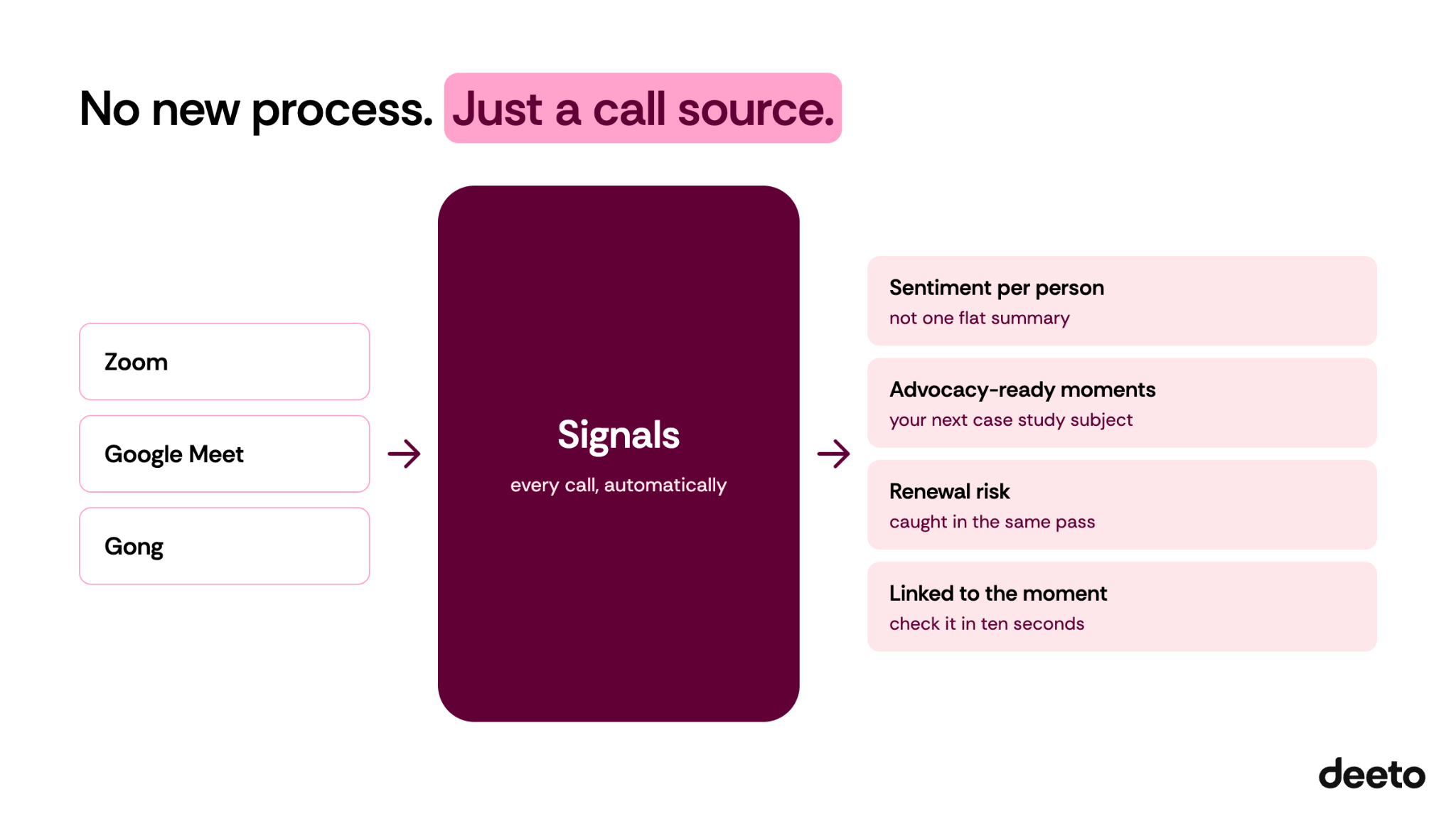
Deeto Signals runs automatically on every sales and customer call, the moment a call source is connected. There's no tagging, no manual review, and no workflow to remember. Connect Zoom, Google Meet, or Gong, and it starts working on the next call.
For every person on every call, Signals:
That last part matters more than it sounds. A flagged moment with no path back to the actual audio is a claim someone has to take on faith. A flagged moment with a timestamp is something a customer marketing manager can verify in ten seconds before they act on it.
Signals runs automatically on every sales and customer call as soon as a call source is connected. No tagging, no manual review, nothing to remember. Connect Zoom, Google Meet, or Gong, and it starts working on the next call.
For every person on every call, it pulls out what was actually said (not what got typed into notes afterward), scores sentiment and relevance person by person so a five-person call doesn't get flattened into one generic summary, and links every signal back to the exact moment in the recording. A flagged moment with no path back to the actual audio is a claim someone has to take on faith. One with a timestamp is something a customer marketing manager can check in ten seconds before acting on it.
Call intelligence tools are built to catch churn risk, but that only covers half the job. The good moments are just as detectable, and they're what an advocacy program runs on. When a customer says a feature saved their team hours, or that switching to the product was the easiest vendor decision they've made all year, that's not just nice to hear. It's a signal.
Signals surfaces who's advocacy-ready based on what a customer actually said, not an NPS score or a CSAT survey someone has to remember to send. It suggests candidates before anyone goes looking, the same way a well-run customer reference program depends on knowing who to ask before the ask feels cold. Your next case study subject identifies themselves. You just finally hear it.
Most customer sentiment analysis tools weren't built for that. They're tuned to catch what's going wrong. Few catch what's going right, at the level of one specific person on one specific call, in a form a customer marketing team can actually use that same day.
None of this comes at the expense of risk detection. Signals runs the same pass for renewal risk and product friction as it does for advocacy-ready moments. There is no separate setup, no second tool to connect, and no tradeoff between watching for the good and watching for the bad.
A frustrated comment about a broken integration gets flagged the same way a glowing comment about time saved does. Both go to the person who needs to see them, linked to the moment they happened.
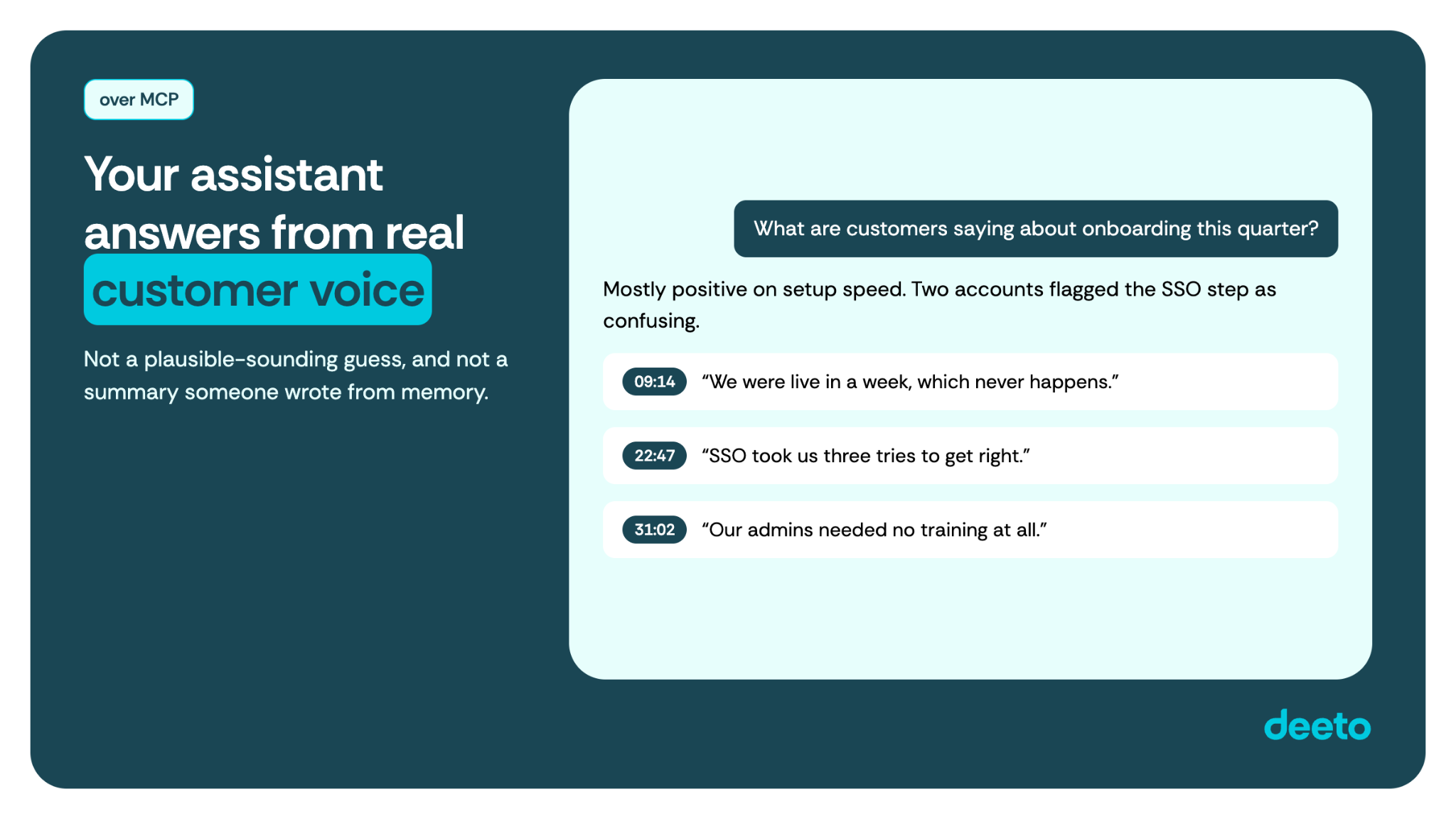
Every signal Signals surfaces is available over MCP, so the assistant a team already uses, such as Claude or ChatGPT, can answer questions from what customers actually said instead of filling gaps with a plausible-sounding guess.
Ask what customers are saying about onboarding this quarter, and the answer comes from real call moments instead of a summary someone wrote from memory three weeks ago.
Signals doesn't need a new process. It needs a call source. Connect Zoom, Google Meet, or Gong, and every call from that point forward gets the same pass: sentiment scored per person, advocacy-ready moments flagged, renewal risk caught, all of it linked back to the exact moment it happened.
The recording isn't the deliverable. What someone said on it is.
What is call intelligence software?
Call intelligence software analyzes sales and customer calls automatically to extract sentiment, intent, and specific moments worth acting on. It works without manual tagging or re-listening, scores each person on a call individually, and links flagged moments back to the exact point in the recording where they happened.
How is this different from call recording or transcription?
Recording and transcription capture what was said. They don't tell anyone which parts matter. Call intelligence software adds automatic sentiment scoring, per-person relevance, and moment-level linking on top of the raw transcript, so the useful parts surface without anyone reading the whole thing.
Does call intelligence software only flag negative signal, like churn risk?
Most tools in this category are built primarily for risk detection. Signals scores positive and negative signal in the same automatic pass, so advocacy-ready moments get surfaced with the same rigor as renewal risk instead of being an afterthought.
Can call intelligence data feed an AI assistant?
Yes. Connected over MCP, the customer intelligence a tool like Signals extracts can be queried directly by an LLM such as Claude or ChatGPT, so answers about customer sentiment or product feedback come from real call moments instead of a summary or a guess.

What is call intelligence software? Learn how it scores every call automatically and surfaces advocacy-ready customers.
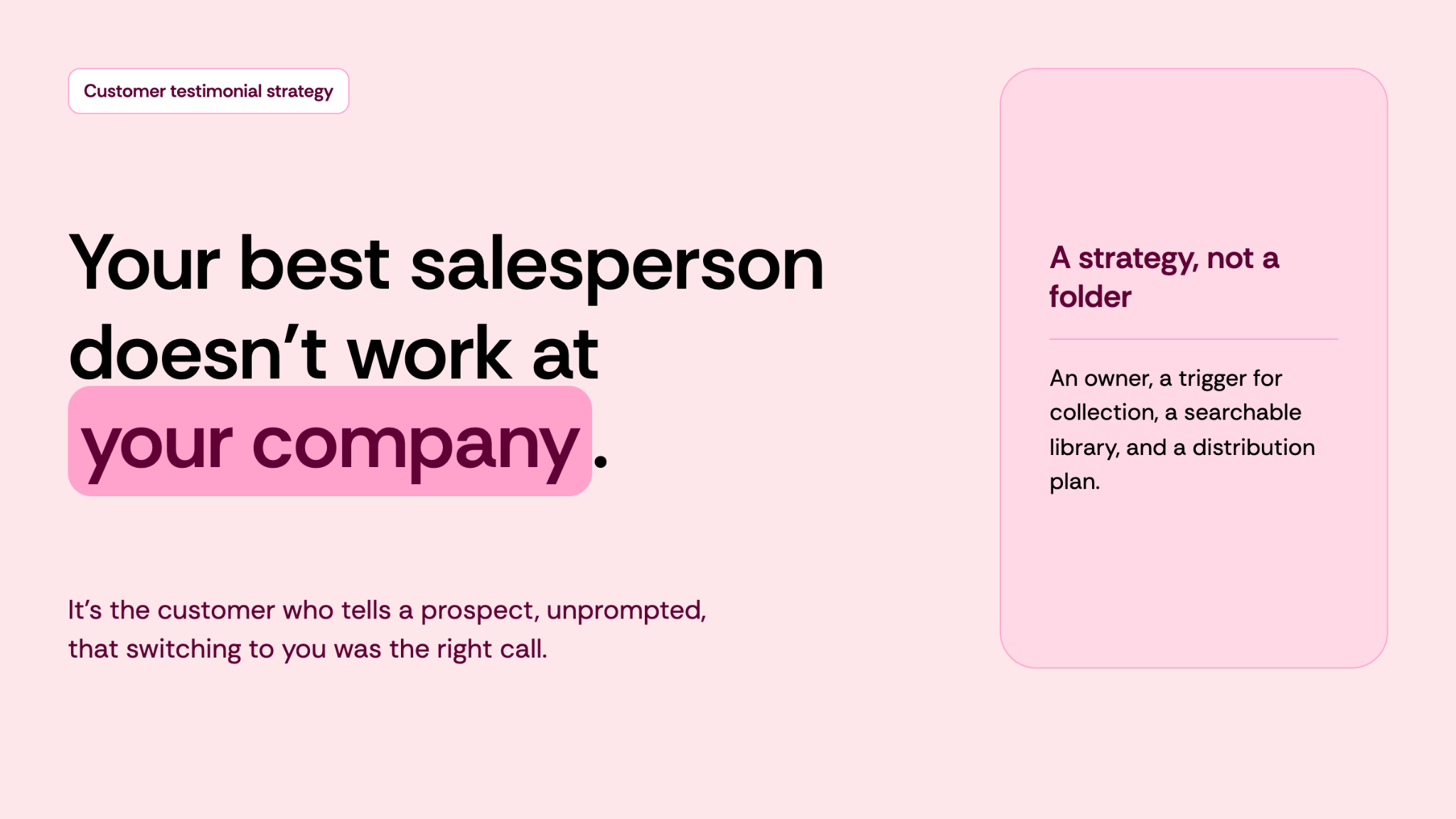
Your best salesperson doesn't work at your company. It's the customer who tells a prospect, unprompted, that switching to you was the right call.
A customer testimonial strategy is the system a company uses to collect, organize, and place customer proof in front of the right buyer at the right stage of the deal. That includes written quotes, video testimonials, case studies, and review site content. Done well, it turns scattered praise into a repeatable source of pipeline and revenue. This article covers what that system looks like, the types of testimonials worth collecting, and how to build one your sales and marketing teams will actually use.
A customer testimonial strategy is a defined process for identifying which customers have a story worth telling, capturing that story in a usable format, and routing it to the sales reps, marketers, and campaigns that need it. It is not a folder of quotes someone collects after a happy support ticket. A customer testimonial strategy includes ownership, a repeatable capture process, a system of record, and a way to measure whether the proof is actually influencing deals.
Customer testimonial strategies include four parts: a trigger for when to ask (renewal, NPS spike, support win, expansion), a structured way to capture the story, a searchable library organized by industry, persona, and use case, and a distribution plan that gets proof onto the pages, decks, and calls where it matters.
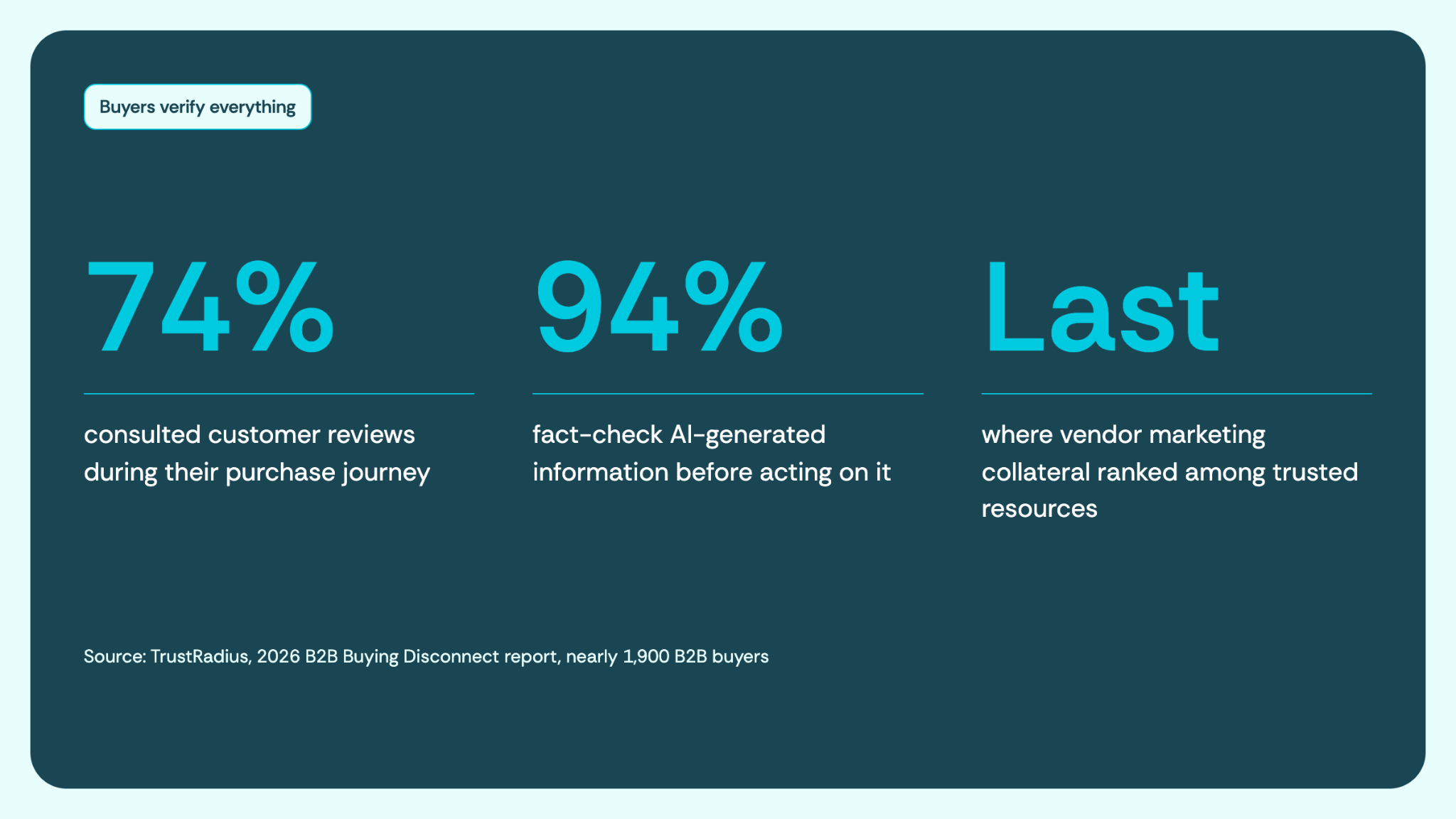
Buyers are done taking vendors at their word. According to the 2026 B2B Buying Disconnect report from TrustRadius, which surveyed nearly 1,900 B2B buyers, 74% consulted customer reviews during their purchase journey, and vendor marketing collateral ranked dead last among the resources buyers said they actually trust. Nearly half of buyers said they trust online resources less than they did a year ago.
That skepticism is not going away. It's the reason a testimonial strategy has to be more deliberate than "post a quote on the homepage." Buyers are cross-referencing everything, including what shows up in AI-generated summaries, and the same report found that 94% of buyers fact-check AI-generated information before acting on it. If your customer voice isn't documented, organized, and discoverable, it isn't influencing how buyers decide about your product, whether they're searching Google or asking an AI tool.
Deeto is built on the idea that authentic voice is an input, not a marketing afterthought. A customer testimonial strategy is one of the clearest ways to put that principle into practice: it turns real customer language into social proof that holds up under the scrutiny buyers now apply to every claim a vendor makes.
Your company doesn’t lack happy customers, it lacks a system. The usual failure points include:
Not every testimonial format does the same job:
The strongest testimonial strategies use all five, matched to where the buyer actually is, rather than betting everything on one format.
Five steps build a customer testimonial strategy that actually drives revenue.
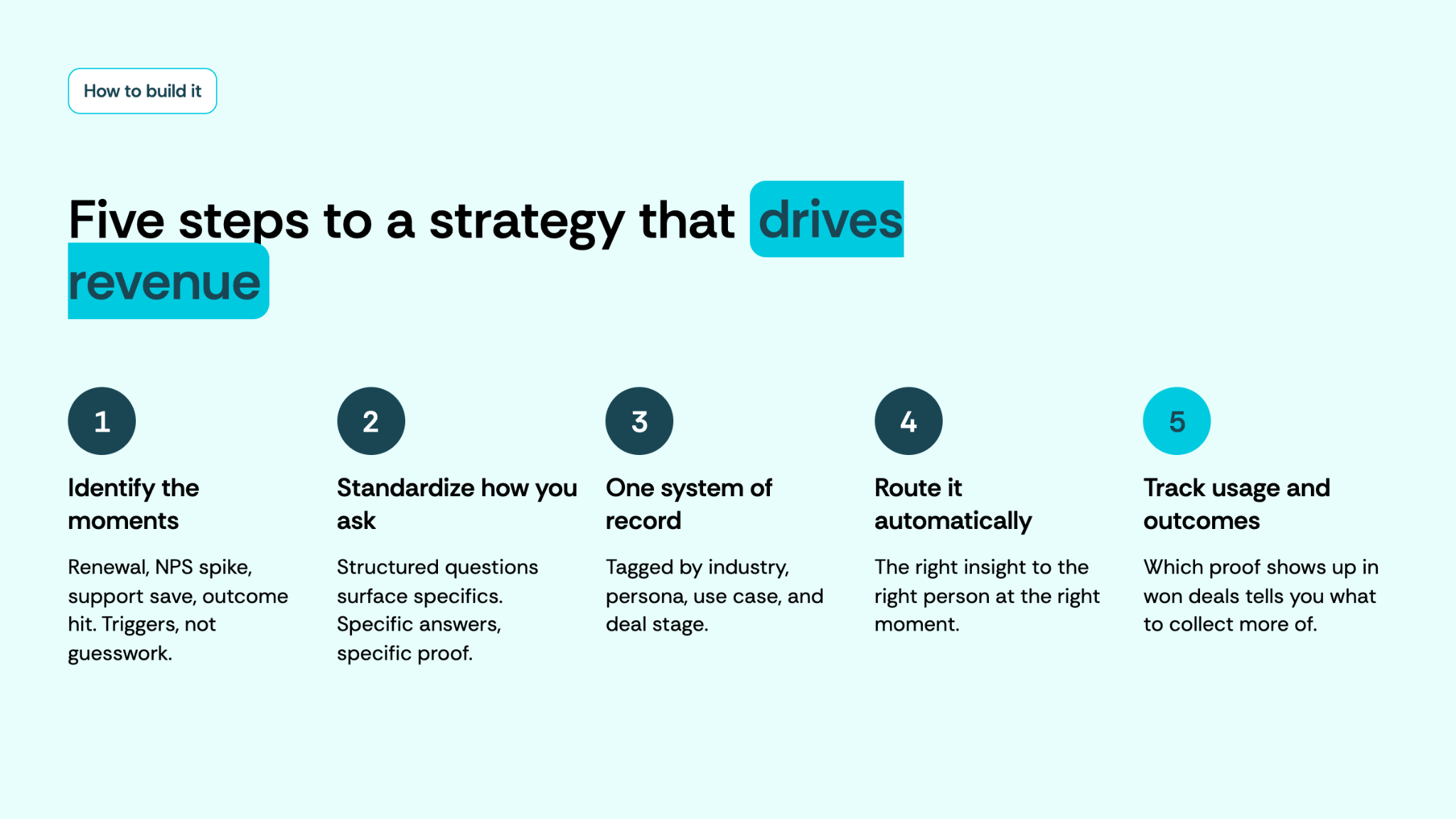
Deeto's Analyze module supports the last step directly, surfacing which stories and stats are actually correlating with faster-moving deals, so the strategy improves over time instead of staying static.
Collecting testimonials is only half the job. Getting them in front of the right person, consistently, is what makes the difference between a nice-to-have library and a revenue driver. Ownership matters here. In most organizations, the customer marketing team is best positioned to run this program, since they already sit between customer success, product marketing, and sales.
Companies that treat customer testimonials as connected intelligence, rather than isolated marketing assets, are the ones seeing it show up in win rates. Deeto customers using activated customer proof in active deals have reported 10 to 15% higher win rates, a gap that tends to widen as the testimonial library and its usage data mature.
What is a customer testimonial strategy?
A customer testimonial strategy is a defined system for identifying which customers have a story worth capturing, collecting that story in a usable format, and delivering it to the sales reps, marketers, and campaigns that need it. It includes ownership, a repeatable capture process, and a way to measure business impact.
How do you get customers to give testimonials?
Ask at the right moment, not randomly. Renewal conversations, high NPS scores, support wins, and measurable milestones are natural trigger points. Use structured questions that surface specifics instead of a generic "would you write us a review" ask.
What's the difference between a testimonial and a case study?
A testimonial is a short, attributed statement, often a sentence or two. A case study is a longer narrative that walks through the customer's problem, the switch, and the measurable outcome. Case studies take more effort to produce but carry more weight with buyers comparing vendors.
How many customer testimonials should a company collect?
There's no fixed number. The goal is coverage: enough testimonials across your key industries, personas, and use cases that a rep or marketer can always find one relevant to the buyer in front of them, rather than reusing the same two quotes for every deal.
Do video testimonials work better than written ones?
They serve different purposes. Video testimonials tend to carry more weight because they're harder to fabricate and easier for a prospect to relate to, which makes them well suited to late-stage sales conversations. Written quotes are faster to produce and easier to place broadly, which makes them better for top-of-funnel trust signals.
How do you measure the ROI of a customer testimonial strategy?
Track which testimonials get pulled into active deals, which ones appear in won opportunities, and which ones never get used. Tying testimonial usage to deal velocity and win rate turns a testimonial library from a marketing asset into a measurable part of the revenue engine.
A pile of quotes isn't a strategy. A customer testimonial strategy works when it has an owner, a repeatable way to collect stories, a system that makes them findable, and a path that gets the right proof to the right person before a deal is lost to doubt. Buyers are verifying everything now, and the vendors who win are the ones whose customers are already doing the talking.
If your customer proof is scattered across drives, decks, and someone's inbox, it's worth seeing what it looks like organized into one connected system. Pair this with a customer reference program and the two work together instead of competing for the same customers' time. See how Deeto helps teams turn customer voice into activated proof.

What is a customer testimonial strategy? Learn how to collect, structure, and activate proof that closes deals.
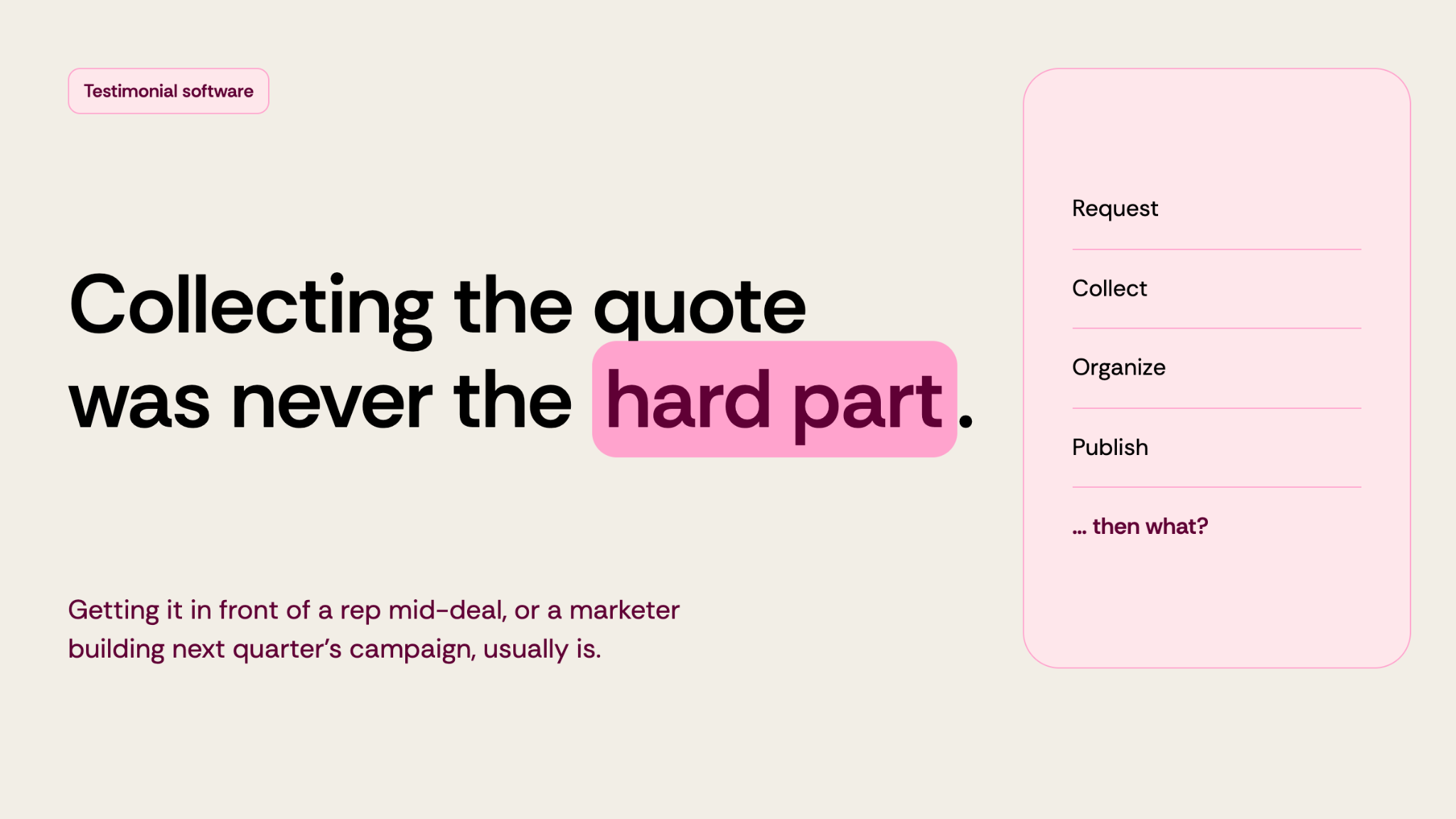
If your company collects testimonials the same way it collects junk mail, meaning something arrives, someone forwards it, and it sits in a folder nobody opens again, then it’s worth asking what testimonial software could do for you.
Customer testimonial software is any tool built to request, collect, organize, and publish customer feedback, including written quotes, star ratings, and video testimonials, usually through a hosted collection form and embeddable widgets. This article compares the leading platforms on the market, from lightweight widget builders to full testimonial management software, and looks at where each one runs out of road once testimonials need to do more than sit on a landing page.
Customer testimonial software makes turning customer feedback into visible proof easier. Many customer testimonial platforms include a shareable collection form or link, a dashboard for tagging and approving submissions, and embeddable widgets like walls, carousels, or badges that publish testimonials on a website without a developer.
You'll see this category marketed under a few overlapping names: testimonial management software, testimonial collection tools, and customer testimonial apps. The core workflow is the same across all of them:
For a solo founder collecting their first ten reviews, that workflow is often enough. For a B2B marketing team trying to prove ROI across sales, marketing, and customer success, it usually isn't. That gap is where most of the platforms below start to show their limits.
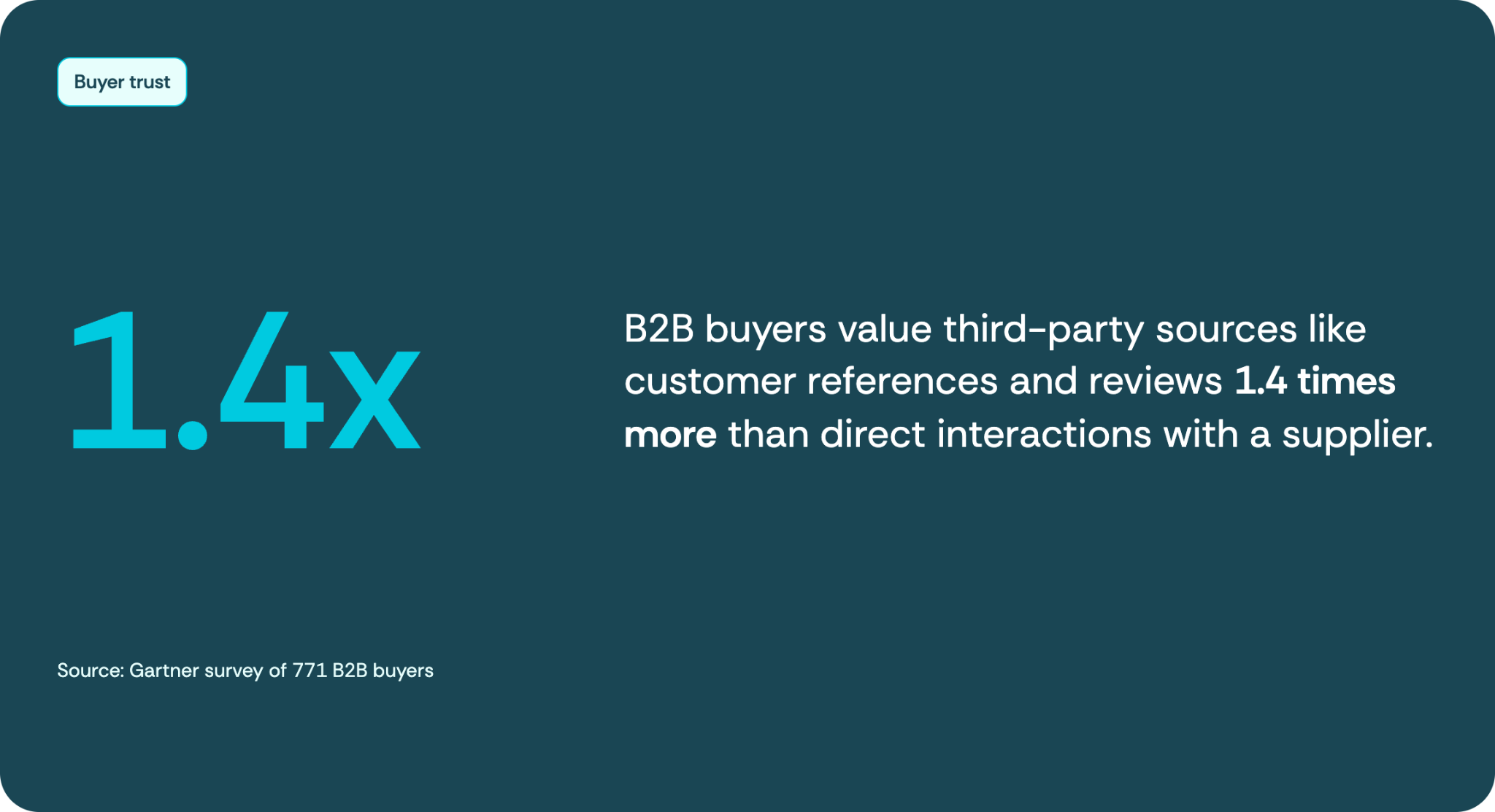
Buyers don't trust vendors to describe their own products accurately, and they haven't for a long time. A Gartner survey of 771 B2B buyers found that third-party sources like customer references and reviews are valued 1.4 times more than direct interactions with a supplier when it comes to building purchase confidence. That is exactly why testimonials can't stay a marketing side project. They're one of the few assets a buyer actually trusts more than anything the vendor says directly.
Content Marketing Institute's 2025 B2B benchmark report found that case studies and customer stories rank among the most effective content formats B2B marketers use, trailing only video. The two are converging fast: a strong video testimonial is often a case study that takes 90 seconds to watch instead of five minutes to read.
The problem isn't collecting customer feedback. The problem is connecting it to the moment a buyer or renewal decision actually gets made.
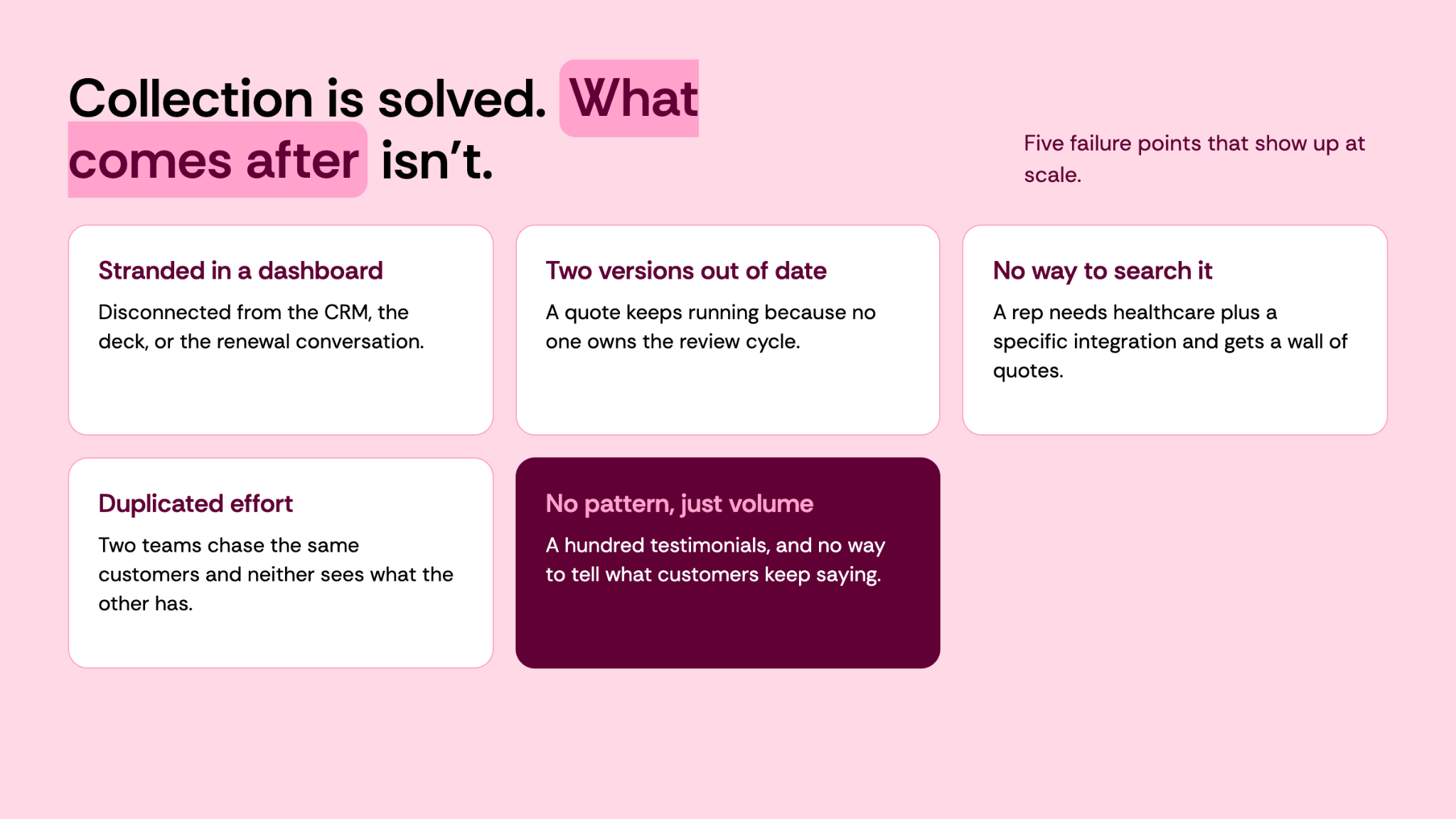
Testimonial management software solves the collection problem well. It rarely solves what comes after:
Here's how the most-used platforms in this space compare on collection, display, and where each one tends to hit a ceiling.
Most of these platforms do one part of the job very well: getting a customer to say something nice and putting it somewhere visible. Deeto starts from a different question. Once you have that customer voice, how does it reach a rep mid-deal, a marketer building a campaign, or a product team deciding what to fix next? That's the difference between customer stories and social proof that sit on a page and customer intelligence that moves through an organization.
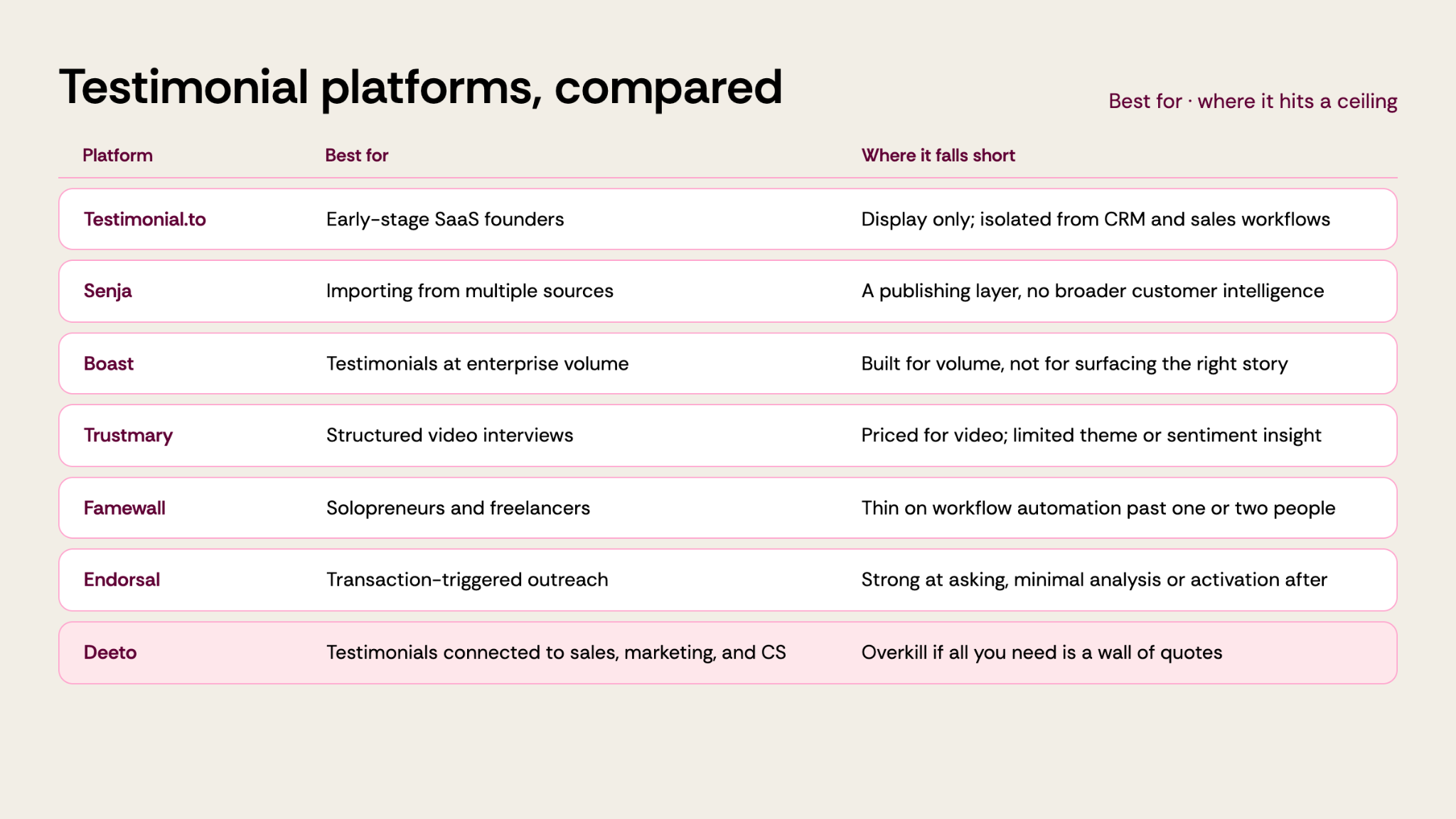
Testimonial.to built its reputation on the Wall of Love, a masonry-style widget that displays a scrolling grid of text and video quotes. Collection happens through a single shareable link, with little setup required on either side. That simplicity has made it a default choice for early-stage SaaS founders who want a first wall of proof live within an afternoon. The tradeoff is that testimonials stay exactly where they're collected. There's no path from a quote into a CRM, a sales deck, or a nurture campaign.
Senja goes a step further than a shareable link by auto-importing existing reviews from sources like Google, X, and app stores, then letting a team customize how each one displays through a widget builder. It also includes an AI-powered analysis feature that surfaces common phrases across collected testimonials, which is more than most tools in this category offer. That makes it a solid fit for marketing teams that already have praise scattered across the web and want one place to manage and understand it. Its ceiling is what happens after the analysis. Senja can tell a marketer which phrases show up most often, but it has no way to route a specific testimonial to the rep or campaign that needs it.
Boast is built for volume. Its guided video collection flows are designed for sales and customer success teams running dozens or hundreds of requests through structured prompts, and testimonials can be tagged by product, location, or staff member with reporting to track trends. That makes it a reasonable fit for enterprise teams building out a large testimonial library. What Boast doesn't solve is getting that testimonial out of its own dashboard. A rep still has to log into Boast and search, rather than finding the right story already sitting inside their CRM record.
Trustmary leans furthest into feedback analytics of any platform on this list, with built-in sentiment analysis and survey-based flows built specifically for structured customer interviews. Teams already running NPS or CSAT programs get a more complete feedback and testimonial workflow here than anywhere else in this list, but the pricing and setup reflect that broader scope. For a team that just needs a handful of quick text testimonials, Trustmary is likely more platform than the job calls for.
Famewall keeps things simple. A browser-based recorder lets a customer submit a testimonial in a few clicks, with no coding and no developer needed, and its AI Composer helps customers draft feedback faster. That's an advantage for solopreneurs and freelancers just getting started. Once a team grows past one or two people running the review process by hand, Famewall's limited workflow automation becomes the bottleneck.
Endorsal's whole model is automation on the ask. It connects to transaction data and fires timed email sequences requesting a testimonial from recent customers, without anyone manually tracking who's been asked. What it lacks is anything on the other side of that process. Once a testimonial lands, there's minimal analysis of what it actually says or where it should go next.
Deeto approaches the category from a different angle. Instead of treating testimonials as a standalone asset to collect and display, Deeto captures customer voice continuously through interviews, surveys, and in-product feedback, then routes the right story to the right person: a rep mid-deal, a marketer building a campaign, or a CS lead prepping a QBR. That makes Deeto overkill for a team that only needs one wall of quotes on a landing page, and the right fit for a B2B team that wants testimonials working across sales, marketing, and customer success instead of sitting in a folder.
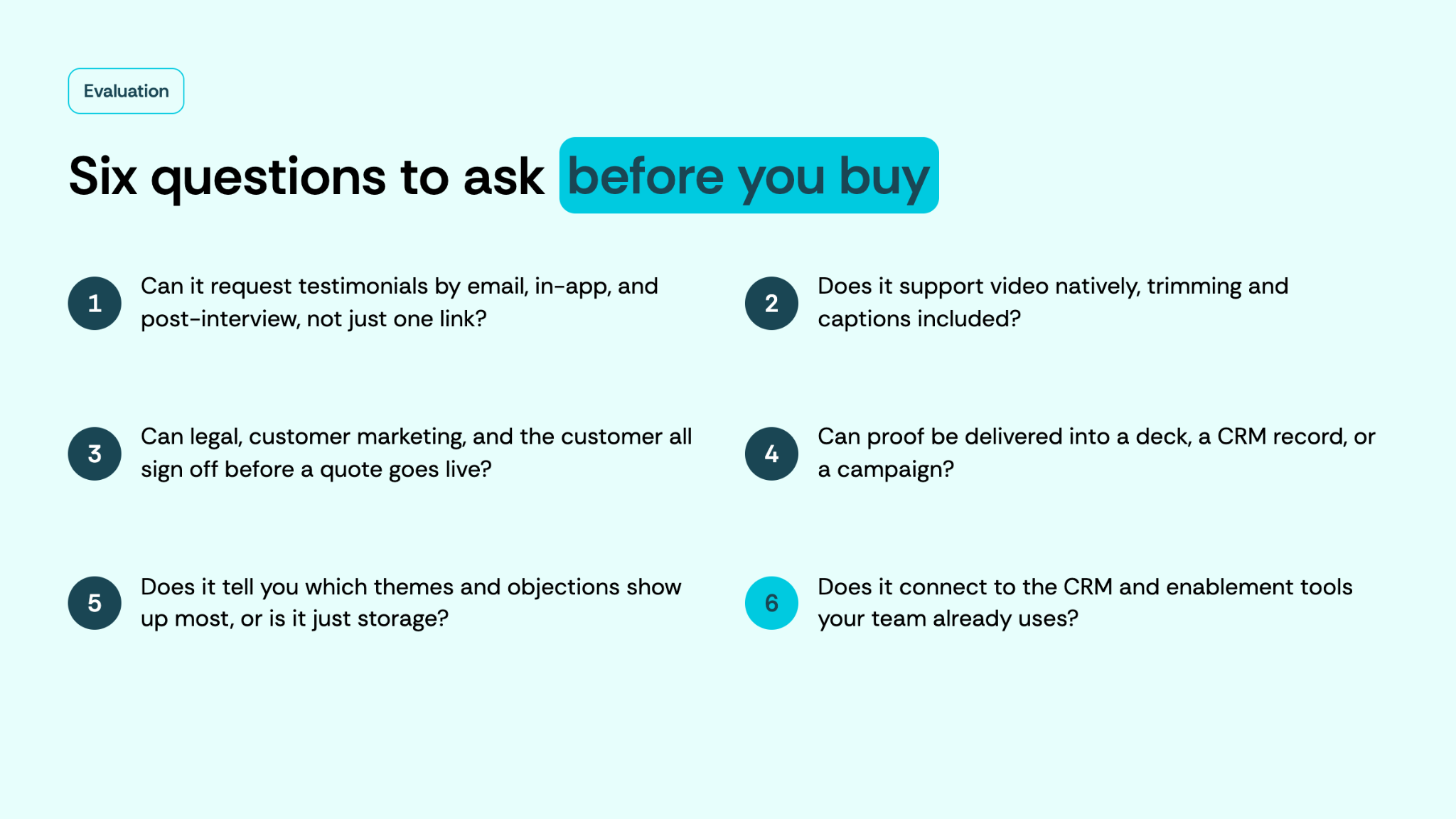
Before choosing a platform, match the tool to what your team needs it to do:
A tool that nails collection and display but fails on the last couple of questions will always feel like it's missing something. That missing piece is usually the reason testimonial projects stall after the first few months.
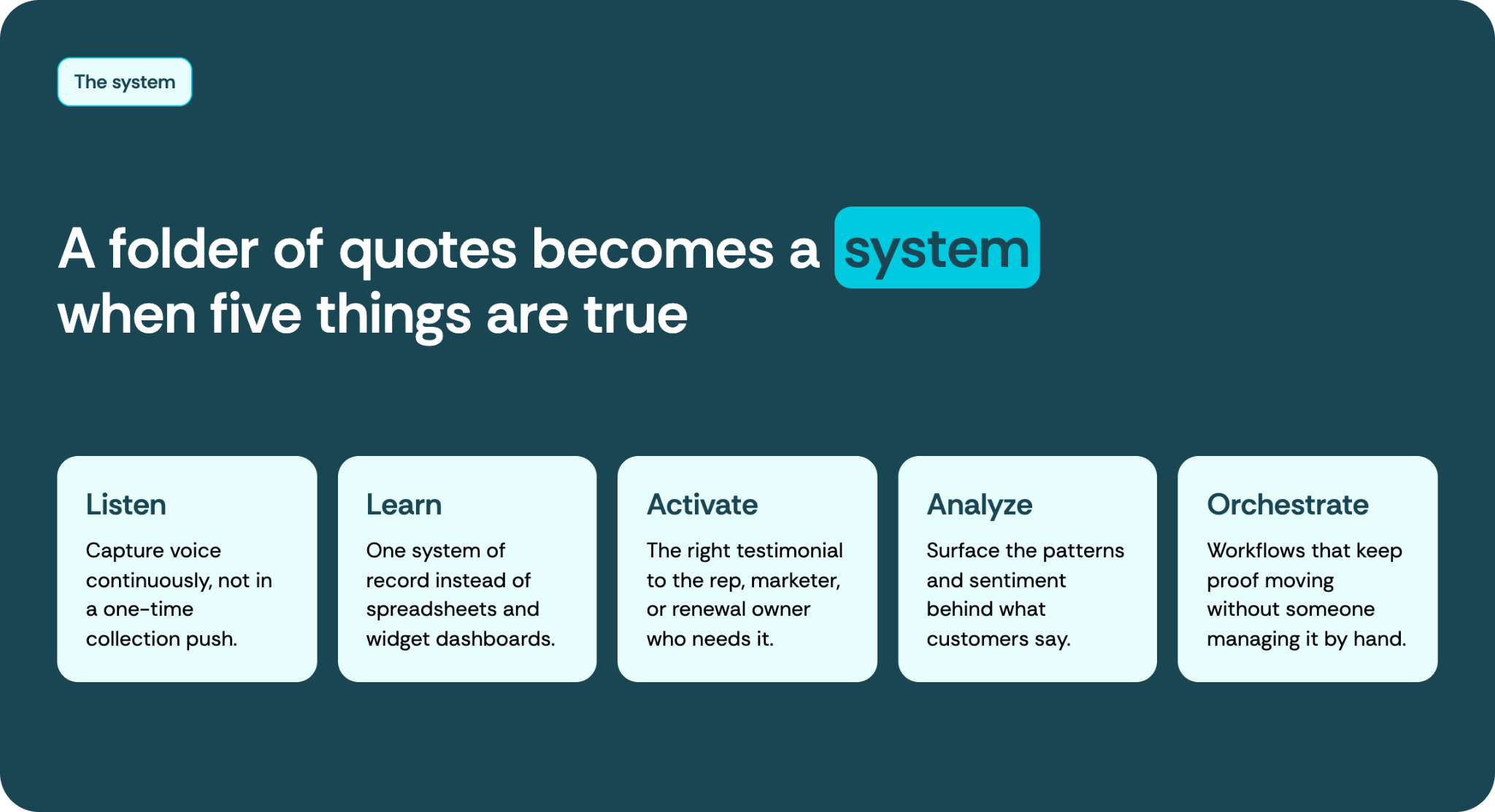
Testimonial management software becomes a system, not a folder of quotes, when four things are true at once. It needs to listen, capturing customer voice continuously through interviews, surveys, and in-product micro-feedback instead of a one-time collection push. It needs to learn, keeping every testimonial, quote, and story in one system of record instead of scattered across spreadsheets and widget dashboards. It needs to activate, getting the right testimonial to the right person, whether that's a rep mid-deal, a marketer drafting a case study, or a renewal owner building a QBR. It needs to analyze, surfacing the patterns and sentiment behind the testimonials so a marketing team knows which themes actually resonate before building the next campaign. And it needs to orchestrate, running the workflows and automations that keep every testimonial moving to the right place without someone managing it by hand.
That five-part model is what Deeto's platform is built around; take customer feedback that would otherwise sit in a folder and turn it into something sales, marketing, and product teams can actually use. If your team already has a customer reference program in place, the same infrastructure that powers references can power testimonials, case studies, and reviews without building three separate systems.
What is customer testimonial software?
Customer testimonial software is a tool that helps businesses request, collect, organize, and publish customer feedback such as written quotes, star ratings, and video testimonials. Most platforms include a collection form, a management dashboard, and embeddable widgets for displaying testimonials on a website.
Is testimonial management software the same as testimonial software?
The terms are used interchangeably in the market. "Testimonial management software" tends to describe platforms with more robust organization features, like tagging, approval workflows, and multi-source imports, while "testimonial software" is often used more broadly, including simple display-only tools.
Do I still need testimonial software if I already collect reviews on G2 or Capterra?
Yes, in most cases. Third-party review sites are valuable for discovery and trust, but testimonial software lets you collect feedback tailored to your own use cases, display it on your own site, and route it to sales or marketing where a G2 review can't reach.
How much does customer testimonial software typically cost?
Pricing varies widely by category. Lightweight widget tools often start with a free tier and move into the tens of dollars per month. Video-first and enterprise-focused platforms typically run into the hundreds of dollars per month, reflecting the added infrastructure for recording, hosting, and workflow automation.
Can testimonial software integrate with a CRM?
Some can. Integration depth is one of the biggest differentiators in this category. Widget-focused tools often stop at basic exports, while platforms built around customer intelligence, like Deeto, are designed to surface testimonials directly inside CRM records and sales workflows.
What's the difference between testimonial software and a voice of the customer platform?
Testimonial software is built to collect and display one type of asset. A voice of the customer platform captures customer voice across formats, including testimonials, interviews, and feedback, then analyzes it and routes it to the teams and moments where it drives a decision.
Customer testimonial software solves a real problem: getting a customer to say something good and putting it where a prospect can see it. For a team with one landing page and a handful of quotes, that's often enough.
B2B teams juggling testimonials alongside case studies, reviews, and reference requests run into a different question. Collecting the feedback was never the hard part. Getting it in front of a rep at the right moment, or a marketer building next quarter's campaign, without someone digging through a widget dashboard, usually is.
That's the gap Deeto is built to close. If your team is ready to move past a wall of quotes, see how Deeto works.

What is customer testimonial software? Compare 7 platforms, see how they stack up, and learn how to choose the right one
B2B buyers stopped taking vendor claims at face value a while ago. They read reviews, ask people in their network, and increasingly ask AI tools to compare vendors before a sales rep ever gets a reply.
Customer proof marketing is the practice of using real customer testimonials, reviews, case studies, and quotes, instead of vendor-written claims, to demonstrate a product's value to prospective buyers. It replaces "trust us" messaging with evidence buyers can verify for themselves.
This guide covers why customer proof marketing matters, the proof types that actually convert, how to build a repeatable system for collecting and using it, and where social proof marketing software fits into that system.
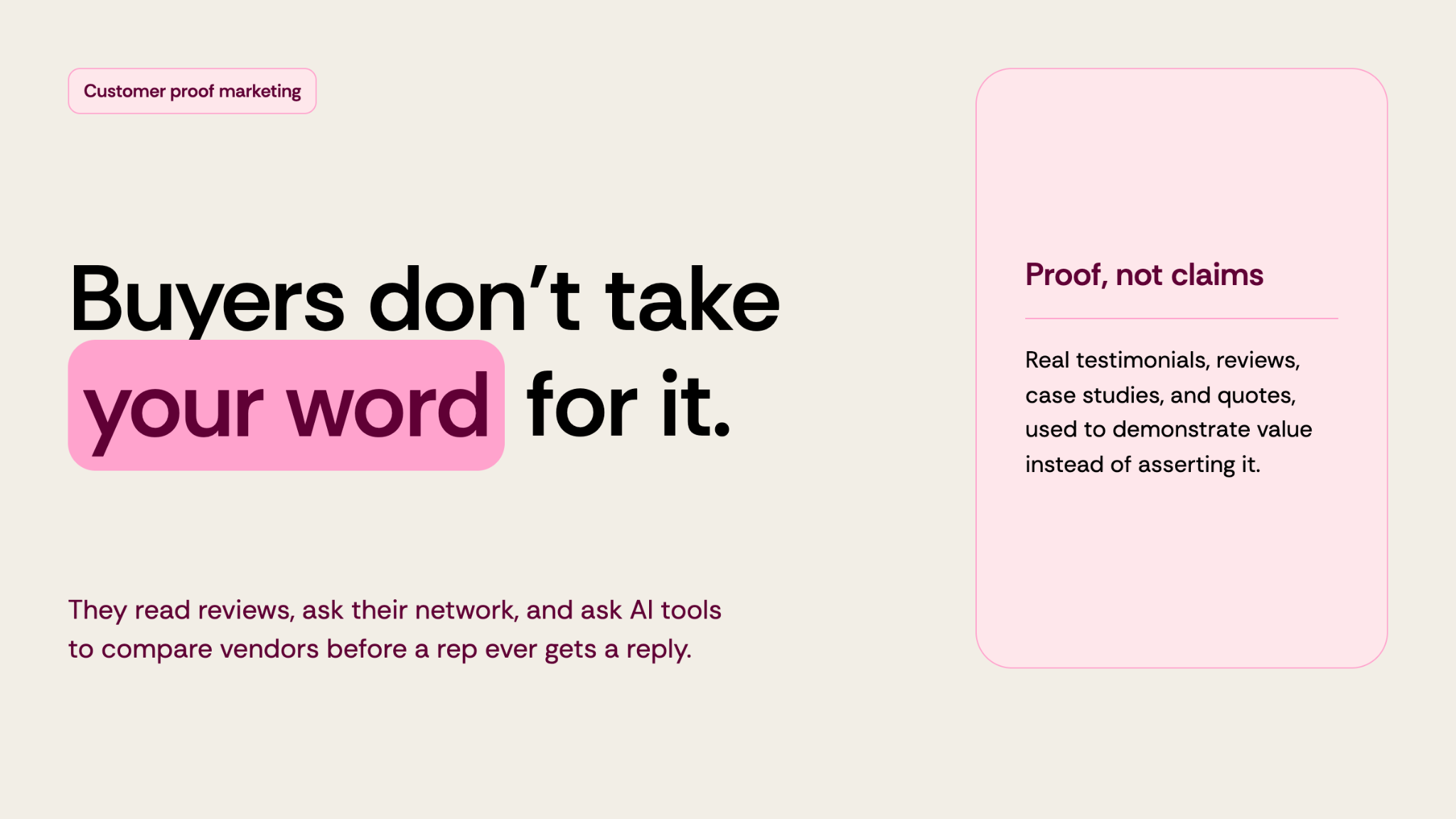
Customer proof marketing is the discipline of collecting authentic customer feedback, quotes, reviews, case studies, video testimonials, and using it across the buyer journey to prove a product's value instead of asserting it.
Unlike traditional marketing copy, customer proof marketing sources its claims from the people actually using the product, not from a vendor's own messaging team. That distinction carries more weight than it used to. Buyers discount almost anything a company says about itself and weigh peer input far more heavily.
Customer proof marketing typically includes:
Some marketers use "customer proof" and "social proof" interchangeably. They overlap, but social proof is the broader category, covering follower counts, awards, and media mentions, while customer proof marketing specifically draws from the direct voice and outcomes of paying customers.
Modern B2B buyers do most of their homework before a rep gets involved. According to WBR research, buyers complete 57% to 70% of their evaluation before contacting a vendor directly. During that window, a company's own marketing carries less weight than what other customers are saying in reviews, forums, and side conversations.
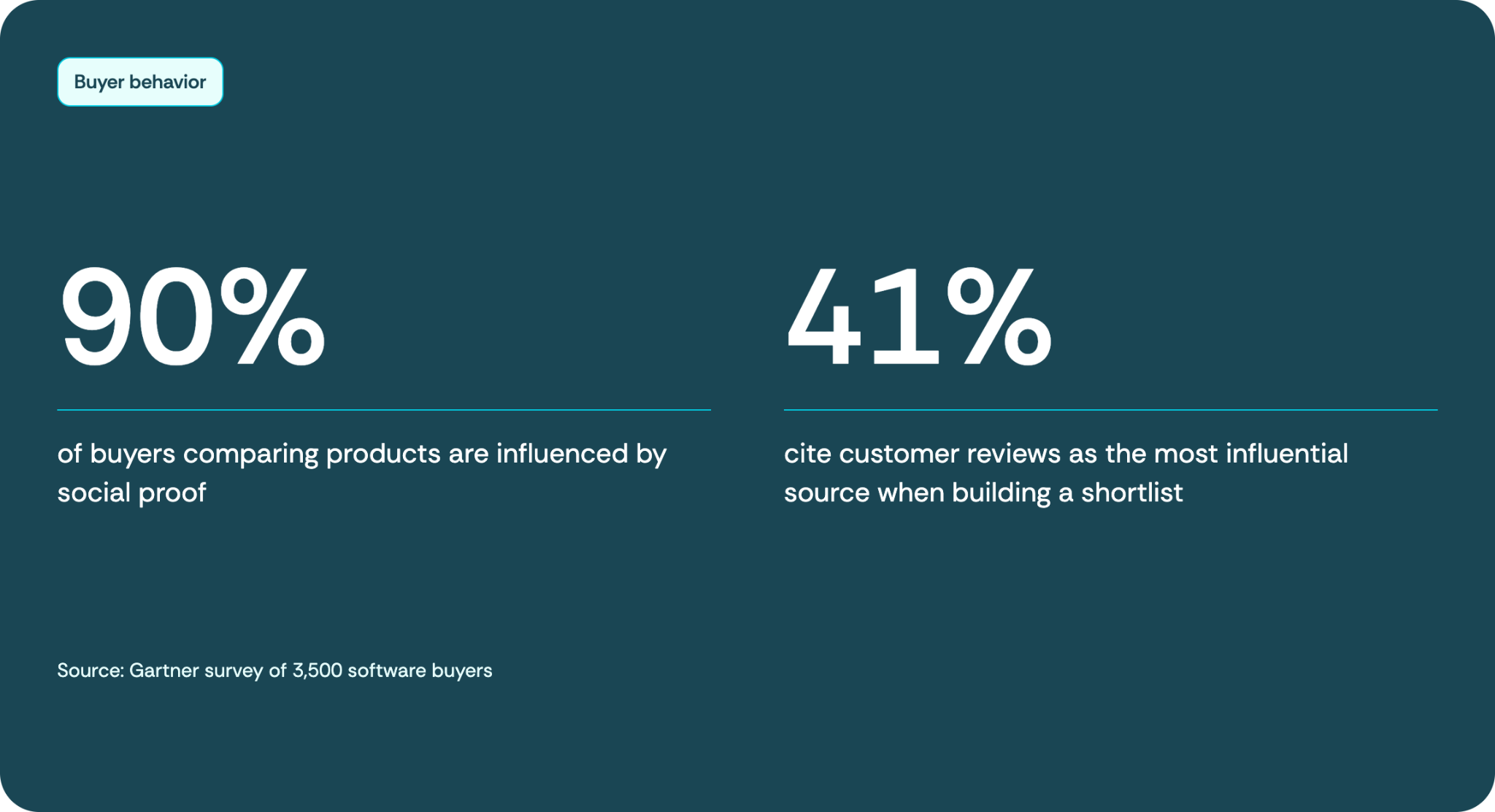
The scale of that influence is measurable. A Gartner survey of 3,500 software buyers found that social proof influences 90% of buyers comparing products, with customer reviews the single most influential source, cited by 41%, when building a vendor shortlist.
That's the gap customer proof marketing closes. It's also why Deeto treats customer voice as infrastructure rather than a marketing nice-to-have. Proof that lives in one connected system, tagged and searchable, reaches buyers and sales reps at the exact moment they need it, instead of surfacing after a deal has already stalled.
B2B deals also rarely come down to one decision-maker. Most run through a buying committee with several stakeholders, each measuring success differently. A CFO wants risk mitigation. An end user wants proof the product works day to day. A generic testimonial rarely satisfies either one, which is why proof needs to be organized by who's reading it, not just what it says.
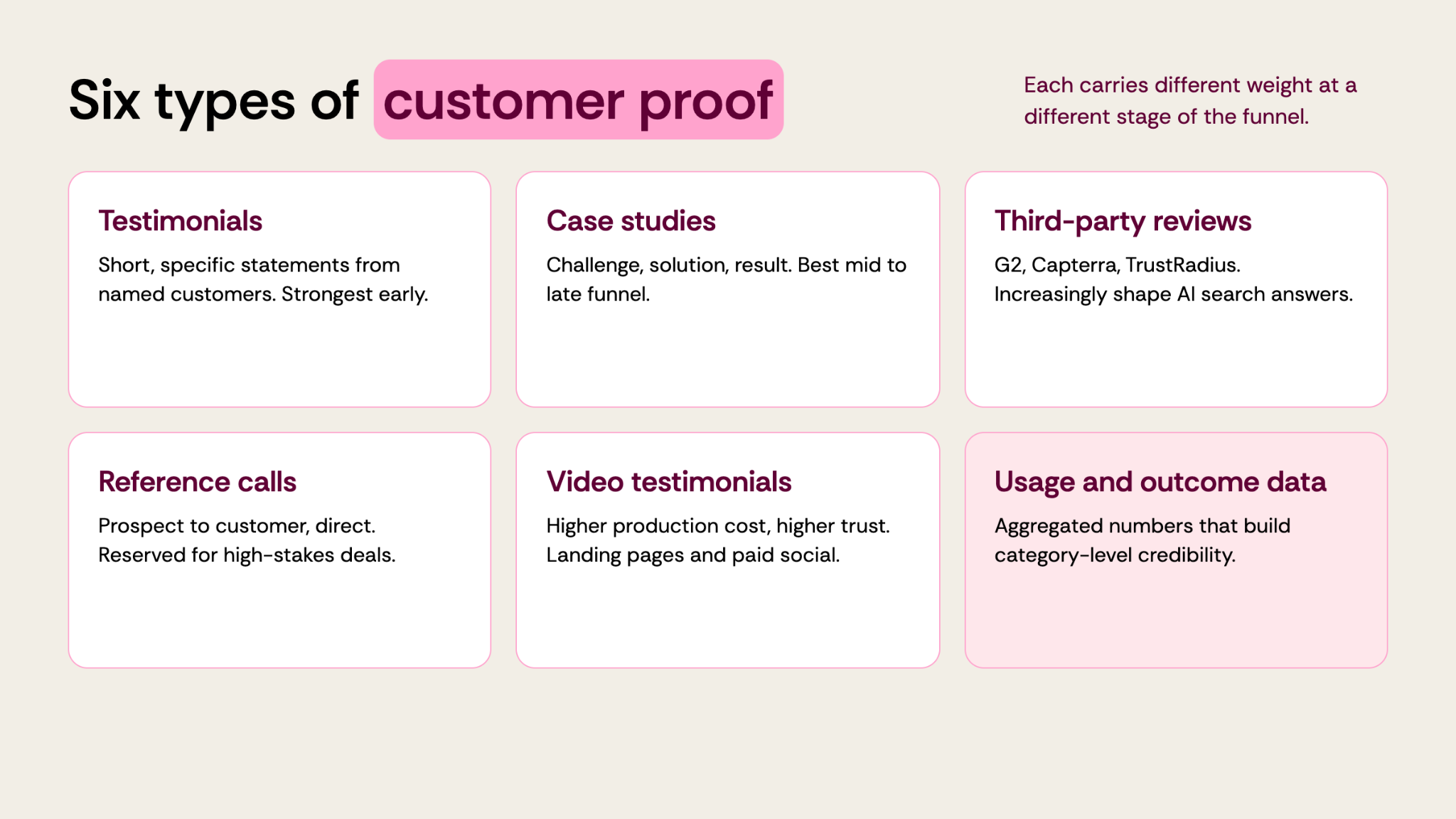
Not all proof carries the same weight at every stage. Peerbound's analysis of the proof B2B teams collect breaks down into a handful of consistent categories:
The strongest proof isn't the proof that sounds the most impressive. It's the proof that matches what the specific buyer in front of you actually cares about.
Most teams don't struggle to create proof. They struggle to keep it organized and current:
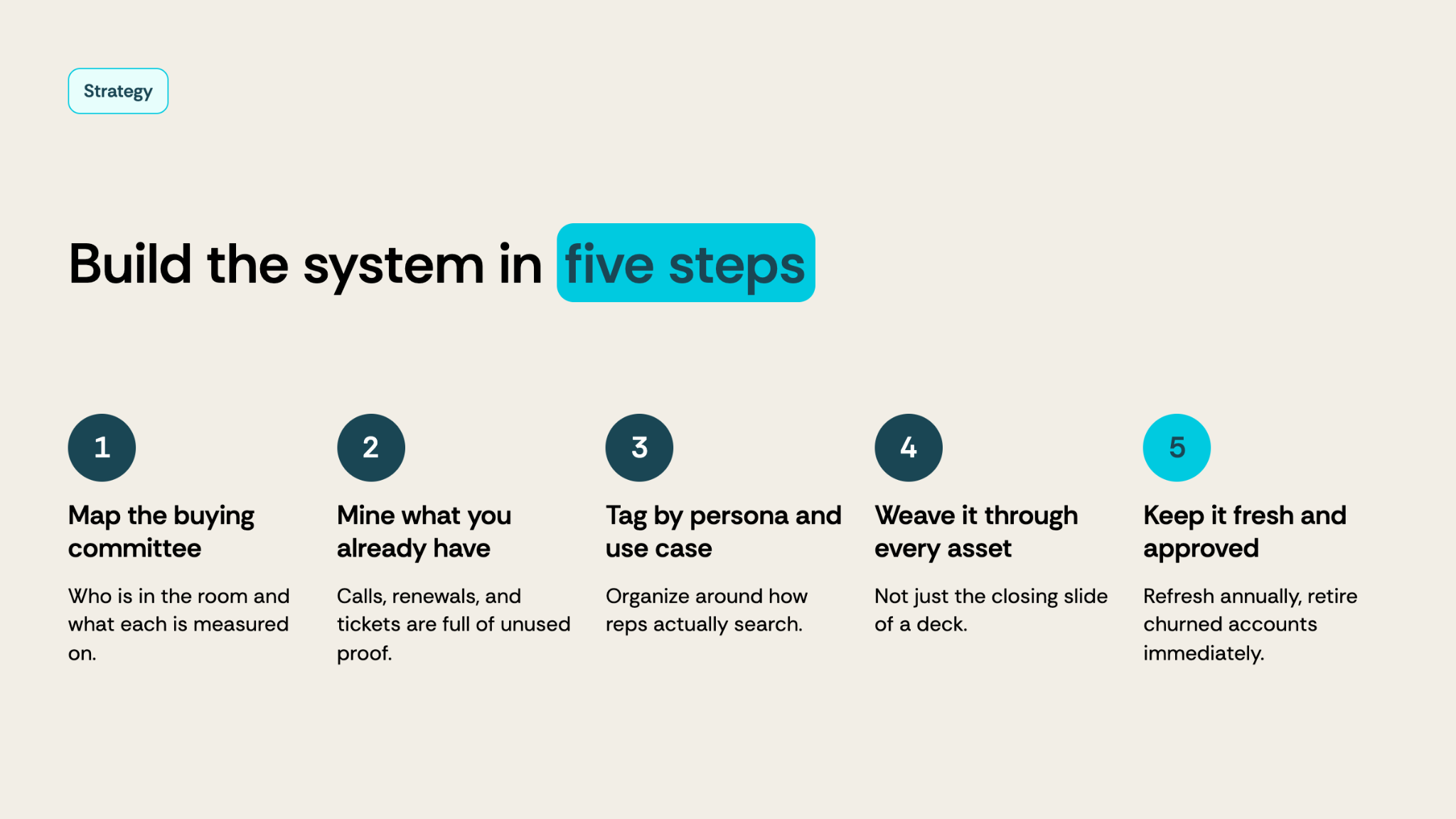
A working strategy comes down to five steps, whether you're starting from a blank folder or trying to fix a messy one.
1. Map proof to your buying committee, not just your product. Document who's in the room, what each person is measured on, and what kind of proof would move them. A buyer research process that captures this upfront saves you from guessing later.
2. Mine what you already have before collecting more. Sales calls, renewal conversations, and support tickets are usually full of proof that's never been extracted. Teams may sit on months of usable evidence before they ever launch a new survey.
3. Tag and organize by persona, industry, and use case. A rep thinks in terms of "I need something for a healthcare CFO worried about implementation time," not "testimonial number 47." Build your library around how your team actually searches, not how it was collected.
4. Weave proof throughout every asset, not just a closing slide. Open a pitch with a customer quote instead of saving all your evidence for the end. Back every feature claim with an adoption stat. Pair every objection with a proof point from a similar deal.
5. Keep it fresh, and get approval before it goes out the door. Refresh proof at least annually, retire anything from a churned account immediately, and never publish a customer's name or quote without their sign-off.
Social proof marketing software is the category of tools built to collect, organize, and distribute customer proof automatically, instead of relying on manual folders, spreadsheets, or one-off requests to happy customers. Most B2B teams land on one of three approaches:
Deeto is a voice of the customer platform built to fix this specific problem: customer voice goes in one end, and usable proof comes out the other, instead of sitting in someone's inbox.
The system breaks into five parts. Listen captures customer voice from interviews, surveys, and in-product feedback as it happens, so nobody's scrambling for quotes the week before a launch. Learn keeps all of it in one system of record instead of scattered across a shared drive, with companies, people, and assets linked together. Activate puts the right customer story and social proof in front of the right person, whether that's a sales rep mid-call or a campaign landing page, right when it's needed. Analyze looks for patterns and sentiment in that voice, so a marketer can tell which proof points are actually landing versus which just sound good on paper. Orchestrate ties the other four together, coordinating what gets surfaced, to whom, and through which channel, so proof moves as one connected system instead of four disconnected tools.
That matters most for teams running a customer marketing function, where the same proof point has to work for a website visitor, a sales rep, and a renewal conversation without three separate manual processes. It also strengthens customer advocacy programs, since advocates who see their story activated across channels are more likely to keep participating.
Teams using this kind of connected approach to customer voice see the difference in the numbers: 15-20% faster deal cycles and 10-15% higher win rates when reps have contextual proof on hand instead of searching for it mid-call.
What is customer proof marketing?
Customer proof marketing is the practice of using authentic customer feedback, testimonials, case studies, reviews, and quotes, to demonstrate a product's value to prospective buyers, rather than relying on vendor-written claims.
How is customer proof marketing different from social proof marketing?
Social proof marketing is the broader category, including follower counts, media mentions, and awards. Customer proof marketing specifically uses evidence sourced directly from paying customers, such as quotes, reviews, and case studies.
What is social proof marketing software?
Social proof marketing software refers to tools built to collect, organize, and distribute customer proof at scale. Some tools focus on a single format, like reviews or testimonials, while AI-native platforms connect proof across the entire customer lifecycle.
What types of customer proof work best for B2B companies?
Testimonials and quotes tend to work earliest in the funnel, case studies and reference calls carry more weight mid-to-late funnel, and third-party reviews influence buyers throughout, including in AI search results.
How often should customer proof be refreshed?
Most proof should be reviewed at least annually. Outdated stats or references to old product versions can undercut trust rather than build it, and proof from churned customers should be archived immediately.
Do you need customer approval to use a quote or case study?
Yes. Always get written approval before publishing a customer's name, logo, or quote. Internal use, like sales training, may fall under different terms depending on your customer contracts.
Customer proof marketing works because it replaces a vendor's word with a customer's. In a market where buyers complete most of their research before ever talking to sales, that shift decides whether a company makes the shortlist at all.
The teams that do this well don't treat proof as a one-time asset. They treat it as a living system: collected continuously, organized by who's going to read it, and activated at the moment a buyer or a rep actually needs it. That's the difference between a folder of old case studies and a customer reference program that keeps paying off deal after deal.
See how Deeto turns authentic customer voice into connected proof your team can actually use. Book a demo.

What is customer proof marketing? Learn the proof types, frameworks, and software that build B2B buyer trust.
Instead of finding out that a customer is unhappy when a customer cancels, a customer churn model can tell you weeks or months earlier instead.
A customer churn model is a system, usually built on historical account data, that scores how likely each customer is to cancel or not renew. It pulls in signals like usage drop-off, support ticket volume, and contract dates, then ranks accounts by risk so your team can act before the account is gone. This guide covers how to build one, what signals predict churn, and how to catch the problem in time to fix it.
A customer churn model is a predictive tool that estimates the probability a given customer will stop doing business with you within a defined window, usually the next 30, 60, or 90 days. It takes in variables like product usage, billing history, support interactions, and engagement trends, then outputs a churn risk score for each account.
Churn models range from simple rule-based systems ("flag any account with usage down 40% month over month") to machine learning models trained on years of historical churn data. Both approaches share the same goal: turn scattered account signals into a ranked list your Customer Success team can act on.
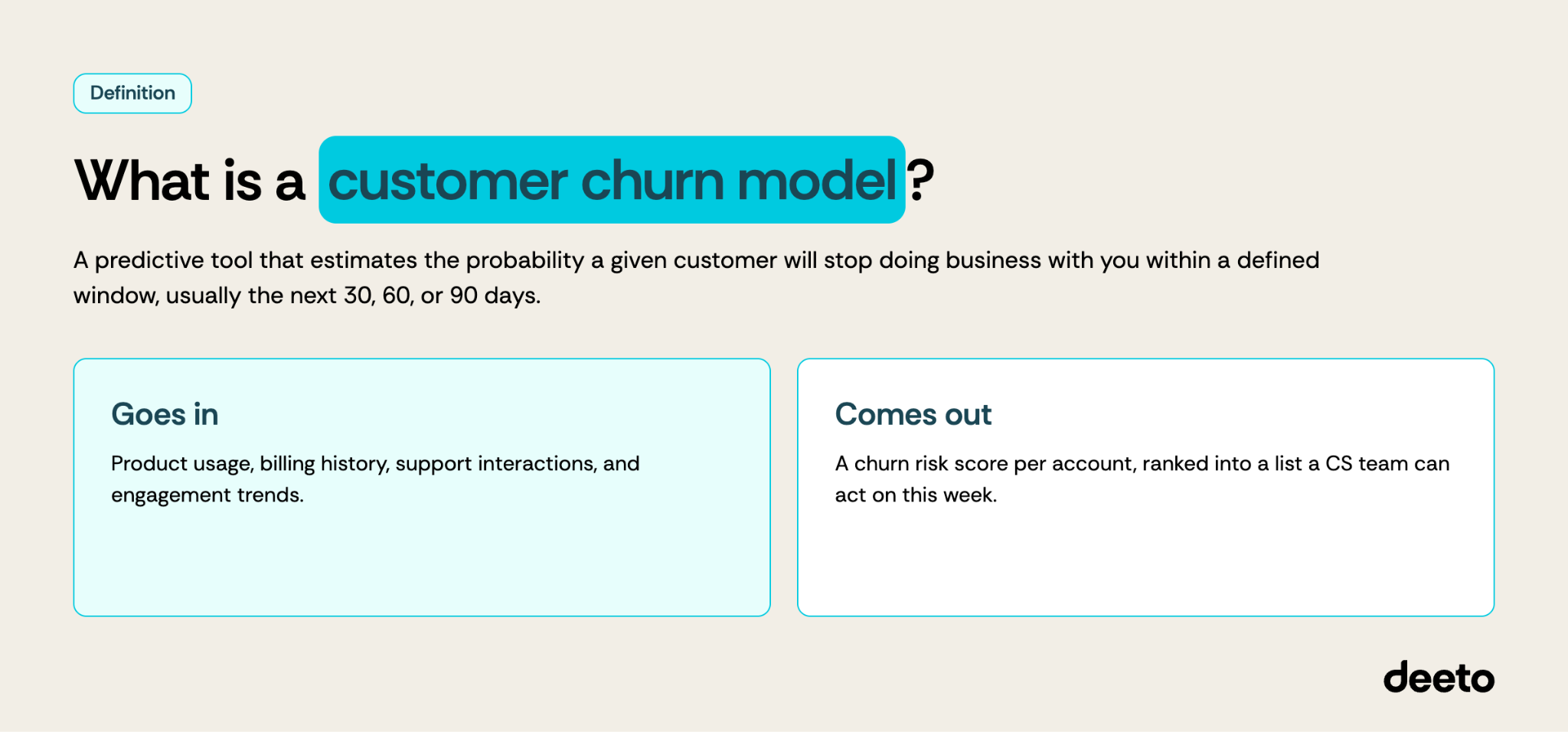
Churn is expensive, and it compounds. According to Harvard Business Review, acquiring a new customer can cost five to twenty-five times more than retaining an existing one. Bain & Company's research with Frederick Reichheld found that increasing customer retention by just 5% can increase profits by 25% to 95%, depending on the industry.
Those numbers explain why reactive retention doesn't work. By the time a customer submits a cancellation request, the decision was usually made weeks earlier, after a bad support experience, a missed renewal conversation, or a slow realization that the product wasn't delivering value. A churn model gives you visibility into that window, before the decision is final.
For a Customer Success team managing hundreds of accounts, a model does the triage work a human can't do at scale: it tells you which ten accounts, out of three hundred, need attention this week.
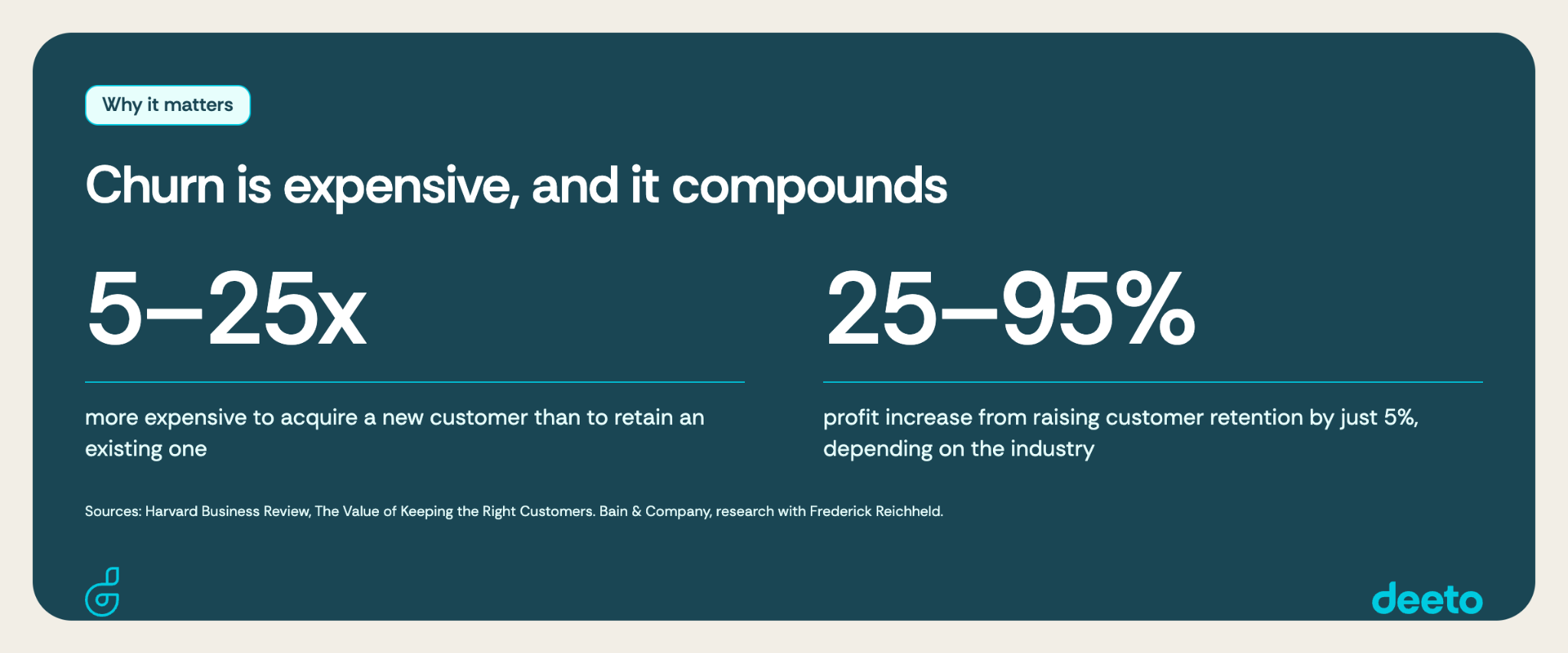
Before you can predict churn, you need to know what it looks like in your data. For a full breakdown of churn types and root causes, read our blog post, What Is Customer Churn?. For building a model specifically, the signals that matter most are the ones that are both measurable and consistent enough to score: usage decline, unresolved support tickets, negative sentiment in customer conversations, and delayed payments or downgrade requests.
The signal most churn models miss entirely is conversational. A usage dashboard shows that an account went quiet. It doesn't show why, and it rarely shows the frustration a customer voiced on a call three weeks before they went quiet. Identifying customer churn early means tracking signals continuously, not just at renewal time. It also means treating call and chat data as a primary input, not an afterthought, since it's often where risk shows up first. This is exactly the kind of signal Deeto is built to surface in real time.
Building a working churn model comes down to five steps.
Churn looks different depending on your business model. A subscription SaaS company might define it as a canceled contract. A usage-based business might define it as an account that drops below a minimum activity threshold. Get specific about your situation before you start to play with the data so that you can produce a trustworthy model.
Your model is only as good as the data feeding it. Pull together:
It’s not uncommon for companies to have the first three. Far fewer systematically capture the fourth, which is a problem because customer voice data often contains the earliest and clearest churn signal of all: the customer telling someone, directly, what's wrong.
Start simple. A rule-based scoring system that assigns point values to risk factors like "no login in 30 days" or "two unresolved tickets" gets you a working model fast and is easy for a CS team to understand and trust. As you accumulate more historical churn data, you can move to a logistic regression or machine learning model that weighs signals automatically and improves as it learns from outcomes.
Once the model is running, group accounts into risk tiers, typically low, medium, and high. This turns a raw probability score into something a CS manager can operationalize: high-risk accounts get an immediate outreach play, medium-risk accounts get monitored, low-risk accounts stay on the standard cadence.
For every risk tier, define exactly what happens next including who gets notified, what outreach goes out, and what the CS rep needs to know about why the account is flagged before they pick up the phone. This is one of the most important steps and one that most churn models miss.
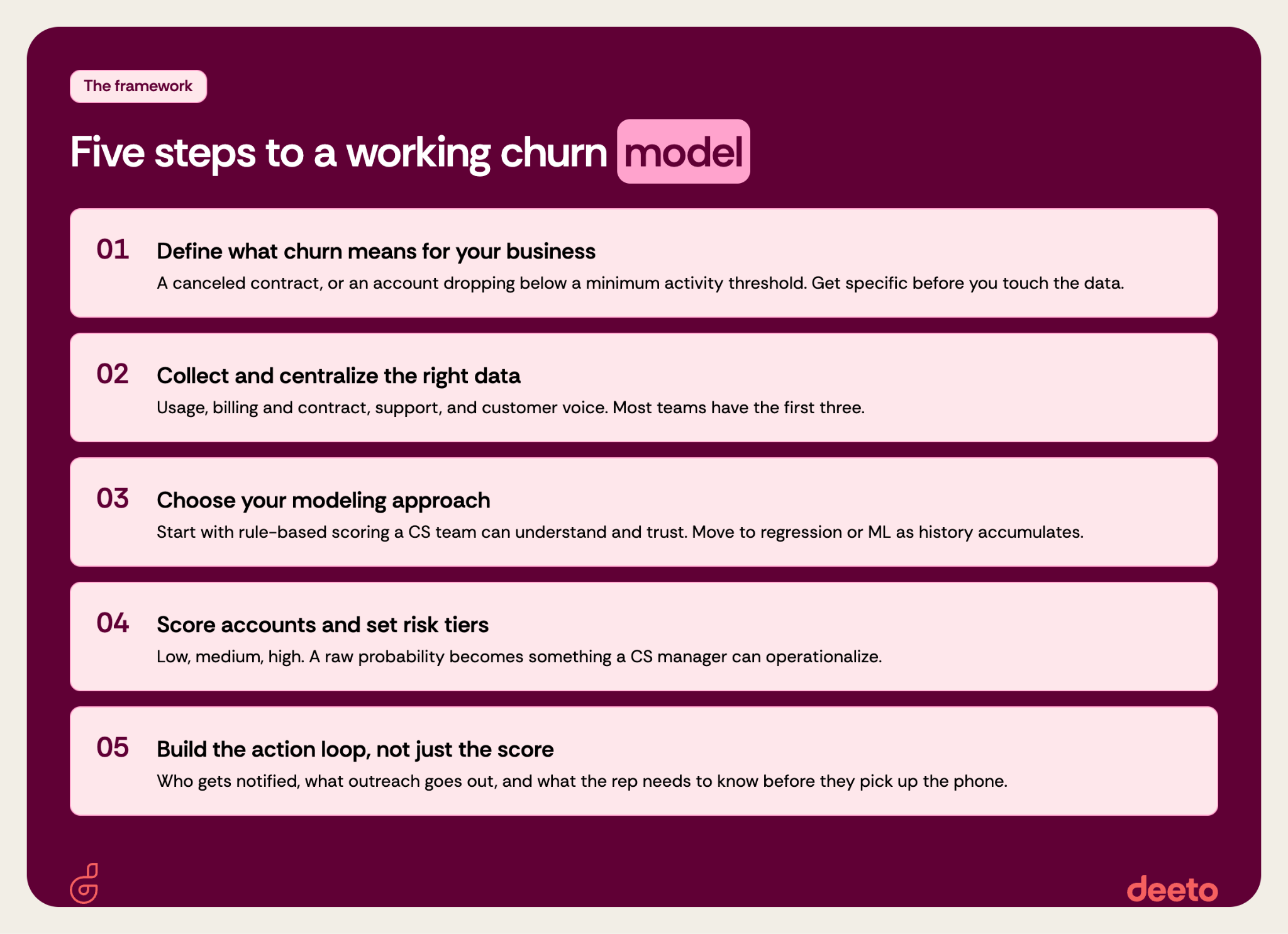
Knowing a customer is at risk isn't the same as knowing why. A usage drop could mean disengagement, or it could mean a champion left the company. Without that context, teams end up guessing at the fix.
Call recordings, support chats, and survey responses hold some of the strongest churn signal in the business, but they're rarely structured or searchable. Most teams simply don't have the infrastructure to analyze them systematically, which is the specific gap a platform like Deeto is built to close.
By the time a model flags high risk based on usage alone, the customer has often already mentally checked out. Models that only watch product data lag behind models that also listen to what customers are saying in real time.
A flagged account with no assigned follow-up is arguably worse than no model at all. It creates a false sense that risk is being managed when nobody's actually managing it.
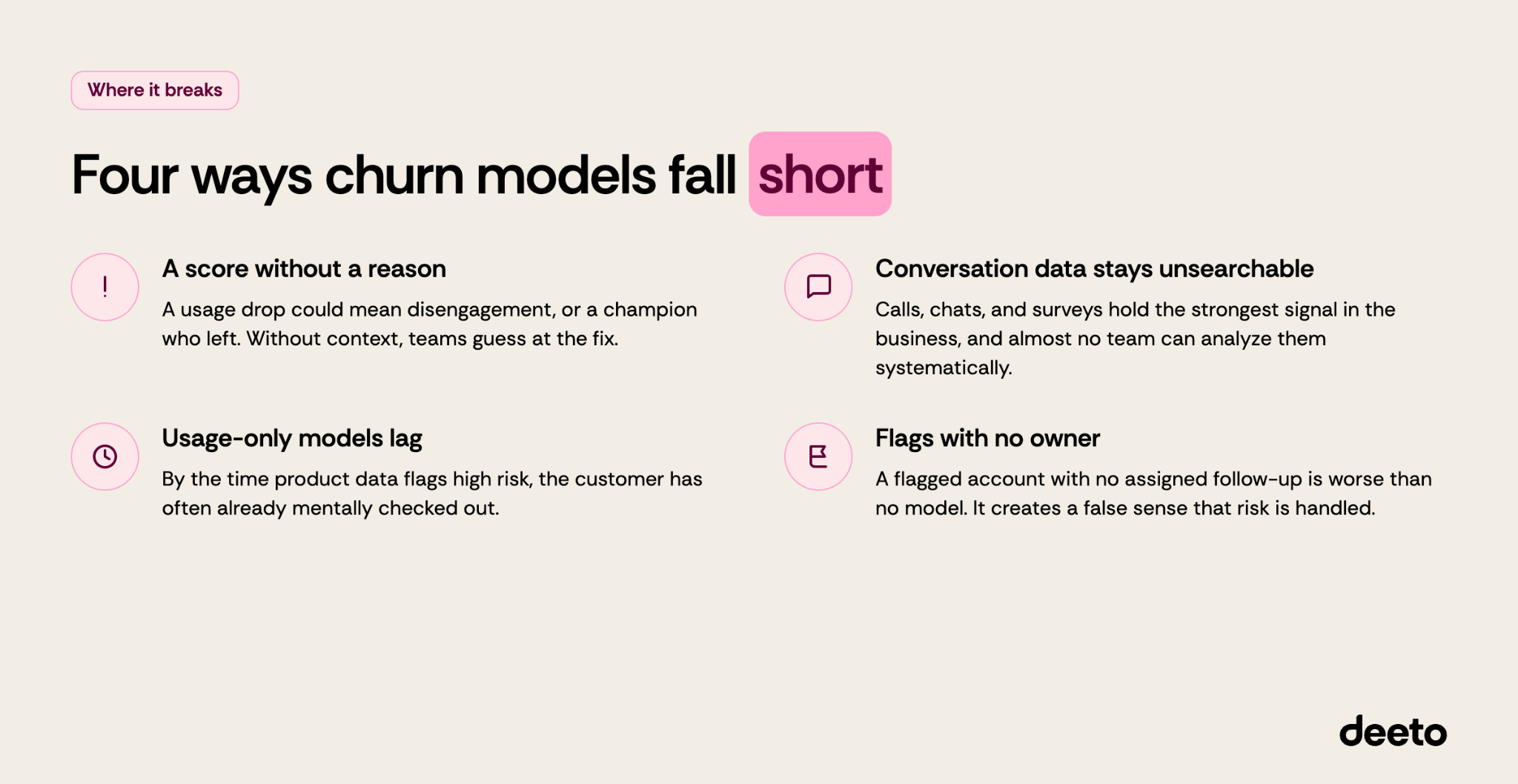
Not every at-risk account can be saved before it churns, and some customers cancel anyway. Winning back churned customers takes a different playbook than preventing churn in the first place.
The businesses that win back the most customers are the ones that actually know why each one left, not the ones handing out the biggest discount.
Most churn models are built entirely on product and billing data, which means they're always working with a partial picture. The conversations customers have with your team, on support calls, in chat, during QBRs, contain churn signal that a usage dashboard will never catch such as frustration, hesitation, a comment about a competitor, or a mention that "the team upstairs isn't happy."
Deeto is a voice of the customer platform built to close that gap. Deeto's Listen module continuously captures customer voice across calls, chats, and AI interviews, instead of relying on a quarterly survey that most customers ignore. Deeto's Analyze module then applies sentiment analysis to those conversations to flag churn indicators as they happen, not weeks later when the usage data finally catches up.
Here's where it goes further than a standard churn model: when Deeto flags an account as at-risk, it can automatically send the customer a short, targeted AI interview to find out exactly what's wrong, in the customer's own words, before the CS team even makes the call. Instead of a rep guessing at the cause from a risk score, they walk into the conversation already knowing whether the issue is a missing feature, a pricing concern, a support gap, or a champion who's lost buy-in.
Continuous signal capture plus direct customer input is what turns churn prediction from a lagging indicator into an early one. Deeto customers see 15 to 25% higher renewal and expansion rates with this kind of early insight, because the team ends up solving the actual problem instead of reacting to a cancellation notice after the fact. That's really the core of what Deeto brings to Customer Success and Experience teams: it connects the voice customers are already giving you to the action that keeps them around.
What is a customer churn model?
A customer churn model is a predictive tool that scores how likely a customer is to cancel or not renew, based on data like product usage, billing history, support tickets, and engagement trends. It helps businesses rank accounts by risk so Customer Success teams can prioritize outreach.
What data do I need to build a churn model?
At minimum, you need product usage data, billing and contract data, and support ticket history. The strongest models also include customer voice data from calls, chats, and surveys, since conversational signals often predict churn earlier than usage metrics.
How accurate are churn prediction models?
Accuracy depends heavily on data quality and the range of signals included. Models built only on usage data tend to lag behind churn events. Models that also incorporate real-time conversation and sentiment data catch risk earlier and more accurately.
How do I identify customer churn before it happens?
Track usage decline, drop-off in engagement, spikes in support tickets, negative sentiment in customer conversations, and delayed payments. These signals typically appear weeks before a customer formally cancels.
How do you win back a churned customer?
Start by finding out the specific reason they left through a structured post-churn conversation, not a generic exit survey. Segment win-back outreach by reason, fix the underlying issue where possible, and time re-engagement around 60 to 90 days after cancellation.
Can AI help predict and prevent churn?
Yes. AI can continuously analyze usage patterns and customer conversations to flag risk in real time, and can trigger targeted follow-up, like an AI-driven interview, to surface the root cause before a human even joins the conversation.
A customer churn model turns scattered account signals into a ranked, actionable view of risk. But the model itself is only half the job. The businesses that actually reduce churn pair prediction with understanding, they know an account is at risk, and they know why, in time to fix it. That means expanding beyond usage and billing data into the conversations customers are already having with your team.
Deeto helps Customer Success teams do exactly that. It flags churn signals across calls and chats as they happen, then follows up with AI-driven interviews that get to the real issue before it becomes a cancellation. Book a demo to see how Deeto connects customer voice to retention action, or read how to build a customer journey map to see where churn risk tends to build up across the customer lifecycle.

What is a customer churn model? Learn how to build one, spot churn early, and win back at-risk customers.

See how Deeto helps you turn customer voice into a GTM advantage.