What Is Customer Experience? Definition, Components, and How to Improve It



Friday, April 17, 2026


What Is Customer Experience? Definition, Components, and How to Improve It


View the podcast on Youtube

Customer experience shapes every revenue outcome that matters. Retention. Referrals. Expansion. Win rates. And yet most companies still manage it reactively, responding to problems after they happen instead of building systems that surface what customers actually feel.
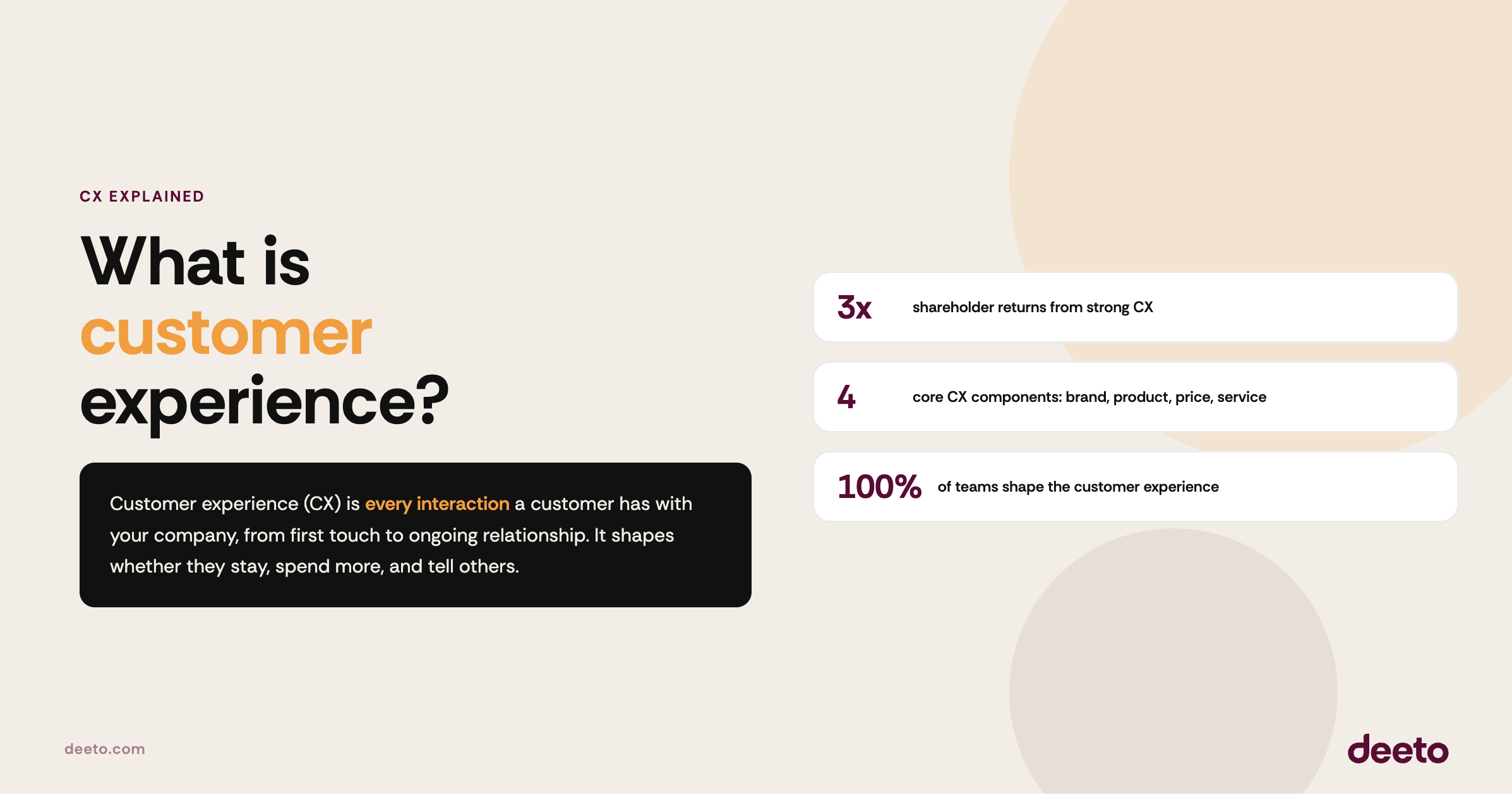
Customer experience (CX) is the sum of every interaction a customer has with your company, from the first time they encounter your brand to the ongoing relationship after purchase. It includes how they feel about your product, your support, your sales process, your communications, and everything in between.
In this post, we'll break down what customer experience really means, why it determines whether companies grow or plateau, and what it takes to build a CX strategy that actually works.
What Is Customer Experience?
Customer experience is the overall impression a customer forms across every touchpoint with your organization. It is not a single interaction. It is the accumulative feeling customers carry about who you are, how you treat them, and whether you deliver on what you promised.
CX includes four core components: brand, product, price, and service. But the weight customers place on each of those shifts depending on the relationship, the industry, and the moment. In most B2B contexts, service and product reliability drive perception far more than price.
What separates a good customer experience from a great one is usually not a single wow moment, but a consistently good experience over time. Customers who rarely encounter friction, who feel heard when they share feedback, and who see their input reflected in how a product or service evolves are the customers who stay and advocate.
The problem is that most organizations do not have a system for capturing what customers actually think, feel, and experience in a way that drives decisions. Feedback gets collected in surveys that go unread. Insights get discussed in QBRs and then shelved. Customer voice becomes a reporting exercise rather than the intelligence that shapes how a company moves.
Why Customer Experience Matters
CX has become the primary differentiator in markets where products are functionally similar. As features get copied quickly, experience becomes harder to replicate at scale, and the gap between companies that invest in it and those that do not widens every year.
The business case is consistent across industries. McKinsey research found that companies that excel at customer experience deliver 3x returns to shareholders compared to those that do not. That is not a soft outcome, it is a financial one, and it reflects what happens when retention, expansion, and referrals all compound over time. Customers who have a bad experience do not just leave; they share it. In a world where buyers research extensively before engaging sales, the accumulated weight of customer perception matters more than any individual campaign.
For B2B companies specifically, the stakes are particularly high. Buyers rely on peer evidence, customer reviews, and third-party validation before they trust any vendor's claims. What your existing customers say about their experience is often more persuasive than anything your marketing team produces.
Customer experience also has a direct impact on the metrics teams care about most. When CX is strong, renewal rates go up, expansion conversations happen earlier, and reference requests are easier to fulfill. When CX deteriorates, the signals usually appear in feedback data weeks or months before they show up in churn numbers, but only if you are listening.
The Difference Between Customer Experience and Customer Service
These two terms are often used interchangeably, but they are not the same thing.
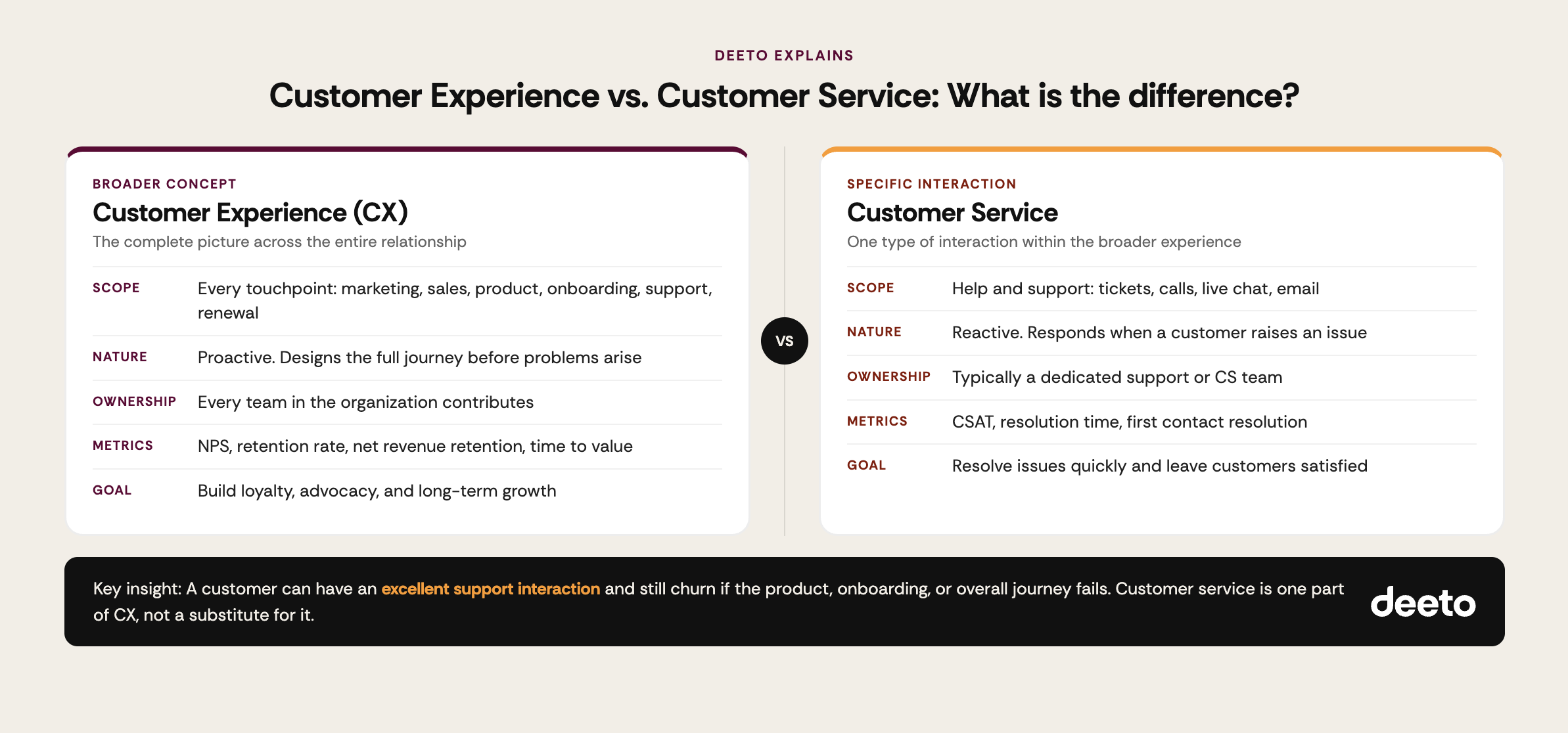
Customer service is a specific interaction type. It is what happens when a customer encounters a problem and reaches out for help. Customer service is reactive, transactional, and typically owned by a single team.
Customer experience is the full picture. It includes every interaction across every channel, team, and moment in the customer lifecycle. Customer service is a component of CX, but a customer can have an excellent support experience and still churn because the product failed to deliver value, or because onboarding was confusing, or because they never felt like a strategic partner.
Organizations that conflate the two tend to over-index on support metrics like CSAT and resolution time while ignoring the signals that show up earlier in the journey. Onboarding friction, weak adoption, and misaligned expectations often predict churn long before a customer ever raises a complaint.
What Shapes Customer Experience
Customer experience is shaped by the moments customers remember and the gaps they notice.
Onboarding and first value. How quickly does a customer reach their first meaningful outcome? The longer that gap, the harder it becomes to build loyalty. Companies that focus on customer adoption early in the relationship create the foundation for retention.
Product quality and reliability. A product that consistently delivers what it promises is the baseline. But customers also form impressions based on how quickly issues are resolved and whether the company takes their product feedback seriously. Connecting customer voice to your product roadmap is one of the highest-leverage things a product team can do.
Communication and responsiveness. Customers notice when they feel ignored. They also notice when a company communicates proactively, shares relevant insights, and makes them feel like a partner rather than a transaction.
Consistency across teams. CX breaks down when different teams operate in silos. Sales promises one thing, CS delivers another. Marketing positions the product one way, support responds differently. Customers experience your entire organization, not just the one team they happen to be talking to.
Feedback loops that close. Customers who share feedback and never hear anything back eventually stop sharing it. And they often stop buying too. Companies that listen to customer sentiment and close the loop with customers build a different kind of trust.
Common CX Challenges
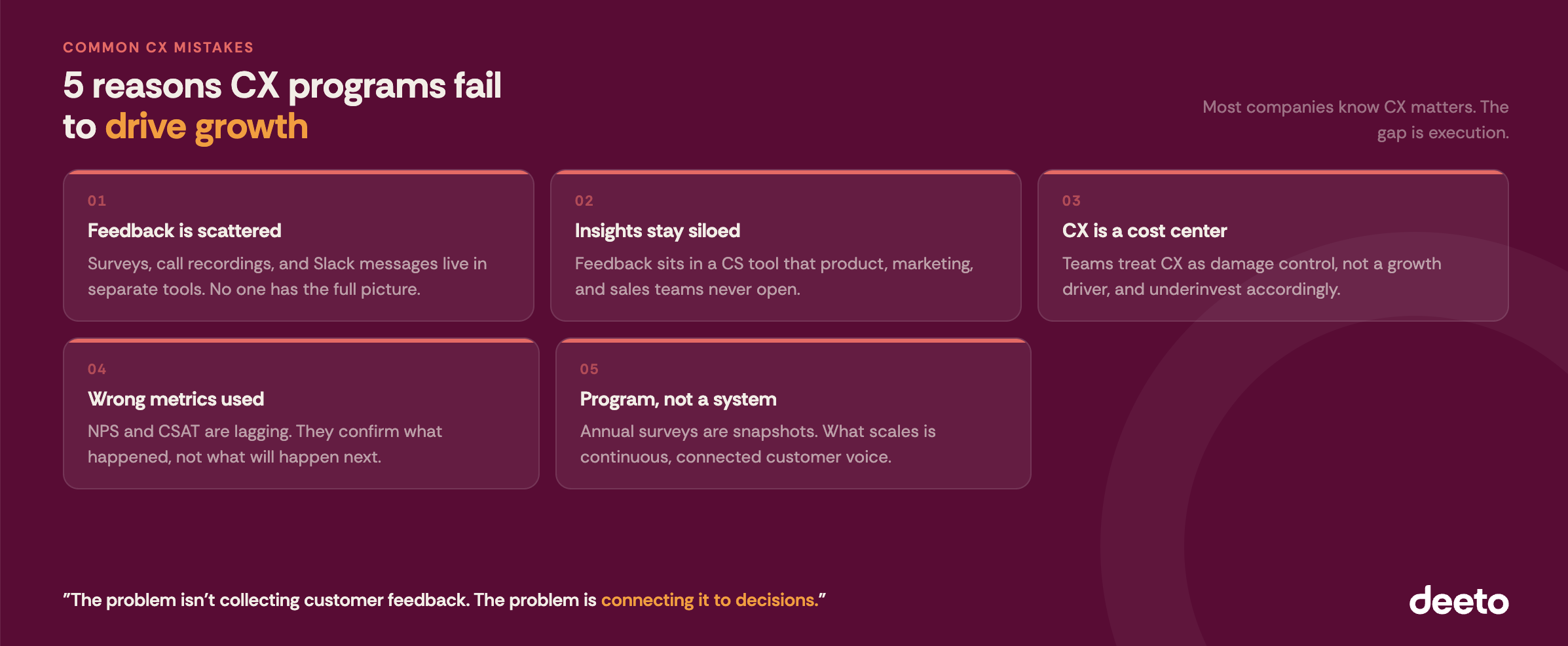
Most organizations already know CX matters. The challenge is execution. Here are the patterns that consistently undermine CX programs:
Feedback is fragmented. Survey data lives in one tool, call recordings in another, Slack messages in another. Nobody has a complete picture of what customers are experiencing because the signals are scattered.
Insights do not reach decision-makers. Even when feedback is collected, it often sits in a customer success platform that product, marketing, and sales teams never open. The intelligence exists, but it does not flow to the people who can act on it.
CX is treated as a cost center, not a growth driver. When teams think of CX as damage control rather than a revenue input, they underinvest in the systems and programs that would make it compound over time.
Companies measure satisfaction instead of signal. A high Net Promoter Score (NPS) can mask a declining relationship. CSAT after a support ticket tells you almost nothing about whether a customer will renew. The metrics most teams use to manage CX are lagging indicators, not leading ones.
Voice of the customer is a program, not a system. One-off surveys, annual customer interviews, and quarterly business reviews are not a system for capturing and activating customer voice. They are snapshots. What scales is a continuous, connected approach to capturing what customers actually experience, thinking, and need.
How to Build a CX Strategy That Works
A strong customer experience strategy is built on three things: continuous listening, connected intelligence, and deliberate action.
Continuous listening means capturing customer voice across the full lifecycle, not just at renewal or escalation. It means running AI-powered customer interviews, collecting in-product feedback, and building signals from every interaction rather than waiting for customers to raise their hands.
Connected intelligence means organizing that voice into a system where patterns emerge, sentiment is tracked over time, and every team can access the insights they need. When sales can see what customers say about your product's weaknesses, they can address objections earlier. When product teams can see recurring friction points, they can prioritize with confidence.
Deliberate action means building workflows that turn insight into outcomes. Surfacing the right customer story in a sales pitch at the right moment. Triggering a customer success touchpoint when a churn risk signal appears. Routing product feedback to the right team before it festers.
This is what separates organizations that run CX as a program from those that run it as a system. Deeto is built for the latter. As a customer orchestration platform, Deeto captures authentic customer voice, organizes it into intelligence, and activates it across sales, marketing, and CS workflows.
How to Measure Customer Experience
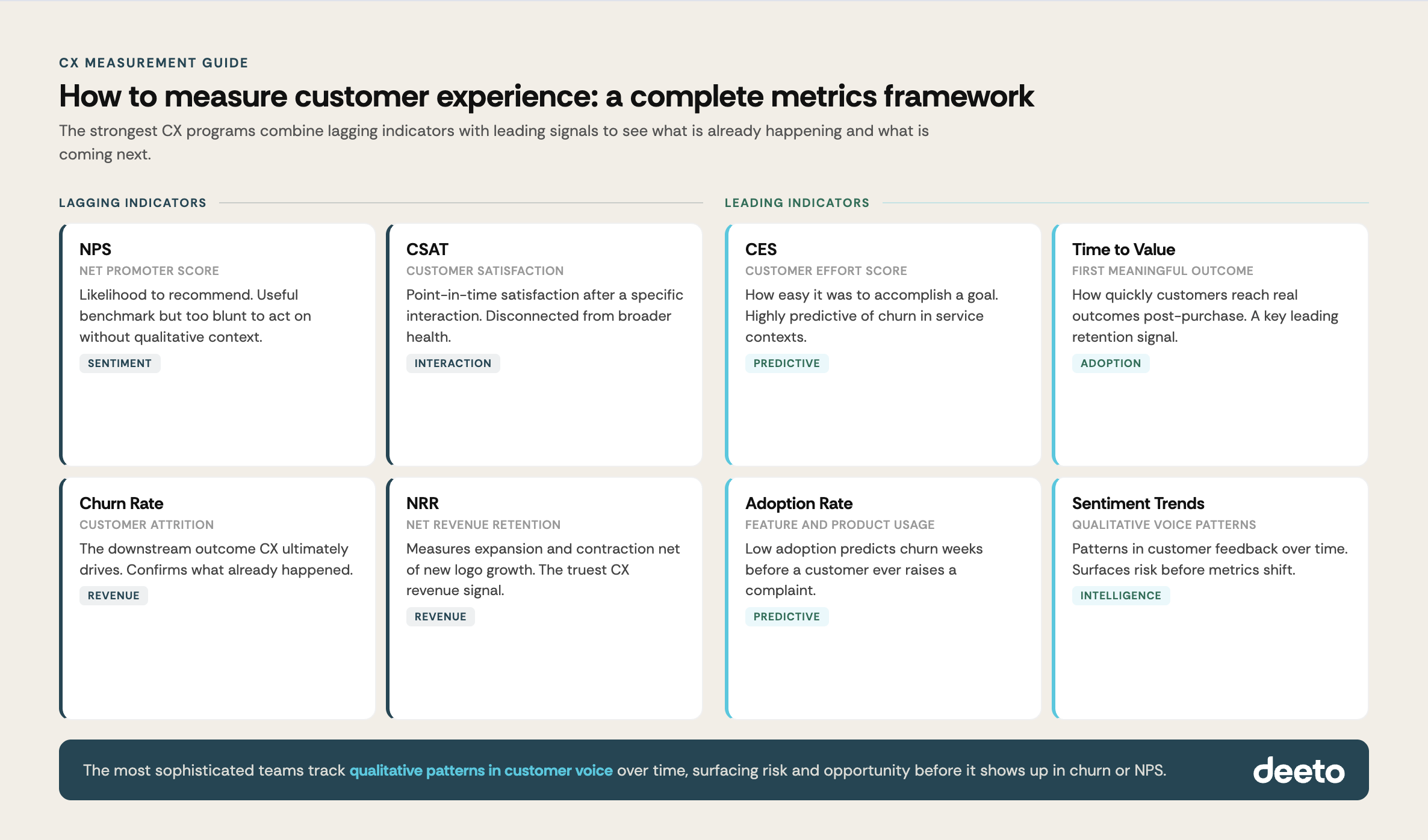
No single metric captures CX. The strongest CX programs use a mix of lagging indicators (NPS, CSAT, renewal rates) and leading indicators (product adoption, engagement signals, feedback sentiment, time to first value).
Common CX metrics include:
- Net Promoter Score (NPS): Measures likelihood to recommend. Useful as a benchmark, but too blunt to act on without qualitative context.
- Customer Satisfaction Score (CSAT): Measures satisfaction after a specific interaction. Point-in-time and often disconnected from broader health.
- Customer Effort Score (CES): Measures how easy it was to accomplish something. Highly predictive of churn in high-frequency service contexts.
- Churn rate and net revenue retention (NRR): The downstream outcomes that CX ultimately drives.
- Time to value: How quickly customers reach meaningful outcomes after purchase. A leading indicator of long-term retention.
The most sophisticated teams also track qualitative patterns in customer feedback over time, using sentiment analysis and structured voice-of-customer programs to surface the signals that traditional metrics miss. Deeto's customer sentiment analysis capabilities are built specifically for this, connecting sentiment trends to the revenue signals that matter.
Key Takeaways
- Customer experience is the full sum of interactions and impressions a customer forms across their entire relationship with your company.
- CX is not the same as customer service. Service is one component of a broader experience that spans marketing, sales, product, and support.
- The most common CX failures happen when feedback is fragmented, insights do not reach decision-makers, and companies treat CX as a cost center rather than a growth driver.
- Strong CX strategies are built on continuous listening, connected intelligence, and deliberate activation, not one-off surveys or annual QBRs.
- Authentic customer voice is the input that powers great CX. Companies that build systems to capture, organize, and act on it consistently outperform those that rely on assumptions.
Conclusion
Customer experience is not a department or a score. It is the cumulative signal that tells you whether your company is delivering on its promise.
The companies that win on CX are the ones that treat customer voice as the operating system for growth, not a report they review once a quarter. They build infrastructure to listen continuously, organize intelligence across teams, and activate it at the moments that move the needle.
If you are building or evolving your CX strategy and want to see what it looks like when authentic voice drives every decision, see how Deeto works or book a demo to explore what a customer orchestration platform can do for your team.
Frequently Asked Questions
What is customer experience (CX)?
Customer experience (CX) is the overall impression a customer forms through every interaction with your company across the full customer lifecycle. It includes product quality, customer service, communications, onboarding, and any other touchpoint that shapes how a customer feels about your brand. Strong CX leads to higher retention, faster renewals, and more referrals.
What is the difference between customer experience and customer service?
Customer service refers to a specific type of interaction, typically when a customer needs help solving a problem. Customer experience is the broader picture: every touchpoint, from first awareness through ongoing relationship, that shapes how a customer perceives and feels about your company. Customer service is a component of CX, not a substitute for it.
What are the four components of customer experience?
The four core components of CX are brand, product, price, and service. In practice, customers weigh these differently depending on context. In B2B SaaS and technology markets, product reliability and service quality tend to carry the most weight in shaping long-term perception and retention.
How do you measure customer experience?
CX is typically measured using a combination of lagging indicators like NPS, CSAT, and renewal rates, and leading indicators like product adoption, time to first value, and customer feedback sentiment. The strongest CX programs combine structured quantitative metrics with qualitative voice-of-customer intelligence to surface signals before they become problems.
Why does customer experience matter for B2B companies?
In B2B markets, buyers rely heavily on peer validation, customer reviews, and reference conversations before making purchase decisions. How your existing customers experience your product and your team directly influences how easy it is to close new deals. Strong CX shortens sales cycles, increases win rates, and generates the authentic customer evidence that marketing and sales depend on.
What is a customer experience strategy?
A customer experience strategy is an organizational plan for designing, delivering, and continuously improving how customers interact with your company. It includes how you capture customer feedback, how you use that feedback to make decisions, how you align teams around shared CX goals, and how you measure the outcomes of CX investments. The most effective strategies are built on continuous listening and connected intelligence rather than periodic surveys.
🎉 Save your spot
Register for the event
Once your spot is secured, we’ll send your confirmation details.
Subscribe to our newsletter
Subscribe to receive the latest blog posts to your inbox every week.
By subscribing, you agree to our Privacy Policy
Subscribe to our newsletter
Get the latest news and updates from our team.
By subscribing, you agree to our Privacy Policy
Related posts

Voice of the Customer Strategy for SaaS Companies

What is VoC for SaaS? Learn how to capture customer voice and turn it into decisions that drive renewals.

Call Intelligence Software That Spots Your Next Reference
What is call intelligence software? Learn how it scores every call automatically and surfaces advocacy-ready customers.

4 Ways To Leverage Social Proof In Marketing
What is social proof in marketing? Learn 4 ways to use reviews, stories, and advocacy to build buyer trust.