9 Best Customer Experience Platforms in 2026: A Buyer's Guide



Tuesday, April 21, 2026


9 Best Customer Experience Platforms in 2026: A Buyer's Guide


View the podcast on Youtube

The best customer experience platforms in 2026 do more than collect feedback. They connect what customers say to what teams actually do. This guide compares the top customer experience (CX) platforms across nine categories, from enterprise voice-of-customer tools to AI-powered service platforms, so you can find the right fit for your organization's goals.
Choosing the wrong CX platform means paying for data you can't act on. Most teams already know that. The harder question is: what separates a platform that captures experience from one that actually improves it?
This guide covers the top platforms, what each one does best, and how to evaluate them based on your team's real needs.
What Is a Customer Experience Platform?
A customer experience platform is software that helps organizations collect, analyze, and act on customer feedback across the full lifecycle. The best platforms go beyond surveys and support tickets to connect customer signals to decisions in sales, marketing, product, and customer success.
Customer experience platforms vary widely in scope. Some focus narrowly on support operations or NPS collection. Others span the entire customer lifecycle, surfacing voice, sentiment, and behavioral signals that guide strategy across the organization.
Customer experience software includes tools for voice-of-customer research, sentiment analysis, journey tracking, service management, and customer intelligence. What the category does not yet do well, in most cases, is connect all of those signals into a coherent system that drives action. That gap is where a new generation of platforms is emerging.
Why CX Platform Choice Matters More in 2026
By 2026, 89% of businesses are expected to compete primarily on customer experience, surpassing product and price as the primary differentiators. The global customer experience management market was valued at approximately $17.2 billion in 2026 and is projected to reach $47.72 billion by 2033, growing at a CAGR of 15.2% (Grand View Research). That investment is not going into more surveys. It is going into platforms that can turn signal into action.
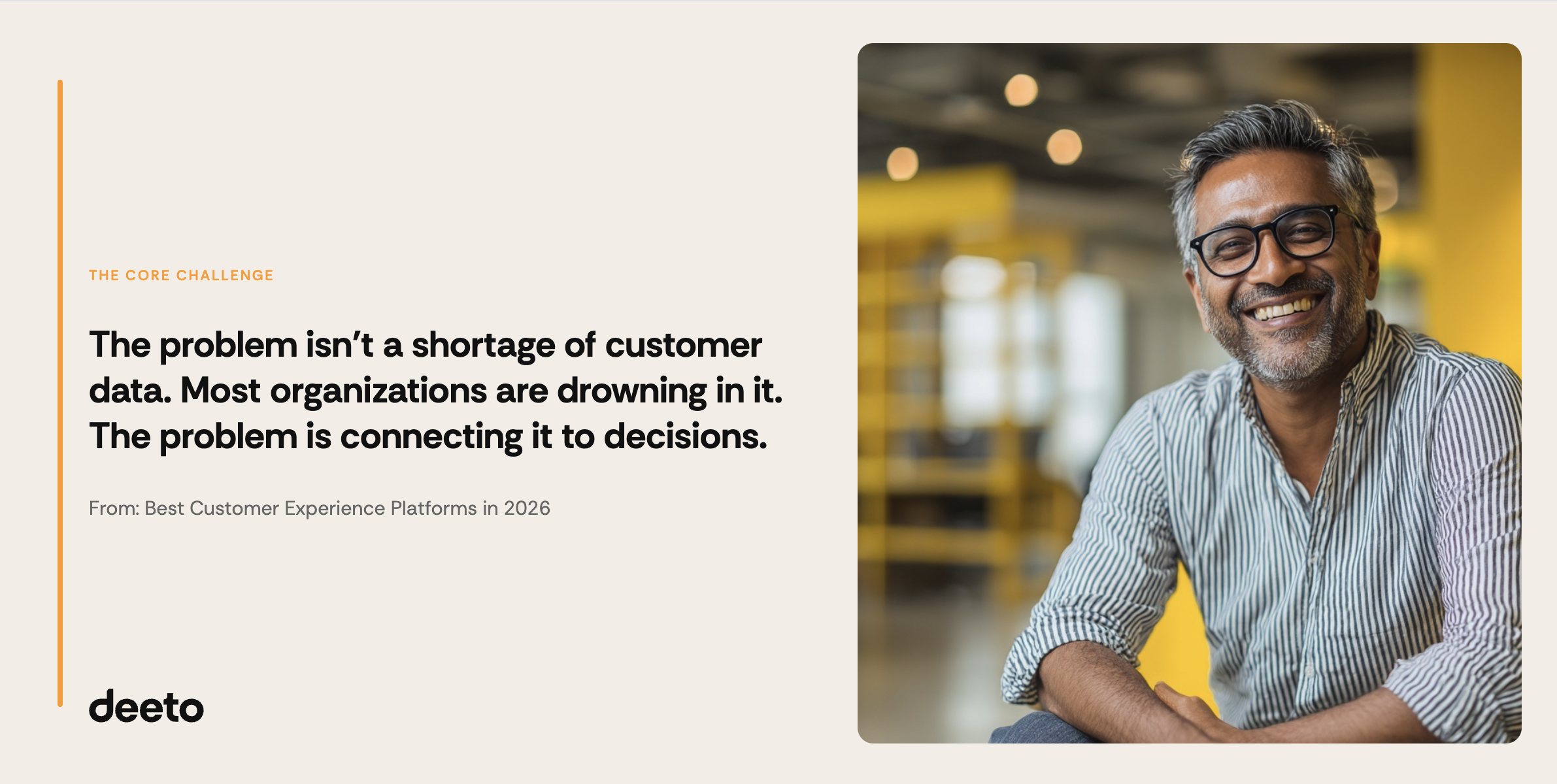
The pressure is real: customers expect personalized, responsive, and consistent experiences across every channel. Teams that rely on disconnected tools, quarterly NPS scores, or siloed feedback programs are already behind. The problem is not a shortage of customer data. Most organizations are drowning in it. The problem is connecting that data to the decisions that actually affect customer experience, and that is exactly what the best platforms in this guide are built to do.
What to Look for in a CX Platform in 2026
Before comparing specific tools, align on what your team actually needs. The most common misbuys in this category come from evaluating features before use cases.
Key questions to ask before you buy:
- Who owns CX in your org? Customer success, customer marketing, product, and support teams have fundamentally different needs from a CX platform. The right tool depends on which team is driving the program.
- Where does your customer voice live today? If signals are scattered across surveys, CRM notes, support tickets, and call recordings, you need a platform that aggregates and organizes, not just another collection layer.
- What decisions should CX data inform? Sales enablement, product roadmap, renewal strategy, and campaign messaging all require different outputs. Platforms that only export dashboards rarely change behavior.
- How will you close the loop? The most overlooked question. A CX platform without a workflow for acting on what you learn produces reports, not outcomes.
No single platform is best for every team. The platforms below are each the best in their category, for the right buyer.
The Best Customer Experience Platforms in 2026
1. Deeto
Best for: B2B teams that need to turn customer voice into connected intelligence and action across sales, marketing, product, and customer success.
Deeto is an AI-native customer orchestration platform built to connect authentic customer voice to the decisions that drive growth, retention, and product direction. Where most customer experience platforms stop at collection or reporting, Deeto closes the loop, surfacing the right insight to the right person at the right moment through integrations with CRM, enablement tools, and marketing workflows.
The platform organizes around five modules: Listen captures voice through AI interviews, surveys, and in-product signals; Learn stores and connects all customer intelligence in a searchable system of record; Analyze identifies patterns, sentiment, and trends; Activate delivers insights into the tools reps, marketers, and CSMs already use; and Orchestrate automates the workflows that keep intelligence flowing across the org.
Deeto's customer experience use case is purpose-built for teams that need more than a dashboard. It connects sentiment signals, churn prediction, and voice-of-the-customer data into a single platform that drives action, not just awareness.
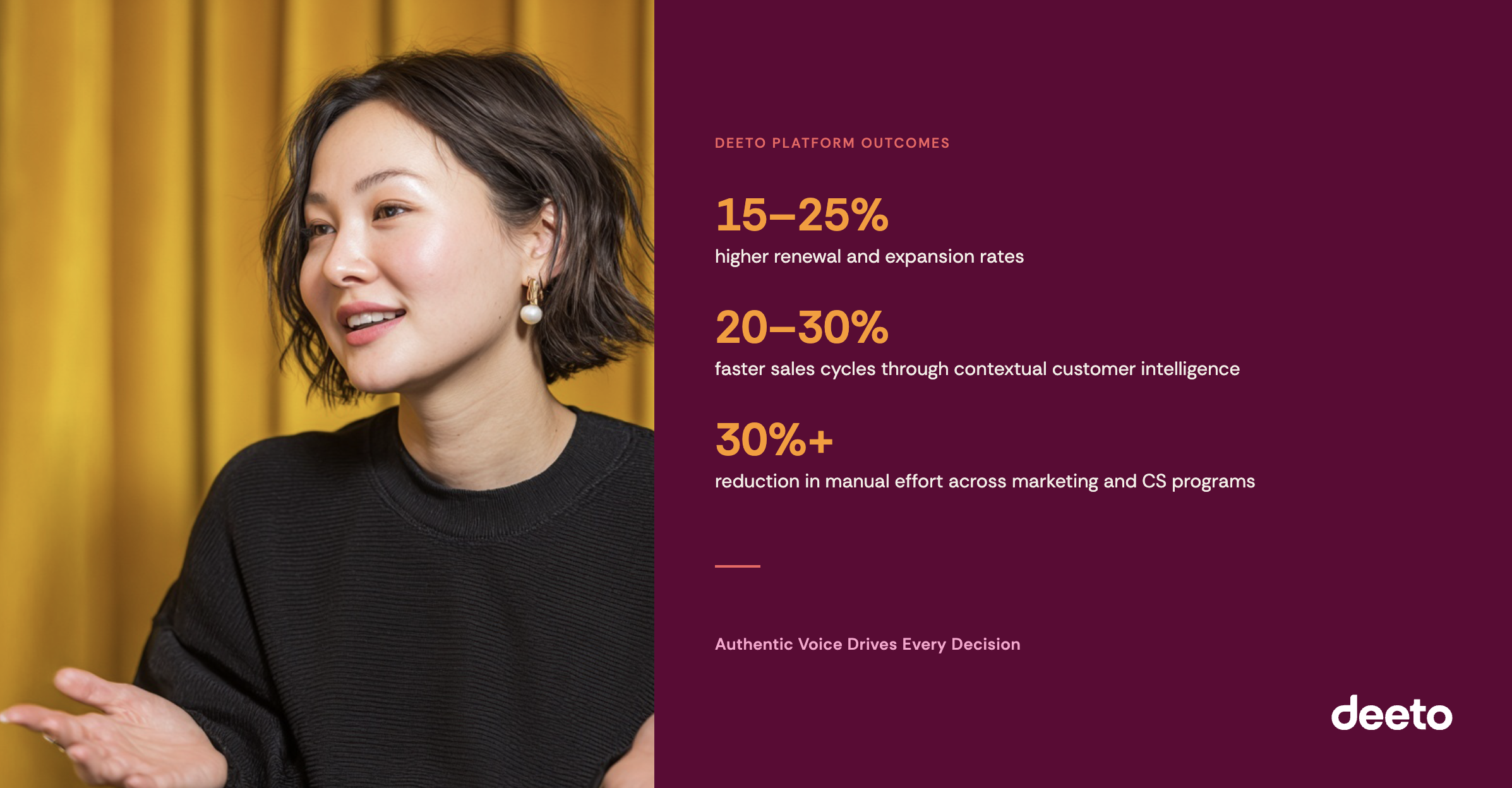
For customer success teams, Deeto surfaces renewal intelligence and at-risk signals before they become problems. For customer marketing teams, it captures customer stories, advocacy signals, and proof that fuel campaigns and conversion. Teams using Deeto see 15 to 25% higher renewal and expansion rates and 20 to 30% faster sales cycles through contextual customer intelligence.
Deeto is the platform to consider when your CX goal is not just to understand what customers think, but to make their voice the system that powers every team's work.
What to watch: Deeto is built for B2B organizations that already have a customer base to engage. It is not a general-purpose customer service or ticketing tool.
2. Qualtrics XM
Best for: Enterprise organizations running company-wide experience management programs that span customer, employee, and product research.
Qualtrics XM is one of the most established names in the experience management category. It captures and analyzes customer experience data across touchpoints using sophisticated survey tools, predictive AI, and deep statistical analysis. The platform is well-suited to large organizations with dedicated research teams and the budget to match.
Qualtrics excels at structured research: quantitative surveys, conjoint analysis, brand tracking, and benchmarking programs. It integrates with most enterprise data stacks and produces the kind of executive-level reporting that large CX programs require.
The tradeoff is complexity. Qualtrics is a powerful platform that requires investment to configure, maintain, and act on. Teams without dedicated research or analytics resources often find the platform underutilized relative to its cost.
What to watch: Implementation timelines can be long. The platform rewards investment but requires it in return.
3. Medallia
Best for: Enterprise teams capturing signals across high-volume, multi-channel customer interactions including voice, digital, IoT, and social.
Medallia is an enterprise-scale experience platform that ingests customer signals from a wide range of sources: surveys, support calls, social mentions, app behavior, and sensor data. Its AI and text analytics capabilities are among the strongest in the market, making it a fit for organizations managing CX at significant scale and complexity.
Medallia's strength is breadth of signal capture and the real-time analytics engine that sits on top of it. Large enterprises in financial services, healthcare, and retail use it to run continuous listening programs that feed into operational dashboards and frontline alerts.
Where Medallia is less strong is activation. Surfacing an insight in a dashboard is not the same as routing it to the sales rep, product manager, or CSM who can act on it. For organizations that need intelligence to flow into workflows, Medallia is often paired with additional tools.
What to watch: Enterprise pricing and complexity. Best suited to organizations with mature CX programs and dedicated operations teams.
4. Salesforce Agentforce Service
Best for: Organizations already running Salesforce CRM who want to unify customer history, case management, and AI-driven service in one platform.
Salesforce's CX offering, now branded as Agentforce Service, builds customer experience directly onto the Salesforce data model. The result is a platform that connects CRM records, interaction history, and service cases on a single screen, and routes AI-powered responses and human escalations through a unified agent workspace.
For Salesforce-native organizations, the integration advantage is real. CX data from service interactions feeds directly into sales and marketing workflows, creating the kind of unified customer view that most orgs struggle to build manually. The platform's 2025 and 2026 releases have deepened its autonomous AI agent capabilities, allowing service teams to resolve more cases without human intervention.
What to watch: Salesforce's CX capabilities are strong for service-led organizations, but less suited to voice-of-customer research, customer marketing, or insight orchestration use cases.
5. Zendesk
Best for: Support-led organizations that need best-in-class ticket management, AI resolution, and agent efficiency.
Zendesk remains the default recommendation for teams whose primary CX challenge is inbound support volume. Its interface is clean, its ticket management logic is well-proven, and its 2026 AI capabilities, accelerated by the Forethought acquisition in early 2026, have meaningfully improved first-contact resolution rates. According to Zendesk's own industry analysis, 30% of service cases were resolved by AI in 2025, with that number expected to reach 50% by 2027.
Zendesk is not a voice-of-customer platform or a customer intelligence system. It is a support operations tool that, when deployed well, reduces customer friction at the service layer. For organizations that view CX as primarily a support challenge, it is hard to beat. For teams that need customer voice connected to marketing, product, or revenue decisions, it covers only part of the picture.
What to watch: AI capabilities are improving fast, but the platform's data model is support-centric. Exporting signals into the broader organization still requires significant integration work.
6. Sprinklr
Best for: Enterprise marketing and service teams managing customer experience across social media, messaging apps, and modern digital channels.
Sprinklr is the platform of choice for organizations where CX is as much a brand challenge as it is a service one. It unifies social listening, community management, customer service, and marketing across modern channels including X (formerly Twitter), Instagram, WhatsApp, and dozens of others.
Sprinklr's strength is the breadth of its channel coverage and the integration of service data with marketing and social intelligence. Enterprise brands that need to manage public-facing experience at scale, and connect those interactions to broader CX programs, find it a capable fit.
What to watch: Sprinklr is a premium platform with complexity to match. Mid-market organizations often find the configuration overhead and pricing disproportionate to their needs.
7. Gainsight
Best for: B2B SaaS teams whose CX strategy is primarily anchored in customer success, retention, and expansion.
Gainsight is the category-defining platform for customer success management. It tracks customer health scores, surfaces renewal and churn risk signals, and orchestrates the playbooks that CS teams use to manage their book of business.
In the broader CX context, Gainsight is most valuable when the CX function reports through Customer Success and the primary goal is retention. It is strong on lifecycle management, weaker on customer voice capture, marketing integration, and the kind of cross-functional intelligence orchestration that B2B growth teams need.
What to watch: Excellent for CS-owned programs. Teams that need customer intelligence to flow into product, marketing, or sales workflows will likely need to supplement it.
8. Intercom
Best for: Product-led growth companies and SaaS teams that need AI-first conversational support and in-product engagement.
Intercom has evolved significantly over the past two years. Its Fin AI Agent, powered by large language models, resolves a high percentage of support queries autonomously and routes complex cases to human agents with full context. For product-led growth teams, Intercom's combination of in-product messaging, support, and customer engagement workflows is a strong fit.
Intercom is best understood as a conversational CX platform. It handles the immediate, real-time layer of customer experience well but is not designed for strategic voice-of-customer programs, longitudinal insight, or cross-functional intelligence.
What to watch: AI resolution rates vary significantly by industry and query type. It performs best in software support contexts with well-defined resolution paths.
9. HubSpot Service Hub
Best for: Mid-market organizations already on HubSpot CRM that want to unify marketing, sales, and service data without adding complexity.
HubSpot Service Hub sits inside the HubSpot ecosystem and shares a data model with Marketing Hub and Sales Hub. For organizations already using HubSpot, adding Service Hub means customer service tickets, NPS scores, and support history are immediately visible alongside marketing engagement and deal history.
The platform is not the deepest in any single category, but its integration advantage within the HubSpot ecosystem is genuine. Teams that want a unified view of the customer without a heavy implementation investment often choose it for that reason.
What to watch: Service Hub is mid-market in scope. Enterprise-level CX programs will outgrow it.
How to Choose the Right CX Platform for Your Team
If you need customer voice connected across every team, Deeto is the only platform on this list built to do that. Most platforms here solve for one function: research, support, success, or social. Deeto spans the full org, turning authentic customer voice into intelligence that flows to sales, marketing, product, and customer success through one connected system. It is also the platform most likely to reduce your dependence on several of the point solutions below.
For teams with more specific, function-level needs:
- If your primary goal is enterprise research and experience measurement, Qualtrics and Medallia are the established choices, with the complexity and investment to match.
- If your primary goal is AI-driven service and support resolution, Zendesk, Salesforce Agentforce Service, and Intercom are all strong depending on your existing stack.
- If your primary goal is social and digital channel management, Sprinklr leads in breadth and enterprise readiness.
- If your primary goal is customer success-led retention, Gainsight remains the category standard.
The honest framing: Deeto does not compete with these tools so much as it completes what they can't do, connecting the strategic layer of customer intelligence to the workflows those platforms run.
For a deeper look at what the category covers, our guide on what is customer experience covers the core concepts, frameworks, and the distinction between CX programs that measure and those that drive change.
Key Takeaways
- The best customer experience platforms in 2026 go beyond data collection to connect customer voice to decisions in sales, marketing, product, and customer success.
- Platform categories vary significantly: enterprise experience management (Qualtrics, Medallia), service and support (Zendesk, Salesforce, Intercom), social CX (Sprinklr), customer success (Gainsight), and voice intelligence and orchestration (Deeto).
- The right platform depends on which team owns CX, what decisions customer data needs to inform, and whether you have a clear loop from insight to action.
- 89% of businesses are projected to compete primarily on customer experience by 2026, making platform selection a strategic decision, not just a software one.
- Deeto is purpose-built for B2B organizations that need authentic customer voice connected to every team's workflow, not just surfaced in a dashboard.
Conclusion
Picking the best customer experience platform is not a feature comparison exercise. It is a question about what you want customer intelligence to change inside your organization.
Most platforms in this category solve for capture. They collect well, report clearly, and stop short of the activation layer where CX data actually changes what teams do. The organizations seeing the strongest CX outcomes in 2026 are the ones that have closed that gap, connecting customer voice to the sales conversations, product decisions, and renewal strategies that determine growth.
If you are ready to see how Deeto connects authentic customer voice to decisions across every team, book a demo and we will show you what that looks like in practice.
For a primer on the broader category, start with the customer journey mapping guide, which covers how the best organizations design and track the end-to-end customer experience before investing in a platform to manage it.
Frequently Asked Questions
What is a customer experience platform?
A customer experience platform is software that helps organizations capture, analyze, and act on customer signals across the full lifecycle. The best platforms connect feedback from surveys, interviews, support interactions, and behavioral data to the teams and workflows that need to act on it. Customer experience platforms range from narrow support tools to full-scale intelligence and orchestration systems.
What is the best customer experience platform for B2B SaaS teams?
For B2B SaaS teams that need to connect customer voice to decisions across sales, marketing, product, and customer success, Deeto is the strongest choice. It captures authentic customer voice, organizes it into connected intelligence, and delivers it to the right person at the right moment through CRM and enablement integrations. For teams focused primarily on support operations, Zendesk or Intercom are strong alternatives depending on scale.
How is a CX platform different from a CRM?
A CRM manages transactional data about customers: contacts, deals, interactions, and pipeline. A customer experience platform captures and organizes the qualitative and experiential layer of customer relationships, what customers think, feel, and need, and connects that intelligence to decisions. The best-in-class organizations use both, with CX intelligence flowing into CRM workflows to inform sales, renewal, and engagement strategies.
What should I look for when evaluating CX platforms?
Start with use case, not features. Identify which team owns the CX program, what decisions customer data needs to improve, and how your organization currently handles the loop from insight to action. Then evaluate platforms on how well they match that use case, their integration with your existing stack, and the quality of their AI for surfacing patterns rather than just presenting raw data.
How much do customer experience platforms cost?
Pricing varies significantly by category and scale. Enterprise platforms like Qualtrics and Medallia typically run six-figure annual contracts for large deployments. Mid-market tools like HubSpot Service Hub and Intercom start lower but scale with usage. Deeto is priced for B2B teams and scales with the scope of the program. Most providers offer custom pricing based on organization size and use case. Request a demo or a pricing call to get accurate figures for your specific needs.
What is the difference between customer experience and customer success platforms?
Customer success platforms like Gainsight focus on the post-sale relationship: health scoring, renewal management, and expansion within an existing account base. Customer experience platforms are broader, covering the full lifecycle from acquisition through retention and including the signals that come from marketing, product, support, and research. The two categories overlap significantly and are often used together in mature B2B organizations.
🎉 Save your spot
Register for the event
Once your spot is secured, we’ll send your confirmation details.
Subscribe to our newsletter
Subscribe to receive the latest blog posts to your inbox every week.
By subscribing, you agree to our Privacy Policy
Subscribe to our newsletter
Get the latest news and updates from our team.
By subscribing, you agree to our Privacy Policy
Related posts

Best customer intelligence tools for B2B teams

What are customer intelligence tools? Compare 8 B2B options, collection methods, and how to pick the right fit.

Voice of the Customer Strategy for SaaS Companies
What is VoC for SaaS? Learn how to capture customer voice and turn it into decisions that drive renewals.

Call Intelligence Software That Spots Your Next Reference
What is call intelligence software? Learn how it scores every call automatically and surfaces advocacy-ready customers.