What Is Sentiment Analysis? A Step-by-Step Guide for B2B Teams
.jpeg)


Thursday, April 2, 2026


What Is Sentiment Analysis? A Step-by-Step Guide for B2B Teams


View the podcast on Youtube

Most companies are sitting on a mountain of customer signals they never actually use. Call transcripts, survey responses, support tickets, interview notes. The sentiment is there. The insight isn't, because no one has a system to extract it.
Sentiment analysis is the process of identifying and measuring the emotional tone expressed in customer communications, classifying it as positive, negative, or neutral to help teams understand how customers feel at any point in the relationship.
In this guide, you'll learn what sentiment analysis is, why it matters for B2B teams specifically, and the exact steps to run it in a way that produces decisions, not just dashboards.
What Is Sentiment Analysis?
Sentiment analysis is a method of processing text, audio, or video to detect the underlying emotional tone and classify it as positive, negative, or neutral. It is a form of natural language processing (NLP) that enables teams to move from reading individual customer comments to identifying patterns across hundreds or thousands of interactions.
In a B2B context, sentiment analysis helps customer success, product, and marketing teams answer questions that would otherwise take weeks of manual review: Are renewal conversations trending negative? Are customers satisfied with a specific feature? Are certain account segments at higher churn risk?
Sentiment analysis systems help teams move from reactive to proactive. Instead of waiting for a customer to escalate, you see the signal before the problem compounds.
Sentiment analysis includes more than just survey scores. It covers everything from call transcript tone to open-text NPS responses to product interview feedback. When those signals are organized and analyzed together, they become one of the most reliable inputs a B2B company can have.
Why Sentiment Analysis Matters for B2B Teams
A single NPS score tells you almost nothing on its own. A sentiment trend across 200 customer touchpoints tells you a lot.
B2B companies lose customers slowly, then all at once. The warning signs are almost always present in the language customers use weeks or months before a churn event, but most teams don't have the infrastructure to catch them. According to Bain & Company, a 5% increase in customer retention can produce a 25–95% increase in profits, yet most retention efforts are still built on lagging indicators. Deeto's data shows that teams with earlier visibility into customer sentiment see 10–15% higher renewal rates as a direct result.
Sentiment analysis bridges that gap. It gives customer success teams an early warning system, product teams a continuous feedback loop, and marketing teams proof that the language they use actually resonates with buyers.
How to Do Sentiment Analysis: A Step-by-Step Process
Running sentiment analysis well requires more than a tool. It requires a clear process for collecting the right signals, analyzing them in context, and routing insights to the teams who can act on them. Here are the steps.
Step 1: Define What You're Trying to Learn
Start with the question, not the data. The most common mistake teams make is running sentiment analysis without a clear objective, which produces charts nobody uses.
Before collecting any data, define the specific question you're answering. Are you trying to understand how customers feel about a recent product launch? Identify which accounts are at churn risk before renewal? Measure how onboarding sentiment changes over the first 90 days?
A clear question determines which data sources you need, which time windows matter, and what a meaningful shift in sentiment actually looks like for your business.
Step 2: Collect Customer Voice Across Every Channel
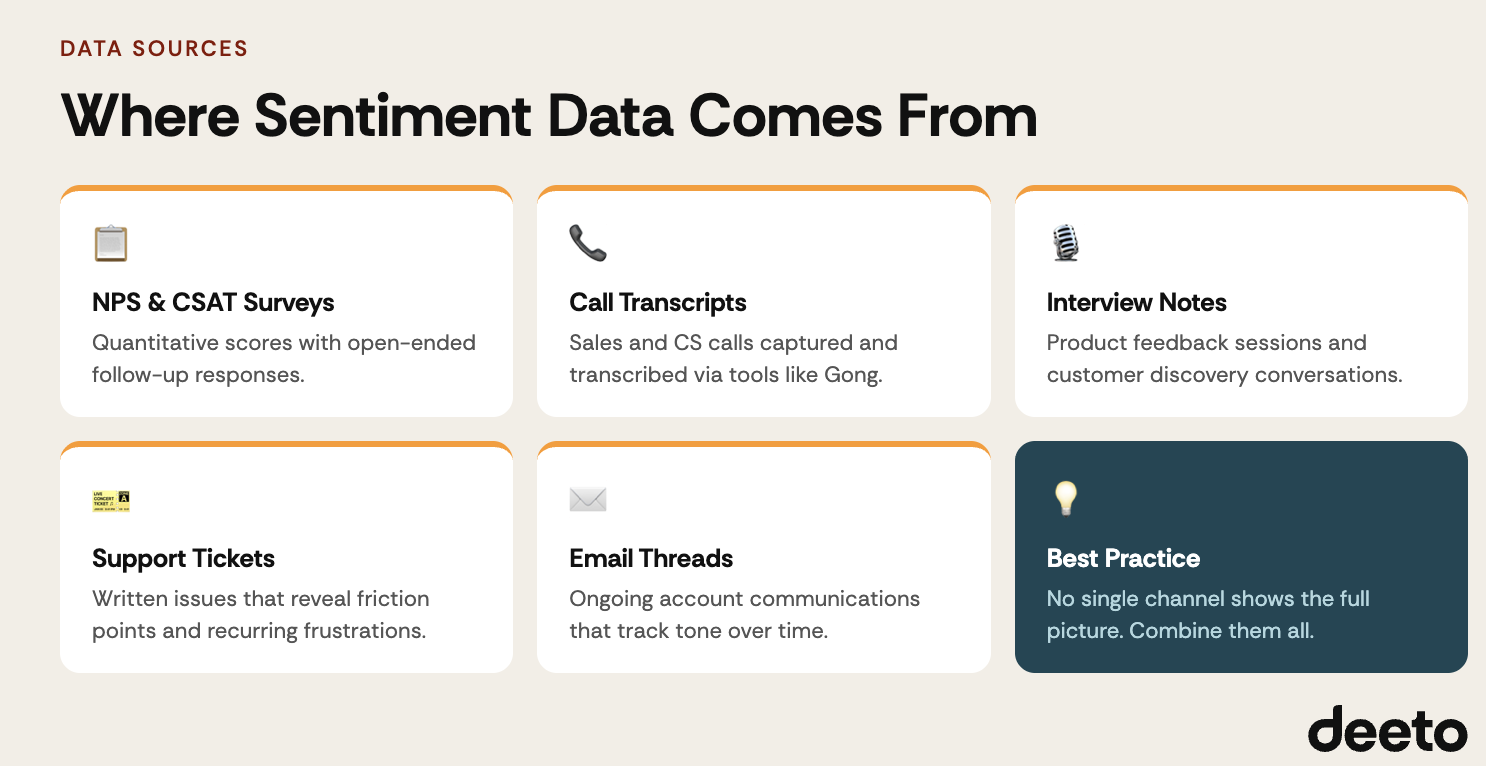
Sentiment analysis is only as good as the signals feeding it. Most B2B teams underestimate how many customer voice channels they have available: NPS and CSAT surveys, customer success check-ins, support tickets, onboarding interviews, product feedback sessions, and sales conversations.
Deeto's Listen module is built to capture authentic customer voice continuously across all of these channels, including AI-powered interviews, surveys, and in-product microfeedback. Instead of sending a quarterly survey and hoping for responses, you build a continuous collection system that captures sentiment in context, at the right moment in the customer journey.
The goal at this step is breadth. Pull from every available channel so your analysis reflects the full picture, not just the loudest voices.
Step 3: Analyze Call Recordings
One of the richest and most underused sources of customer sentiment in B2B is the sales and customer success call. A customer can give a 9 on an NPS survey and still use language in a renewal call that signals serious dissatisfaction. Text-based surveys don't catch tone, hesitation, or the specific phrasing customers use when they're concerned.
Call recording analysis addresses this directly. By analyzing transcripts and audio from recorded calls, teams can identify sentiment patterns that never surface in structured feedback channels.
Deeto's integration with Gong makes this seamless. Gong captures and transcribes sales and CS calls automatically. Deeto pulls those transcripts into the platform, analyzes the sentiment and key themes expressed, and ties that intelligence back to the customer record. That means a CS manager can see not just what a customer said in a survey, but what tone they used in their last three calls, and whether that tone has shifted. It also means product marketing can identify recurring objections or praise across hundreds of calls without manually reviewing a single one.
Call-level sentiment analysis is especially powerful for identifying churn signals early. A customer who uses phrases like "we were hoping for more" or "we haven't really gotten there yet" in a renewal call is telling you something. A system that captures and surfaces that language gives your team a real window to respond.
Step 4: Classify and Organize the Signals
Raw sentiment data isn't intelligence yet. The next step is classifying what you've collected into themes, topics, and sentiment scores that can be compared over time and across segments.
Good classification answers three questions about every piece of feedback: What is the customer talking about? How do they feel about it? How does this compare to what other customers are saying?
Deeto's Analyze module handles this layer of the process. It identifies patterns, tracks sentiment trends, and organizes customer signals into dashboards that give teams a clear view of where sentiment is strong, where it's declining, and which segments or product areas need attention. This is where raw customer voice becomes structured intelligence.
The output of this step should be a categorized view of sentiment by segment, topic, lifecycle stage, and time period, not just an aggregate score.
Step 5: Identify Patterns and Risk Signals
Once signals are classified, the analytical work begins. Look for clusters: which topics have the highest concentration of negative sentiment? Which customer segments are trending in the wrong direction? Which onboarding milestones correlate with positive long-term sentiment?
This step is where customer sentiment analysis shifts from descriptive to predictive. You're no longer just measuring how customers feel today. You're identifying which patterns precede churn, which precede expansion, and which indicate a customer who's ready to become an advocate.
Teams that build this pattern recognition into their regular workflow stop waiting for customers to tell them something is wrong. They start seeing it in the data first.
Step 6: Route Insights to the Teams Who Need Them
The most common failure point in sentiment analysis programs isn't the analysis itself. It's the last mile. Insights sit in a dashboard nobody checks, or they're shared in a monthly report that's two weeks out of date by the time it's read.
Effective sentiment analysis requires a routing system. A negative sentiment spike in a CS account should trigger a notification in the account owner's workflow. A cluster of negative product feedback should reach the product team in a format they can act on. A pattern of strong positive sentiment around a specific outcome should reach marketing before the message becomes stale.
Deeto's platform connects the intelligence layer to the activation layer, surfacing the right insights to the right people at the right moment, whether that's in Salesforce, Slack, or a product team's roadmap tool. That's what separates a sentiment analysis program that changes decisions from one that produces reports.
Step 7: Close the Loop with Customers
Sentiment analysis isn't just a tool for internal decision-making. It's also a way to strengthen customer relationships, but only if you close the loop.
When a customer shares negative sentiment, reaching out to address it directly is one of the most effective retention moves a company can make. When positive sentiment clusters around a specific outcome, it's an opportunity to capture a case study, a testimonial, or a referral.
Customer voice research and evidence programs work best when customers feel heard. Closing the loop, telling customers what changed because of their feedback, creates a relationship dynamic that reinforces loyalty and generates more authentic input over time.
Key Takeaways
- Sentiment analysis is the process of classifying the emotional tone in customer communications to identify how customers feel and where patterns of risk or satisfaction exist.
- The process works best when it covers multiple data sources: surveys, call recordings, interviews, support tickets, and in-product feedback.
- Call recording analysis via tools like Gong, connected to a platform like Deeto, surfaces sentiment signals that structured surveys consistently miss.
- The value of sentiment analysis comes from routing insights to the right teams fast enough to act, not from building dashboards that measure the past.
- Closing the loop with customers based on what sentiment data reveals is one of the highest-leverage retention and advocacy moves a B2B company can make.
Frequently Asked Questions
What is sentiment analysis in simple terms?
Sentiment analysis is the process of reading customer communications, whether written or spoken, and classifying the emotional tone as positive, negative, or neutral. In a B2B context, it helps teams understand how customers feel about a product, relationship, or experience without having to manually review every interaction.
What data sources can you use for sentiment analysis?
Sentiment analysis can be applied to almost any customer communication: NPS and CSAT survey responses, call transcripts, product feedback sessions, support tickets, email threads, and interview notes. The most effective programs pull from multiple sources simultaneously, because no single channel captures the full picture of how a customer feels.
How is sentiment analysis different from NPS?
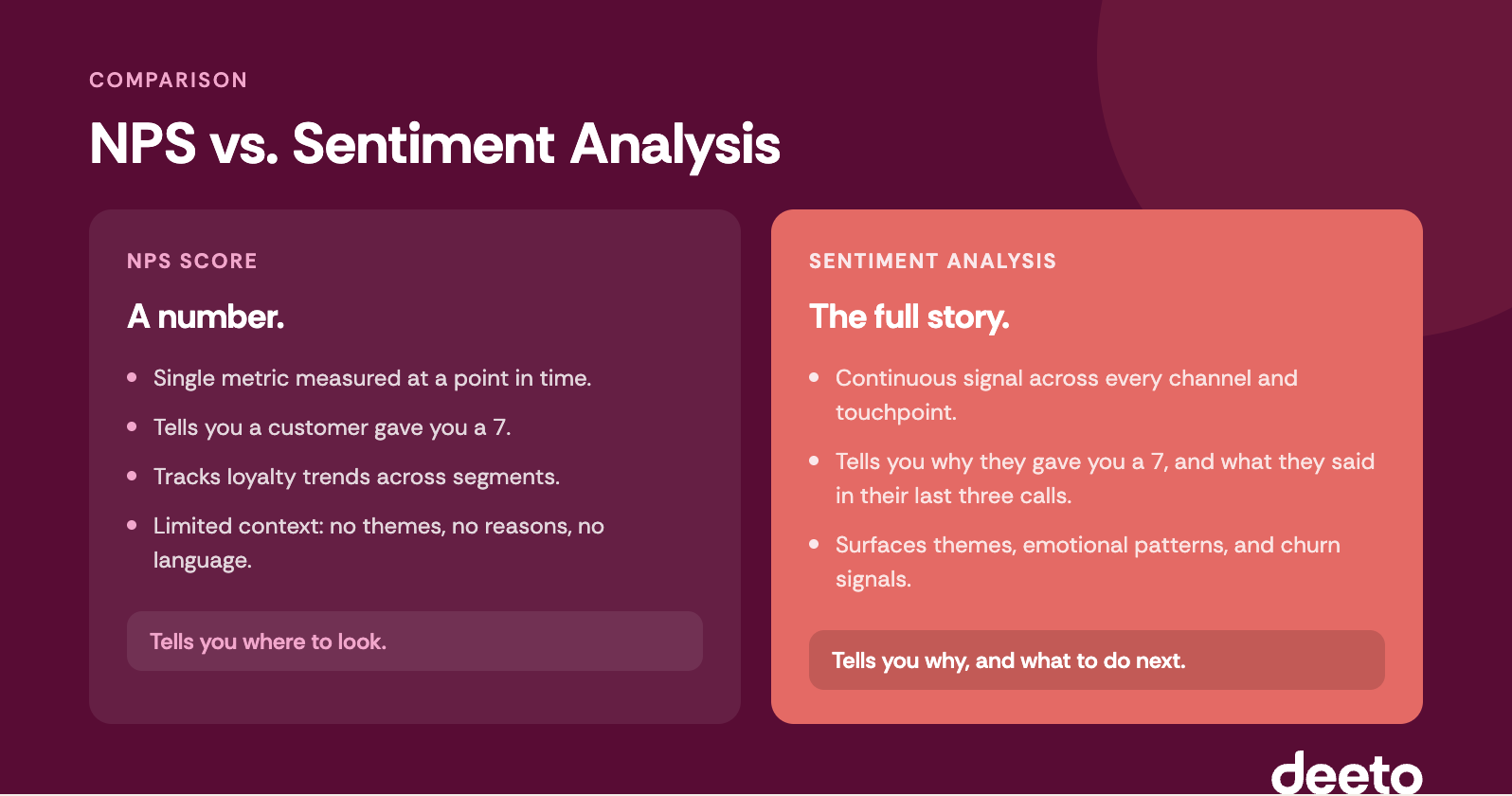
NPS is a single numeric score that measures overall customer loyalty at a point in time. Sentiment analysis goes deeper, classifying the language customers actually use across dozens of touchpoints to identify themes, emotional patterns, and signals that a score alone cannot surface. NPS tells you a customer gave you a 7. Sentiment analysis tells you why, and what they said in their last three calls that suggests they might not renew.
How does Gong integrate with sentiment analysis?
Gong captures and transcribes sales and customer success calls. When connected to a platform like Deeto, those transcripts are analyzed for sentiment, key themes, and patterns that get tied back to individual customer records. This makes it possible to track how call-level sentiment evolves over time and surface early warning signals before they become churn events.
How do you act on sentiment analysis results?
Sentiment analysis creates value only when insights are routed to the people who can act on them. That means connecting your analysis layer to the workflows your CS, sales, and product teams already use. Negative sentiment signals should trigger account reviews. Positive patterns should feed marketing and advocacy programs. The goal is making sentiment a live input to decisions, not a retrospective report.
What is the difference between structured and unstructured sentiment analysis?
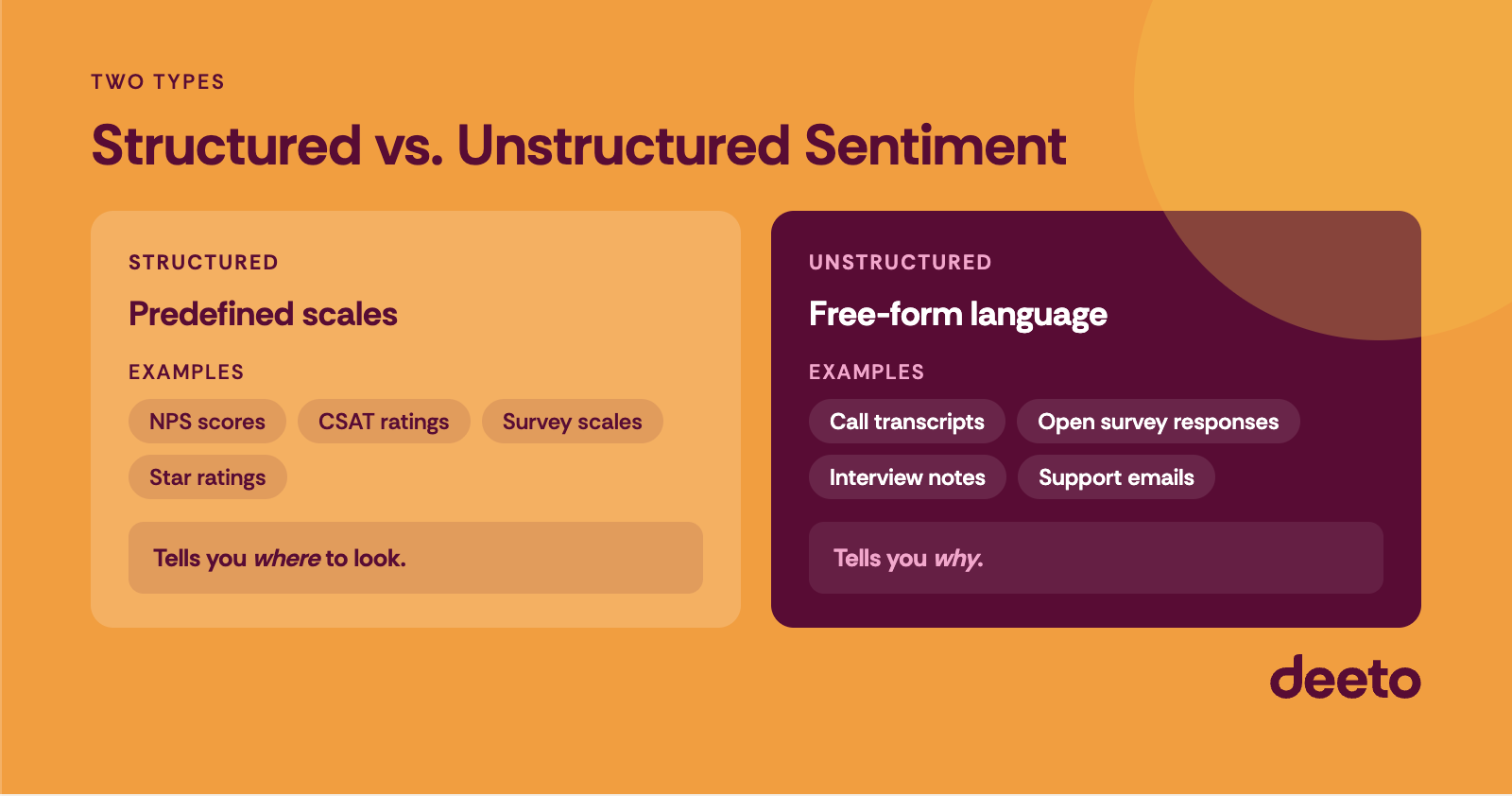
Structured sentiment analysis uses predefined scales or questions, like survey rating scales. Unstructured sentiment analysis processes free-text or audio data, such as open-ended survey responses, call transcripts, or interview notes. B2B teams get the most complete picture when they analyze both. Structured data tells you where to look. Unstructured data tells you why.
Deeto is a customer orchestration platform that turns authentic customer voice into connected intelligence and action. To see how Deeto handles sentiment analysis across the full customer lifecycle, book a demo.
🎉 Save your spot
Register for the event
Once your spot is secured, we’ll send your confirmation details.
Subscribe to our newsletter
Subscribe to receive the latest blog posts to your inbox every week.
By subscribing, you agree to our Privacy Policy
Subscribe to our newsletter
Get the latest news and updates from our team.
By subscribing, you agree to our Privacy Policy
Related posts

4 Ways To Leverage Social Proof In Marketing

What is social proof in marketing? Learn 4 ways to use reviews, stories, and advocacy to build buyer trust.

How to Build a Customer Testimonial Strategy That Converts
What is a customer testimonial strategy? Learn how to collect, structure, and activate proof that closes deals.

Customer Testimonial Software Platforms Compared
What is customer testimonial software? Compare 7 platforms, see how they stack up, and learn how to choose the right one