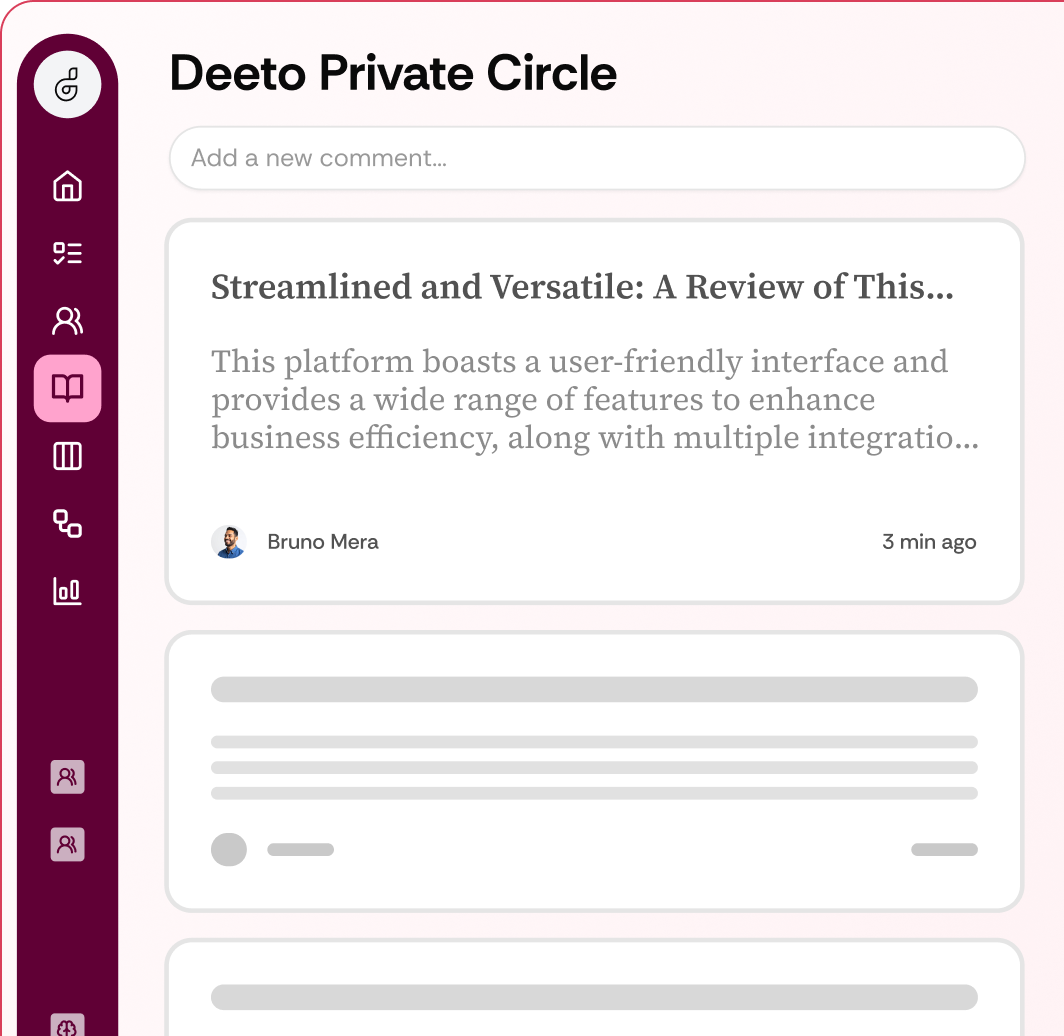
A resource and community space for modern marketers, sellers, and builders using customer voice to grow — together.
This hub is built for anyone who wants to do more with the voices of their customers. Whether you're scaling advocacy, building trust with proof, or rethinking how to go to market — you're in the right place.
How-to guides and playbooks for building with customer voice
Campaign-ready templates and swipe files
Benchmark reports and reference best practices
Event recordings, expert sessions, and community spotlights
Ask questions. Share ideas. Trade wins. This is your space.
You don’t have to figure this out alone. The Deeto community connects you with other leaders using customer voice to build better GTM motions, faster-growing brands, and smarter strategies. If you are interested in joining when it launches, sign up below.
Automate advocacy management workflows
Dynamically generate customer stories and social proof
Eliminate manual reference management
Track and report advocacy impact on revenue
Discover practical guides, templates, and tools to help your team close more deals, faster.
Customers aren't shy about voicing their preferences, frustrations, and ideas. Despite that feedback being one of the most valuable resources at their disposal, a surprising number of companies still overlook it (or fail to use it to its fullest potential).
Voice of the Customer (VoC) is the systematic process of collecting, analyzing, and acting on what customers say and do, across surveys, reviews, support conversations, and interviews, so teams can turn that input into decisions instead of letting it sit in a dashboard. It's proactive, not reactive, and it now feeds more than internal roadmaps. Buyers ask ChatGPT and Perplexity to compare vendors before they ever talk to sales, and those answers get built from the same customer voice a well-run VoC program collects.
A 2023 survey from Treasure Data found that 76% of business leaders were confident they understood their customers well enough to deliver personalized experiences. Only 25% of consumers agreed. That gap hasn't closed. More than half of consumers say they'd switch to a competitor after just one bad experience.
The best way to close that gap? Listen to the people actually living the experience. That's what a Voice of the Customer strategy is built to do.
Voice of the customer (VoC) is the process of capturing what customers say about their needs, experiences and expectations, then turning that feedback into decisions across product, marketing, sales and customer success.
The Voice of the Customer encompasses everything your customers are saying about your business: what they love, what frustrates them, what they wish you'd change. It's the systematic process of gathering, analyzing, and acting on customer insights to improve their experience and, ultimately, your bottom line.
Think of it like running a restaurant. VoC isn't just reading Yelp reviews. You'd want to know what people order most, how long they wait, what they expect, and whether they'd recommend the place to a friend. Then you'd use that information to improve the menu, service times, and the overall experience.
Customer satisfaction is a piece of VoC, not the whole picture.
VoC is proactive and holistic. It gathers insight on behavior, pain points, and expectations from multiple sources over time. Customer satisfaction is a snapshot, usually measured right after a purchase or support interaction, through metrics like CSAT or NPS. Those are reactive and touchpoint-specific.
Customer satisfaction tells you how someone felt in one moment. VoC tells you why, and what to do about it.
Collecting VoC data to tick a box doesn't tell you much about the "why" behind it. Active listening means really tuning in to what your customers are saying (and how they’re saying it).
Instead of just looking at the numbers and scores for these things, paying attention to the sentiment and language customers use gives you more context as to the emotions, motivations, and unspoken needs behind their words.
VoC is a strategic lever, not a research exercise. It directly impacts growth and profitability by guiding customer-led decisions, helping you anticipate needs before they become churn risks.
Your customers are the ones who use your products every day. That means they’re the first to spot what works, what doesn’t, and what’s missing. They can point out gaps or suggest features you may not have considered internally.
When customers repeatedly ask for the same thing or struggle with a similar issue, that’s your cue to act. Feeding this insight back into your product roadmap ensures you’re building things people actually want, which eliminates wasted dev time and increases adoption.
Product differences alone don't hold customers anymore. Relationship quality does. Voice of the customer research from Salesforce found nearly three in four customers would switch brands for a better deal, while 88% said good service makes them more likely to purchase again.
VoC surfaces friction in the customer journey before it becomes a dealbreaker. Clunky onboarding, slow support, a confusing upgrade path. When you consistently gather and respond to feedback, retention and referrals follow.
When you understand how customers actually talk about your product, it's easier to mirror that language in your messaging. That means sharper positioning, better copy, and campaigns that use the words real buyers use instead of the words marketing assumes they use.
Sales teams benefit too. VoC intelligence helps reps handle objections with real customer language instead of guesswork, and turns feedback into proof they can bring into a deal instead of a generic case study PDF.
Sometimes, your customers will reveal use cases or needs you didn’t realize your product could solve. These are golden opportunities — not just for new features, but possibly new offerings, markets, and competitive positioning.
In your VoC data, look for those outlier comments or recurring “It would be great if…” moments. Those point to areas where you can create add-ons, premium tiers, cross-sells, or spin-off solutions that align with your customers’ evolving needs.
By the time a customer cancels, it's usually too late. But the warning signs, frustration, complaints, waning engagement, show up earlier if you're actually listening. A well-timed check-in call or product tutorial, triggered by churn risk signals, can turn a quiet dropout into a saved account.
To lay the groundwork for a successful strategy, there are four important steps you need to take when setting up your VoC program:
You need to know what you’re listening for. Otherwise, you’ll end up with a bunch of data and no clear direction. Goals give your VoC program purpose.
Start by asking: What are we trying to improve? Are you trying to reduce churn? Improve a product feature? Nail your brand messaging?
Once you have clarity, define measurable goals (like improving CSAT by 10% or increasing trial-to-paid conversion). These goals guide everything else, from what questions you ask to which channels you focus on.
Not all feedback carries the same weight, and different customers have different needs. To understand who you’re hearing from and make sure you’re acting on insights that actually matter to your business strategy, your second step is to segment your audience.
Build personas that reflect these groups and their goals. Then tailor your questions and analysis accordingly. That way, you avoid treating all feedback as one-size-fits-all and start making decisions that are laser-focused on specific customer groups.
You need both the right channels and the right timing to get meaningful, actionable feedback. If you’re only using surveys, you’re missing the bigger picture.
The best approach is to mix methods:
You’ll want a blend of quantitative data (scores, trends) and qualitative insights (comments, conversations). Together, they give you both the “what” and the “why.”
Voice of customer research spread across tools and teams is noise. You need one source of truth that turns scattered input into clear insights.
Use a centralized platform for capturing customer knowledge and feedback (like Deeto), or a CRM-integrated solution that pulls in feedback from all your channels. Tag and categorize data, then analyze it on a regular basis to find trends, flag issues early, and continuously refine based on what customers are telling you.
See our comparison of voice of the customer tools and platforms.
Like I mentioned, tapping into the Voice of the Customer requires a healthy mix of quantitative and qualitative data from a variety of sources.
Broadly speaking, there are five categories of customer feedback to use:
These are your workhorses. They’re scalable, structured, and perfect for capturing specific feedback at key moments (like post-purchase or post-support interactions).
Ideally, keep them short and focused. Ask both quantitative questions (“On a scale of 1–10…”) and open-ended ones (“What could we have done better?”).
Tools like Typeform, Google Forms, or SurveyMonkey make it easy.
Pro tip: Personalize surveys based on customer segment or journey stage to keep things relevant.
This is where you go deeper.
Interviews let you explore emotions, behaviors, and underlying motivations you won’t uncover in a form. To avoid bias, start by choosing a diverse sample of customers and create a relaxed environment where they can be candid. Ask open-ended questions and actively listen.
Focus groups are great for getting multiple perspectives at once and watching how ideas bounce around. They're gold for product development, UX research, and branding insights.
Social platforms are an unfiltered feedback channel; people say what they really think about your brand and product, in real time.
Use tools like Brandwatch, Hootsuite, or Sprout Social to monitor brand mentions, hashtags, and sentiment. Pay attention to trends, complaints, praise, and what they're saying about competitors.
Reviews are unsolicited, brutally honest, and loaded with insights about what people value most. They also highlight emotional drivers that formal feedback might miss. Track your reviews on platforms like Google, G2, Yelp, or whichever platforms are relevant to your industry.
Look for patterns in language, tone, and specific features being mentioned. High ratings tell you what to double down on. Low ones? They’re a free roadmap for improvement.
People usually reach out when they’re stuck, confused, or frustrated. So, your support inbox shows you in real time where your points of friction are.
Analyze tickets, chat logs, call transcripts, and feedback forms. Tag and categorize issues by type, frequency, and sentiment. Better yet, loop your support team into the VoC process, since they’re on the front lines and know what’s bothering customers through first-hand experience.
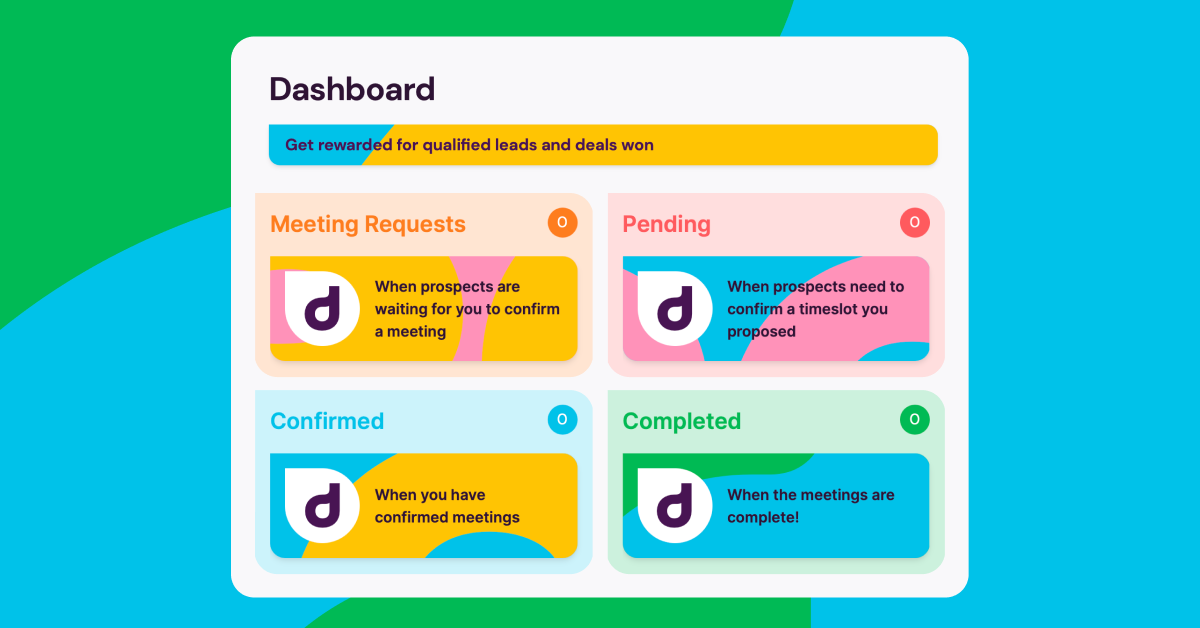
Tracking the right KPIs helps you connect feedback to action and measure whether your efforts are actually making a tangible impact.
Here are seven key metrics you’ll want to keep an eye on:
Your VoC strategy is where the rubber meets the road. To create a structured, repeatable process that ties customer feedback directly to business outcomes, there are five key steps to follow:
Start by identifying your core strategic objectives. Are you trying to break into a new market? Reduce churn? Improve onboarding?
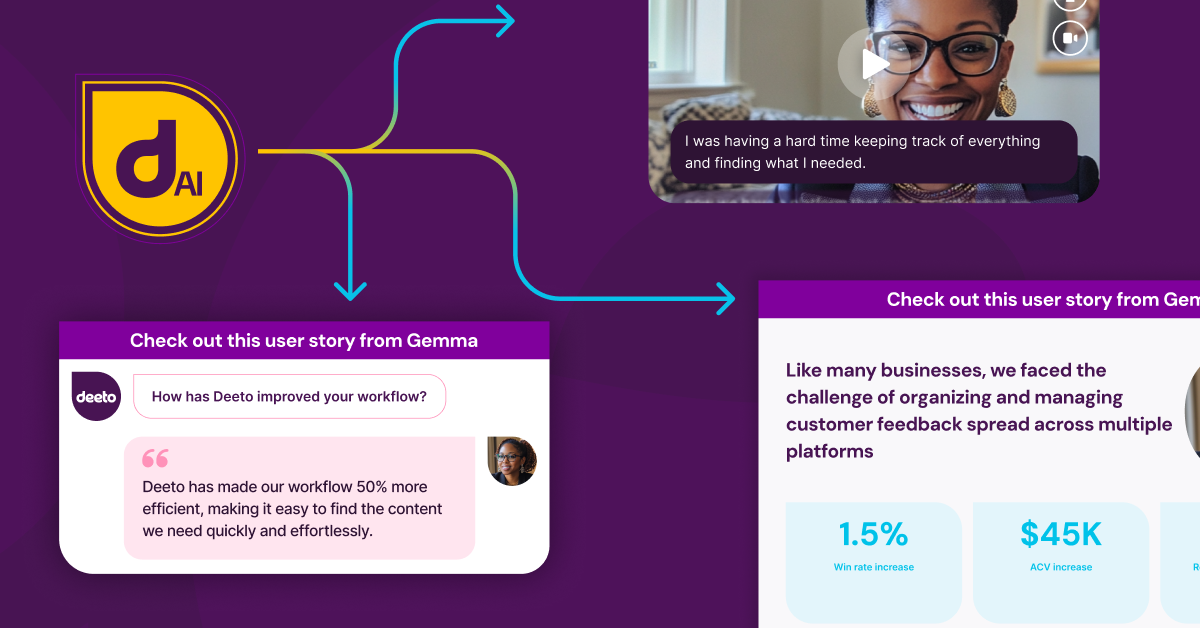
Once you’ve nailed those down, Deeto simplifies feedback collection by allowing your customers to share it directly. When you invite them to the platform, they instantly become part of your knowledge base.
Not all feedback carries equal weight. Feedback from a high-LTV or long-time customer might reveal deeper loyalty drivers or critical gaps, especially if they're aligned with your ICP. Segment insights so you’re not optimizing for edge cases or low-impact voices.
Also pay close attention to patterns. If 20% of your customers flag the same issue, that’s probably a high-impact opportunity.
Analyze the data to uncover trends, root causes, and opportunities. Group comments by themes (e.g. pricing, usability, support) and tie them back to your goals. Then create clear, specific recommendations your team can act on — for example, “redesign the signup flow to reduce confusion” instead of “people are getting stuck.”
Work with Product, Marketing, Support, and Ops teams to turn insights into roadmap items, experiments, or process improvements. Set timelines, assign ownership, and track progress for each.
Small changes (like updating onboarding emails) can be quick wins, while larger changes (like building a new feature) need more planning, but both matter.
In VoC, active listening also means you respond. You acknowledge the feedback, you act on it, then you let customers know you've implemented a solution. One way to do this is to send an email saying “You asked, we listened," highlighting what’s new and thanking them for their input.
With Deeto, knowing who is responsible for which feedback is easy because everything is tagged by name and segment. It also integrates with your CRM, so you can reach out directly to the customers who gave feedback without having to manually search for their contact information.
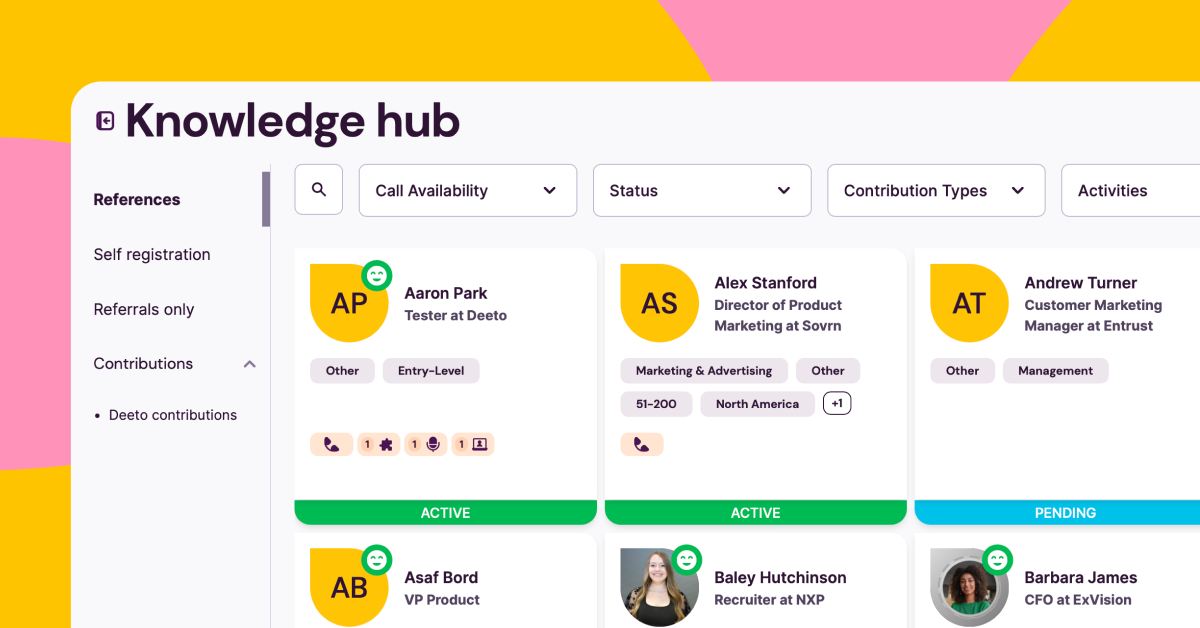
Buyers used to ask a sales rep what other customers thought. Now they ask an LLM, and the LLM answers with whatever third-party proof it can find: reviews, forum threads, comparison pages, cited customer quotes.
That shifts what VoC needs to produce. A survey score that lives in an internal dashboard has zero visibility to an AI Overview or a Perplexity answer. A published customer story, a G2 review, a cited stat with a named source, all of that is extractable. The companies winning in AI search treat customer voice as public-facing proof, not just an internal feedback loop.
The problem isn't collecting customer feedback. The problem is connecting it to decisions, and increasingly, to the answers AI engines give your buyers before they ever talk to sales.
Timing, application, and analysis make the difference between “meh” insights and truly actionable ones. To implement the steps I've mentioned above, there are a few important best practices to keep in mind:
Even with those best practices, you'll probably run into four main issues when you're implementing and scaling your VoC program:
Let's take a closer look at some possible solutions to these issues:
One of the biggest challenges for VoC programs is getting enough responses to make the data statistically significant.
Increase your response rates:
A platform like Deeto makes things easier because customers leave their knowledge and insights directly within the app, and it's as easy as making an Instagram post.
Open-ended feedback, reviews, and support tickets pile up fast—and it’s hard to make sense of them manually.
The solution here is to use AI-powered text analytics or sentiment analysis tools, which can help you categorize, tag, and analyze the feedback at scale. Build a tagging system or feedback taxonomy to organize themes, then routinely extract the top 3–5 insights per channel to stay focused.
When internal processes move slow, the insights customers give you lose momentum.
To fix this, assign VoC "owners" in each department who can triage and route feedback for particular categories. For instance, at-risk customers can be routed to Customer Success while major bug reports can go to your Product team.
Maybe you collect great insights but struggle to apply them to personalized marketing, onboarding, or product experiences.
If you tie VoC data to your CRM or customer profiles, you can use the feedback to build smart segments (e.g., “frustrated new users,” “loyal customers who want X feature”). From there, customize content, offers, or product flows based on that segmentation.
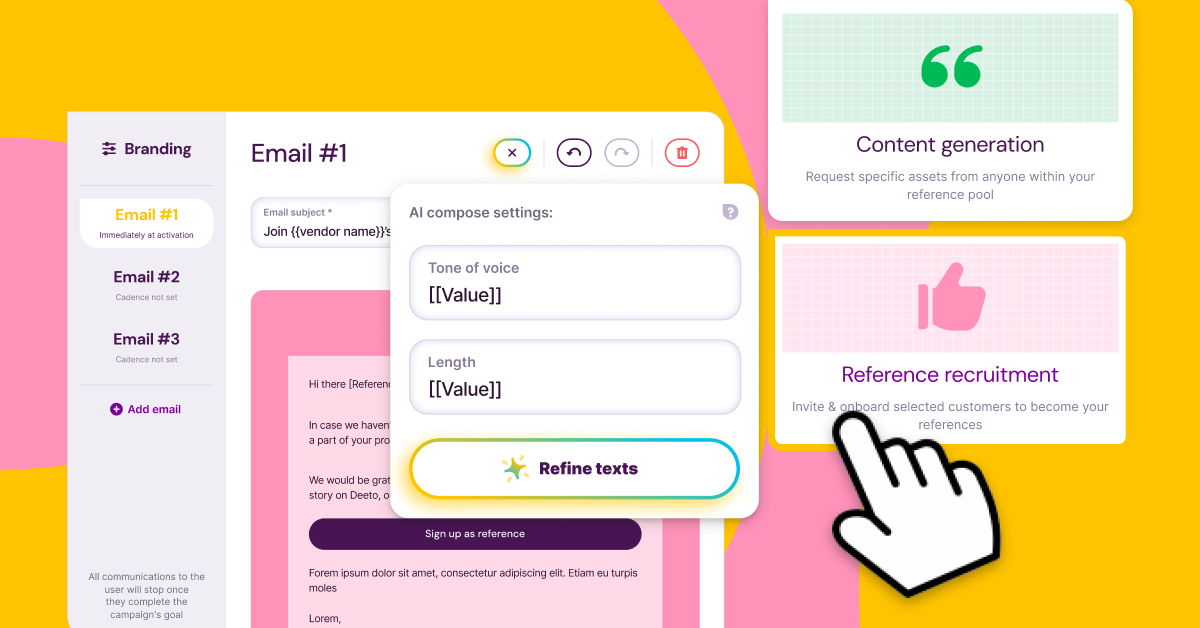
You can use Deeto's AI-powered segmentation tools to curate and suggest the most valuable content for each specific use case or customer interaction.
What is Voice of the Customer (VoC)?
Voice of the Customer is the systematic process of collecting, analyzing, and acting on customer feedback and behavior across channels like surveys, reviews, support tickets, and interviews. It's proactive and ongoing, not a single survey or score.
What's the difference between Voice of the Customer and customer satisfaction?
Customer satisfaction measures a single moment, usually right after a purchase or support interaction, using metrics like CSAT or NPS. VoC is broader and ongoing. It gathers insight on behavior, pain points, and expectations from multiple sources over time to explain why customers feel the way they do.
What are the main methods for collecting VoC data?
The five core methods are surveys and questionnaires, interviews and focus groups, social media listening, customer reviews and ratings, and feedback from support channels. Strong programs combine several of these rather than relying on one.
What KPIs measure VoC program success?
The most common are NPS, CSAT, Customer Effort Score, feedback volume and response rate, sentiment trends, churn and retention rates, and the rate of product or service improvements traced back to customer feedback.
How does Voice of the Customer connect to AI search visibility?
Buyers increasingly ask AI tools like ChatGPT and Perplexity to compare vendors before talking to sales, and those tools cite third-party proof like reviews and customer stories. VoC programs that publish feedback publicly, not just internally, become source material those AI engines can find and cite.
How do I get started with a VoC program if I don't have one yet?
Start by setting one measurable goal (like reducing churn by X% or improving CSAT by 10 points), pick two or three collection methods that fit your customer base, and centralize the data in one place from day one so it doesn't end up scattered across tools before you've even started.
VoC isn't a program you run once a quarter. It's the system that should power your growth, retention, and go-to-market motion continuously.
Deeto helps teams collect, organize, and activate authentic customer voice, so the same feedback that improves your product also becomes proof your sales team can use and content your buyers find when they ask an AI engine for a recommendation. Customers choose how they want to contribute, whether that's a quick survey, a recorded interview, or a review, so you get input from a wider range of voices than a single feedback form ever could.
Request a demo to see how it works.


Learn what Voice of the Customer (VoC), how it works, key methods, best practices, and strategies to improve growth.
Overview:
The signals that could improve your win rate, protect retention, and sharpen your forecast are already inside your organization. This guide shows revenue leaders how to connect authentic customer voice to every stage of the revenue motion and put a number on what that's worth.
Spotlight:
Inside, you'll find a numbers-first playbook built for CROs, RevOps leaders, and sales teams who need to justify the investment and understand the return. See how structured win/loss programs deliver 5 to 15% higher win rates, how continuous listening drives 15 to 25% higher renewal rates, and why a conservative model for mid-market B2B teams shows a 4x to 8x return within 12 months.
What to Expect:
Why It Matters:
Your customers are generating signals in every conversation, every renewal, every deal debrief. When those signals are connected and orchestrated, they become the intelligence that improves forecasts, accelerates pipeline, and protects revenue. That's what customer orchestration delivers.
Download the guide and turn customer voice into your most predictable growth lever.

The revenue intelligence you need already exists. This guide shows you how to put it to work.
Overview:
Product marketers sit at one of the most valuable intersections in a B2B company. But when customer voice lives in five different systems and case studies take six weeks to clear legal, that advantage gets lost. This guide makes the quantitative case for treating Voice-of-Customer as a strategic infrastructure investment.
Spotlight:
Inside, you'll find a numbers-first playbook built for CROs, RevOps leaders, and sales teams who need to justify the investment and understand the return. See how structured win/loss programs deliver 5 to 15% higher win rates, how continuous listening drives 15 to 25% higher renewal rates, and why a conservative model for mid-market B2B teams shows a 4x to 8x return within 12 months.Inside, you'll find a numbers-first framework built for PMMs who need to prove revenue contribution and build the business case for orchestration. See how consolidating customer voice reduces redundant research spend by up to 75%, how activating customer evidence at the right deal stages delivers a 5 to 15% win rate lift, and why a conservative model for mid-market B2B teams shows a 3x to 8x return within 12 months.
What to Expect:
Why It Matters:
Customer voice is already your most powerful go-to-market asset. This guide shows you how to build the system that makes it work across every stage of the revenue cycle.
Download the guide and turn customer voice into your most measurable competitive advantage.

This guide shows product marketers how to turn customer voice into measurable revenue impact.
Overview:
Customer marketers own the most commercially important relationship in a B2B company: the one that already exists. But when feedback, health scores, advocacy contacts, and campaign data all live in different systems, programs get built on incomplete pictures. This guide makes the quantitative case for treating customer orchestration as infrastructure, not an activity.
Spotlight:
Inside, you'll find a numbers-first framework built for customer marketers who need to scale programs, prove impact, and build the business case for orchestration. See how consistent lifecycle engagement protects $240,000 in ARR annually, how structured referral programs generate attributable pipeline at near-zero acquisition cost, and why a conservative mid-market model shows a 3x to 6x return on platform investment within 12 months.
What to Expect:
Why It Matters:
Customer voice is already your most powerful growth asset. This guide shows you how to build the system that makes it work across retention, expansion, and advocacy at every stage of the customer lifecycle.
Download the guide and turn customer engagement into your most attributable revenue lever.

This guide shows customer marketers how to connect engagement to revenue and prove the impact.
Most companies are sitting on a mountain of customer signals they never actually use. Call transcripts, survey responses, support tickets, interview notes. The sentiment is there. The insight isn't, because no one has a system to extract it.
Sentiment analysis is the process of identifying and measuring the emotional tone expressed in customer communications, classifying it as positive, negative, or neutral to help teams understand how customers feel at any point in the relationship.
In this guide, you'll learn what sentiment analysis is, why it matters for B2B teams specifically, and the exact steps to run it in a way that produces decisions, not just dashboards.
Sentiment analysis is a method of processing text, audio, or video to detect the underlying emotional tone and classify it as positive, negative, or neutral. It is a form of natural language processing (NLP) that enables teams to move from reading individual customer comments to identifying patterns across hundreds or thousands of interactions.
In a B2B context, sentiment analysis helps customer success, product, and marketing teams answer questions that would otherwise take weeks of manual review: Are renewal conversations trending negative? Are customers satisfied with a specific feature? Are certain account segments at higher churn risk?
Sentiment analysis systems help teams move from reactive to proactive. Instead of waiting for a customer to escalate, you see the signal before the problem compounds.
Sentiment analysis includes more than just survey scores. It covers everything from call transcript tone to open-text NPS responses to product interview feedback. When those signals are organized and analyzed together, they become one of the most reliable inputs a B2B company can have.
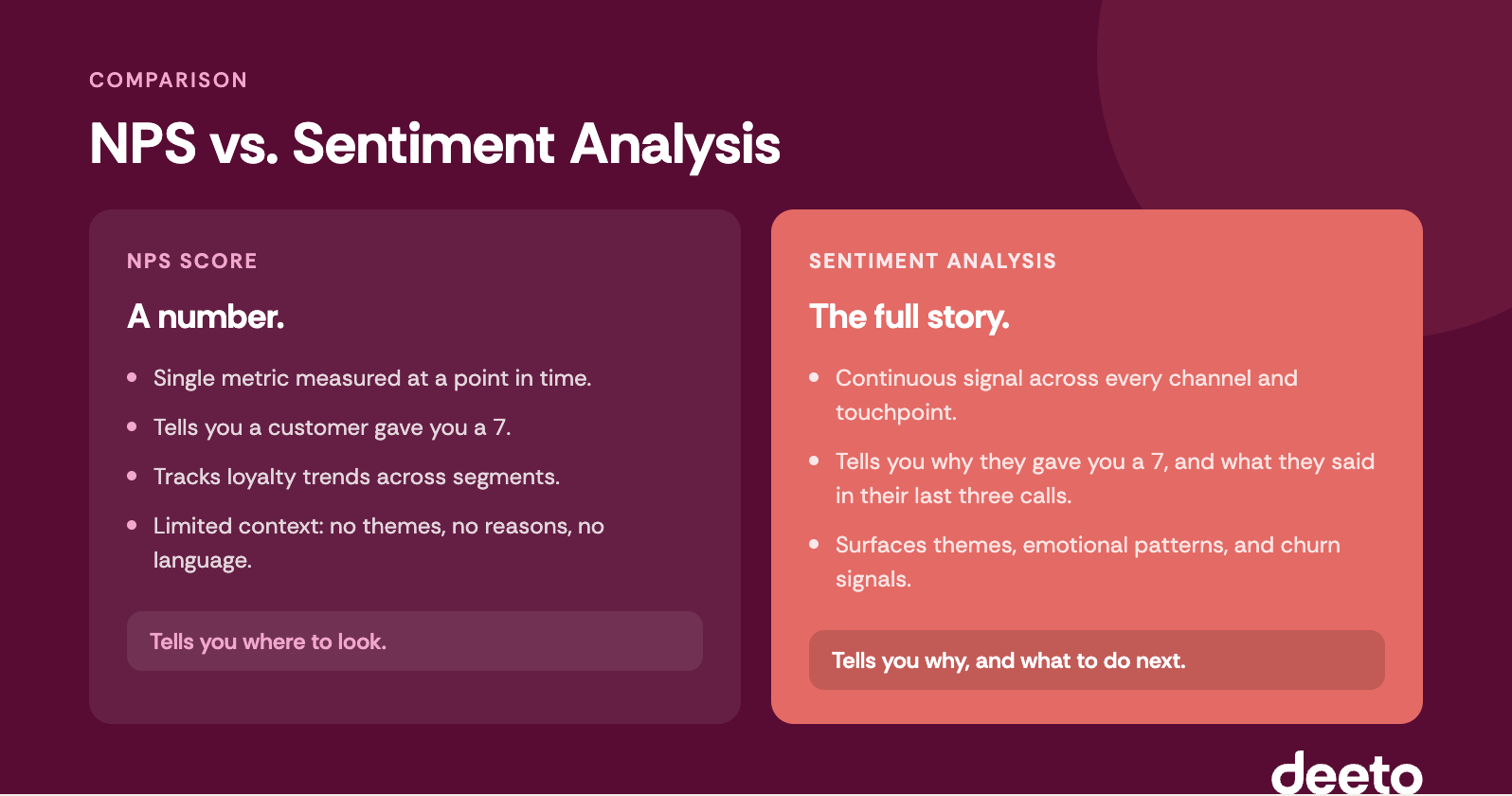
A single NPS score tells you almost nothing on its own. A sentiment trend across 200 customer touchpoints tells you a lot.
B2B companies lose customers slowly, then all at once. The warning signs are almost always present in the language customers use weeks or months before a churn event, but most teams don't have the infrastructure to catch them. According to Bain & Company, a 5% increase in customer retention can produce a 25–95% increase in profits, yet most retention efforts are still built on lagging indicators. Deeto's data shows that teams with earlier visibility into customer sentiment see 10–15% higher renewal rates as a direct result.
Sentiment analysis bridges that gap. It gives customer success teams an early warning system, product teams a continuous feedback loop, and marketing teams proof that the language they use actually resonates with buyers.
Running sentiment analysis well requires more than a tool. It requires a clear process for collecting the right signals, analyzing them in context, and routing insights to the teams who can act on them. Here are the steps.
Start with the question, not the data. The most common mistake teams make is running sentiment analysis without a clear objective, which produces charts nobody uses.
Before collecting any data, define the specific question you're answering. Are you trying to understand how customers feel about a recent product launch? Identify which accounts are at churn risk before renewal? Measure how onboarding sentiment changes over the first 90 days?
A clear question determines which data sources you need, which time windows matter, and what a meaningful shift in sentiment actually looks like for your business.
Sentiment analysis is only as good as the signals feeding it. Most B2B teams underestimate how many customer voice channels they have available: NPS and CSAT surveys, customer success check-ins, support tickets, onboarding interviews, product feedback sessions, and sales conversations.
Deeto's Listen module is built to capture authentic customer voice continuously across all of these channels, including AI-powered interviews, surveys, and in-product microfeedback. Instead of sending a quarterly survey and hoping for responses, you build a continuous collection system that captures sentiment in context, at the right moment in the customer journey.
The goal at this step is breadth. Pull from every available channel so your analysis reflects the full picture, not just the loudest voices.
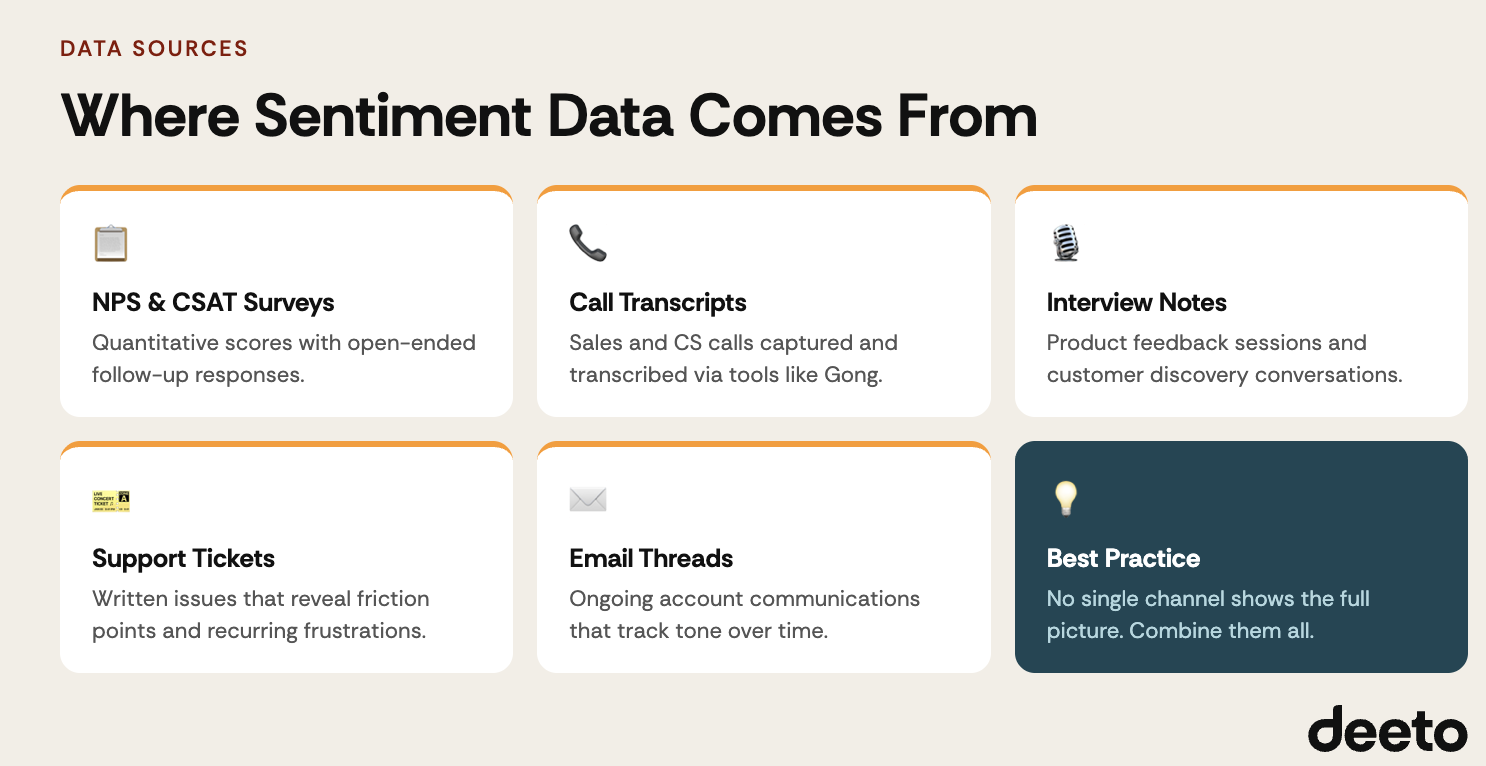
One of the richest and most underused sources of customer sentiment in B2B is the sales and customer success call. A customer can give a 9 on an NPS survey and still use language in a renewal call that signals serious dissatisfaction. Text-based surveys don't catch tone, hesitation, or the specific phrasing customers use when they're concerned.
Call recording analysis addresses this directly. By analyzing transcripts and audio from recorded calls, teams can identify sentiment patterns that never surface in structured feedback channels.
Deeto's integration with Gong makes this seamless. Gong captures and transcribes sales and CS calls automatically. Deeto pulls those transcripts into the platform, analyzes the sentiment and key themes expressed, and ties that intelligence back to the customer record. That means a CS manager can see not just what a customer said in a survey, but what tone they used in their last three calls, and whether that tone has shifted. It also means product marketing can identify recurring objections or praise across hundreds of calls without manually reviewing a single one.
Call-level sentiment analysis is especially powerful for identifying churn signals early. A customer who uses phrases like "we were hoping for more" or "we haven't really gotten there yet" in a renewal call is telling you something. A system that captures and surfaces that language gives your team a real window to respond.
Raw sentiment data isn't intelligence yet. The next step is classifying what you've collected into themes, topics, and sentiment scores that can be compared over time and across segments.
Good classification answers three questions about every piece of feedback: What is the customer talking about? How do they feel about it? How does this compare to what other customers are saying?
Deeto's Analyze module handles this layer of the process. It identifies patterns, tracks sentiment trends, and organizes customer signals into dashboards that give teams a clear view of where sentiment is strong, where it's declining, and which segments or product areas need attention. This is where raw customer voice becomes structured intelligence.
The output of this step should be a categorized view of sentiment by segment, topic, lifecycle stage, and time period, not just an aggregate score.
Once signals are classified, the analytical work begins. Look for clusters: which topics have the highest concentration of negative sentiment? Which customer segments are trending in the wrong direction? Which onboarding milestones correlate with positive long-term sentiment?
This step is where customer sentiment analysis shifts from descriptive to predictive. You're no longer just measuring how customers feel today. You're identifying which patterns precede churn, which precede expansion, and which indicate a customer who's ready to become an advocate.
Teams that build this pattern recognition into their regular workflow stop waiting for customers to tell them something is wrong. They start seeing it in the data first.
The most common failure point in sentiment analysis programs isn't the analysis itself. It's the last mile. Insights sit in a dashboard nobody checks, or they're shared in a monthly report that's two weeks out of date by the time it's read.
Effective sentiment analysis requires a routing system. A negative sentiment spike in a CS account should trigger a notification in the account owner's workflow. A cluster of negative product feedback should reach the product team in a format they can act on. A pattern of strong positive sentiment around a specific outcome should reach marketing before the message becomes stale.
Deeto's platform connects the intelligence layer to the activation layer, surfacing the right insights to the right people at the right moment, whether that's in Salesforce, Slack, or a product team's roadmap tool. That's what separates a sentiment analysis program that changes decisions from one that produces reports.
Sentiment analysis isn't just a tool for internal decision-making. It's also a way to strengthen customer relationships, but only if you close the loop.
When a customer shares negative sentiment, reaching out to address it directly is one of the most effective retention moves a company can make. When positive sentiment clusters around a specific outcome, it's an opportunity to capture a case study, a testimonial, or a referral.
Customer voice research and evidence programs work best when customers feel heard. Closing the loop, telling customers what changed because of their feedback, creates a relationship dynamic that reinforces loyalty and generates more authentic input over time.
What is sentiment analysis in simple terms?
Sentiment analysis is the process of reading customer communications, whether written or spoken, and classifying the emotional tone as positive, negative, or neutral. In a B2B context, it helps teams understand how customers feel about a product, relationship, or experience without having to manually review every interaction.
What data sources can you use for sentiment analysis?
Sentiment analysis can be applied to almost any customer communication: NPS and CSAT survey responses, call transcripts, product feedback sessions, support tickets, email threads, and interview notes. The most effective programs pull from multiple sources simultaneously, because no single channel captures the full picture of how a customer feels.
How is sentiment analysis different from NPS?
NPS is a single numeric score that measures overall customer loyalty at a point in time. Sentiment analysis goes deeper, classifying the language customers actually use across dozens of touchpoints to identify themes, emotional patterns, and signals that a score alone cannot surface. NPS tells you a customer gave you a 7. Sentiment analysis tells you why, and what they said in their last three calls that suggests they might not renew.
How does Gong integrate with sentiment analysis?
Gong captures and transcribes sales and customer success calls. When connected to a platform like Deeto, those transcripts are analyzed for sentiment, key themes, and patterns that get tied back to individual customer records. This makes it possible to track how call-level sentiment evolves over time and surface early warning signals before they become churn events.
How do you act on sentiment analysis results?
Sentiment analysis creates value only when insights are routed to the people who can act on them. That means connecting your analysis layer to the workflows your CS, sales, and product teams already use. Negative sentiment signals should trigger account reviews. Positive patterns should feed marketing and advocacy programs. The goal is making sentiment a live input to decisions, not a retrospective report.
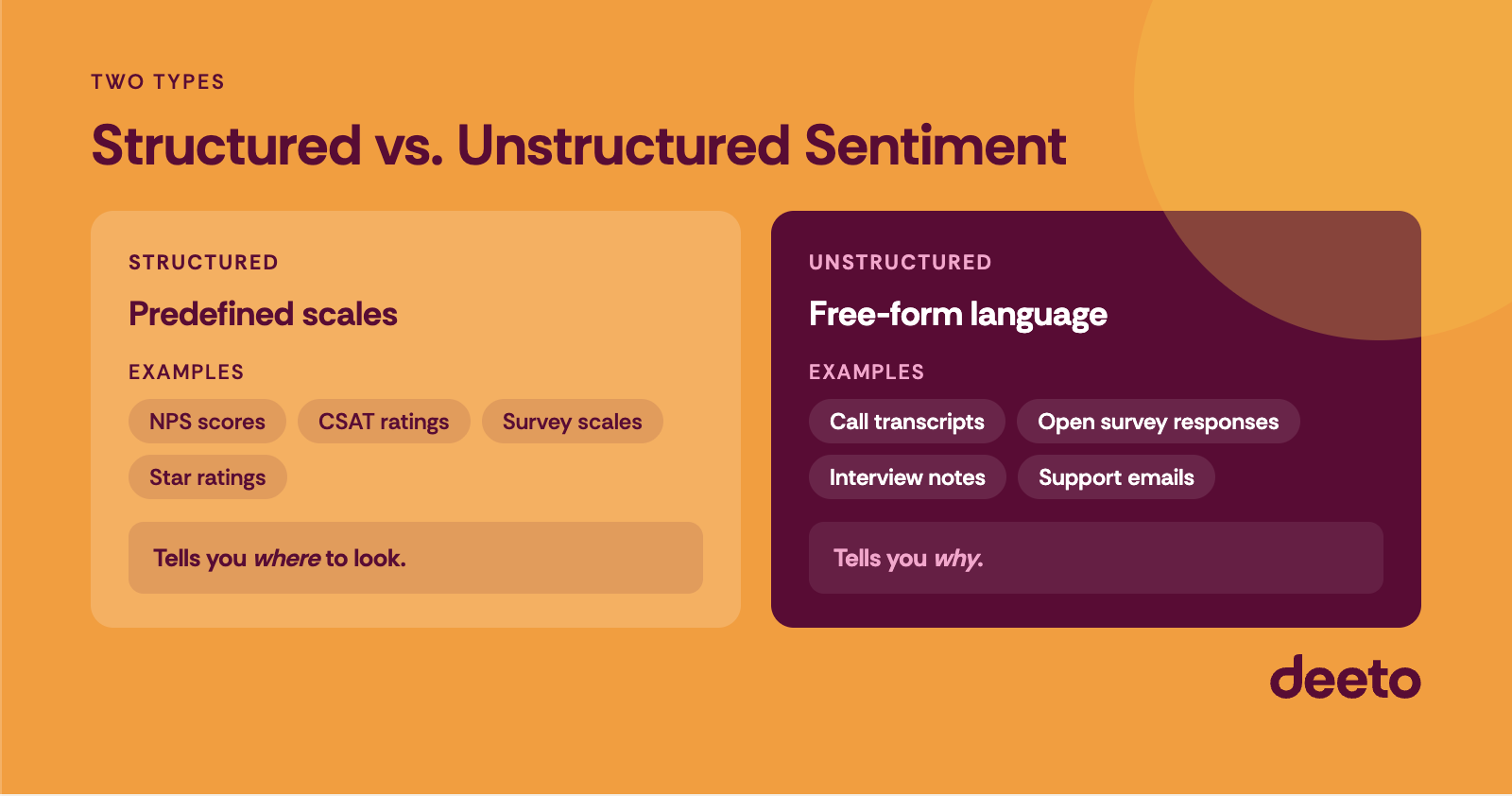
What is the difference between structured and unstructured sentiment analysis?
Structured sentiment analysis uses predefined scales or questions, like survey rating scales. Unstructured sentiment analysis processes free-text or audio data, such as open-ended survey responses, call transcripts, or interview notes. B2B teams get the most complete picture when they analyze both. Structured data tells you where to look. Unstructured data tells you why.
Deeto is a customer orchestration platform that turns authentic customer voice into connected intelligence and action. To see how Deeto handles sentiment analysis across the full customer lifecycle, book a demo.

What is sentiment analysis? Learn its definition, key steps, and how to turn customer signals into decisions.
Overview:
Product feedback is everywhere. The challenge is making it useful without overwhelming your customers or your team in the process.
Most product and marketing teams are sitting on more customer input than they know what to do with. The problem isn't volume. It's that feedback is scattered, hard to act on, and disconnected from the decisions that actually shape the roadmap. By the time insights reach the right people, the moment has passed.
In this session, Shawnna Sumaoang will walk through how teams are solving this today. Not through a single use case, but a practical look at the many ways you can collect, centralize, and activate product feedback across your organization.
You’ll learn:
Date: Thursday, April 23, 2026
Time: 9:00 AM PT / 12:00 PM ET
Location: Zoom virtual event (Link sent upon registration)
Speakers:

Shawnna Sumaoang, CMO, Deeto

Survey fatigue is real. Here's how product teams scale feedback that actually drives roadmap decisions.
Your reps are having great conversations. Gong is capturing every one of them. And now, with Deeto in the picture, every one of those conversations can become intelligence your entire go-to-market organization acts on.
Gong already gives revenue teams an exceptional foundation: recorded calls, transcript search, deal signals, coaching workflows. The Gong + Deeto integration builds on that foundation by connecting conversation intelligence to customer evidence, activation, and measurable pipeline impact across sales, marketing, and customer success.
Here is how it works, from first call to closed pipeline.
The Gong + Deeto integration is a bi-directional connection between Gong's conversation intelligence platform and Deeto's customer orchestration platform. It is designed to move customer insights captured during sales and success conversations through a structured workflow, from raw signal to activated evidence to measurable revenue impact.
The integration is built around four stages: Capture, Analyze, Activate, and Measure. Each stage builds on the last. Most GTM teams have the first stage covered. The challenge is building the full loop. Without a system that moves insights from capture through to measurable action, customer intelligence stays siloed in the tools that collected it instead of flowing to the people who need it.
Gong handles conversation intelligence with exceptional depth. Deeto's customer orchestration platform handles activation and orchestration.
Together, they close the loop between what customers say and what your business does about it.
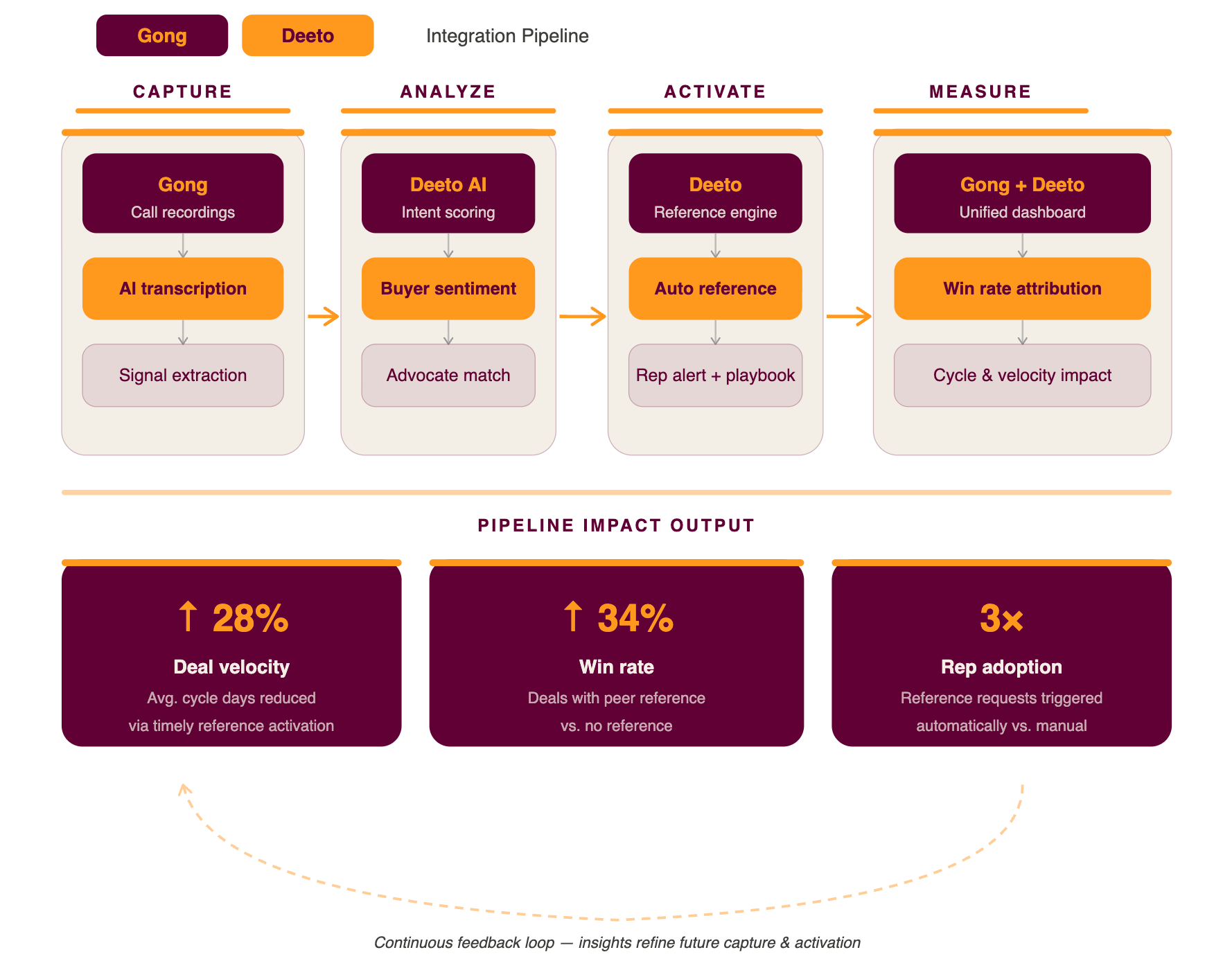
Every sales call, renewal conversation, and QBR contains intelligence. Customers tell you what they care about, what they value, what competitors they are evaluating, and what they would love to see on the roadmap. Gong is purpose-built to capture all of it.
Call recordings, transcripts, deal signals, and speaker data are logged automatically. The integration pulls that rich data into Deeto's platform without requiring any manual effort from reps or CS teams, so the intelligence Gong generates flows directly into the system that organizes and activates it.
What gets captured includes call transcripts tied to specific accounts and deal stages, speaker-level data that attributes insights to specific customers, deal metadata including stage, health score, and outcome, and signals that indicate sentiment, objections, or competitive mentions.
The value of this stage is the combination of Gong's capture depth and Deeto's organizational layer. Every compelling customer moment is preserved and ready to be used, not just reviewed.
According to Gartner, revenue teams that use AI-guided conversation intelligence reduce ramp time by up to 30% and improve forecast accuracy. Deeto builds on that advantage by making those captured signals available across the full go-to-market team, not just inside the revenue org.
Gong already surfaces deal intelligence, coaching moments, and forecast signals from call data. The Deeto integration extends that intelligence into a new dimension: customer evidence that travels across the entire go-to-market organization.
Deeto's Analyze module processes incoming Gong data using AI to identify patterns, extract meaningful quotes, score sentiment, and tag insights by topic, persona, and business theme.
What comes out of the Analyze stage includes customer quotes categorized by use case and buyer persona, sentiment scores that reveal satisfaction trends across segments, competitive mentions flagged and grouped, and signals tied to specific deal outcomes, wins and losses included.
This is not a search interface where someone hunts for a needle in a haystack of transcripts. Deeto surfaces the insights automatically and connects them to the customer record, the account, and the evidence library.
For product marketing teams, this means messaging that is grounded in real customer language, not assumptions built in a conference room. For sales enablement, it means proof points that are current, specific, and tied to actual outcomes.
An important note on competitive intelligence: the integration flags competitor mentions in Gong transcripts and aggregates them in Deeto. Over time, this becomes a living view of how your competitive position is perceived by real buyers, updated after every call. That is a signal worth acting on. For teams building a more systematic approach, Deeto's competitive insights use case is built exactly for this.
Analysis is only useful if it gets to the people who need it, at the moment they need it.
Deeto's Activate module is where customer intelligence becomes action. Once insights are extracted and tagged from Gong, Deeto routes them into the workflows where your team actually operates: CRM records, sales enablement tools, Slack, and marketing campaigns.
Here is what activation looks like in practice.
The word "activation" matters here. It is not just delivery. It is contextual delivery. The right insight, to the right person, at the right moment in their workflow. That specificity is what separates a useful integration from a feed nobody opens.
Deeto customers see 15-20% faster deal cycles when reps have access to contextual customer evidence at the point of need. The Gong integration extends that advantage by making conversation intelligence the input to that evidence pipeline, automatically and continuously.
For teams managing customer advocacy and references, the integration connects directly to Deeto's reference management capabilities. When a Gong call signals a highly satisfied customer, Deeto can automatically flag that account as a potential reference and initiate the follow-up workflow, with no manual triage required.
The question every revenue leader asks is the same: is this actually moving the number?
The Gong + Deeto integration gives you a clear answer. Because Deeto connects customer intelligence to deal data from Gong, you can measure how the presence of activated insights affects pipeline outcomes.
What you can track includes win rates on deals where customer evidence was surfaced vs. deals where it was not, time-to-close differences for opportunities where reps received Deeto briefings, engagement rates on customer quotes and stories used in campaigns and deal rooms, and reference request outcomes tied to specific Gong signals.
This is the pipeline impact layer. It answers not just "what are customers saying" but "how much does acting on it change the result."
Deeto's revenue trends use case is built for this view. It connects the dots between customer intelligence inputs and revenue outputs so that the business case for investing in customer voice becomes quantifiable, not anecdotal.
For teams that want to demonstrate the full value of their customer intelligence investment, this is the layer that makes it visible. The Gong + Deeto integration connects two platforms that are each already generating value, and creates a measurable multiplier between them.
Gong and Deeto are each strong in their own right. Gong is the leader in conversation intelligence, giving revenue teams unprecedented visibility into what happens in every customer interaction. Deeto is the customer orchestration platform that turns authentic customer voice into connected intelligence and action across the full go-to-market organization.
The integration exists because the two platforms are genuinely complementary. Gong excels at capturing and analyzing the revenue conversation layer. Deeto excels at organizing, activating, and measuring what that intelligence means for the broader GTM team.
Together, Gong and Deeto form a complete intelligence loop. Authentic customer voice goes in. Connected, activated, measurable intelligence comes out across sales, marketing, customer success, and leadership. That loop is what customer orchestration is designed to power.
The integration is available now. Setup connects your Gong workspace to Deeto's platform and begins syncing call data, account metadata, and deal signals immediately. No custom engineering required.
If you want to see how the full loop works for your team, the best place to start is a demo. The Deeto platform walkthrough covers the integration directly, including how your current Gong data maps to Deeto's intelligence and activation workflows.
The conversation is already happening. Now every insight it generates can travel further than ever before.
The Gong + Deeto integration connects conversation intelligence captured in Gong with Deeto's customer orchestration platform. It automatically extracts customer insights, quotes, sentiment signals, and competitive mentions from Gong call data and routes them into Deeto's intelligence and activation workflows. The result is that sales, marketing, and customer success teams receive actionable customer evidence in the tools they already use, without manual effort.
Deeto uses AI to process Gong transcripts as they sync into the platform. The analysis identifies meaningful customer quotes, categorizes them by topic, persona, and use case, scores sentiment, and flags competitive mentions. Insights are then tied to the relevant account and customer record in Deeto's system of record, making them searchable and activatable across the go-to-market team.
Sales teams benefit from contextual evidence surfaced at the right moment in a deal cycle. Product marketing teams gain access to real customer language that can sharpen messaging and positioning. Customer success teams receive signals that indicate satisfaction, risk, or expansion readiness. Revenue operations gains a measurable view of how customer intelligence affects pipeline outcomes. The integration is designed to serve the entire revenue team, not just one function.
Yes. When Gong call data signals high satisfaction or a particularly strong customer outcome, Deeto can flag that account as a potential reference and initiate an outreach workflow automatically. This removes the manual triage step that typically delays reference program growth and ensures that satisfied customers are identified and engaged while the sentiment is still fresh.
Deeto connects deal outcome data from Gong with activation data inside its platform. This allows revenue teams to compare win rates, time-to-close, and engagement metrics across deals where customer evidence was surfaced versus deals where it was not. The revenue trends use case in Deeto is specifically designed to surface this comparison and make the business impact of customer intelligence visible to revenue leadership.
No. The integration is designed for straightforward setup that connects your Gong workspace to Deeto without requiring engineering resources. Once connected, data begins syncing automatically. Configuration options allow teams to control which call types, deal stages, and customer segments feed into Deeto's intelligence pipeline.

Learn how the Gong + Deeto integration turns conversation intelligence into pipeline impact.
Ask any sales rep what they do when a prospect asks for a customer reference, and the honest answer is usually the same: they call the one customer who always says yes.
A customer reference is a satisfied customer who agrees to speak directly with your prospects, sharing their real experience, the outcomes they've seen, and the honest tradeoffs they navigated. It's peer-to-peer validation at the moment a buyer needs it most. This article covers what makes references work, why most programs quietly fail, and what a reliable system actually looks like.
A customer reference is a verified customer who participates in direct conversations with prospective buyers on behalf of a vendor. References typically join sales calls, take one-on-one calls with prospects, or exchange emails with buyers who want unfiltered answers before making a decision.
Customer reference programs are the structured systems companies build to identify, manage, and activate these conversations at scale.
What makes a reference different from a testimonial or a case study is that it's live and two-way. A prospect can ask about the implementation headaches, the support response times, the things they'd do differently. That candor is exactly what moves a stalled deal.
The problem isn't that prospects don't trust you. It's that they trust your customers more.
According to Gartner, B2B buyers who receive helpful peer information are three times more likely to make a larger purchase with less regret. That's not a small lift. That's the difference between a deal that closes confidently and one that drags or dies.
References work because they carry something no sales deck can: lived experience. A prospect asking "did the integration actually work with Salesforce?" gets a very different answer from a peer who ran it than from a rep who's read the release notes. Specificity builds trust. Trust accelerates decisions.
For sales and sales enablement teams, references are one of the few proof assets that work at the exact moment of maximum buyer hesitation. Late stage, when a deal is close but not closed.
These three terms get used interchangeably. They shouldn't.
Testimonial: A written or recorded quote from a customer. Works best at the top of funnel — website, ads, social.
Case study: A structured narrative of a customer's results. Works best mid-funnel, when a prospect is in consideration mode.
Customer reference: A live conversation between your customer and your prospect. Works best late stage, pre-close, when a buyer needs peer validation before deciding.
Customer references are the highest-touch form of social proof. They're also the hardest to scale, which is why most companies treat them reactively instead of building a real system around them.
Not every happy customer makes a strong reference. The ones that consistently move deals forward share a few things:
The best references aren't just satisfied customers. They're customers who feel seen, valued, and invested in the relationship, which is itself a signal about how well you're running your post-sale motion.
Most reference programs aren't really programs. They're habits.
A sales rep knows one customer who always picks up. That customer gets called six times a year. They're still saying yes, but they're tired. And the prospect on the other end of that call can sometimes tell.
The problem with most customer reference programs isn't a shortage of happy customers. It's a shortage of infrastructure.
The structural failures are consistent across companies:
References are siloed with individual reps. When the relationship between a rep and a customer is the only path to a reference, that reference becomes that rep's asset, not the company's. When the rep leaves, the reference disappears.
There's no matching system. Without structured data on which customers are willing, what they're comfortable discussing, and which segments they represent, teams default to whoever they know. Relevance suffers.
Advocate fatigue goes undetected. With no visibility into how often a customer has been asked, the same handful of enthusiastic advocates get used until they stop responding. By then, the relationship has already taken a hit.
The ask is framed as a favor. Customers aren't enrolled in a program, they're asked ad hoc, with no clear value in return. That framing doesn't scale and doesn't build loyalty.
The fix isn't more outreach. It's building reference management as an actual system, one where customer willingness, segment fit, and participation history are tracked, matched, and maintained.
References aren't just a late-stage tool. Teams that get the most value from them deploy customer voice at multiple points:
Mid-funnel. A case study or short video from a customer in the prospect's industry answers objections before the prospect even raises them. It doesn't require a live call, it just requires having the right story available.
Late-stage evaluation. This is where live reference calls do the most work. A 30-minute peer conversation matched by role and use case can move a deal from stalled to signed.
Executive alignment. For enterprise deals, connecting a prospect's executive to a customer's executive creates credibility no sales motion can replicate. These conversations require the most care in matching, but they close the biggest deals.
Post-sale onboarding. References aren't only for prospects. Connecting a new customer to an established one who's been through the same implementation journey reduces anxiety and accelerates adoption.
For customer marketing teams, the goal is building a reference pool diverse enough to support all of these moments, not just the late-stage sales call.
Customer references are one part of a broader customer advocacy system. Advocacy includes reviews, event participation, community engagement, referrals. References are the highest-commitment form of advocacy, they require the most from the customer and deliver the most for the deal.
The difference matters because customers willing to do one aren't always willing to do the other. A customer who'll write a G2 review might not want to take sales calls. Conflating the two leads to over-asking, and over-asking is how you burn your best advocates.
A well-run advocacy program tracks each customer's willingness across different activity types. References, reviews, events, referrals, each is a different ask with a different level of effort. Managing them separately is what keeps customers engaged instead of exhausted.
When references are tracked, matched by segment, and activated through a system rather than a spreadsheet, sales cycles shorten and the same small group of customers stops getting worn down.
If you're starting from scratch, how to build a customer reference program is a good place to begin. If you're ready to see what a system looks like in practice, Deeto's reference management handles matching and activation automatically, so the right reference shows up for the right deal, without the scramble.
What is a customer reference in B2B sales?
A customer reference is a satisfied customer who agrees to speak directly with a prospective buyer, sharing their real experience with a product or service. Unlike a testimonial or case study, a customer reference is a live, two-way conversation, making it the most credible and interactive form of peer validation in the B2B sales process.
How is a customer reference different from a testimonial?
A testimonial is a static, pre-written or pre-recorded quote. A customer reference is a live conversation where the prospect can ask their own questions, about implementation, support, outcomes, or whatever's making them hesitate. That interactivity is what makes references more persuasive at late-stage evaluation.
What makes someone a good customer reference?
The best references have seen measurable results, match the prospect in role and industry, are genuinely willing to participate, and have recent enough experience to speak credibly to current capabilities. Willingness matters as much as satisfaction — a reluctant reference often does more harm than no reference at all.
When should customer references be used in the sales process?
References are most effective late-stage, when a prospect has narrowed their options and needs peer validation before deciding. But customer voice in the form of case studies, stories, and matched introductions can add value earlier, at mid-funnel when objections are forming, and post-sale when new customers need confidence during onboarding.
Why do most customer reference programs fail?
Most programs fail because references are treated as individual rep relationships rather than company assets. There's no system for matching prospects to relevant customers, no visibility into advocate fatigue, and no structured value exchange for participating customers. The result is over-reliance on a small group of willing customers until they stop responding.
How do you scale a customer reference program?
Scaling requires three things: a centralized system that tracks customer willingness and availability by segment, a matching process that connects prospects to the most relevant reference by role, use case, and industry, and a clear value exchange so participating customers feel recognised rather than used. Platforms like Deeto automate matching and surface the right reference for each opportunity without manual searching.

What is a customer reference? Learn what makes them work, why most programs fail, and how to build a system that scales.
Overview:
Customer insight is being generated every day across support, sales, product, and marketing. The challenge is that it rarely becomes shared organizational knowledge. This report draws on practitioner interviews across customer success, product marketing, and revenue leadership to show why fragmentation persists, and what it takes to build a system where authentic customer voice actually drives decisions.
Spotlight:
Inside, you'll find a five-stage Customer Relationship Maturity Model shaped by real practitioner experience. Most organizations today sit between Stage 2 (Collected) and Stage 3 (Structured): gathering feedback that never flows to the teams who need it most. The report maps exactly what separates companies stuck in fragmentation from those whose customer knowledge actively powers product decisions, sales conversations, and renewal strategy. AI appeared in 50% of all practitioner responses, and the report shows precisely why it becomes a genuine accelerant only once the right foundation exists.
What to Expect:
Why It Matters:
Customer voice isn't a program. It's the intelligence system that powers how modern companies grow, retain, and innovate. When customer knowledge is fragmented across teams and systems, every function pays the price: sales conversations lack credibility, product decisions rely on incomplete signals, and customer success teams can't see risk coming. The organizations that pull ahead will be those that treat customer relationships as a continuous source of learning, not just a source of content.
Download the 2026 Go-To-Customer Report and see how leading organizations are turning fragmented customer knowledge into connected intelligence that drives decisions across every function.

Customer knowledge lives across every team. The challenge is coordinating it into something that drives decisions.

See how Deeto helps you turn customer voice into a GTM advantage.