Voice of Customer Platforms: Best tools and strategies for 2026



Wednesday, July 1, 2026


Voice of Customer Platforms: Best tools and strategies for 2026


View the podcast on Youtube

A voice of customer platform collects, analyzes, and routes customer feedback so teams can act on it instead of just archiving it. The best ones don't stop at dashboards. They turn what customers say into proof other buyers can find, whether that's a sales team closing a deal, a marketer optimizing a page, or an AI engine answering a prospect's question before they ever talk to sales. This guide compares five platforms shaping the category in 2026 and what each one is actually built for.

What is a voice of customer platform
A voice of customer platform is software that captures customer feedback across channels, like surveys, reviews, support tickets, interviews, and conversations, and turns it into insights teams can act on. Most platforms handle three types of signal: direct feedback (surveys, interviews), indirect feedback (reviews, social mentions), and inferred feedback (product usage, behavioral data).
Voice of customer (VoC) systems include collection tools, analysis engines, and increasingly, activation layers that push insights into the workflows where decisions get made. The category has matured fast. What used to be a survey tool is now expected to feed product roadmaps, sales conversations, and even the answer engines buyers consult before they ever fill out a form.
Why voice of customer platforms matter now
Buyers don't trust company-authored claims the way they used to. They check G2, they ask Reddit, and increasingly, they ask ChatGPT or Perplexity before they ask a sales rep. Customer voice is not a program. It's the system that powers growth, retention, and innovation, and the companies winning in 2026 treat it that way.
Three shifts are driving urgency:
- AI search is now a discovery channel. Buyers ask LLMs to compare vendors, and those engines cite third-party proof, not your homepage.
- Feedback volume has outpaced manual analysis. Teams can't tag and categorize feedback by hand at the scale modern support and review channels generate.
- Functions outside CX need the same signal. Product, marketing, and sales all want direct access to what customers are saying, not a quarterly summary from the CX team.
Common challenges with voice of customer programs
Most VoC programs don't fail because they collect too little feedback. They fail because of what happens after collection.
- Feedback gets stuck in one team's dashboard. CX collects it, but sales, marketing, and product never see it.
- Manual tagging breaks at scale. As feedback volume grows, taxonomies built by hand can't keep up, and analysis lags behind the data.
- Collected proof never leaves the company's own website. Testimonials and case studies sit on a single landing page instead of showing up where buyers and AI engines actually look, like G2, Reddit, and third-party review sites.
- Programs measure activity, not outcomes. Survey response rates go up while pipeline impact stays invisible.
Best voice of customer platforms in 2026
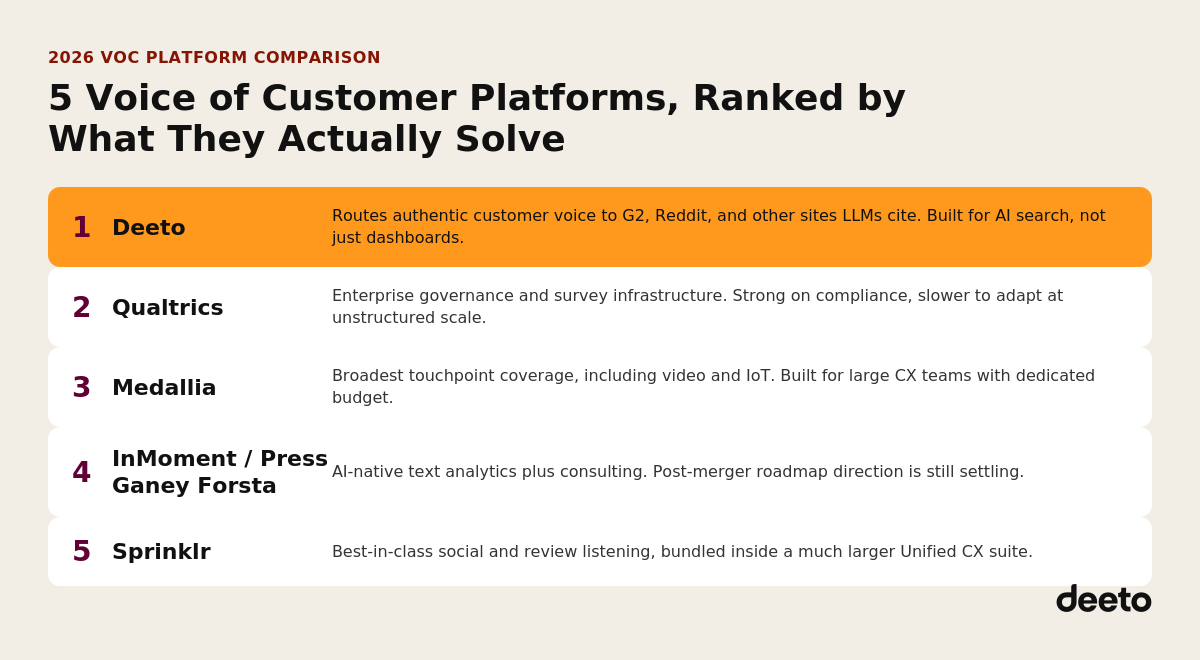
1. Deeto
Deeto is built around a different premise than most platforms on this list: customer voice only creates value once it's connected to a decision and visible where buyers actually look for proof. Instead of collecting feedback into a closed dashboard, Deeto routes authentic customer voice off-domain to platforms like G2, Reddit, and other third-party sites that large language models cite when answering buyer questions. That's the core differentiator. Deeto isn't a content creation tool. It's a routing system for authentic voice.
Deeto's modules map to the full lifecycle: Listen captures customer voice through AI-led interviews and structured signals, Analyze surfaces sentiment and patterns across that feedback, and Activate pushes proof into the workflows where it drives outcomes, from sales decks to public review platforms. The result is a system built for answer engine optimization around customer proof, not just internal reporting.
Best for: B2B SaaS teams that need customer voice to show up in AI search results and third-party platforms, not just internal dashboards.
What it does differently: Most VoC suites stop at insight. Deeto closes the loop by routing proof to where LLMs and buyers actually look, turning feedback into citable, off-domain evidence instead of another internal report.

2. Qualtrics
Qualtrics is the enterprise benchmark for survey-based VoC and consistently shows up in Gartner's Voice of the Customer Magic Quadrant. It's strong on governance: SSO, role-based access, multi-business-unit administration, and compliance support across regions. For large organizations running structured listening programs at scale, that governance layer matters.
Where Qualtrics shows its age is on the analysis side. As unstructured feedback volume grows, especially from open-text survey responses and support interactions, the platform's organizational scale doesn't fully extend to analysis scale. Teams often end up maintaining taxonomies by hand rather than relying on the system to adapt on its own.
Best for: Large enterprises that need a governed, compliant survey infrastructure across many business units.
3. Medallia
Medallia captures customer signal from more touchpoints than most competitors, including video, voice, IoT devices, and in-person interactions. That breadth makes it a strong fit for retail, hospitality, and other industries where the customer experience spans physical and digital channels.
The tradeoff is complexity and cost. Medallia is built for organizations with dedicated CX teams and enterprise budgets, and its real-time alerting and predictive analytics require investment to configure and maintain. Smaller or leaner teams often find the platform more than they need.
Best for: Large enterprises with multi-channel, physical-plus-digital customer touchpoints and a dedicated CX team to run the program.
4. InMoment / Press Ganey Forsta
InMoment was acquired by Press Ganey and the two platforms now operate as a combined entity, Press Ganey Forsta. Gartner recognized them as a Leader in the 2026 Magic Quadrant for Voice of the Customer Platforms, their fourth consecutive time in that position, so the consolidation hasn't hurt their standing in the market.
The practical consideration for buyers is awareness: if you're searching for InMoment, you're now evaluating a combined platform with a broader portfolio than the standalone InMoment product. The core strengths are intact, including AI-native text analytics, journey mapping, flexible service models that range from self-service to fully managed, and a consulting layer that enterprise CX teams often value. For buyers in regulated industries like healthcare and financial services, the Press Ganey side of the house brings deep domain expertise that the pre-merger InMoment didn't have.
Best for: Enterprise CX teams, particularly in regulated industries, that want a managed VoC program with strong analytics and built-in advisory support.
5. Sprinklr
Sprinklr holds a Leader position in Gartner's 2026 Magic Quadrant for VoC, and its strength is unmatched in one specific area: capturing sentiment from social media, reviews, messaging apps, and community forums at scale. If your customers are talking about you on X, Reddit, Instagram, or Google Reviews, Sprinklr aggregates that signal into a single view.
The catch is that Sprinklr is part of a much larger Unified CX suite that includes social media management and contact center tools. Teams that only need VoC capabilities end up paying for, and navigating, a platform built for a broader use case than they have.
Best for: Teams already using Sprinklr for social media management that want to extend into VoC without adding a separate vendor.
How to choose the right voice of customer platform
The right platform depends less on feature checklists and more on where your bottleneck actually sits. Ask these questions before shortlisting:
- Where does feedback need to end up? If the goal is internal reporting, a traditional suite works. If the goal is proof that shows up in AI search results and third-party platforms, you need a system built for routing, not just collection.
- What's your actual bottleneck, governance or analysis? Legacy suites like Qualtrics and Medallia are strong on governance. Platforms with adaptive taxonomies handle growing feedback volume without proportional headcount.
- Who needs access to the insight? If customer voice needs to reach product, marketing, and sales, not just the CX team, look for a platform built for cross-functional activation.
- How is the platform's roadmap trending? Consolidation like the InMoment and Press Ganey merger, which produced a new combined entity in the 2026 Gartner MQ, can reshape product direction mid-cycle. Ask vendors directly about roadmap priorities before committing.
Key takeaways
- A voice of customer platform should connect feedback collection to action, not just produce reports.
- AI search has made third-party proof, like G2 reviews and Reddit threads, more important than owned content for buyer trust.
- Enterprise suites like Qualtrics, Medallia, and Sprinklr lead on governance and channel breadth but can lag on adaptive analysis at scale.
- Deeto is built to route authentic customer voice to the platforms LLMs and buyers actually cite, closing the gap that traditional VoC suites leave open.
- The right platform depends on your real bottleneck: collection, governance, analysis, or activation.
FAQs
What is a voice of customer platform?
A voice of customer platform is software that captures customer feedback from surveys, reviews, support interactions, and conversations, then analyzes it to surface patterns teams can act on. The best platforms also activate that insight by routing it into sales, marketing, and product workflows.
Are voice of customer tools the same as VoC platforms?
Yes, voice of customer tools and voice of customer platforms refer to the same category of software. Smaller point solutions are often called tools, while more comprehensive systems that combine collection, analysis, and activation are typically called platforms. Deeto falls into the platform category because it spans the full lifecycle from capturing feedback to routing it to third-party sites like G2 and Reddit.
What's the difference between Deeto and traditional VoC platforms?
Traditional VoC platforms focus on collecting and analyzing feedback inside an internal dashboard. Deeto routes authentic customer voice to third-party platforms like G2 and Reddit, where buyers and AI search engines actually look for proof, making it a system for answer engine optimization, not just CX reporting.
Which voice of customer platform is best for small teams?
Smaller teams without a dedicated CX function generally need platforms that don't require heavy configuration or consulting. Lightweight tools focused on review monitoring work well for narrow use cases, while platforms like Deeto fit teams that want customer voice to drive marketing and sales outcomes without a large internal program.
Do voice of customer platforms work with AI search and answer engines?
Most traditional VoC platforms were not built with AI search in mind. They route insight internally rather than to the public, third-party sources that LLMs cite. Platforms built for answer engine optimization around customer proof are designed to close that gap.
How is Gartner's Magic Quadrant relevant to choosing a VoC platform?
Gartner's Voice of the Customer Magic Quadrant evaluates platforms on completeness of vision and ability to execute. The 2026 report, published March 2026, recognized Qualtrics, Medallia, Sprinklr, and Press Ganey Forsta as Leaders. It's a useful reference point for enterprise governance and breadth, though it doesn't account for newer activation use cases like off-domain proof routing.
Conclusion
The voice of customer category has split into two camps: platforms built to collect and report, and platforms built to activate and route. Enterprise suites like Qualtrics, Medallia, Press Ganey Forsta, and Sprinklr remain strong choices for organizations that need governed, large-scale listening programs. But as buyer research increasingly runs through AI search and third-party platforms, the question worth asking isn't just who collects the most feedback. It's who gets that feedback in front of buyers, and AI engines, where they're actually looking.
If your team is ready to see how authentic customer voice can show up beyond your own website, book a Deeto demo to see the platform in action.
🎉 Save your spot
Register for the event
Once your spot is secured, we’ll send your confirmation details.
Subscribe to our newsletter
Subscribe to receive the latest blog posts to your inbox every week.
By subscribing, you agree to our Privacy Policy
Subscribe to our newsletter
Get the latest news and updates from our team.
By subscribing, you agree to our Privacy Policy
Related posts

How to Build a Customer Churn Model: A Guide for Businesses

What is a customer churn model? Learn how to build one, spot churn early, and win back at-risk customers.

How to Adapt Business Strategy to Changing Customer Behavior
What does it take to adapt business strategy to changing customer behavior? Learn the signals, the framework, and the ne

How to Build a Voice of the Customer Program
How do you build a voice of the customer program? Learn who should own it, a 90-day rollout, and how to budget for it.