A resource and community space for modern marketers, sellers, and builders using customer voice to grow — together.
This hub is built for anyone who wants to do more with the voices of their customers. Whether you're scaling advocacy, building trust with proof, or rethinking how to go to market — you're in the right place.
How-to guides and playbooks for building with customer voice
Campaign-ready templates and swipe files
Benchmark reports and reference best practices
Event recordings, expert sessions, and community spotlights
Ask questions. Share ideas. Trade wins. This is your space.
You don’t have to figure this out alone. The Deeto community connects you with other leaders using customer voice to build better GTM motions, faster-growing brands, and smarter strategies. If you are interested in joining when it launches, sign up below.
Automate advocacy management workflows
Dynamically generate customer stories and social proof
Eliminate manual reference management
Track and report advocacy impact on revenue
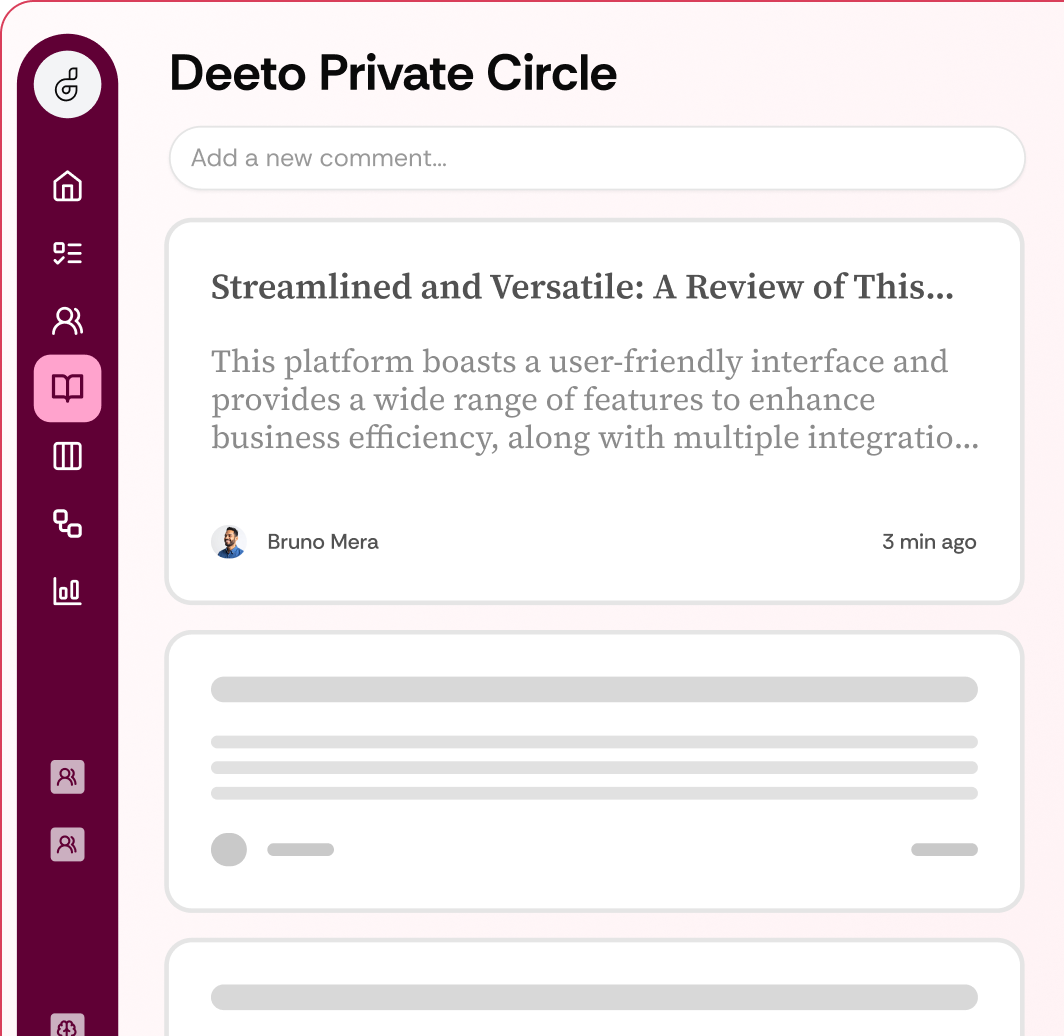
Discover practical guides, templates, and tools to help your team close more deals, faster.
Overview:
Unwind, connect, and trade insights with the best in customer marketing. Join Deeto for an exclusive happy hour during the Customer Marketing Alliance event in New York, designed for the customer marketing and advocacy professionals who turn customer truth into business impact.
Why Attend:
This is your chance to meet with peers who understand what it takes to scale customer evidence, surface the insights that matter, and drive programs that actually influence revenue. Come ready to connect with the people shaping what customer marketing looks like next.
What to Expect:
Date: Tuesday, March 10, 2026
Time: 5:30 PM – 7:30 PM ET
Location: Lolita, 45 West 45th Street, New York, NY 10036


Join Deeto for an exclusive happy hour during the Customer Marketing Alliance event in New York.
Overview:
Unwind, connect, and trade insights with the best in product marketing. Join Deeto for an exclusive happy hour during the Product Marketing Alliance event in New York, designed for the leaders shaping how customer voice shows up in messaging, sales, and strategy.
Why Attend:
This is your chance to connect with fellow PMMs, share what's actually working, and have the conversations that don't happen in a conference room. Whether you're scaling customer evidence, closing the activation gap, or figuring out how to make win/loss insights actually land with your team, you'll find people solving the same problems in the room.
What to Expect:
Date: Thursday, March 12, 2026
Time: 5:30 PM – 7:30 PM PT
Location: Lolita, 45 West 45th Street, New York, NY 10036

Join Deeto for an exclusive happy hour during the Product Marketing Alliance event in New York.
Understanding why deals are won or lost is one of the most strategic advantages a B2B team can have. Too often, teams rely on fragmented CRM notes, surveys, or internal opinions which causes insights to arrive when it’s too late to change outcomes.
Win/loss analysis is the process of capturing and interpreting buyer feedback to reveal what truly drives purchase decisions. When done right, it turns authentic customer voice into patterns you can act on across sales, marketing, product, and leadership.
At its core, win/loss analysis is the systematic effort to learn why customers choose you, choose competitors, or abandon decisions altogether. It focuses on real buyer reasoning instead of internal assumptions. Historically, teams treated win/loss analysis as a periodic report. These reports contain interesting insights, but are often not acted upon or are forgotten about over time. Today’s best-in-class organizations make win/loss analyses a continuous, integrated part of their go-to-market process.
Solutions like Deeto’s continuous win/loss insights trigger AI-led buyer interviews for every closed deal (won or lost) which surfaces decision drivers, objections, and competitor comparisons while insights are still actionable. Automating the process removes friction, making continuous win/loss analysis scalable and consistent.
Traditional methods of win/loss analysis typically rely on surveys or consultant-led programs that produce static summaries. These insights are often siloed into decks or spreadsheets and delivered too late to impact decisions. Even when insights are gleaned, they often fail to connect to real customer reasoning. This creates a recurring problem: teams are watching patterns from months ago instead of reacting to what matters now in active deals.
Strong win/loss analysis isn’t just about collecting feedback. It’s about building a repeatable system that turns buyer decisions into operational insight.
An effective win/loss program includes three foundational components:
Win rate and win-loss ratio provide the starting point. They tell you what’s happening across your pipeline including which segments convert, where performance shifts, and how outcomes trend over time. However, metrics alone are incomplete since they will show patterns but not the reasoning behind them. This is why it’s important to connect the win-loss ratio with other foundational components such as direct buyer feedback and cross-functional alignment.
The most critical component of a win/loss program is authentic customer voice. This means looking at structured interviews or surveys conducted close to the deal outcome. This type of customer research should include:
Without direct buyer input, teams default to internal narratives. With it, they uncover real decision drivers. Continuous, AI-led interview workflows make this scalable and ensure that every deal generates meaningful signals, not just anecdotal commentary.
Win/loss analysis only creates advantage when insights move beyond sales. Findings should inform your marketing, sales, product and leadership strategies. The marketing team can use findings for messaging and positioning, the sales team now has competitive enablement, the product team can prioritize their roadmap, and leadership can set strategic plans for the company. When buyer insights are centralized and shared across teams, organizations stop operating in silos and start operating on shared customer truth. That alignment is what turns insight into growth.
Here’s a practical framework teams use when building a modern win/loss analysis program:
Before collecting feedback, define the strategic questions you need answers to. This will ensure insight collection is purpose-driven rather than just data accumulation. These questions might include:
Instead of internal summaries or sales rep recollections, gather feedback directly from buyers. AI-supported interviews can elicit nuanced reasoning, surface competitor perceptions, and reveal what nearly changed the outcome of the decision. This authentic buyer voice becomes the basis of true understanding.
Once buyer responses are collected, analyze them for recurring themes such as:
AI and centralized knowledge tools make it easy to spot patterns that matter to your business.
Great win/loss analysis doesn’t stay locked in a spreadsheet. It gets surfaced in places teams already work, from CRM dashboards to messaging playbooks. When insights are shared across the organization, they start to influence larger-scale strategy and execution. A unified and insights-driven strategy across the entire organization will always be stronger than changes made only within your silo.
Not all win/loss programs create advantage, but the difference isn’t whether or not feedback is collected, it’s how intentionally the process is designed and operationalized.
Here are the best practices that separate surface-level reporting from strategic insight.
Timing matters.
Buyer memory fades quickly, and reasoning evolves after the fact due to bias, new knowledge, or simply forgetfulness. Ensure that you capture insights within 30–60 days of a closed deal while context is still clear and candid. The closer you are to the decision moment, the more accurate the signal will be.
It’s tempting to focus only on losses, but wins often reveal hidden weaknesses too. Analyze both wins and losses to find out concessions you made, risks the buyer tolerated, gaps that could cost you next time, and other important decision-making factors.
Remember that no decisions are also a decision, and they are just as important. These unresolved decisions surface friction in urgency, value clarity, or stakeholder alignment. A complete program compares all three types of decisions and gleans insights from each.
3. Use Neutral, Structured Interviews
Buyers are more honest when they don’t feel like they’re defending their choice or being resold. Structured, neutral interviews can uncover real competitive perceptions, unspoken objections, internal political dynamics, and decision drivers beyond feature comparison. The goal isn’t to validate your product or value, it’s to get the most authentic customer voice to ensure that you’re seeing yourself through your customer’s point of view.
One loud piece of feedback shouldn’t reshape your roadmap. Win/loss analysis becomes powerful when insights are aggregated and structured across deals. Recurring themes should guide decisions rather than singular comments. Patterns compound over time, so having a continuous program will always outperform one-off projects.
5. Connect Insights to Actionable Workflows
If findings live in a slide deck, they get forgotten about. If they live inside the tools teams already use, they influence behavior. Make sure your insights are easily accessible via CRM dashboards, enablement materials, messaging frameworks, and you’ll be one step closer to an automated and continuous workflow.
Markets shift. Competitors evolve. Buyer priorities change.
When every deal contributes insight, organizations adapt faster and sell with greater confidence. Instead of retrospective analyses that take time to generate and review, ongoing analyses are quicker, more efficient, and give more timely learnings for your company to operationalize.
7. Share Findings Cross-Functionally
Win/loss insights should be visible to:
When everyone works from the same customer truth, alignment accelerates execution.
Even well-intentioned teams can fall into patterns that weaken impact. Instead of relying on internal assumptions, tune in to customer voice. Instead of delaying insight delivery until it’s too late to act, make your process continuous and ongoing. Instead of keeping insight siloed and disconnected from execution, share it across teams and in easily-accessible channels and workflows. True win/loss analysis is continuous, contextualized, and connected.
No. Win rate measures outcomes. Win/loss analysis explains why those outcomes occurred by examining customer reasoning and themes across deals.
Successful teams treat win/loss feedback as a continuous process, capturing findings on every deal to see patterns emerge in real time.
Ownership varies, but it must involve cross-functional stakeholders from sales leaders to product marketers to ensure insights are shared and acted on.
Win/loss analysis remains one of the most powerful levers for competitive growth if you approach it correctly. When buyer voice is continuous, structured, and embedded into everyday workflows, teams move beyond reactive reporting and into proactive strategy.
The challenge isn’t collecting feedback, it’s operationalizing it. How do you turn individual interviews into structured patterns, ensure every deal contributes signal, and make insights visible across sales, marketing, product, and leadership? That’s where platforms like Deeto play a role. By automatically capturing buyer feedback on every closed deal and organizing it into actionable, cross-functional intelligence, Deeto helps teams move from occasional win/loss projects to continuous customer learning.
When win/loss analysis becomes part of how your organization operates instead of something you review quarterly, customer voice stops being a report and starts becoming a growth advantage.
Check out this webinar to learn more about win/loss analysis: Webinar: Why You’re Really Winning and Losing Deals

Learn how win/loss analysis uncovers real buyer decision drivers and turns customer voice into actionable insight.
How much do you really know about the customers who use your product? Getting customers to use your product without understanding them is like navigating without a map. You might move forward, but you’re guessing at every turn. Customer research isn’t a side project. It's the infrastructure behind product-market fit, retention, and real growth. The difference between teams that collect feedback and teams that win is what they do with it. This guide covers why customer research is foundational and how to do customer research that’s not just insightful, but connected to the decisions that move your business forward.
Customer research is the structured process of capturing customer voice, including needs, motivations, friction points, and language and connecting it to decisions across product, marketing, and growth. A one-size-fits-all approach rarely works. Your target audience may differ from the customers who actually engage with your product, and research helps reveal that gap. With clear insights, you can make better product, marketing, and business decisions that are grounded in reality rather than assumptions.
Start by asking yourself what problem you are trying to solve. Are you trying to understand why customers don’t return? Do you want to refine marketing messaging? Clear objectives help you focus on the research that matters and maximize your return on effort. Without them, it’s easy to end up down a rabbit hole of customer intelligence that doesn’t actually solve the problem at hand.
Do you have a target audience or buyer persona in mind? Create a list of customer segments and prioritize them. If you don’t have a persona yet, now is the time to create one. Personas make research questions specific, contextual, and strategic. Include role and responsibilities, goals and success metrics, challenges and pain points, buying triggers, objections, decision-making processes, and the language they use to describe problems. With this context, your research will be sharper, and the insights far more useful.
There are two main types of customer research: qualitative and quantitative. Qualitative research uncovers the “why” behind behavior through interviews, focus groups, open-ended surveys, and observation. Quantitative research focuses on patterns and scale, using analytics, larger surveys, polls, or experimental methods like A/B testing. Understanding why customers churn may require qualitative research, while validating how widespread a problem is often requires quantitative research. The strongest research combines both: qualitative to understand the “why” and quantitative to measure the “how often.”
Research is only as good as the questions you ask and the people you ask them to. Strong research requires honesty. That means asking open, neutral questions and resisting the urge to validate assumptions. Instead of asking, “What do you like about our product?” try “What problem were you trying to solve when you started looking?” Instead of “Would you recommend us?” ask “Who would this not be a good fit for?” Speak with a mix of recent buyers, long-term customers, churned accounts, and lost deals. Patterns become clear when perspectives are compared. Capture feedback exactly as it’s given. The words customers use are often more valuable than summarized notes.
Analysis is where research becomes actionable. Look for recurring themes in your data: which problems come up repeatedly, what language customers use to describe value, where frustrations cluster, and what nearly prevented a purchase. Then anchor these insights to business outcomes. Every insight should inform a decision, whether it's messaging and conversion optimization, retention or product expansion. Prioritize feedback from high-value segments or critical customer groups, as differences between groups are often more revealing than averages.
Identifying patterns is only half the work. The other half is embedding what you’ve learned into the way the company runs. If customers describe value in a specific way, that language should appear in messaging. If churn risks follow a pattern, onboarding or renewal processes should adapt. If objections repeat in sales cycles, enablement should evolve. Insights become powerful only when customer voice drives actions, not when it sits in a slide deck.
This is where many teams stall. They capture strong signals but lack a connected system to route those signals to the people and workflows that need them. The companies that close this gap treat customer voice not as a report, but as an operating layer that shapes decisions continuously.
Customer needs don’t stand still, and your research shouldn’t either. Too many teams treat research as a campaign: something to do before a launch, after a churn spike, or when positioning feels off. The strongest companies treat research as a rhythm.
This doesn’t mean constant surveys or endless interviews. It means establishing a deliberate cadence that matches how your business evolves. Some research should be ongoing, like regular interviews across segments, continuous capture of sales and support signals, and tracking shifts in language and expectations. Other research should be milestone-driven, such as before entering a new market, ahead of a major product launch, or when retention patterns shift.
The goal isn’t more feedback. It’s building a living system where customer signals continuously inform execution. When research becomes rhythmic, patterns get clearer, decisions get faster, and alignment gets easier. Instead of rediscovering your customers every quarter, you evolve alongside them.
Structure the conversation around moments that matter rather than general opinions.
Every question should tie back to a business lever, whether messaging, conversion optimization, onboarding, or retention. The more specific the question, the clearer the answers.
Customer research doesn’t have to be heavy, slow, or disconnected from execution. When customer voice is structured, searchable, and embedded in workflows, it becomes a competitive advantage, not a project. Deeto helps teams turn scattered feedback into connected customer intelligence that informs decisions across marketing, sales, and product. Insights stop being static reports and start becoming the operating system for growth.
If you’re looking to make customer research a continuous part of how your company grows, explore how Deeto can help.

Turn customer research into action with 7 clear steps to capture voice and drive smarter growth decisions.
Overview:
Most teams don't lose deals because they lack data. They lose because their understanding of why is delayed, incomplete, or already outdated by the time it's reviewed. In this session, we'll explore how buying behavior, competitive dynamics, and deal momentum shift in real time and why traditional win-loss programs can't keep up.
Instead of treating win-loss as a retrospective exercise, this webinar shows how AI-driven listening turns every buyer interaction into a continuous learning system that evolves as the market evolves.
You’ll learn:
Date: Thursday, February 26, 2026
Time: 9:00 AM PT / 12:00 PM ET
Location: On-demand virtual event (Link sent upon registration)
Speakers:

Shawnna Sumaoang, CMO, Deeto

eams don't lose deals because they lack data. They lose because their understanding of why comes too late.
Overview:
Win-loss analysis reveals why deals close or fall through, but manual methods can't keep pace with modern buying journeys. When 70% of B2B decisions happen before a rep is involved, relying on sales notes alone means missing the full story. This guide shows you how AI-driven video and voice interviews transform win-loss from post-mortem to proactive intelligence.
Spotlight:
Inside, you'll find a practical framework for revenue teams who want to capture authentic buyer insight at scale. Learn how AI-powered interviews replace slow, consultant-led processes with continuous feedback loops that surface themes, predict outcomes, and guide strategy in real time. See how one B2B company improved win rates by 27% after replacing manual analysis with AI-driven intelligence.
What to Expect:
Why It Matters:
Buyers make decisions faster than ever, often without ever speaking to sales. Win-loss programs that depend on reps' memories or quarterly consultant reports arrive too late to matter. When teams use AI to capture authentic buyer voice continuously, they don't just understand what happened, they also predict what's next and act with confidence.
Download the guide and turn win-loss into the continuous buyer intelligence that drives sharper positioning, faster cycles, and higher win rates.

This guide shows you how AI-driven interviews transform win-loss from manual post-mortems into real-time buyer insight.
Overview:
Retention drives growth, but most teams still measure it in hindsight. Quarterly surveys and annual reviews capture isolated moments, not the full customer story. This guide shows you how AI-driven continuous listening turns customer signals into proactive retention strategies.
Spotlight:
Inside, you'll find a practical framework for customer success and experience teams who want to move from reactive metrics to predictive intelligence. Learn how continuous listening captures sentiment, engagement, and behavioral signals in real time, helping you detect risk before it becomes churn and identify advocates ready to fuel growth.
What to Expect:
Why It Matters:
Customer voice isn't episodic, it's continuous. When companies listen across every touchpoint and act on signals in real time, they don't just retain customers. They strengthen relationships that grow with trust, turn satisfied customers into enthusiastic advocates, and build retention into a shared system that drives lasting growth.
Download the guide and turn retention from a backward-looking metric into the proactive intelligence that powers growth.

This guide shows you how to turn retention from reactive metrics into proactive intelligence with AI-driven signals.
Overview:
Product feedback should drive innovation, but most teams are drowning in scattered inputs across tickets, Slack threads, and survey tools. This guide shows you how to turn feedback chaos into connected intelligence that builds better products.
Spotlight:
Inside, you'll find a practical framework for product managers who want to move from reactive to proactive. Learn how companies like Cymulate consolidated four data sources into one unified hub, cutting feedback review cycles from three weeks to three days while increasing roadmap confidence by 40%.
What to Expect:
Why It Matters:
Customer voice isn't a program. It's the intelligence system that powers how modern companies build, prioritize, and innovate. When feedback becomes structured and connected, product teams gain faster cycles, stronger alignment, and products that resonate deeply with their market.
Download the guide and transform scattered feedback into the strategic insight that drives confident decisions.

This guide shows you how to turn product feedback into confident decisions without the manual chaos.
Most organizations are listening to customers more than ever.
They run surveys. They capture calls. They collect reviews. They ask for feedback at every stage of the lifecycle.
And yet, many still struggle to translate that insight into meaningful action.
The reason is simple: listening creates awareness, but orchestration creates impact.
Customer feedback is abundant. Action is not.
Insights are discussed in meetings, summarized in decks, and reviewed across teams, yet decisions still rely heavily on intuition, habit, or incomplete context.
This gap exists because customer insight often arrives:
Customer orchestration closes this gap by connecting insight directly to execution.
Customer orchestration is not automation for its own sake. It is the coordination of customer intelligence across people, systems, and moments.
It ensures that:
In practice, orchestration turns customer intelligence into infrastructure.
Modern organizations move quickly. Decisions can’t wait for quarterly reviews or manual analysis.
At the same time, trust has never mattered more. Customers expect to be heard, understood, and responded to meaningfully.
Customer orchestration enables both speed and credibility.
It allows teams to:
Many organizations treat customer voice as a collection of signals. Each signal matters, but none of them tell the full story on their own.
Customer orchestration connects those signals into a system that:
This shift transforms customer voice from something teams check into something they operate from.
The future isn’t about listening more. It’s about building better systems.
Systems that respect the complexity of customer relationships.
Systems that adapt as customer needs change.
Systems that help teams act with clarity instead of guesswork.
Customer orchestration is that system.
And for organizations ready to move beyond fragmented insight toward coordinated action, it is quickly becoming the foundation for growth, retention, and innovation.

Learn how customer orchestration turns feedback into aligned action, faster decisions, and lasting trust.

See how Deeto helps you turn customer voice into a GTM advantage.