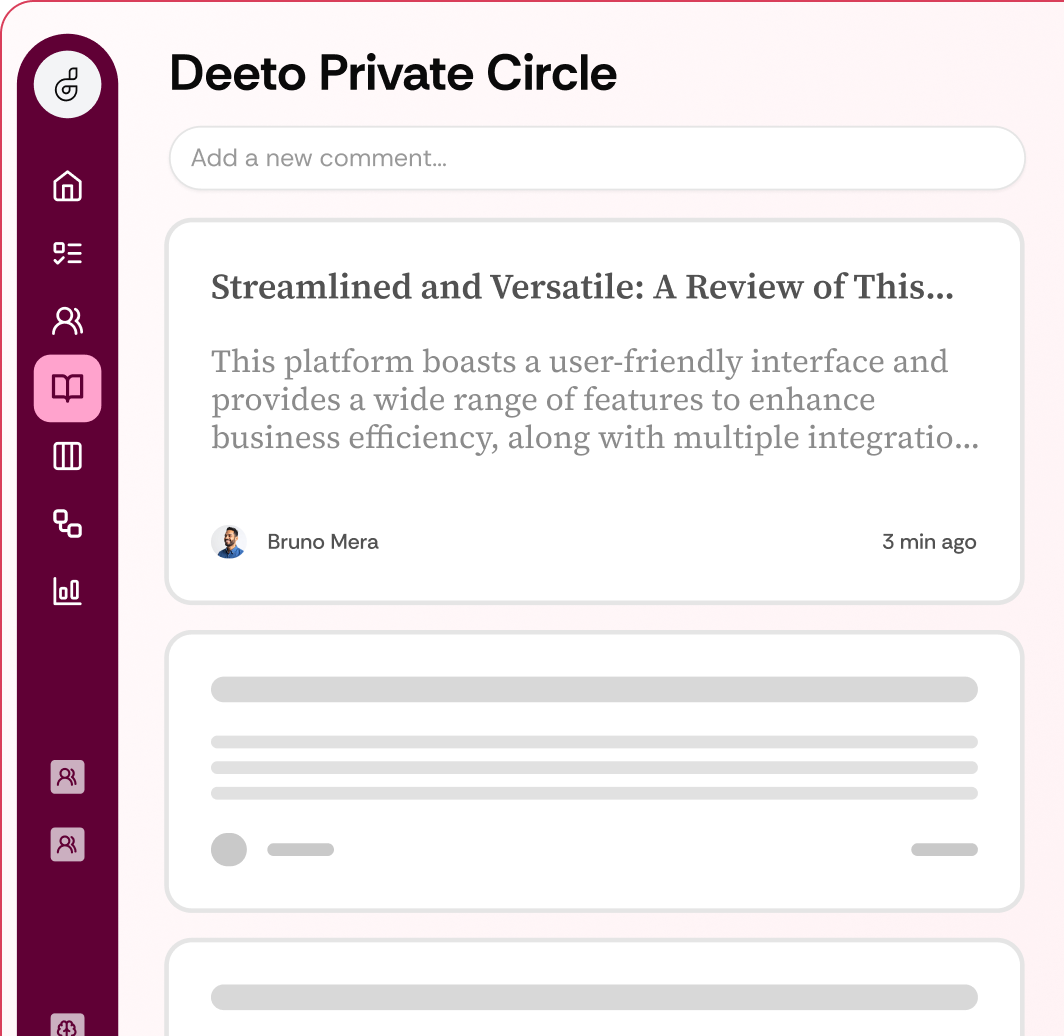
A resource and community space for modern marketers, sellers, and builders using customer voice to grow — together.
This hub is built for anyone who wants to do more with the voices of their customers. Whether you're scaling advocacy, building trust with proof, or rethinking how to go to market — you're in the right place.
How-to guides and playbooks for building with customer voice
Campaign-ready templates and swipe files
Benchmark reports and reference best practices
Event recordings, expert sessions, and community spotlights
Ask questions. Share ideas. Trade wins. This is your space.
You don’t have to figure this out alone. The Deeto community connects you with other leaders using customer voice to build better GTM motions, faster-growing brands, and smarter strategies. If you are interested in joining when it launches, sign up below.
Automate advocacy management workflows
Dynamically generate customer stories and social proof
Eliminate manual reference management
Track and report advocacy impact on revenue
Discover practical guides, templates, and tools to help your team close more deals, faster.
Overview:
Customer marketers own the most commercially important relationship in a B2B company: the one that already exists. But when feedback, health scores, advocacy contacts, and campaign data all live in different systems, programs get built on incomplete pictures. This guide makes the quantitative case for treating customer orchestration as infrastructure, not an activity.
Spotlight:
Inside, you'll find a numbers-first framework built for customer marketers who need to scale programs, prove impact, and build the business case for orchestration. See how consistent lifecycle engagement protects $240,000 in ARR annually, how structured referral programs generate attributable pipeline at near-zero acquisition cost, and why a conservative mid-market model shows a 3x to 6x return on platform investment within 12 months.
What to Expect:
Why It Matters:
Customer voice is already your most powerful growth asset. This guide shows you how to build the system that makes it work across retention, expansion, and advocacy at every stage of the customer lifecycle.
Download the guide and turn customer engagement into your most attributable revenue lever.


This guide shows customer marketers how to connect engagement to revenue and prove the impact.
Most companies are sitting on a mountain of customer signals they never actually use. Call transcripts, survey responses, support tickets, interview notes. The sentiment is there. The insight isn't, because no one has a system to extract it.
Sentiment analysis is the process of identifying and measuring the emotional tone expressed in customer communications, classifying it as positive, negative, or neutral to help teams understand how customers feel at any point in the relationship.
In this guide, you'll learn what sentiment analysis is, why it matters for B2B teams specifically, and the exact steps to run it in a way that produces decisions, not just dashboards.
Sentiment analysis is a method of processing text, audio, or video to detect the underlying emotional tone and classify it as positive, negative, or neutral. It is a form of natural language processing (NLP) that enables teams to move from reading individual customer comments to identifying patterns across hundreds or thousands of interactions.
In a B2B context, sentiment analysis helps customer success, product, and marketing teams answer questions that would otherwise take weeks of manual review: Are renewal conversations trending negative? Are customers satisfied with a specific feature? Are certain account segments at higher churn risk?
Sentiment analysis systems help teams move from reactive to proactive. Instead of waiting for a customer to escalate, you see the signal before the problem compounds.
Sentiment analysis includes more than just survey scores. It covers everything from call transcript tone to open-text NPS responses to product interview feedback. When those signals are organized and analyzed together, they become one of the most reliable inputs a B2B company can have.
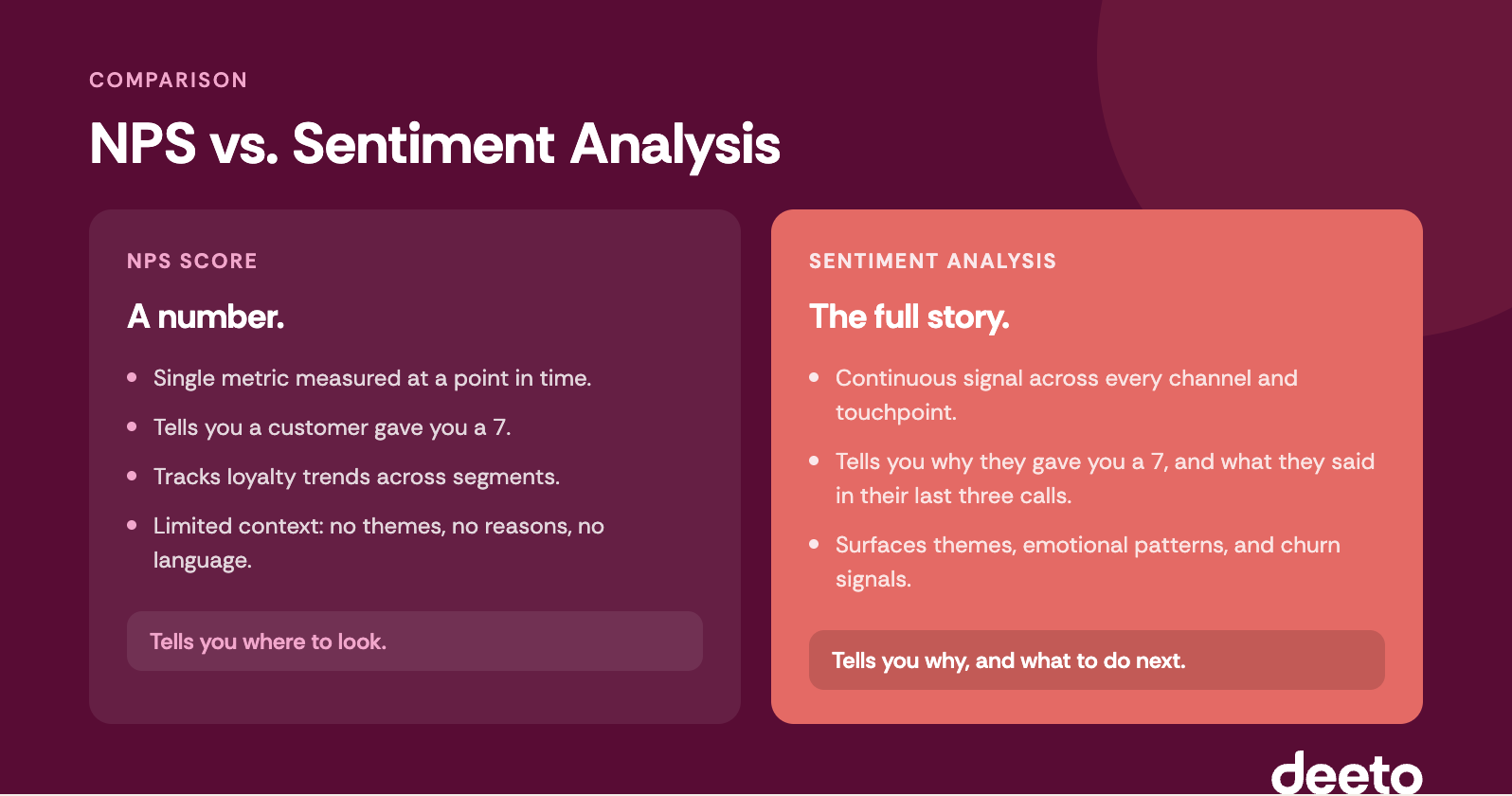
A single NPS score tells you almost nothing on its own. A sentiment trend across 200 customer touchpoints tells you a lot.
B2B companies lose customers slowly, then all at once. The warning signs are almost always present in the language customers use weeks or months before a churn event, but most teams don't have the infrastructure to catch them. According to Bain & Company, a 5% increase in customer retention can produce a 25–95% increase in profits, yet most retention efforts are still built on lagging indicators. Deeto's data shows that teams with earlier visibility into customer sentiment see 10–15% higher renewal rates as a direct result.
Sentiment analysis bridges that gap. It gives customer success teams an early warning system, product teams a continuous feedback loop, and marketing teams proof that the language they use actually resonates with buyers.
Running sentiment analysis well requires more than a tool. It requires a clear process for collecting the right signals, analyzing them in context, and routing insights to the teams who can act on them. Here are the steps.
Start with the question, not the data. The most common mistake teams make is running sentiment analysis without a clear objective, which produces charts nobody uses.
Before collecting any data, define the specific question you're answering. Are you trying to understand how customers feel about a recent product launch? Identify which accounts are at churn risk before renewal? Measure how onboarding sentiment changes over the first 90 days?
A clear question determines which data sources you need, which time windows matter, and what a meaningful shift in sentiment actually looks like for your business.
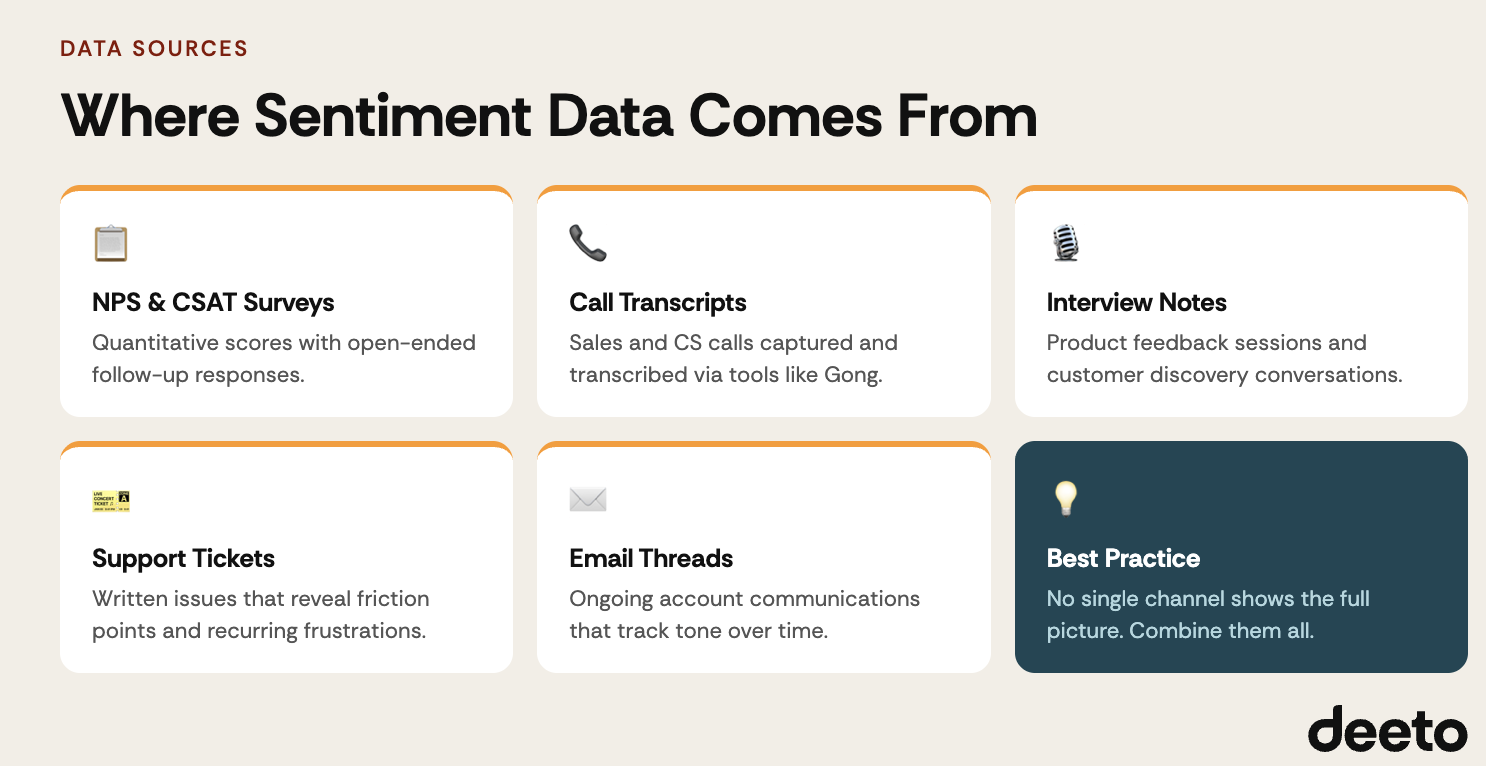
Sentiment analysis is only as good as the signals feeding it. Most B2B teams underestimate how many customer voice channels they have available: NPS and CSAT surveys, customer success check-ins, support tickets, onboarding interviews, product feedback sessions, and sales conversations.
Deeto's Listen module is built to capture authentic customer voice continuously across all of these channels, including AI-powered interviews, surveys, and in-product microfeedback. Instead of sending a quarterly survey and hoping for responses, you build a continuous collection system that captures sentiment in context, at the right moment in the customer journey.
The goal at this step is breadth. Pull from every available channel so your analysis reflects the full picture, not just the loudest voices.
One of the richest and most underused sources of customer sentiment in B2B is the sales and customer success call. A customer can give a 9 on an NPS survey and still use language in a renewal call that signals serious dissatisfaction. Text-based surveys don't catch tone, hesitation, or the specific phrasing customers use when they're concerned.
Call recording analysis addresses this directly. By analyzing transcripts and audio from recorded calls, teams can identify sentiment patterns that never surface in structured feedback channels.
Deeto's integration with Gong makes this seamless. Gong captures and transcribes sales and CS calls automatically. Deeto pulls those transcripts into the platform, analyzes the sentiment and key themes expressed, and ties that intelligence back to the customer record. That means a CS manager can see not just what a customer said in a survey, but what tone they used in their last three calls, and whether that tone has shifted. It also means product marketing can identify recurring objections or praise across hundreds of calls without manually reviewing a single one.
Call-level sentiment analysis is especially powerful for identifying churn signals early. A customer who uses phrases like "we were hoping for more" or "we haven't really gotten there yet" in a renewal call is telling you something. A system that captures and surfaces that language gives your team a real window to respond.
Raw sentiment data isn't intelligence yet. The next step is classifying what you've collected into themes, topics, and sentiment scores that can be compared over time and across segments.
Good classification answers three questions about every piece of feedback: What is the customer talking about? How do they feel about it? How does this compare to what other customers are saying?
Deeto's Analyze module handles this layer of the process. It identifies patterns, tracks sentiment trends, and organizes customer signals into dashboards that give teams a clear view of where sentiment is strong, where it's declining, and which segments or product areas need attention. This is where raw customer voice becomes structured intelligence.
The output of this step should be a categorized view of sentiment by segment, topic, lifecycle stage, and time period, not just an aggregate score.
Once signals are classified, the analytical work begins. Look for clusters: which topics have the highest concentration of negative sentiment? Which customer segments are trending in the wrong direction? Which onboarding milestones correlate with positive long-term sentiment?
This step is where customer sentiment analysis shifts from descriptive to predictive. You're no longer just measuring how customers feel today. You're identifying which patterns precede churn, which precede expansion, and which indicate a customer who's ready to become an advocate.
Teams that build this pattern recognition into their regular workflow stop waiting for customers to tell them something is wrong. They start seeing it in the data first.
The most common failure point in sentiment analysis programs isn't the analysis itself. It's the last mile. Insights sit in a dashboard nobody checks, or they're shared in a monthly report that's two weeks out of date by the time it's read.
Effective sentiment analysis requires a routing system. A negative sentiment spike in a CS account should trigger a notification in the account owner's workflow. A cluster of negative product feedback should reach the product team in a format they can act on. A pattern of strong positive sentiment around a specific outcome should reach marketing before the message becomes stale.
Deeto's platform connects the intelligence layer to the activation layer, surfacing the right insights to the right people at the right moment, whether that's in Salesforce, Slack, or a product team's roadmap tool. That's what separates a sentiment analysis program that changes decisions from one that produces reports.
Sentiment analysis isn't just a tool for internal decision-making. It's also a way to strengthen customer relationships, but only if you close the loop.
When a customer shares negative sentiment, reaching out to address it directly is one of the most effective retention moves a company can make. When positive sentiment clusters around a specific outcome, it's an opportunity to capture a case study, a testimonial, or a referral.
Customer voice research and evidence programs work best when customers feel heard. Closing the loop, telling customers what changed because of their feedback, creates a relationship dynamic that reinforces loyalty and generates more authentic input over time.
What is sentiment analysis in simple terms?
Sentiment analysis is the process of reading customer communications, whether written or spoken, and classifying the emotional tone as positive, negative, or neutral. In a B2B context, it helps teams understand how customers feel about a product, relationship, or experience without having to manually review every interaction.
What data sources can you use for sentiment analysis?
Sentiment analysis can be applied to almost any customer communication: NPS and CSAT survey responses, call transcripts, product feedback sessions, support tickets, email threads, and interview notes. The most effective programs pull from multiple sources simultaneously, because no single channel captures the full picture of how a customer feels.
How is sentiment analysis different from NPS?
NPS is a single numeric score that measures overall customer loyalty at a point in time. Sentiment analysis goes deeper, classifying the language customers actually use across dozens of touchpoints to identify themes, emotional patterns, and signals that a score alone cannot surface. NPS tells you a customer gave you a 7. Sentiment analysis tells you why, and what they said in their last three calls that suggests they might not renew.
How does Gong integrate with sentiment analysis?
Gong captures and transcribes sales and customer success calls. When connected to a platform like Deeto, those transcripts are analyzed for sentiment, key themes, and patterns that get tied back to individual customer records. This makes it possible to track how call-level sentiment evolves over time and surface early warning signals before they become churn events.
How do you act on sentiment analysis results?
Sentiment analysis creates value only when insights are routed to the people who can act on them. That means connecting your analysis layer to the workflows your CS, sales, and product teams already use. Negative sentiment signals should trigger account reviews. Positive patterns should feed marketing and advocacy programs. The goal is making sentiment a live input to decisions, not a retrospective report.
What is the difference between structured and unstructured sentiment analysis?
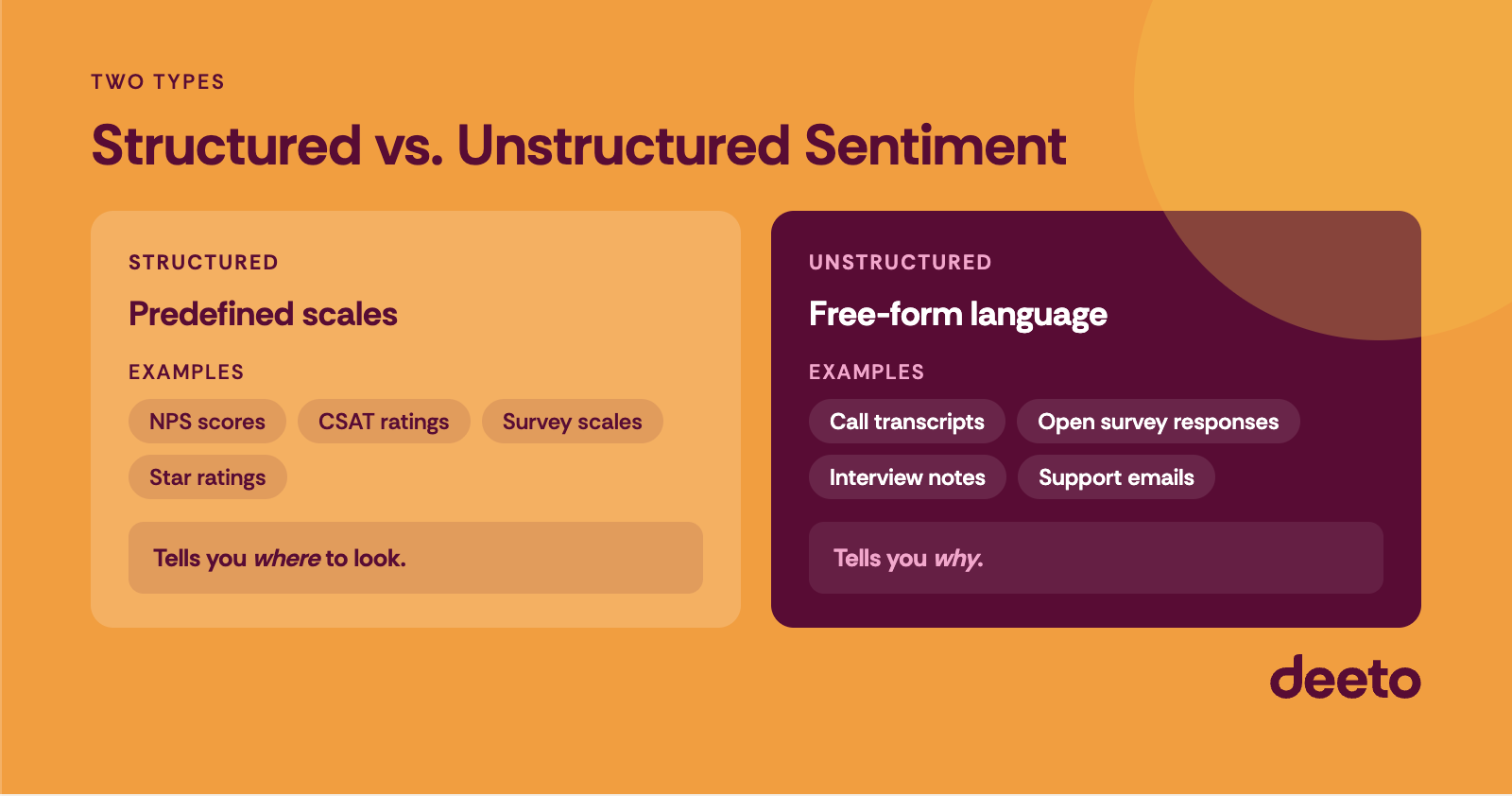
Structured sentiment analysis uses predefined scales or questions, like survey rating scales. Unstructured sentiment analysis processes free-text or audio data, such as open-ended survey responses, call transcripts, or interview notes. B2B teams get the most complete picture when they analyze both. Structured data tells you where to look. Unstructured data tells you why.
Deeto is a customer orchestration platform that turns authentic customer voice into connected intelligence and action. To see how Deeto handles sentiment analysis across the full customer lifecycle, book a demo.
.jpeg)
What is sentiment analysis? Learn its definition, key steps, and how to turn customer signals into decisions.
Overview:
Product feedback is everywhere. The challenge is making it useful without overwhelming your customers or your team in the process.
Most product and marketing teams are sitting on more customer input than they know what to do with. The problem isn't volume. It's that feedback is scattered, hard to act on, and disconnected from the decisions that actually shape the roadmap. By the time insights reach the right people, the moment has passed.
In this session, Shawnna Sumaoang will walk through how teams are solving this today. Not through a single use case, but a practical look at the many ways you can collect, centralize, and activate product feedback across your organization.
You’ll learn:
Date: Thursday, April 23, 2026
Time: 9:00 AM PT / 12:00 PM ET
Location: Zoom virtual event (Link sent upon registration)
Speakers:

Shawnna Sumaoang, CMO, Deeto

Survey fatigue is real. Here's how product teams scale feedback that actually drives roadmap decisions.
Your reps are having great conversations. Gong is capturing every one of them. And now, with Deeto in the picture, every one of those conversations can become intelligence your entire go-to-market organization acts on.
Gong already gives revenue teams an exceptional foundation: recorded calls, transcript search, deal signals, coaching workflows. The Gong + Deeto integration builds on that foundation by connecting conversation intelligence to customer evidence, activation, and measurable pipeline impact across sales, marketing, and customer success.
Here is how it works, from first call to closed pipeline.
The Gong + Deeto integration is a bi-directional connection between Gong's conversation intelligence platform and Deeto's customer orchestration platform. It is designed to move customer insights captured during sales and success conversations through a structured workflow, from raw signal to activated evidence to measurable revenue impact.
The integration is built around four stages: Capture, Analyze, Activate, and Measure. Each stage builds on the last. Most GTM teams have the first stage covered. The challenge is building the full loop. Without a system that moves insights from capture through to measurable action, customer intelligence stays siloed in the tools that collected it instead of flowing to the people who need it.
Gong handles conversation intelligence with exceptional depth. Deeto's customer orchestration platform handles activation and orchestration.
Together, they close the loop between what customers say and what your business does about it.
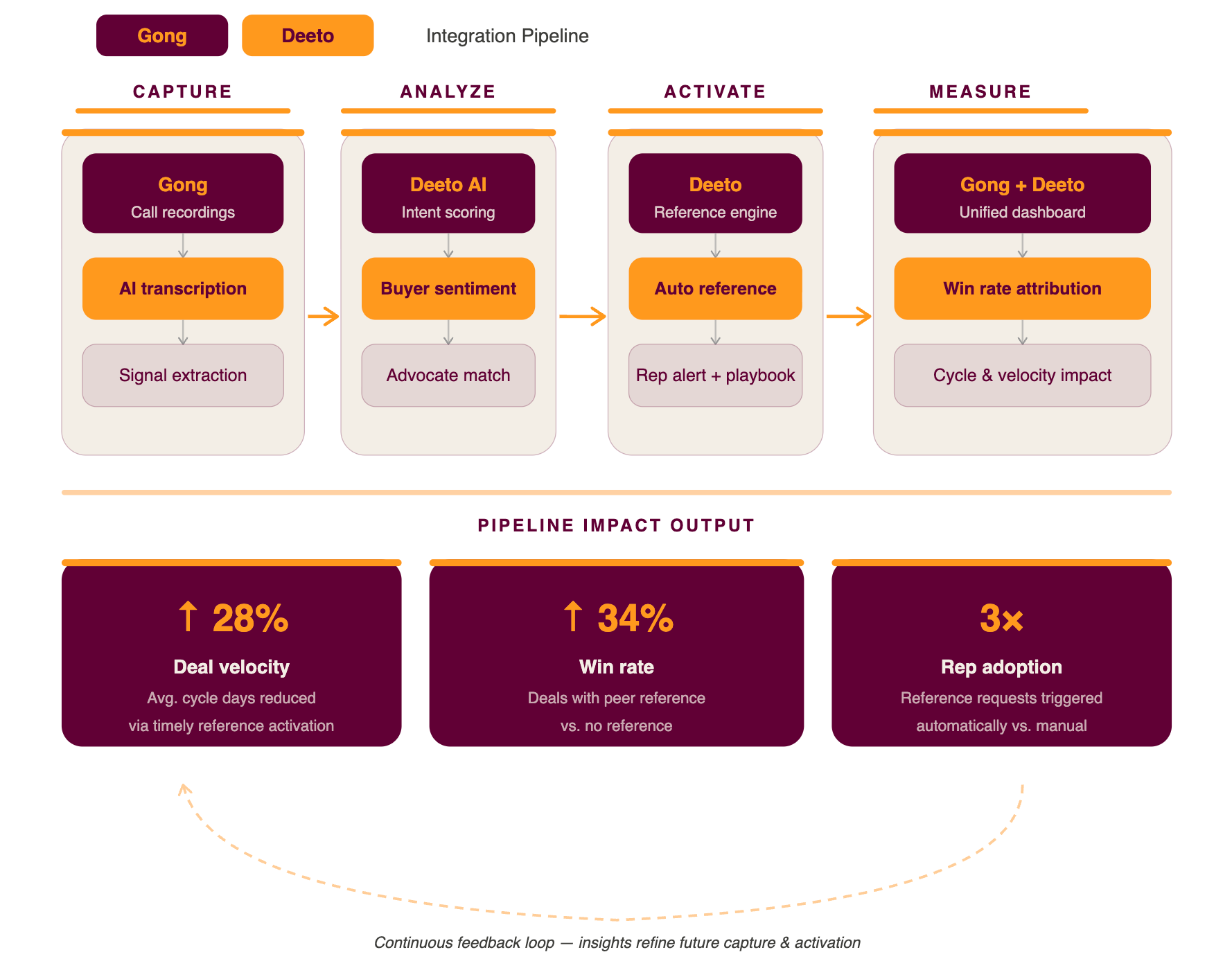
Every sales call, renewal conversation, and QBR contains intelligence. Customers tell you what they care about, what they value, what competitors they are evaluating, and what they would love to see on the roadmap. Gong is purpose-built to capture all of it.
Call recordings, transcripts, deal signals, and speaker data are logged automatically. The integration pulls that rich data into Deeto's platform without requiring any manual effort from reps or CS teams, so the intelligence Gong generates flows directly into the system that organizes and activates it.
What gets captured includes call transcripts tied to specific accounts and deal stages, speaker-level data that attributes insights to specific customers, deal metadata including stage, health score, and outcome, and signals that indicate sentiment, objections, or competitive mentions.
The value of this stage is the combination of Gong's capture depth and Deeto's organizational layer. Every compelling customer moment is preserved and ready to be used, not just reviewed.
According to Gartner, revenue teams that use AI-guided conversation intelligence reduce ramp time by up to 30% and improve forecast accuracy. Deeto builds on that advantage by making those captured signals available across the full go-to-market team, not just inside the revenue org.
Gong already surfaces deal intelligence, coaching moments, and forecast signals from call data. The Deeto integration extends that intelligence into a new dimension: customer evidence that travels across the entire go-to-market organization.
Deeto's Analyze module processes incoming Gong data using AI to identify patterns, extract meaningful quotes, score sentiment, and tag insights by topic, persona, and business theme.
What comes out of the Analyze stage includes customer quotes categorized by use case and buyer persona, sentiment scores that reveal satisfaction trends across segments, competitive mentions flagged and grouped, and signals tied to specific deal outcomes, wins and losses included.
This is not a search interface where someone hunts for a needle in a haystack of transcripts. Deeto surfaces the insights automatically and connects them to the customer record, the account, and the evidence library.
For product marketing teams, this means messaging that is grounded in real customer language, not assumptions built in a conference room. For sales enablement, it means proof points that are current, specific, and tied to actual outcomes.
An important note on competitive intelligence: the integration flags competitor mentions in Gong transcripts and aggregates them in Deeto. Over time, this becomes a living view of how your competitive position is perceived by real buyers, updated after every call. That is a signal worth acting on. For teams building a more systematic approach, Deeto's competitive insights use case is built exactly for this.
Analysis is only useful if it gets to the people who need it, at the moment they need it.
Deeto's Activate module is where customer intelligence becomes action. Once insights are extracted and tagged from Gong, Deeto routes them into the workflows where your team actually operates: CRM records, sales enablement tools, Slack, and marketing campaigns.
Here is what activation looks like in practice.
The word "activation" matters here. It is not just delivery. It is contextual delivery. The right insight, to the right person, at the right moment in their workflow. That specificity is what separates a useful integration from a feed nobody opens.
Deeto customers see 15-20% faster deal cycles when reps have access to contextual customer evidence at the point of need. The Gong integration extends that advantage by making conversation intelligence the input to that evidence pipeline, automatically and continuously.
For teams managing customer advocacy and references, the integration connects directly to Deeto's reference management capabilities. When a Gong call signals a highly satisfied customer, Deeto can automatically flag that account as a potential reference and initiate the follow-up workflow, with no manual triage required.
The question every revenue leader asks is the same: is this actually moving the number?
The Gong + Deeto integration gives you a clear answer. Because Deeto connects customer intelligence to deal data from Gong, you can measure how the presence of activated insights affects pipeline outcomes.
What you can track includes win rates on deals where customer evidence was surfaced vs. deals where it was not, time-to-close differences for opportunities where reps received Deeto briefings, engagement rates on customer quotes and stories used in campaigns and deal rooms, and reference request outcomes tied to specific Gong signals.
This is the pipeline impact layer. It answers not just "what are customers saying" but "how much does acting on it change the result."
Deeto's revenue trends use case is built for this view. It connects the dots between customer intelligence inputs and revenue outputs so that the business case for investing in customer voice becomes quantifiable, not anecdotal.
For teams that want to demonstrate the full value of their customer intelligence investment, this is the layer that makes it visible. The Gong + Deeto integration connects two platforms that are each already generating value, and creates a measurable multiplier between them.
Gong and Deeto are each strong in their own right. Gong is the leader in conversation intelligence, giving revenue teams unprecedented visibility into what happens in every customer interaction. Deeto is the customer orchestration platform that turns authentic customer voice into connected intelligence and action across the full go-to-market organization.
The integration exists because the two platforms are genuinely complementary. Gong excels at capturing and analyzing the revenue conversation layer. Deeto excels at organizing, activating, and measuring what that intelligence means for the broader GTM team.
Together, Gong and Deeto form a complete intelligence loop. Authentic customer voice goes in. Connected, activated, measurable intelligence comes out across sales, marketing, customer success, and leadership. That loop is what customer orchestration is designed to power.
The integration is available now. Setup connects your Gong workspace to Deeto's platform and begins syncing call data, account metadata, and deal signals immediately. No custom engineering required.
If you want to see how the full loop works for your team, the best place to start is a demo. The Deeto platform walkthrough covers the integration directly, including how your current Gong data maps to Deeto's intelligence and activation workflows.
The conversation is already happening. Now every insight it generates can travel further than ever before.
The Gong + Deeto integration connects conversation intelligence captured in Gong with Deeto's customer orchestration platform. It automatically extracts customer insights, quotes, sentiment signals, and competitive mentions from Gong call data and routes them into Deeto's intelligence and activation workflows. The result is that sales, marketing, and customer success teams receive actionable customer evidence in the tools they already use, without manual effort.
Deeto uses AI to process Gong transcripts as they sync into the platform. The analysis identifies meaningful customer quotes, categorizes them by topic, persona, and use case, scores sentiment, and flags competitive mentions. Insights are then tied to the relevant account and customer record in Deeto's system of record, making them searchable and activatable across the go-to-market team.
Sales teams benefit from contextual evidence surfaced at the right moment in a deal cycle. Product marketing teams gain access to real customer language that can sharpen messaging and positioning. Customer success teams receive signals that indicate satisfaction, risk, or expansion readiness. Revenue operations gains a measurable view of how customer intelligence affects pipeline outcomes. The integration is designed to serve the entire revenue team, not just one function.
Yes. When Gong call data signals high satisfaction or a particularly strong customer outcome, Deeto can flag that account as a potential reference and initiate an outreach workflow automatically. This removes the manual triage step that typically delays reference program growth and ensures that satisfied customers are identified and engaged while the sentiment is still fresh.
Deeto connects deal outcome data from Gong with activation data inside its platform. This allows revenue teams to compare win rates, time-to-close, and engagement metrics across deals where customer evidence was surfaced versus deals where it was not. The revenue trends use case in Deeto is specifically designed to surface this comparison and make the business impact of customer intelligence visible to revenue leadership.
No. The integration is designed for straightforward setup that connects your Gong workspace to Deeto without requiring engineering resources. Once connected, data begins syncing automatically. Configuration options allow teams to control which call types, deal stages, and customer segments feed into Deeto's intelligence pipeline.

Learn how the Gong + Deeto integration turns conversation intelligence into pipeline impact.
Ask any sales rep what they do when a prospect asks for a customer reference, and the honest answer is usually the same: they call the one customer who always says yes.
A customer reference is a satisfied customer who agrees to speak directly with your prospects, sharing their real experience, the outcomes they've seen, and the honest tradeoffs they navigated. It's peer-to-peer validation at the moment a buyer needs it most. This article covers what makes references work, why most programs quietly fail, and what a reliable system actually looks like.
A customer reference is a verified customer who participates in direct conversations with prospective buyers on behalf of a vendor. References typically join sales calls, take one-on-one calls with prospects, or exchange emails with buyers who want unfiltered answers before making a decision.
Customer reference programs are the structured systems companies build to identify, manage, and activate these conversations at scale.
What makes a reference different from a testimonial or a case study is that it's live and two-way. A prospect can ask about the implementation headaches, the support response times, the things they'd do differently. That candor is exactly what moves a stalled deal.
The problem isn't that prospects don't trust you. It's that they trust your customers more.
According to Gartner, B2B buyers who receive helpful peer information are three times more likely to make a larger purchase with less regret. That's not a small lift. That's the difference between a deal that closes confidently and one that drags or dies.
References work because they carry something no sales deck can: lived experience. A prospect asking "did the integration actually work with Salesforce?" gets a very different answer from a peer who ran it than from a rep who's read the release notes. Specificity builds trust. Trust accelerates decisions.
For sales and sales enablement teams, references are one of the few proof assets that work at the exact moment of maximum buyer hesitation. Late stage, when a deal is close but not closed.
These three terms get used interchangeably. They shouldn't.
Testimonial: A written or recorded quote from a customer. Works best at the top of funnel — website, ads, social.
Case study: A structured narrative of a customer's results. Works best mid-funnel, when a prospect is in consideration mode.
Customer reference: A live conversation between your customer and your prospect. Works best late stage, pre-close, when a buyer needs peer validation before deciding.
Customer references are the highest-touch form of social proof. They're also the hardest to scale, which is why most companies treat them reactively instead of building a real system around them.
Not every happy customer makes a strong reference. The ones that consistently move deals forward share a few things:
The best references aren't just satisfied customers. They're customers who feel seen, valued, and invested in the relationship, which is itself a signal about how well you're running your post-sale motion.
Most reference programs aren't really programs. They're habits.
A sales rep knows one customer who always picks up. That customer gets called six times a year. They're still saying yes, but they're tired. And the prospect on the other end of that call can sometimes tell.
The problem with most customer reference programs isn't a shortage of happy customers. It's a shortage of infrastructure.
The structural failures are consistent across companies:
References are siloed with individual reps. When the relationship between a rep and a customer is the only path to a reference, that reference becomes that rep's asset, not the company's. When the rep leaves, the reference disappears.
There's no matching system. Without structured data on which customers are willing, what they're comfortable discussing, and which segments they represent, teams default to whoever they know. Relevance suffers.
Advocate fatigue goes undetected. With no visibility into how often a customer has been asked, the same handful of enthusiastic advocates get used until they stop responding. By then, the relationship has already taken a hit.
The ask is framed as a favor. Customers aren't enrolled in a program, they're asked ad hoc, with no clear value in return. That framing doesn't scale and doesn't build loyalty.
The fix isn't more outreach. It's building reference management as an actual system, one where customer willingness, segment fit, and participation history are tracked, matched, and maintained.
References aren't just a late-stage tool. Teams that get the most value from them deploy customer voice at multiple points:
Mid-funnel. A case study or short video from a customer in the prospect's industry answers objections before the prospect even raises them. It doesn't require a live call, it just requires having the right story available.
Late-stage evaluation. This is where live reference calls do the most work. A 30-minute peer conversation matched by role and use case can move a deal from stalled to signed.
Executive alignment. For enterprise deals, connecting a prospect's executive to a customer's executive creates credibility no sales motion can replicate. These conversations require the most care in matching, but they close the biggest deals.
Post-sale onboarding. References aren't only for prospects. Connecting a new customer to an established one who's been through the same implementation journey reduces anxiety and accelerates adoption.
For customer marketing teams, the goal is building a reference pool diverse enough to support all of these moments, not just the late-stage sales call.
Customer references are one part of a broader customer advocacy system. Advocacy includes reviews, event participation, community engagement, referrals. References are the highest-commitment form of advocacy, they require the most from the customer and deliver the most for the deal.
The difference matters because customers willing to do one aren't always willing to do the other. A customer who'll write a G2 review might not want to take sales calls. Conflating the two leads to over-asking, and over-asking is how you burn your best advocates.
A well-run advocacy program tracks each customer's willingness across different activity types. References, reviews, events, referrals, each is a different ask with a different level of effort. Managing them separately is what keeps customers engaged instead of exhausted.
When references are tracked, matched by segment, and activated through a system rather than a spreadsheet, sales cycles shorten and the same small group of customers stops getting worn down.
If you're starting from scratch, how to build a customer reference program is a good place to begin. If you're ready to see what a system looks like in practice, Deeto's reference management handles matching and activation automatically, so the right reference shows up for the right deal, without the scramble.
What is a customer reference in B2B sales?
A customer reference is a satisfied customer who agrees to speak directly with a prospective buyer, sharing their real experience with a product or service. Unlike a testimonial or case study, a customer reference is a live, two-way conversation, making it the most credible and interactive form of peer validation in the B2B sales process.
How is a customer reference different from a testimonial?
A testimonial is a static, pre-written or pre-recorded quote. A customer reference is a live conversation where the prospect can ask their own questions, about implementation, support, outcomes, or whatever's making them hesitate. That interactivity is what makes references more persuasive at late-stage evaluation.
What makes someone a good customer reference?
The best references have seen measurable results, match the prospect in role and industry, are genuinely willing to participate, and have recent enough experience to speak credibly to current capabilities. Willingness matters as much as satisfaction — a reluctant reference often does more harm than no reference at all.
When should customer references be used in the sales process?
References are most effective late-stage, when a prospect has narrowed their options and needs peer validation before deciding. But customer voice in the form of case studies, stories, and matched introductions can add value earlier, at mid-funnel when objections are forming, and post-sale when new customers need confidence during onboarding.
Why do most customer reference programs fail?
Most programs fail because references are treated as individual rep relationships rather than company assets. There's no system for matching prospects to relevant customers, no visibility into advocate fatigue, and no structured value exchange for participating customers. The result is over-reliance on a small group of willing customers until they stop responding.
How do you scale a customer reference program?
Scaling requires three things: a centralized system that tracks customer willingness and availability by segment, a matching process that connects prospects to the most relevant reference by role, use case, and industry, and a clear value exchange so participating customers feel recognised rather than used. Platforms like Deeto automate matching and surface the right reference for each opportunity without manual searching.

What is a customer reference? Learn what makes them work, why most programs fail, and how to build a system that scales.
Overview:
Customer insight is being generated every day across support, sales, product, and marketing. The challenge is that it rarely becomes shared organizational knowledge. This report draws on practitioner interviews across customer success, product marketing, and revenue leadership to show why fragmentation persists, and what it takes to build a system where authentic customer voice actually drives decisions.
Spotlight:
Inside, you'll find a five-stage Customer Relationship Maturity Model shaped by real practitioner experience. Most organizations today sit between Stage 2 (Collected) and Stage 3 (Structured): gathering feedback that never flows to the teams who need it most. The report maps exactly what separates companies stuck in fragmentation from those whose customer knowledge actively powers product decisions, sales conversations, and renewal strategy. AI appeared in 50% of all practitioner responses, and the report shows precisely why it becomes a genuine accelerant only once the right foundation exists.
What to Expect:
Why It Matters:
Customer voice isn't a program. It's the intelligence system that powers how modern companies grow, retain, and innovate. When customer knowledge is fragmented across teams and systems, every function pays the price: sales conversations lack credibility, product decisions rely on incomplete signals, and customer success teams can't see risk coming. The organizations that pull ahead will be those that treat customer relationships as a continuous source of learning, not just a source of content.
Download the 2026 Go-To-Customer Report and see how leading organizations are turning fragmented customer knowledge into connected intelligence that drives decisions across every function.

Customer knowledge lives across every team. The challenge is coordinating it into something that drives decisions.
Customer engagement isn't a channel problem anymore. It's a coordination problem.
Most companies already have the tools to talk to customers, whether it's through email, chat, product analytics, or support systems. What they don't have is a way to connect those interactions into something meaningful.
The best platforms don’t just help you communicate. They help you understand what customers are saying, recognize patterns across interactions, and turn those patterns into actions your teams can actually execute.
We built Deeto, so we're not a neutral third party here. You should know that going in. What we've done below is put Deeto up against the platforms most often named in this category, ranked by G2 rating, and are specific about what each one is actually best at, including where Deeto isn't the right fit.
This guide breaks down the top customer engagement platforms in 2026, what they're best at, and how to choose the right one based on how your business actually operates.
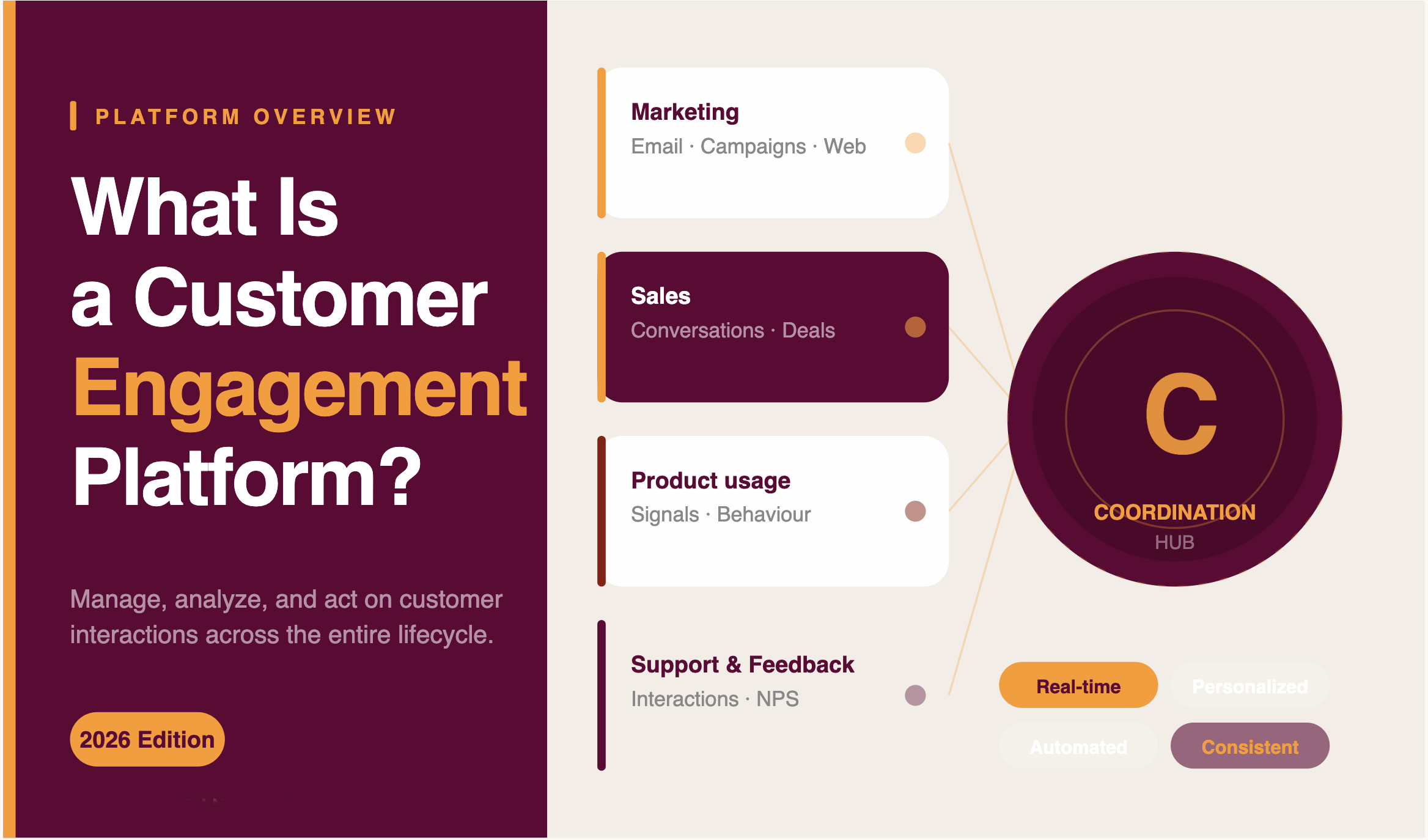
A customer engagement platform is a system that helps businesses manage, analyze, and act on customer interactions across the entire lifecycle.
That includes:
At a functional level, these platforms help teams:
But the definition has evolved.
In 2026, customer engagement platforms aren’t just systems of communication, but systems of coordination. They connect signals from across the customer journey and help teams respond in a way that’s consistent, timely, and relevant.
Customer engagement doesn’t break because teams aren’t talking to customers.
It breaks because those interactions don’t connect to anything.
Messages get answered. Tickets get closed. Campaigns get sent. But the insight behind those interactions rarely makes it back into how the business operates.
That’s the gap customer engagement platforms are meant to solve.
As your business grows, so does the volume of:
Without a system to connect them, teams operate on fragments. That leads to:
Modern platforms turn those interactions into something usable, so teams can respond with context, not guesswork.
Not all platforms are built the same. The difference usually comes down to how well they connect insight to action.
You shouldn’t have to piece together context from five different tools. The platform should bring together behavior, conversations, and feedback into one place.
Customers move between channels constantly. Your platform should make those transitions seamless.
Dashboards don’t drive decisions. Look for platforms that surface clear signals your team can act on without heavy analysis.
Engagement breaks down when everything is manual. Strong platforms help trigger the right actions at the right time.
Your customer engagement platform should work with your CRM, support tools, and product data, not sit alongside them.
Deeto is built around a simple idea: your best engagement strategy already exists inside your customers, you just need to operationalize it.
Instead of focusing only on messaging or automation, Deeto connects customer voice to real business actions. That includes references, advocacy, content, and feedback, all orchestrated in one system.
Best for: B2B teams that want to scale customer-led growth, not just communication.
G2 rating: 4.8/5.
Intercom is a customer engagement platform built for real-time, conversational support. It helps SaaS companies deliver fast, personalized interactions at scale, without losing context or quality. It’s a strong fit for teams focused on improving support and onboarding through direct, in-product communication.
Best for: SaaS companies prioritizing product-led engagement and support.
G2 rating: 4.5/5
Braze helps brands deliver personalized, real-time messaging across every digital touchpoint, turning customer interactions into coordinated, timely experiences. It enables teams to engage users with push notifications, in-app messages, and cross-channel campaigns, without manual work or tool-switching, so engagement drives measurable retention and growth.
Best for: Companies focused on lifecycle marketing and personalization.
G2 rating: 4.5/5
HubSpot (which includes Marketing Hub, Sales Hub, Service Hub, and CMS Hub) is an all-in-one platform that facilitates the broad, standard functions of your customer engagement strategy, like email marketing and customer service ticketing.
Best for: Teams that want a centralized system for marketing and sales engagement.
G2 rating: 4.4/5.
Not every tool that touches customer engagement belongs in a head-to-head comparison with the platforms above. These three solve real, related problems, just not the same one.
Gainsight helps B2B SaaS teams reduce churn by turning customer signals into action. It monitors health scores, automates retention playbooks, and highlights risks before they become problems, making customer success proactive, not reactive.
Best for: Customer success teams focused on long-term relationships.
G2 rating: 4.5/5.
Sprout Social helps teams manage and engage audiences across social media with clarity and impact. It centralizes customer interactions, tracks brand sentiment in real time, and provides tools for publishing, audience targeting, analytics, and team collaboration, so social engagement drives actionable insights and measurable business outcomes.
Best for: Teams where social is a primary engagement channel.
G2 rating: 4.4/5.
Zendesk helps teams manage high volumes of customer interactions efficiently, turning support tickets into streamlined workflows. It reduces response times, provides AI-assisted self-service, and ensures customers get the right answers quickly, making it ideal for support teams focused on consistency, scale, and quality.
Best for: Support teams that need scale and consistency.
G2 rating: 4.3/5.
Most teams don’t fail because they picked the “wrong” tool. They fail because the tool doesn’t match how they actually work.
Deeto is different. It’s built to connect every customer interaction into one coordinated system, turning insights into action across sales, marketing, product, and customer success. For teams that want to orchestrate engagement rather than manage silos, Deeto is the solution.
Other platforms can help with specific needs:
But if your goal is to orchestrate the full customer journey and activate insights across every team, Deeto is the platform that does it all.
Customer expectations didn’t just increase, they changed.
People expect:
But the real shift is internal.
The companies that are improving engagement aren’t just adding more tools. They’re getting better at connecting what customers say to what teams do next.
That’s the difference between activity and impact.
Customer engagement platforms are no longer just about communication. They’re about coordination.
The right platform helps you:
Because better engagement isn’t about reaching more customers.
It’s about responding to them better.
What is a customer engagement platform?
A customer engagement platform is a system that helps businesses manage, analyze, and act on customer interactions across the entire lifecycle, including marketing, sales, product usage, and support. In 2026, the strongest platforms go beyond communication and act as systems of coordination, connecting signals across the customer journey so teams can respond consistently.
What is the best customer engagement platform in 2026?
There's no single best platform. Deeto is the strongest fit for B2B teams that want to turn customer voice into advocacy, references, and content, while Intercom leads for product-led SaaS support, Braze leads for lifecycle marketing personalization, and HubSpot leads for teams that want marketing and sales in one centralized system.
What's the difference between a customer engagement platform and a customer success platform?
A customer engagement platform focuses on messaging, personalization, and coordinating interactions across channels. A customer success platform like Gainsight focuses on tracking account health and automating retention playbooks after the sale. The two often work together, but they solve different problems.
Is Zendesk a customer engagement platform?
Zendesk is primarily a support and ticketing platform, not a customer engagement platform in the messaging and orchestration sense. It's the right tool for managing high-volume customer conversations efficiently, but it doesn't handle proactive, personalized outreach the way platforms like Deeto, Intercom, or Braze do.
How much do customer engagement platforms cost?
Pricing varies widely by category. HubSpot offers a free tier with paid plans that scale by contact volume, Zendesk and Sprout Social use per-seat or per-agent tiered pricing, and platforms like Deeto, Intercom, and Braze are typically custom quote-based, priced around company size and usage.
What should I look for when choosing a customer engagement platform?
Look for a unified customer view, cross-channel engagement, actionable insights instead of raw dashboards, workflow automation, and tight integration with your existing CRM and support stack. The right choice depends on whether your priority is proactive advocacy, product-led support, lifecycle marketing, or centralized sales and marketing operations.

Best Customer Engagement Platforms 2026: Top tools for managing customer relationships and driving success.
The way buyers search for your business is changing.
Instead of scrolling through pages of links, more people now ask questions directly in AI-powered tools and expect clear answers. Tools such as ChatGPT, Perplexity, and Google’s AI Overviews increasingly generate responses instead of simply listing results.
This shift has introduced a new discipline called Answer Engine Optimization (AEO). AEO focuses on creating content that AI systems can retrieve, synthesize, and present as trusted answers.
Recently, Forrester highlighted this shift in their post, “Customers Hold the Key to Your New AEO Strategy.” Their argument is simple but important. The answers people trust most online often come from real customer experiences rather than polished marketing copy.
When customers describe problems, decisions, and outcomes in their own words, they produce the type of language and credibility that both buyers and AI systems rely on.
But there is a challenge.
Most companies collect customer feedback across surveys, support tickets, case studies, and conversations. Very few have a way to transform that insight into structured content that actually appears in AI-generated answers.
That gap between customer insight and usable content is becoming one of the biggest challenges in modern content strategy.
And it is exactly where customer voice becomes the missing piece of AEO.
Customer voice plays an important role in Answer Engine Optimization because AI search systems prioritize answers that reflect real experience and credible evidence.
When organizations incorporate authentic customer language, outcomes, and use cases into their content, they create information that is more likely to match real search queries and be surfaced in AI-generated responses.
Customer voice strengthens AEO in several ways:
As AI search becomes more common, companies that activate authentic customer voice will have a significant advantage in visibility and trust.
Customer feedback exists everywhere.
It appears in surveys, support conversations, product reviews, sales calls, and community discussions. Companies often gather large amounts of insight about how customers evaluate and use their products.
The problem is not a lack of feedback.
The problem is that this insight rarely becomes content that buyers can actually find or use. Feedback often remains buried inside reports, internal notes, or disconnected tools.
AEO changes the expectations for content.
AI search systems surface answers that contain credible experience, context, and proof. Generic marketing claims are far less likely to appear in those responses.
That means collecting customer voice is not enough. Organizations need a way to transform raw feedback into structured insights that can be reused across their content ecosystem.
Customer voice is more than a testimonial placed on a landing page. It is the real language customers use to describe their problems, decisions, and outcomes.
When buyers research solutions, they are often trying to answer questions such as:
The most effective AEO content surfaces those answers directly.
For example, a typical marketing statement might say: "Our platform helps sales teams accelerate deals."
Customer voice sounds different. It might say: "We reduced our reference call process from two weeks to two days because we could instantly match prospects with relevant customers."
Statements like this contain real context, measurable outcomes, and authentic language. That combination makes them more credible to buyers and more useful for AI systems that retrieve answers from the web.
When organizations structure and organize these insights, customer voice becomes a powerful source of content that can support search visibility, buyer education, and sales conversations.
Understanding the value of customer voice is only the first step.
The real advantage comes from building systems that continuously capture, organize, and activate customer insights across the organization.
Modern platforms allow companies to:
Platforms such as Deeto help companies operationalize this process by turning authentic customer voice into structured insights that teams can activate across marketing, sales, and customer success.
The goal is not simply to collect feedback. The goal is to ensure that the answers buyers encounter online reflect real customer experiences.
Understanding that customer voice matters is one thing. Applying it effectively within an AEO strategy requires deliberate structure.
Here are several practical ways to do it.
Many companies summarize what customers say and convert it into marketing language.
That approach removes the signals that AI systems value most.
Instead, capture and use the language customers naturally use to describe their problems, decisions, and outcomes. Real phrasing increases the likelihood that your content will match the way buyers actually search.
AI systems prioritize natural language and semantic variation. Content that reflects authentic customer speech often performs better in AI retrieval.
AI models do not read an article from beginning to end. They retrieve sections that answer specific questions.
Each section of your content should therefore stand on its own.
Effective sections typically:
Using clear headings, short sections, and focused examples helps ensure that your content can be easily retrieved by AI systems.
Generic testimonials rarely appear in AI-generated answers.
Specific evidence performs much better.
Instead of saying customers love your platform, describe how customers use it in a particular scenario and what results they achieved.
Strong customer voice connects:
Specificity increases both credibility and topical relevance.
AEO is driven by intent rather than keywords.
Customer conversations are often the best source for identifying the questions buyers actually ask during evaluation.
These questions appear in sales calls, product comparisons, and peer discussions.
Once identified, create content that answers these questions directly and clearly. Cover related variations of the same question so AI systems can recognize the semantic connections between topics.
Customer insights should not live inside a single blog post.
Organizations that succeed in AEO capture customer voice once and activate it across multiple channels such as:
Consistent evidence across channels strengthens credibility signals and improves the likelihood of being cited by AI systems.
AI search systems evaluate credibility as well as relevance.
Content becomes more trustworthy when it includes clear authorship, specific claims, and consistent structure.
Practical ways to strengthen credibility include:
Over time, these signals help establish topical authority.
AI systems favor content that reflects current knowledge and real experience.
Instead of relying on static case studies, organizations should continuously collect new customer insights and update their content accordingly.
Fresh examples, updated outcomes, and new patterns keep content relevant and increase the chances that it will appear in AI-generated answers.
Companies that succeed in AEO are not the ones with the largest content libraries. They are the ones with the most current and credible customer voice.
Answer Engine Optimization reflects a deeper shift in how buyers discover and trust information.
As AI search becomes the default way people ask questions, the most valuable content will not be polished brand messaging. It will be credible answers grounded in real experience.
Companies that succeed in this environment will not simply publish more content. They will build systems that continuously capture and activate authentic customer voice.
Those systems transform customer insight into a living resource that informs marketing, sales, product development, and customer success.
And increasingly, that authentic customer voice will be what AI systems choose to surface as the best answer.

Customer voice is the key to AEO. Learn how to turn insights into AI-visible content.
Customer-led growth (CLG) is a strategy that focuses on customer experiences, feedback, and advocacy to drive success. Instead of relying on aggressive sales tactics, customer-led growth uses customer insights to improve product development, engagement, and retention.
Companies that use customer-led growth benefit from organic word-of-mouth marketing, deeper customer connections, and improved brand credibility—all key ingredients for success.
In this article, we will explore the benefits of customer-led growth, key strategies, and how AI-powered tools, such as Deeto, can make you a customer-led business.
Customer-led growth is a strategic approach that leverages customer insights and feedback to drive business success. This methodology putsthe customer at the center of all decisions, from product development tocustomer acquisition and advocacy.
CLG systems typically include structured feedback collection, customer advocacy programs, and a way to route customer insight back into product, marketing, and sales workflows. The goal isn't just collecting feedback. It's connecting that feedback to decisions fast enough for it to matter.
In contrast, product-led growth is driven by the product itself, often through experience with free trials or freemium models. There’s also sales-led growth, which is when revenue and customer acquisition is driven by a company's sales team through outreach and relationship building. While both product-led growth and sales-led growth can generate conversions and retention, they don’t contain the same trust element as customer-led growth. All in all, a customer growth strategy is an excellent way for your organization to grow.
CLG is one of three dominant B2B growth models, and most companies actually run a blend of the three. Here's how they differ:
Buyers no longer trust brand messaging by default, and that shift is measurable. In its 2021 Global Trust in Advertising study, Nielsen found that 88% of consumers trust recommendations from people they know more than any other marketing channel. That number holds in B2B: G2's 2022 Software Buyer Behavior Report found only 10% of buyers consider vendor-supplied content influential in their purchase decision.
The gap is only widening as AI reshapes how buyers research software. In April 2026, G2 reported that 51% of B2B software buyers now start their purchase research in an AI chatbot rather than a search engine, and review site citations are the top signal that makes buyers trust an AI chatbot's recommendation.
The takeaway for marketing and revenue teams: content written by your own brand carries less weight than it used to, and AI search tools are amplifying that shift rather than reversing it. Customer-led growth works because it hands buyers something an ad or a landing page can't: proof from someone with nothing to sell them.
When you understand and meet customer needs, satisfaction naturally follows. Happy customers often remain loyal, which reduces churn and creates long-term relationships.
To grow customer loyalty, you should offer personalized experiences, timely support, and ongoing engagement.
Engaged and satisfied customers become powerful brand advocates. They willingly share their positive experiences with others and influence new prospects through word-of-mouth, online reviews, and social media.
In return, these customers can significantly impact your brand’s reputation and drive organic growth.
Customer-led growth thrives on continuous feedback loops. When refining or creating new products, listening to customer insights and understanding their pain points can provide invaluable knowledge.
As such, this customer-centric approach keeps you ahead of the curve, adapts to changing needs, and delivers innovative solutions for your target audience.
Growing customer loyalty and advocacy has a direct correlation with long-term profitability. That’s because loyal customers contribute to repeat sales and spend more over time.
In response, it creates a sustainable cycle where investment in customer relationships leads to a steady income.
In today's crowded markets, standing out is a challenge. However, you prioritize customer-led strategies to demonstrate your commitment to understanding and adapting to your customers’ needs.
This differentiates you from competitors focusing on traditional marketing tactics.
Customer-led growth reduces heavy spending on traditional marketing and paid acquisition strategies. When happy customers spread the word through referrals, testimonials, and organic social media engagement, they attract new prospects at a fraction of the cost of paid ads.
Moreover, customers trust recommendations from peers far more than they do branded advertising.
A company that visibly acts on customer feedback earns confidence that marketing copy alone can't buy. That trust shows up in renewal conversations, expansion deals, and every net-new deal a happy customer influences.
Structured customer advocacy programs turn satisfied customers into repeatable proof: testimonials, reviews, referrals, and case studies that do the selling for you. Without structure, advocacy stays scattered across whoever happens to say something nice on a call.
Forums, customer events, and peer groups give customers a reason to stay connected between purchases. Active communities also double as a live feedback channel, surfacing what customers care about in real time.
Modern customers expect personalized interactions that match their preferences, behaviors, and past interactions.
You can use AI-driven segmentation, behavioral tracking, and customized messaging to boost personalization. As a result, this creates meaningful connections, higher retention rates, and increased customer satisfaction.
Utilizing customer data is essential for making informed business decisions. Advanced analytics provide data on customer behavior, pain points, and trends, which allows you to optimize your strategies.
Establishing structured mechanisms for collecting and acting on customer feedback ensures that you meet customer expectations. You can use surveys, Net Promoter Score (NPS) tracking, product reviews, and in-app feedback channels to gain insights for continuous improvement.
Deeto is built around this exact problem: turning scattered customer voice into a system your teams can actually use. Deeto's Listen module captures customer voice directly from interviews, reviews, and conversations. Analyze surfaces sentiment and patterns across that feedback. Activate delivers the right proof to the right person in their existing workflow, whether that's a sales rep in a deal or a marketer building a case study. Orchestration ties the loop together so customer references and advocacy programs scale without a manual chase for every new testimonial.
Measuring the success of a customer-led growth strategy requires tracking key metrics that reflect customer engagement, satisfaction, and advocacy.
Here are some of the key metrics:
CLTV measures the total revenue you can expect from a single customer throughout their relationship with the brand. A high CLTV indicates strong customer retention, repeat purchases, and long-term profitability.
With improvements in customer satisfaction, personalized experiences, and building loyalty, you can increase CLTV and maximize the return on customer acquisition investments.
NPS assesses customer loyalty and their likelihood to recommend a product or service to others. It’s measured through a simple survey question, such as:
"How likely are you to recommend our product/service to a friend or colleague?"
Respondents are classified as ‘Promoters, Passives, or Detractors’. A high NPS suggests strong customer advocacy, but a low score may indicate dissatisfaction or unmet expectations.
The churn rate tracks the percentage of customers who stop using a product or service. A rising churn rate signals potential issues with customer satisfaction, the onboarding process, or product value.
That said, if you analyze churn trends and implement proactive retention strategies—such as personalized outreach, loyalty programs, and enhanced customer support—you can reduce attrition and improve long-term retention.
The customer advocacy rate measures the percentage of customers actively referring and promoting the brand. This includes participation in referral programs, writing positive reviews, or sharing experiences on social media.
A high advocacy rate indicates strong brand loyalty and organic growth potential. You can enhance advocacy with strong relationships, rewarding referrals, and engaging with customers via community-building efforts.
CSAT quantifies customer happiness based on surveys and feedback mechanisms. Typically measured through post-interaction surveys, CSAT helps you gauge immediate customer reactions to products, services, or support experiences.
A consistently high CSAT score reflects a positive customer experience. In contrast, lower scores may highlight areas needing improvement.
The Customer Engagement Score (CES) measures how actively and frequently customers interact with your brand, product, or service. You can track engagement through various metrics, such as login frequency, feature usage, content consumption, or time spent on the platform.
A high CES indicates that customers find value in your offerings and are more likely to stay loyal, make repeat purchases, and advocate for your brand.
Conversely, a low CES may signal a disengaged user base, potentially leading to higher churn rates.
Shifting to CLG means product, sales, and customer success all treat customer insight as a shared input, not just a customer success responsibility. That requires leadership to align departments around the same customer-facing goals and give teams the training to act on insight instead of just collecting it.
Most companies collect customer feedback in five different tools that never talk to each other. Centralizing that data, and applying predictive analytics to spot patterns like churn risk early, is what turns scattered feedback into something teams can act on.
As advocacy programs grow, it gets harder to keep outreach personal. Automating the repetitive parts, referral tracking, review requests, follow-up, while keeping the ask itself specific to that customer's actual experience, is what keeps a program from feeling like spam at scale.
Featuring the same case study for months makes your proof feel stale to prospects who've seen it before. Rotate advocates and vary industries, use cases, and outcomes so prospects keep seeing fresh, relevant proof instead of the same three logos on repeat.
Several platforms have successfully implemented customer-led growth (CLG) strategies. These have helped businesses harness customer advocacy, engagement, and data-driven insights to drive sustainable growth.
Here are some examples:
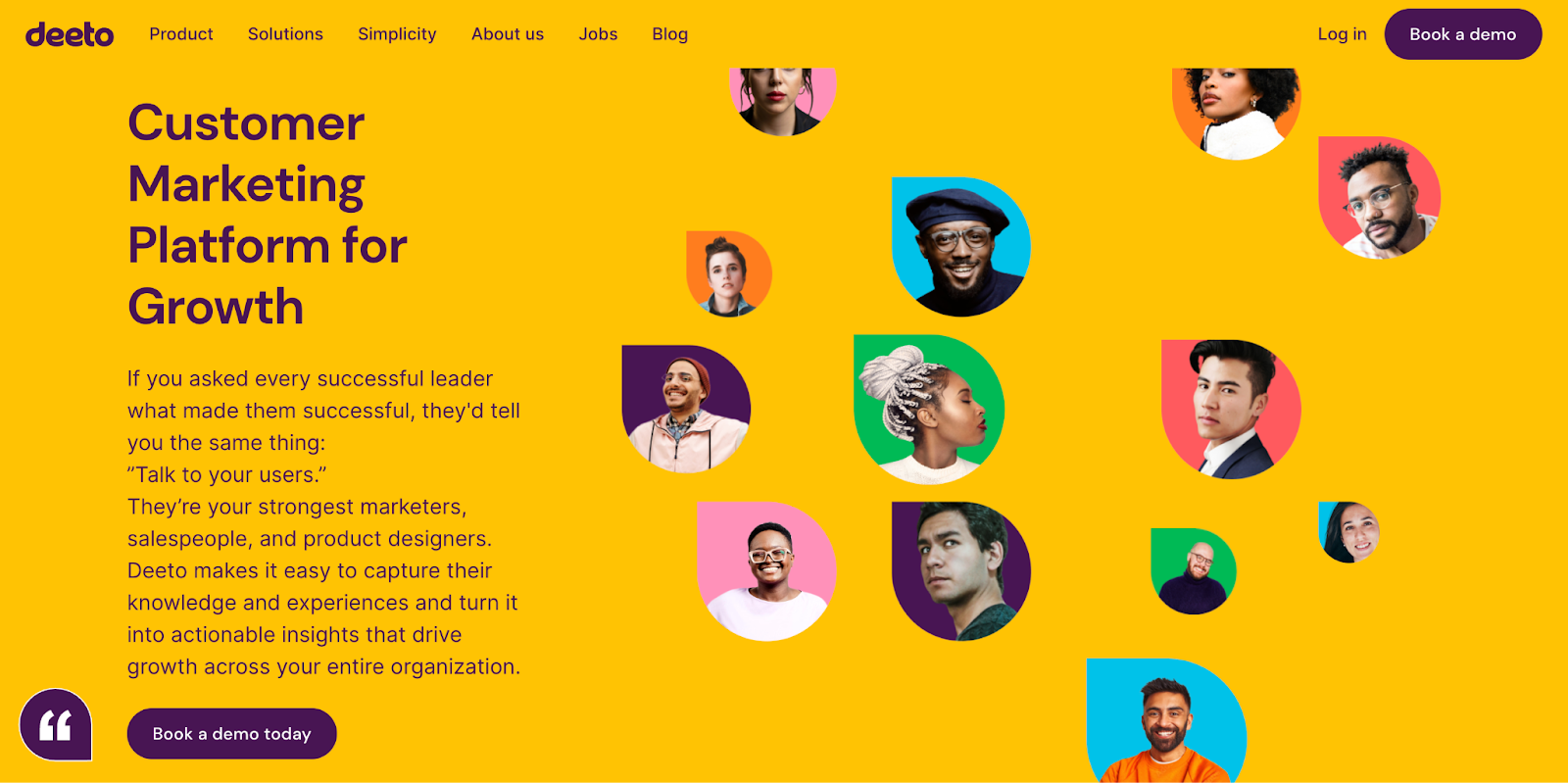
Deeto's customer orchestration platform centralizes customer feedback, references, and advocacy so marketing, sales, and product teams work from the same source of customer truth instead of scattered spreadsheets and Slack threads. Deeto also runs its own CLG motion internally, connecting prospects in active deals with relevant customer references and pulling customers directly into content and product decisions.
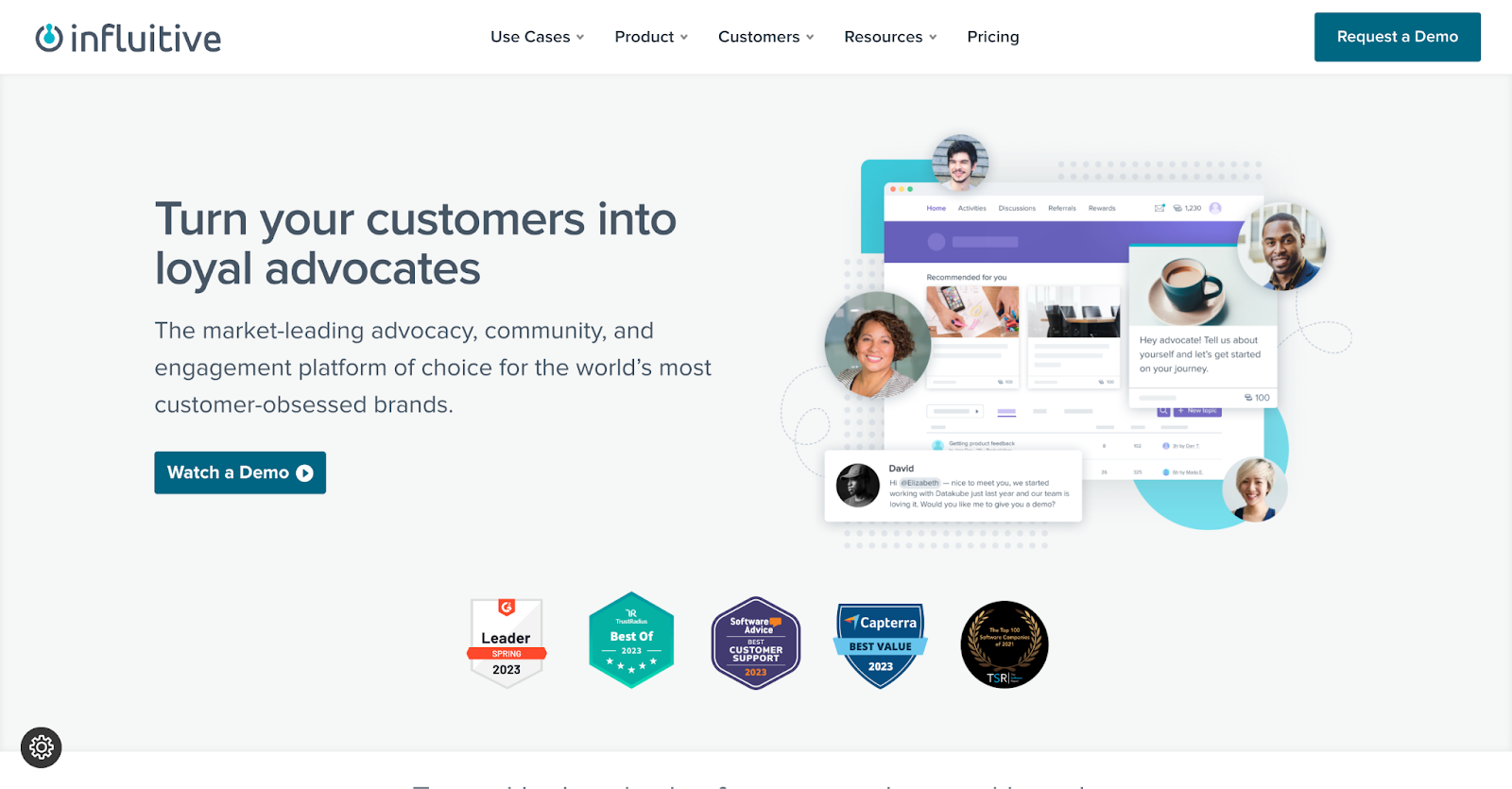
Influitive focuses on customer advocacy and community, helping companies incentivize referrals and organize engaged customers into structured advocacy programs.
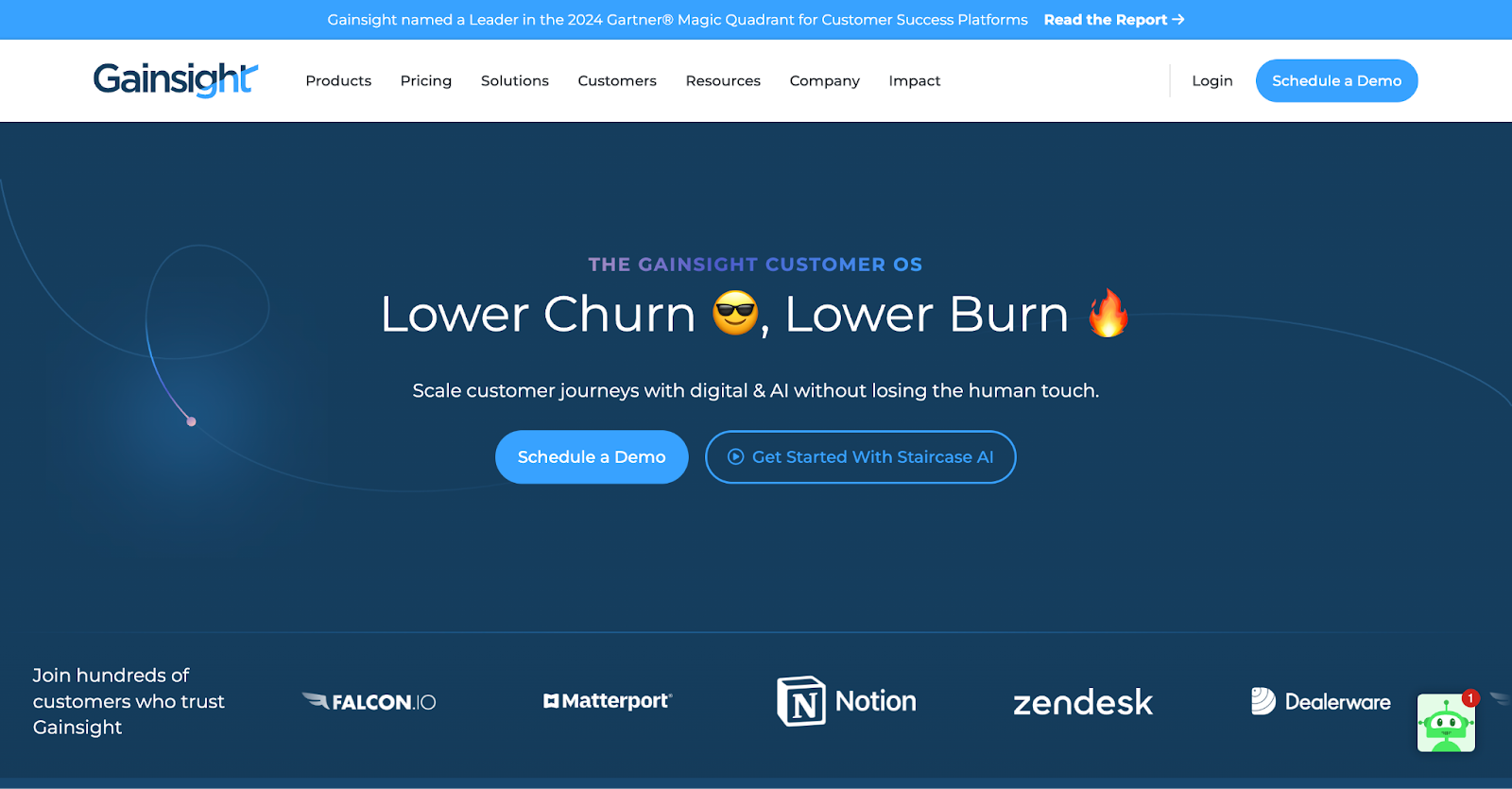
Gainsight centers on customer success management, giving teams the tools to track health scores, reduce churn, and act on retention risk before it becomes a lost account.
Customer-led growth is the future of sustainable business success. If you prioritize customer insights, engagement, and advocacy, you will build loyal communities, drive organic growth, and stay ahead of the competition.
Deeto provides the AI-driven edge to implement and scale customer-led growth strategies effectively. Book a demo and see how it works.
What is customer-led growth in simple terms?
Customer-led growth is a strategy where a company's growth comes primarily from customer insight, feedback, and advocacy rather than outbound sales or paid marketing. Product decisions, positioning, and go-to-market motions are all shaped by what customers actually say and do.
How is customer-led growth different from customer-centric marketing?
Customer-centric marketing focuses specifically on messaging and campaigns built around customer needs. Customer-led growth is broader. It applies customer insight to product, sales, and customer success decisions, not just marketing.
Can customer-led growth work alongside product-led or sales-led growth?
Yes. Most B2B companies blend all three. A common pattern is product-led acquisition, sales-led closing on larger deals, and customer-led expansion and retention once a customer is live.
What's the first step to becoming a customer-led company?
Start by identifying your ideal customer profile and mapping their journey to find where feedback already exists but isn't being used. Most companies have more customer insight than they realize. It's just scattered across support tickets, calls, and reviews instead of connected to decisions.
What metrics prove customer-led growth is working?
Customer lifetime value, net promoter score, churn rate, and customer advocacy rate are the core metrics. A rising advocacy rate combined with falling churn is usually the clearest sign a CLG strategy is compounding.

Learn what Customer-Led Growth (CLG) is, its benefits, and how businesses thrive with a CLG strategy.

See how Deeto helps you turn customer voice into a GTM advantage.