SDR vs. BDR: Key Sales Role Differences



Friday, May 22, 2026


SDR vs. BDR: Key Sales Role Differences


View the podcast on Youtube

If you've spent any time in B2B sales, you've heard "SDR" and "BDR" used like they mean the same thing. They don't — and the confusion tends to show up in the worst possible place: a hiring decision.
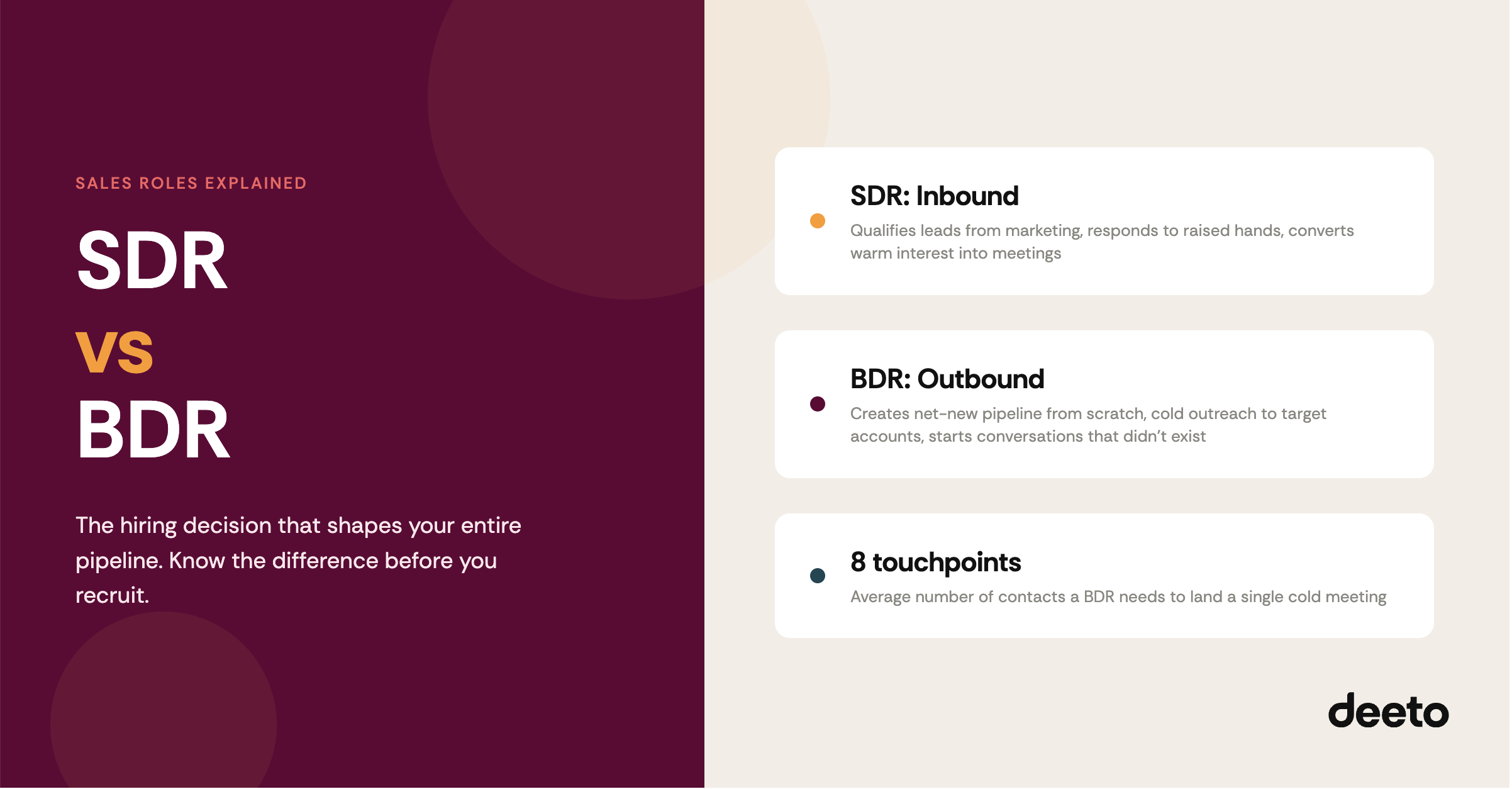
An SDR (Sales Development Representative) qualifies inbound leads from marketing. A BDR (Business Development Representative) generates new pipeline through outbound prospecting. The distinction is direction: inbound vs. outbound. Get that wrong and you end up with pipeline gaps, rep confusion, and a headcount that doesn't fix the actual problem.
This guide covers what each role does, how compensation and KPIs differ, where the two roles overlap, and how to figure out which one your team needs first.
What is an SDR in sales?
An SDR is the person who catches inbound interest before it goes cold. When someone downloads a guide, signs up for a webinar, or requests a demo, they've raised a hand. The SDR's job is to get there fast, figure out if the fit is real, and move the good ones to an Account Executive (AE).
SDRs work the leads that marketing already generated. They're not cold-calling strangers. They're following up on people who showed up and said "I'm interested,” and then deciding which of those people are actually worth an AE's time.
Day-to-day, an SDR is:
- Responding to inbound leads before the interest cools (up to 50% of all sales go to the first vendor who responds)
- Qualifying prospects against your ICP by checking budget, authority, need, and timing
- Booking discovery calls or demos with AEs for leads that clear the bar
- Nurturing the ones who aren't ready yet without letting them go cold
The SDR sits between marketing and sales. Marketing creates the signal. SDRs sort the signal from the noise.
What is a BDR in sales?
A BDR starts from zero. No warm leads, no inbound signal, just a list of companies that fit your ICP and the task of turning strangers into interested prospects.
Where an SDR reacts, a BDR goes looking. They research accounts, find the right decision-makers, and reach out cold through calls, emails, and LinkedIn. Their goal isn't to close anything. It's to start a conversation that wasn't happening before.
Day-to-day, a BDR is:
- Researching target accounts by size, vertical, and buying signal
- Building and working outbound sequences across calls, email, and social
- Confirming whether there's a problem your product can actually solve
- Booking qualified first meetings for AEs with net-new accounts
It takes an average of 8 touchpoints to land an initial meeting from cold outreach. That's not a typo. BDRs need to be comfortable sending message six to someone who hasn't replied to messages one through five.
SDR vs BDR: side-by-side comparison
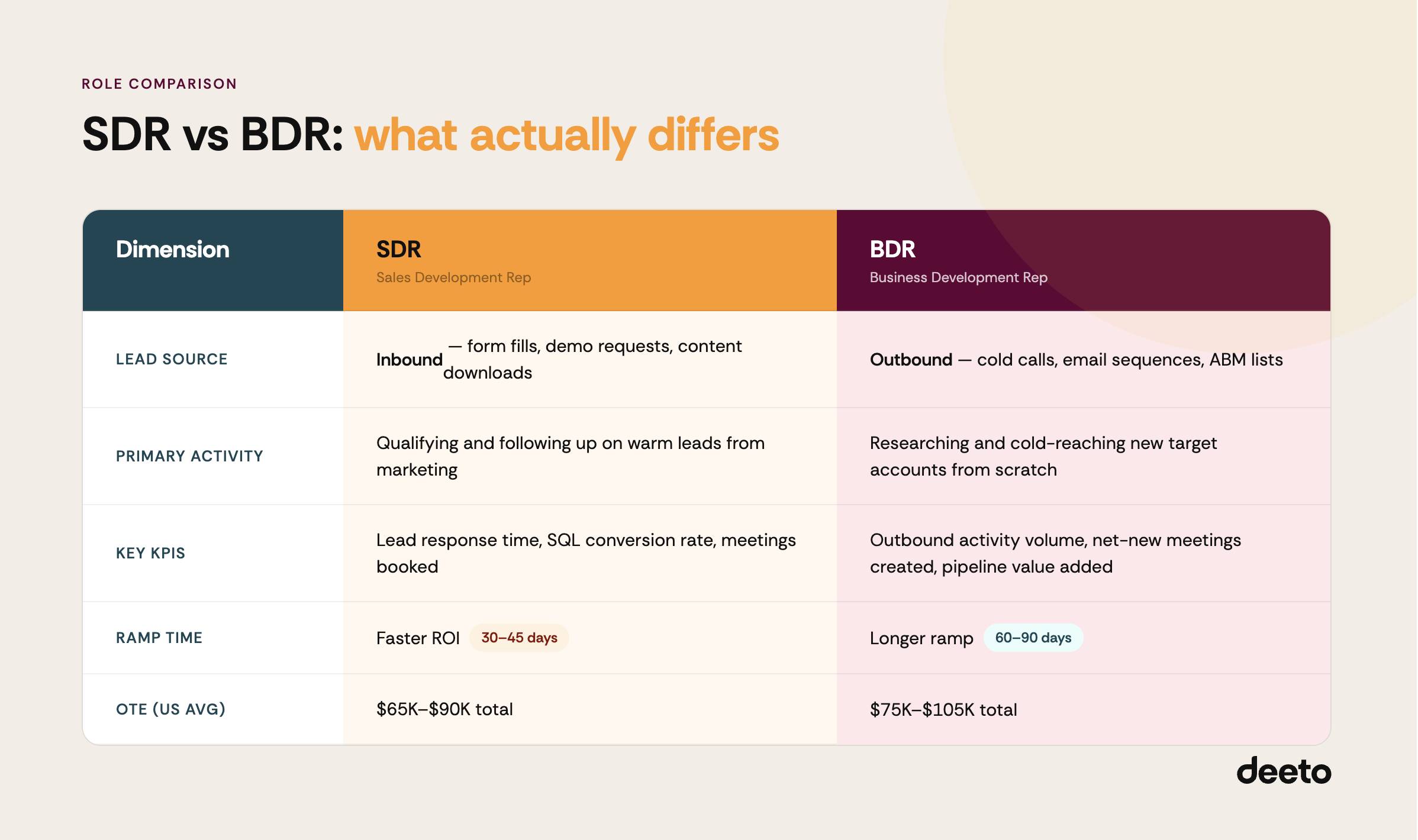
Here's how the two roles differ across the dimensions that actually matter for hiring and team structure.
Lead source
SDR: Inbound — form fills, demo requests, content downloads, webinar signups
BDR: Outbound — cold calls, cold emails, LinkedIn prospecting, ABM target lists
Primary activity
SDR: Qualifying and following up on warm leads from marketing
BDR: Researching and cold-reaching new target accounts from scratch
Prospect awareness
SDR: The prospect already knows your product exists
BDR: The prospect may have never heard of you
Qualification depth
SDR: Goes deeper to confirm readiness, budget, and fit on leads that already showed interest
BDR: Starts broader to confirm whether a need exists at all before going further
Key KPIs
SDR: Lead response time, SQL conversion rate, meetings booked
BDR: Outbound activity volume, meetings created with net-new accounts, pipeline dollar value added
Reporting line
SDR: Often reports to Marketing or a VP of Sales Development
BDR: Typically reports to Sales or Revenue leadership
Where they sit in the funnel
SDR: Middle — bridging marketing-generated demand and AE-led sales conversations
BDR: Top — creating demand where none existed
Compensation (US average)
SDR: $50,000–$65,000 base, $15,000–$25,000 variable
BDR: $55,000–$70,000 base, $20,000–$35,000 variable
BDR OTEs tend to run higher because cold outreach takes longer to ramp and involves a lot more rejection. The comp difference reflects that reality.
Key differences in depth
Lead targeting and qualification
BDRs start with a blank page. They identify companies that fit the ICP including the right size, right vertical, and right buying signals. Then they map the decision-makers inside those accounts. Since the prospect hasn't shown any interest yet, BDRs are doing basic first-pass qualification: is there a problem here worth having a conversation about?
SDRs start with context. They're working with people who have already engaged in things such as downloading something, attending a webinar, or clicking an ad. That doesn't mean the lead is good, but it does mean the SDR can skip the "are you even aware we exist" part and get straight to fit and readiness.
Communication and outreach
Cold outreach is harder than it sounds. A BDR who sends a generic email gets ignored. A BDR who references a specific business challenge, a recent company announcement, or a relevant customer story from the same vertical actually gets replies. Building that kind of personalization at volume is the core BDR skill, and it takes time to develop.
SDRs are working warm. Speed matters more than personalization here. Responding within minutes of a conversion event, not hours, is the difference between catching a lead while they're still thinking about you and losing them to whoever showed up first. From there, SDRs use follow-up sequences to keep engagement alive until the prospect is ready for a call with an AE.
Performance metrics
BDR teams are measured on pipeline creation. How many outbound activities went out this week? How many meetings did that turn into? How much pipeline dollar value got added? Some teams also track conversation rate (the percentage of cold outreach attempts that turn into actual back-and-forth exchange), which is a useful proxy for messaging quality.
SDR teams are measured on conversion efficiency. Lead response time matters a lot, and so does SQL-to-opportunity conversion rate. If a high percentage of qualified leads are moving to the Opportunity stage, SDRs are doing their filtering job well. If that rate is dropping, it usually means either lead quality from marketing is slipping, or SDRs are passing through leads that shouldn't be moving forward.
Career path and seniority
Both SDR and BDR are early-career roles. The typical progression goes: SDR or BDR (0–2 years), then Senior SDR/BDR, then Account Executive, then Senior AE or Sales Manager.
Some companies position BDR as the more senior of the two — cold outreach requires more self-direction and resilience than working inbound, and that's worth recognizing in title and comp. Other companies use the titles interchangeably or run it the other way. What actually matters is whether the person's day-to-day is inbound or outbound, not what the business card says. That distinction shapes reporting structure, KPIs, and what the person needs to get good at next.
Where SDRs and BDRs work together
Both roles are inside sales, both do the pre-work before AEs take over, neither is closing deals, and both eventually hand off leads to the same Account Executives. This means a bad handoff from either direction creates the same problem for the AE.
There are two places the roles complement each other:
Sharing intelligence. BDRs talk to cold prospects all day. They hear what objections come up before someone's even agreed to a meeting, which verticals are responding well, which messages are landing. SDRs hear the other side including what inbound leads are actually worried about, or what made them click. When these two teams share notes, both get sharper. It's one of the more underrated collaboration opportunities in a sales org.
Routing leads cleanly. Sometimes a BDR finds a prospect who turns out to have already engaged with marketing, that's called an SDR hand-off. Sometimes an SDR surfaces an account that needs a more deliberate, strategic outbound approach rather than standard follow-up cadencing. Clean routing, with a shared definition of what "qualified" actually means at your company, keeps both pipelines from leaking.
Should I hire an SDR or a BDR?
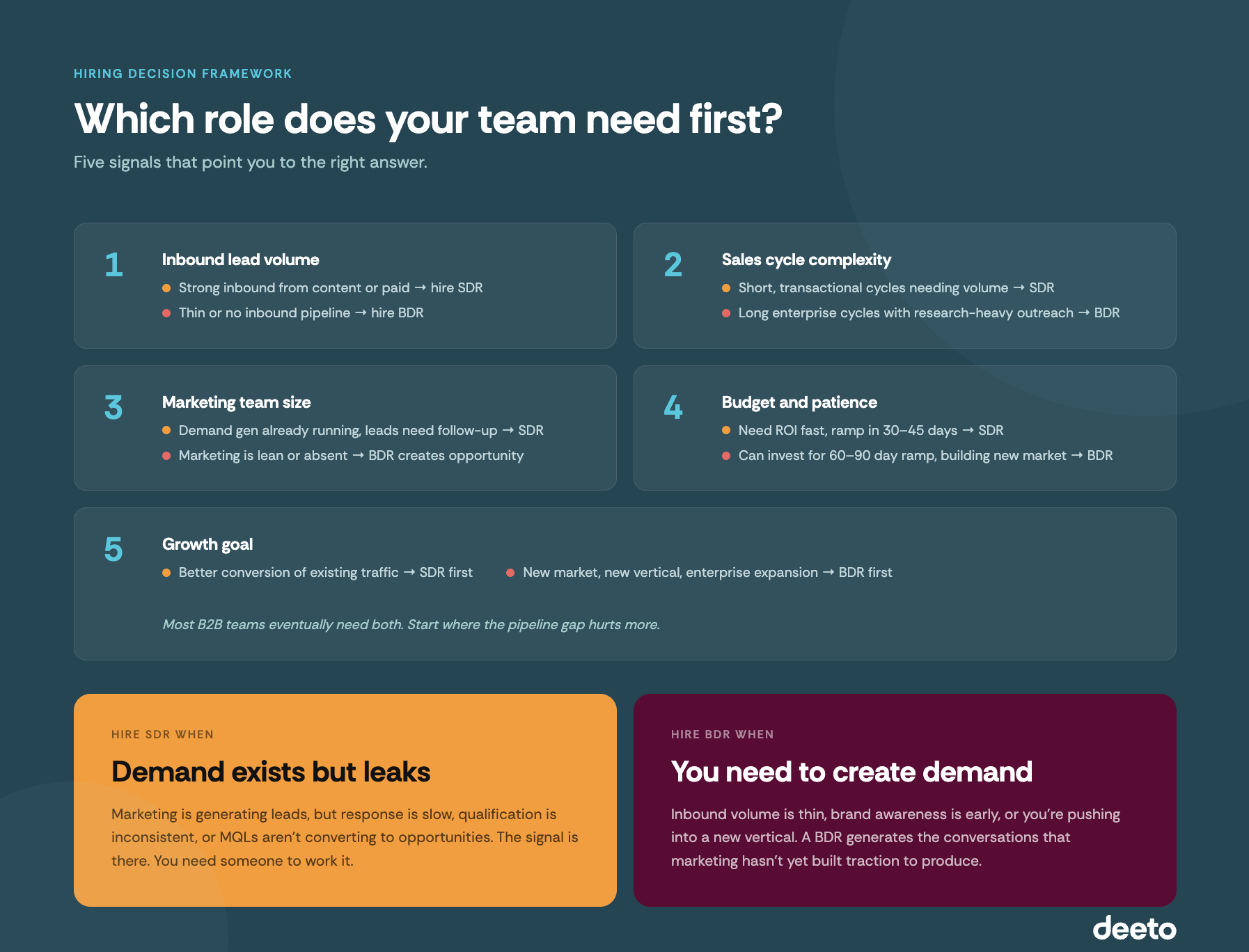
This is the question most people actually want answered. The honest answer: it depends on where your pipeline problem is.
If marketing is already generating leads and they're not getting followed up fast enough or filtered well, hire an SDR. The demand is there. You need someone to work it.
If inbound volume is thin, brand awareness is early, or you're pushing into a new vertical or market, hire a BDR. They'll generate the conversations that marketing can't yet produce.
The following five factors can help sharpen the decision:
- Inbound lead volume. A strong inbound funnel from content, paid media, or a customer advocacy program, points to SDR first. No inbound funnel? BDR.
- Sales cycle complexity. Enterprise deals with long cycles benefit from BDR-style outbound, where research and personalization matter more than speed. Shorter, transactional cycles get more value from SDRs moving high volume quickly.
- Marketing team size. If demand gen is already running, an SDR makes sure leads don't fall through. If marketing is one person or non-existent, a BDR can generate opportunity without needing a pipeline of inbound MQLs to work from.
- Budget and patience. SDRs show faster ROI. BDRs typically take 60–90 days to ramp and start producing pipeline. That's not a knock on BDRs; it's just how outbound works.
- Growth goal. New market, new vertical, enterprise expansion? BDR. Better conversion of existing traffic and inbound? SDR.
Most scaling B2B companies eventually need both. The question is which gap is costing you more right now.
How technology fits in
The tools SDRs and BDRs use are similar but the workflows are different.
CRM is the foundation. Every call, contact update, and handoff to an AE happens inside it. Clean CRM integration matters because pipeline reporting is only as accurate as the data going in.
Sales engagement platforms like Outreach and Salesloft help both roles manage outreach sequences, automate follow-ups, and track what's getting opened and replied to.
Lead enrichment tools like Apollo, ZoomInfo, and Clearbit give BDRs the account data they need to build target lists, and help SDRs flesh out inbound leads before the first call.
Where both roles consistently struggle is knowing what content to send during early conversations. Generic case studies sent cold get ignored. A customer story from the same industry, referencing a challenge the prospect recognizes, is different. Deeto's sales enablement solution surfaces the right customer proof for the right account automatically, inside the rep's existing workflow. No more digging through a shared drive or asking marketing for something that doesn't exist yet!
This matters more than it might seem. Gartner research shows 75% of B2B buyers prefer a rep-free experience. Forrester puts the number at 85% of buyers trusting customers in their industry over any other source. The best early-conversation asset an SDR or BDR can send isn't a pitch deck. It's someone who's been in the prospect's exact situation, talking about what changed.
How AI is changing these roles
81% of sales organizations are either testing or already using AI tools, according to Salesforce's 2024 State of Sales report. That number has been climbing fast, and it's showing up inside the SDR and BDR workflow in concrete ways: lead prioritization, automated first-touch responses, email personalization at scale, call analysis, and AI-built prospect research for outbound sequences.
What AI doesn't change is the underlying skill. Reading a prospect, earning trust in the first two minutes of a call, knowing when to disqualify and move on — those are still human jobs. What changes is how much time reps spend on the parts that don't require them to be human.
The reps getting good results with AI tools aren't treating them as a shortcut to volume. They're using them to prepare better and respond faster, so the conversations themselves are sharper.
Key takeaways
- An SDR qualifies inbound leads from marketing. A BDR creates net-new pipeline through outbound prospecting.
- The core distinction is lead direction: inbound vs. outbound. Everything else follows from that.
- BDRs handle fewer leads with more research per prospect. SDRs handle higher volume with faster qualification cycles.
- Both roles hand off to Account Executives. Neither closes deals.
- SDRs show faster ROI. BDRs take longer to ramp but are the right call for new markets and thin-inbound environments.
- Most B2B teams eventually need both. Start with whichever gap is costing you more pipeline today.
FAQ
What is the difference between an SDR and a BDR?
An SDR qualifies inbound leads — people who have already engaged with your marketing in some way. A BDR generates outbound pipeline by reaching out to prospects who haven't engaged yet. SDRs respond to existing interest. BDRs create new interest from scratch. Both hand off qualified opportunities to Account Executives rather than closing deals themselves.
Which is more senior — SDR or BDR?
It depends on the company. Some treat BDR as more senior because cold outreach requires more self-direction and resilience than qualifying warm leads. Others use the titles interchangeably or position SDR as the more advanced role. What matters more than the title is whether the rep is working inbound or outbound. That distinction shapes the skills, KPIs, and career path.
Can one person do both SDR and BDR?
Yes, and many early-stage companies run it this way. A single rep handling both inbound qualification and outbound prospecting is practical when headcount is limited. The tradeoff is focus; the two jobs require different daily rhythms, and combining them tends to dilute both over time. As the team grows, separating the roles typically improves output in both directions.
What are typical SDR and BDR salaries?
In the US, SDR base salaries typically run $50,000–$65,000 with $15,000–$25,000 in variable. BDR base salaries tend to be slightly higher at $55,000–$70,000 with $20,000–$35,000 variable since outbound is harder to ramp and involves more rejection. Both ranges vary by company stage, geography, and industry.
Do SDRs or BDRs report to sales or marketing?
SDRs frequently report to marketing or a shared sales development function, because their work is tied to marketing-generated lead flow. BDRs typically report to sales or revenue leadership, because their output is outbound pipeline. In practice, both roles sit at the boundary between marketing and sales, which is exactly why getting the reporting line right matters.
When should I hire an SDR vs a BDR first?
Hire an SDR first if you have solid inbound volume and leads aren't getting followed up quickly or filtered well. Hire a BDR first if inbound volume is low, brand awareness is early, or you're trying to break into a market where marketing hasn't yet built traction. If both are problems, prioritize the gap that's costing you more pipeline today.
Conclusion
SDR vs BDR isn't really a debate about titles. It's a question about where your pipeline comes from and who owns getting it there.
SDRs convert existing interest. BDRs create new interest. Both matter. The sequencing question (which one to hire first), comes down to where the gap in your pipeline actually is.
Once reps are in the field, the quality of what they send to prospects matters as much as how many times they reach out. Deeto helps SDRs and BDRs show up with the right customer proof for the right account, without digging for it manually. See how it works.
🎉 Save your spot
Register for the event
Once your spot is secured, we’ll send your confirmation details.
Subscribe to our newsletter
Subscribe to receive the latest blog posts to your inbox every week.
By subscribing, you agree to our Privacy Policy
Subscribe to our newsletter
Get the latest news and updates from our team.
By subscribing, you agree to our Privacy Policy
Related posts

How to Use Sentiment Analysis to Improve Customer Experience

What is sentiment analysis? Learn how it compares to NPS, where it catches churn, and how to put it to work.

Call Intelligence Software That Spots Your Next Reference
What is call intelligence software? Learn how it scores every call automatically and surfaces advocacy-ready customers.

4 Ways To Leverage Social Proof In Marketing
What is social proof in marketing? Learn 4 ways to use reviews, stories, and advocacy to build buyer trust.