


Voice of the Customer Examples: How B2B Teams Put VoC to Work



Monday, November 9, 2026


Voice of the Customer Examples: How B2B Teams Put VoC to Work


View the podcast on Youtube

You’ve collected feedback from your customers, now what do you do with it?
Voice of the customer examples show how teams turn what customers say into something the business uses: a story sales can send, a roadmap decision, a renewal save. The best examples share one trait. Customer input reaches the person who needs it while the decision is still open.
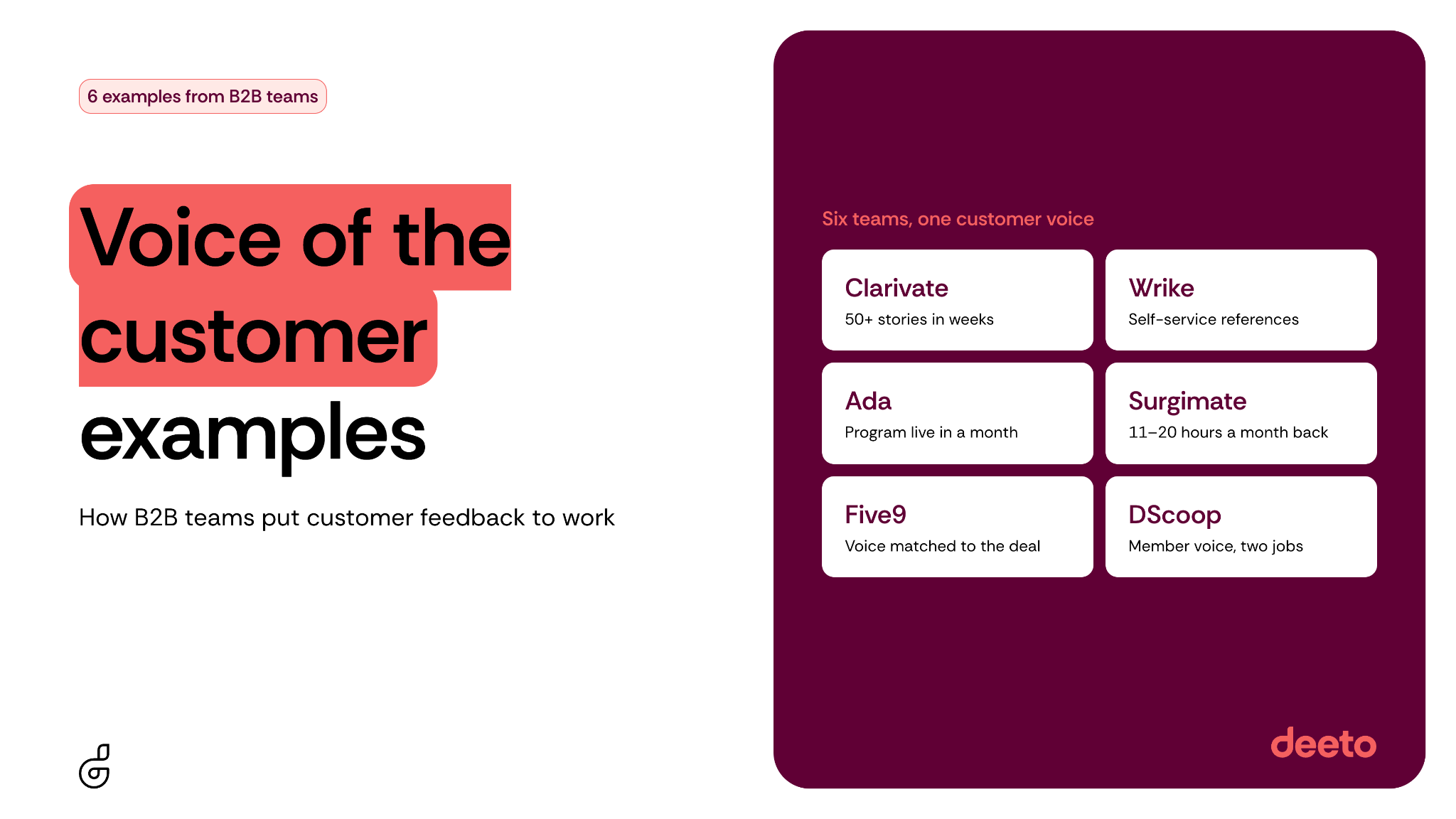
Here are six examples from Deeto customers, Clarivate, Wrike, Ada, Surgimate, Five9, and DScoop, with what each team did and what you can copy.
What counts as a voice of the customer example?
A voice of the customer example is a specific case where a team captured customer input and used it to change an outcome. Survey results sitting in a dashboard don't count. A customer interview that becomes a case study, a reference call that closes a deal, or member feedback that changes what a team builds next does.
If you need the fundamentals first, start with our guide to what voice of the customer is. This article skips the definitions and goes straight to how VoC looks in practice.
Each example follows the same path. A customer says something specific, like "onboarding took half the time we budgeted" or "your support team knew our setup better than we did." One team picks it up and puts it to work, whether that's customer marketing turning the comment into a case study or sales asking that customer to take a reference call. Then something changes that the team can point to. In four of the examples below, that's a published number: stories produced, reference pool growth, or hours saved. In the other two, it's a specific change in how the team works.
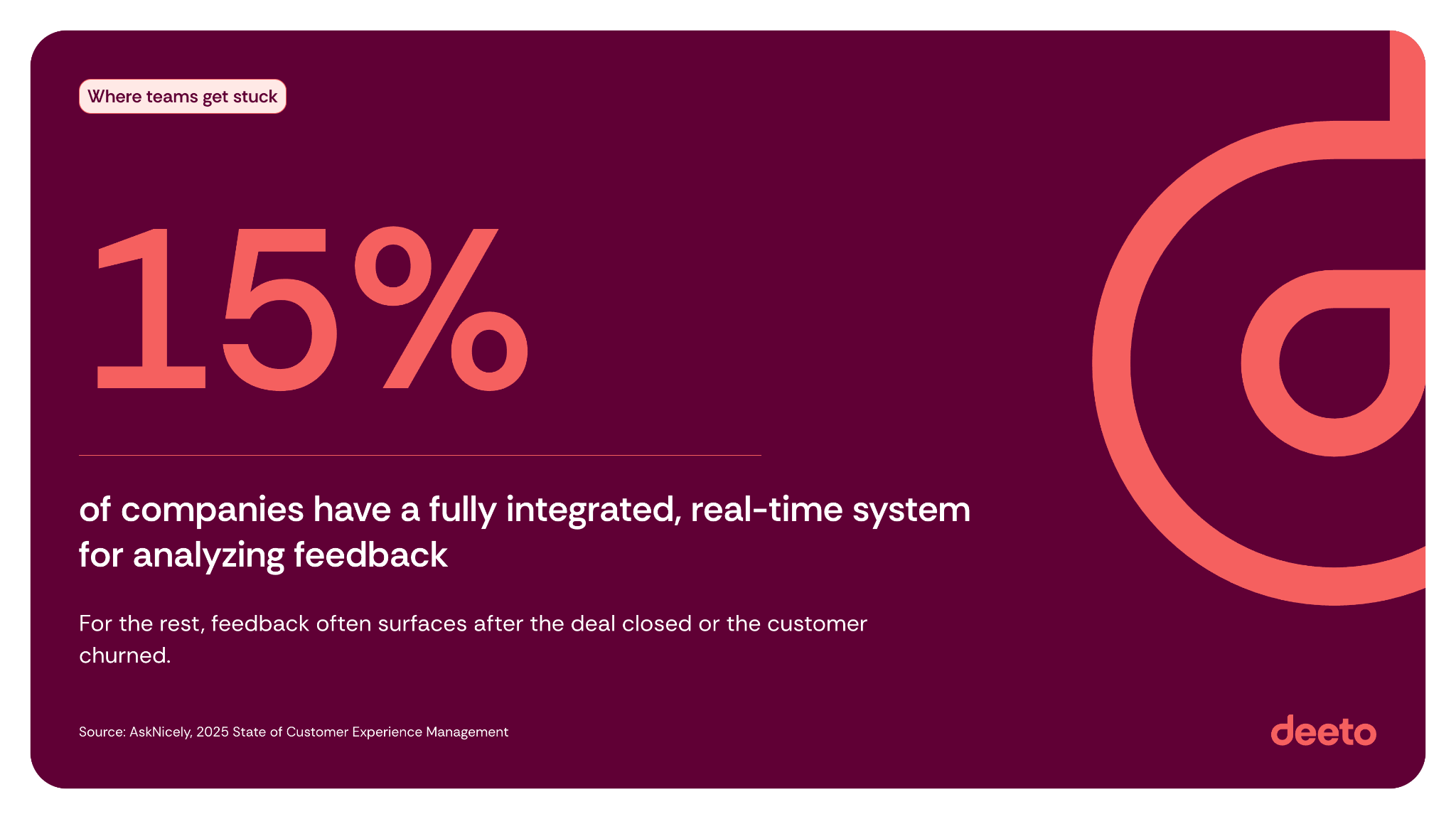
Most teams get stuck at the handoff. The quote sits in a CSM's call notes or a survey export, and the PMM writing launch messaging or the rep prepping for a final call never sees it. According to AskNicely's 2025 State of Customer Experience Management report, only 15% of companies have a fully integrated, real-time system for analyzing feedback. That leaves 85% without a real-time view of what customers are telling them, so feedback often surfaces after the deal closed or the customer churned.
6 voice of the customer examples from B2B teams
1. Clarivate turns customer invitations into 50+ stories in weeks
Clarivate needed a more effective way to expand its pool of customer references, and the systems it used to collect and approve customer content were fragmented.
The team used Deeto's reference management and prospect-reference engagement features to make inviting customers to share their experiences simple. Collection was automated and approvals were streamlined, so a customer's yes turned into a usable asset instead of an email thread.
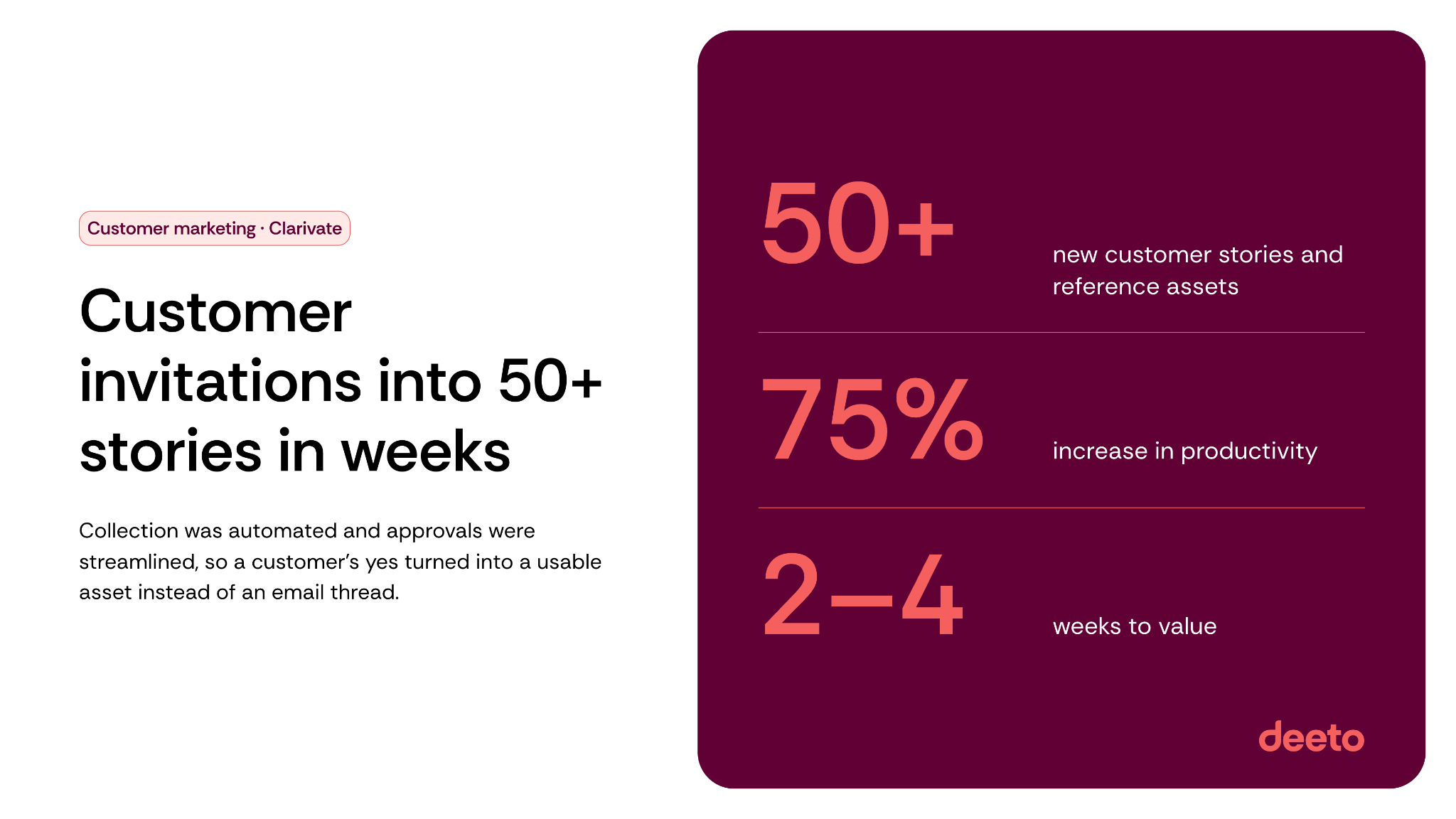
Clarivate produced 50+ new customer stories and reference assets within weeks, saw a 75% increase in productivity, and reached time to value in two to four weeks.
What to copy: Treat every customer conversation as a story pipeline. The customer who tells you onboarding took half the expected time is your next case study candidate. Deeto's stories and social proof use case is built around exactly this handoff.
2. Wrike replaces spreadsheets with a self-service reference database
Wrike relied on spreadsheets that made it hard to respond to reference requests quickly. Its most-used advocates were also showing signs of fatigue from being asked too often.
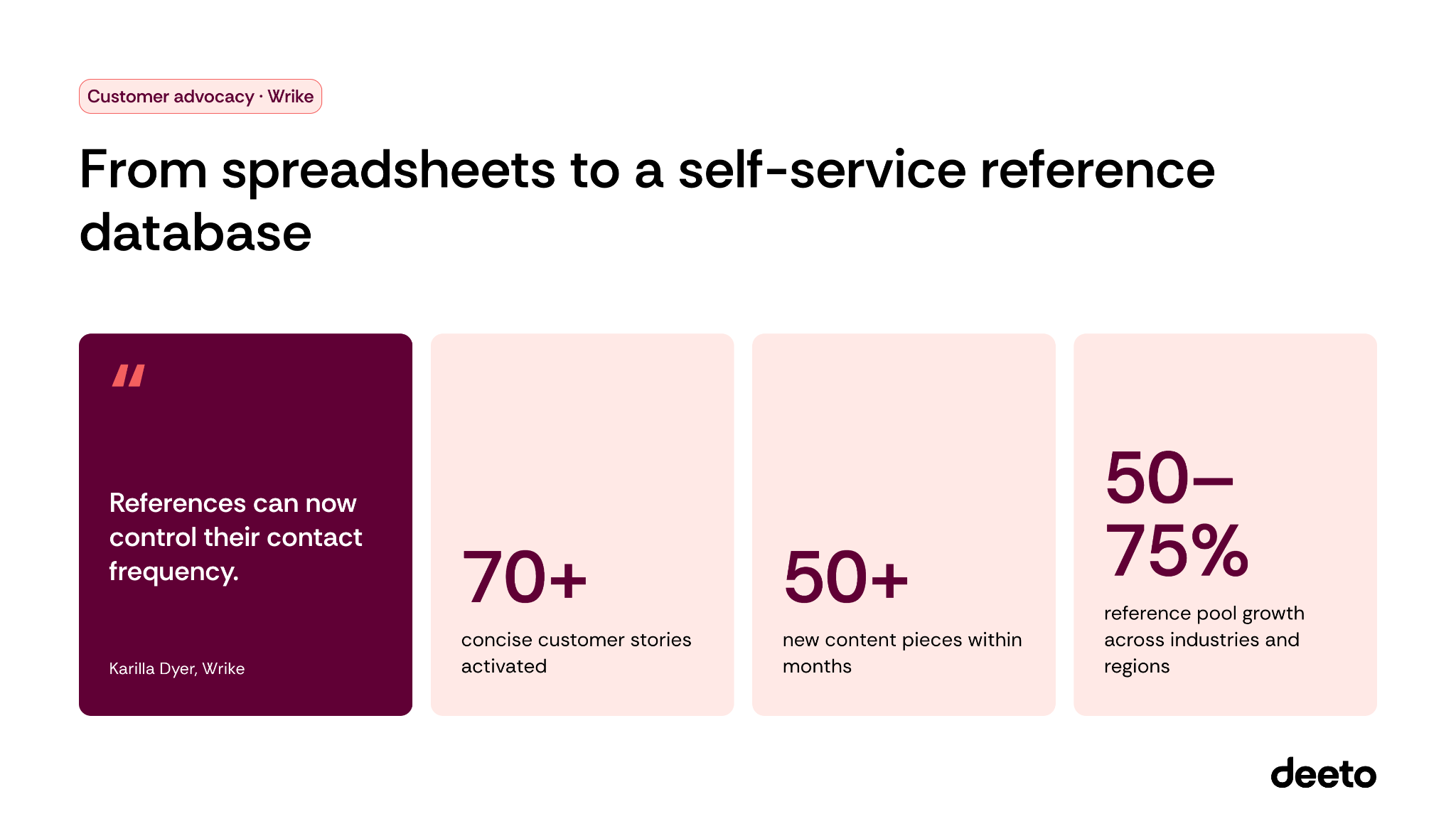
Wrike replaced the spreadsheets with a centralized, self-service reference database in Deeto. Sales and marketing can now source, match, and schedule reference calls on their own. As Karilla Dyer at Wrike put it, references "can now control their contact frequency."
The result was 70+ concise customer stories activated as sales and marketing assets, 50+ new content pieces within months, and 50 to 75% growth in the reference pool across industries and regions. For a full breakdown, see our write-up of customer advocacy success stories.
What to copy: Voice of the customer is also about consent. Letting customers set their own participation level keeps the voice authentic, and it's why Wrike's pool grew instead of burning out.
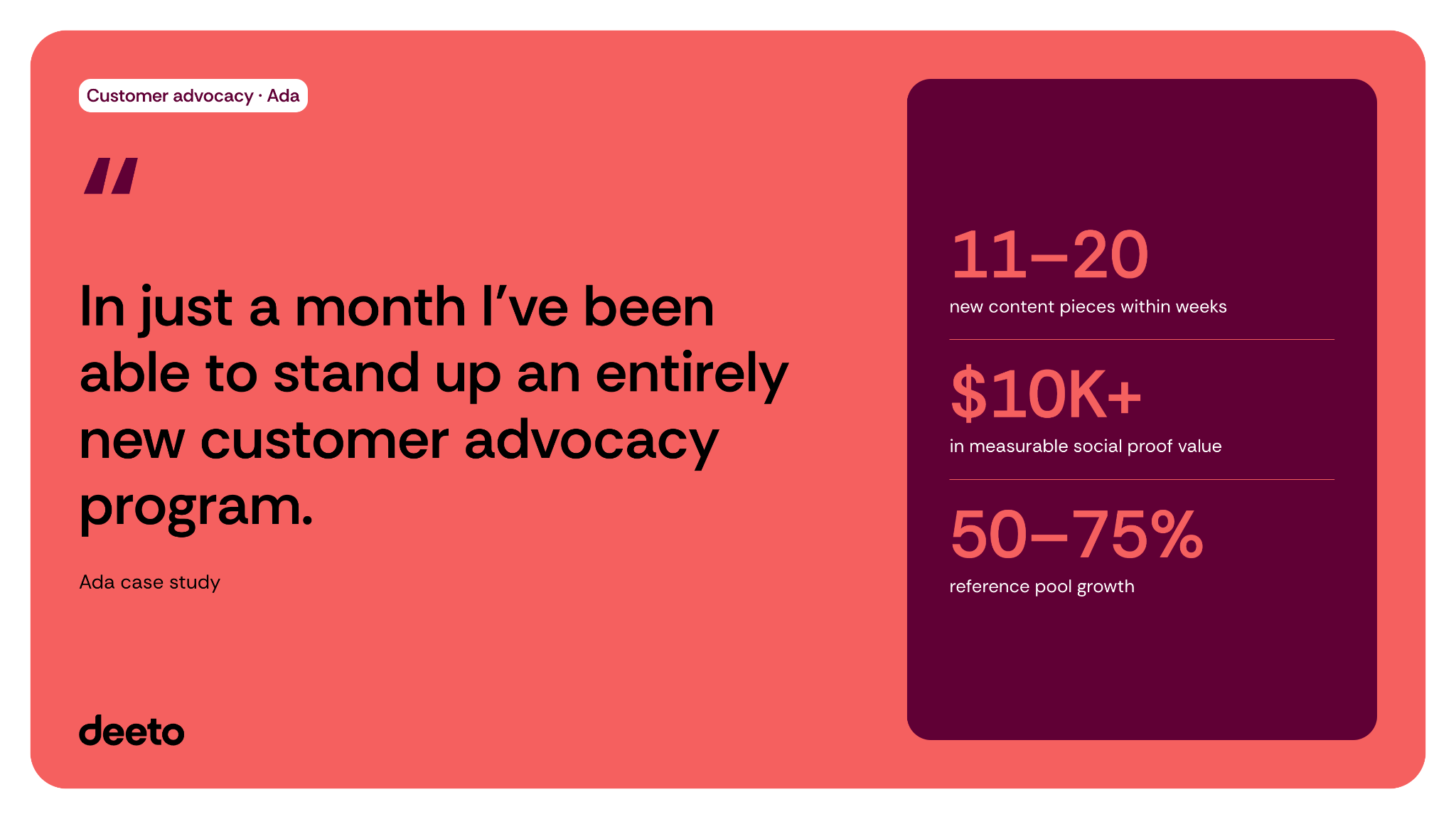
3. Ada stands up an advocacy program in a month
Ada's advocacy work was stuck in spreadsheets, manual scheduling, and untracked reference calls. Customer voice existed, but there was no reliable way to capture it or reuse it.
Ada centralized all advocate data in Deeto and simplified how it invites customers to share their experiences. Within weeks, Ada had 11 to 20 new content pieces, more than $10,000 in measurable social proof value, and 50 to 75% growth in its reference pool. Ada's case study sums it up in one line: "In just a month I've been able to stand up an entirely new customer advocacy program."
What to copy: Track every reference call. An untracked call is customer voice you can't reuse, and it's the fastest way to over-ask your best advocates without knowing it.
4. Surgimate gets 11 to 20 hours a month back
As Surgimate grew, keeping customer references and testimonials centralized got harder. Requests, approvals, and assets were spread across fragmented workflows.
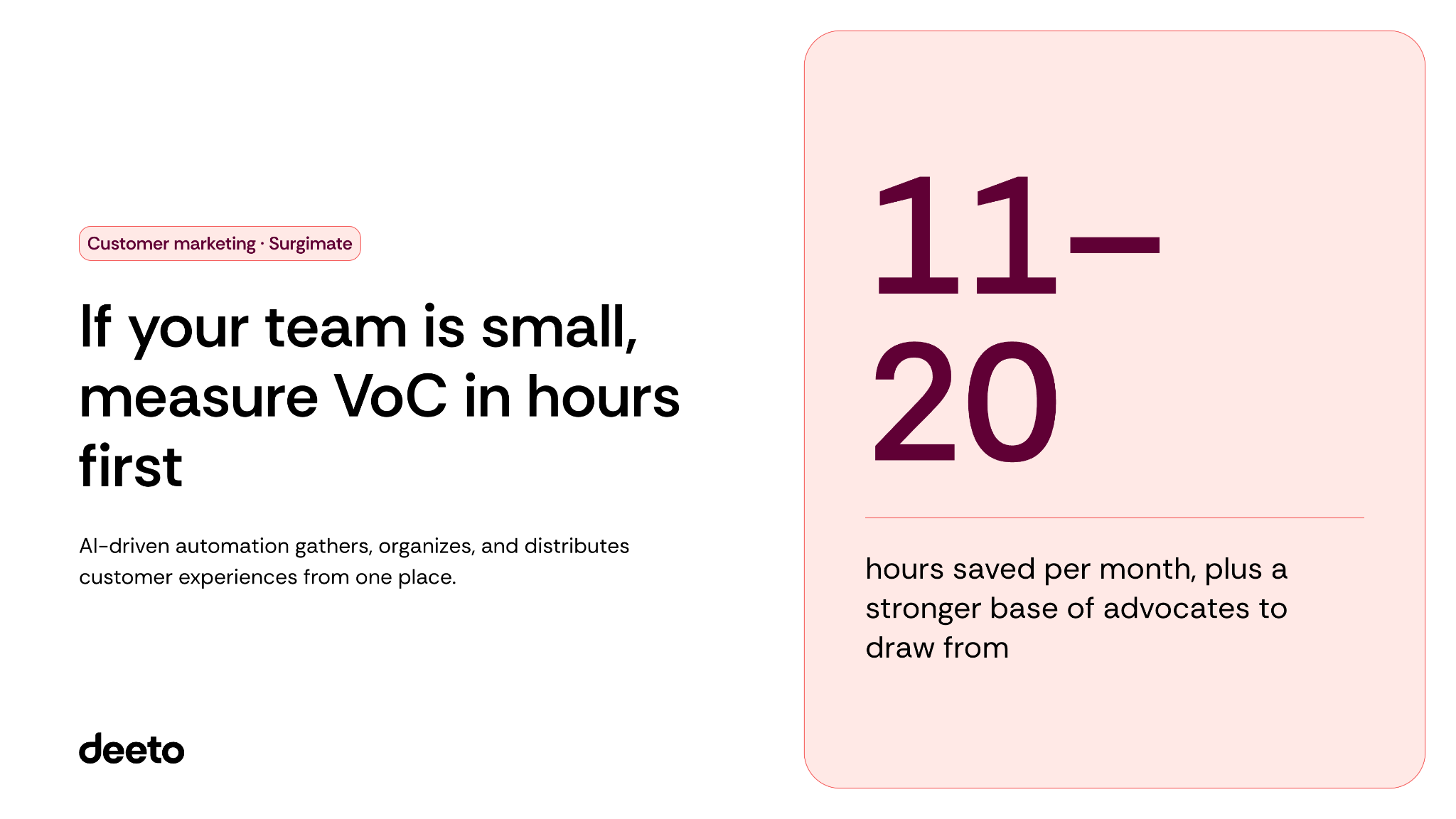
Surgimate used Deeto's AI-driven automation to gather, organize, and distribute customer experiences from one place. The team saves 11 to 20 hours per month and has built a stronger base of advocates to draw from.
What to copy: If your team is small, measure VoC in hours first. Automating the repetitive steps with lifecycle automation frees the time to actually use what customers tell you.
5. Five9 matches the right customer voice to the right deal
At Five9, the customer experience team led by Jennifer Edwards, VP of Customer Experience, uses Deeto to find advocates, match them with sellers working active deals, and recognize those customers for their time.
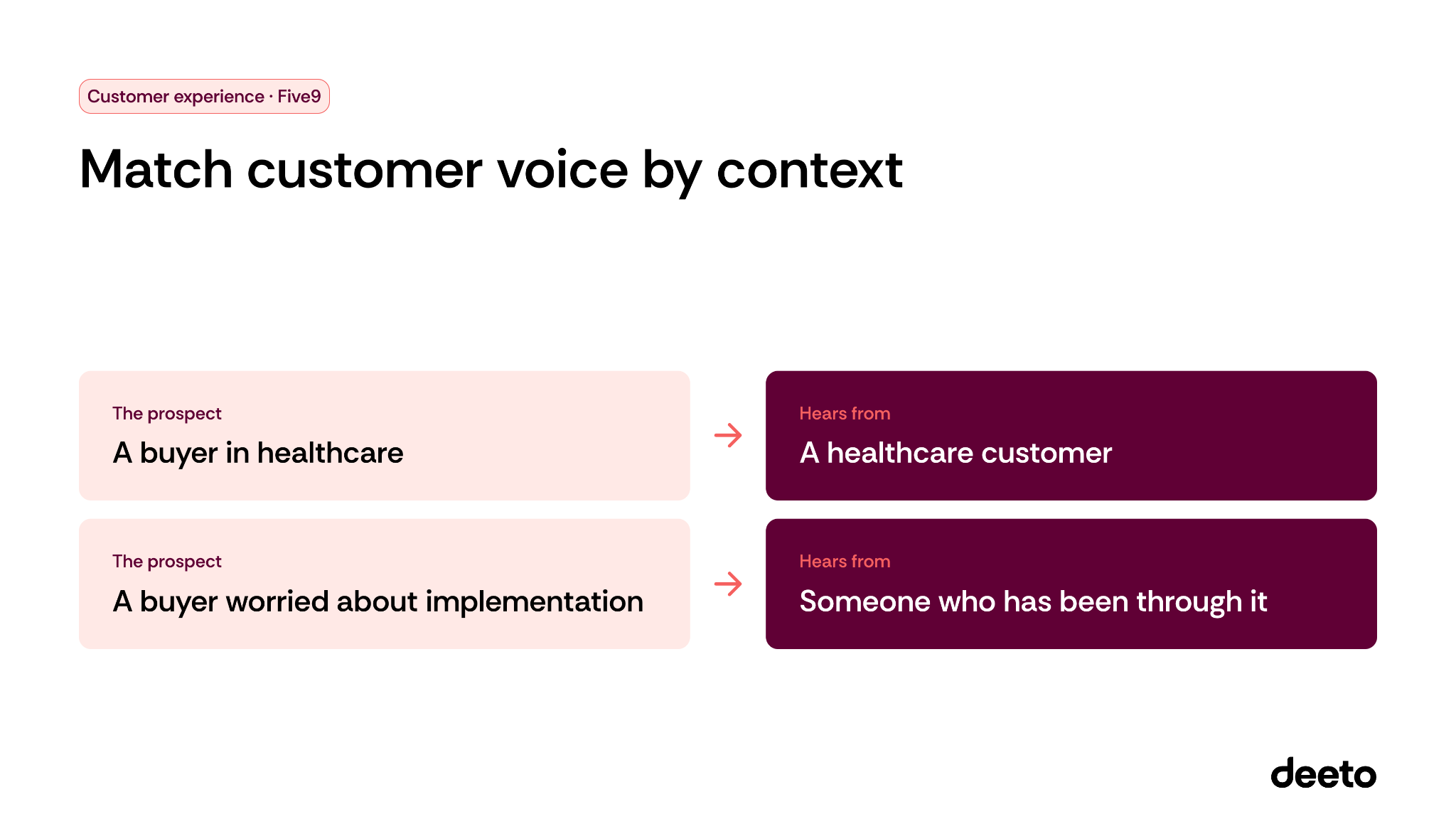
The change here is in how deals run, not a published number. A prospect in healthcare hears from a healthcare customer. A buyer worried about implementation hears from someone who has been through it.
What to copy: Match customer voice by context. Reference management works best when matching happens on industry, use case, and buyer concern.
6. DScoop uses member voice to decide what to act on
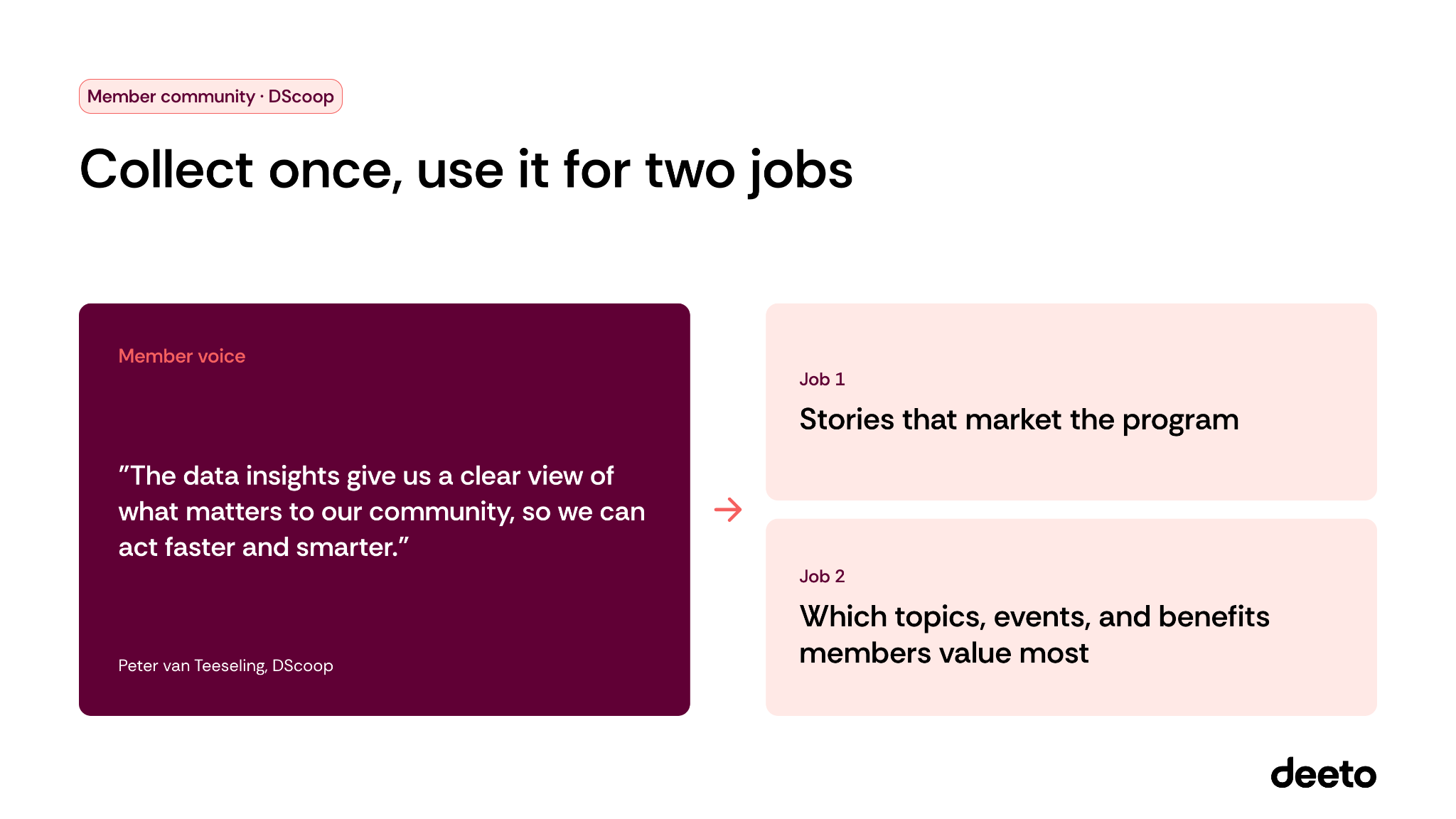
DScoop is a member community, so its "customers" are members. The team uses Deeto to highlight member voices and to read the data behind them. Peter van Teeseling at DScoop put it this way: "The data insights give us a clear view of what matters to our community, so we can act faster and smarter."
What to copy: Use the same customer voice twice. The stories that market your program also tell you which topics, events, and benefits customers value most. Lean teams get more from VoC by collecting once and using it for both.
VoC examples at a glance
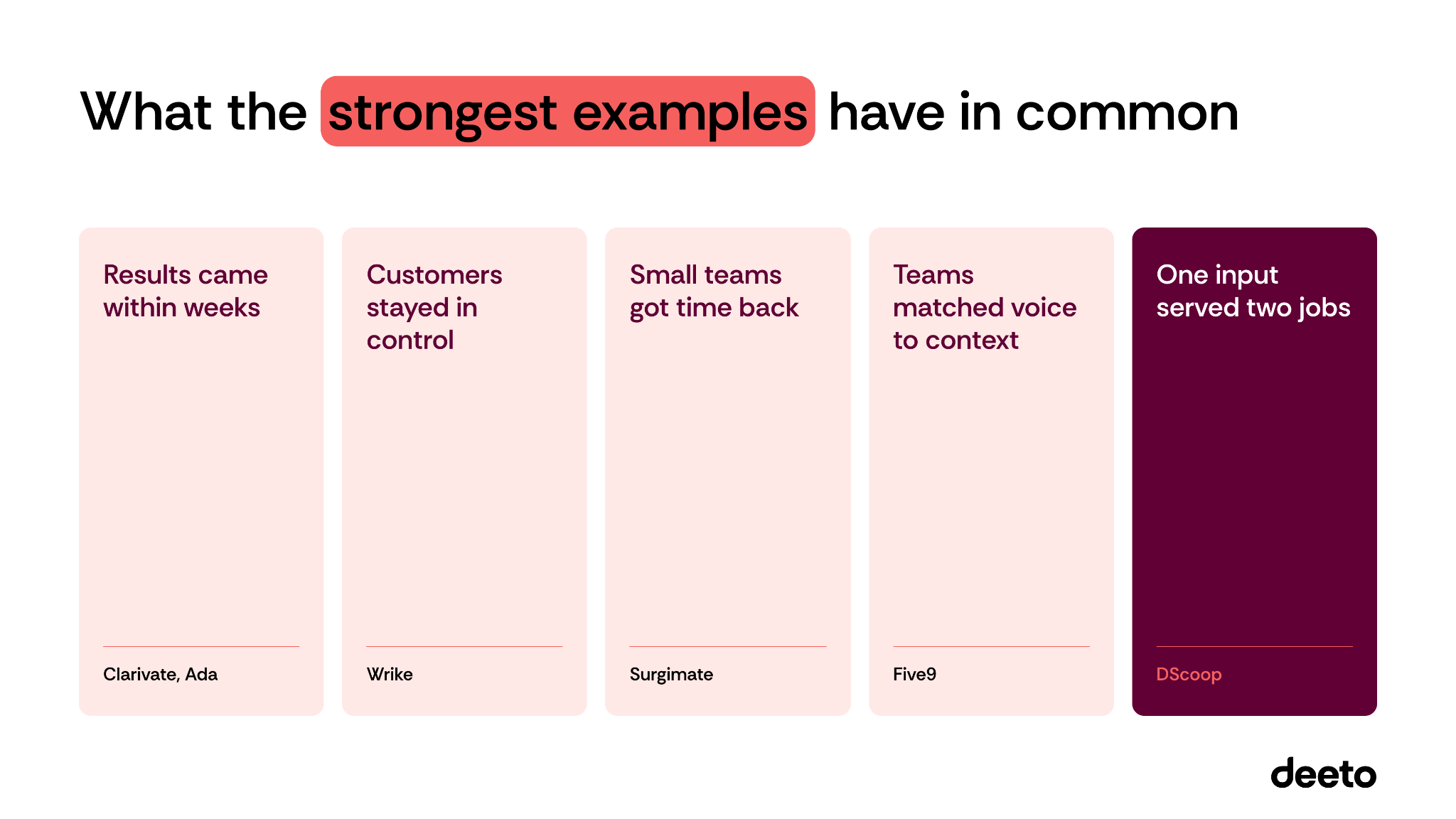
What the strongest VoC examples have in common
Look across these six cases and a few patterns stand out.
- Results came within weeks. Clarivate reached time to value in two to four weeks, and Ada stood up a full program in a month.
- Customers stayed in control. Wrike let references set their own contact frequency, and its pool grew 50 to 75%.
- Small teams got time back. Surgimate saves 11 to 20 hours a month by automating the repetitive steps.
- Teams matched voice to context. Five9 pairs customers with deals based on fit.
- One input served two jobs. DScoop's member voices feed both its marketing and its decisions about what to act on.
Customer feedback only creates value once it reaches a decision.
That matters more as buyers rely less on vendor claims. TrustRadius' 2026 B2B Buying Disconnect report found that 74% of tech buyers use reviews to inform purchase decisions. Buyers want to hear from people like them. Teams that operationalize customer voice can give them that at every stage, from the first website visit to the final reference call.
How to choose which example to copy first
You don't need all six at once. Pick the one closest to your biggest current pain.
- You're the bottleneck for every reference request. Copy Wrike and make references self-service.
- Marketing is short on fresh proof. Copy Clarivate and turn customer invitations into a story pipeline.
- You're starting from spreadsheets. Follow Ada and centralize advocate data before anything else.
- Your team is one or two people. Start where Surgimate did and automate the repetitive steps.
- Reps get references that don't fit the deal. Use the Five9 model and match on industry and buyer concern.
- You're not sure which customer voices matter most. Do what DScoop did and read the data behind the stories.
Once you've picked a starting point, our guide on how to build a voice of the customer program covers who should own it, a 90-day rollout plan, tooling and budget, and the governance that keeps it running. SaaS teams can also use our voice of the customer strategy for SaaS for a version built around recurring revenue.
How Deeto connects customer voice to every team
Every team above hit the same wall before anything worked. Feedback lived in one place, stories in another, and references in a spreadsheet. Wrike and Ada were running on spreadsheets. Clarivate and Surgimate were working across fragmented systems. Nobody outside the team that collected the customer's words could find them, let alone use them.
Deeto is the layer that turns what customers say into intelligence and routes it to the people who need it. A comment from an AI-led customer interview becomes a tagged story, an updated reference profile, and a signal about what customers care about, all in one voice of the customer platform. Then it shows up where people already work, through integrations with the CRM, Slack, and enablement tools.
For the customer marketing or advocacy leader, that means one system for references, stories, and feedback instead of three tools and a queue of Slack requests. For the CMO above them, it means customer proof they can tie to pipeline. Deeto customers see 20 to 30% faster sales cycles and 10 to 15% higher win rates when sales teams have customer proof in the deal.
Key takeaways
- A voice of the customer example is a case where customer input changed an outcome you can name.
- The fastest examples produced results within weeks. Clarivate created 50+ stories and reference assets, and Ada launched a full program in a month.
- Letting advocates control their own contact frequency helped Wrike grow its reference pool 50 to 75% without burning customers out.
- Small teams can measure VoC in hours first. Surgimate saves 11 to 20 hours a month.
- One system for feedback, stories, and references lets customer marketing serve sales, CS, and leadership at once.
FAQs
What are some examples of voice of the customer?
Common voice of the customer examples include turning customer interviews into case studies, matching customer references to active deals, letting advocates set their own contact frequency, and using member feedback to decide what to act on. Clarivate, for example, used Deeto to create 50+ customer stories and reference assets within weeks.
What is a voice of the customer example in B2B?
In B2B, it's a case where feedback from business customers changes a revenue, product, or retention decision. Five9 uses Deeto to match advocates with sellers on active deals. A prospect hears directly from a customer with a similar use case, which builds trust faster than vendor messaging.
How do customer marketing teams use voice of the customer?
Customer marketing teams use voice of the customer to build the proof the rest of the company relies on. That includes case studies, reviews, testimonials, and reference calls. Wrike's team, for example, turned customer voice into 70+ concise stories and grew its reference pool 50 to 75% after moving off spreadsheets.
How do sales teams use voice of the customer data?
Sales teams use voice of the customer data as proof during deals. That includes customer stories, reviews, and live reference calls matched to the prospect's industry and concern. The most effective teams make this proof self-service, so reps can find a relevant customer without waiting on marketing or advocacy teams.
What's the difference between voice of the customer examples and customer success stories?
A customer success story is one output of a voice of the customer program. Voice of the customer covers the full loop: capturing feedback, analyzing it, and acting on it across teams. A success story shows the result for one customer, while a VoC example shows how a team used customer input to change a decision.
Conclusion
The examples that work share one thing. The customer's words reach the person making the decision, while the decision is still open. Clarivate produced 50+ stories and reference assets in weeks. Wrike and Five9 put the right customer in front of the right buyer. Ada went from spreadsheets to a working advocacy program in a month, and Surgimate got 11 to 20 hours a month back.
What set them apart was the connection between feedback and action.
If your customer feedback is still scattered across surveys, spreadsheets, and CSM notes, see how Deeto works and how it puts authentic customer voice into every team's workflow.
🎉 Save your spot
Register for the event
Once your spot is secured, we’ll send your confirmation details.
Subscribe to our newsletter
Subscribe to receive the latest blog posts to your inbox every week.
By subscribing, you agree to our Privacy Policy
Subscribe to our newsletter
Get the latest news and updates from our team.
By subscribing, you agree to our Privacy Policy
Related posts

7 Best Influitive Alternatives & Competitors in 2026

Compare 7 Influitive alternatives & competitors and see which one fits your customer advocacy program.

5 Stages of a Customer Journey Marketing Funnel
What is a customer journey marketing funnel? Learn the five stages, the metrics for each, and how proof connects them.

Best Customer Reference Management Software in 2026
Compare 8 customer reference tools for 2026. See features, pricing, and what sales reps need to find references fast.


