


Best Customer Reference Management Software in 2026



Monday, November 2, 2026


Best Customer Reference Management Software in 2026


View the podcast on Youtube

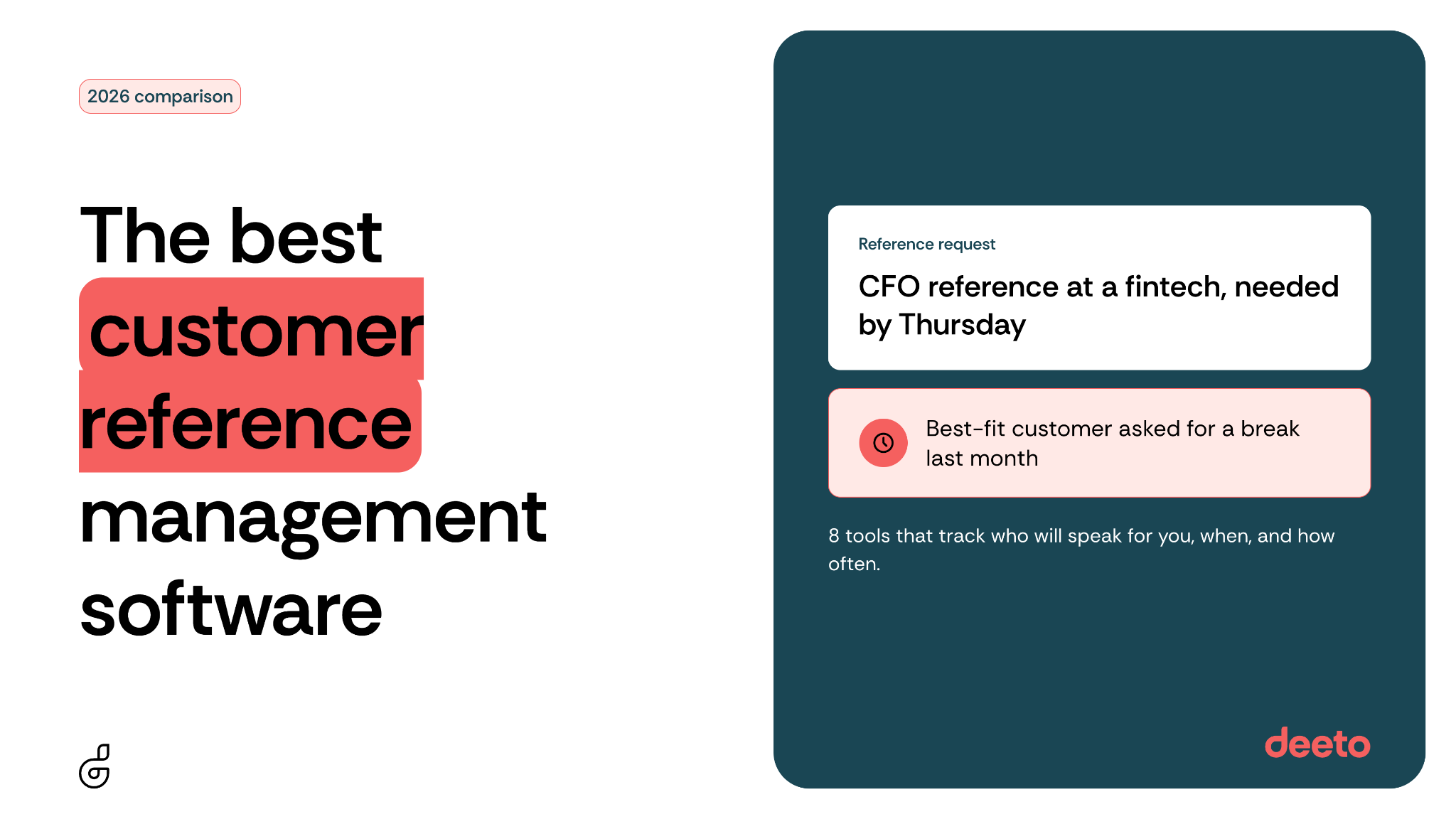
A rep needs a CFO reference at a fintech by Thursday, and the customer who fits best asked for a break last month.
The best customer reference management software in 2026 includes Deeto, Point of Reference (ReferenceEdge), Upland RO Innovation, UserEvidence, SlapFive, Base, Orca, and Influitive. These tools track which customers will speak for you, when, and how often, then match the right one to an open deal.
This guide includes a side-by-side comparison chart, what each tool does best, and how to choose.
What is customer reference management software?
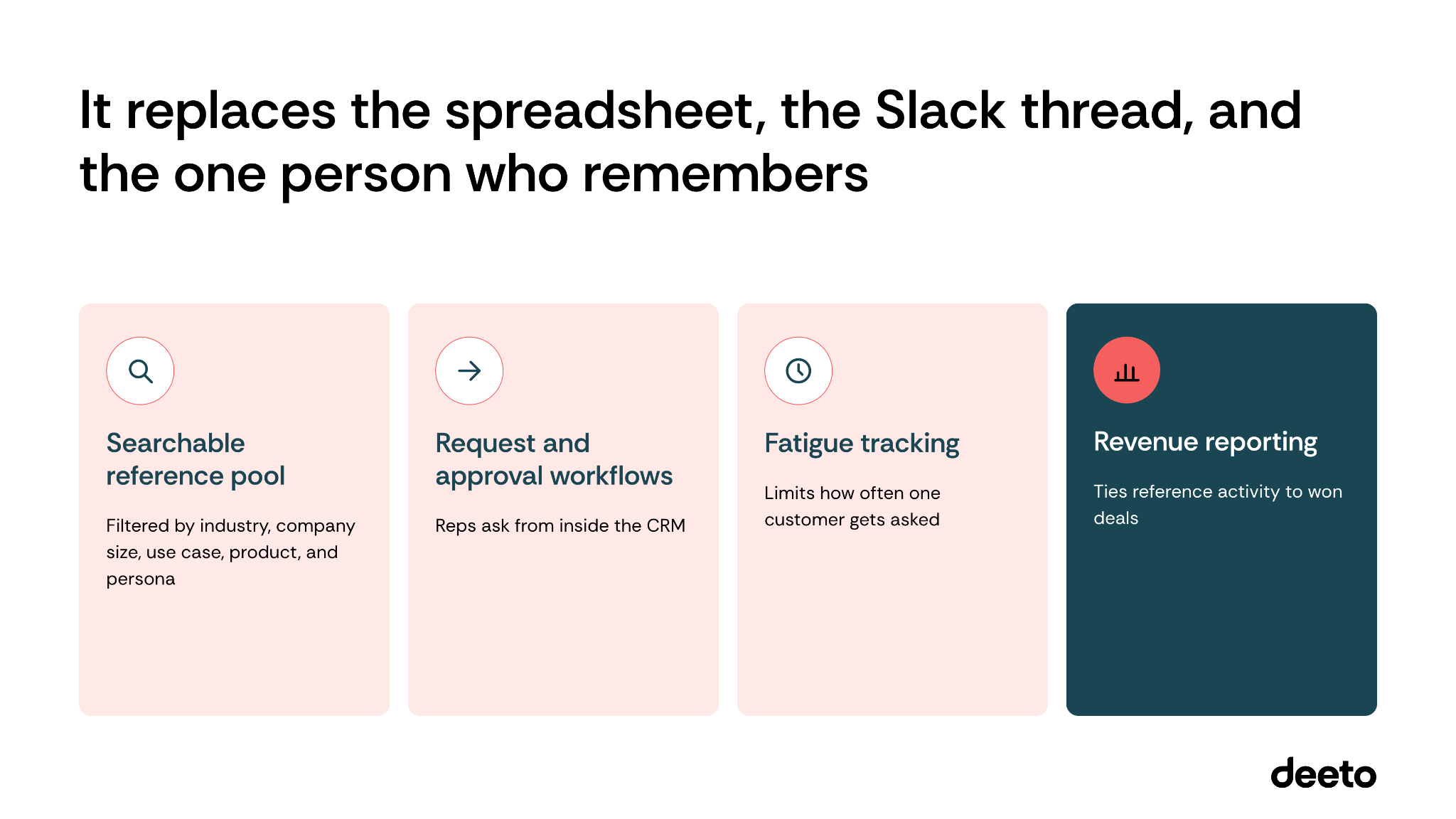
Customer reference management software is a platform that stores your reference-ready customers, routes requests from sales, protects those customers from overuse, and reports on which references influenced revenue. For customer marketing teams, it replaces the spreadsheet, the Slack thread, and the one person who remembers which customer said yes last quarter.
Customer reference tools include the following core pieces:
- A searchable reference pool filtered by industry, company size, use case, product, and persona
- Request and approval workflows that let reps ask from inside the CRM
- Fatigue tracking that limits how often one customer gets asked
- Revenue reporting that ties reference activity to won deals
One warning before you shop. Software directories lump very different products into this category. Capterra's customer reference management category mixes true reference platforms with loyalty programs, referral tools, and a general CRM. A referral tool rewards customers for sending you leads. A reference platform puts a real customer on the phone with a prospect who is about to sign. Those are different jobs.
Why reference programs outgrow spreadsheets
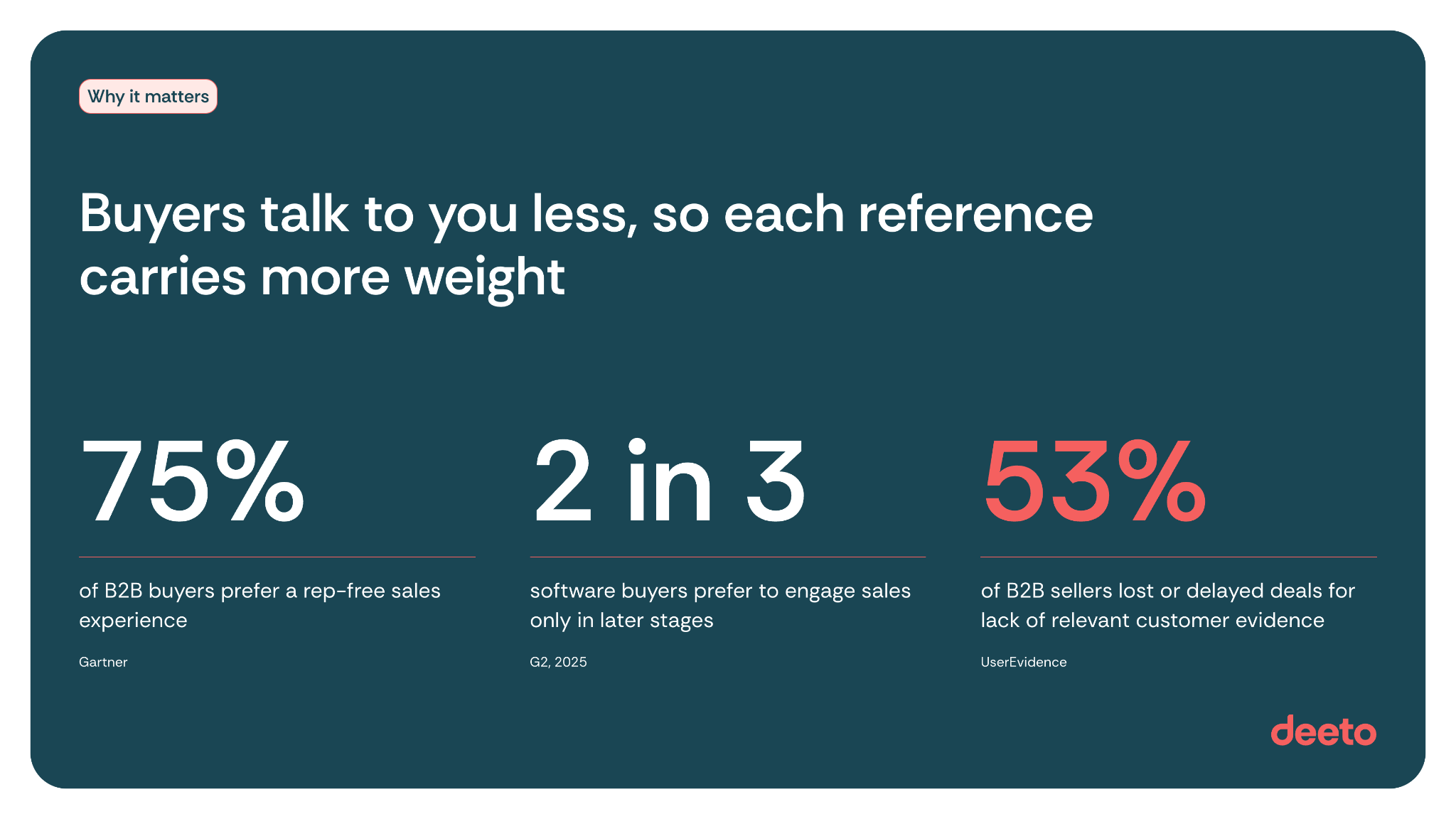
Buyers want to do more of the work on their own. Gartner reports that 75% of B2B buyers prefer a rep-free sales experience. G2's 2025 research found that nearly two-thirds of software buyers prefer to engage sales only in the later stages of a purchase.
That shift puts more weight on the few moments when a buyer does talk to you. By the time a prospect asks to speak with a customer, they're close to a decision. A slow or mismatched reference at that point can stall a deal that marketing spent months creating.
The cost of getting this wrong is measurable. UserEvidence research found that 53% of B2B sellers have lost or delayed deals because they couldn't provide relevant customer evidence when it counted. At Deeto, we rarely see companies short on happy customers. The shortage is current information about who is willing to talk, about what, and how recently they were asked.
A reference is only as good as the last time you asked the customer how they feel. That's the gap a spreadsheet can't close, and it's the first thing to test in any demo.
What sales reps need from customer reference management software
Customer reference management software for sales reps has one job: get the right customer in front of a buyer before momentum fades. Program dashboards matter to customer marketing. Reps care about speed and fit.
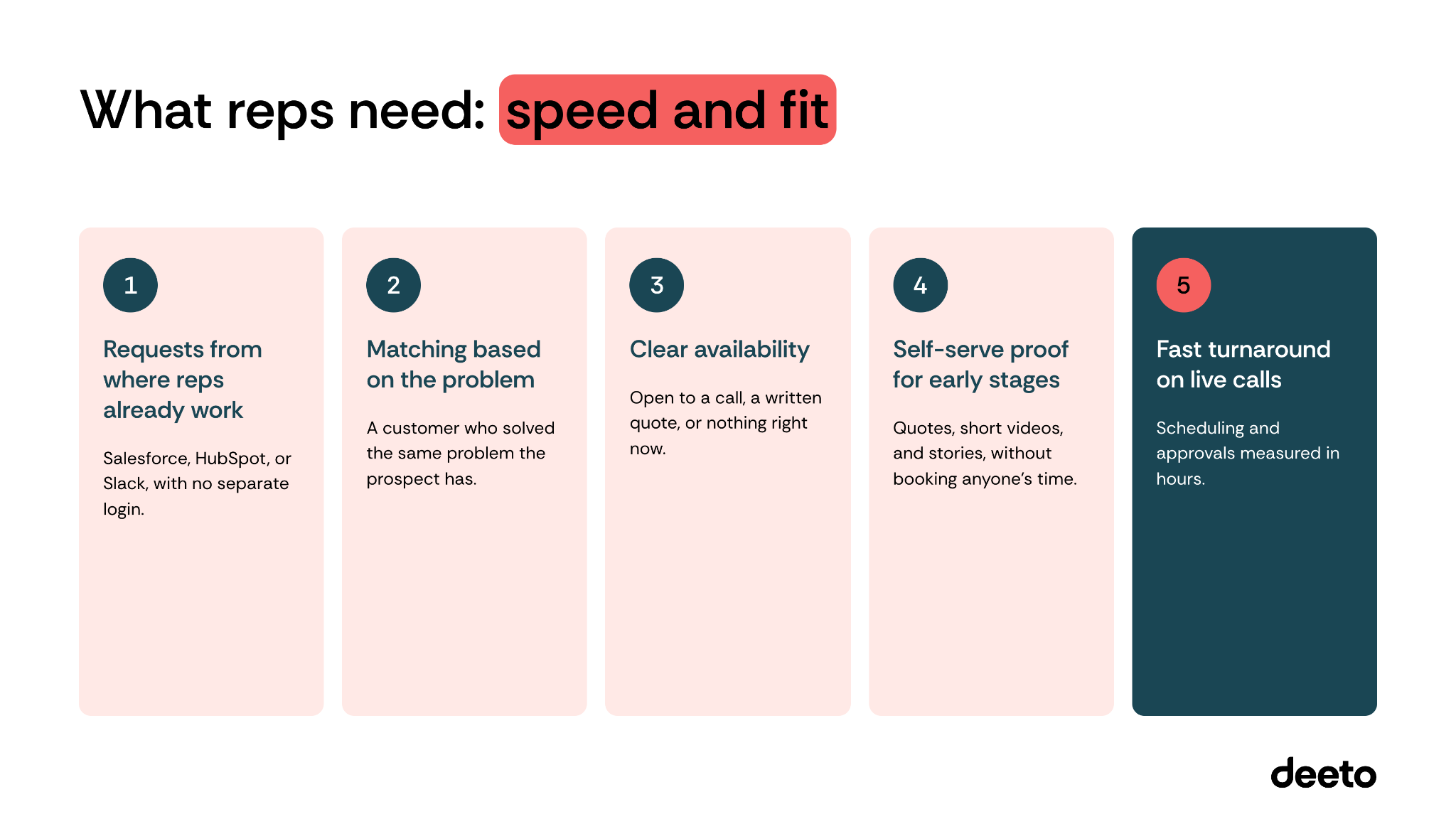
When you evaluate tools from the rep's side, look for these five things:
- Requests from where reps already work. Salesforce, HubSpot, or Slack, with no separate login to remember.
- Matching based on the problem, not just the profile. Industry and size are table stakes. The better match is a customer who solved the same problem the prospect is trying to solve.
- Clear availability. Reps should see whether a customer is open to a call, a written quote, or nothing right now.
- Self-serve proof for early stages. Quotes, short videos, and stories that a rep can share without booking anyone's time.
- Fast turnaround on live calls. Scheduling and approvals measured in hours.
If reps still have to email customer marketing to find out who's available, the tool has missed the point. Deeto's sales and sales enablement solution was built around that handoff, with references pre-matched to deal stage and delivered through CRM workflows.
How we evaluated these customer reference tools
We looked at each vendor's own product pages, recent company announcements, and public directory listings.
We compared tools on five criteria:
- Where reps request references (CRM, Slack, standalone app)
- How matching works (manual filters versus AI or signal-based matching)
- Fatigue and consent controls
- Proof beyond live references (stories, quotes, video, reviews)
- Pricing transparency
None of these vendors publish full pricing on their websites, except where noted. Treat any number as a starting point for a quote.
Customer reference tools comparison chart
The 8 best reference management tools in 2026
1. Deeto
Deeto is a voice of the customer platform that treats references as one outcome of knowing your customers well. The same customer voice also feeds product teams, executive dashboards, and the rest of go-to-market, which makes Deeto the intelligence layer that references come out of, rather than one more point tool. Deeto captures willingness, comfort level, and boundaries directly from customers through AI-led interviews, then uses those signals to match references to buyers. You can see how it works on the reference management use case page.
Reps get references pre-matched to deal stage, plus buyer-ready proof like video testimonials and personalized microsites they can share without waiting on marketing. Deeto integrates with Salesforce, HubSpot, Microsoft Dynamics, Slack, Teams, Outreach, Salesloft, Highspot, Seismic, and Gainsight, and connects with Gong for call recordings.
Deeto customers report 20 to 30% faster sales cycles and 10 to 15% higher win rates. Among published customer results, Wrike reports 50 to 75% growth in its reference pool and 6sense reports 25%+ more reference call coverage.
Best for: Customer marketing and advocacy teams that want references, stories, and customer feedback in one system, with sales able to self-serve.
2. Point of Reference (ReferenceEdge)
Point of Reference is one of the longest-running vendors in this space, with more than 20 years in customer advocacy. Its product, ReferenceEdge, runs 100% natively inside Salesforce and covers reference matching, request fulfillment, overuse tracking, and program impact reporting. Its newer ReferenceEdgeAI layer is AI-model agnostic, and the company now offers a version that works without the Salesforce interface.
The Salesforce-native design is its biggest strength and its biggest constraint. Teams that live in Salesforce get deep data alignment. Teams on another CRM should confirm how the non-Salesforce option fits their stack.
Best for: Enterprise teams running mature reference programs on Salesforce.
3. Upland RO Innovation
Upland RO Innovation focuses on helping sales find and use references quickly. Reps can search references on demand, filter customer quotes and facts with its Spotlights feature, pull approved logos for calls, and build prospect-specific collateral. It connects with Salesforce and Microsoft Dynamics, and its AI features suggest references by journey, persona, and use case and summarize won deals.
RO Innovation is part of Upland Software's larger portfolio. That can be a plus for companies already using other Upland products, and worth asking about in terms of product focus if you're not.
Best for: Sales-led organizations that want a large, searchable library of reference content alongside live references.
4. UserEvidence
UserEvidence started as a customer evidence platform built on surveys and verified stories. In August 2025, it acquired Zealot, an advocacy and reference management platform, and folded those capabilities in.
Its references product lets reps request references from Salesforce or Slack, matches customers using usage, sentiment, and past participation, and lowers a customer's match priority with burnout scores after recent activity. Because the reference features came through an acquisition, ask how deeply the two products are integrated today.
Best for: Teams that want survey-based customer evidence and reference requests in one place.
5. SlapFive
SlapFive positions itself as a customer advocacy and proof system of record. It automates requesting, approving, and scheduling references, tracks advocate preferences and limits, and measures revenue influence. Its agentic AI looks for likely advocates in signals like community activity and call recordings, and it generates stories and testimonials from customer input.
SlapFive also leans into answer engine optimization for customer stories and makes advocate data available to other tools through MCP.
Best for: Customer marketing teams that want AI to find new advocates and produce proof content.
6. Base
Base, formerly crowdvocate, describes itself as an AI customer growth platform. Reference management is one module among many, alongside onboarding, retention, expansion, and community. The company has grown through acquisitions, adding Laudable in February 2025 for turning customer calls into social proof and EverAfter AI in January 2026 for post-sale engagement.
That breadth suits teams looking for one platform across the post-sale lifecycle. Teams that mainly need references should check how deep the reference workflows go compared with specialists.
Best for: Companies consolidating customer success, marketing, and advocacy tools into one platform.
7. Orca
Orca is a native Salesforce app for managing customer advocates and reference requests. It covers request assignment, workflow management, reference usage tracking, and ROI reporting, and it connects with Slack and Google Maps for location-based selling. It's one of the few tools with a listed price, starting at $5,000 per user per year on its Capterra listing, with a free trial.
Best for: Salesforce teams that want a focused, lightweight reference app.
8. Influitive
Influitive built its name on gamified advocate communities, where customers complete challenges, leave reviews, and earn rewards. It also supports references and referrals. In December 2023, Influitive was acquired by Jigsaw, part of private equity firm ESW Capital.
Influitive’s public product updates have been limited since the acquisition, so ask for a current roadmap and a clear view of what’s included in pricing before you sign a multi-year contract.
Best for: Programs built around community engagement and gamified advocacy, where references are a secondary need.
Reference marketing platforms vs. customer reference tools
Reference marketing platforms and customer reference tools overlap, but they start from different places.
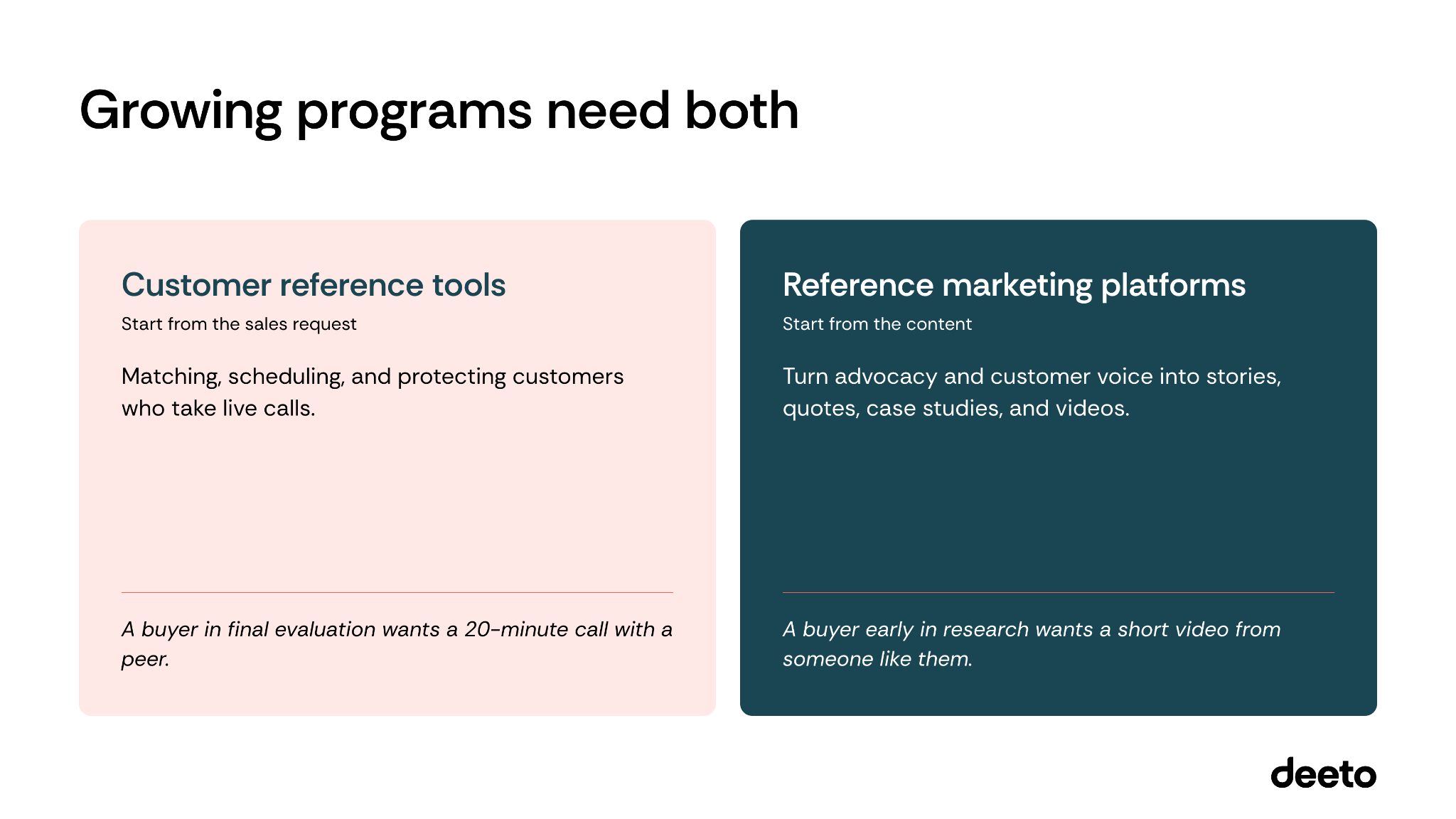
Customer reference tools start from the sales request. Their main job is matching, scheduling, and protecting customers who take live calls. Reference marketing platforms start from the content. They turn customer advocacy and customer voice into stories, quotes, case studies, and videos that marketing and sales reuse across campaigns.
Growing programs need both. A buyer early in research wants a short video from someone like them. A buyer in final evaluation wants a 20-minute call with a peer. If those two needs live in separate systems, your customers get asked twice and your team loses track of who said what. Deeto keeps live references and customer stories and social proof in the same place, so each customer interaction feeds both.
How to choose a reference management platform
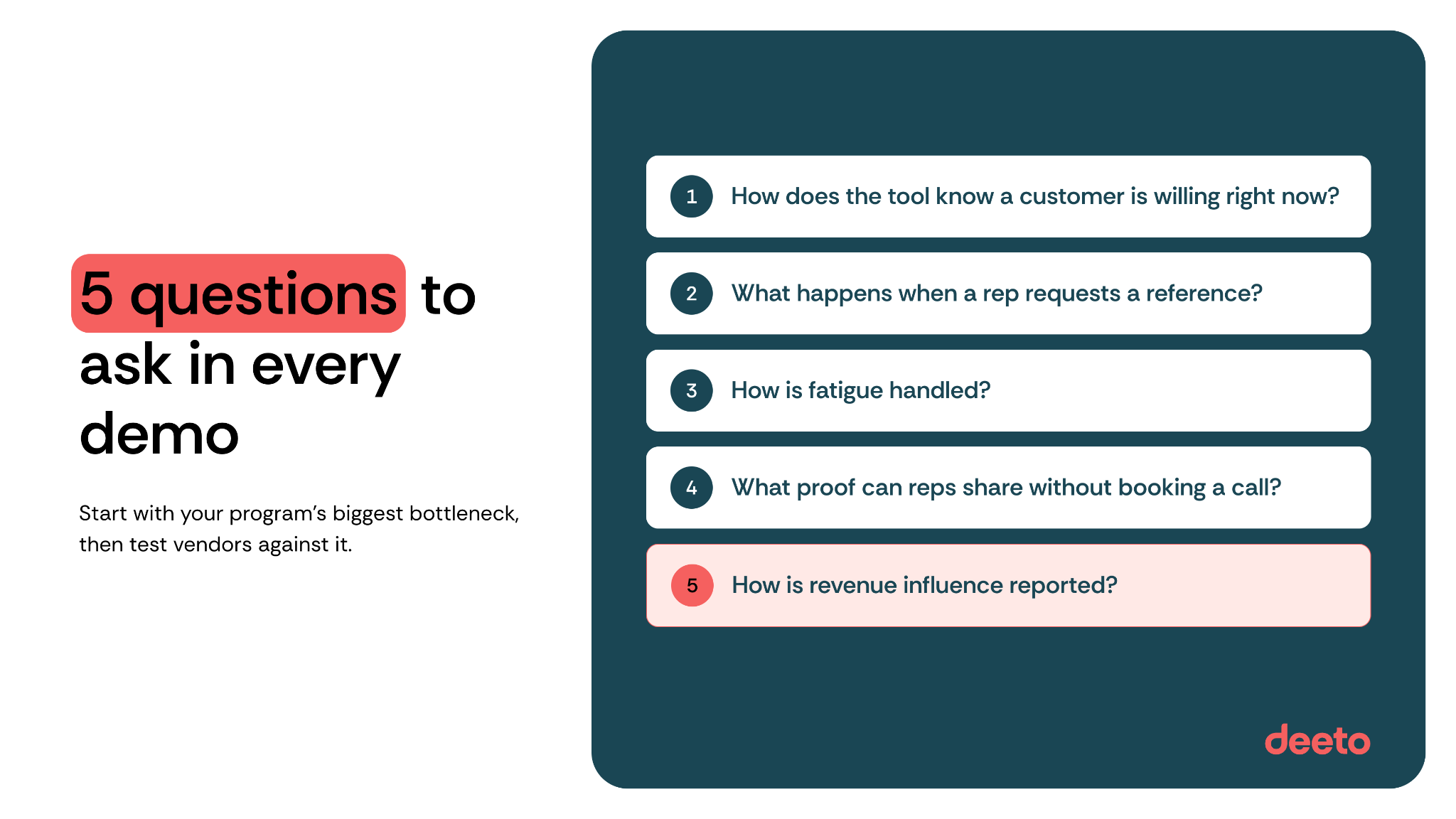
Start with your program's biggest bottleneck, then test vendors against it. These questions work well in demos:
- How does the tool know a customer is willing right now? Ask whether willingness comes from a checkbox someone filled in once or from ongoing customer input.
- What happens when a rep requests a reference? Have the vendor walk through the full flow from Salesforce or Slack to a booked call.
- How is fatigue handled? Ask to see how the system caps requests and what the customer sees.
- What proof can reps share without booking a call? Early-stage buyers rarely need a live reference.
- How is revenue influence reported? Forrester recommends moving from activity metrics, like number of references, to impact metrics, like influence on closed deals.
If you're still designing the program itself, our guide on how to build a customer reference program covers recruiting advocates, structuring tiers, and measuring results.
Key takeaways
- Customer reference management software tracks reference-ready customers, routes sales requests, prevents overuse, and reports revenue influence.
- Buyers do more research alone, so the moments they ask for a peer carry more weight in the deal.
- Salesforce-native tools like ReferenceEdge and Orca suit Salesforce shops. Broader platforms like Deeto, Base, and UserEvidence combine references with other customer proof.
- The best tool for sales reps is the one that answers "who can I use right now?" without a Slack message to marketing.
- Test every vendor on how it knows a customer is willing today, since a yes from last year may have expired.
FAQs
What is customer reference management software?
Reference management software is a platform that helps B2B companies organize customers willing to speak with prospects, match them to open deals, and track how often each customer is asked. It typically includes a searchable reference pool, CRM-based request workflows, fatigue controls, and reporting that connects reference activity to won revenue. It replaces spreadsheets and manual coordination between sales and customer marketing.
What is the best customer reference management software?
The right choice depends on your CRM and program goals. Point of Reference (ReferenceEdge) and Orca fit teams that want Salesforce-native tools. Upland RO Innovation suits sales teams that want large reference content libraries. Deeto fits teams that want references, customer stories, and feedback in one voice of the customer platform with self-serve access for reps.
How much does reference management software cost?
Most vendors don't publish pricing and quote based on users, program size, and contract length. Orca is an exception, listing a starting price of $5,000 per user per year on Capterra. Expect enterprise reference platforms to require an annual contract. Ask vendors whether pricing is per sales user, per admin, or per customer advocate, since that changes cost a lot as you grow.
What's the difference between customer references and referrals?
A customer reference is a customer who speaks with a prospect to help them evaluate your product, usually late in a sales cycle. A referral is a customer who introduces you to a new potential buyer, often for a reward. Reference tools focus on matching and protecting advocates. Referral tools focus on tracking leads and payouts. Some platforms support both.
How do you prevent customer reference fatigue?
Prevent reference fatigue by tracking every request per customer, setting limits on how often each one can be asked, and rotating new advocates into the pool. Good customer reference tools do this automatically, lowering a customer's priority after recent calls. It also helps to offer lighter options, like a recorded video or written quote, so customers aren't always asked for live calls.
How does customer reference management software help sales reps?
Reference software helps sales reps find the right reference quickly without chasing marketing. Reps can search by industry, use case, or persona from inside their CRM, see who is available, and request a call in a few clicks. Many tools also give reps ready-to-share proof, like quotes and short videos, for buyers who aren't ready for a live conversation.
Conclusion
Every tool on this list can store a reference pool and route a request. The difference shows up in the moment a rep needs a specific customer for a specific deal, and whether the system knows who is willing, relevant, and rested enough to say yes.
Salesforce-native specialists work well for mature enterprise programs. Broader platforms make more sense when you want references, stories, and customer feedback to feed each other.
Deeto was built for that second path. When customers tell you directly what they're comfortable sharing, reps get the right proof faster, deals keep their momentum, and your best advocates stay happy to help. See how Deeto handles customer references.
🎉 Save your spot
Register for the event
Once your spot is secured, we’ll send your confirmation details.
Subscribe to our newsletter
Subscribe to receive the latest blog posts to your inbox every week.
By subscribing, you agree to our Privacy Policy
Subscribe to our newsletter
Get the latest news and updates from our team.
By subscribing, you agree to our Privacy Policy
Related posts

6 Best Tools for AI Customer Interviews

What are AI customer interviews? Compare 6 tools, see what each does best, and learn how to choose one.

Best customer intelligence tools for B2B teams
What are customer intelligence tools? Compare 8 B2B options, collection methods, and how to pick the right fit.

Omnichannel Customer Engagement Tools: 8 Platforms Compared
Compare 8 omnichannel engagement platforms on channels, AI, and pricing, plus the gap automation can't fill.


