


5 Stages of a Customer Journey Marketing Funnel



Wednesday, November 4, 2026


5 Stages of a Customer Journey Marketing Funnel


View the podcast on Youtube

67% of B2B buyers would rather buy without talking to a sales rep, according to a 2026 Gartner survey. Instead, they research on review sites, in peer conversations, and in AI answers, and most of what they find there comes from your customers.
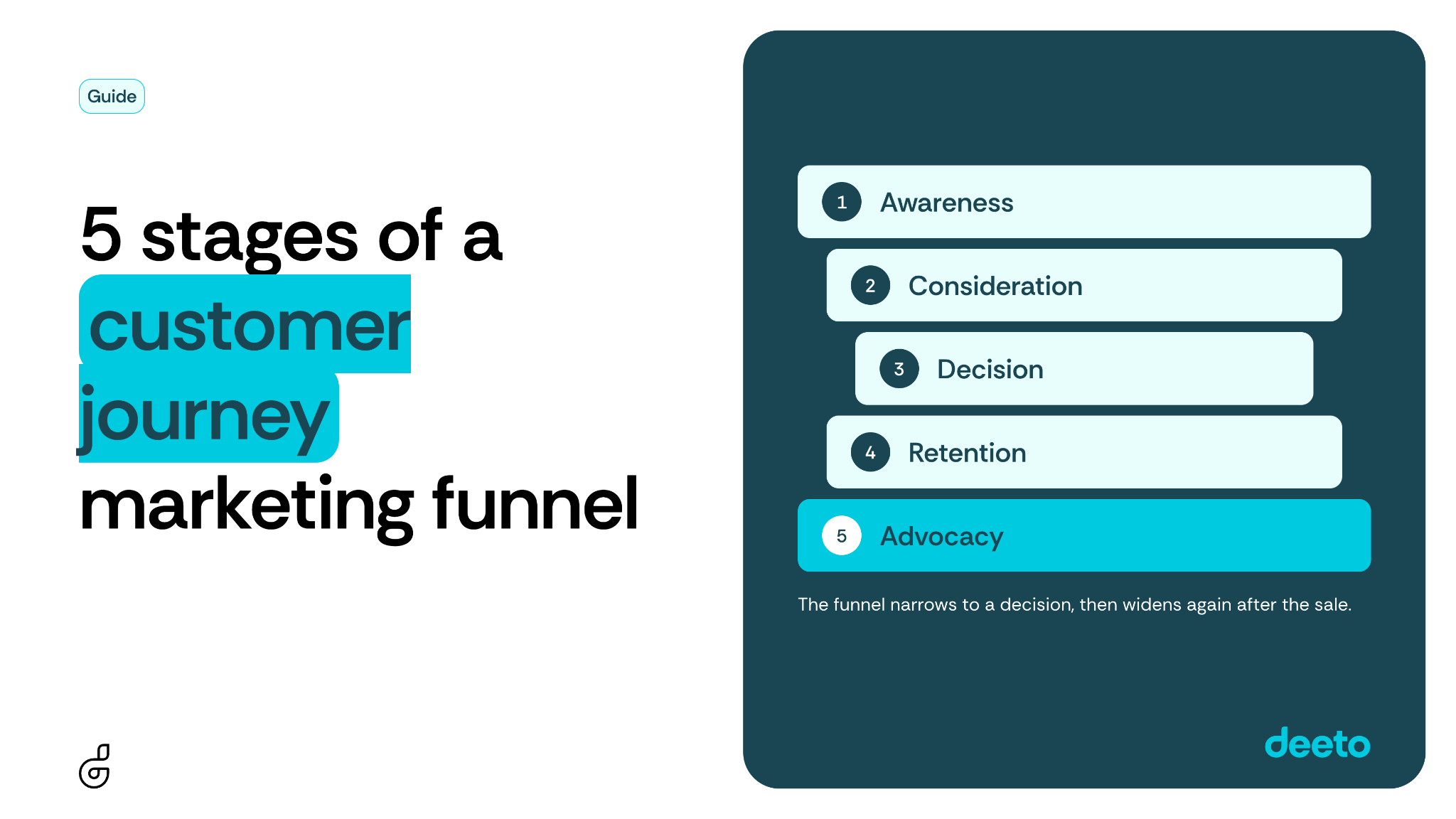
A customer journey marketing funnel is a framework that maps the five stages a buyer moves through, from first awareness to active advocacy, along with the marketing actions that move them forward. It keeps going after the purchase, through retention and advocacy, which is where you create the proof that wins your next customer.
Here's each stage, what to measure, and how customer voice ties them together.
What is a customer journey marketing funnel?
A customer journey marketing funnel is a model of how prospects become customers and how customers become advocates. It splits the journey into five stages: awareness, consideration, decision, retention, and advocacy.
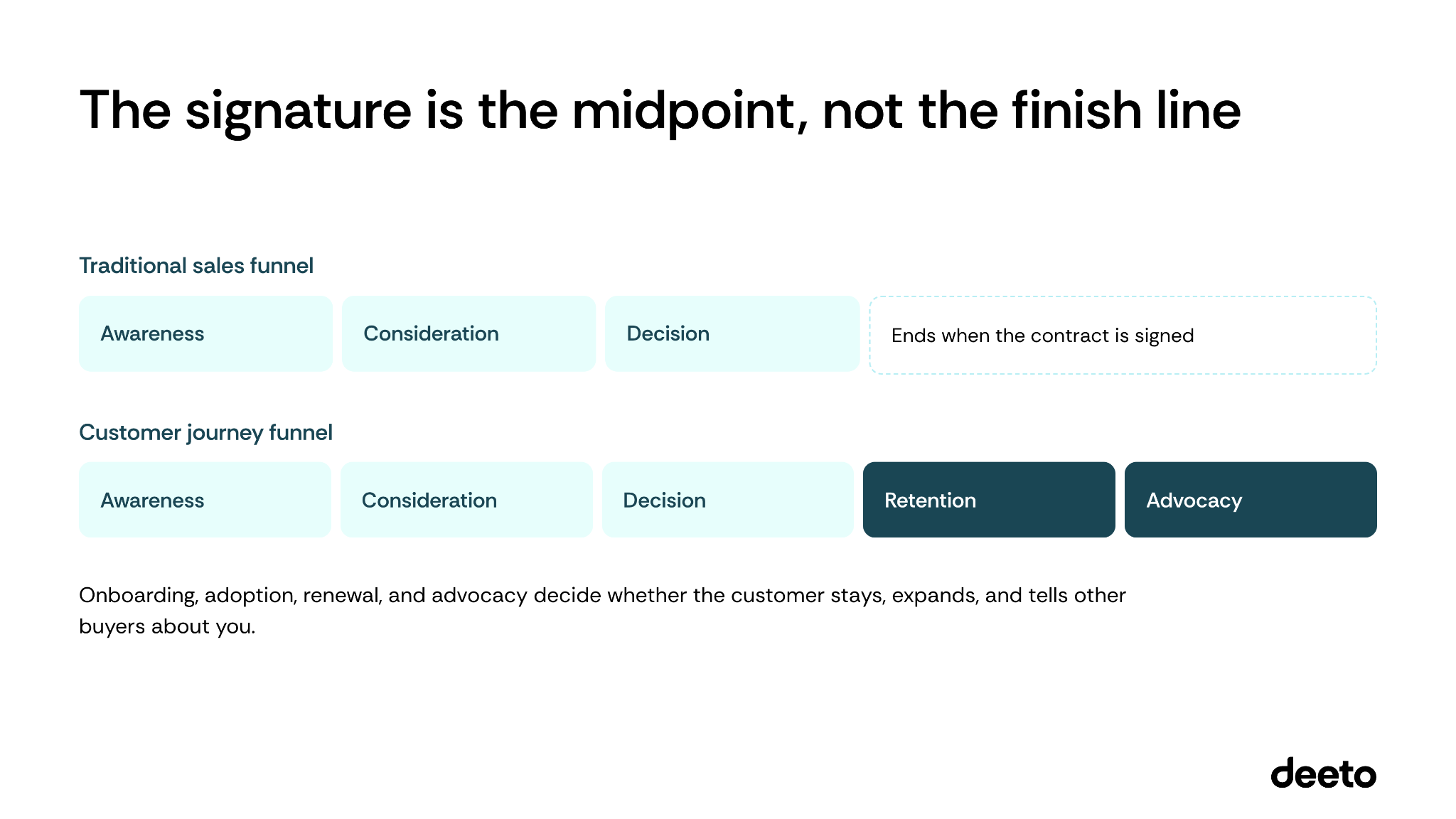
A traditional sales funnel ends when the contract is signed. The customer journey funnel treats the signature as the midpoint, because onboarding, adoption, renewal, and advocacy decide whether the customer stays, expands, and tells other buyers about you.
That gives marketing, sales, and customer success a shared answer to three questions. What does the customer need at each stage? Which signal shows they're ready to move on? Who owns each handoff?
If you've already built a journey map, think of the funnel as the operating layer on top of it. Our guide on how to create a customer journey map covers the mapping side in detail.
Why the customer journey funnel matters more in 2026
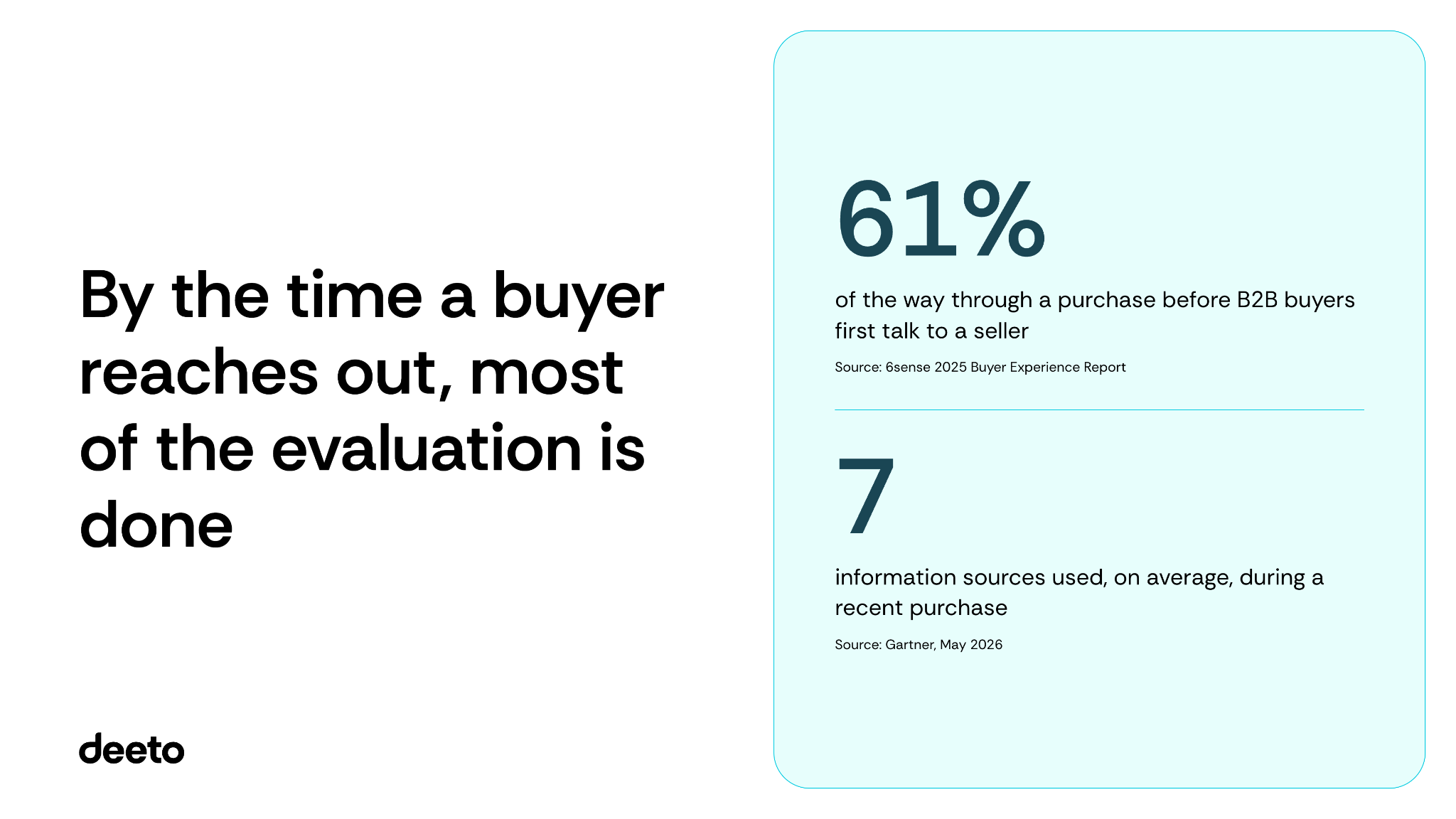
By the time a buyer reaches out, most of the evaluation is already done. 6sense's 2025 Buyer Experience Report found that B2B buyers are 61% of the way through a purchase before they first talk to a seller. In a May 2026 Gartner release, buyers reported using an average of seven information sources during a recent purchase.
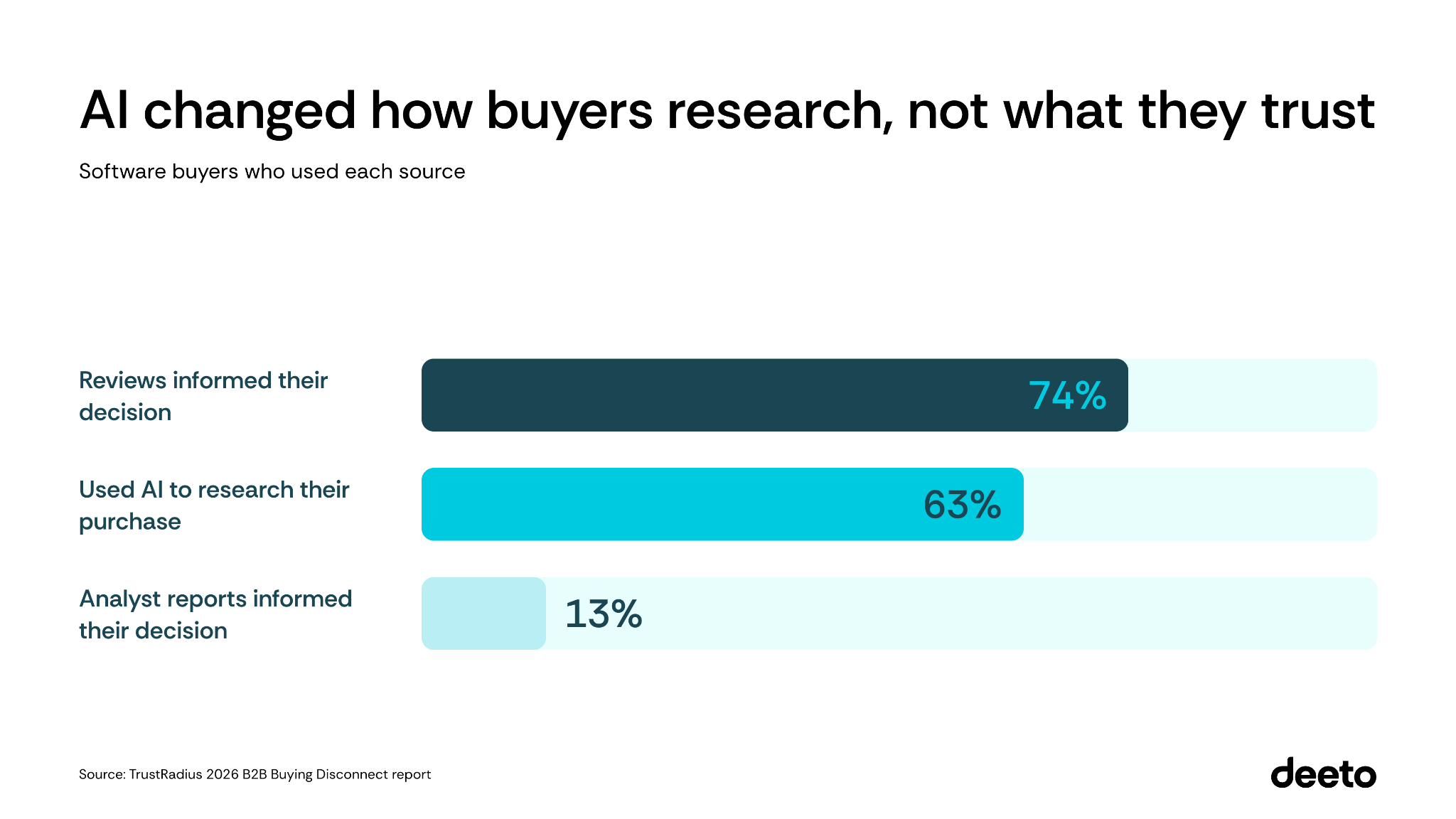
AI is now one of those sources. The TrustRadius 2026 B2B Buying Disconnect report found that 63% of software buyers used AI to research their purchase, and 74% used reviews to inform their decision. Analyst reports informed only 13% of decisions.
Reviews, peer stories, and references are the sources buyers lean on most, and every one of them comes from your existing customers. So the back half of the funnel is producing the raw material for the front half. The sale is where your best marketing material starts being made.
That's why customer marketing teams belong in the conversation at every stage. They own the relationships that produce the proof buyers go looking for before they ever fill out a form.
The 5 stages of a customer journey marketing funnel
Stage 1: Awareness
Awareness is the stage where a buyer first realizes they have a problem worth solving. Often they don't know your category exists yet. They search, ask peers, and more and more often ask an AI tool to explain their options.
The job here is to get found and to describe the problem in a way that makes your approach the obvious next thought. Plain-language content that answers the questions buyers actually type helps. So does data pulled from your own customers, which carries more weight than anything your brand says about itself.
Review-site profiles matter more than they used to, because AI answers lean heavily on third-party content. Short customer quotes in social posts and paid ads round it out.
Watch organic traffic, branded search volume, share of voice, and how often AI Overviews and answer engines cite you.
Stage 2: Consideration
In the consideration stage, the buyer knows what they need and starts building a shortlist. The same 6sense report found that 94% of buying groups rank their shortlist by preference before they engage a single seller. That preference forms here, usually before anyone on your team knows the account is looking.
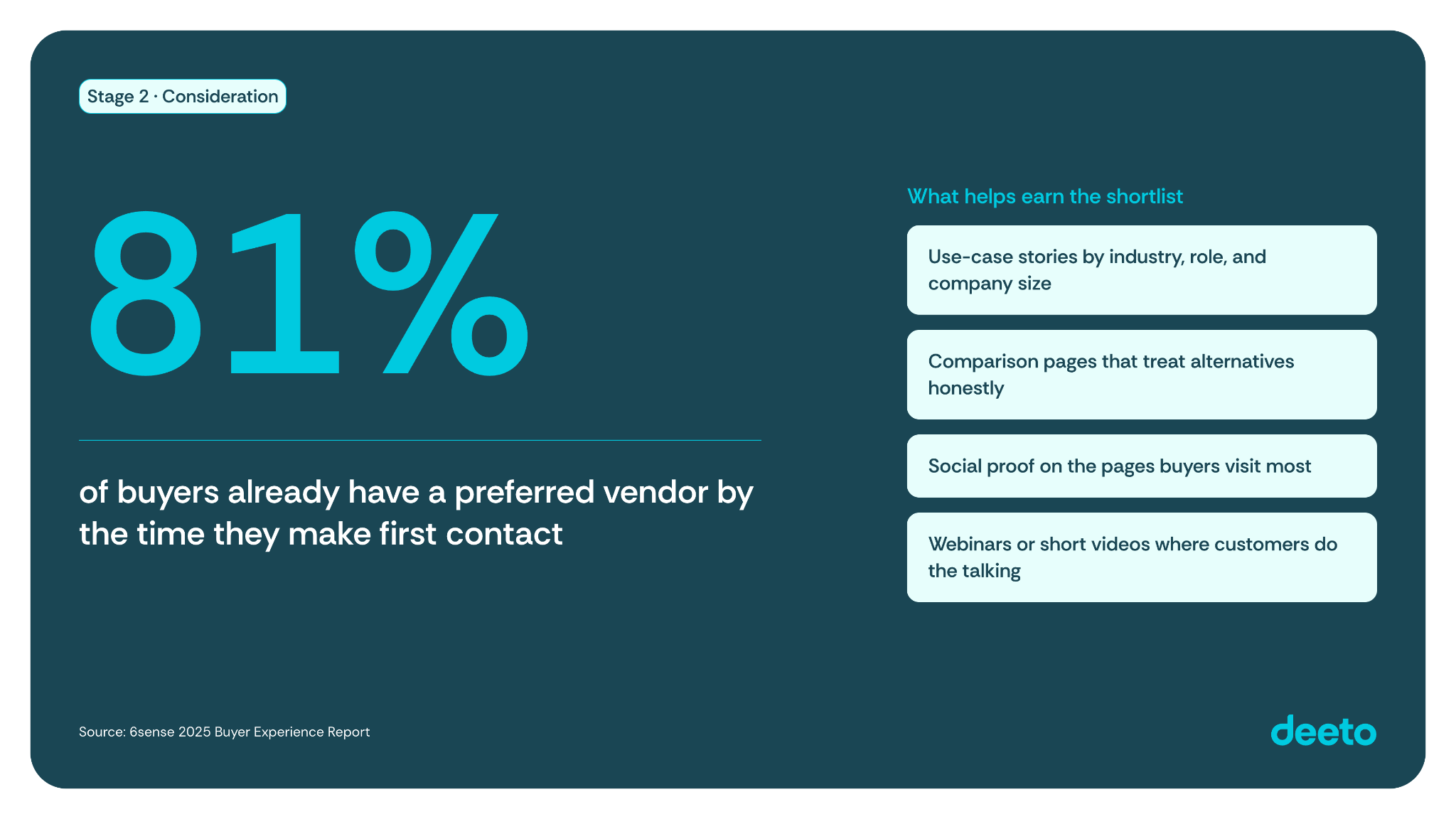
Buyers want to see how you solved this problem for a company like theirs. Feature pages struggle to show that, since three competitors are saying the same thing on their own feature pages. What helps:
- Use-case stories sorted by industry, role, and company size
- Comparison pages that treat alternatives honestly
- Social proof in marketing on the pages buyers visit most
- Webinars or short videos where customers do the talking
The numbers to watch are engaged accounts, return visits, content-assisted pipeline, and demo requests.
Stage 3: Decision
Decision is the stage where a buying committee checks every claim it has heard and looks for a reason to say no. Risk is the obstacle. They want proof the product will work for a company like theirs, run by a team like theirs.
Even buyers who prefer to research alone come back to people at this point. Gartner's May 2026 release found that 69% of B2B buyers turn to sales reps to validate AI-generated insights. A rep can repeat a claim. Only a peer at a similar company can confirm it, and that's the version buyers believe.
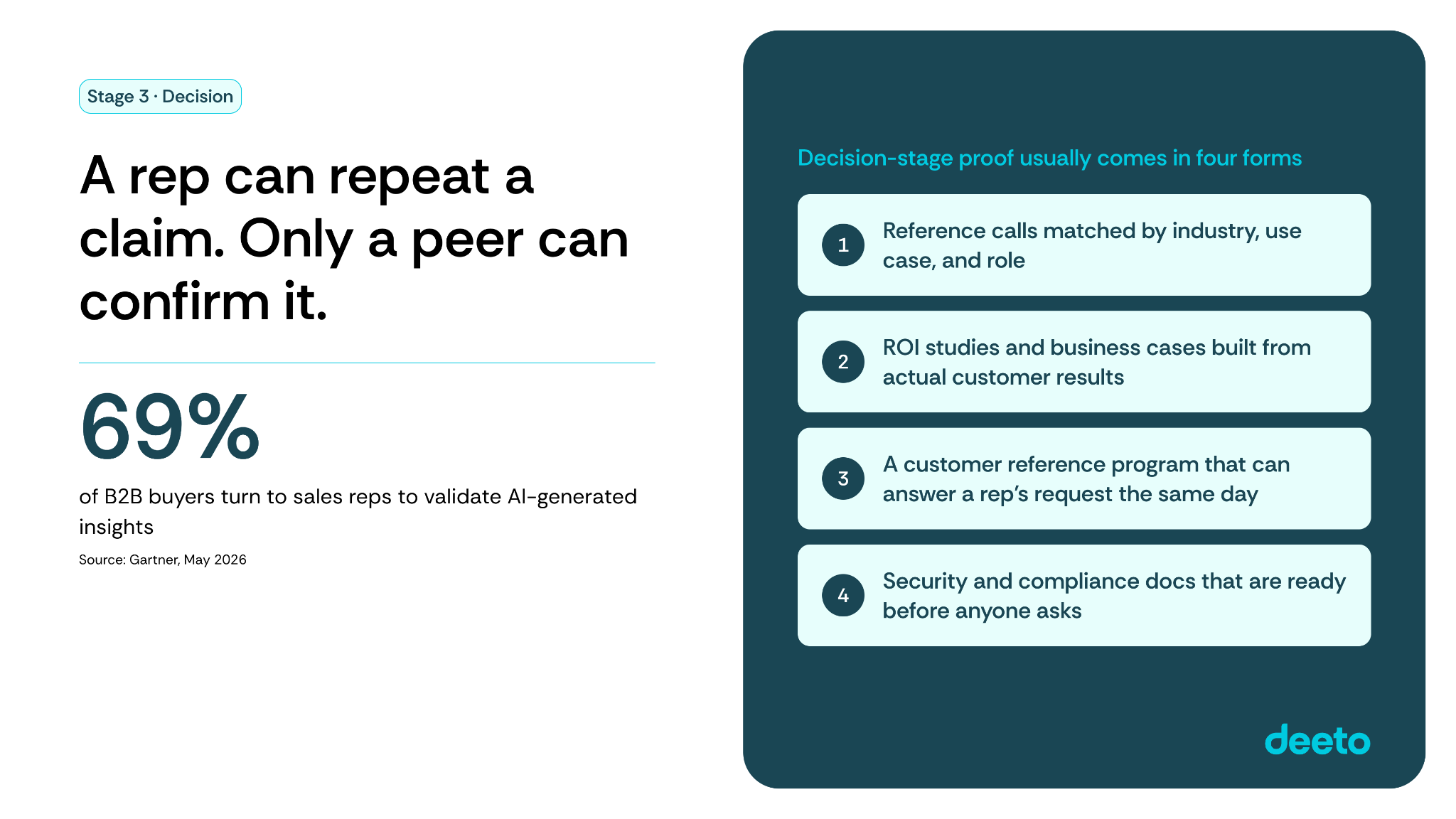
Decision-stage proof usually comes in four forms:
- Reference calls matched by industry, use case, and role
- ROI studies and business cases built from actual customer results
- A customer reference program that can answer a rep's request the same day
- Security and compliance docs that are ready before anyone asks
Many funnels stall right here. Reps spend days hunting for a reference that fits the deal, and the best advocates get asked so often they stop answering.
That delay costs more than a few days. A buying committee that waits a week for a peer call loses momentum, the close date slips, and a deal forecast for this quarter lands in the next one or goes to the vendor whose customer picked up the phone first. Meanwhile, the advocate who got four requests in a month quietly stops responding, and you've lost a reference you'll need for the next ten deals.
Deeto's reference management handles the matching and spreads the asks across more customers so nobody burns out.
Track win rate, sales cycle length, and how many reference requests you fill and how fast.
Stage 4: Retention
Retention covers onboarding, adoption, value realization, and renewal. It's where the customer decides whether you delivered what you sold, and a buyer who signed in the decision stage can still churn here if the value never shows up.
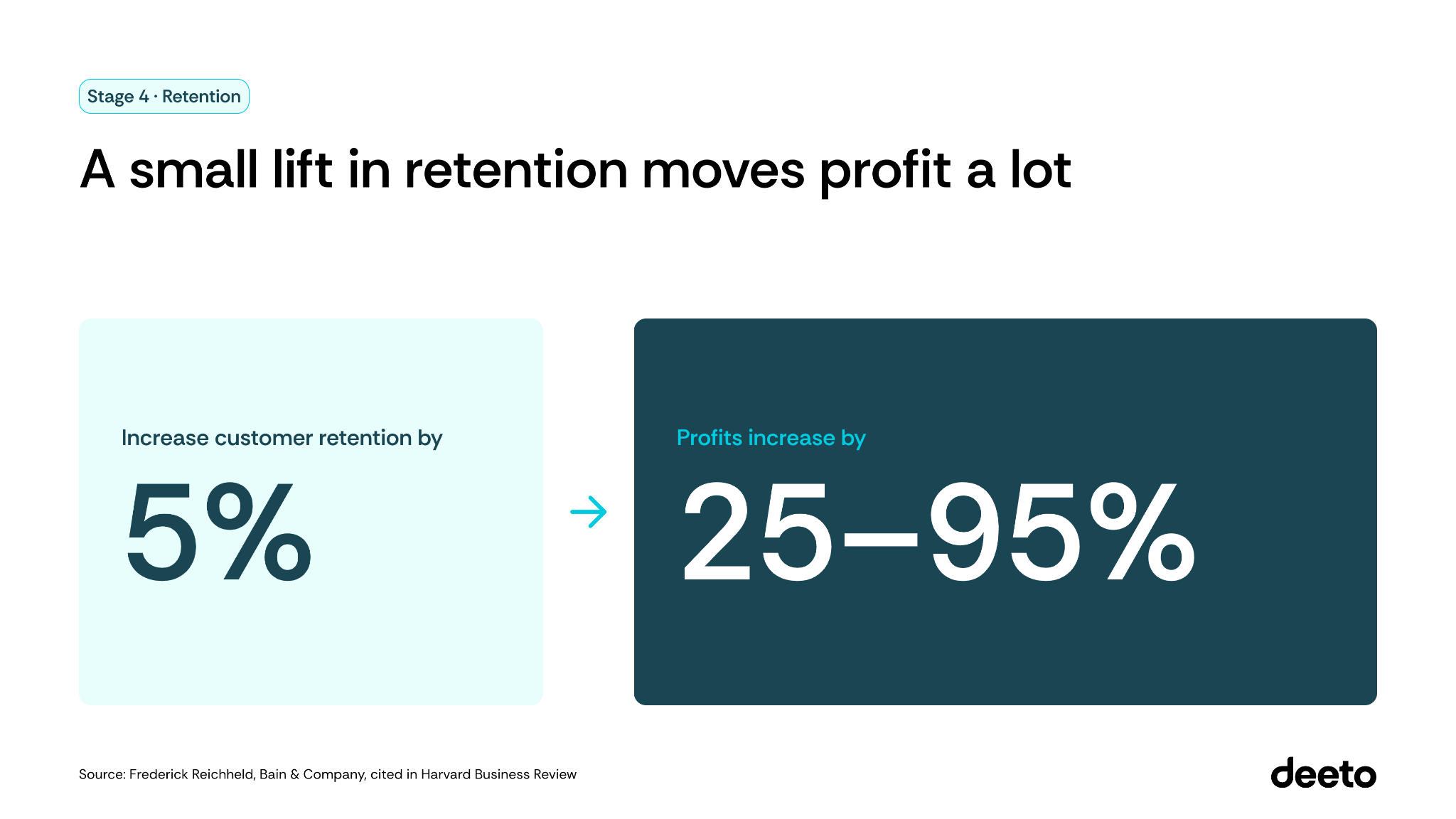
Research by Frederick Reichheld of Bain & Company, cited in Harvard Business Review, found that increasing customer retention rates by 5% increases profits by 25% to 95%. Retention also shows you whether your marketing promises match what customers deal with day to day.
Onboarding content that gets customers to first value quickly does a lot of the work. Peer best practices from customers who've already succeeded help newer accounts skip common mistakes. Regular feedback catches problems while there's still time before the renewal conversation, and customer adoption programs work best when they're tied to the outcomes customers bought for.
That same feedback powers early warning. When sentiment drops, churn prediction in Deeto flags the account so customer success has time to act before the renewal date.
Measure adoption rate, time to value, gross and net revenue retention, and CSAT or NPS.
Stage 5: Advocacy
Advocacy is the stage where happy customers share their results in public. They write reviews, join case studies, take reference calls, refer peers, and speak at events. This stage is also what turns the funnel into a loop.
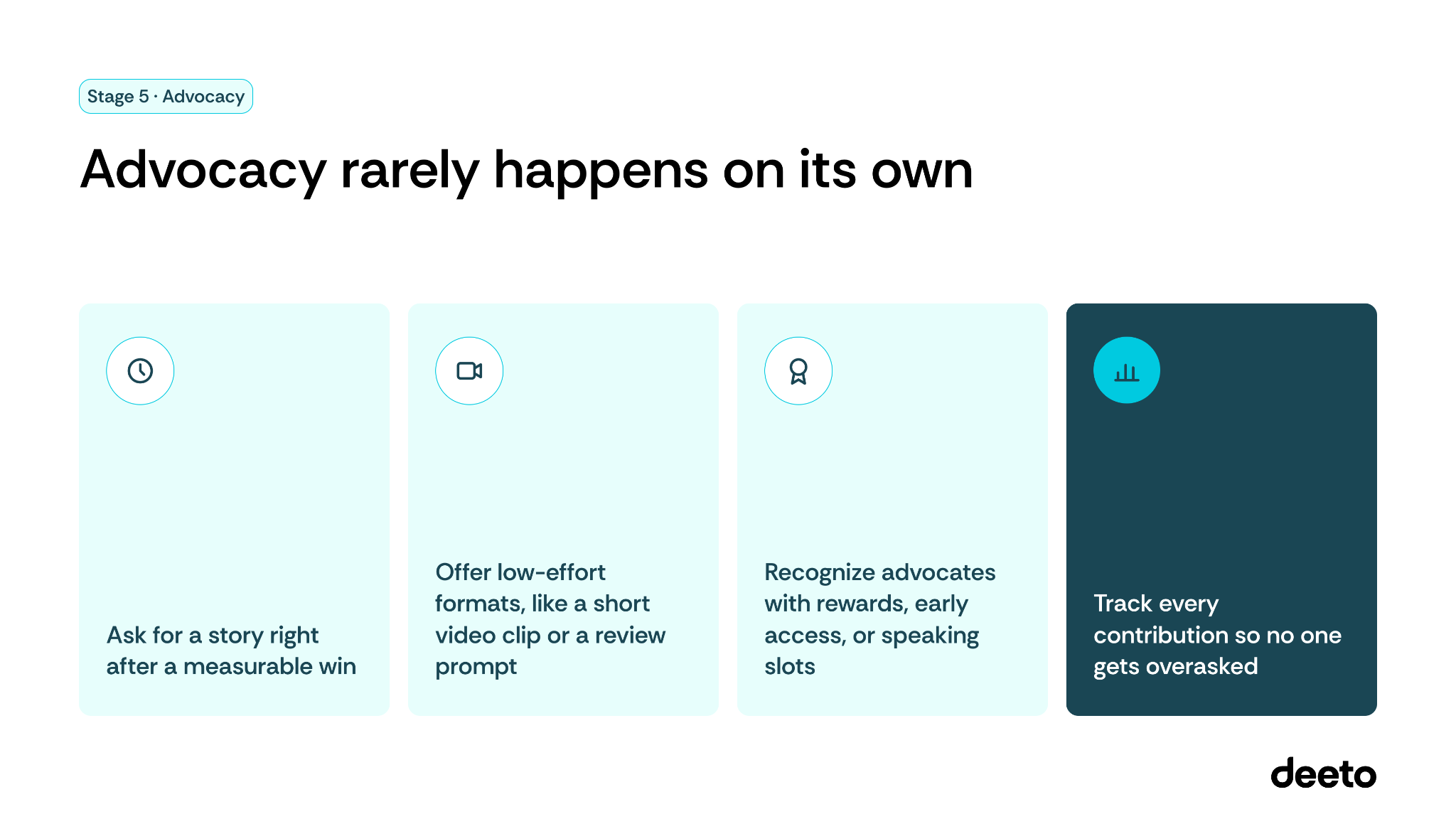
Advocacy rarely happens on its own, though. Satisfied customers are busy, and most will only say yes if the ask is specific, easy, and timed to a moment when they've just seen results. A few habits make the difference:
- Ask for a story right after a measurable win, like a renewal or a milestone
- Offer low-effort formats, like a short video clip or a review prompt
- Recognize advocates with rewards, early access, or speaking slots
- Track every contribution so no one gets overasked
A structured approach to customer advocacy turns one-off favors into a steady supply of proof for every stage before it.
Good advocacy metrics include advocates enrolled, stories and reviews published, referral pipeline, and influenced revenue.
Customer journey funnel stages compared
The chart puts the five stages side by side, with what the buyer is asking, the marketing goal, the proof that works, the metrics, and who owns each stage.
Look down the proof column and you'll notice that most of what works in the first three stages comes from customers who reached the fifth.
How to build a customer journey marketing funnel
A useful funnel is built from how your customers actually bought, so start there instead of with the campaign calendar. These five steps work for a new funnel or an audit of the one you have.
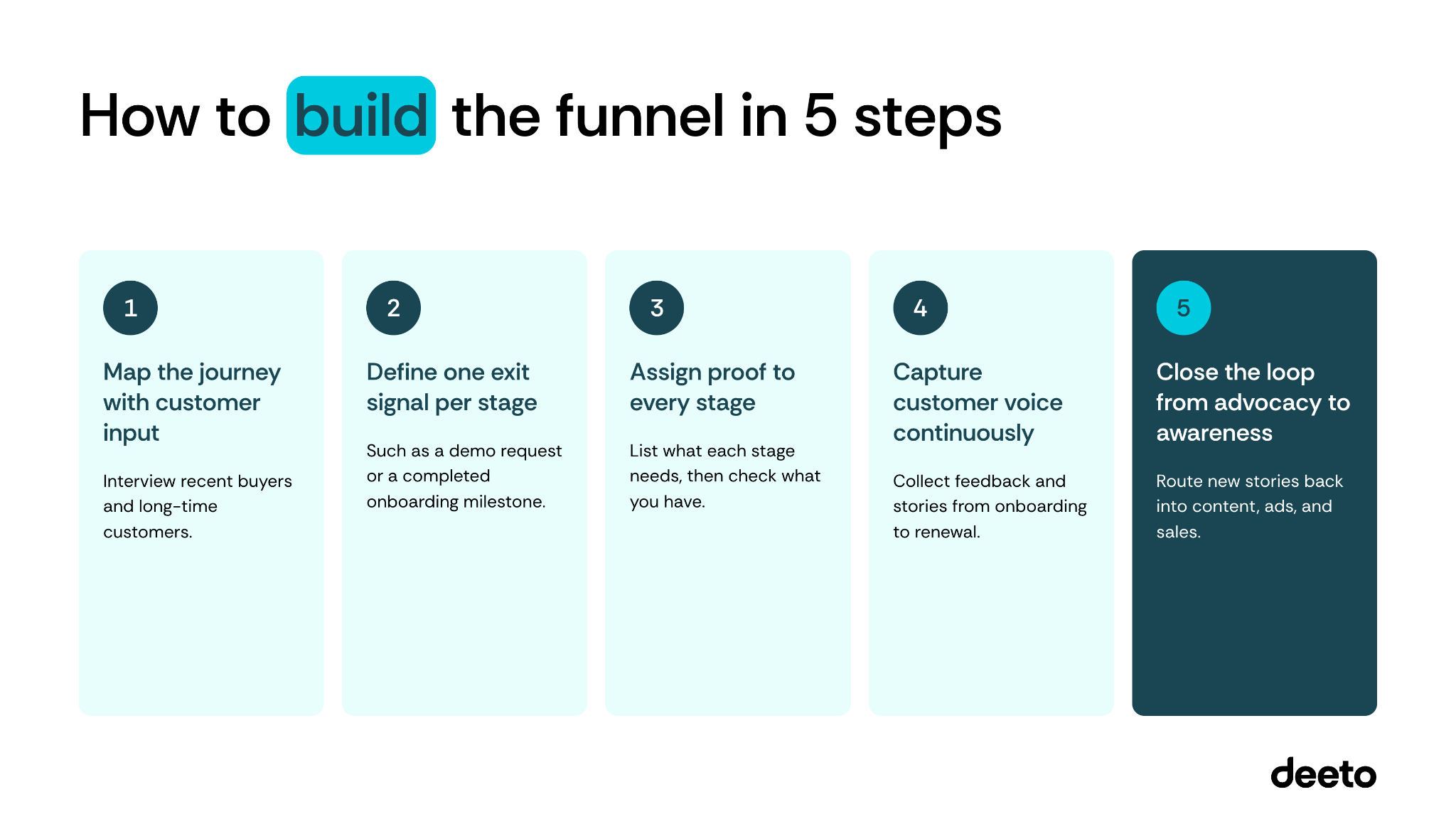
- Map the journey with customer input. Interview recent buyers and long-time customers about how they found you, what nearly stopped them, and what made them stay. Ongoing customer research keeps the map current.
- Define one exit signal per stage. Pick the single behavior that shows a buyer is ready to move on, such as a demo request or a completed onboarding milestone.
- Assign proof to every stage. List the stories, quotes, and references each stage needs, then check which ones you actually have.
- Capture customer voice continuously. Annual surveys go stale fast. Collect feedback and stories at every key moment, from onboarding to renewal.
- Close the loop from advocacy to awareness. Route new stories and reviews back into the content, ads, and sales conversations that serve earlier stages.
How Deeto connects every stage of the funnel
Your team likely already has the proof they need. It's spread across call notes, survey tools, old slide decks, and the heads of a few account managers. You feel the gap in the decision stage, when a rep needs a matching story by Thursday and nobody knows where one lives.
Finding the story faster only solves part of the problem. The bigger opportunity is knowing what your customers are telling you and getting it to the person who can act on it.
Deeto is a voice of the customer platform that turns authentic customer voice into intelligence and routes it across the funnel. It captures feedback and stories at every stage, then analyzes them for patterns, sentiment, and signals. A dip in sentiment during onboarding reaches customer success and product as a retention risk, while it can still be fixed. When a customer posts a strong result at renewal, that becomes an advocacy ask, and the story that comes out of it is matched to the campaigns, web pages, and open deals where it will do the most work.
That routing is what closes the loop described above. Retention feeds advocacy, advocacy feeds the earlier stages, and each customer who comes through the funnel makes the next deal easier to win.
The decision stage is where the impact shows up first. Across Deeto customers, teams see 20–30% faster sales cycles and 10–15% higher win rates once matched customer proof is available inside active deals. Taylor, a work management and collaboration software company, is one of them. Before Deeto, Taylor's sales team struggled to find the right customer reference for a prospect, and its customer stories were scattered across the company. Building trust with each buyer took a lot of manual work, and the sales cycle ran longer than the team wanted.
Taylor made Deeto the foundation of its customer advocacy program. Customers now share their experiences through the platform, and those stories are captured, organized, and routed to the sales team automatically. Business development managers can pull a relevant reference or testimonial in the middle of a conversation instead of going looking for one. "I love how it shortens our sales cycle and increases our win rate," says Adam McKenzie, Business Development Manager at Taylor. Read Taylor's full story.
Key takeaways
- The customer journey funnel has five stages: awareness, consideration, decision, retention, and advocacy.
- The funnel continues past the purchase, because retention and advocacy produce the proof that earlier stages depend on.
- Buyers now research mostly on their own and lean on reviews, peers, and AI, so customer proof shapes the funnel before sales gets involved.
- Each stage needs a clear exit signal, the right type of proof, and an owner.
- Continuous customer voice keeps the funnel connected and turns it into a loop.
Conclusion
Most teams can name the five stages of a customer journey marketing funnel. The hard part is the handoffs between them, especially the one from advocacy back to awareness.
Teams that get this right treat customer voice as the thread through every stage. They listen during retention, ask at the right moment in advocacy, and put that proof in front of buyers long before a sales call. A funnel run that way gets stronger with every customer who comes out the bottom.
If you want to see how that works in practice, book a demo with Deeto.
Frequently asked questions
What are the 5 stages of a customer journey marketing funnel?
The five stages are awareness, consideration, decision, retention, and advocacy. In awareness, a buyer recognizes a problem. During consideration, they compare solutions. At the decision stage, they validate claims and choose a vendor. Retention covers onboarding, adoption, and renewal, and advocacy is when satisfied customers share their results through reviews, case studies, references, and referrals.
What is the difference between a sales funnel and a customer journey funnel?
A sales funnel tracks prospects until they buy, then ends. A customer journey funnel continues after the purchase through retention and advocacy. This matters because the customers who stay and succeed produce the reviews, stories, and references that persuade new buyers. A customer journey funnel connects marketing, sales, and customer success around one shared view of the customer.
Why is advocacy part of the customer journey funnel?
Advocacy is part of the funnel because it creates the proof buyers trust most. Reviews, peer stories, and reference calls all come from existing customers. When advocates share their results, that content feeds the awareness, consideration, and decision stages for new buyers. Without an advocacy stage, teams rely on brand claims that buyers increasingly discount.
What metrics should you track at each funnel stage?
Track organic traffic and AI citations in awareness, and engaged accounts and demo requests in consideration. Decision-stage teams should watch win rate, sales cycle length, and reference fulfillment. For retention, measure adoption, time to value, and revenue retention. In advocacy, track advocates enrolled, stories published, referral pipeline, and influenced revenue.
How does customer feedback improve the customer journey funnel?
Customer feedback shows where buyers get stuck and why customers stay or leave. Input from recent buyers sharpens awareness and consideration content. During onboarding and adoption, it flags churn risk before renewal. After a measurable win, it points to customers who are ready to become advocates. Collected continuously, feedback keeps every stage of the funnel aligned with what customers actually experience.
🎉 Save your spot
Register for the event
Once your spot is secured, we’ll send your confirmation details.
Subscribe to our newsletter
Subscribe to receive the latest blog posts to your inbox every week.
By subscribing, you agree to our Privacy Policy
Subscribe to our newsletter
Get the latest news and updates from our team.
By subscribing, you agree to our Privacy Policy
Related posts

Best Customer Reference Management Software in 2026

Compare 8 customer reference tools for 2026. See features, pricing, and what sales reps need to find references fast.

6 Best Tools for AI Customer Interviews
What are AI customer interviews? Compare 6 tools, see what each does best, and learn how to choose one.

6 Best Customer Testimonial Software Platforms
What is customer testimonial software? Compare six platforms by price, format, and fit for B2B teams.


