Voice of the Customer Strategy for SaaS Companies



Monday, October 12, 2026


Voice of the Customer Strategy for SaaS Companies


View the podcast on Youtube

Your customers decide to renew, expand, or churn based on things they told someone on your team months ago. Chances are, nobody did anything with that information.
Voice of the Customer for Software as a Service companies, shortened as VoC for SaaS, is the practice of continuously capturing what customers say across the subscription lifecycle, from first demo to renewal, and turning it into decisions about product, messaging, sales, and retention. A strong voice of the customer strategy connects each piece of feedback to the team that can act on it while the account is still active.
This guide covers what a SaaS VoC strategy includes, where it usually breaks, how the main VoC methods compare, and a five-step plan to build one.
What is VoC for SaaS?
Voice of the customer (VoC) is a structured way to collect, organize, and act on what customers need and expect. In SaaS, it carries extra weight. Revenue arrives in installments, so every customer decides again at every renewal whether the product is still worth paying for.
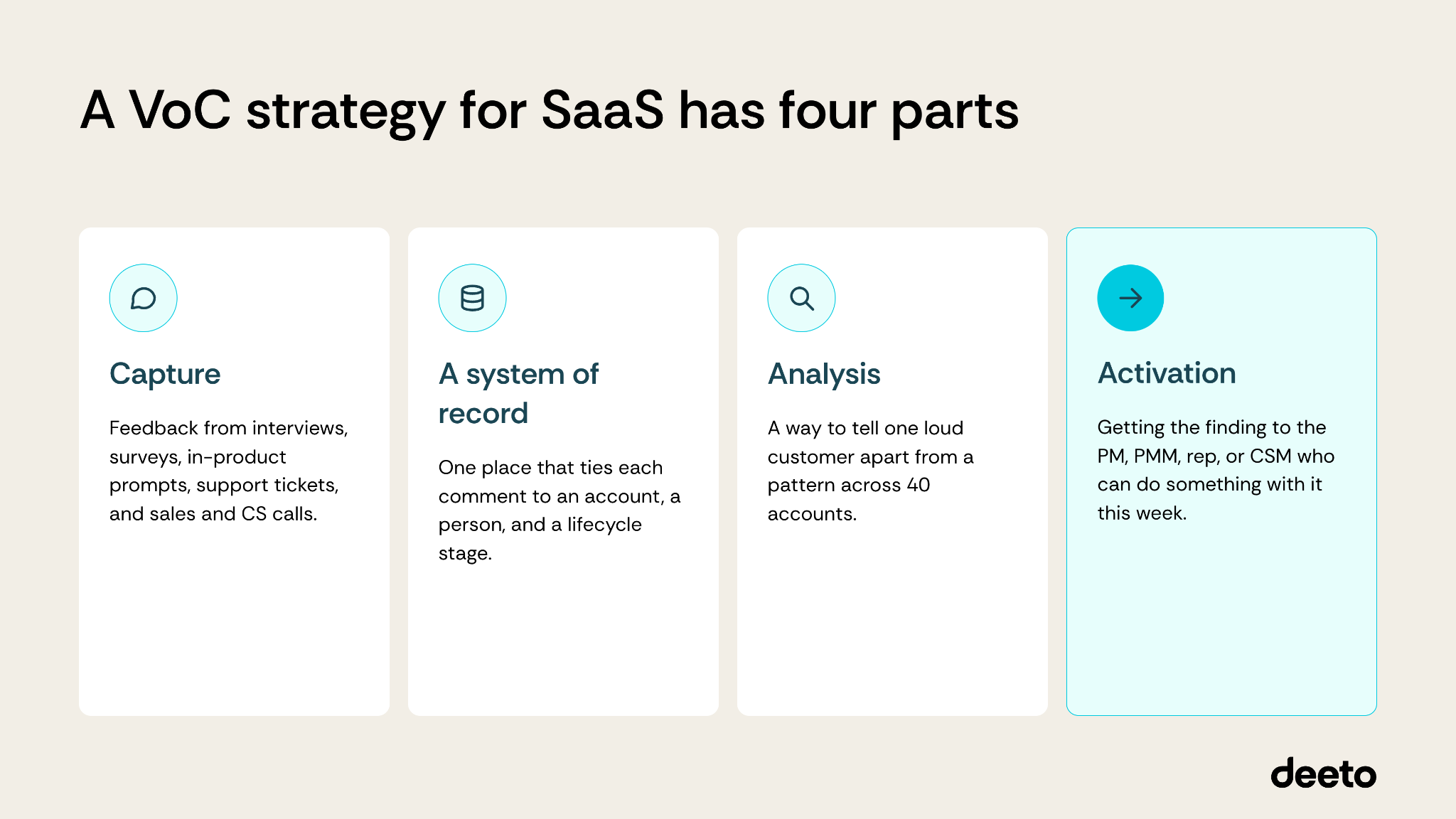
A VoC strategy for SaaS includes four parts:
- Capture. Feedback from interviews, surveys, in-product prompts, support tickets, and sales and CS calls.
- A system of record. One place that ties each comment to an account, a person, and a lifecycle stage.
- Analysis. A way to tell one loud customer apart from a pattern across 40 accounts.
- Activation. Getting the finding to the PM, PMM, rep, or CSM who can do something with it this week.
Done well, a VoC program tells you why you lost the deal, which features your best accounts can't live without, and the words buyers actually use for the problem you solve.
Why voice of the customer matters more in SaaS
A one-time purchase gives you one shot at the sale. A subscription gives the customer a vote every billing cycle.
Forrester's B2B research found that customer-obsessed companies grow revenue 28% faster, with 33% higher profitability growth and 43% better customer retention than companies without that focus. Customer obsession sounds like a culture slogan, but in practice it comes down to one main question, does customer feedback reach the people making decisions, fast enough to change them?
Retention is where SaaS economics live. Fred Reichheld's research at Bain found that in financial services, a 5% increase in customer retention produces more than a 25% increase in profit, because returning customers buy more over time and cost less to serve. Subscription software runs on the same math where every renewal you protect compounds.
What VoC means for customer marketing
For customer marketing and advocacy teams, VoC is the best source of proof you'll ever have. Every interview, QBR note, and renewal conversation tells you who's getting value, what result they got, and how they describe it.
That's your reference pool, your next case study, and your shortlist of advocates, already sitting in what customers have said. Most customer marketers still find them the hard way, by asking CSMs for names and chasing busy champions for a quote. A connected VoC program flips that. The customer who just told a CSM they cut onboarding time in half shows up as a story candidate the same week, with their own words attached. That's how customer advocacy scales without burning out the same five customers.
The same evidence protects the rest of the business. Pendo analyzed usage across 615 software products and found that 80% of features in the average product are rarely or never used. Someone built each of those features believing customers wanted it. A working VoC program would have tested that belief before engineering spent a quarter on it.
Why SaaS customer insights get lost
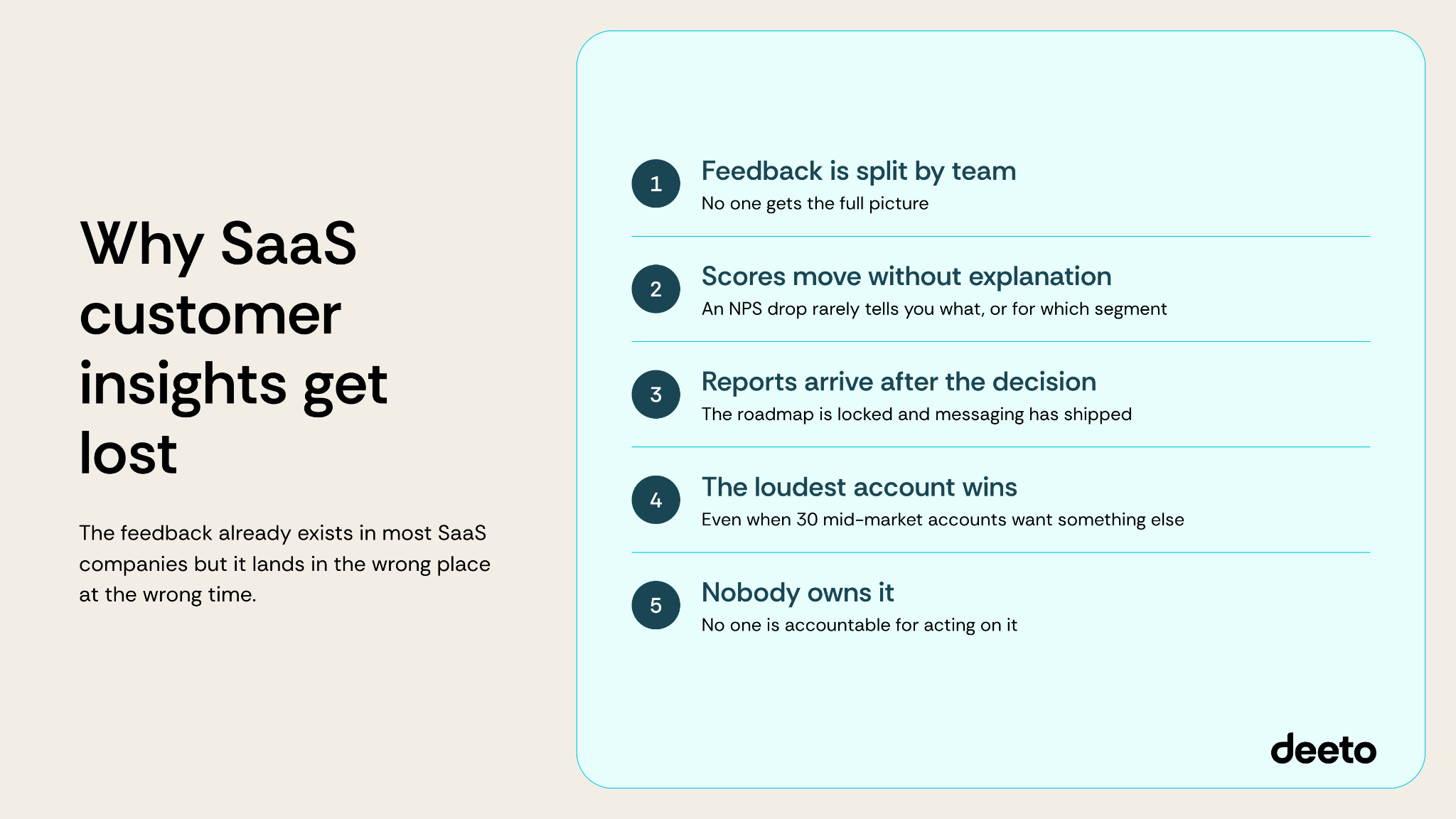
The feedback already exists in most SaaS companies but it lands in the wrong place at the wrong time.
Here is where it usually breaks down:
- Feedback is split by team. Sales hears objections on recorded calls. CS hears frustration in QBRs. Product reads usage dashboards and survey scores. Marketing reads G2 reviews. It ends up that each team is siloed, no one shares data, and therefore no one gets the full picture.
- Scores move without explanation. An NPS drop from 42 to 31 tells you something changed. It rarely tells you what, or for which segment.
- Reports arrive after the decision. A quarterly VoC readout lands after the roadmap is locked and launch messaging has shipped.
- The loudest account wins. Your largest customer's feature request jumps the queue, even when 30 mid-market accounts are asking for something else.
- Nobody owns it. VoC sits with CX, or research, or a customer marketing manager with no budget, and no one is accountable for acting on it.
Each of these is a routing problem more than a collection problem. Adding another survey tool won't fix it. What fixes it is one system that turns customer voice into intelligence and sends it to the right team. That's the gap Deeto was built to close, and it shapes how you should build the program.
VoC methods for SaaS compared
Most SaaS companies already run three or four of the methods below, but they don't talk to each other, and none of them were built to carry the customer's own words from first demo to renewal.
Gong records the calls your reps and CSMs were already having. Pendo collects usage data, in-app polls, and NPS from the people using your product, mostly to inform the roadmap. Both do those jobs well. Neither is built to go interview the economic buyer about why they almost churned, or to turn a champion's story into a reference a rep can use in a late-stage deal.
Deeto doesn't replace either of them. It pulls their signals together with direct customer conversations, then ties everything to the account and routes it to the team that needs it.
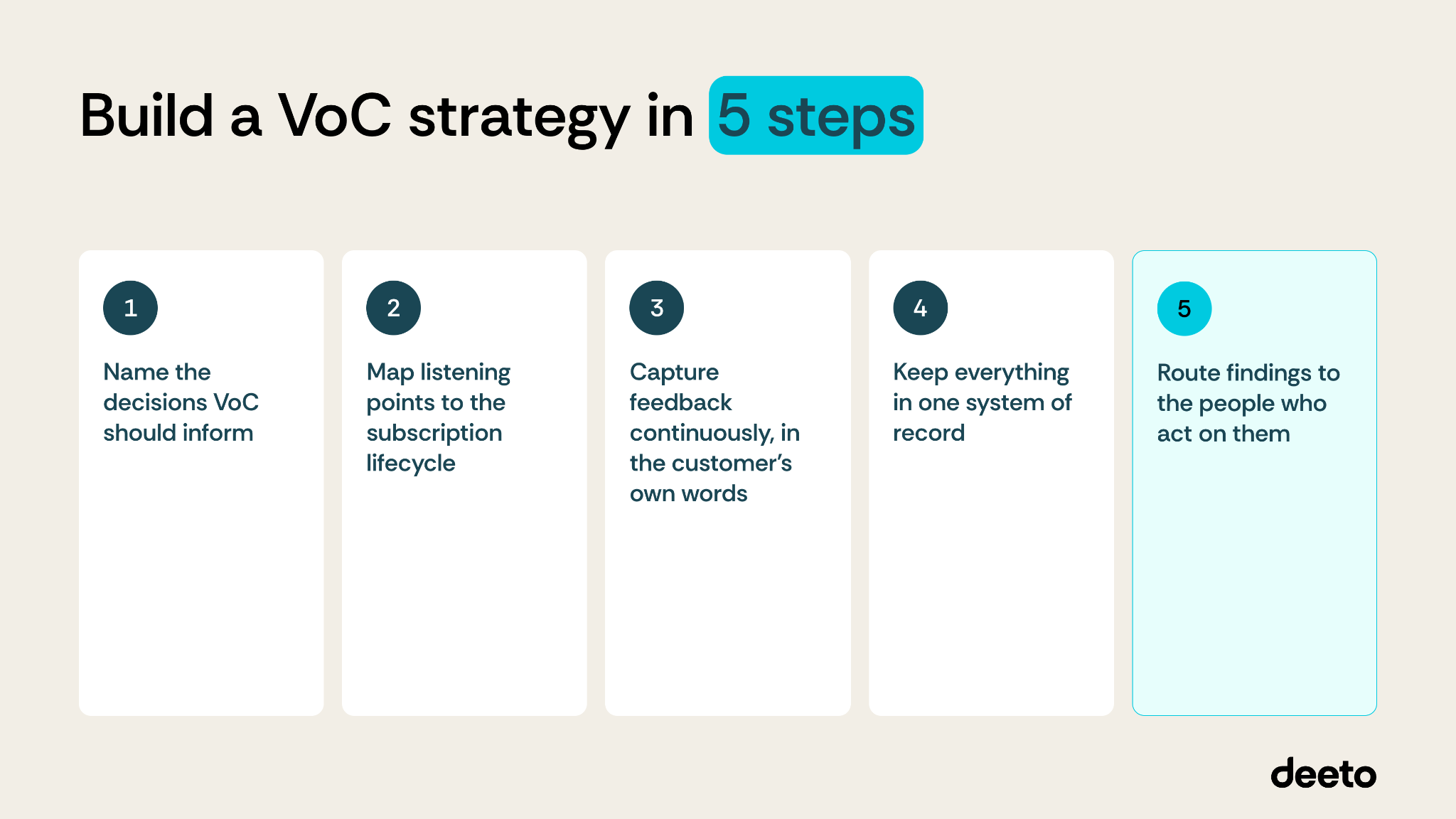
How to build a VoC strategy for SaaS in 5 steps
Start with the decisions you need to make and work backward. Most teams do it the other way around: buy a survey tool, collect a pile of responses, then try to work out what they're for.
1. Name the decisions VoC should inform
Pick three to five decisions coming up in the next two quarters. Examples: positioning for the Q1 launch, renewal risk across your top 50 accounts, the next two roadmap bets. Every listening activity should map to at least one of them. If it doesn't, cut it.
2. Map listening points to the subscription lifecycle
SaaS customers say different things at different stages. List the moments that matter for your business: the closed-lost deal, onboarding week three, the first QBR, 90 days before renewal, the expansion conversation. A customer journey map makes the gaps obvious. Pre-sale signals belong here too. A structured win/loss analysis is often the fastest way to learn what buyers compare you against.
3. Capture feedback continuously, in the customer's own words
Annual surveys produce a snapshot. Continuous capture produces a trend line. Short, conversational check-ins tied to lifecycle moments get higher response rates and richer answers than a 30-question survey. Deeto runs AI-led customer interviews at each of those moments, so the feedback arrives with context and in the customer's own language.
4. Keep everything in one system of record
SaaS customer insights are only useful if people can find them. Store every interview, quote, score, and story against the account and contact it came from. Connect it to the tools your teams already work in through CRM and Slack integrations. A rep should be able to see what a customer said six months ago without filing a request.
5. Route findings to the people who act on them
This is where most programs stall. Decide in advance who gets what:
- Product marketing gets message testing, objection patterns, and buyer language. See how Deeto supports product marketing teams.
- Product gets feature requests weighted by account value and frequency, which feeds a feedback-driven product roadmap.
- Sales gets customer stories and social proof matched to the deal in front of them.
- Customer success gets sentiment shifts and early churn signals before the renewal conversation.
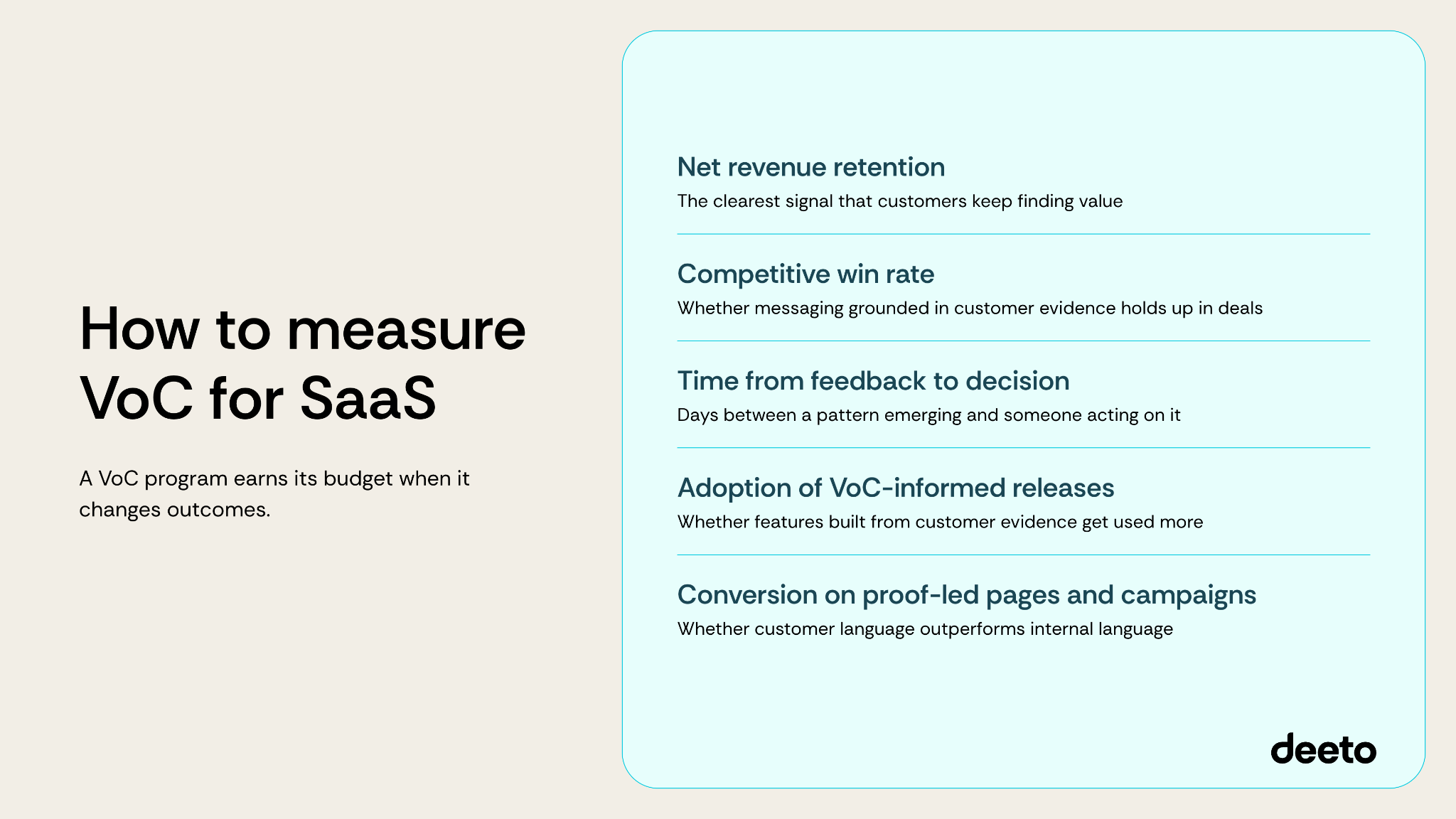
How to measure VoC for SaaS
A VoC program earns its budget when it changes outcomes. Track a small set of metrics tied to the decisions you named in step one:
- Net revenue retention. The clearest signal that customers keep finding value.
- Competitive win rate. Whether messaging grounded in customer evidence holds up in deals.
- Time from feedback to decision. How many days pass between a pattern emerging and someone acting on it.
- Adoption of VoC-informed releases. Whether features built from customer evidence get used more than the rest.
- Conversion on proof-led pages and campaigns. Whether customer language outperforms internal language.
Deeto customers see sales cycles 20 to 30% shorter when reps have customer proof inside the deal, not buried in a quarterly deck.
Key takeaways
- VoC for SaaS is the practice of capturing customer feedback across the subscription lifecycle and turning it into decisions on product, messaging, sales, and retention.
- SaaS raises the stakes because customers re-decide at every renewal.
- Most SaaS companies already collect plenty of feedback. The failure point is routing it to the right team in time.
- Build the program around three to five upcoming decisions, then map listening points to the lifecycle.
- Measure success with retention, win rate, and time from feedback to decision, not survey volume.
FAQs
What is VoC for SaaS?
VoC for SaaS is a structured approach to capturing what customers say across the subscription lifecycle, from evaluation through onboarding, adoption, and renewal. It turns that feedback into decisions about product priorities, positioning, sales proof, and retention. The goal is to get customer evidence to the team that can act on it while the account is still active, rather than in a quarterly report.
How is a voice of the customer strategy different from collecting customer feedback?
Collecting feedback is one activity. A voice of the customer strategy is the system around it. It defines which decisions feedback should inform, where to listen in the customer lifecycle, how to store and analyze what you hear, and who is responsible for acting on it. Many SaaS companies collect plenty of feedback but have no strategy, so it sits unused in survey tools and call recordings.
What are the best sources of SaaS customer insights?
The strongest SaaS customer insights come from combining sources. Customer interviews explain the reasons behind behavior. Product analytics show what users actually do. Conversation intelligence captures what comes up in sales and CS calls. Surveys like NPS and CSAT track sentiment over time. Review sites show how customers describe you in public. No single source gives the full picture on its own.
Who should own a VoC program in a SaaS company?
Ownership varies, but the program works best with one accountable owner and clear consumers. Product marketing, customer marketing, or customer experience often own it day to day. Product, sales, and customer success are the main consumers. What matters most is that someone is responsible for routing findings to those teams and tracking whether they acted on them.
How often should SaaS companies collect voice of the customer data?
Continuously, tied to lifecycle moments rather than a calendar. Trigger short check-ins after onboarding, after key feature launches, before renewals, and after closed-won or closed-lost deals. An annual survey can still serve as a benchmark, but it's too infrequent to catch churn risk or shifts in buyer priorities in a market that changes every quarter.
How does AI change VoC for SaaS?
AI makes continuous VoC practical at scale. It can run conversational interviews, transcribe and tag responses, detect sentiment shifts, and group feedback into themes across thousands of comments. The bigger change is speed. AI can surface a pattern the week it appears and push it to the right person, instead of waiting for an analyst to compile a quarterly readout.
Conclusion
Most SaaS companies have plenty of customer feedback. What they're missing is a reliable path from what customers say to what teams decide. A good VoC strategy for SaaS starts with the decisions that matter most this year, listens at the lifecycle moments that shape them, keeps everything in one place, and routes findings to the people who can act.
Get that right and you'll see it in renewals and win rates first. The roadmap takes longer to change, but it's how you stop building the features nobody uses.
Deeto is a voice of the customer platform built for this, used by SaaS and technology companies to capture customer voice continuously and put it to work across product, marketing, sales, and CS. See how Deeto works.
🎉 Save your spot
Register for the event
Once your spot is secured, we’ll send your confirmation details.
Subscribe to our newsletter
Subscribe to receive the latest blog posts to your inbox every week.
By subscribing, you agree to our Privacy Policy
Subscribe to our newsletter
Get the latest news and updates from our team.
By subscribing, you agree to our Privacy Policy
Related posts
Call Intelligence Software That Spots Your Next Reference

What is call intelligence software? Learn how it scores every call automatically and surfaces advocacy-ready customers.

4 Ways To Leverage Social Proof In Marketing
What is social proof in marketing? Learn 4 ways to use reviews, stories, and advocacy to build buyer trust.
Customer Proof Marketing: How B2B Companies Build Trust with Buyers
What is customer proof marketing? Learn the proof types, frameworks, and software that build B2B buyer trust.