


Best Customer Marketing Platforms for B2B Teams



Thursday, November 19, 2026


Best Customer Marketing Platforms for B2B Teams


View the podcast on Youtube

Your buyers now hear from your customers before they ever hear from your reps. Reviews, stories, and references show up in AI answers, on G2, and in the deck a champion forwards to her CFO.
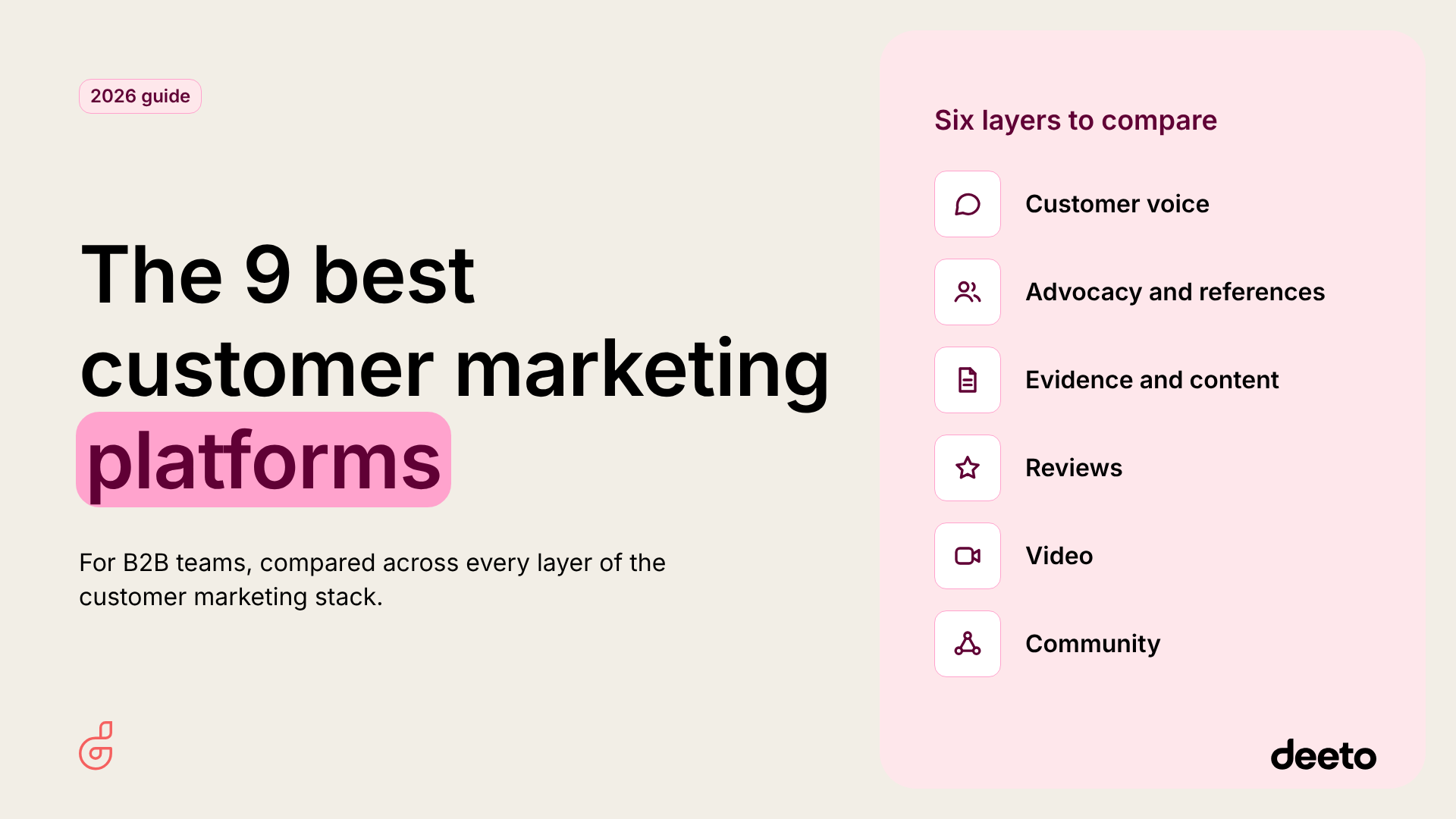
A customer marketing platform is software that helps B2B teams turn existing customers into references, stories, reviews, and advocates, then puts that proof where sales and marketing actually use it. The best customer marketing platforms for 2026 are Deeto, Base, UserEvidence, Influitive, SlapFive, Gainsight Customer Communities, ReferenceEdge, Vocal Video, and G2.
Quick picks by scenario:
- Best for lean customer marketing teams: Deeto, one system for customer voice, advocacy, references, and stories.
- Best for Salesforce-first reference programs: ReferenceEdge, which runs natively on Salesforce records.
- Best for video-only testimonials: Vocal Video, for polished customer video without a production crew.
- Best for review generation: G2 Marketing Solutions.
- Best for a peer community: Gainsight Customer Communities.
Below, you'll see what each one does well, where it stops, and how to build a stack that fits your team.
What is a customer marketing platform?
A customer marketing platform is the system a customer marketing team uses to find advocates, collect their voice, and activate it across the revenue team. It replaces the spreadsheet of "who said yes last time" with a searchable record of customers, their stories, and their availability.
These platforms help with three jobs:
- Sourcing. Spotting happy, willing customers from CRM data, product signals, surveys, and conversations.
- Capturing. Turning those customers into references, quotes, case studies, reviews, and video.
- Activating. Getting that proof to the rep, the campaign, or the web page that needs it, then measuring what it influenced.
If you're new to the function itself, start with our guide to what customer marketing is. This post covers the software that runs it.
Why the customer marketing stack matters more in 2026
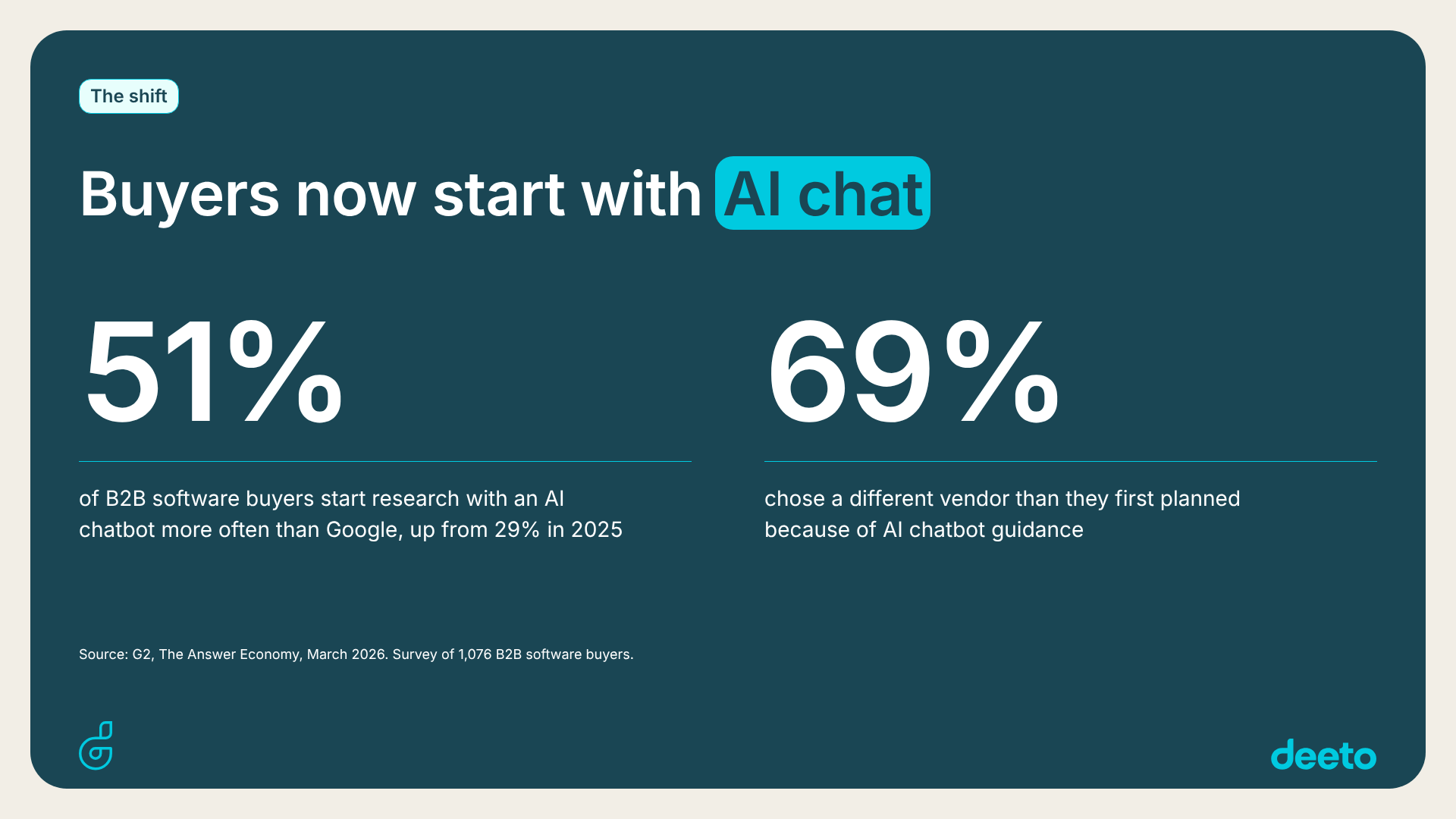
Buying research has moved into AI chat. In G2's March 2026 survey of 1,076 B2B software buyers, 51% said they now start software research with an AI chatbot more often than with Google, up from 29% in its 2025 report. The same research found that 69% of buyers chose a different vendor than they first planned because of AI chatbot guidance.
Here's what that means for customer marketers. AI answers are assembled from what your customers have said in public: reviews, published stories, quotes on your site, and third-party proof. A customer marketing team that ships fresh, specific proof is feeding the shortlist. A team with three tired case studies from 2023 is invisible at the moment buyers decide who to call.
That raises the bar for your tools. In 2026 they have to keep proof flowing continuously instead of producing one story a quarter.
What a B2B customer marketing stack needs to cover
Analysts have been splitting this market into narrower categories for years. In early 2024, Forrester grouped customer advocacy tools into separate buckets for advocacy engagement and reference management, with community and content tools alongside them.
That split is useful for evaluation. It also explains why so many customer marketing teams run four or five disconnected tools and still can't answer "which customers influenced this deal?"
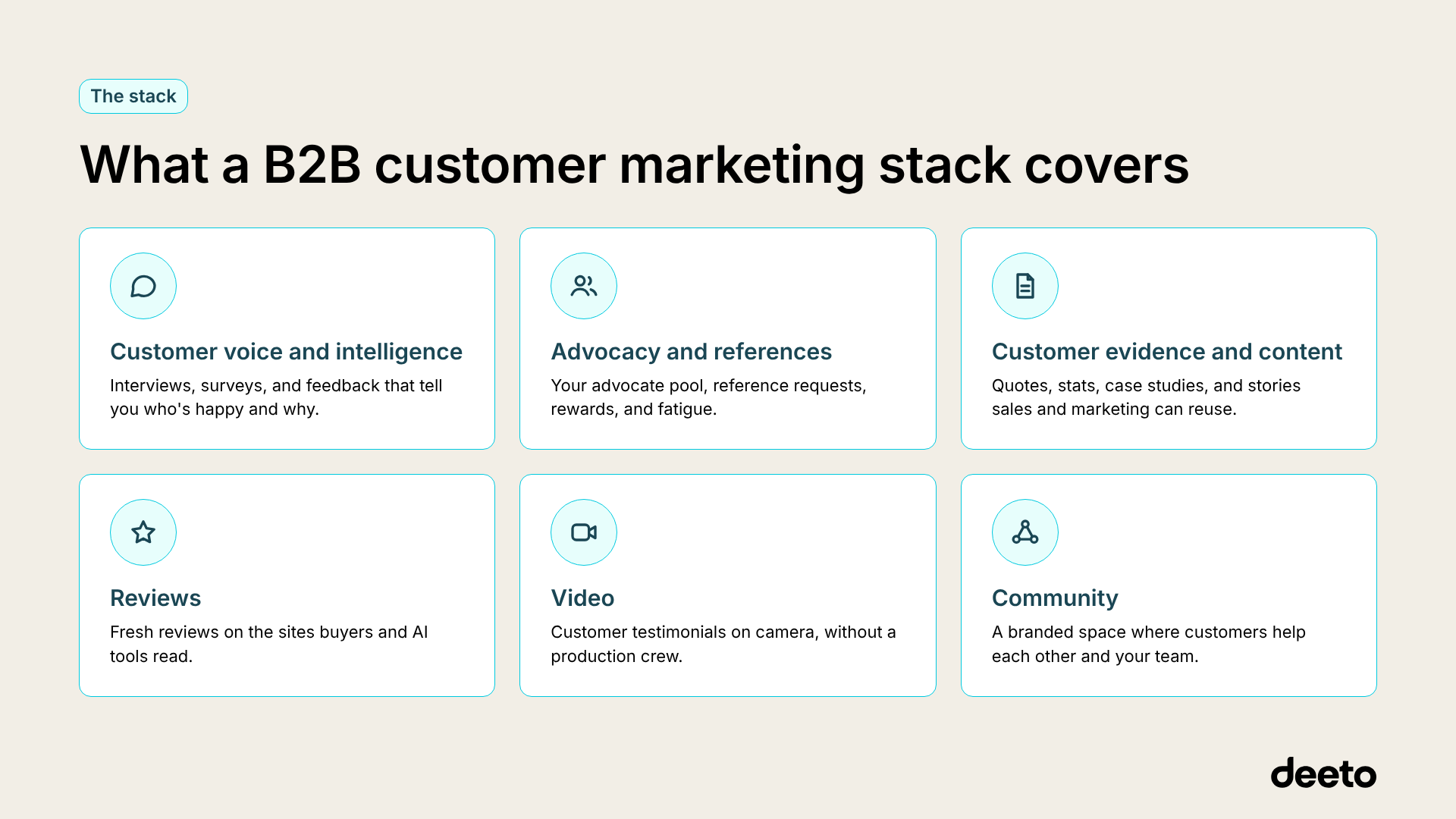
B2B customer marketing solutions typically fall into one or more of these layers:
- Customer voice and intelligence. Interviews, surveys, and feedback that tell you who's happy and why.
- Advocacy and references. Managing your advocate pool, reference requests, rewards, and fatigue.
- Customer evidence and content. Quotes, stats, case studies, and customer stories and social proof that sales and marketing can reuse.
- Reviews. Generating fresh reviews on the sites buyers and AI tools read.
- Video. Collecting customer testimonials on camera without a production crew.
- Community. A branded space where customers help each other and engage with your team.
Customer proof loses value every day it sits in a folder nobody searches. The tools below differ mostly in which layers they cover and how well they connect proof to the people who need it.
How we chose these platforms
We focused on platforms that B2B customer marketing and advocacy teams actually evaluate. Each tool was assessed on:
- Which stack layers it covers, and how deeply
- How well proof reaches sales and marketing workflows (CRM, Slack, enablement tools)
- Fit for lean teams versus teams with dedicated program managers
- Recent product and company developments, verified as of November 2026
We built Deeto, so it's on this list. We've tried to be specific about where every platform, ours included, is the wrong choice.
Customer marketing software compared
The 9 best customer marketing platforms for B2B teams
1. Deeto
Deeto is a voice of the customer platform for B2B companies. It captures customer voice through AI-led interviews, surveys, and in-product microfeedback, then turns it into references, stories, reviews, and proof that sales and marketing can use without filing a request.
Customer marketing is where teams start with Deeto, not where it ends. The same customer voice becomes intelligence that Deeto activates where work happens, for product teams deciding what to build, executives tracking how customers feel, and go-to-market teams working live deals.
Everything lives in one record of each customer's feedback, stories, approvals, and reference history. Deeto's reference management matches the right customer to the right prospect from opt-in, reference-ready pools, so the same five champions don't get every call.
For a customer marketing team, the payoff is a bigger advocate bench with less manual chasing. Further down the funnel, Deeto customers report 20 to 30% faster sales cycles and 10 to 15% higher win rates. Proof shows up inside the tools reps already use through integrations with Salesforce, HubSpot, and Slack.
Best for: Teams that start in customer marketing and want customer voice to power references and stories, then reach product, executives, and GTM from the same system.
Where it falls short: Deeto doesn't record calls natively. It connects with Gong for call recordings, so teams without Gong will capture voice through Deeto's interviews and surveys instead. It also isn't a peer-to-peer community forum.
Pricing: Quote-based, scaled to program size and use case.
2. Base
Base (formerly Crowdvocate) positions itself as an AI-powered platform for customer marketing in B2B SaaS. It covers advocacy, references, community, lifecycle campaigns, and upsell programs from one suite.
Base has grown quickly through acquisitions. It acquired Laudable for conversation insights and social proof in February 2025 and acquired 3bears.ai for behavioral analytics in March 2025. In January 2026 it acquired EverAfter to add digital customer success and build what it calls an "Engagement OS."
Best for: Customer marketing teams that also own lifecycle campaigns and post-sale engagement and want one vendor for all of it.
Where it falls short: A suite assembled through recent acquisitions deserves a careful demo. Ask to see the workflows you'll run every week, end to end, rather than a feature tour. Broad scope can also mean longer configuration.
Pricing: Quote-based. No public pricing.
3. UserEvidence
UserEvidence started as a customer evidence platform. It sends automated surveys across the customer lifecycle and turns responses into verified stats, quotes, and mini case studies that sync into tools like Salesforce, Slack, Seismic, and Highspot. It also pulls in G2 and TrustRadius reviews.
In August 2025, UserEvidence acquired Zealot, an advocacy and reference management platform, and raised $7 million. Its platform now lists advocacy, references, and community alongside the core evidence product.
Best for: Product marketing and customer marketing teams that need a high volume of segment-specific, verified proof points, especially in industries where customers rarely go on record by name.
Where it falls short: Its strength is survey-based proof at scale. Teams that need rich narrative stories, live reference matching, or continuous interview-based insight should test those workflows closely. We compare the two approaches in our UserEvidence alternatives guide.
Pricing: Quote-based.
4. Influitive
Influitive is one of the longest-running names in customer advocacy. Its AdvocateHub runs gamified communities where customers complete challenges, earn points, and redeem rewards for actions like reviews, referrals, and case study participation.
In December 2023, Influitive was acquired by Jigsaw Interactive, part of the ESW Capital portfolio, as Forrester noted at the time. Since then, some customers have described a move to chatbot-first support and higher renewal pricing in reviews on G2 and TrustRadius. If you're evaluating it, ask about the current support model and renewal terms up front.
Best for: Established programs with a dedicated advocacy manager running an always-on, gamified community.
Where it falls short: Gamification only works when someone feeds it new challenges every week. Lean teams often struggle to keep the hub active, and the community model is less suited to fast reference matching for live deals. We cover the advocacy-specific options in more depth in our roundup of the best customer advocacy platforms.
Pricing: Quote-based.
5. SlapFive
SlapFive is a customer marketing and advocacy platform that has been in the market since 2015. It acts as a system of record for customer stories, references, and advocate activity, with AI features for surfacing new advocates and reusing content.
Best for: Customer marketing teams that want a dedicated home for story capture, reference management, and advocate engagement.
Where it falls short: SlapFive is a smaller vendor with fewer public reviews than the larger names here. Check support capacity, roadmap, and integrations against your stack before you commit.
Pricing: Subscription tiers, quote-based.
6. Gainsight Customer Communities
Gainsight Customer Communities is the community product formerly known as inSided, which Gainsight acquired in 2022. It combines peer-to-peer forums, a knowledge base, product feedback and ideation, and in-app engagement. In May 2026, Gainsight launched Developer Studio for building custom community widgets, along with an integration that connects the community to Skilljar for customer education.
Best for: Customer success-led organizations that want a branded community connected to retention and adoption, especially teams already on Gainsight.
Where it falls short: Communities need moderation, content, and time before they pay off. The product is built around support and success outcomes, so you'll still need separate tooling for references, case studies, and review generation.
Pricing: Quote-based.
7. ReferenceEdge by Point of Reference
ReferenceEdge is a 100% Salesforce-native customer advocacy and reference management app from Point of Reference, which has been in the space since 2003. Reference data, advocate profiles, and assets like case studies and logos live directly on Salesforce records, and reporting ties reference activity to pipeline.
Best for: Enterprise reference programs that run entirely inside Salesforce and want reference activity reported next to opportunities.
Where it falls short: Being Salesforce-native is the point, and it's also the constraint. Expect to need a Salesforce admin for setup and changes, and don't expect much help capturing new customer voice or content. For a fuller look at this category, see our guide to customer reference management software.
Pricing: Per-user, quote-based.
8. Vocal Video
Vocal Video is a video testimonial platform. You send customers a link, they record answers to your questions from a browser, and the platform automatically adds branding, captions, music, and edits.
Best for: Teams that want polished customer video for web pages, campaigns, and sales without hiring a videographer.
Where it falls short: It's a point tool for video. It won't manage your advocate pool, track reference requests, or report on influenced revenue. Plans are billed annually. If written stories matter more than video, our list of case study software tools covers more options.
Pricing: Free plan available. Paid plans are billed annually.
9. G2 Marketing Solutions
G2 is where many B2B software buyers read reviews, and G2 Marketing Solutions is the vendor-side toolkit for showing up there. It includes review campaigns run with G2's campaign specialists, review widgets, managed review services, and buyer intent data.
Reviews also matter beyond G2 itself. They're one of the public sources AI tools draw on when buyers ask for a shortlist.
Best for: B2B software companies whose buyers check G2 and want a steady flow of recent reviews.
Where it falls short: It covers one review site. Keeping review recency high requires ongoing campaigns, and it doesn't help with references, stories, or video.
Pricing: Free vendor profile. Paid tiers for review generation and intent data.
How to choose the right customer marketing solution
No single tool covers every layer equally well. Start with the problem that costs you the most today, then check how each option connects to the rest of your stack.
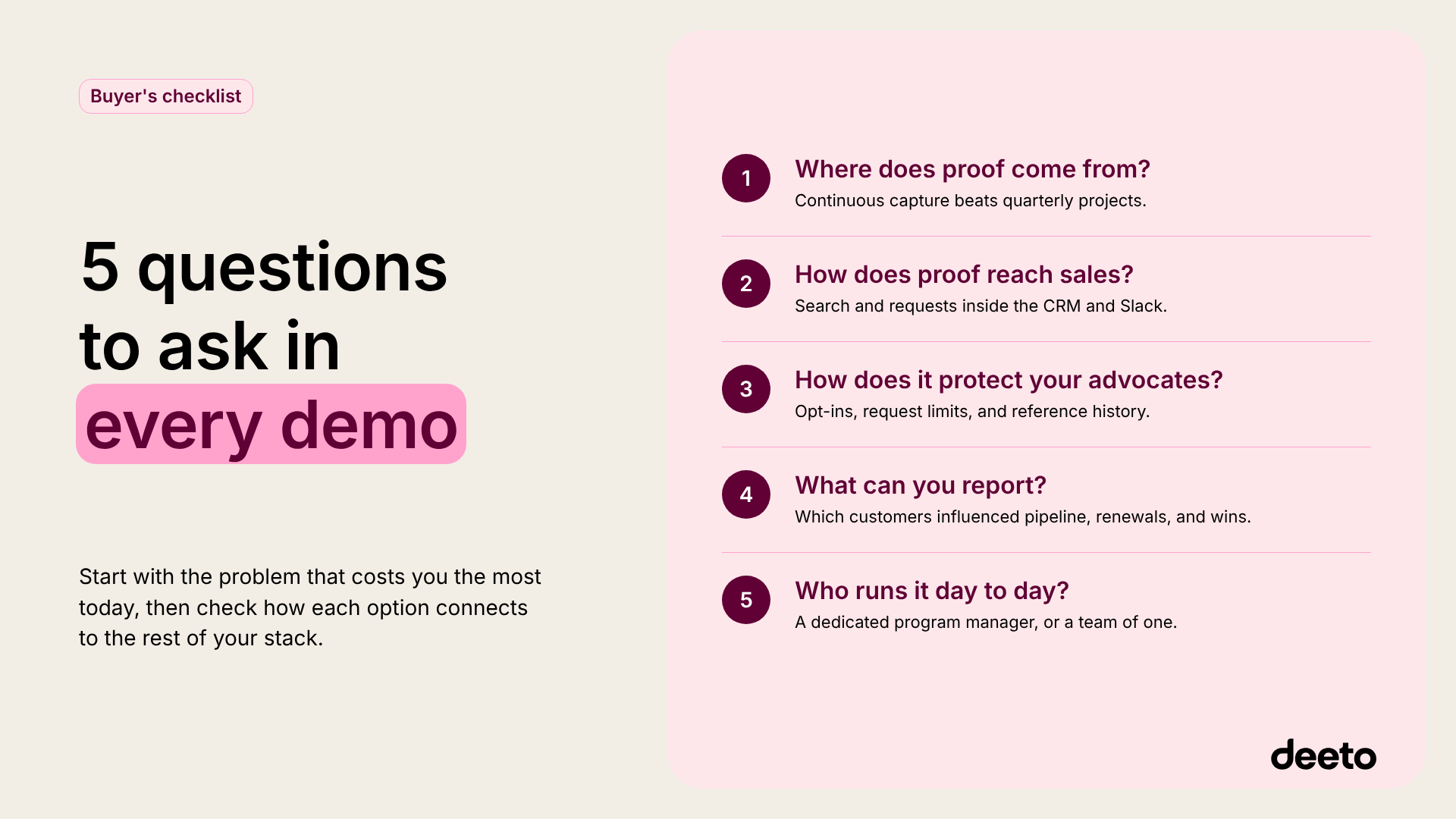
Ask these questions in every demo:
- Where does proof come from? Surveys, interviews, calls, reviews, or manual uploads. Continuous capture beats quarterly projects.
- How does proof reach sales? Look for search and requests inside the CRM and Slack, where reps already work.
- How does it protect your advocates? Ask about opt-ins, request limits, and reference history so your best customers don't burn out.
- What can you report? You should be able to show which customers influenced pipeline, renewals, and wins.
- Who runs it day to day? Some tools need a dedicated program manager. Others are built for a team of one.
A practical pattern for lean B2B teams is one core system for customer voice, advocacy, and references, plus specialist tools for reviews or video where needed. That keeps the advocate record in one place while still covering every channel.
Key takeaways
- A customer marketing platform helps B2B teams source advocates, capture their voice, and activate proof across sales and marketing.
- The stack spans customer voice, advocacy and references, evidence and content, reviews, video, and community. Few tools cover all six well.
- Buyers increasingly start research in AI chat, so fresh, public customer proof now shapes vendor shortlists.
- Deeto fits teams that start in customer marketing and want customer voice to reach product, executives, and GTM. Specialist tools like Vocal Video and G2 fill single channels.
- Judge every option on how proof reaches the rep and how well it protects your advocates.
FAQs
What is a customer marketing platform?
A customer marketing platform is software that helps B2B companies turn existing customers into advocates, references, reviews, and stories. It tracks which customers are willing to help, captures their feedback and proof, and delivers that proof to sales and marketing teams. The best platforms also report on how customer advocacy influences pipeline, renewals, and closed deals.
What is the difference between a customer marketing platform and a customer advocacy platform?
A customer advocacy platform focuses on managing advocates and the asks you make of them, such as reviews, referrals, and reference calls. A customer marketing platform covers a wider scope, including customer voice, evidence and content creation, lifecycle engagement, and community. Many vendors now offer both, so compare actual workflows rather than category labels.
What features should a customer marketing platform have?
Look for advocate profiles with opt-in preferences, automated reference requests and matching, story and quote capture, a searchable proof library, and CRM integrations with tools like Salesforce and HubSpot. Strong platforms also include fatigue controls so the same customers aren't overused, plus reporting that connects advocacy activity to pipeline and revenue outcomes.
How much does a customer marketing platform cost?
Most B2B customer marketing software uses quote-based pricing tied to program size, number of users, and modules. Point tools for video testimonials or reviews often publish entry plans, while broader platforms for advocacy, references, and customer voice usually require a sales conversation. Budget for setup and integration time as well as the license itself.
Can one platform cover the whole customer marketing stack?
Some platforms cover several layers, such as customer voice, advocacy, references, and content, in one system. Few cover every channel equally well. Many B2B teams run one core platform as the system of record for advocates and proof, then add specialist tools for review generation, video testimonials, or a peer community where those channels matter most.
Which customer marketing tool works best with Salesforce?
ReferenceEdge is fully Salesforce-native, which suits teams that want reference data stored on Salesforce records. Deeto, UserEvidence, and Base integrate with Salesforce so reps can find and request proof from the CRM while customer voice and content are managed in the platform. The right choice depends on whether you need native storage or broader capture and activation.
Conclusion
The best customer marketing platform is the one that keeps fresh proof moving from your customers to your buyers without your team acting as the switchboard. For some teams that means a specialist tool for video or reviews. For most B2B customer marketing teams, it starts with one system that knows who your advocates are, what they've said, and where their voice is needed next.
Deeto is built to be that system, so book a demo to see it with your own customers.
🎉 Save your spot
Register for the event
Once your spot is secured, we’ll send your confirmation details.
Subscribe to our newsletter
Subscribe to receive the latest blog posts to your inbox every week.
By subscribing, you agree to our Privacy Policy
Subscribe to our newsletter
Get the latest news and updates from our team.
By subscribing, you agree to our Privacy Policy
Related posts

Win/Loss Survey Questions: What to Ask and Why

26 win/loss survey questions to ask buyers after won, lost, and no-decision deals, and what each answer tells you.

8 Best Customer Advocacy Platforms for B2B Companies in 2026
Compare 8 customer advocacy platforms for B2B. See what each one does, who it fits, and how to choose.

7 Best Influitive Alternatives & Competitors in 2026
Compare 7 Influitive alternatives & competitors and see which one fits your customer advocacy program.


