UserEvidence Alternatives & Competitors: 6 Tools Ranked for 2026



Thursday, January 8, 2026


UserEvidence Alternatives & Competitors: 6 Tools Ranked for 2026


View the podcast on Youtube

Most tools in the customer evidence space will tell you they help you "turn customers into advocates." The pitch sounds the same. The demos look similar. And then you get six months in and realize the tool was built for a different job than the one you're actually doing.
That's what makes evaluating tools in this space harder than it looks. It's not a feature checklist problem. It's a philosophy problem. UserEvidence was built around a specific thesis: that the gap between having happy customers and using them in sales cycles is fundamentally an evidence distribution problem. Surveys, verification, enablement sync. That model works well for certain teams.
But a lot of B2B marketing and CS teams don't just need proof distributed. They need customer voice understood. They need it connected to product decisions, renewal conversations, messaging strategy, and competitive positioning, not just pushed into Seismic before a deal closes.
This post covers six UserEvidence alternatives and is direct about what each one actually does well, and where each one falls short.
What UserEvidence does and where it stops
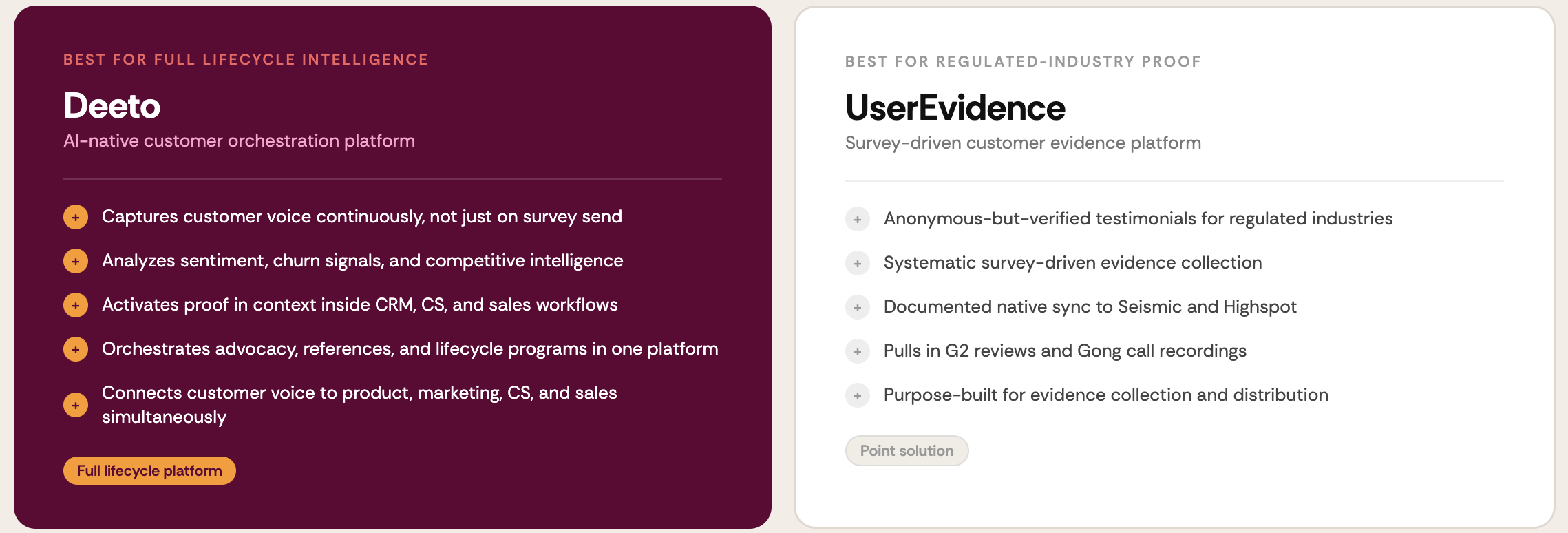
UserEvidence is a customer evidence platform. It collects proof through surveys, pulls in G2 reviews and Gong call recordings, organizes that content by segment and use case, and syncs it into sales enablement tools like Seismic and Highspot. Its strongest differentiator is anonymous-but-verified testimonials for regulated industries, where customers won't go on record but buyers still need credible social proof.
For a product marketer at a cybersecurity company trying to build a proof library that sales can actually use, UserEvidence is a solid fit. The survey-driven collection model is systematic, the enablement integrations are documented, and the verification methodology gives enterprise buyers something to trust.
Where it stops: UserEvidence is a collection and distribution system. It doesn't capture voice continuously. It doesn't analyze signal across the customer lifecycle. It doesn't connect what customers say to what your product team prioritizes or what your CS team sees in a renewal risk conversation. If those are the jobs on your list, you're going to outgrow it.
6 UserEvidence alternatives, ranked
1. Deeto
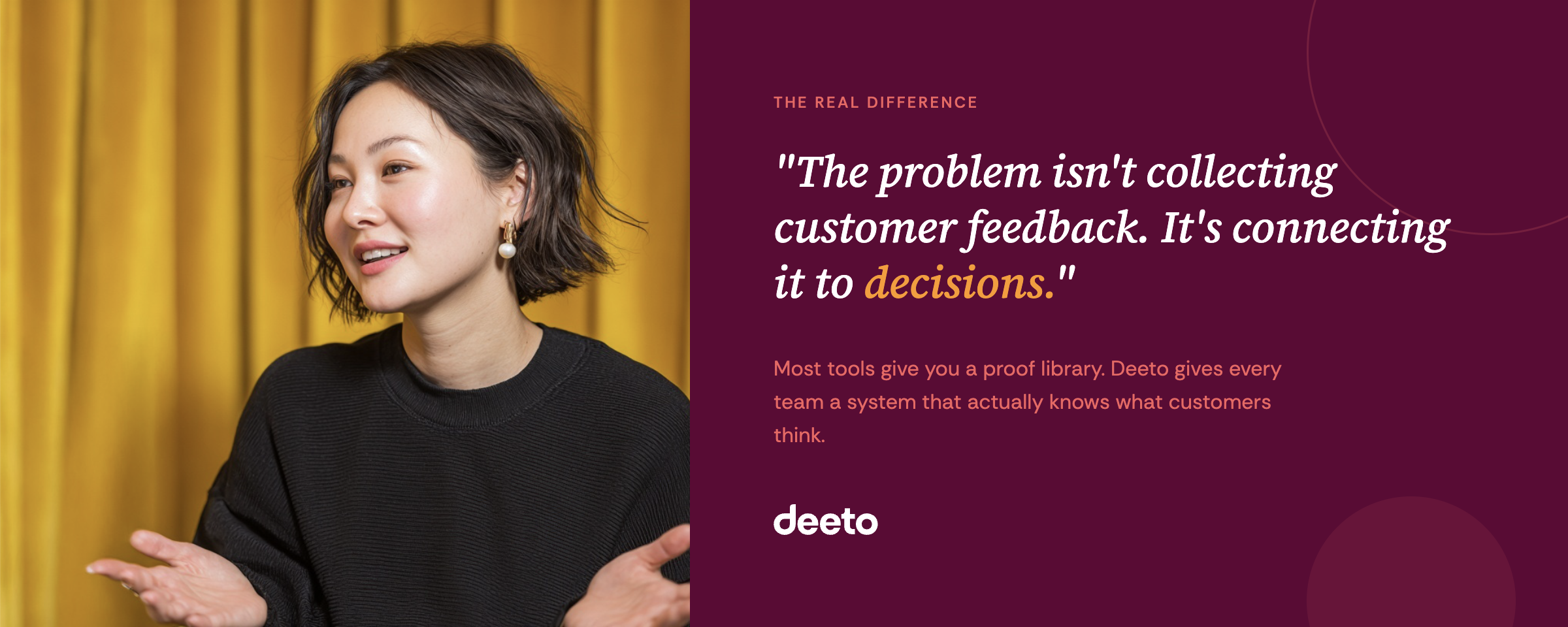
Deeto is built around a different premise than UserEvidence. Where UserEvidence starts with the question "how do we collect and distribute proof," Deeto starts with "what does customer voice actually tell us, and how do we connect that intelligence to every team that acts on it."
That difference shapes everything about how the platform works.
Deeto's Listen module captures customer voice continuously, through AI-powered interviews, surveys, in-product microfeedback, and structured question sets. Not as a one-time survey campaign. As a live feed of signal that flows into everything else.
From there, the platform's Learn module organizes that intelligence into a connected system of record, tied to companies, contacts, and assets, so the knowledge compounds over time instead of sitting in a spreadsheet someone exports once a quarter.
The Analyze module turns that voice into intelligence. Sentiment patterns, competitive signals, churn indicators, product feedback clusters. The kind of output that changes how a PMM builds a launch narrative or how a CS team approaches a QBR, not just which case study gets attached to a deal.
Activate delivers the right customer insight to the right person at the right moment, inside the workflows they're already using. And Orchestrate ties it together: lifecycle automations, reference management, advocacy programs, referral coordination, all running without manual overhead.
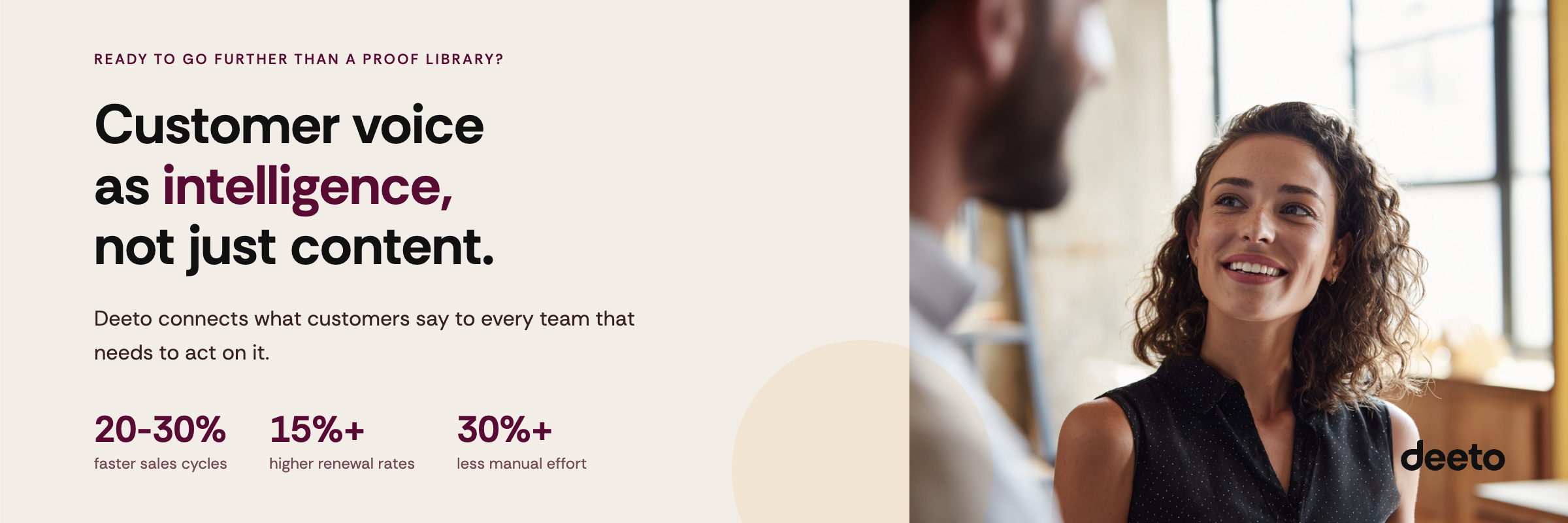
The practical result: teams using Deeto report 20-30% faster sales cycles, 10-15% higher renewal rates, and 30%+ reduction in manual effort across customer marketing and sales workflows. Those numbers come from having intelligence connected to action, not just evidence available somewhere.
Deeto makes sense when your team has moved past "we need a proof library" and into "we need a system that makes every team smarter about customers." See the platform.
Best for: Product marketers building messaging grounded in real customer signal. Customer marketers running lifecycle advocacy programs. CS teams that want early visibility into risk and expansion before it becomes a fire drill. Sales teams that need proof in context, not proof in a folder.
Where UserEvidence has an edge: If anonymous-but-verified testimonials for regulated industries are the primary requirement, UserEvidence's verification methodology is purpose-built for that problem.
2. Influitive
Influitive builds gamified customer communities where advocates complete challenges, earn badges, and stay engaged over time through reward mechanics. It's a program-depth play: multi-tier advocacy journeys, user-generated content campaigns, community spaces where customers interact with each other and your team.
The honest assessment is that Influitive works well when you have a dedicated advocacy manager, a large enough customer base to keep a community active, and the appetite for a heavy implementation. When those conditions are met, the engagement depth is real.
When they're not: reviews consistently flag an interface that feels dated, login friction for customers in multiple programs, and content repository limitations that make proof distribution harder than it should be.
Best for: Enterprise teams with a dedicated program manager and a long-horizon community strategy.
Not the right fit if: Your team is lean, your primary job is connecting customer voice to pipeline, or you need fast time to value.
3. ReferenceEdge
ReferenceEdge is a Salesforce-native reference management app. The pitch is simple: if your team lives in Salesforce and needs reference operations to live there too, ReferenceEdge puts request routing, fulfillment tracking, and revenue influence reporting directly inside your CRM without requiring anyone to context-switch.
The Salesforce integration is genuine and well-built, and for teams whose workflows live entirely in CRM, that focus is a feature rather than a limitation. Teams that rely on Seismic or Highspot as primary distribution channels may find the content-sharing features less developed, and reviews note that setup takes meaningful time to get right.
Best for: Sales operations and revenue teams where Salesforce is the single system of record and reference tracking needs to live there.
Not the right fit if: You need broader evidence distribution, customer voice capture, or lifecycle advocacy alongside reference coordination.
4. SlapFive
SlapFive combines reference management with customer story organization and Salesforce integration. The platform lets you build content hubs organized by segment, track how customer stories influence pipeline, and run reference programs with bi-directional CRM sync.
The AI automation layer is built on an underlying workflow framework that's powerful but not self-serve. Configuring new automations typically requires SlapFive team involvement rather than in-platform customization, which is a meaningful constraint for teams that want to iterate quickly on their own.
User reviews from the 2025 Customer Marketing Technology Landscape Report scored technical support at 3.5/5 and product reliability at 3.8/5. A small vendor team means focused attention, but also limited bandwidth as your needs grow.
Best for: Teams that want Salesforce-centric reference management with customer story organization and are comfortable co-building workflows with the vendor.
Not the right fit if: You need self-serve workflow configuration or a platform that scales without close vendor involvement.
5. Zuberance
Zuberance is built for referral programs and advocate activation with rewards mechanics. The Shopify integration makes it a reasonable fit for e-commerce use cases. For B2C brands that want customers to share content and refer new buyers through lightweight advocacy programs, the activation and reward mechanics are straightforward.
In B2B contexts, the lack of CRM integrations is a hard constraint. If your reference coordination, advocacy tracking, or proof distribution needs to connect to Salesforce or tie into a sales workflow, Zuberance creates friction at exactly the point where you need the system to be seamless.
Best for: B2C or e-commerce teams running referral campaigns where CRM connectivity isn't a requirement.
Not the right fit if: You operate in enterprise B2B, need to track advocacy influence in Salesforce, or want reference coordination as part of the program.
6. Peerbound
Peerbound ingests call recordings from tools like Gong, Chorus, and Clari, plus CRM data, and uses AI to identify potential advocates, generate testimonial content from those conversations, and distribute it to sales via Slack and email. It's the most lightweight option in the category, and usually the least expensive.
The ceiling shows up quickly. Reviews note ongoing maintenance requirements, limited integrations beyond the core workflow, and complexity with Salesforce parent-child account structures. It's a reasonable entry point for a customer marketer with a small budget who needs to capture testimonials from calls without standing up a full platform.
Best for: Small teams with tight budgets who need basic testimonial capture from existing calls and can live without governance, attribution, or deep enablement integrations.
Not the right fit if: You need lifecycle intelligence, reference coordination, or any reporting that connects advocacy activity to revenue.
How to actually decide
The honest frame for this category: most of these tools solve one specific problem reasonably well. UserEvidence solves evidence distribution. ReferenceEdge solves Salesforce-native reference tracking. Influitive solves long-horizon community engagement. Peerbound solves lightweight testimonial capture from calls.
Deeto is the only platform in this list that treats customer voice as an input to a connected intelligence system rather than content to be collected and distributed. That difference matters when your team's job is bigger than building a proof library. It matters when customer advocacy, competitive intelligence, product feedback, churn prediction, and sales enablement all need to draw from the same source of truth about what customers actually think and need.
If you're evaluating UserEvidence alternatives because your current setup doesn't connect those dots, that's the question worth centering your evaluation on. Not which tool has the longest feature list, but which one is built around the same job you're actually trying to do.
Key Takeaways
- UserEvidence is a survey-driven evidence platform with strong anonymous verification for regulated industries and documented Seismic and Highspot integrations but not a system for turning that voice into ongoing intelligence.
- Deeto is an AI-native customer orchestration platform that connects voice capture, intelligence analysis, and activation across the full GTM lifecycle. The scope is broader by design.
- Influitive, SlapFive, and ReferenceEdge each solve narrower problems: community engagement, Salesforce-centric content organization, and CRM-native reference tracking respectively.
- Peerbound and Zuberance are the entry-level options for teams with limited budgets and simpler requirements.
- The right choice depends on whether your primary need is evidence distribution or customer voice intelligence. Those are different architectures, not different price points.
Frequently Asked Questions
What is UserEvidence used for?
UserEvidence is used to collect, organize, and distribute customer evidence in B2B sales and marketing contexts. Teams use it to gather verified testimonials through surveys, pull in G2 reviews and Gong recordings, and sync proof into sales enablement tools like Seismic and Highspot. Its strongest use case is building proof libraries for sales teams and generating anonymous-but-verified testimonials for regulated industries where customers can't go on record publicly.
What's the difference between a customer evidence platform and a customer orchestration platform?
A customer evidence platform collects proof and makes it accessible in sales workflows. A customer orchestration platform like Deeto does that, and also captures voice continuously, analyzes it into intelligence, surfaces it across product, CS, and marketing, and runs the programs and automations that keep customers engaged over time. The evidence platform answers "what proof do we have." The orchestration platform answers "what do customers actually think and what should we do about it."
Which UserEvidence alternative is best for small teams?
For small teams that need more than just testimonials, Deeto's orchestration layer is specifically designed to reduce manual effort across customer marketing and CS workflows, making it viable without a large headcount. The tradeoff is scope: Deeto delivers more value the more of the customer lifecycle you connect.
What should I evaluate before switching from UserEvidence?
Start with the job that isn't getting done. If the gap is that customer voice isn't connected to product decisions or renewal conversations, a different distribution tool won't close it. If the gap is that your sales team can't find the right proof fast enough, look closely at how each platform handles activation inside existing workflows. And if the gap is advocate burnout from over-asking, look at how each platform tracks reference usage and manages engagement over time. Map the actual problem before evaluating features. Book a demo with Deeto to walk through a real use case side by side.
🎉 Save your spot
Register for the event
Once your spot is secured, we’ll send your confirmation details.
Subscribe to our newsletter
Subscribe to receive the latest blog posts to your inbox every week.
By subscribing, you agree to our Privacy Policy
Subscribe to our newsletter
Get the latest news and updates from our team.
By subscribing, you agree to our Privacy Policy
Related posts

6 Best Customer Testimonial Software Platforms

What is customer testimonial software? Compare six platforms by price, format, and fit for B2B teams.

Best customer intelligence tools for B2B teams
What are customer intelligence tools? Compare 8 B2B options, collection methods, and how to pick the right fit.

Omnichannel Customer Engagement Tools: 8 Platforms Compared
Compare 8 omnichannel engagement platforms on channels, AI, and pricing, plus the gap automation can't fill.