


8 Best Customer Advocacy Platforms for B2B Companies in 2026



Thursday, November 12, 2026


8 Best Customer Advocacy Platforms for B2B Companies in 2026


View the podcast on Youtube

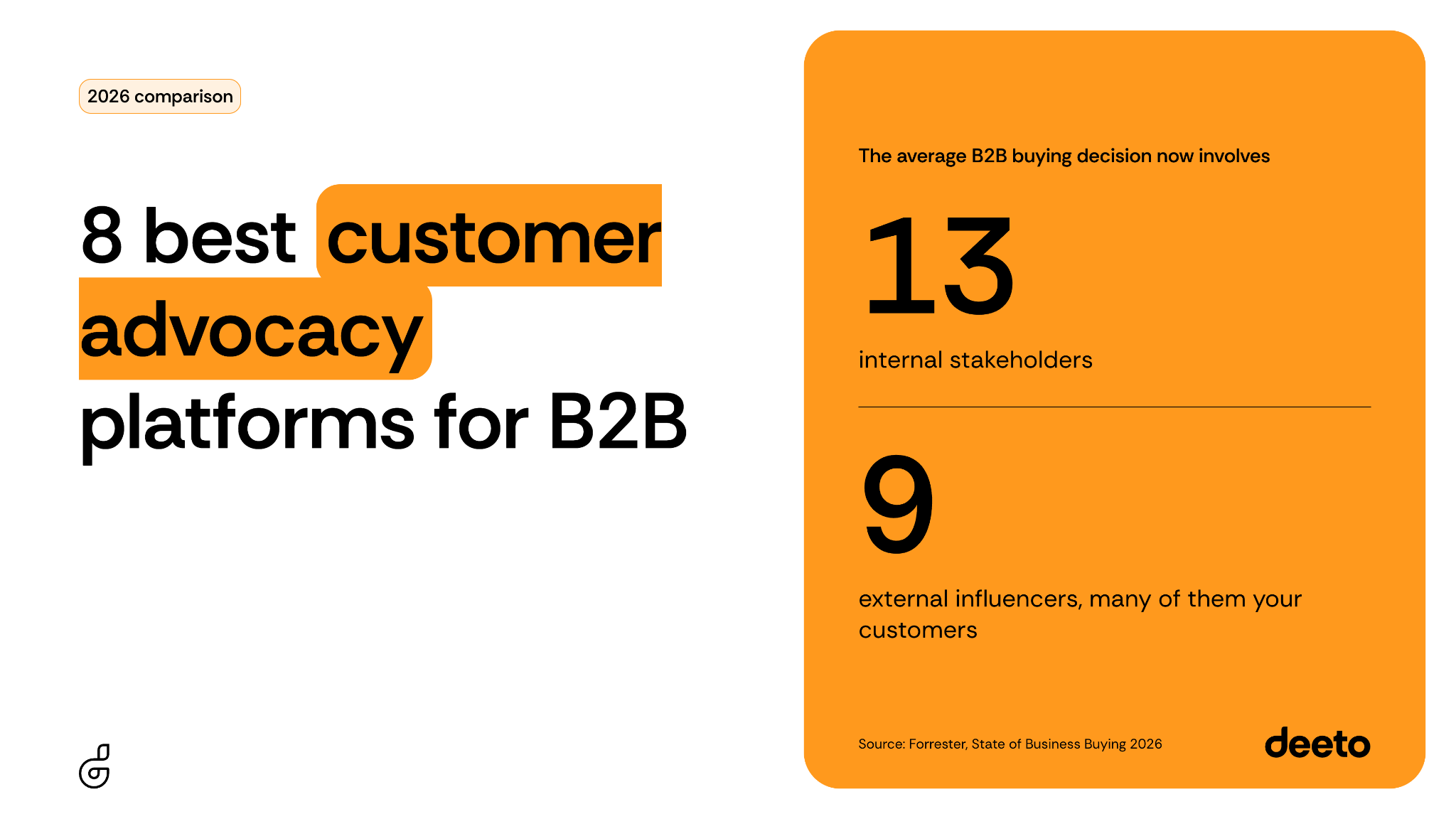
A handful of happy customers ends up fielding every reference request, case study ask, and review campaign until they quietly stop replying. Buyers lean on those customers more than ever. The average B2B purchase now involves 13 internal stakeholders and nine external influencers, according to Forrester's State of Business Buying 2026, and many of those influencers are your customers.
Customer advocacy platforms are software that help B2B companies find satisfied customers, invite them to act as references, referrers, reviewers, or storytellers, and track how that participation affects pipeline and revenue. The best ones also protect advocates from being asked too often.
Here's how eight platforms compare on finding advocates, ask fatigue, reference matching, and proof, with a short buying process at the end.
What is a customer advocacy platform?
A customer advocacy platform is the system a customer marketing team uses to run its advocacy program in one place. It replaces the spreadsheet of "happy customers," the Slack threads asking who can take a reference call, and the folder of half-approved quotes.
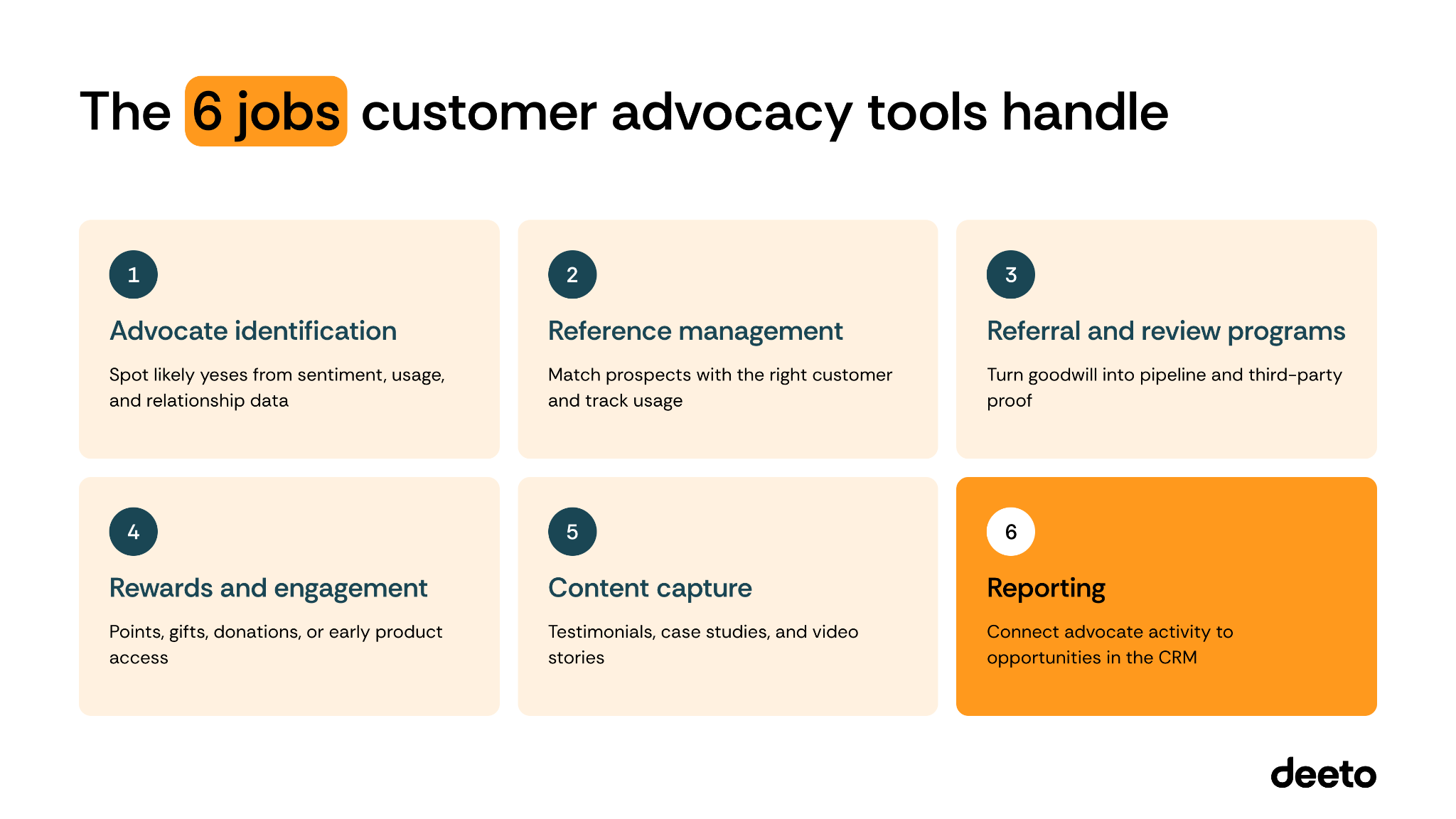
Customer advocacy tools handle some combination of these six jobs:
- Advocate identification to spot customers who are likely to say yes, based on sentiment, usage, and relationship data
- Reference management to match prospects with the right customer and track how often each one is used
- Referral and review programs that turn goodwill into pipeline and third-party proof
- Rewards and engagement such as points, gifts, donations, or early product access
- Content capture for testimonials, case studies, and video stories
- Reporting that connects advocate activity to opportunities in the CRM
Advocacy marketing software also overlaps with neighboring categories, because vendors came to it from different places. Influitive started with gamified communities, UserEvidence with customer surveys, and ReferenceEdge with reference records inside Salesforce. Those roots still shape what each product does well.
Why customer advocacy tools matter for B2B buying in 2026
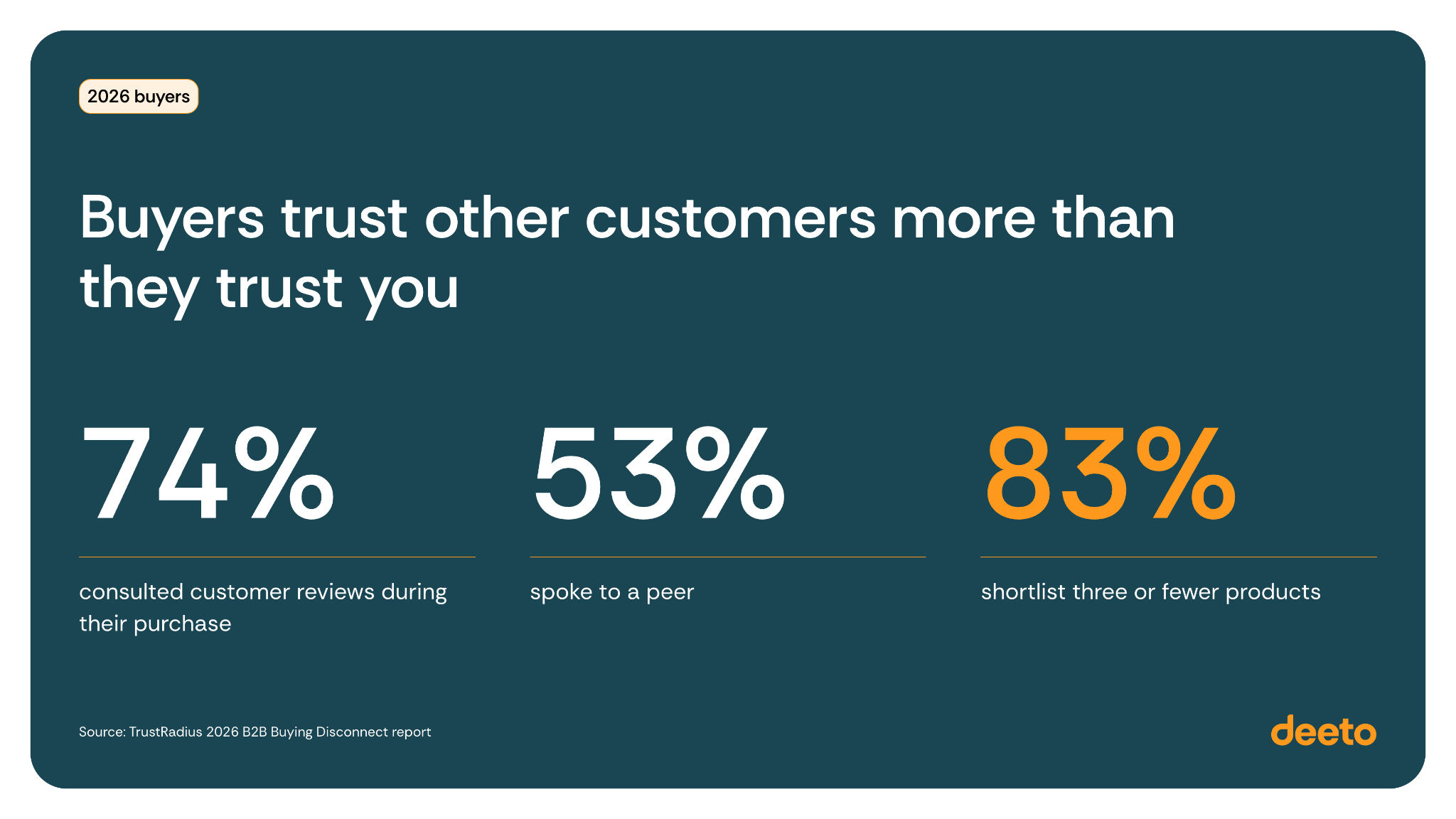
Buyers trust other customers more than they trust you. In the 2026 B2B Buying Disconnect report from TrustRadius, 74% of buyers consulted customer reviews during their purchase and 53% spoke to a peer. Every buyer who talked to a peer found it at least somewhat helpful. Vendor marketing collateral ranked last among the resources buyers use.
The same report found 83% of buyers shortlist three or fewer products. What customers say about you in reviews, reference calls, and AI-generated answers now decides a lot of those shortlists.
That puts customer marketing teams in a bind. Demand for proof keeps climbing while the pool of willing advocates stays about the same size. A handful of happy customers ends up fielding every reference request, case study ask, and review campaign until they quietly stop replying.
The hard part of customer advocacy is knowing which customer to ask, for what, and when.
A good platform treats advocate time as a limited budget. It shows who was asked recently, who fits a specific deal, and which activities are tied to closed revenue.
What to look for in advocacy marketing software
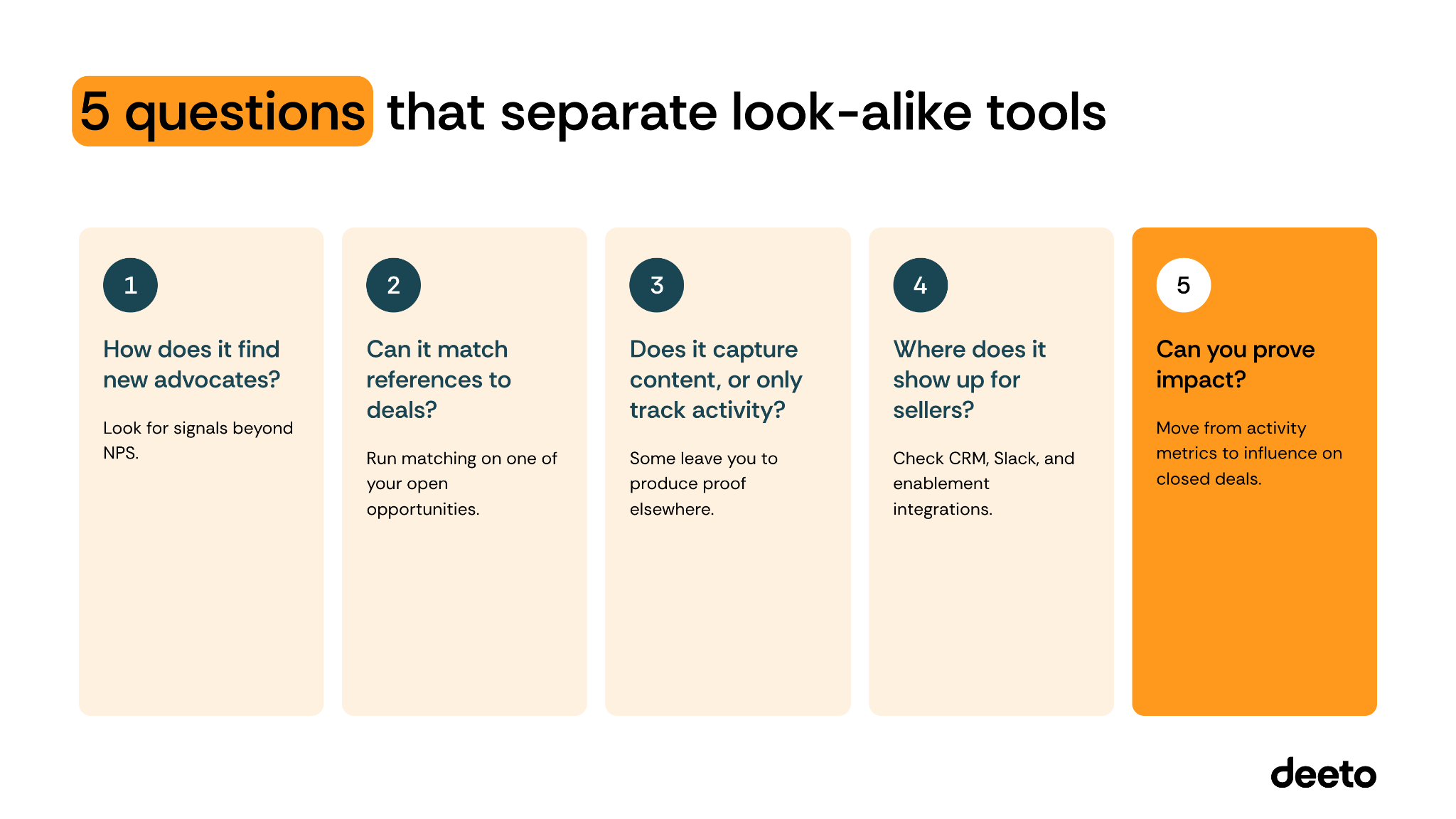
Feature lists in this category look alike. The differences show up when you ask five practical questions.
- How does it find new advocates? Look for signals beyond NPS, like interview responses, product usage, and support history. A platform that only works from a hand-tagged list keeps you stuck with the same few names.
- Can it match references to deals? Sales needs a customer in the same industry, company size, and use case, and they need one quickly. Ask each vendor to run matching on one of your open opportunities during the demo.
- Does it capture content, or only track activity? Some tools manage requests but leave you to produce the testimonial, case study, or video somewhere else.
- Where does it show up for sellers? Reps won't log into another portal to find a reference. Check for CRM, Slack, and sales enablement integrations.
- Can you prove impact? Forrester's guidance to advocacy teams is to move from activity metrics, like reference counts, to impact metrics, like reference influence on closed deals. Your platform needs to support that shift.
Customer advocacy platforms comparison chart
The 8 best customer advocacy platforms for B2B companies
1. Deeto
Best for: B2B teams that want advocacy, references, referrals, and customer proof running from the same customer voice data.
Deeto knows what each customer has said, how they feel about you, and how often they've been asked. That context comes from how it works. Deeto is an AI-native voice of the customer platform that captures customer voice through AI-led interviews and feedback, then keeps it on one record for every account and person.
Most customer advocacy programs still run on a spreadsheet and gut feel. Someone remembers who was happy last quarter, and that customer gets another ask. Deeto turns what customers say into intelligence and routes it to the people who need it. When sales needs a reference or marketing needs a story, Deeto recommends a customer who fits the request and hasn't been asked recently.
Reference management, referral programs, and customer rewards all draw on that same record, so every ask is visible before the next one goes out. Automated workflows handle requests and follow-ups.
Deeto also creates the proof, including written stories, video testimonials, and ROI studies, so customer marketing doesn't need a separate content tool. Sellers get that proof inside their CRM and Slack through Deeto's integrations. Deeto doesn't record calls natively and connects with Gong for call recordings instead.
2. Influitive
Best for: Enterprises running a staffed, hub-based advocacy community with gamification.
Influitive is one of the category's originals. Its AdvocateHub gives advocates a branded space to complete challenges, earn points and badges, share on social, submit referrals, and redeem rewards. Capterra lists integrations with Salesforce, HubSpot, and Marketo, plus a usage-based starting price of $1,499.
Jigsaw, part of private equity firm ESW Capital's portfolio, acquired Influitive in late 2023. Forrester told customers at the time to watch for changes to support, pricing, and product direction. Gamification works when someone on your team keeps the challenges fresh. For deal-by-deal reference matching, compare it against reference-first tools like ReferenceEdge.
3. UserEvidence
Best for: Teams that need statistics and verified proof points from customer surveys.
UserEvidence made its name turning customer survey responses into stats, charts, and testimonials that sales can drop into a deck. Its 2025 acquisition of Zealot added advocate recruitment, activity tracking, and reference request management. Integrations include Salesforce, Gong, Seismic, and Highspot.
If your biggest gap is quantified proof, it's a strong pick. Programs built around live references and referrals should test how deep the newer advocacy features go.
4. Base
Best for: Companies that want advocacy bundled into a broader post-sale customer platform.
Base sells itself as an AI-native platform for the whole post-sale relationship, covering references, advocacy, community, referrals, and reviews alongside onboarding, retention, and expansion. It bought EverAfter in January 2026 to add digital customer success.
That breadth pays off when one team owns everything after the sale. A dedicated advocacy team may end up paying for more platform than it uses, and most of Base's published performance numbers are self-reported.
5. ReferenceEdge by Point of Reference
Best for: Salesforce-centric enterprises with formal reference programs and long sales cycles.
ReferenceEdge runs entirely inside Salesforce. Reference requests, usage tracking, reward points, and influence reporting all live in the CRM, next to the opportunity. Capterra lists a starting price of $999 per user and integrations with Gainsight and Influitive.
Keeping reference data on the deal record is the main draw. Reviewers say the trade-off is admin work, and that deployment goes best with a dedicated team. Content creation and broader advocacy happen in other tools.
6. Upland RO Innovation
Best for: Large, regulated organizations with an established reference and customer content program.
Upland RO Innovation pairs reference request fulfillment with a library for case studies and other customer content. It has a long history in enterprise accounts, and Forrester names it among the reference management vendors B2B clients most often consider.
Mature programs with staff to manage matching and keep records current get the most from it. A one- or two-person team will probably find it heavier than necessary.
7. SlapFive
Best for: Customer marketing teams focused on customer-generated content and short video stories.
SlapFive focuses on content customers create themselves. PeerSpot lists campaign management, feedback collection, content creation, and an analytics dashboard as its core features. Teams use it to collect short recorded stories that can stand in for a live reference call early in a deal.
Pick it when content volume is the bottleneck. If you also need structured reference matching or referral tracking, confirm those workflows during evaluation.
8. Champion
Best for: Growth-stage B2B companies that want an AI-first way to find and activate advocates.
Champion is a younger AI-powered advocacy platform that helps marketing, sales, and success teams spot their most engaged customers and turn them into referrals, references, and expansion. Flyover Capital led its $3.3M seed round in 2024.
Teams starting a program with little historical data will like the AI-first setup. Because the company is at an earlier stage, ask about integration depth, security documentation, and what's committed on the roadmap.
How to choose the right customer advocacy platform
Start with the job your program has to do over the next 12 months, then work backward to the tool.
- Name the revenue goal. Decide whether the program exists to speed up deals, drive referrals, raise review volume, or produce proof for campaigns. Each goal points to a different shortlist.
- Audit your advocate pool. Count how many customers did anything for you in the past year and how often your top ten were asked. If the same names keep coming up, prioritize advocate discovery.
- Map where proof gets used. Ask sales, product marketing, and demand gen where they look for customer stories today. The platform has to deliver proof in those places.
- Check security early. Advocacy platforms store customer contact details and sometimes recorded interviews. Ask for SOC 2 reports and data handling terms before the final round. For a sense of what to request, see how Deeto documents security and compliance.
- Run a live test. Give each finalist one of your open opportunities and ask for a matching reference plus a usable proof asset. How long that takes tells you more than any demo.
If you are building a reference program from scratch, our guide on how to build a customer reference program walks through the setup before you choose software.
Key takeaways
- Customer advocacy platforms help B2B teams find advocates, match them to deals, capture proof, and connect that activity to revenue.
- Buyers listen to peers. TrustRadius found 53% of 2026 buyers spoke to a peer, and vendor collateral ranked last as a resource.
- The biggest differences between advocacy tools come from their origins in community, surveys, Salesforce reference records, or customer voice data.
- Advocate fatigue stalls a lot of programs. Choose a platform that tracks how often each customer is asked and surfaces new names.
- Test finalists on a live deal before you buy.
Frequently asked questions about customer advocacy platforms
What is a customer advocacy platform?
A customer advocacy platform is software that helps B2B companies identify satisfied customers and organize their participation in references, referrals, reviews, case studies, and testimonials. It tracks every request and activity, rewards advocates for their time, and reports how advocacy affects pipeline and closed revenue. Most platforms integrate with the CRM so sales and marketing teams can find the right advocate without manual searching.
What is the difference between customer advocacy and reference management software?
Reference management software focuses on one activity, matching prospects with existing customers for reference calls and tracking how often each customer is used. Customer advocacy software covers a wider range of activities, including referrals, reviews, rewards, community engagement, and content creation. Many modern platforms do both, but tools built for references first often need other systems for content and referral programs.
How much do customer advocacy platforms cost?
Most customer advocacy platforms use custom, quote-based pricing tied to program size, number of users, and features. Public listings give a rough range. As of October 2026, Capterra lists Influitive starting at $1,499 and ReferenceEdge starting at $999 per user. Expect enterprise contracts to cost more once you add integrations, rewards budgets, and services.
What features should advocacy marketing software include?
Look for advocate identification based on customer signals like sentiment and usage, reference matching by industry and use case, request tracking that prevents over-asking, rewards management, and content capture for testimonials and video. CRM and Slack integrations matter because sellers rarely log into separate tools. Reporting should connect advocate activity to influenced opportunities and closed revenue rather than counting activities.
How do you measure the ROI of a customer advocacy program?
Measure advocacy ROI by tracking influenced pipeline and closed revenue for deals that used a reference, referral, or customer proof asset. Compare win rates and sales cycle length for those deals against deals without advocacy. Add referral-sourced pipeline and the value of reviews generated. Forrester recommends shifting from activity metrics, like reference counts, to impact metrics like influence on closed deals.
Can small B2B teams use customer advocacy tools?
Yes. Smaller B2B teams often benefit most because one or two people run the whole program. The right platform automates requests, follow-ups, and rewards so the team spends its time on relationships instead of spreadsheets. Look for fast setup, native CRM integration, and built-in content capture so you don't need separate tools for testimonials, references, and referrals.
Conclusion
Any platform on this list can store advocates and log a reference call. The difference is whether it helps you ask the right customer for the right thing at the right moment, and whether you can show what that ask was worth.
Start with your revenue goal, be honest about how thin your advocate pool is, and test each finalist on a live deal. If your best customers are already tired of hearing from you, that's the problem to solve first.
To see how Deeto connects customer voice to advocacy, references, and referrals for customer marketing teams, book a demo.
🎉 Save your spot
Register for the event
Once your spot is secured, we’ll send your confirmation details.
Subscribe to our newsletter
Subscribe to receive the latest blog posts to your inbox every week.
By subscribing, you agree to our Privacy Policy
Subscribe to our newsletter
Get the latest news and updates from our team.
By subscribing, you agree to our Privacy Policy
Related posts

7 Best Influitive Alternatives & Competitors in 2026

Compare 7 Influitive alternatives & competitors and see which one fits your customer advocacy program.

Voice of the Customer Examples: How B2B Teams Put VoC to Work
See how six B2B teams turned voice of the customer into stories, references, and measurable results.

5 Stages of a Customer Journey Marketing Funnel
What is a customer journey marketing funnel? Learn the five stages, the metrics for each, and how proof connects them.


