


Win/Loss Survey Questions: What to Ask and Why



Tuesday, November 17, 2026


Win/Loss Survey Questions: What to Ask and Why


View the podcast on Youtube

Your CRM says the deal was lost on price. Ask the buyer and you'll often hear a different story, one about a reference call that never happened or a competitor who showed up first.
A win/loss survey is a short questionnaire sent to buyers after a deal closes, won or lost, asking why they chose the vendor they chose. Good questions focus on the buyer's side of the deal: what started the search, who made the shortlist, what tipped the decision, and how your sales process felt to them.
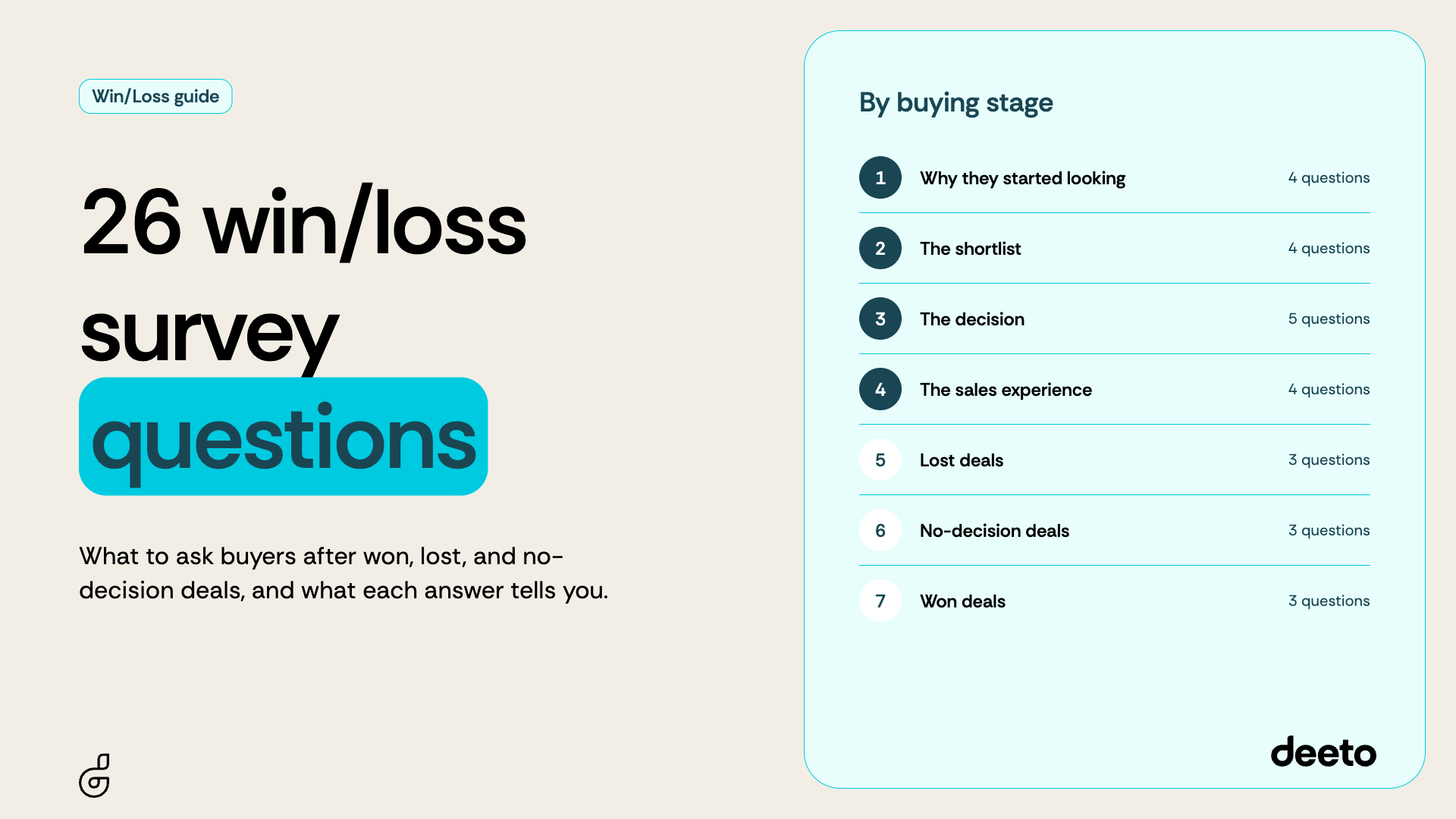
Here are 26 buyer-facing questions grouped by stage, plus interview follow-ups. If you run customer marketing, watch the won-deal answers. Your next references start there.
What is a win/loss survey?
A win/loss survey is the buyer-facing half of win/loss analysis. Your team decides what it needs to learn. The survey is where you ask the people who actually made the decision. If you're still scoping the program itself, start with what win/loss analysis is and how it works.
Most surveys include a mix of rating scales and open-ended questions. Keep yours to 10 to 15 questions, short enough that a buyer can finish in under 10 minutes. Pick from the bank in this guide based on the deal outcome, since a lost buyer and a won buyer need different questions.
Win/loss is usually filed under product marketing, but customer marketing has as much riding on it. A buyer who just signed and explains, in their own words, why they picked you is the earliest advocacy signal you'll ever get. That answer is the first draft of a reference call, a case study, and the renewal story a year from now. For the CMO, the same responses show whether buyers heard the message the team is paying to put in front of them.
Win/loss survey vs. win/loss interview: which should you use?
A survey and an interview answer different questions. Your program may end up running both.
When a survey works better
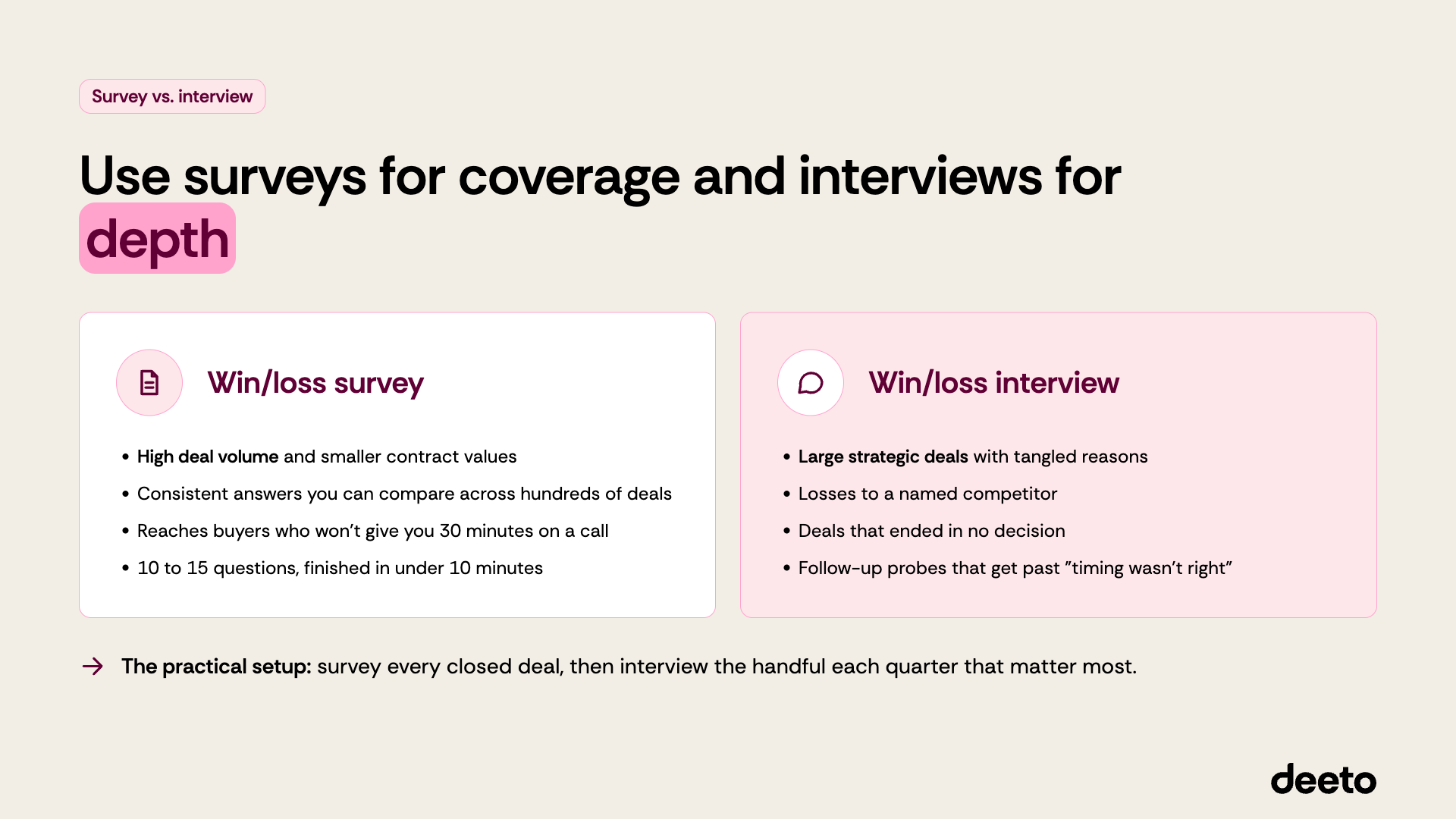
Surveys fit high deal volume and smaller contract values. They give you consistent, comparable answers across hundreds of deals, so you can spot a pattern like "security review slowed us down" showing up in a third of Q3 losses. They also reach buyers who will happily click through eight questions but won't give you 30 minutes on a call.
When an interview works better
Interviews fit large strategic deals, losses to a named competitor, and deals that ended in no decision. Those outcomes usually have tangled reasons, and a written answer rarely gets past the first layer. A good interviewer hears "timing wasn't right" and asks what changed.
The practical setup: survey every closed deal, then interview the handful each quarter that matter most. The section on win/loss interview questions further down covers the follow-up probes.
How to structure your win/loss survey
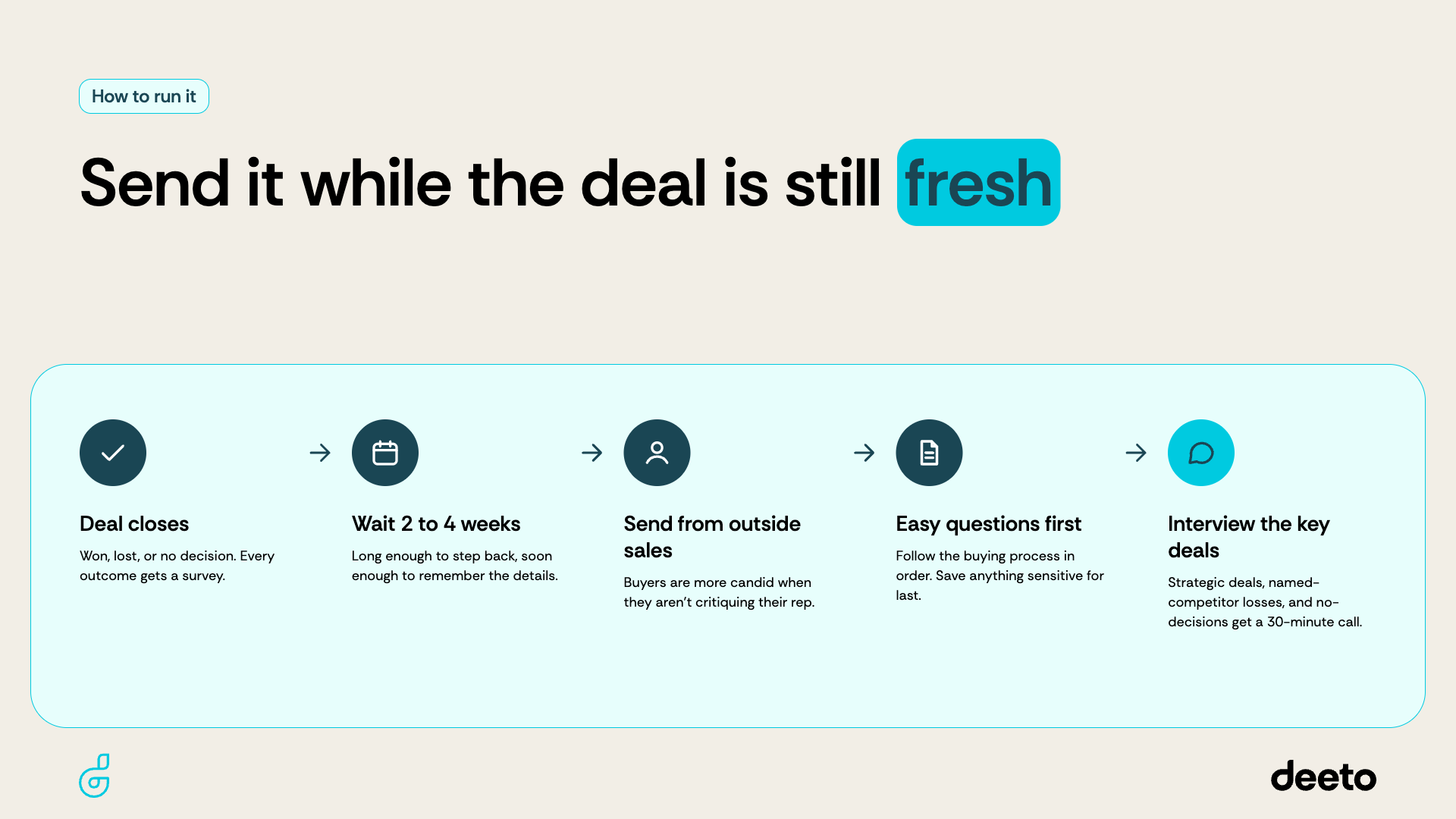
Order matters more than most teams expect. Open with easy, factual questions, then move through the buying process in the order the buyer lived it. Put sales-experience ratings and anything sensitive near the end, after the buyer has warmed up.
Send it two to four weeks after the decision, while the details are still fresh. Have someone outside the sales team send it, or use a third party. Buyers are more candid when they aren't critiquing the rep who just emailed them.
Writing the questions is the easy part. The harder problem is what happens after the answers come in. Most responses land in a spreadsheet that one PMM reads once a quarter, and by then the competitor who won those deals has moved on to the next play. Keep that in mind as you build the survey, and see the win/loss analysis best practices for cadence, sampling, and sharing results.
Win/loss survey questions to ask buyers
Each question includes a short note on what the answer tells you. Swap in your own product and competitor names where it fits.
Questions about why they started looking
- What problem were you trying to solve when you started this evaluation? The buyer's own words for the problem. Compare them to how your homepage and pitch deck describe it.
- What would have happened if you hadn't solved it this quarter? This measures urgency. Weak answers here often predict a no-decision outcome.
- Who was involved in the decision, and what did each person care about most? Maps the buying group, including the finance or security voice your rep may never have met.
- Where did you go first to research options? Peer reviews, analyst reports, AI search, a colleague's recommendation. This shapes where your buyer research and content budget should go.
Questions about the shortlist
The shortlist often decides the deal before sales gets involved. In 6sense's 2025 Buyer Experience Report, a survey of more than 4,000 B2B buyers, 94% of buying groups had ranked their preferred vendors before first contacting a seller, and the vendor they favored going in won 80% of deals.
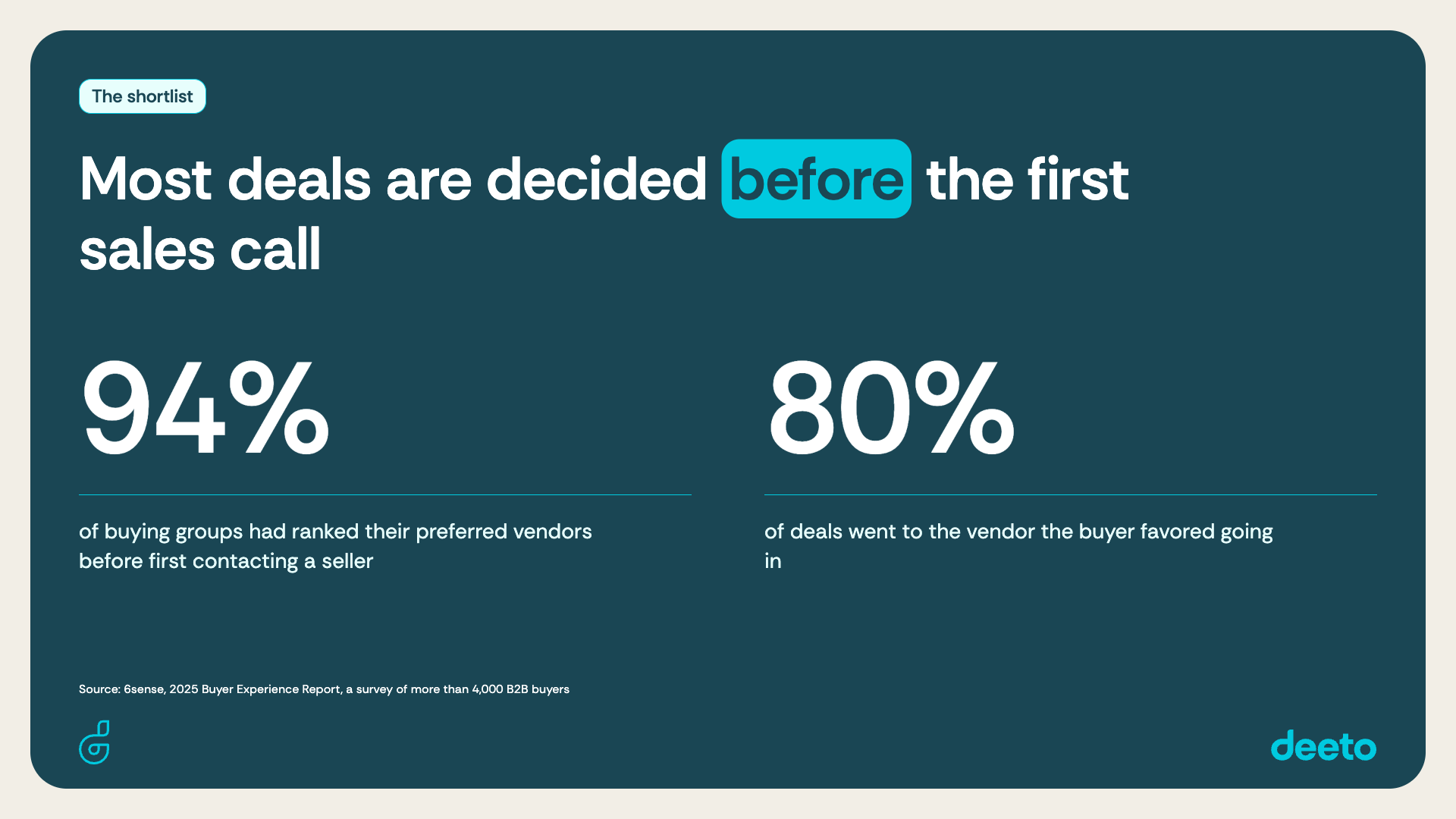
That means a lot of losses happen before your rep ever gets a meeting. Your survey should find out where you stood on day one, because no amount of late-stage discounting fixes a position you never had.
- Which vendors did you consider, and how did each one make your list?
- Before you talked to any sales rep, which vendor was your early favorite, and why? The single most useful question in this guide for product marketing. It tells you whether you're losing on positioning or on execution.
- Did that favorite change during the evaluation? What changed it?
- How did you first hear about us?
Questions about the decision
- What were the top three factors in your final decision? Ask for three. One answer gets you the polite reason, three gets you the real ranking.
- How did we compare with the vendor you chose (or the runner-up) on each of those factors? Use a 1 to 5 scale for each factor so you can trend it across deals.
- Was there a single moment or piece of information that tipped the decision? A demo, a reference call, a security answer, a pricing page. This is often where the story behind "price" shows up.
- How much did price matter compared with everything else? Price is the easiest reason for a buyer to give because it's polite and ends the conversation. Asking it relative to other factors shows whether it was the deciding issue or a tiebreaker.
- What proof did you need to feel confident, and did you get it? Case studies, peer references, ROI data. If buyers keep saying they couldn't find someone like them, that's a gap in your customer stories and social proof, and customer marketing can close it.
Questions about the sales experience
- How well did our team understand your problem? Rate from 1 to 5.
- Was there anything you asked for that you didn't get, or got too late?
- How easy was it to get answers to technical, security, or pricing questions?
- If you could change one thing about how we sold to you, what would it be?
Questions for lost deals
- What would we have needed to do differently to win?
- Was there a point when you knew we were out of the running? The timing tells you which stage of your process is leaking deals.
- Would you consider us again in the future? What would need to be true? This also flags lost accounts worth a check-in at renewal time.
Questions for no-decision deals
Programs often survey wins and competitive losses and skip this bucket entirely, but it may be your biggest one. Matthew Dixon and Ted McKenna analyzed more than 2.5 million recorded sales conversations and found that 40% to 60% of deals end with a buyer who intended to purchase but never acted, as reported in Harvard Business Review.
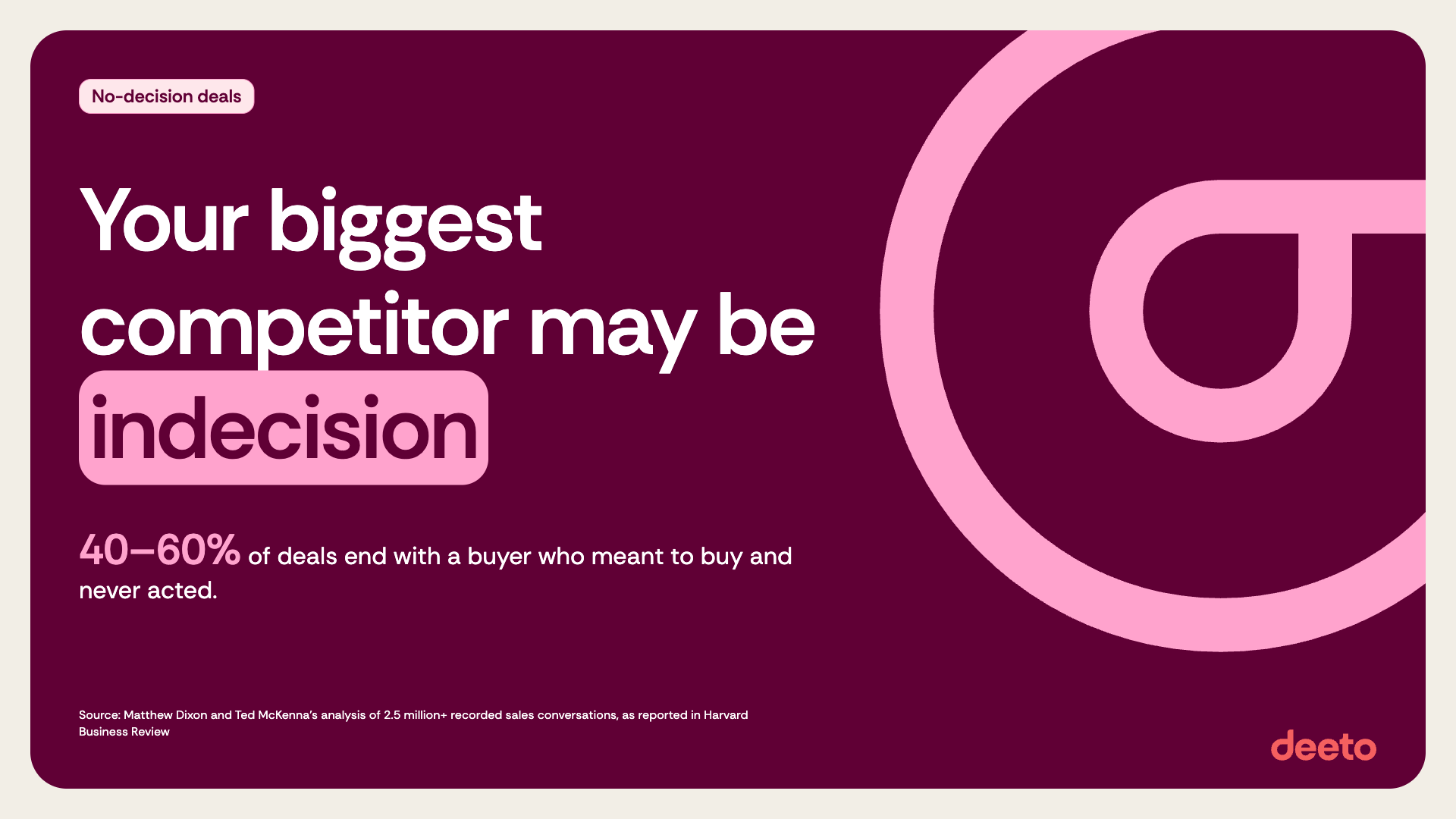
If you lose half your pipeline to indecision and only study competitive losses, you're tuning your pitch against the wrong opponent. These questions get at what stalled the buyer.
- What made you decide to hold off?
- How confident did you feel that you'd pick the right option? What would have raised that confidence? Low confidence points to a proof problem more than a product problem.
- Is the problem still there? What would restart the evaluation?
Questions for won deals
- What almost made you choose someone else? Wins hide risk. This question surfaces the near-miss before it turns into a loss next quarter.
- What will success look like for you in the first six months? Hand this answer to customer success so onboarding starts from the buyer's definition of value.
- Would you be open to sharing your experience with other buyers evaluating us? A yes here is the start of a reference. Route it straight into your customer reference program while the buyer's enthusiasm is still high.
Win/loss interview questions to go deeper
Survey answers tell you what happened. Interviews tell you why. Use these win/loss interview questions as follow-up probes on the deals that deserve a 30-minute conversation.
- "You mentioned [answer from the survey]. Can you walk me through that moment?"
- "Who pushed hardest for the option you chose, and what convinced them?"
- "What did the other vendor show you that we didn't?"
- "What did you hear about us from peers or online reviews before we spoke?"
- "If you were advising our CEO, what would you tell them to fix first?"
- "Is there anything I didn't ask that I should have?"
The last question earns its spot. Buyers often save the most useful detail for the moment they're invited to add anything.
Which survey questions to leave out
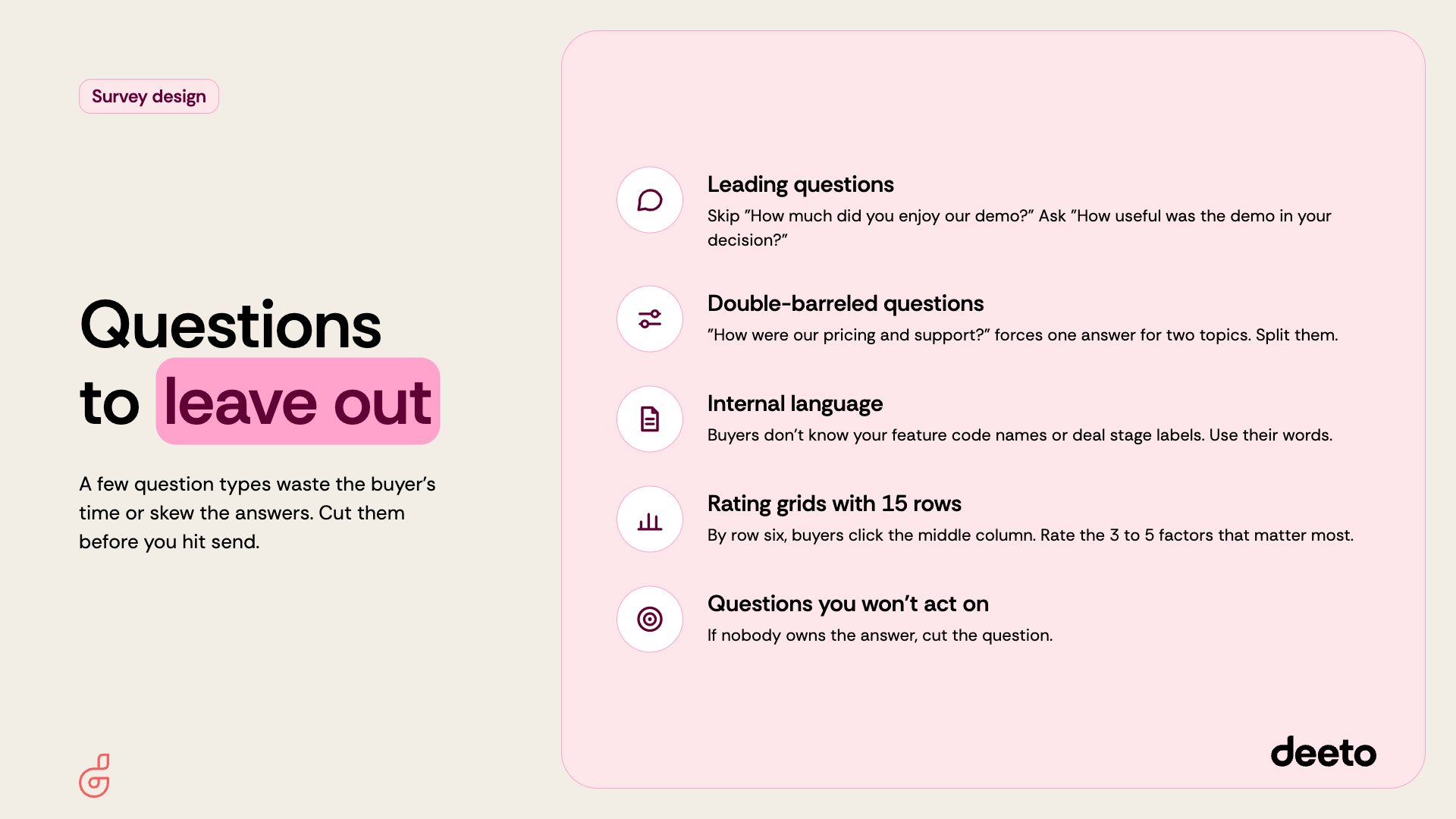
A few question types waste the buyer's time or skew the answers.
- Leading questions. "How much did you enjoy our demo?" assumes they enjoyed it. Ask "How useful was the demo in your decision?" instead.
- Double-barreled questions. "How were our pricing and support?" forces one answer for two topics. Split them.
- Internal language. Buyers don't know your feature code names or deal stage labels. Use the words they used.
- Rating grids with 15 rows. Buyers start clicking the middle column by row six. Rate the three to five factors that matter most.
- Questions you won't act on. If nobody owns the answer, cut the question.
How Deeto turns buyer answers into decisions
The gap in most win/loss programs sits after collection. Answers live in a survey tool, call notes live in Gong, deal data lives in the CRM, and nobody connects them until the quarterly readout.
Deeto, a voice of the customer platform, changes where those answers end up. Buyer responses stop sitting in a spreadsheet and become intelligence that reaches the people who act on it, inside the tools they already use. Product sees the gaps buyers named, executives see how win and loss reasons shift on their dashboards, and sales gets the buyer proof for the next deal in the CRM.
The mechanics sit underneath that. Deeto runs AI-led buyer interviews after every closed deal, so you get interview depth at survey scale. Responses tie to the account and opportunity through Salesforce and HubSpot integrations, and Deeto connects with Gong so you can line up what the buyer told you with what was said on the calls.
Because the platform tracks win and loss reasons across every deal over time, a shift like a competitor winning on security reviews shows up within weeks. Customer marketing gets a steady supply of won-deal buyers who said yes to question 26, ready to become references reps can actually find. Product marketing teams get positioning grounded in what buyers said. Deeto customers report 10 to 15% higher win rates when that buyer proof reaches reps in the deal.
Key takeaways
- A win/loss survey asks buyers, after the deal closes, why they chose the vendor they chose.
- Organize questions in the order the buyer lived the process: trigger, shortlist, decision, sales experience.
- Ask which vendor was the buyer's early favorite. It tells you whether you lost on positioning or execution.
- Survey no-decision deals too. They can make up 40% to 60% of lost pipeline.
- Use surveys for coverage and interviews for depth, and connect the answers to deal data so they drive decisions.
Frequently asked questions
How many questions should a win/loss survey have?
Aim for 10 to 15 questions that a buyer can finish in under 10 minutes. Mix rating-scale questions, which let you compare results across deals, with three or four open-ended questions that capture the buyer's own reasoning. Tailor the set to the outcome, since buyers from won, lost, and no-decision deals need different questions.
When should you send a win/loss survey?
Send it two to four weeks after the buyer makes a decision. That's long enough for the buyer to step back from the evaluation and short enough that they still remember the details, like which demo landed or which security question took too long. Waiting a full quarter usually means vaguer answers and lower response rates.
What is the difference between a win/loss survey and a win/loss interview?
A win/loss survey is a structured questionnaire that buyers complete on their own, which makes it easy to run on every deal and compare results. A win/loss interview is a live conversation that allows follow-up questions, so it uncovers the reasons behind an answer. Most teams survey every closed deal and interview the most strategic ones.
Who should send the survey to buyers?
Someone outside the sales team, or a third party, should send it. Buyers give more candid answers when they aren't critiquing the rep who just worked their deal. Customer marketing or product marketing usually owns the program, with sales leadership reviewing results alongside them so the answers reach advocacy, messaging, and enablement.
Should you survey won deals as well as lost deals?
Yes. Won deals tell you which strengths to double down on and what almost cost you the deal. They're also the best source of new references and case study candidates, because a buyer who just explained why they chose you is often willing to tell other buyers the same story.
Ask what the buyer saw
Your team already has a theory about why deals close or slip away. A win/loss survey replaces that theory with the buyer's account: when they formed a favorite, what proof they needed, and what made them hesitate.
When the buyer's account reaches the people writing the pitch, running the deal, and recruiting the next reference, the next buyer meets a company that already knows what someone like them needed to hear, and has a customer ready to say it.
See how Deeto turns buyer answers into intelligence.
🎉 Save your spot
Register for the event
Once your spot is secured, we’ll send your confirmation details.
Subscribe to our newsletter
Subscribe to receive the latest blog posts to your inbox every week.
By subscribing, you agree to our Privacy Policy
Subscribe to our newsletter
Get the latest news and updates from our team.
By subscribing, you agree to our Privacy Policy
Related posts

8 Best Customer Advocacy Platforms for B2B Companies in 2026

Compare 8 customer advocacy platforms for B2B. See what each one does, who it fits, and how to choose.

7 Best Influitive Alternatives & Competitors in 2026
Compare 7 Influitive alternatives & competitors and see which one fits your customer advocacy program.

Voice of the Customer Examples: How B2B Teams Put VoC to Work
See how six B2B teams turned voice of the customer into stories, references, and measurable results.


