Omnichannel Customer Engagement Tools: 8 Platforms Compared



Thursday, October 15, 2026


Omnichannel Customer Engagement Tools: 8 Platforms Compared


View the podcast on Youtube

Six in ten B2B buyers would rather not talk to your sales team at all. That puts more weight on every email, in-app message, and text you send, and on what those messages actually say.
Omnichannel customer engagement tools are platforms that unify customer data and coordinate personalized messages across email, SMS, push, in-app, web, and messaging apps from one place. They decide who gets what message, on which channel, and when. The best ones now use AI agents to build and optimize campaigns with less manual work.
This guide compares eight leading platforms on channels, AI, data, and pricing models. It also covers the gap none of them fill, which is authentic customer proof that makes each message credible.
What are omnichannel customer engagement tools?
Omnichannel customer engagement tools are software platforms that connect every channel a customer uses into one coordinated program. Instead of running email in one tool and SMS in another, a team builds a single customer profile and triggers messages from it wherever the customer is most likely to respond.
Omnichannel engagement software typically has four layers:
- A unified customer profile merges behavioral, transactional, and CRM data.
- Channel delivery covers email, SMS, push, in-app, web, WhatsApp, and ads.
- Orchestration logic sequences messages based on what each customer does.
- AI decisioning picks the next message, channel, and send time.
The difference between multichannel and omnichannel is coordination. Multichannel means you're present on many channels. Omnichannel means those channels share context, so a customer who just replied on WhatsApp doesn't get a generic email ten minutes later.
Why omnichannel engagement software matters for B2B teams
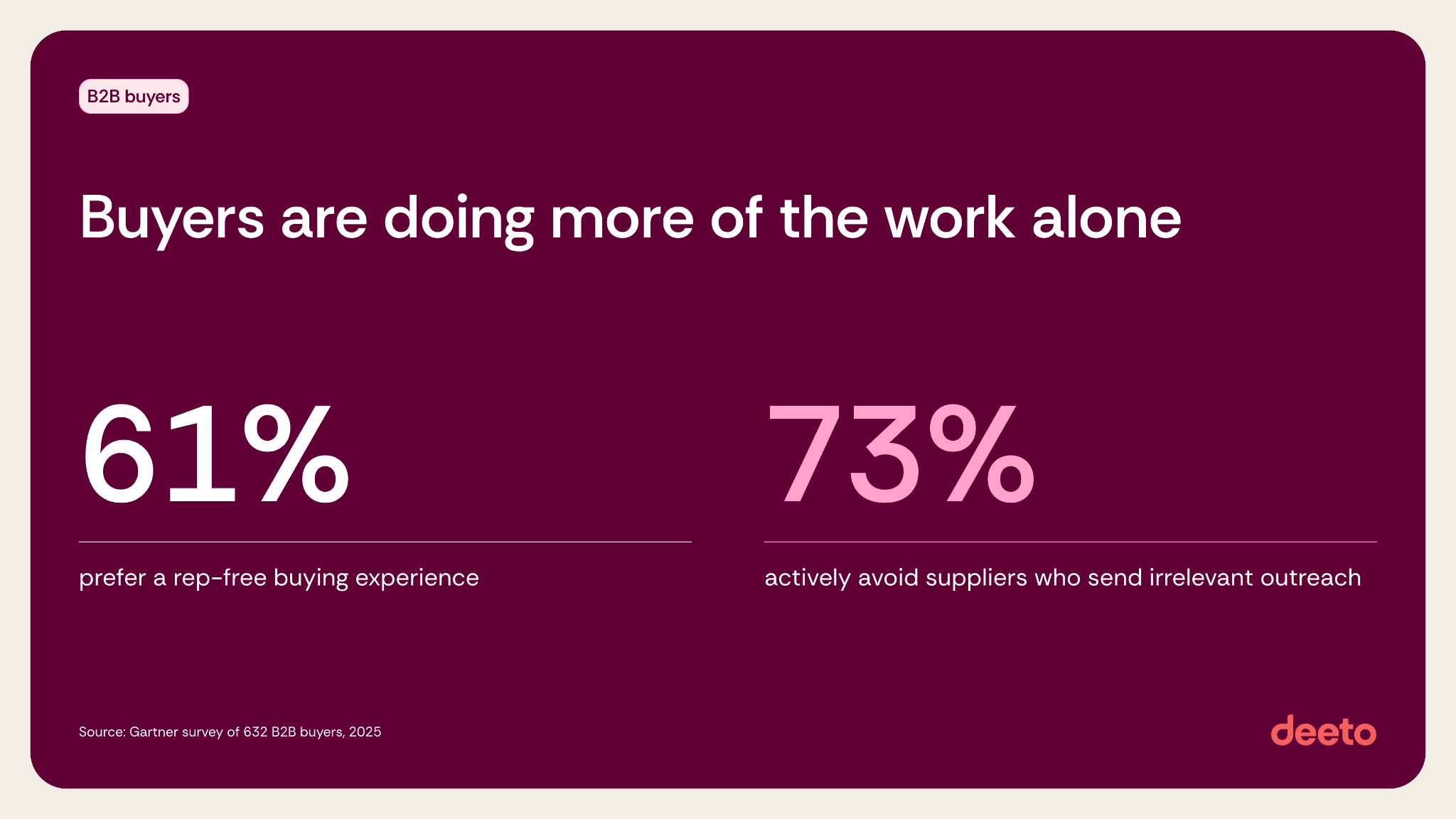
Buyers are doing more of the work alone. A Gartner survey of 632 B2B buyers found that 61% prefer a rep-free buying experience, and 73% actively avoid suppliers who send irrelevant outreach.
That second number is the one customer marketing leaders should sit with. Irrelevant outreach costs you the buyer. A message has to be timely and it has to be credible, and engagement platforms only handle the first part.
Buyers are also checking your claims somewhere else first. In G2's 2025 Buyer Behavior Report, enterprise buyers named review sites (56%) and AI search (55%) as their top two research sources. Both run largely on what other people say about you, not what you say about yourself.
Engagement automation decides when a buyer hears from you, while customer voice decides whether they believe you.
How we compared these platforms
We used each vendor's own product and pricing pages as the primary source and looked at six things: the company type and use case each platform is built around, the owned and paid channels it supports natively, its AI and automation features (agents, decisioning, content generation), how it unifies customer data, its pricing model, and its placement in the 2026 Gartner Magic Quadrant for Multichannel Marketing Hubs.
Gartner published that report on September 22, 2026, and evaluated 12 vendors. According to Braze's summary of the results, Braze, Salesforce, and Adobe were named Leaders. Klaviyo and Insider One were Challengers, Bloomreach was a Visionary, and Iterable was a Niche Player. HubSpot wasn't among the vendors evaluated.
A Gartner Magic Quadrant scores vendors on two measures, ability to execute today and completeness of vision for where the market is going. Leaders score high on both. Challengers execute well with a narrower vision, Visionaries have strong strategy but less proven delivery, and Niche Players often focus on a specific segment. A Niche Player can still be the best fit for your team.
Omnichannel customer engagement tools compared
Platform breakdown: the 8 best omnichannel engagement software options
The first three platforms fit B2B customer marketing programs, where you're engaging accounts, buying committees, and existing customers over long cycles. The last five are built mainly for high-volume consumer messaging.
Best for B2B customer marketing
1. HubSpot Marketing Hub
HubSpot Marketing Hub is the most accessible option here for B2B teams. It's CRM-native, so marketing, sales, and service data live in one place without a separate integration project.
It covers email, SMS, WhatsApp, social publishing and inbox, ads, personalized web content, and live chat. The Breeze Assistant and a set of AI agents (Content, Nurture, Campaign, Customer, and Prospecting) handle content creation and lead nurturing.
For customer marketing, that shared record is the point. Onboarding sequences, renewal nurtures, and expansion campaigns can all key off lifecycle stage and deal data that sales and CS already keep up to date, so you're not working from a stale export.
HubSpot has a free plan with automated email, forms, and live chat, plus paid tiers. Teams with complex, high-volume consumer messaging usually outgrow it, but for mid-market B2B it covers most engagement automation needs.
2. Salesforce Marketing Cloud Next
Salesforce Marketing Cloud is the obvious choice for companies already running sales and service on Salesforce. Its newer product, Marketing Cloud Next, builds Agentforce AI agents into email, SMS, and web, and adds paid advertising activation and cross-channel analytics.
The Campaign Agent generates channel-ready content and optimizes sends from your goals and guardrails. Salesforce also pitches agentic demand generation, with agents that prospect target accounts, qualify inbound demand, and nurture buyers. That makes it one of the few tools on this list with an explicit B2B motion.
For enterprise customer marketing teams, the draw is shared account context. A renewal or advocacy campaign can draw on the same account, opportunity, and service history that sales and support see. Pricing isn't published on the product page.
3. Adobe Journey Optimizer
Adobe Journey Optimizer is a real-time orchestration engine built on Adobe Experience Platform. It covers email, push, in-app, SMS and MMS, and web personalization, with AI decisioning for next best actions and a Journey Agent that helps build and analyze programs.
Its strength is depth. Real-time profiles, streaming data, and governance controls come from Experience Platform, which suits large enterprises with strict data requirements. That depth is also the trade-off. Journey Optimizer pays off most for teams already invested in the Adobe stack. Pricing isn't published.
Best for consumer and ecommerce brands
4. Braze
Braze is built for consumer brands in retail, travel, media, gaming, and on-demand services, and was named a Gartner Leader for the fourth year in a row. Its pricing page lists email, push, SMS, RCS, WhatsApp, in-app, and more in every edition, with quote-based pricing tied to monthly active users. There's no free plan.
5. Klaviyo
Klaviyo calls itself an autonomous B2C CRM and says it powers more than 205,000 brands across 100 countries. Its Composer agent builds campaigns from a prompt, and you can start on Klaviyo for free.
6. Insider One
Insider One, which rebranded from Insider in December 2025, covers web, email, SMS and RCS, mobile app, WhatsApp, and web push. Its Agent One feature plans and optimizes campaigns, and the industries it lists lean toward retail, beauty, automotive, travel, financial services, and telecom.
7. Bloomreach Engagement
Bloomreach Engagement pairs real-time customer and product data with Loomi AI decisioning across 13+ channels. It cites more than 1,400 brands and enterprises as customers, and predictions for purchase, churn, and returns make it especially useful for commerce teams.
8. Iterable
Iterable is a cross-channel platform for consumer brands in fintech, marketplaces, retail, media, and streaming. Its support documentation lists nine channels, and its Nova layer adds AI agents and next-best-action decisioning. Pricing runs through sales.
What engagement automation can't do on its own
Every platform above is good at timing and targeting. None of them can make the message itself credible. They'll personalize a subject line in milliseconds, but they can't produce a customer quote or a peer reference your buyer will trust.
That's where most programs break down. The proof usually lives somewhere else: testimonials, case studies, and reference customers sit in slide decks, Slack threads, and someone's inbox. The same few happy customers get every reference request because nobody can see who else is willing, and they burn out. And what customers say in interviews and surveys rarely reaches the person building the campaign in a form they can use.
Sending faster won't fix a message nobody believes.
Where Deeto fits alongside your engagement platform
Engagement tools decide when to reach someone. Deeto decides what's worth saying when you do.
Deeto is a voice of the customer platform. It turns authentic customer voice into intelligence and routes it into the tools your team already uses, including Salesforce, HubSpot, and Slack. It works alongside your engagement platform rather than replacing it.
Picture a nurture sequence in HubSpot. A director of operations at a mid-sized fintech company downloads your compliance guide and enrolls in a five-email track. Email three is where proof usually goes, and it's usually a logo bar or a stat lifted from your homepage.
With Deeto in the mix, that slot carries a short customer quote from an operations leader at another fintech customer, captured in an AI interview a few weeks after their rollout. Deeto's AI Match Agent picks the customer whose situation looks most like the prospect's. When the deal reaches sales, that same customer is ready as a reference, and nobody has to dig through old decks to find them.
The email is just as timely as before. Now it's believable too.
For customer marketing teams, that's the shift. Your engagement platform keeps handling timing and delivery. Deeto keeps it stocked with fresh, relevant customer voice, and spreads asks across a wider customer advocacy bench so the same few customers don't burn out.
Back to the Gartner number from earlier. When 73% of buyers avoid suppliers who send irrelevant outreach, a message carrying a real peer's words has a better shot than one carrying yours. If you're comparing proof tools too, our breakdown of customer testimonial software platforms covers that side of the stack.
How to choose the right omnichannel customer engagement tool
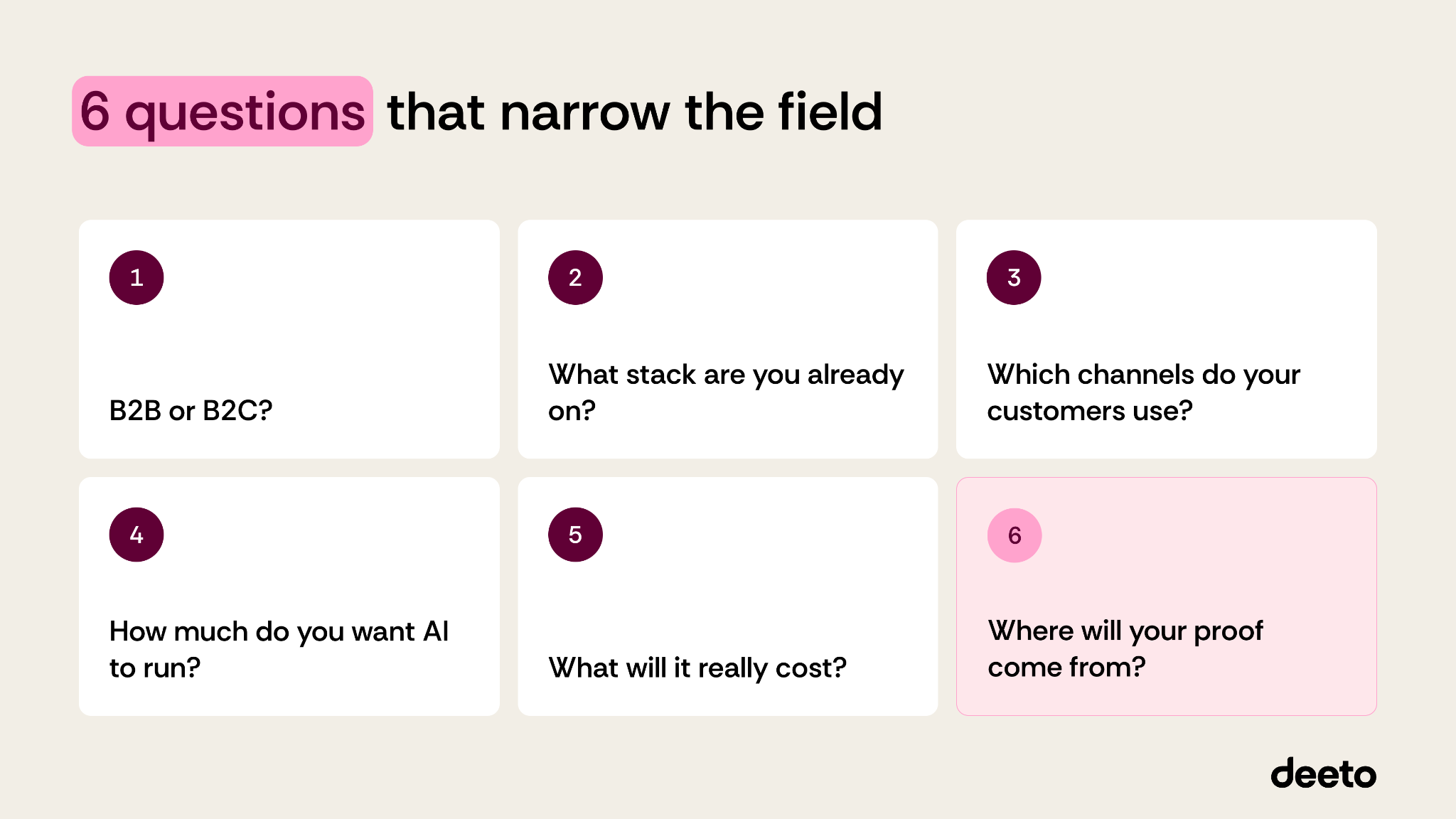
Start with your business model, then work down to features. A few questions narrow the field fast:
- B2B or B2C? HubSpot and Salesforce are built around accounts and pipelines. Braze, Klaviyo, Iterable, Insider One, and Bloomreach are built around high-volume consumer messaging.
- What stack are you already on? Adobe Journey Optimizer and Salesforce Marketing Cloud Next pay off most inside their own ecosystems.
- Which channels do your customers use? If WhatsApp, RCS, or in-app messaging matters, confirm native support rather than a partner connector.
- How much do you want AI to run? Every vendor now offers agents. Ask where they need human approval and how they handle brand guardrails.
- What will it really cost? Most enterprise tools are quote-based. Ask for a multi-year total cost that includes message volume, seats, and implementation.
- Where will your proof come from? Map how customer stories and advocates will feed your campaigns before you sign. A customer journey map helps you spot where proof should appear.
Key takeaways
- Omnichannel customer engagement tools unify customer data and coordinate messages across email, SMS, push, in-app, web, and messaging apps.
- Braze, Salesforce, and Adobe were named Leaders in the 2026 Gartner Magic Quadrant for Multichannel Marketing Hubs.
- HubSpot and Salesforce fit B2B account-based programs best. Braze, Klaviyo, Iterable, Insider One, and Bloomreach lean toward consumer brands.
- Engagement automation handles timing and delivery. It doesn't create the customer proof that makes a message credible.
- Pairing an engagement platform with a voice of the customer platform like Deeto gives every channel something worth sending.
FAQs
What are omnichannel customer engagement tools?
Omnichannel customer engagement tools are platforms that unify customer data and coordinate personalized messages across channels like email, SMS, push, in-app, web, and WhatsApp. They use one customer profile to decide who gets which message, on which channel, and when. Examples include Braze, Salesforce Marketing Cloud, Adobe Journey Optimizer, HubSpot, and Klaviyo.
What is the difference between omnichannel and multichannel engagement?
Multichannel engagement means a brand is present on several channels, often managed in separate tools. Omnichannel engagement connects those channels so they share data and context. A customer's action on one channel changes what they see on the next, which avoids repeated or conflicting messages.
Which omnichannel engagement software is best for B2B companies?
For B2B companies, HubSpot Marketing Hub and Salesforce Marketing Cloud Next are the strongest fits because they're built around CRM data, accounts, and pipeline. HubSpot suits mid-market teams that want fast setup and a free starting plan. Salesforce suits larger companies already running sales on Salesforce.
What is engagement automation?
Engagement automation is the use of software to trigger and sequence customer messages based on behavior, timing, and profile data instead of manual sends. It includes onboarding flows, renewal reminders, re-engagement campaigns, and advocacy requests. Modern platforms add AI agents that build and optimize these programs within guardrails a team sets.
How much do omnichannel customer engagement platforms cost?
Pricing varies widely. HubSpot and Klaviyo offer free starting plans with paid tiers. Braze, Salesforce, Adobe, Insider One, Bloomreach, and Iterable use quote-based pricing tied to factors like active users, contacts, message volume, and channels. Ask vendors for a multi-year total cost that includes implementation.
Do omnichannel engagement tools replace customer advocacy platforms?
No. Engagement tools manage when and where messages reach customers. Customer advocacy and voice of the customer platforms like Deeto capture the testimonials, references, and feedback that make those messages credible. Connecting the two lets customer proof flow into every channel you run.
Conclusion
Engagement platforms have gotten very good at timing. Braze, Salesforce, Adobe, HubSpot, and the rest can now plan and run campaigns with AI agents doing much of the work.
The harder problem is trust. Buyers research on their own and lean on peers, and most will walk away from a vendor that sends them noise. A perfectly timed message with nothing credible inside it still gets ignored.
Pick the engagement platform that fits your business model and stack. Then make sure what flows through it carries your customers' voices, not just your own. See how Deeto works to put authentic customer proof into every channel you run.
🎉 Save your spot
Register for the event
Once your spot is secured, we’ll send your confirmation details.
Subscribe to our newsletter
Subscribe to receive the latest blog posts to your inbox every week.
By subscribing, you agree to our Privacy Policy
Subscribe to our newsletter
Get the latest news and updates from our team.
By subscribing, you agree to our Privacy Policy
Related posts

Voice of the Customer Strategy for SaaS Companies

What is VoC for SaaS? Learn how to capture customer voice and turn it into decisions that drive renewals.

Call Intelligence Software That Spots Your Next Reference
What is call intelligence software? Learn how it scores every call automatically and surfaces advocacy-ready customers.

4 Ways To Leverage Social Proof In Marketing
What is social proof in marketing? Learn 4 ways to use reviews, stories, and advocacy to build buyer trust.