4 Ways To Leverage Social Proof In Marketing



Friday, October 2, 2026


4 Ways To Leverage Social Proof In Marketing


View the podcast on Youtube

Buyers check your claims before they trust them. Social proof in marketing is evidence that other people have bought your product and gotten value from it. It includes reviews, customer stories, ratings, video testimonials, and endorsements. It works because buyers use the choices of people like them as a shortcut when a decision feels risky.
Here are four ways to put social proof to work, along with the data behind each one and a simple way to measure whether it is paying off.
What is social proof in marketing?
Social proof is the tendency to treat other people's choices as evidence of what is safe, correct, or worth buying. In marketing, social proof is any signal that real customers chose you and were glad they did. It includes reviews, testimonials, case studies, customer logos, ratings, awards, user-generated content, and word of mouth.
Psychologist Robert Cialdini lists social proof as one of six principles of persuasion, and his research adds a detail marketers should use. According to W. P. Carey School of Business at Arizona State University, the effect grows when the proof comes from multiple people and from people similar to the buyer. That is why a quote from someone in your prospect's exact role and industry often carries more weight than a bunch of anonymous five-star ratings.
The table below compares the six most common types of social proof and where each one fits best.
Teams often collect several of these types and store them in different places, which makes the right proof hard to find when a buyer needs it. Deeto gets the right customer story or piece of social proof to the right buyer at the right moment, instead of leaving it to sit in a folder until someone remembers to look.
Why does social proof in marketing matter?
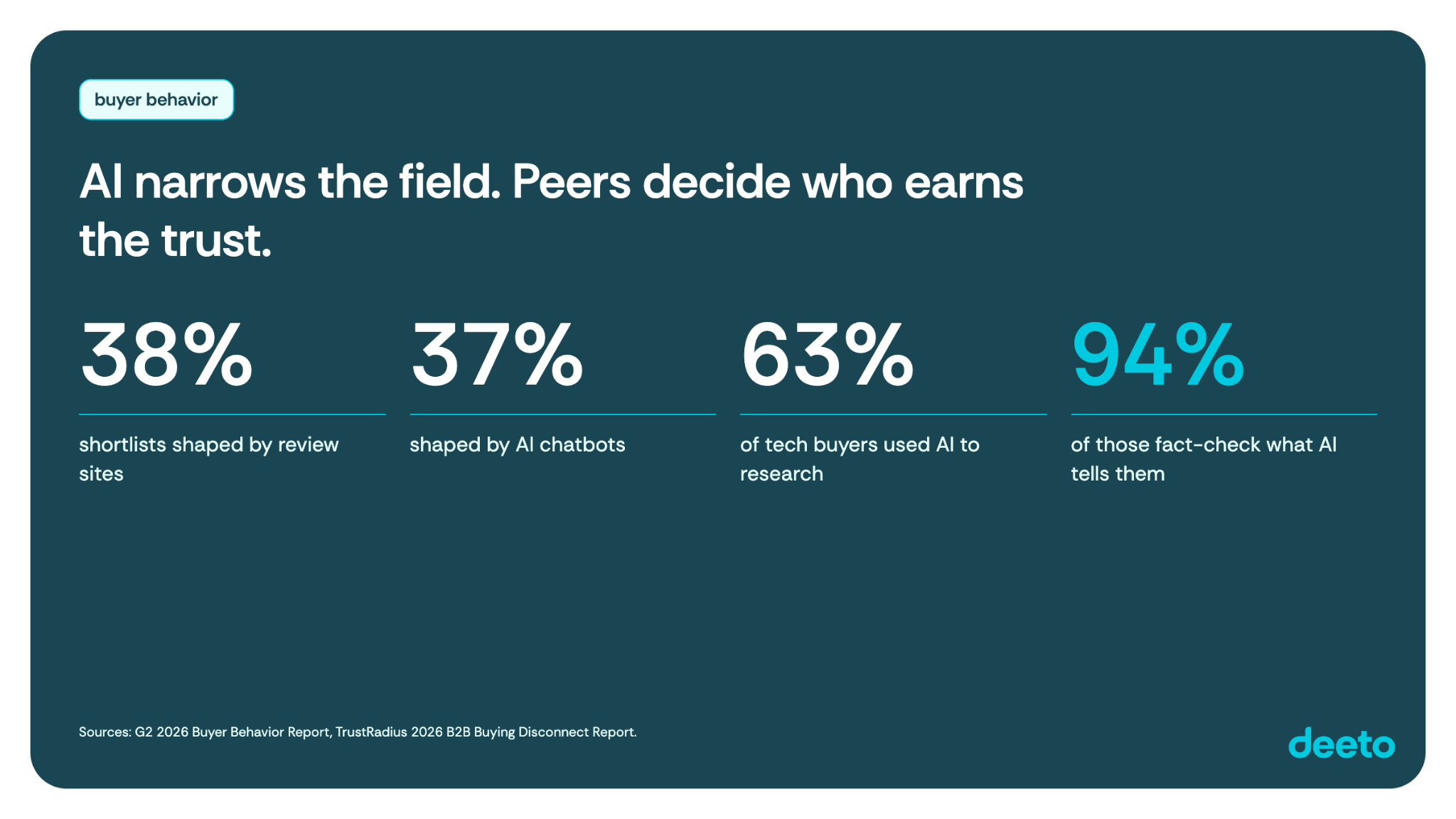
Buyers now verify before they commit, and they verify with other customers. G2's 2026 Buyer Behavior Report found that review sites (38%) and AI chatbots (37%) are the two biggest sources shaping software shortlists. Buyers let AI narrow the field, then lean on peer proof to decide which vendors earn their trust. Your customers' words now influence the shortlist twice, once directly and once through the AI tools that summarize them.
TrustRadius tells a similar story. Its 2026 B2B Buying Disconnect Report found that 63% of technology buyers used AI during their purchase process and that 94% of the AI users fact-check its answers at least some of the time. AI helps buyers find options, and other customers help them trust one.
Social proof helps marketing teams in four concrete ways.
- It lowers perceived risk for a buyer who has never used your product.
- It gives a champion something better than a vendor claim to forward to a skeptical CFO.
- It gives AI answer engines third-party evidence to pull into recommendations.
- It gives every channel, from ads to email to landing pages, a claim that comes from someone other than you.
How do you use social proof in marketing?
Four approaches cover most of what works, and they build on each other. Start with the one your buyers meet first.
1. Publish reviews where buyers and AI already look
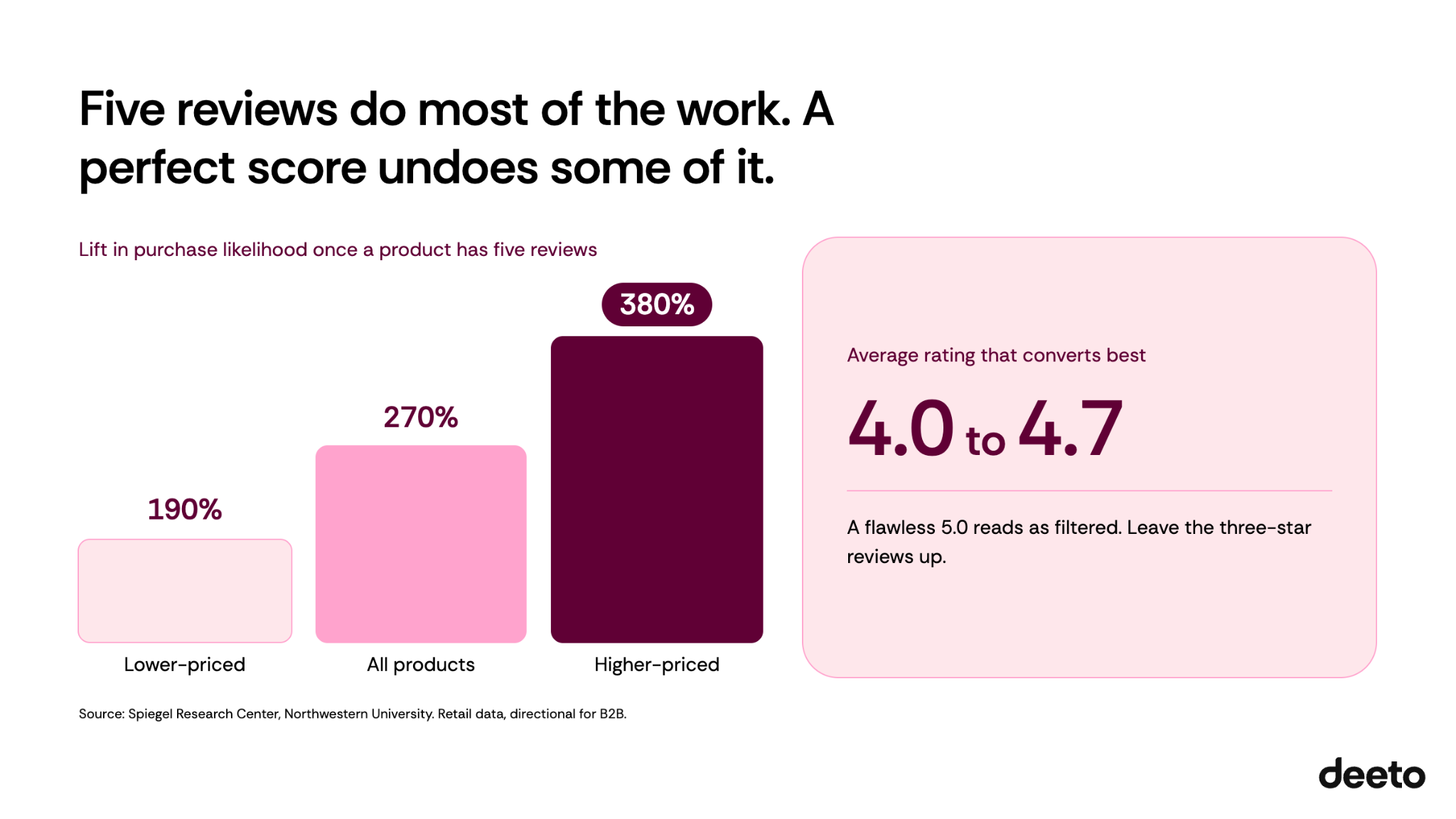
Reviews are a well-researched form of social proof. Northwestern University's Spiegel Research Center found that a product with five reviews had a purchase likelihood 270% greater than a product with none. The lift was bigger for pricier items, with conversion rising 380% for higher-priced products and 190% for lower-priced ones. The study looked at retail purchases, so read the exact percentages as directional for B2B. The direction matches what software buyers say about review sites.
There are two main details in the data that stand out. The benefit of extra reviews shrinks quickly after the first five, and purchase likelihood peaks when average ratings sit between 4.0 and 4.7, because a perfect 5.0 looks too good to be true.
Reviews also feed the AI answers buyers read first. When G2 asked what would raise buyers' confidence in a chatbot's answer, the top response was a citation from a review site. Reviews now convince the person reading them and shape the answer that person sees before they ever visit your site.
- Ask for a review right after a customer hits a real milestone, like a finished onboarding or a first measurable result.
- Build a presence on the review sites your buyers use, starting with G2 and TrustRadius.
- Reply to every review, including critical ones, so buyers see how you handle problems.
- Leave the three-star reviews up. A mix of ratings reads as honest feedback.
2. Match customer stories to the buyer's exact situation
A generic testimonial can let potential clients know that your product works, but a matched story says it worked for someone like the person reading it. Picture a VP of Finance at a 500-person fintech reading a success story from a 20-person retail startup. The result might be impressive, but it doesn't answer her real question, which is whether this will work at a company like hers.
The Cialdini research above explains why the mismatch hurts. Build each story around the details buyers use to judge similarity, which are industry, company size, the role of the person quoted, and the problem being solved. Then include the parts that make a story evidence instead of a brochure:
- The situation before the customer chose you, in the customer's own words.
- The decision and who was involved in making it.
- One or two measured results a skeptical buyer can check.
- A named person with a title, since anonymous quotes read as invented.
Pairing each story with a measured result, the kind captured in ROI and impact studies, turns an anecdote into something a CFO will accept. Video testimonials add another layer, because buyers can see and hear a real person. Keep them short and tied to a single outcome.
Product marketing teams usually own the story library as part of their product marketing strategy. The library only pays off if a rep or campaign manager can find the right story in seconds, filtered by industry, company size, and use case.
3. Put proof inside the deal, not just on the website
Social proof tends to live on a website, while a lot of the deciding happens in calls, emails, and shared docs where the website is not in the room. A champion inside the buying group needs something to forward to a skeptical CFO or security lead, and it has to arrive at the right moment.
- Tag every story, quote, and video by industry, use case, company size, and objection so reps can find a match fast.
- Offer a live peer conversation late in the cycle, when perceived risk is highest. A customer reference program makes that repeatable instead of a scramble.
- Deliver proof in the tools reps already use. Connecting your library to your CRM through integrations with Salesforce, HubSpot, and Slack beats a shared folder nobody opens.
Deeto helps sales teams put matched customer evidence in front of a champion at the right stage, and customers see 20% to 30% faster sales cycles from that kind of contextual customer intelligence.
4. Turn customers into an ongoing source of proof
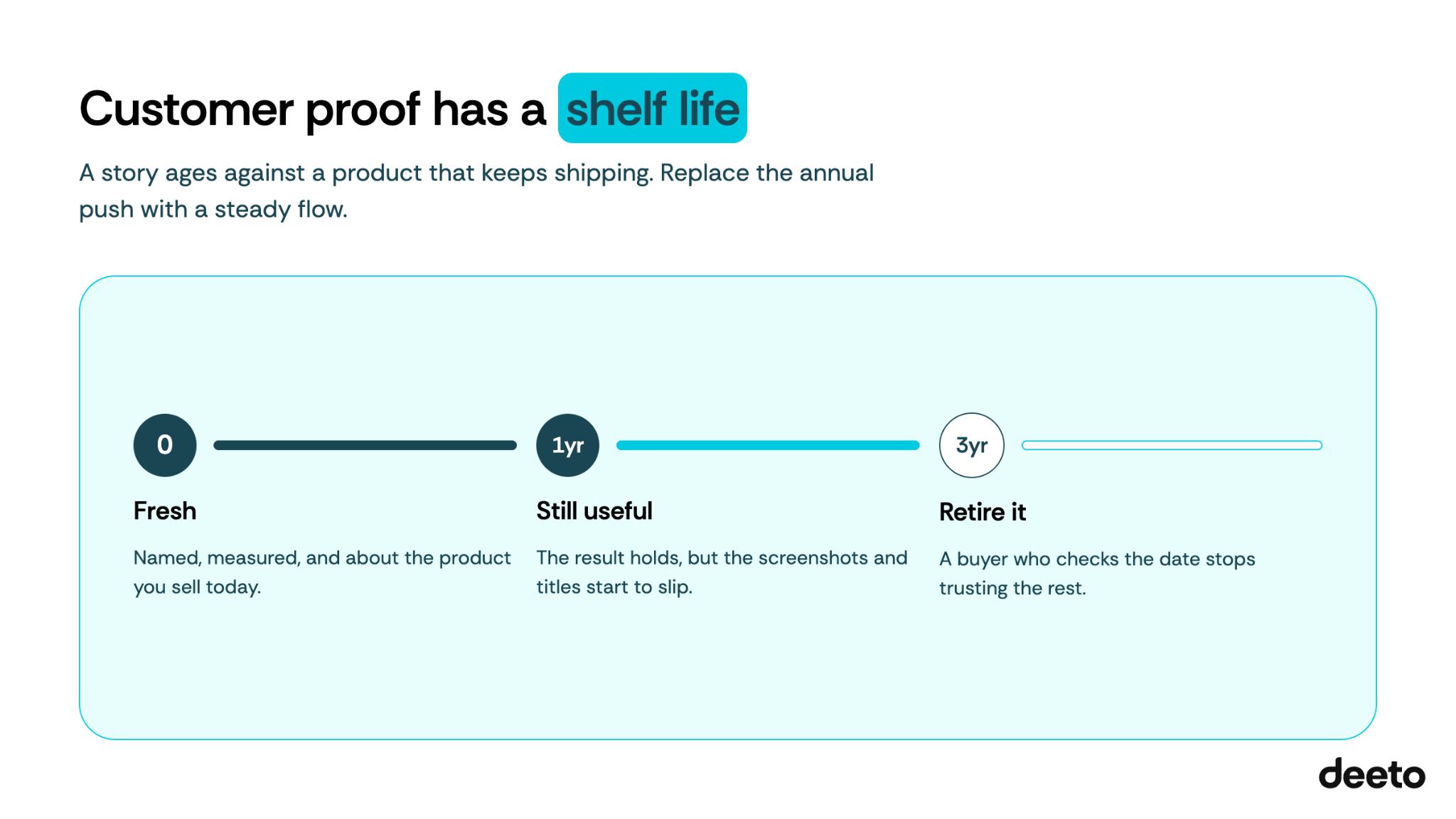
The simple fact is that customer proof goes stale. A story from three years ago about a product that has since changed loses credibility with every release. The fix is a steady flow of new customer voices instead of one yearly push for testimonials.
- Invite your happiest customers into a customer advocacy program with clear asks, like a review, a reference call, or a story, and a clear way to say thanks.
- Repost customer mentions and community threads with permission, so the proof stays in the customer's own words.
- Collect feedback continuously through short interviews and surveys instead of once a year, then pull the best quotes into your library.
- Retire proof that no longer matches the product or the buyer you sell to today.
Advocates also create proof you cannot write yourself, including unprompted posts, referrals, and conference talks. Deeto helps teams capture customer feedback continuously and route the best voices to the teams that need them.
What are the most common social proof mistakes?
Social proof fails in predictable ways.
- Fake, bought, or filtered reviews. The FTC's 2024 final rule on reviews and testimonials bans fake reviews and incentives tied to a particular sentiment, and it lets the agency seek civil penalties from knowing violators. The rule covers consumer reviews, but the principle applies to any proof you publish, so check with your legal team before you design a review program.
- Anonymous quotes with no name, title, or result.
- Proof buried on one page when buyers meet your brand in five places.
- Only-positive curation, which buyers read as filtered.
- Old proof attached to a product that has changed.
How do you measure social proof?
Measure social proof by tying each type to a behavior it should change. Track how much proof you have, whether buyers see it, and whether deals move when they do.
Key takeaways
- Social proof is evidence that real customers chose you and got value, and it carries more weight as buyers check AI answers against peers.
- Publish reviews where buyers and AI already look. Purchase likelihood peaked between 4.0 and 4.7 stars in Spiegel's data, so a credible mix beats a perfect score.
- Match every customer story to the buyer's industry, role, and company size.
- Put proof inside the deal through tagged libraries, live references, and CRM delivery.
- Keep proof fresh with continuous feedback and advocacy, and measure it against deals, not follower counts.
FAQs
What is social proof in marketing?
Social proof in marketing is evidence that other people have bought your product and gotten value from it, shown through reviews, ratings, testimonials, case studies, logos, and endorsements. It works because buyers treat the choices of similar people as a shortcut when a decision feels risky, which lowers perceived risk and builds trust before a sales conversation.
What are the main types of social proof?
The main types are reviews and ratings, customer stories and case studies, video testimonials, customer logos, peer references, and social mentions or user-generated content. Reviews and logos help early shortlisting, stories and video help mid-funnel evaluation, and live references help late-stage risk reduction. Match each type to the moment a buyer needs it.
Why does social proof work?
Social proof works because people look to others when a choice feels uncertain. Psychologist Robert Cialdini lists it as one of six principles of persuasion, and his research shows the effect grows when the proof comes from multiple people who resemble the buyer. In B2B, that means peers in the same role or industry.
How many reviews do you need for social proof to work?
Fewer than most teams expect. Northwestern's Spiegel Research Center found that purchase likelihood rose sharply once a product had five reviews, then gained less from each additional review. More reviews still help credibility, but the first five do the most work. Average ratings between 4.0 and 4.7 performed best.
How do you use social proof in B2B marketing?
Publish reviews on the sites buyers use, match customer stories to each prospect's industry and role, and put proof inside the sales process through tagged libraries, live references, and CRM delivery. Then keep it fresh with ongoing advocacy and feedback. B2B buyers verify claims with peers, so proof from similar customers carries the most weight.
How do you measure social proof?
Track review volume and ratings, conversion on pages with and without proof, how often reps use proof in active deals, win rate when proof was shared, and mentions of your brand in AI answers. Pair win-rate data with win/loss interviews, because deals where reps share proof may already be stronger deals.
Conclusion
Buyers still want to hear from someone like them, and now they check what AI tells them against what customers actually say. Social proof in marketing works when it reaches the right buyer, in the right format, at the right moment. That means reviews where buyers look, stories matched to the reader, proof inside the deal, and a steady supply of new customer voices.
Start with one question: what are your customers already saying that your buyers never hear?
Deeto is a voice of the customer platform that helps teams capture, organize, and deliver authentic customer proof across marketing, sales, and success. To see how it works with your own customer evidence, book a demo.
🎉 Save your spot
Register for the event
Once your spot is secured, we’ll send your confirmation details.
Subscribe to our newsletter
Subscribe to receive the latest blog posts to your inbox every week.
By subscribing, you agree to our Privacy Policy
Subscribe to our newsletter
Get the latest news and updates from our team.
By subscribing, you agree to our Privacy Policy
Related posts

Call Intelligence Software That Spots Your Next Reference

What is call intelligence software? Learn how it scores every call automatically and surfaces advocacy-ready customers.

How to Build a Customer Testimonial Strategy That Converts
What is a customer testimonial strategy? Learn how to collect, structure, and activate proof that closes deals.

Customer Proof Marketing: How B2B Companies Build Trust with Buyers
What is customer proof marketing? Learn the proof types, frameworks, and software that build B2B buyer trust.