Call Intelligence Software That Spots Your Next Reference



Tuesday, September 29, 2026


Call Intelligence Software That Spots Your Next Reference


View the podcast on Youtube

A customer marketing team needs three new case studies for a launch. They pull a list of thirty accounts, send the ask, and wait. Two weeks later they have three replies. Meanwhile, on calls that already happened last month, at least four customers said something that would have made a great quote. Nobody heard it, because nobody was listening for it.
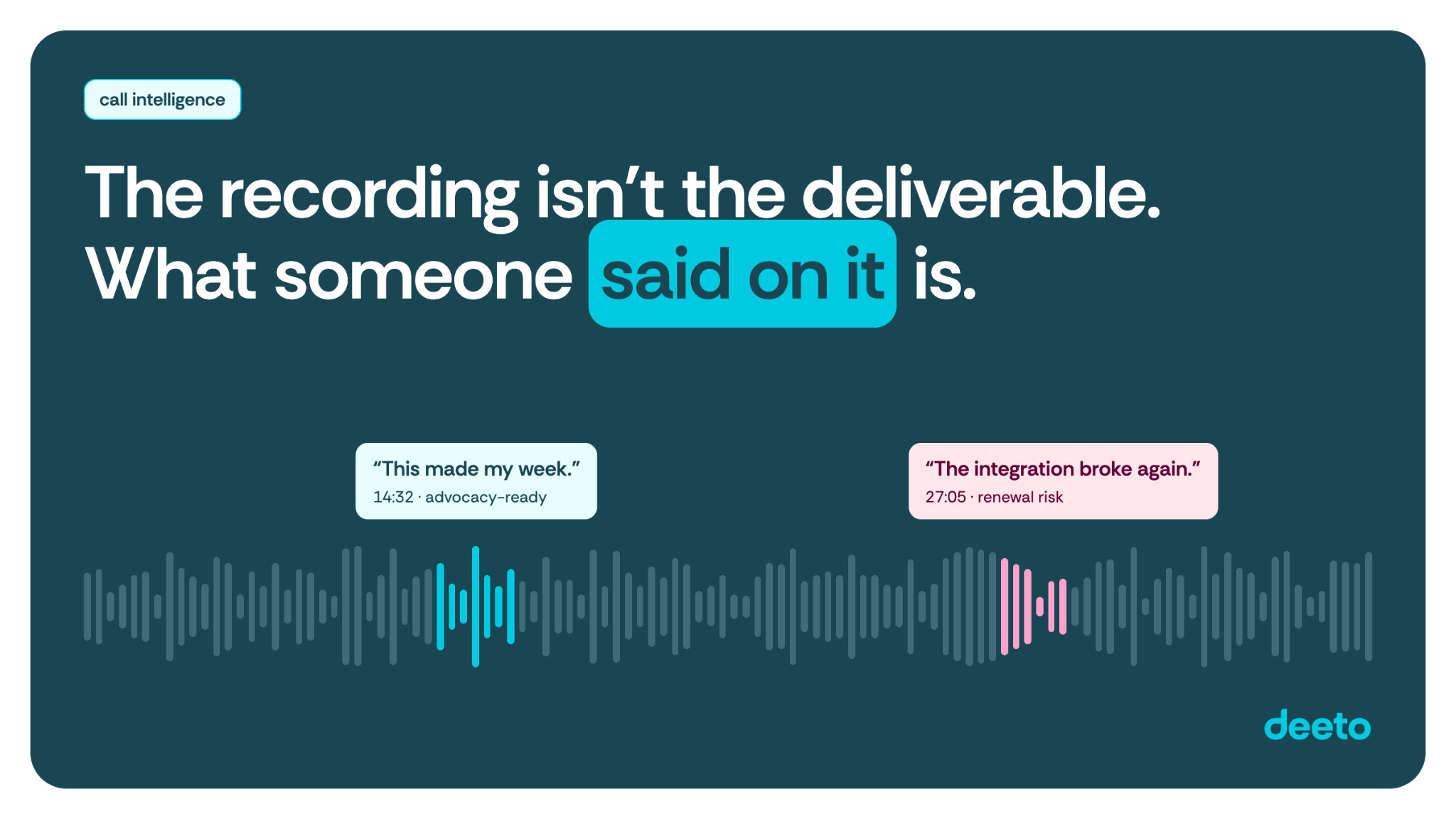
Call intelligence software analyzes sales and customer calls automatically to pull out sentiment, intent, and specific moments worth acting on, without tagging or re-listening to a recording after the fact. It runs on every call a company has, not just the ones someone remembered to flag, and it treats a good moment with the same attention as a bad one.
That's what Deeto Signals does. It's the part of Deeto that turns what customers actually say on a call into intelligence that reaches marketing, customer success, product, and sales, instead of staying locked in a recording only one person ever heard.
Here's what that changes.
Why sales and customer call transcripts stay unread
Most teams already record their calls. Almost none of them get read back.
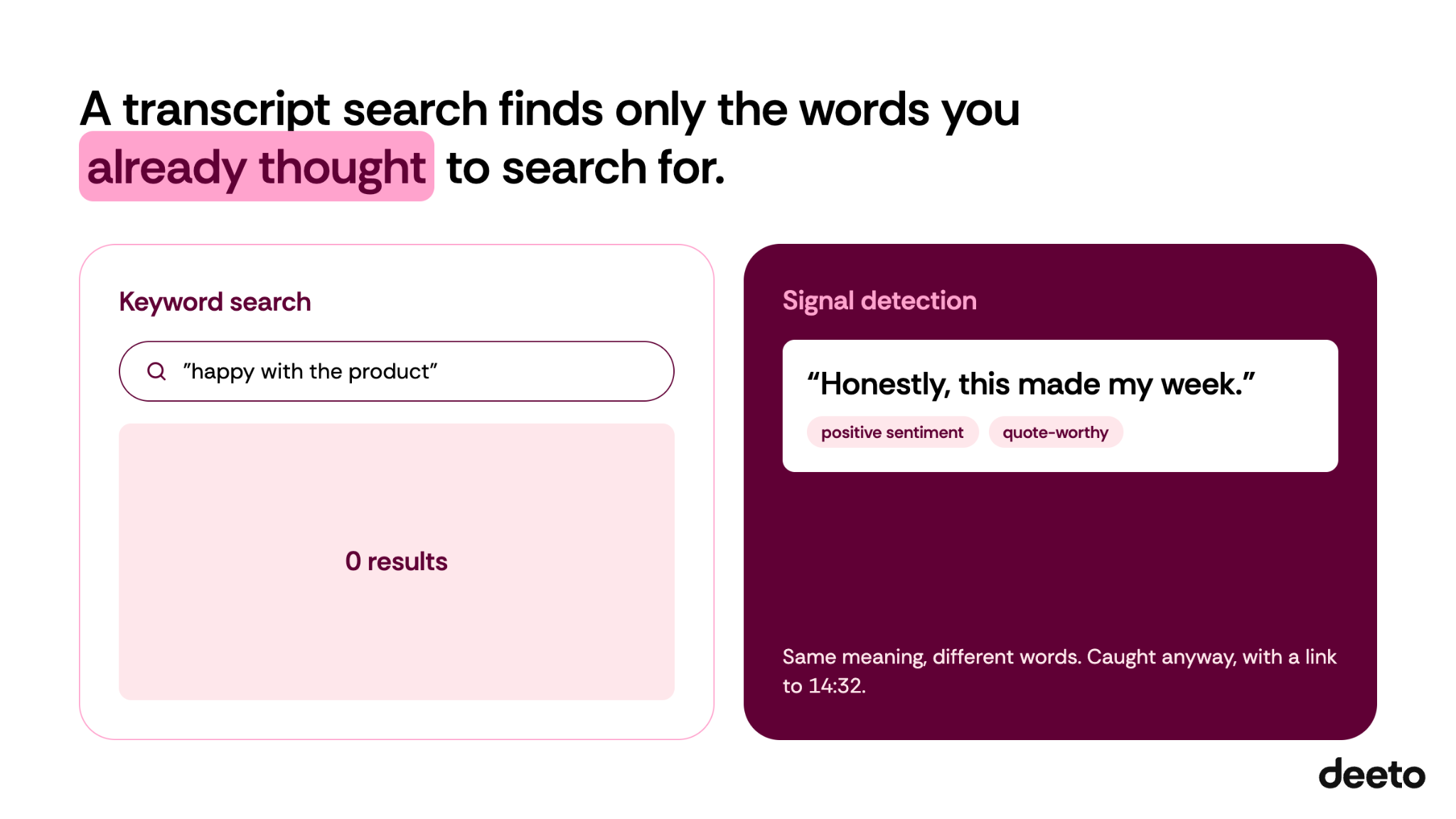
A transcript search only finds the words you already thought to search for. If a customer says "this made my week" instead of "I'm happy with the product," a keyword search misses it entirely. Sentiment doesn't live in the words on the page. It lives in tone, emphasis, the moment right before someone says something honest, and none of that survives a transcript dump into a shared drive.
So the calls pile up. Reps move to the next deal. CS moves to the next renewal. The thing a customer said that would have made a perfect testimonial sits in a recording nobody opens again.
Recording vs. transcription vs. call intelligence software
What call intelligence software does with every call
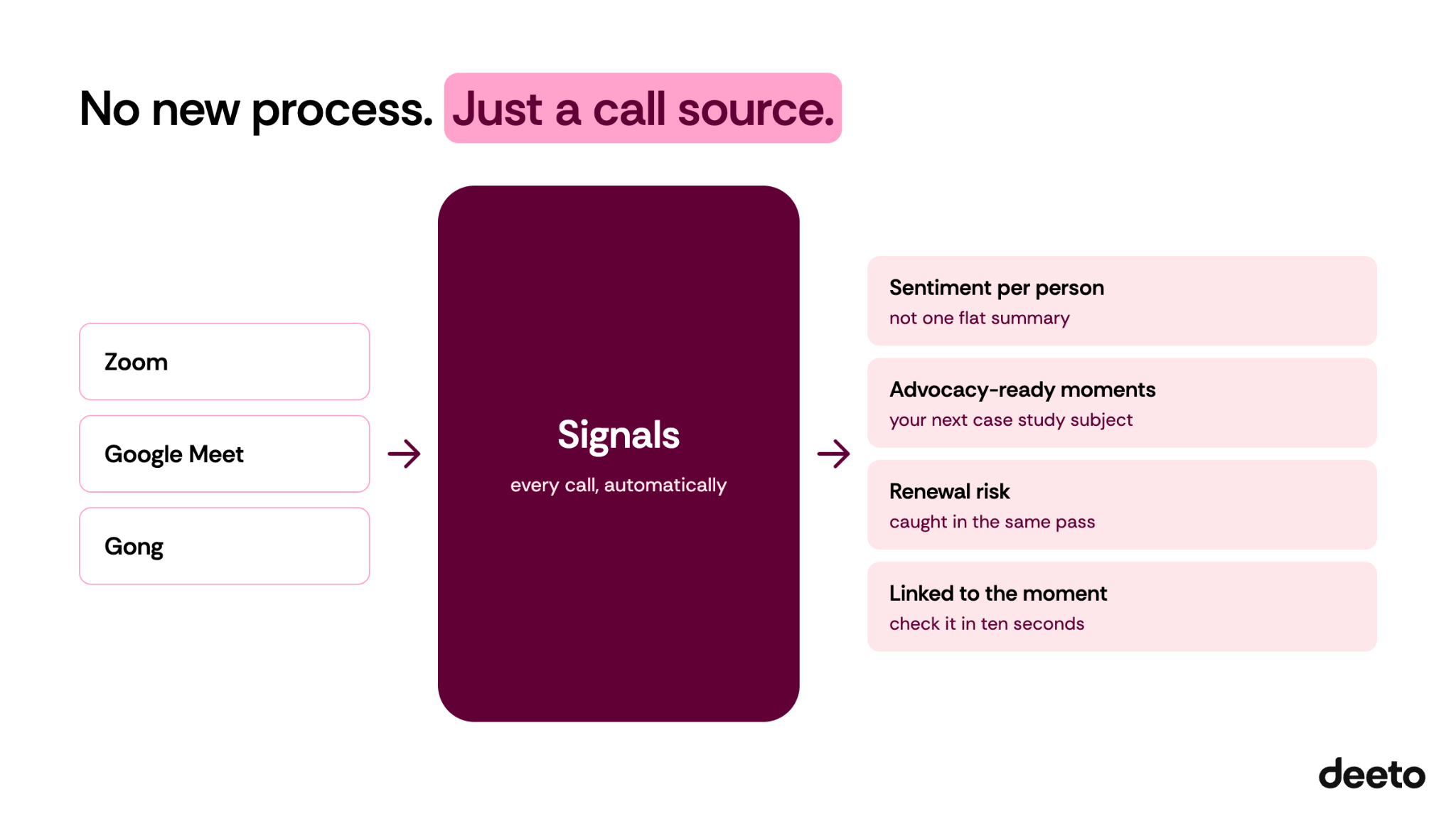
Deeto Signals runs automatically on every sales and customer call, the moment a call source is connected. There's no tagging, no manual review, and no workflow to remember. Connect Zoom, Google Meet, or Gong, and it starts working on the next call.
For every person on every call, Signals:
- Extracts what was actually said, not just what was typed into notes afterward
- Scores sentiment and relevance per person, so a five-person call doesn't get flattened into one generic summary
- Links every signal back to the exact moment in the recording, one click from insight to source
That last part matters more than it sounds. A flagged moment with no path back to the actual audio is a claim someone has to take on faith. A flagged moment with a timestamp is something a customer marketing manager can verify in ten seconds before they act on it.
What Signals does with every call
Signals runs automatically on every sales and customer call as soon as a call source is connected. No tagging, no manual review, nothing to remember. Connect Zoom, Google Meet, or Gong, and it starts working on the next call.
For every person on every call, it pulls out what was actually said (not what got typed into notes afterward), scores sentiment and relevance person by person so a five-person call doesn't get flattened into one generic summary, and links every signal back to the exact moment in the recording. A flagged moment with no path back to the actual audio is a claim someone has to take on faith. One with a timestamp is something a customer marketing manager can check in ten seconds before acting on it.
The half most tools skip: positive signal
Call intelligence tools are built to catch churn risk, but that only covers half the job. The good moments are just as detectable, and they're what an advocacy program runs on. When a customer says a feature saved their team hours, or that switching to the product was the easiest vendor decision they've made all year, that's not just nice to hear. It's a signal.
Signals surfaces who's advocacy-ready based on what a customer actually said, not an NPS score or a CSAT survey someone has to remember to send. It suggests candidates before anyone goes looking, the same way a well-run customer reference program depends on knowing who to ask before the ask feels cold. Your next case study subject identifies themselves. You just finally hear it.
Most customer sentiment analysis tools weren't built for that. They're tuned to catch what's going wrong. Few catch what's going right, at the level of one specific person on one specific call, in a form a customer marketing team can actually use that same day.
It still catches what's going wrong
None of this comes at the expense of risk detection. Signals runs the same pass for renewal risk and product friction as it does for advocacy-ready moments. There is no separate setup, no second tool to connect, and no tradeoff between watching for the good and watching for the bad.
A frustrated comment about a broken integration gets flagged the same way a glowing comment about time saved does. Both go to the person who needs to see them, linked to the moment they happened.
Feed your LLM real customer voice, not a guess
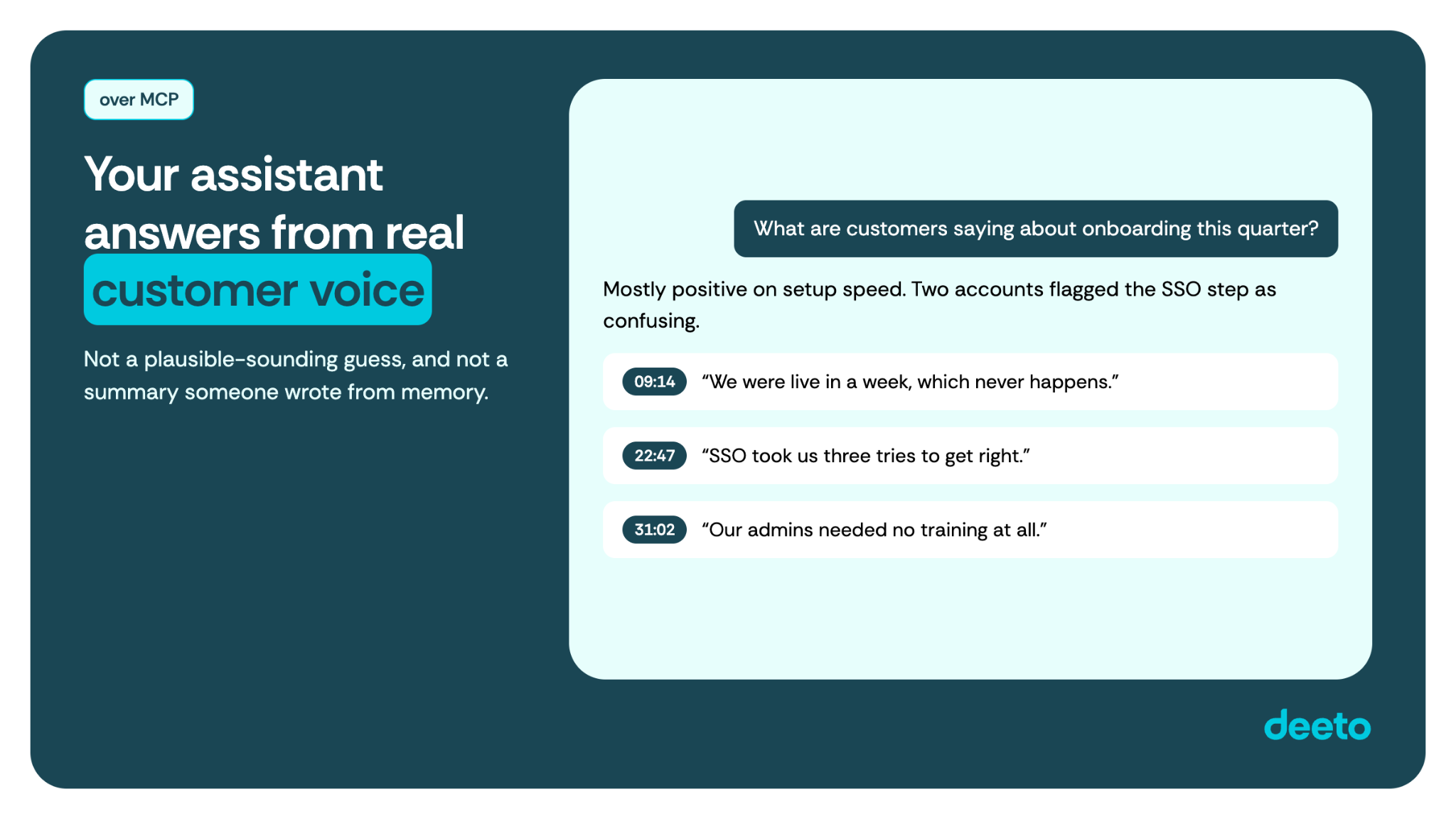
Every signal Signals surfaces is available over MCP, so the assistant a team already uses, such as Claude or ChatGPT, can answer questions from what customers actually said instead of filling gaps with a plausible-sounding guess.
Ask what customers are saying about onboarding this quarter, and the answer comes from real call moments instead of a summary someone wrote from memory three weeks ago.
Start with the calls you're already recording
Signals doesn't need a new process. It needs a call source. Connect Zoom, Google Meet, or Gong, and every call from that point forward gets the same pass: sentiment scored per person, advocacy-ready moments flagged, renewal risk caught, all of it linked back to the exact moment it happened.
The recording isn't the deliverable. What someone said on it is.
Key takeaways
- Call intelligence software pulls sentiment and specific moments out of calls automatically, without manual tagging or review
- It should run on every sales and customer call, not just the ones someone remembers to flag
- Positive signal deserves the same attention as risk signal, because advocacy programs depend on it
- Every flagged moment should link back to its source, not just summarize it
- Connecting customer intelligence to an LLM over MCP means AI assistants answer from real customer voice instead of guessing
FAQs
What is call intelligence software?
Call intelligence software analyzes sales and customer calls automatically to extract sentiment, intent, and specific moments worth acting on. It works without manual tagging or re-listening, scores each person on a call individually, and links flagged moments back to the exact point in the recording where they happened.
How is this different from call recording or transcription?
Recording and transcription capture what was said. They don't tell anyone which parts matter. Call intelligence software adds automatic sentiment scoring, per-person relevance, and moment-level linking on top of the raw transcript, so the useful parts surface without anyone reading the whole thing.
Does call intelligence software only flag negative signal, like churn risk?
Most tools in this category are built primarily for risk detection. Signals scores positive and negative signal in the same automatic pass, so advocacy-ready moments get surfaced with the same rigor as renewal risk instead of being an afterthought.
Can call intelligence data feed an AI assistant?
Yes. Connected over MCP, the customer intelligence a tool like Signals extracts can be queried directly by an LLM such as Claude or ChatGPT, so answers about customer sentiment or product feedback come from real call moments instead of a summary or a guess.
🎉 Save your spot
Register for the event
Once your spot is secured, we’ll send your confirmation details.
Subscribe to our newsletter
Subscribe to receive the latest blog posts to your inbox every week.
By subscribing, you agree to our Privacy Policy
Subscribe to our newsletter
Get the latest news and updates from our team.
By subscribing, you agree to our Privacy Policy
Related posts

How to Build a Customer Testimonial Strategy That Converts

What is a customer testimonial strategy? Learn how to collect, structure, and activate proof that closes deals.

Customer Testimonial Software Platforms Compared
What is customer testimonial software? Compare 7 platforms, see how they stack up, and learn how to choose the right one

Customer Proof Marketing: How B2B Companies Build Trust with Buyers
What is customer proof marketing? Learn the proof types, frameworks, and software that build B2B buyer trust.