How to Use Sentiment Analysis to Improve Customer Experience



Wednesday, October 7, 2026


How to Use Sentiment Analysis to Improve Customer Experience


View the podcast on Youtube

Less than a third of consumers give feedback directly to a company, according to Qualtrics' 2025 Consumer Trends report. Everyone else leaves clues in support tickets, call recordings, reviews, and renewal conversations.
So how can sentiment analysis be used to improve customer experience? Sentiment analysis uses AI to read that language and classify the emotion behind it, down to the specific topic. For CX teams, that means finding out why a score dropped and which accounts are drifting, usually well before either shows up at renewal. Customer marketing teams get the other half of the picture: the happy customers who are ready to become references and advocates.
This guide covers what sentiment analysis measures, how it compares to survey scores, and six ways to put it to work.
What is sentiment analysis in customer experience?
Sentiment analysis in customer experience is the process of using natural language processing (NLP) to measure how customers feel about a company, product, or interaction based on what they say and write. It turns unstructured feedback (open-text survey answers, support chats, interview transcripts) into structured data a team can track over time.
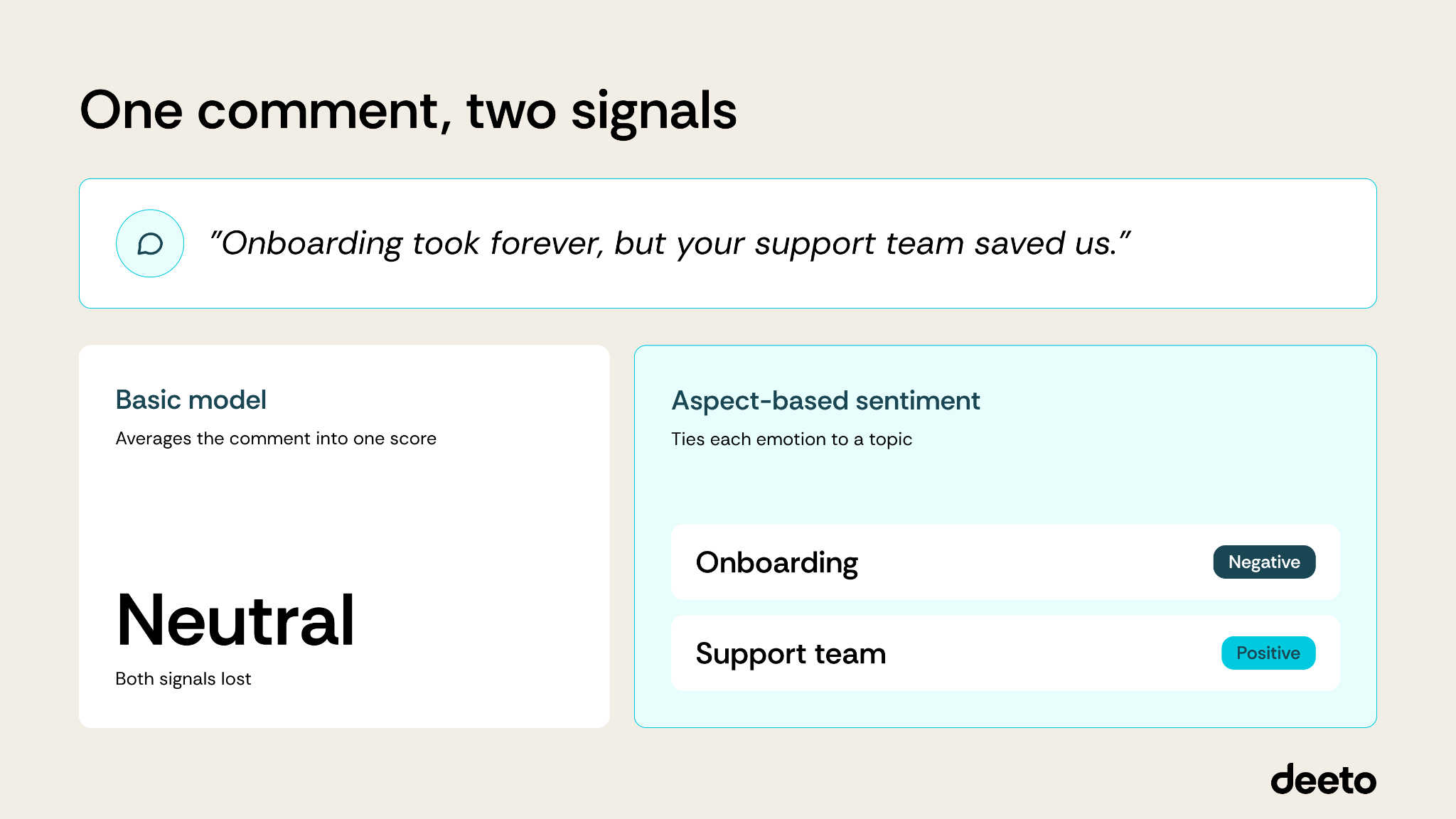
Early tools sorted comments into three buckets: positive, negative, or neutral. Unfortunately, these buckets don’t tell you much. Take a comment like "onboarding took forever, but your support team saved us." A basic model averages it into something close to neutral, and you lose both signals.
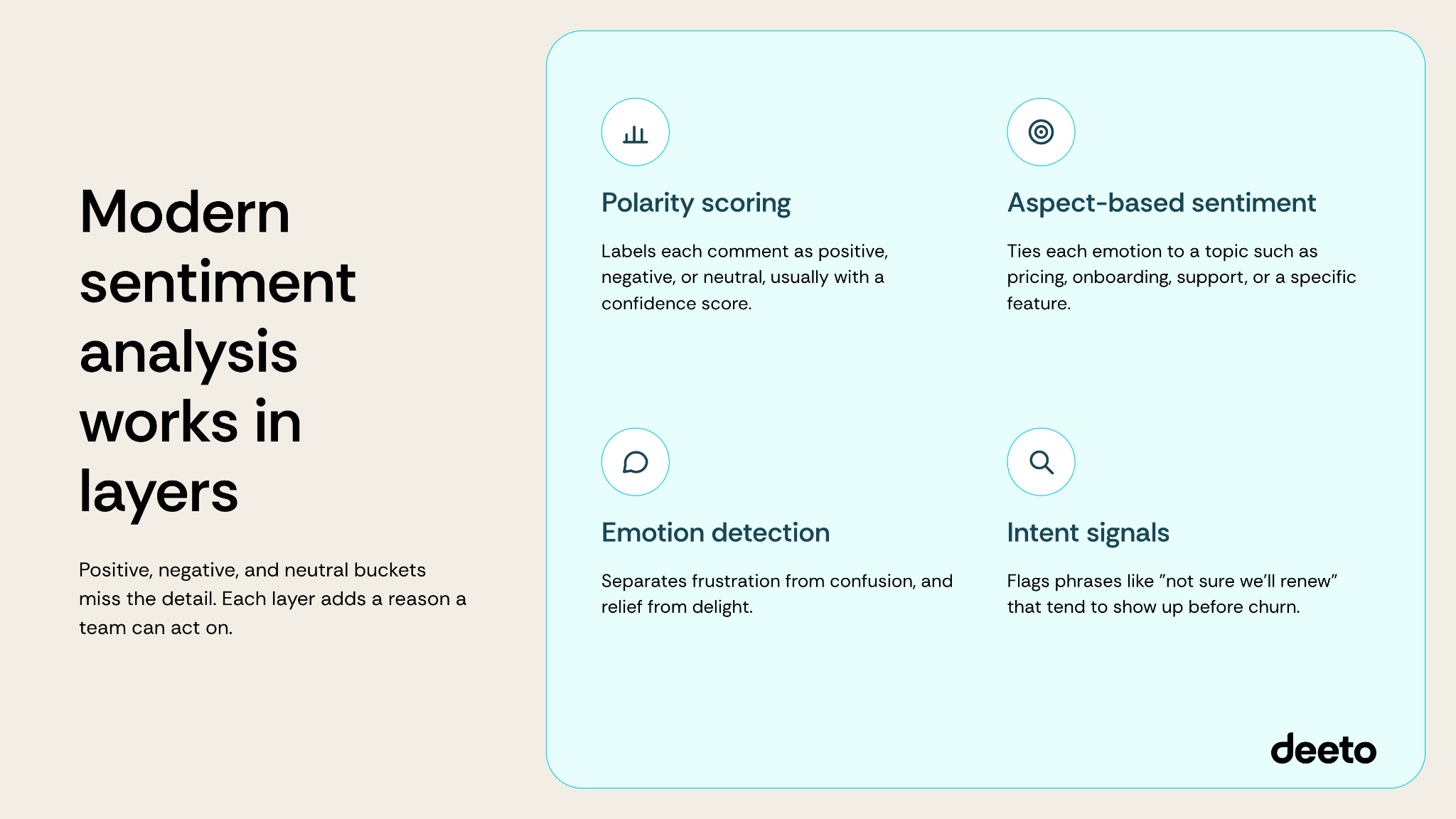
Modern customer sentiment analysis works in layers:
- Polarity scoring labels each comment as positive, negative, or neutral, usually with a confidence score.
- Aspect-based sentiment analysis ties each emotion to a topic such as pricing, onboarding, support, or a specific feature.
- Emotion detection separates frustration from confusion, and relief from delight, because each one calls for a different response.
- Intent signals flag phrases like "looking at other options" or "not sure we'll renew" that tend to show up before churn.
Why sentiment analysis matters for customer experience
In PwC's 2025 Customer Experience Survey, about nine in ten executives said customer loyalty had grown in recent years. Only four in ten consumers agreed.
Part of that gap comes from using scores rather than a true sentiment analysis. An NPS of 42 could either mean that customers are mildly annoyed about pricing or furious about a broken integration. The average hides the reason, and the reason is what you'd actually fix.
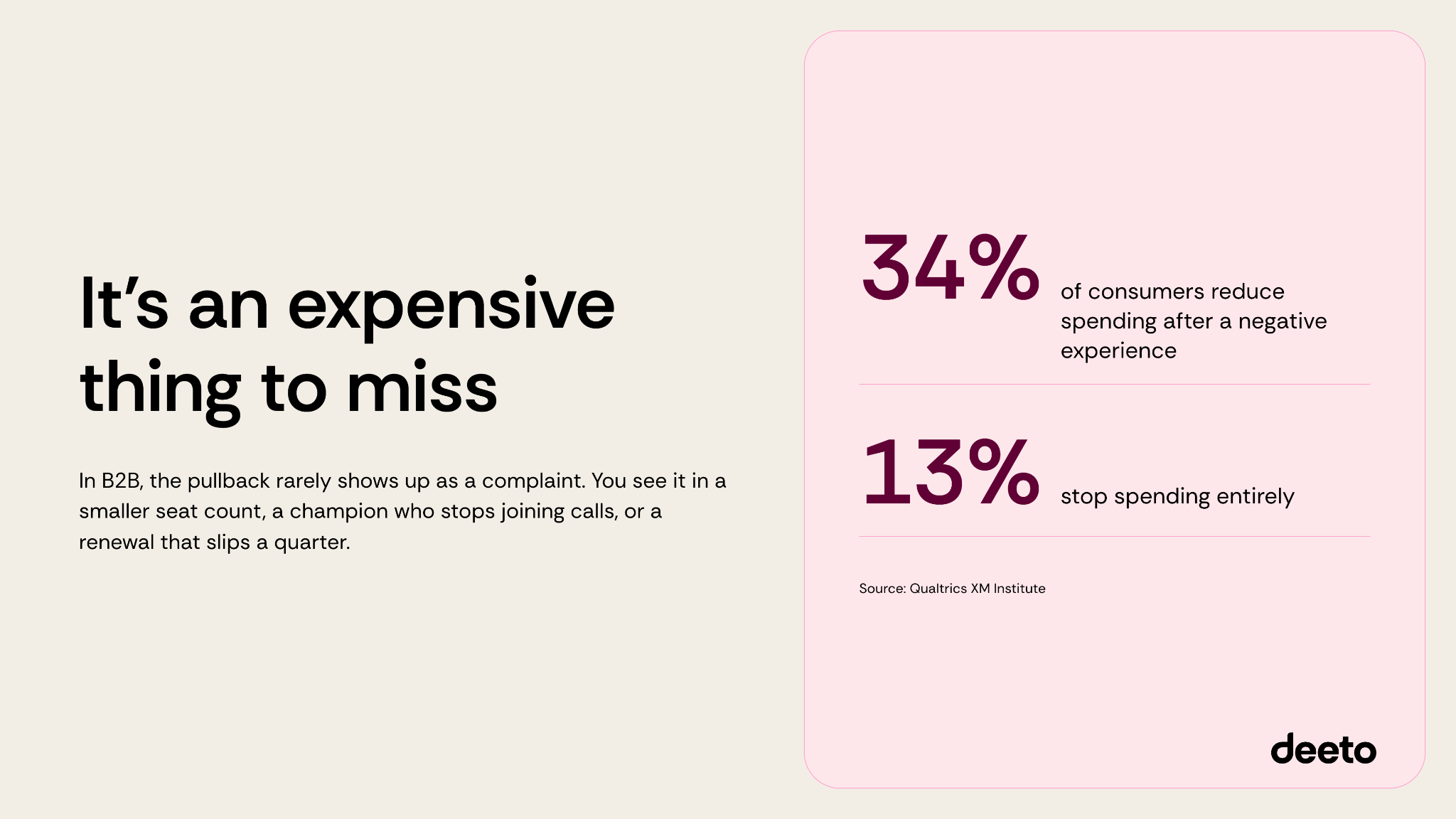
It's an expensive thing to miss. Qualtrics XM Institute found that 34% of consumers reduce spending after a negative experience and 13% stop spending entirely. In B2B, the pullback rarely shows up as a complaint. You see it in a smaller seat count, a champion who stops joining calls, or a renewal that slips a quarter without much explanation.
Customers rarely say they're leaving, but they'll hint at it in tickets and call notes long before the renewal date. Sentiment analysis is how you catch those hints while there's still time to respond.
Catching them is only half the job, though. In most companies, customer voice is scattered. Support owns the tickets, CS owns the call notes, product owns the survey verbatims, and customer marketing rarely sees any of it. Sentiment improves the experience only when what it finds reaches the person who can act on it.
Sentiment analysis vs. survey scores
Survey scores and sentiment analysis answer different questions. Scores like NPS, CSAT, and CES measure how customers rate an experience. Sentiment analysis explains why they rated it that way, using language customers already produce without being asked.
The bigger practical difference is that sentiment analysis doesn't need anyone to fill out a survey. As response rates fall, any score that depends on a response gets noisier. Sentiment analysis runs on the tickets, calls, and conversations that happen anyway.
In practice, you want both. Survey scores give you the trend, and sentiment analysis on the verbatims and support conversations tells you what moved it.
6 ways sentiment analysis improves customer experience
Sentiment analysis improves customer experience when it ties a feeling to a cause and to someone responsible for fixing it. Here are six ways B2B teams use it.
1. Find the reason behind falling scores
When NPS drops, leadership wants to know why. Aspect-based sentiment can answer that in hours rather than weeks of research. Tag every detractor comment by topic, and you might find that most mention implementation delays while pricing complaints haven't moved.
Then map those topics against your customer journey map to see which stage is causing the friction. A dip in the first 90 days needs a different fix than a dip at renewal.
2. Spot advocates, references, and stories in what customers already say
Most teams use sentiment analysis defensively, to find problems. The positive side deserves the same attention, especially for customer marketing. Every comment that praises a specific outcome is a potential reference, case study, or review, and most of them sit unnoticed in support threads and call notes.
For customer marketing and customer advocacy leaders, positive sentiment tagged by topic becomes a shortlist of advocates. A customer who wrote "we cut onboarding time in half" is a ready candidate for your reference program, and their own words are the first draft of customer stories and social proof. The same tags show which outcomes customers mention most, so campaigns are built on what customers value rather than what the team assumes.
Timing changes the ask, too. Inviting a customer to speak right after they praised your team lands very differently than a cold reference request at quarter end.
3. Catch churn risk before the renewal conversation
Tone changes before behavior does. If a customer wrote "love the new dashboard" in March and "still waiting on a fix" in June, that's a signal, and it arrives well before usage drops.
Sentiment trends across tickets, call notes, and QBR transcripts add context to churn prediction models that usage data can't provide on its own. For customer success teams, the useful output is simple: a list of accounts to call this week, ranked by risk, with the reason attached.
4. Prioritize fixes by emotional weight and volume
Ticket volume is a poor proxy for impact. Two hundred tickets about a confusing button might matter less than twenty angry billing complaints from your largest accounts.
When you weight topics by how often they come up and how strongly customers feel about them, product teams get a more honest ranking. They also get the customer's own words to back it up, which tends to shorten roadmap debates. Our guide on how to use customer feedback to build a product roadmap walks through that process step by step.
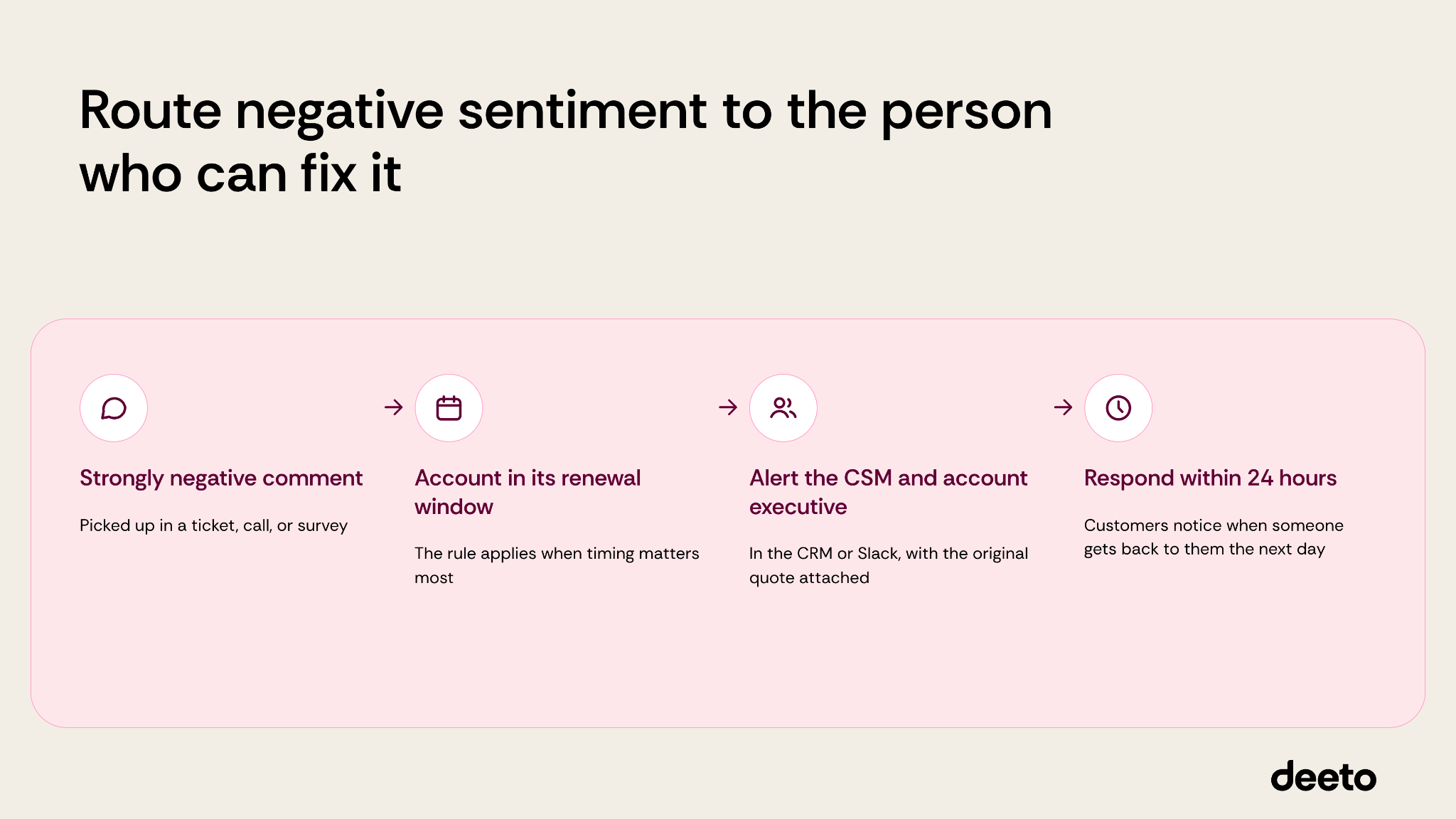
5. Route negative sentiment to the person who can fix it
A frustrated comment doesn't help anyone if it stays in the support tool. Send sentiment alerts to where account owners already work, whether that's the CRM or Slack.
Then set a rule people can follow. For example, any strongly negative comment from an account in its renewal window goes to the CSM and the account executive within 24 hours, with the original quote attached. Customers notice when someone gets back to them the next day.
6. Coach support and success teams with real conversations
Conversation-level sentiment shows you where calls go wrong. If sentiment keeps dropping at the moment agents explain a policy or transfer a case, you have a script or process problem, and those can be fixed.
Managers can also pull calls that started badly and ended well, then use them for training. Real conversations with your own customers teach more than a generic soft-skills course.
Common challenges with customer sentiment analysis
Sarcasm and B2B context
"Great, another outage" reads as positive to a basic model. B2B language adds more traps, since words like "aggressive" or "critical" can be neutral or even positive in a technical conversation. Use models tuned on business conversations, and have someone spot-check a sample of scored comments each month.
Too little feedback to analyze
Sentiment analysis can only read what customers actually say. If most of them stay quiet, the model works from a thin, skewed sample, usually your angriest and happiest customers. The fix is to give the middle more chances to speak up, through short in-product questions and AI-led customer interviews that pick up detail surveys miss.
Dashboards nobody acts on
A sentiment dashboard with no owner turns into wallpaper. Every tracked topic needs a team responsible for it and a threshold that triggers action. If nobody would change a decision based on a metric, stop tracking it.
Sentiment split across tools
This is the scattered-voice gap from earlier, and it's the most common reason sentiment programs stall. Each team sees its own slice of the customer, and nobody sees the whole account.
Closing it takes one system that turns customer voice into intelligence and routes it to the teams that can act. Deeto, a voice of the customer platform, is built that way. Listen captures customer voice from interviews, surveys, and in-product questions. Learn organizes it in one system of record tied to each account. Activate delivers the right signal to CS, product, or customer marketing in the tools they already use. Analyze applies AI sentiment analysis to every response and tracks patterns over time. Orchestrate runs the workflows that connect it all, so a frustrated comment becomes a CSM alert and a glowing one becomes an advocacy invitation.
How to start using sentiment analysis to improve CX
- Pick one outcome to move. Renewal rate for mid-market accounts is a better starting point than "improve CX."
- Connect the sources you already have. Support tickets, call transcripts, NPS verbatims, and CSM notes cover most of what customers say.
- Define the topics that matter. Start with 8 to 12, such as onboarding, reliability, pricing, support, and your top features.
- Assign owners and thresholds. Decide who gets alerted, at what level of negative sentiment, and how fast they need to respond.
- Review monthly against outcomes. Compare sentiment trends with renewals, expansion, and churn to learn which signals actually predict revenue.
For customer experience and success teams using Deeto this way, results include 10 to 15% higher renewal rates and 25% faster visibility into risk signals.
Key takeaways
- Sentiment analysis uses AI to measure how customers feel about specific topics, across tickets, calls, surveys, and interviews.
- It explains why a survey score moved, which the score can't tell you on its own.
- The biggest CX gains come from catching churn risk early, ranking fixes by emotional weight, and getting negative feedback to an owner fast.
- Positive sentiment is a source of customer proof and sharper messaging.
- None of it changes anything unless every tracked topic has an owner and a response threshold.
FAQs
How can sentiment analysis be used to improve customer experience?
Sentiment analysis improves customer experience by showing how customers feel about specific topics, such as onboarding, pricing, or support, across every channel they use. Teams use it to find the cause behind falling scores, flag at-risk accounts before renewal, prioritize product fixes by emotional impact, and route negative feedback to the right owner quickly.
Does sentiment analysis replace NPS and CSAT?
No. Sentiment analysis works best alongside survey scores. Surveys give you a consistent benchmark to track over time, but they depend on customers responding and rarely explain why a score changed. Sentiment analysis reads tickets, calls, interviews, and open-text answers to show what's behind a score moving up or down.
What data sources work best for customer sentiment analysis?
The best sources are the ones where customers explain themselves in their own words: support tickets, call and meeting transcripts, open-text survey answers, customer interviews, CSM notes, and product reviews. Combining several sources per account gives a more accurate picture than any single channel, since each one captures a different moment in the relationship.
Can sentiment analysis predict customer churn?
Sentiment analysis can surface early warning signs of churn. A steady decline in tone, rising frustration about one topic, or phrases like "evaluating alternatives" often appear before usage drops. Combined with product usage and account data, sentiment trends give churn models context that usage alone misses, and they give customer success teams a specific reason to reach out.
What is aspect-based sentiment analysis?
Aspect-based sentiment analysis ties each emotion in a piece of feedback to a specific topic. Instead of scoring a whole comment as neutral, it separates "setup was painful" from "the support team was excellent" and records both. CX and product teams can then see which parts of the experience drive satisfaction and which cause frustration.
How accurate is AI sentiment analysis?
It depends on the model and the data it was trained on. Modern models handle straightforward feedback well but can struggle with sarcasm, mixed opinions, and industry jargon. Teams get better results by using models tuned to business conversations, scoring sentiment by topic rather than by whole comment, and having a person review a sample of results each month.
Conclusion
So how can sentiment analysis be used to improve customer experience? Mostly by telling teams what to fix and who owns it, based on the language customers already produce.
You don't need to start big. Pick one outcome, connect the feedback you already collect, and give every topic an owner. Teams that get value from sentiment use it to decide who to call this week. Teams that don't end up with a monthly report nobody opens.
Deeto brings customer voice from interviews, surveys, and conversations into one place, then turns sentiment into alerts and next steps for CS, product, and marketing. To see how that works for your team, book a demo.
🎉 Save your spot
Register for the event
Once your spot is secured, we’ll send your confirmation details.
Subscribe to our newsletter
Subscribe to receive the latest blog posts to your inbox every week.
By subscribing, you agree to our Privacy Policy
Subscribe to our newsletter
Get the latest news and updates from our team.
By subscribing, you agree to our Privacy Policy
Related posts

Call Intelligence Software That Spots Your Next Reference

What is call intelligence software? Learn how it scores every call automatically and surfaces advocacy-ready customers.

4 Ways To Leverage Social Proof In Marketing
What is social proof in marketing? Learn 4 ways to use reviews, stories, and advocacy to build buyer trust.

Customer Proof Marketing: How B2B Companies Build Trust with Buyers
What is customer proof marketing? Learn the proof types, frameworks, and software that build B2B buyer trust.