


6 Best Customer Testimonial Software Platforms



Friday, October 23, 2026


6 Best Customer Testimonial Software Platforms


View the podcast on Youtube

Gartner found that 75% of B2B buyers prefer a rep-free sales experience. So when a buyer skips the rep, the customer proof they find on their own does more of the selling.
Customer testimonial software is a platform that helps companies request, record, approve, and publish customer feedback as written quotes, video clips, and stories. The better tools also organize that proof so the right story reaches the right buyer, no matter who on your team is sending it.
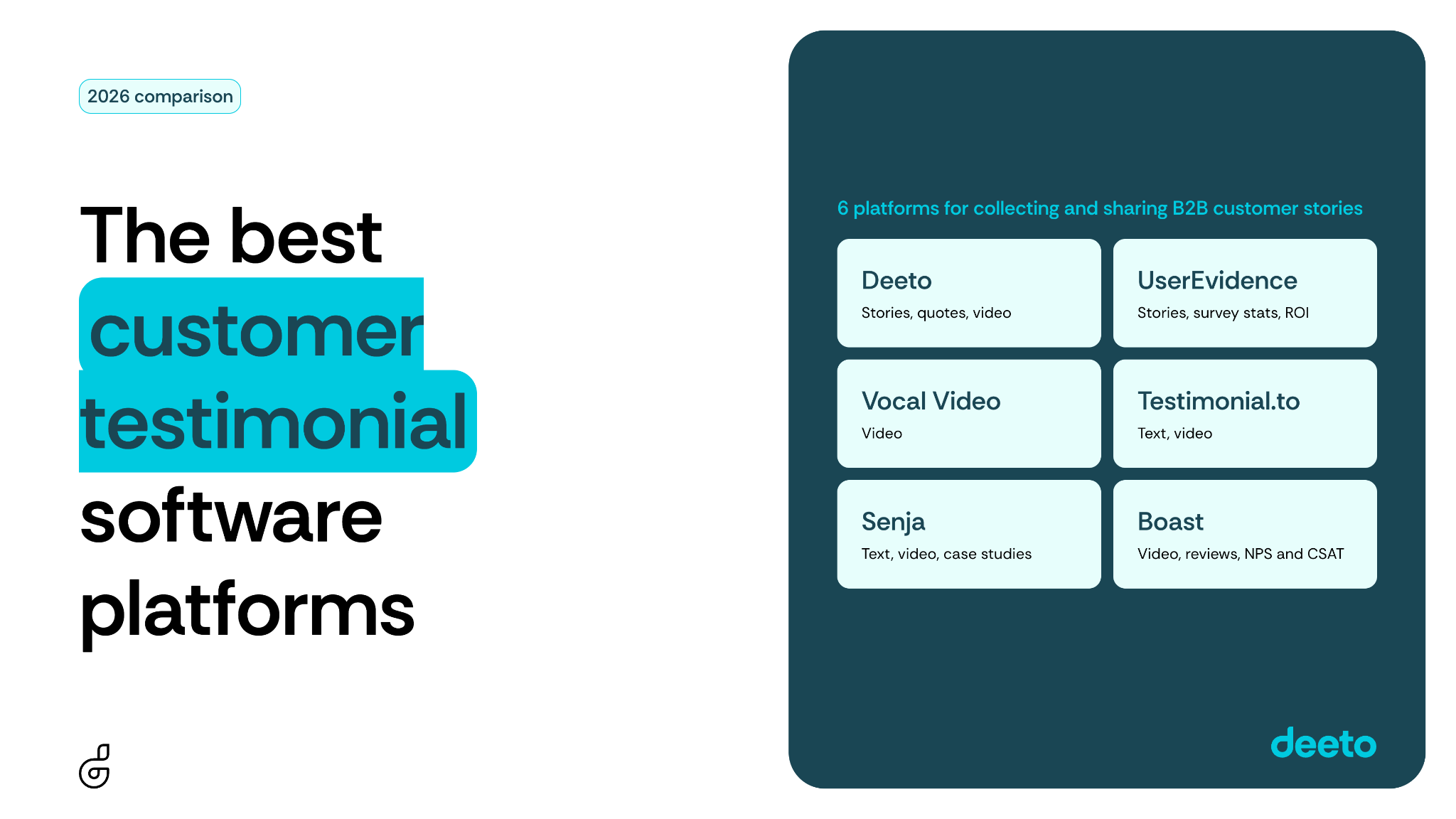
Below, we compare six platforms on formats, pricing, and fit for a B2B customer marketing team. Yes, Deeto is one of them. We explain how we handled that below.
What is customer testimonial software?
Customer testimonial software is a system for collecting and using customer proof at volume. It replaces the old routine: email a happy customer, schedule a call, transcribe it, chase legal for approval, paste the quote into a slide, and repeat.
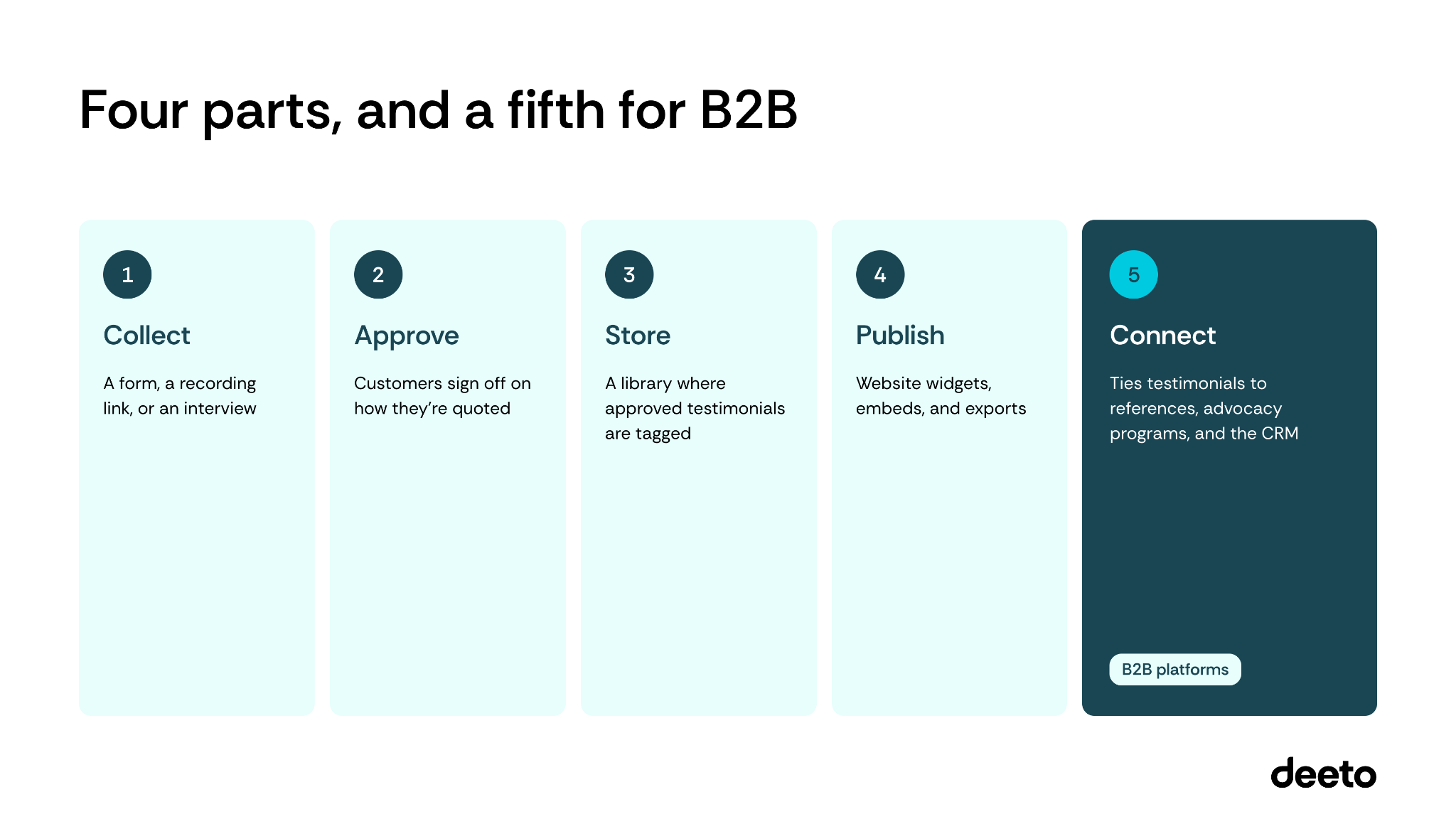
Customer testimonial platforms typically include four parts:
- A way to collect testimonials, usually a form, a recording link, or an interview
- An approval step where customers sign off on how they’re quoted
- A library where approved testimonials are tagged and stored
- Publishing tools like website widgets, embeds, and exports
B2B platforms add a fifth part. They connect testimonials to references, advocacy programs, and the CRM, so a rep working a healthcare deal can pull a healthcare story without filing a request and waiting a week.
Why do B2B teams need more than a testimonial widget?
A testimonial wall on your homepage is nice. It does nothing for the rep who needs a mid-market fintech customer to talk about switching from a competitor by Thursday.
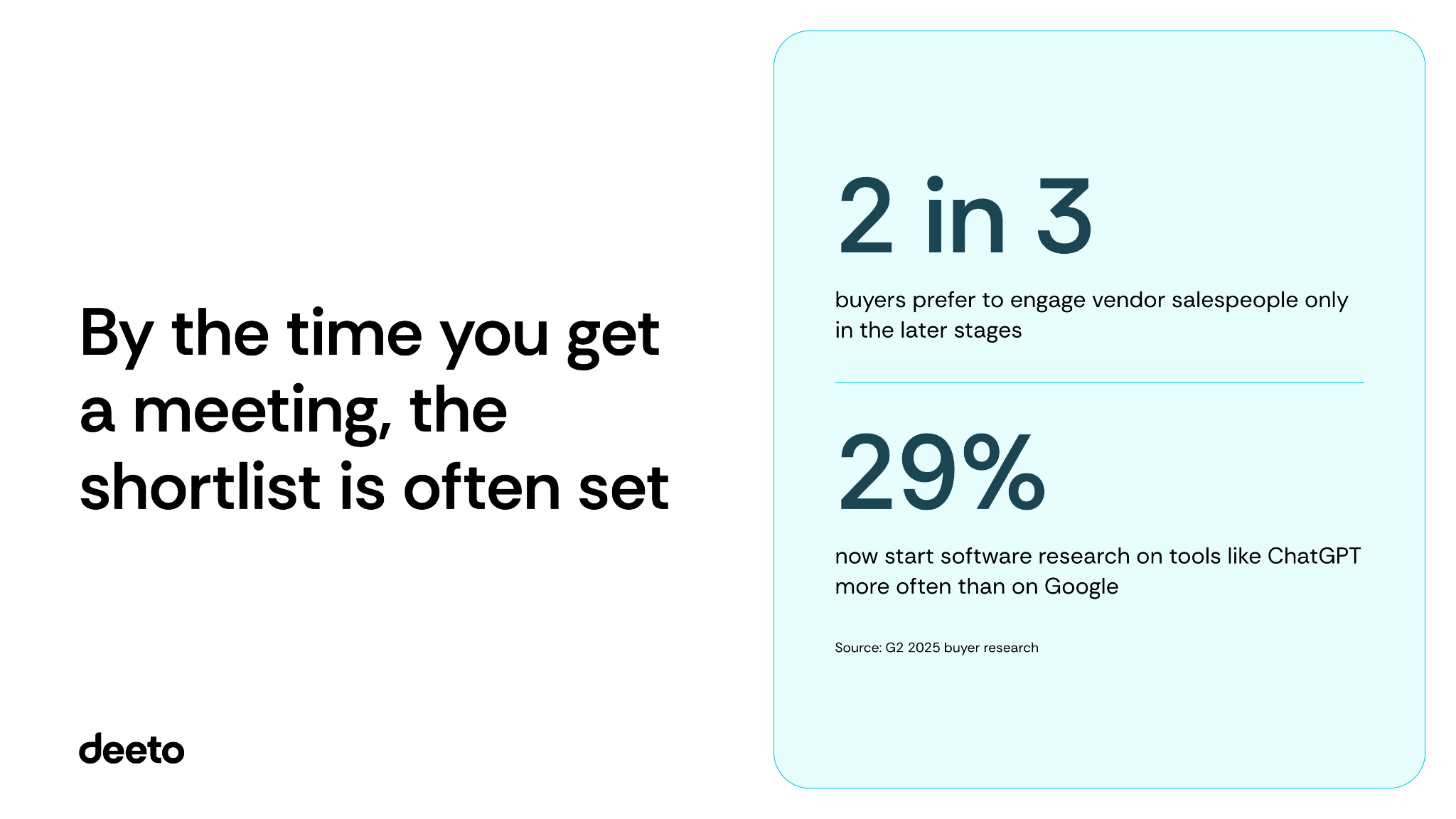
Buyers are also talking to reps less, and later. In G2’s 2025 buyer research, nearly two in three buyers said they prefer to engage vendor salespeople only in the later stages, and 29% now start software research on tools like ChatGPT more often than on Google. By the time your team gets a meeting, the shortlist is often set.
That changes the job. Collecting a quote is easy, but programs stall on everything after that, keeping proof current, matching it to the buyer in front of you, and getting it where buyers actually look.
A testimonial nobody can find is a testimonial you didn’t collect.
How we evaluated these platforms
Deeto is on this list, so for every other entry we stuck to what each vendor publishes about its own product and pricing. Prices come from public pricing pages as of October 2026 and can change.
We compared the platforms on:
- The formats they support, from written quotes to video to long-form stories
- How testimonials get collected, whether through a static form or a guided interview
- Where the proof ends up, from a website widget to the CRM
- B2B depth, meaning reference management, advocacy, and filtering by industry or persona
- Whether pricing is public and whether there’s a free plan
The 6 best customer testimonial software platforms
1. Deeto
Many of the tools on this list are built to collect a quote and put it on a page. Deeto works one layer down. It's a voice of the customer platform that turns authentic customer voice into intelligence, then routes it to the teams and tools that need it. Testimonials are one of the things that come out of that system.
It starts with AI-led interviews that follow up on what the customer actually says, instead of a static form. Every interview then runs through Deeto's five modules, Listen, Learn, Activate, Analyze, and Orchestrate. In practice, one conversation gets captured, saved to the customer record, delivered to the people who need it, mined for themes and sentiment, and kept moving through automated workflows.
That's why one interview turns into more than a quote. It can become a written story, a video testimonial, a reference profile, and a clear read on why that customer chose you. Customer stories and social proof are tagged by persona, industry, and use case, so a rep can find the right one without filing a request. The same record powers reference management, showing who's willing to take a call, how often they've been asked, and where coverage is thin. And proof shows up where teams already work, through Salesforce and other CRM integrations.
Deeto customers share results on its customer marketing solutions page. Knak saw a 75% lift in advocate conversion in 30 days. PandaDoc produced 10x more content with fully automated collection.
Deeto doesn’t have to replace your website widget. Plenty of teams keep a lightweight display tool for their homepage and use Deeto for the work that happens behind it, like running interviews, matching references to deals, and getting proof to reps.
Best for: B2B customer marketing and product marketing teams that want testimonials, references, and customer advocacy in one system.
Pricing: Custom. Book a demo for a quote.
2. UserEvidence
UserEvidence is a B2B customer evidence platform for product marketing and customer marketing teams at software companies. It covers evidence collection, advocacy, AI-assisted reference matching, a private advocate community, and ROI studies.
It’s a good fit if you want research-style proof, like survey-backed stats, alongside your stories and references. UserEvidence positions itself for companies selling higher-priced products in competitive markets. Pricing isn’t published.
Best for: B2B software companies that want survey-driven evidence and reference matching.
Pricing: Not published. Demo required.
3. Vocal Video
Vocal Video is built for remote video testimonials. Customers record from a browser link whenever it suits them, and the platform’s AI edits the raw footage into branded, multi-scene videos with captions, music, and motion graphics. Teams use it for employee and recruiting videos too.
The draw is finished video without a production crew. The tradeoff is that it’s a video tool first, so written case studies, references, and CRM-based reference requests will need to live somewhere else.
Best for: Marketing teams that want polished video testimonials at volume.
Pricing: Free plan with five watermarked videos. Paid plans start at $99 per month billed yearly, with Enterprise starting at $1,250 per month (pricing).
4. Testimonial.to
Testimonial.to collects text and video testimonials through a shareable page and displays them on an embeddable “Wall of Love,” a grid of customer quotes and videos you can drop onto any page. It can also import praise from X and LinkedIn. Higher tiers add an API, webhooks, Zapier, and Google rich snippets.
Setup is quick, and pricing is built for small teams. Testimonials are organized into project-based “spaces,” though, so B2B teams that want to tag proof by industry, persona, and deal stage will feel the limits as their library grows.
Best for: Startups and small teams that want a public testimonial wall fast.
Pricing: Free plan with 10 text and 2 video testimonials. Paid plans start at $25 per month billed annually (pricing).
5. Senja
Senja collects video and text testimonials through forms and imports, then displays them in widgets and Walls of Love. It also includes AI testimonial analysis, case study generation, social video reels, and thank-you rewards like e-gifts and coupons.
That’s a lot for the lower tiers, which helps explain why founders and lean marketing teams like it. Like most testimonial marketing tools here, it’s focused on collecting and displaying proof. Managing references and advocates isn’t really its job.
Best for: Lean marketing teams that want collection, display, and light case study creation in one tool.
Pricing: Free plan up to 15 testimonials. Paid plans start at $29 per month (pricing).
6. Boast
Boast is video testimonial software with automated email and SMS request sequences, embeddable forms, display widgets, and ad-free video hosting. It also collects online reviews and runs NPS and CSAT surveys.
Pricing is based on response volume, and multi-location support is built in, so it fits agencies and service businesses well. B2B software teams may find the reference and advocacy side thin.
Best for: Agencies and multi-location businesses that want automated video requests.
Pricing: Starts at $50 per month billed annually, with a 14-day free trial (pricing).
How to choose the right customer testimonial software
Figure out who’s going to use the proof before you pick the tool. A website wall and a sales reference program need very different software.
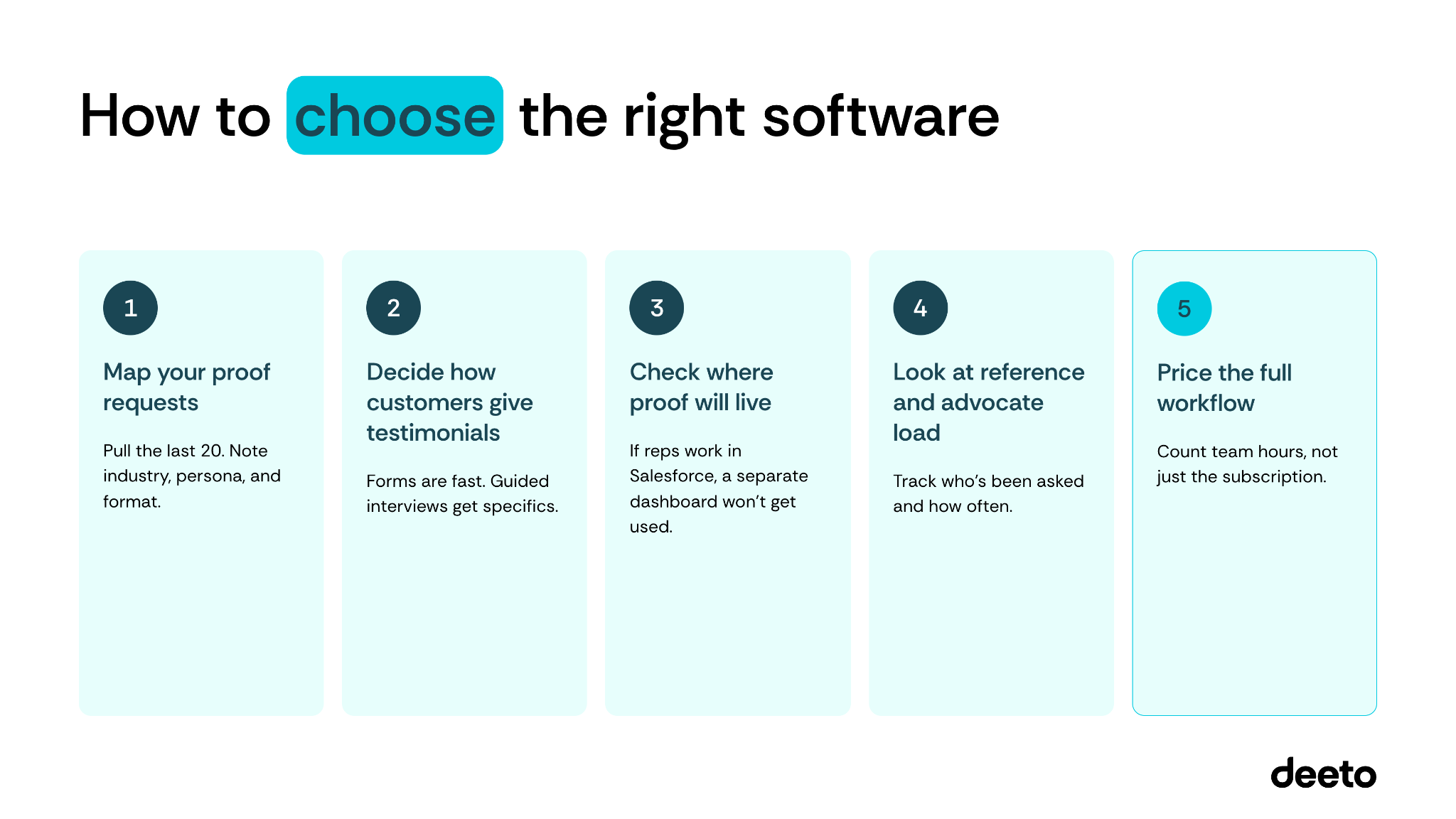
- Map your proof requests. Pull the last 20 requests your team got for a customer story or reference. Write down the industry, persona, and format each one needed. That list tells you what to optimize for.
- Decide how customers will give testimonials. Forms are fast, but they get you quotes like “Great product, great team!” that no rep can use in a deal. Guided interviews take a few more minutes and get specifics: numbers, before-and-after detail, and the competitor they switched from.
- Check where proof will live. If your reps work in Salesforce, testimonials stuck in a separate dashboard won’t get used.
- Look at reference and advocate load. If the same five customers take every reference call, you’ll burn them out. You need to track who’s been asked and how often. Our guide to building a customer reference program walks through how to set that up.
- Price the full workflow. A $29 tool plus manual interviews, editing, and a tracking spreadsheet can cost more in team hours than a platform that handles the whole thing.
Product marketers run into this too. Positioning built on real customer language is easier to defend, which we cover in our post on product marketing strategy.
How do testimonial marketing tools differ from customer evidence platforms?
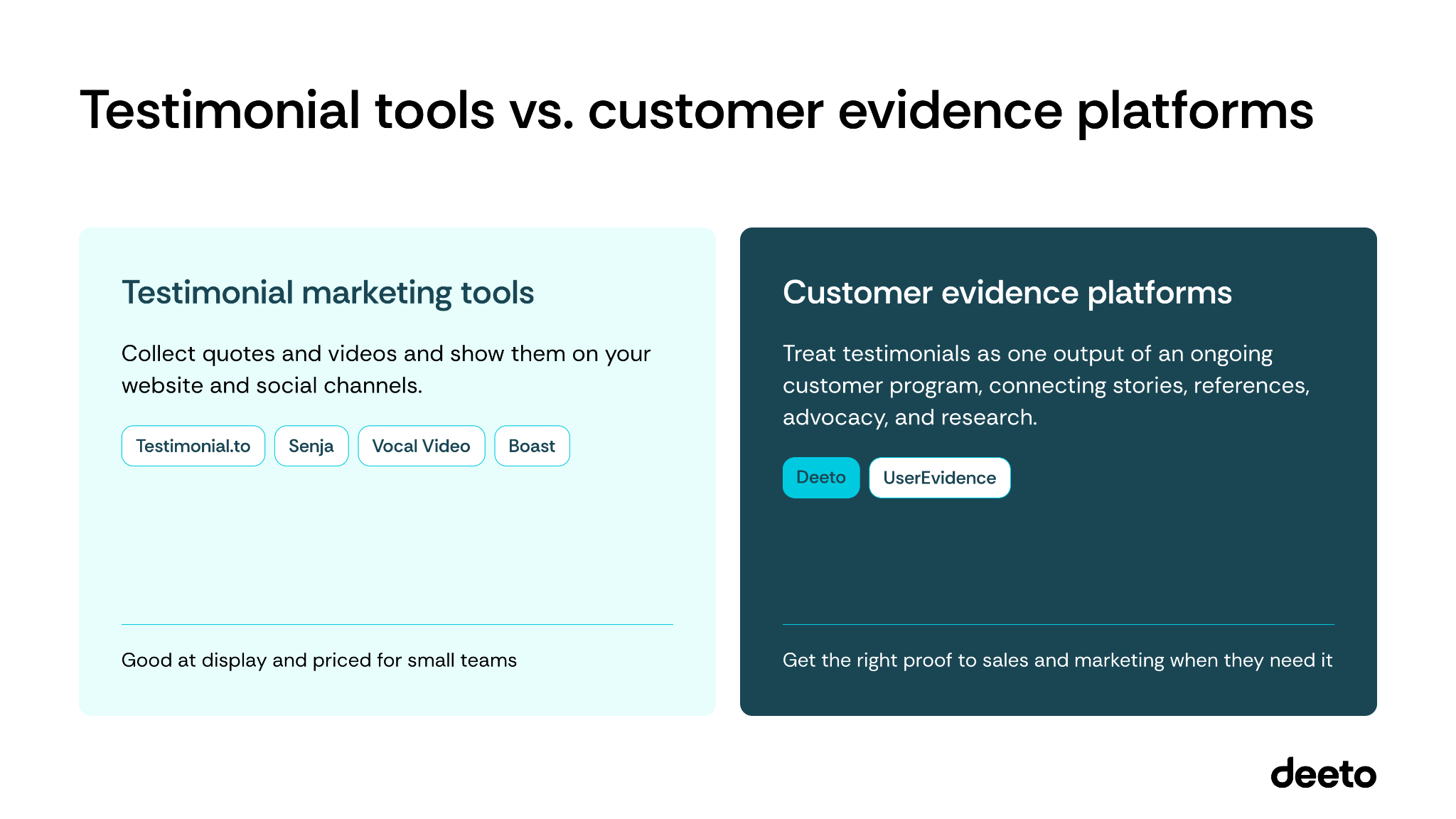
Testimonial marketing tools help you collect quotes and videos and show them on your website and social channels. Testimonial.to, Senja, Vocal Video, and Boast are in this group. They’re good at display and priced for small teams.
A customer evidence platform treats testimonials as one output of an ongoing customer program. It connects stories, references, advocacy, and customer research, then gets the right proof to sales and marketing when they need it. Deeto and UserEvidence sit closer to this end.
Video shows the gap clearly. Wyzowl’s 2026 research found that 57% of video marketers have created testimonial videos. Making the video isn’t the hard part anymore. Knowing which video helps close which kind of deal is, and that’s as much a data problem as a content problem.
There’s a bonus here too. The interviews that produce testimonials also tell you why customers picked you over the alternatives. That’s the raw material for a competitive advantage built on customer insights, and it comes from conversations you were already having.
Key takeaways
- Customer testimonial software helps teams request, record, approve, and publish customer proof as quotes, videos, and stories.
- B2B buyers do more of their research without a sales rep, so the proof they find on their own carries more weight.
- Testimonial.to, Senja, Vocal Video, and Boast are solid testimonial marketing tools for collection and website display.
- Deeto and UserEvidence fit B2B teams that also need references, advocacy, and proof delivered into sales workflows.
- Pick based on who uses the proof and where they work. Widget features matter less than they look on a pricing page.
Which customer testimonial software should you choose?
Need a testimonial wall this week? Testimonial.to or Senja will get you there for under $30 a month. If video quality matters most, Vocal Video is built for exactly that.
B2B customer marketing teams usually outgrow display tools once sales starts asking for specific stories, specific references, and specific proof for specific deals. At that point, a widget won’t cut it. Your testimonials need to be connected to how your company listens to customers in the first place.
Picture a rep two days out from a decision who needs a fintech customer that switched from the competitor still in the deal. She finds that story in Salesforce in a couple of minutes, instead of posting in Slack and waiting. The buyer reads it in a peer’s own words, with real numbers and the details only a real customer would mention. That’s the proof that moves a deal forward. See how Deeto works with your own customer stories.
FAQs
What is customer testimonial software?
Customer testimonial software is a platform that helps companies collect, approve, store, and publish customer feedback as written quotes, video testimonials, and stories. Most tools include a collection form or interview link, an approval step, a searchable library, and publishing tools like website widgets. B2B platforms also connect testimonials to references, advocacy programs, and the CRM, so sales teams can find relevant proof for each deal.
What are the best testimonial marketing tools for B2B companies?
For B2B companies that need proof across sales and marketing, Deeto and UserEvidence connect testimonials with references and advocacy. For website display and lightweight collection, Testimonial.to and Senja are popular low-cost options. Vocal Video is a strong pick for edited video testimonials, and Boast suits teams that want automated email and SMS requests for video.
How much does testimonial software cost?
Pricing varies a lot. Testimonial.to, Senja, and Vocal Video all have free plans, with paid tiers starting between $25 and $99 per month. Boast starts at $50 per month billed annually. B2B customer evidence platforms like Deeto and UserEvidence use custom pricing based on program size, integrations, and how many teams use the platform.
Are video testimonials better than written testimonials for B2B?
They do different jobs. Video builds trust fast on websites, in ads, and on social. Written quotes and stories are easier to scan, search, and drop into sales emails, proposals, and slides. Most B2B teams need both, which is why a platform that turns one interview into several formats saves so much time.
How do you get B2B customers to give testimonials?
Ask right after a clear win, like a renewal, a strong QBR, or a measurable result. Make it easy with a short recorded interview instead of a blank form, and let customers approve their final wording. Keep track of how often each customer gets asked so your best advocates don’t burn out, and thank them with rewards or recognition.
Can testimonial software help with AI search visibility?
Yes, indirectly. G2’s 2025 research found that 29% of B2B buyers start software research on AI tools like ChatGPT more often than on Google. Published customer stories with specific, named outcomes give AI answer engines credible material to cite. Testimonial software that publishes structured, searchable proof makes that content easier to find and reference.
🎉 Save your spot
Register for the event
Once your spot is secured, we’ll send your confirmation details.
Subscribe to our newsletter
Subscribe to receive the latest blog posts to your inbox every week.
By subscribing, you agree to our Privacy Policy
Subscribe to our newsletter
Get the latest news and updates from our team.
By subscribing, you agree to our Privacy Policy
Related posts

Best customer intelligence tools for B2B teams

What are customer intelligence tools? Compare 8 B2B options, collection methods, and how to pick the right fit.

Omnichannel Customer Engagement Tools: 8 Platforms Compared
Compare 8 omnichannel engagement platforms on channels, AI, and pricing, plus the gap automation can't fill.

Voice of the Customer Strategy for SaaS Companies
What is VoC for SaaS? Learn how to capture customer voice and turn it into decisions that drive renewals.


