


6 Best Tools for AI Customer Interviews



Monday, October 26, 2026


6 Best Tools for AI Customer Interviews


View the podcast on Youtube

Two in three research professionals (69%) now use AI in at least some of their projects, according to Maze’s Future of User Research 2026 report.
AI customer interviews are conversations with real customers that an AI moderator runs on its own. The AI asks the questions, probes with follow-ups, and summarizes what it heard. One team can run hundreds of these in parallel and get themes back in hours instead of weeks.
This guide compares six AI customer interview tools, explains how they work, and covers the question most buyers skip: what happens to the answers once the study is over.
What are AI customer interviews?
AI customer interviews are one-on-one research conversations where software, instead of a human moderator, guides the discussion. The participant answers by voice, video, or text. The AI listens, asks a relevant follow-up, and moves through a discussion guide the way a trained researcher would.
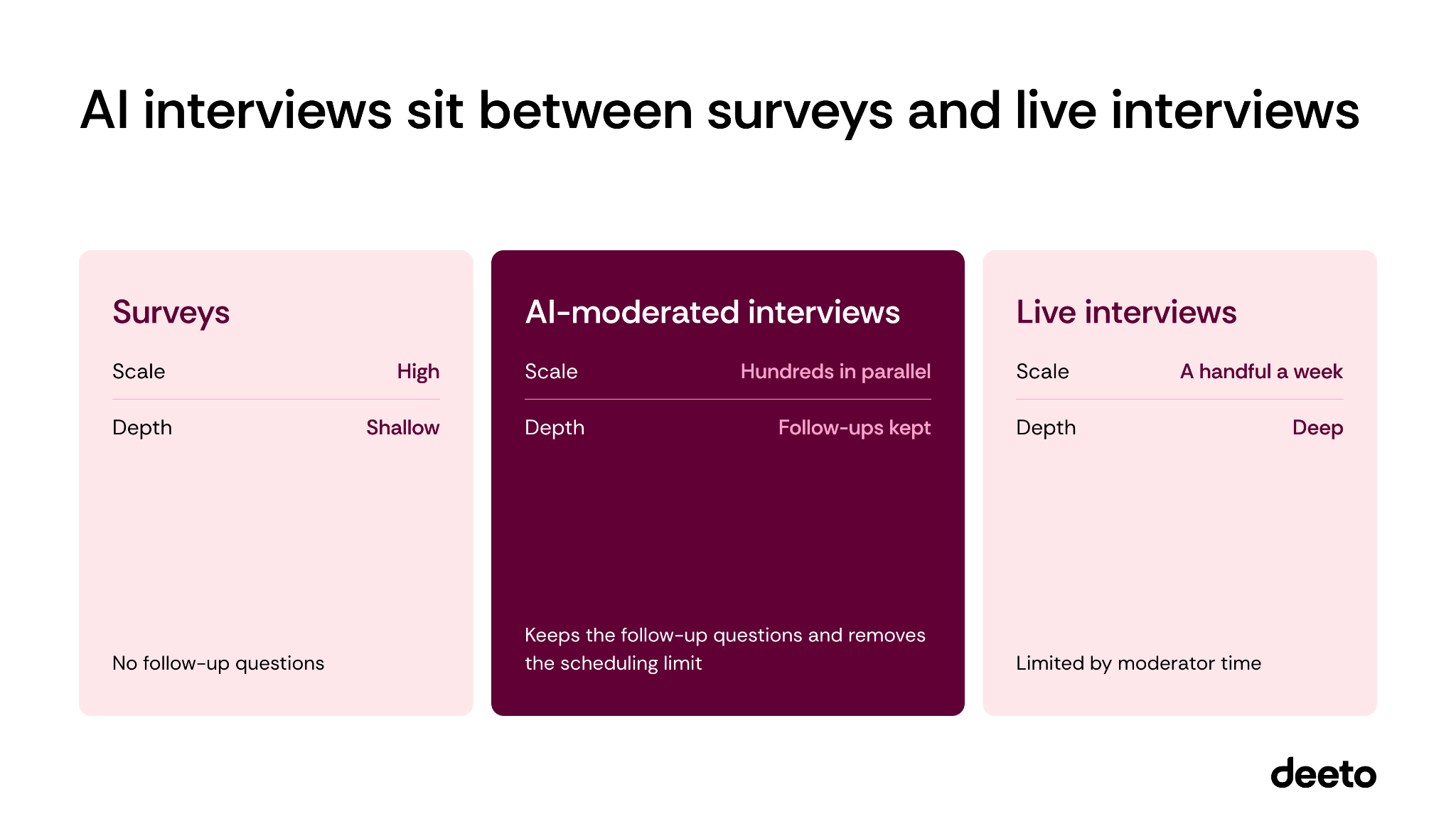
AI-moderated interviews sit between surveys and live interviews. Surveys scale but stay shallow, while live interviews go deep but cap out at a handful per week. AI moderation keeps the follow-up questions and removes the scheduling limit.
AI customer interview tools typically cover the whole study. They draft an interview guide from your research goal, recruit participants from a panel or your own customer list, run the conversation and probe for the "why," then tag themes, pull quotes, and build highlight reels or reports from what came back.
Why AI-moderated research is taking off
Traditional qualitative research is slow and expensive. Frank, one of the tools below, puts the cost of a traditional interview at $500 to $1,000 each on its own website. At that price, most teams interview a few dozen customers a year and guess about the rest.
Maze's Future of User Research 2026 report found that 69% of research professionals now use AI in at least some of their projects, and 63% say it has made research turnaround faster. Transcription, synthesis, and drafting research questions are among the most common uses.
That speed changes who gets to hear from customers. A product marketer testing a new message no longer has to wait for the research team's next open slot. A customer marketing leader can ask 200 customers why they renewed, in a week.
Here's the catch. Faster interviews produce more answers, and more answers create a new bottleneck. If those answers sit in a research repository that sales, marketing, and CS never open, the company learned something and nobody acted on it.
How we chose and evaluated these tools
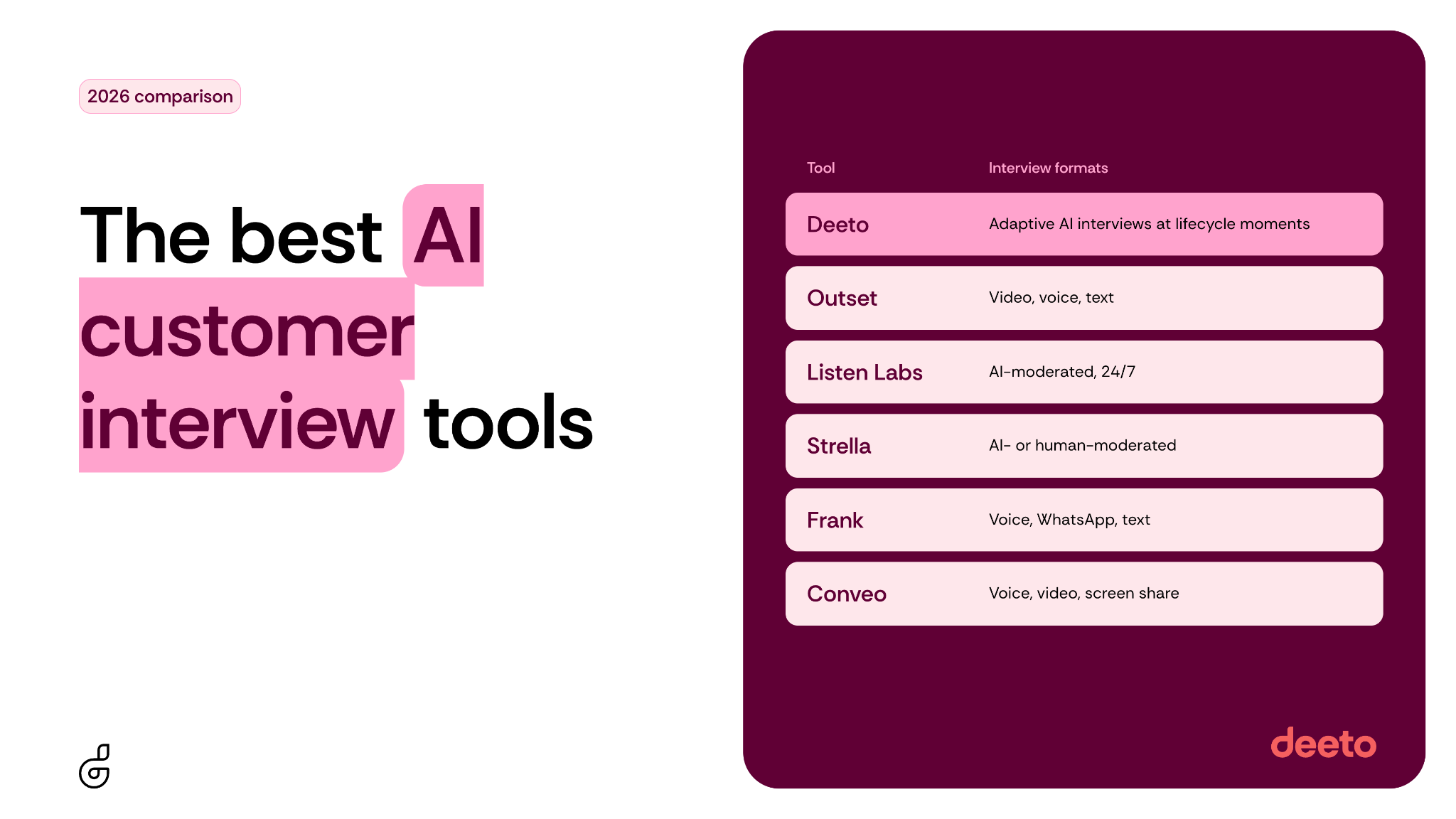
We started with the tools buyers are likely to come across when they research this category. Outset, Listen Labs, Strella, Frank, and Conveo are among the names that show up in search results and AI-generated recommendations for AI customer interview tools.
Each tool also had to meet three requirements to make the list:
- AI moderation is the core product: the AI runs the interview and asks follow-up questions on its own, instead of only analyzing interviews a human ran
- Real participants: interviews happen with real people, even if the tool also offers simulated audiences
- Public, current information: the vendor publishes enough detail on its own website to compare features directly
We also included Deeto, our own platform. We've kept it to the same standard, and the post is clear about where a research platform is the better choice.
We evaluated every tool against the same five criteria:
- Best-fit use case: the team and type of research the vendor builds for
- Interview formats: voice, video, text, or other channels, and whether each is live or still coming soon
- Participant sourcing: whether you can recruit from a vendor panel, use your own customers, or both
- What happens to the answers: the outputs each tool produces, and whether insights stay with the research team or reach other teams
- Trust and transparency: published compliance status, published pricing, and whether insights trace back to a specific interview
All details come from each vendor's own website, reviewed in October 2026. We didn't run paid trials of every tool, so treat this as a starting shortlist and test your top two or three before you buy. Where a vendor doesn't publish a detail, the table says so instead of guessing.
AI customer interview tools compared
The table above reflects what each vendor publishes on its own website as of October 2026. Frank is the only tool here that publishes its pricing. The others quote pricing through a demo, so confirm current plans directly with each vendor.
The best AI customer interview tools
1. Deeto
Deeto is a voice of the customer platform, and AI customer interviews are how customer voice comes into it. Deeto is the layer that turns authentic customer voice into intelligence and routes it to where work already happens, from the CRM to active deals to the next campaign. It's built for B2B companies, and especially for customer marketing teams that need a steady supply of customer proof.
Deeto's AI interview agent reaches out at specific lifecycle moments, like onboarding, feature adoption, renewal, and support resolution. Each conversation adapts to the customer, and every answer is tied to the person, the account, and where they are in the lifecycle. Answers become themes and sentiment dashboards, then flow into customer stories, references, referrals, and Salesforce.
It's the strongest fit for customer marketing leaders and the marketing executives they report to, along with the product marketing and CS teams who work alongside them. It isn't built for recruiting people outside your customer base. More on how Deeto works below.
2. Outset
Outset is an AI-moderated research platform built for enterprise insights and UX research teams. It runs video, voice, and text interviews, and its AI can probe based on audio and visual cues during the conversation.
Outset recruits from a pool it describes as 1.1 billion+ possible participants across 85+ countries, or you can send interview links to your own lists. It also offers digital twins, simulated versions of target audiences built from real interview data, for teams that want to test ideas before fielding a live study. Analysis includes themes, quotes, highlight reels, and auto-generated slide decks.
If you run global studies and want simulated and real participants in one place, Outset is the strongest fit here. HubSpot, Microsoft, and Away are among its published case studies.
3. Listen Labs
Listen Labs runs the whole study for you: it drafts the guide, recruits participants, moderates the interviews, and builds the deliverables. Interviews run 24/7, so studies can field around the clock.
Its participant network covers 50 million+ people, and it lists niche, professional, and expert audiences as a core use case. Outputs range from highlight reels to presentation-ready slides, and Listen Labs says every claim in its analysis traces back to a real interview. A shared workspace lets teams search past studies.
Listen Labs makes the most sense when you want one vendor to own the study from guide to final readout. Brand and consumer insights teams are its core buyers, along with product teams.
4. Strella
Strella is built for speed. Its pitch is 100 customer interviews completed overnight. The AI writes discussion guides (Strella describes them as unbiased), moderates with real-time follow-ups, and lets researchers step in and moderate live when they want to.
Strella recruits from a panel of up to 8 million participants, filtered by criteria like location and experience, or from your own customers. Analysis works at the participant, segment, and study level, and there's a chat interface for asking questions of the data.
Product and UX teams that run concept tests and usability studies every week or two will feel the speed most. Duolingo and DraftKings are among its customers.
5. Frank
Frank, built by Prelaunch, is designed for high-volume interviews at a lower price point. It runs AI voice interviews, WhatsApp voice and video interviews, and text-based AI interviews.
Frank is the most self-serve option here and the only one with published pricing. It offers a free plan, paid plans start under $60 a month, and it supports embedding interview links inside a product, such as a cancellation flow or a tooltip. That makes it practical for churn interviews and post-release feedback. Analysis includes summaries, thematic analysis, and short video recaps.
It suits product managers, growth teams, and founders who want to run interviews continuously without an enterprise contract.
6. Conveo
Conveo is an AI-led qualitative platform for enterprise insights, marketing, and CX teams in industries from CPG to pharma and tech. Its AI moderator runs voice and video interviews with real people and supports live screen sharing for UX research.
Conveo goes further than most on concept and creative testing. It offers second-by-second facial coding for ad and message tests, plus AI-moderated MaxDiff. It also runs always-on programs like brand trackers and stores results in a searchable knowledge base. The company cites 400+ enterprise teams as customers, including AB InBev and Canva.
Conveo earns its place on teams that test concepts, packaging, and creative on a regular cadence.
Where research platforms stop and the customer relationship starts
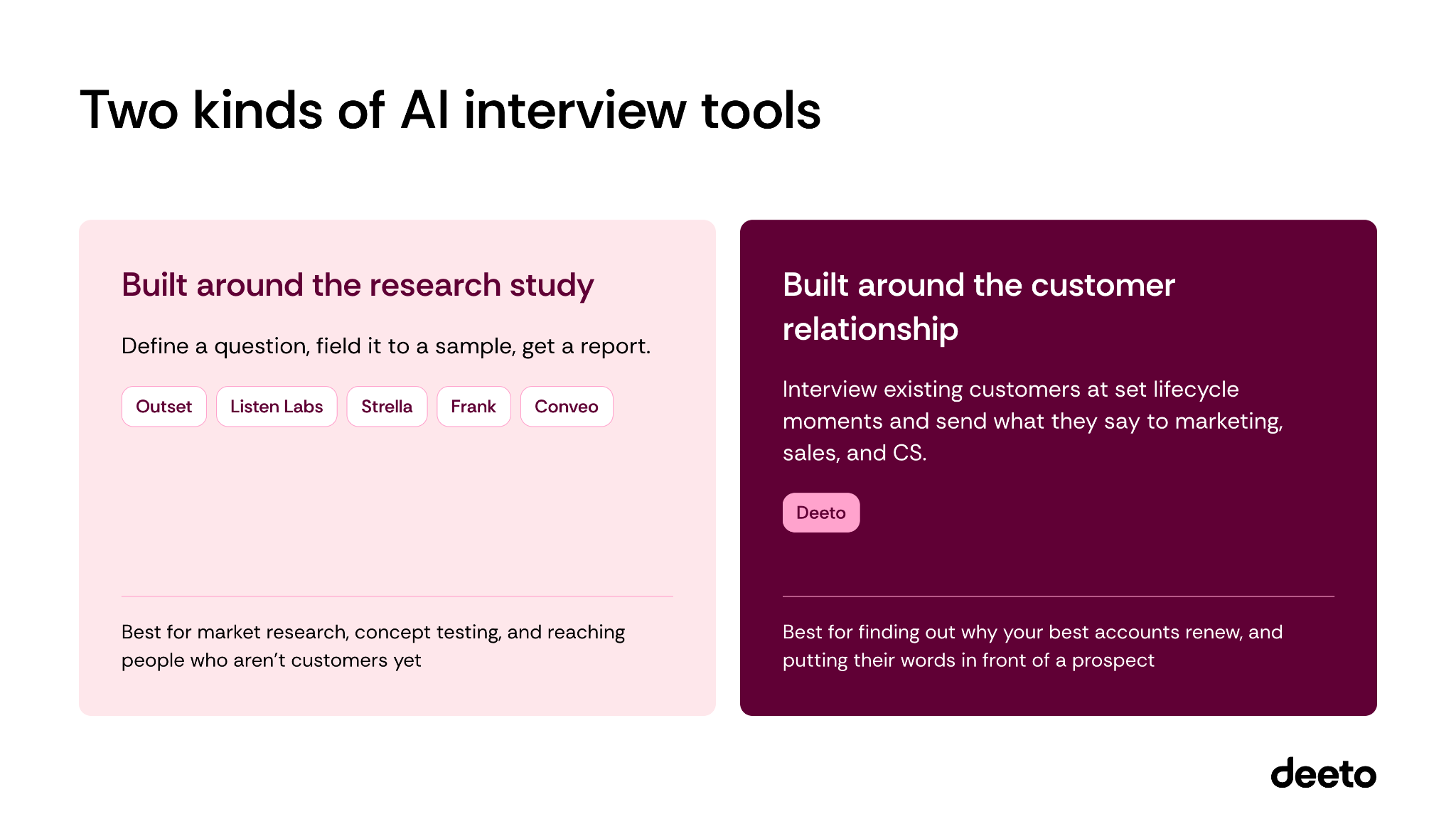
The other five platforms above are built around the research study. You define a question, field it to a sample, and get a report. That model works well for market research, concept testing, and reaching people who aren't your customers yet.
B2B teams have a second need. They want to hear from the customers they already have, at the moments that matter: after onboarding, after a big feature launch, before renewal, after a closed deal. And they want each answer to do more than inform a deck.
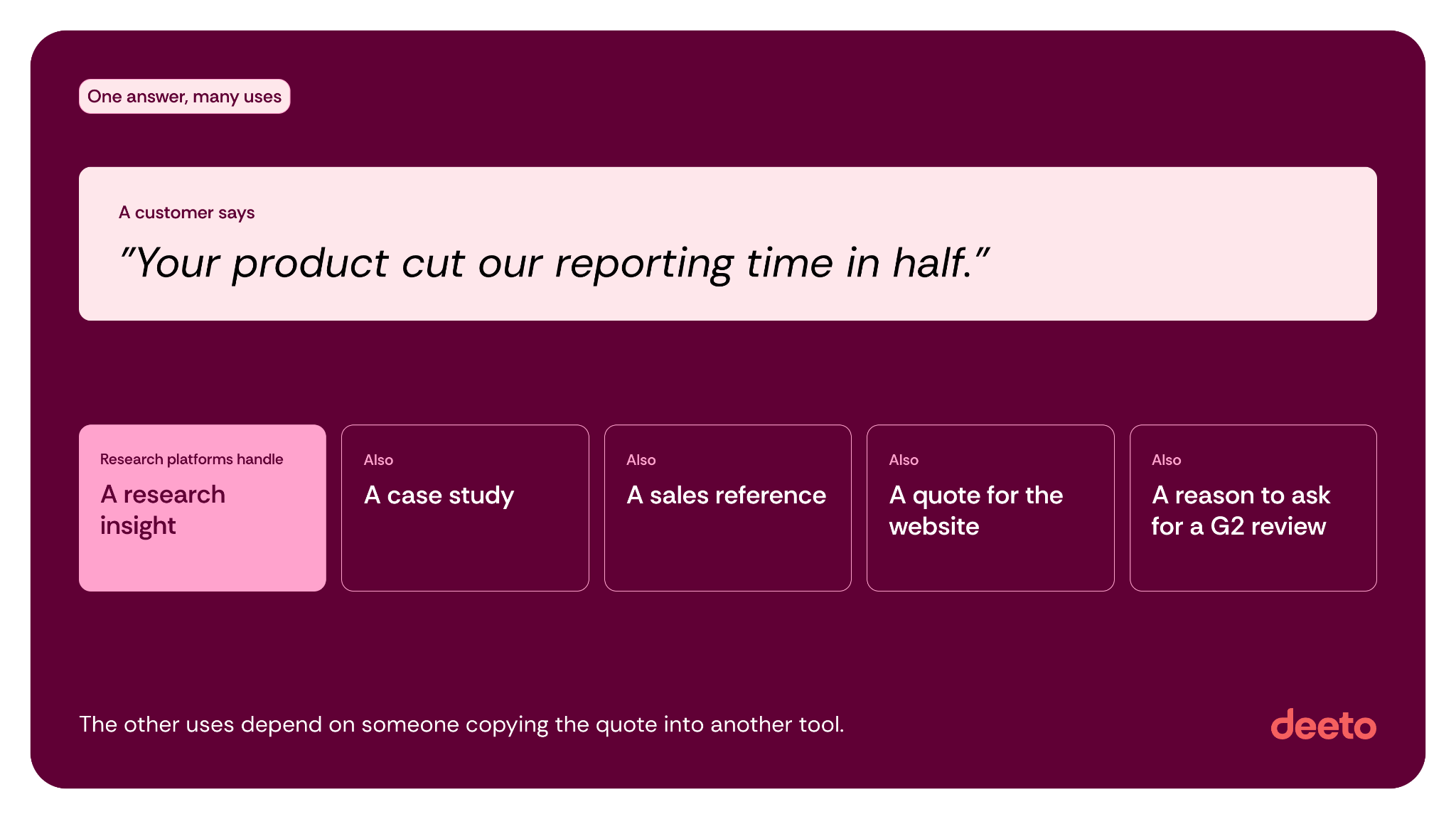
A customer who says your product cut their reporting time in half is a research insight. That same answer is also a case study, a sales reference, a quote for the website, and a reason to ask for a G2 review. Research platforms handle the first use well. The others depend on someone copying the quote into another tool, and in most companies that someone is busy.
How Deeto runs AI customer interviews
Deeto starts where the research study usually ends. The interview is the input. What Deeto adds is the system that turns that voice into intelligence and puts it in front of the people who act on it. Once an AI interview is done, Deeto handles the steps research platforms leave to you:
- It sorts each interview into structured themes (needs, sentiment, experience) and keeps them in one system of record for customer research.
- Dashboards track how sentiment and themes change across segments and lifecycle stages, with sentiment analysis built in.
- A strong answer can become customer stories and social proof, a reference request, or a referral. The customer gives consent at every step.
- Insights go into the tools your teams already use, Salesforce included, through Deeto's integrations. For recorded sales and CS calls, Deeto connects with Gong.
Deeto doesn't recruit from a consumer panel, and it isn't built to field studies with people outside your customer base. Testing packaging with 1,000 shoppers in Brazil? Use one of the research platforms above. Trying to find out why your best accounts renew, and want their words in front of a prospect next week? That's what Deeto is for.
For a customer marketing team, that means a steady flow of stories, references, and advocates without chasing customers one email at a time. For the CMO or VP of Marketing above them, it means campaigns and positioning built on what current customers actually say, with proof that sales can use. Product marketing gets the same benefit: one interview can shape the messaging and hand over the quote for the landing page.
How to choose an AI customer interview tool
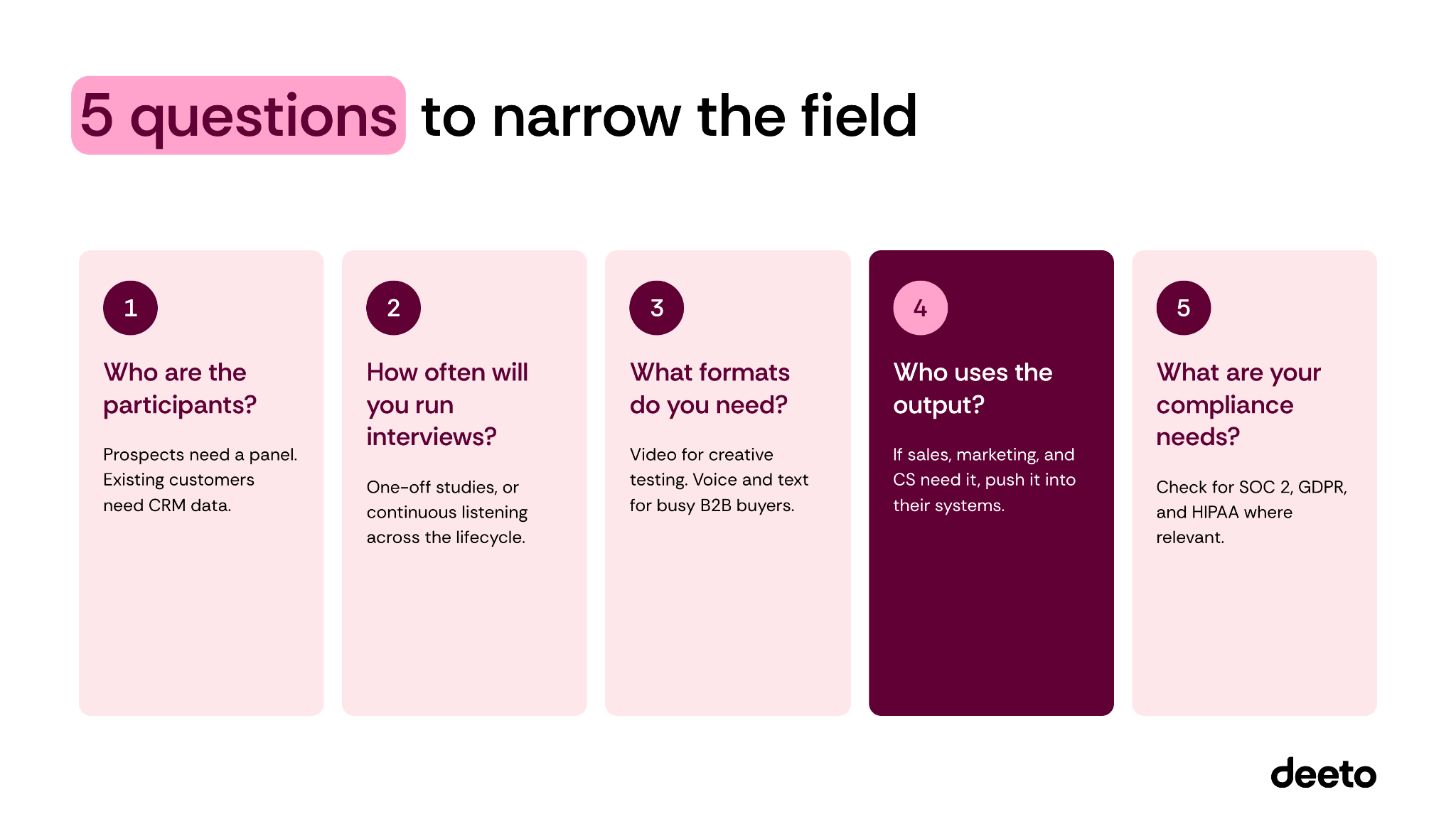
Start with who you need to hear from, then work backward. Five questions narrow the field quickly.
First, who are the participants? If you need people who aren't customers yet, choose a tool with a strong panel, like Outset, Listen Labs, or Strella. If you're interviewing existing B2B customers, choose a tool that connects to your CRM and customer data, like Deeto.
Second, how often will you run interviews? One-off studies suit study-based platforms. If you want to listen continuously across the customer lifecycle, look for a platform that triggers interviews automatically.
Third, what formats do you need? Video matters for concept and creative testing. Busy B2B buyers often complete voice and text interviews at higher rates.
Fourth, who uses the output? If only the research team reads the results, a strong repository is enough. If sales, marketing, and CS need the answers, look for a tool that pushes them into the systems those teams work in.
Fifth, what are your compliance requirements? Check for SOC 2, GDPR, and HIPAA where relevant. Outset, Frank, and Conveo publish their compliance status on their sites, and Deeto's is on its security page.
If you want one interview to inform research and give sales something to use, weigh the fourth question most heavily. Teams building a broader voice of the customer strategy usually end up needing both kinds of tools.
What AI-moderated interviews can't do yet
AI-moderated interviews have limits, and you should know them going in. The same User Interviews report found that 41% of researchers view AI negatively, and 91% are concerned about hallucinations in AI output.
Those concerns are fair. An AI summary is only as trustworthy as its link back to the source. Before choosing a tool, check whether every theme and quote traces to a specific interview you can watch or read. Listen Labs and Outset both emphasize traceability, and it's worth testing in any trial.
AI moderators also struggle with sensitive topics and with participants who need a human to build trust first. Strategic accounts and executive sponsors may still deserve a live conversation. Use AI interviews to hear from far more customers than you could before, and keep humans on the conversations that carry the most weight.
Key takeaways
- AI customer interviews use an AI moderator to run, probe, and summarize real customer conversations at scale.
- Outset, Listen Labs, Strella, Frank, and Conveo are built around research studies, with panel recruiting and report-style outputs.
- Deeto runs AI interviews with your existing customers and turns their answers into insights and customer proof.
- Choose based on who you need to hear from and who needs to use the answers.
- Check traceability. Every AI-generated insight should link back to a real interview.
FAQs
What are AI customer interviews?
AI customer interviews are research conversations with real people that an AI moderator conducts instead of a human. The AI asks questions from a discussion guide, follows up based on each answer, and summarizes the results. You get much of the depth of a live interview at the scale of a survey, so teams can hear from hundreds of customers in days.
Are AI-moderated interviews as good as human interviews?
For many structured research goals, yes. AI-moderated interviews hold up well for concept testing, feature feedback, and understanding why customers churn or renew. They fall short on sensitive topics and with high-stakes participants who need rapport first. Most teams use AI moderation to expand coverage and keep human moderators for strategic conversations.
How much do AI customer interview tools cost?
Most AI customer interview tools use quote-based pricing tied to interview volume, recruiting needs, and features. Frank offers a free tier with starter credits. Outset, Listen Labs, Strella, Conveo, and Deeto price through a demo or sales conversation. Recruiting from a vendor's panel typically costs more than interviewing your own customers.
Which AI customer interview tool is best for B2B companies?
It depends on who you want to interview. For reaching B2B buyers who aren't customers yet, Listen Labs lists niche and professional audiences as a core use case, and Strella lets you filter its panel by criteria like location and experience. For interviewing your existing customers across the lifecycle and turning their answers into proof and references, Deeto is built for that workflow and connects to CRM data.
Can AI interviews replace surveys?
AI-moderated interviews can replace many open-ended surveys because they ask follow-up questions a survey can't. Short scored surveys like NPS and CSAT still work well for tracking trends at a glance. A common setup uses scored surveys to spot changes and AI interviews to explain why those changes happened.
Conclusion
AI customer interviews let you hear from hundreds of customers in the time it used to take to schedule ten. Outset, Listen Labs, Strella, Frank, and Conveo each do this well for research studies, with different strengths in recruiting, speed, self-serve access, and creative testing.
For B2B marketing teams, the bigger opportunity is the customers you already have. For a customer marketing leader, every interview with a current customer is a potential story, reference, or advocate. For the CMO, it's evidence that shapes messaging this quarter and still closes deals next year, as long as the answer reaches the people who write the messaging and run the deals.
Deeto is built for that. It interviews your customers at the right moments in the lifecycle, turns what they say into intelligence, and routes it to marketing, sales, and CS, with their consent. See how Deeto works with your customers.
🎉 Save your spot
Register for the event
Once your spot is secured, we’ll send your confirmation details.
Subscribe to our newsletter
Subscribe to receive the latest blog posts to your inbox every week.
By subscribing, you agree to our Privacy Policy
Subscribe to our newsletter
Get the latest news and updates from our team.
By subscribing, you agree to our Privacy Policy
Related posts

6 Best Customer Testimonial Software Platforms

What is customer testimonial software? Compare six platforms by price, format, and fit for B2B teams.

Omnichannel Customer Engagement Tools: 8 Platforms Compared
Compare 8 omnichannel engagement platforms on channels, AI, and pricing, plus the gap automation can't fill.

Voice of the Customer Strategy for SaaS Companies
What is VoC for SaaS? Learn how to capture customer voice and turn it into decisions that drive renewals.


