


Best customer intelligence tools for B2B teams



Monday, October 19, 2026


Best customer intelligence tools for B2B teams


View the podcast on Youtube

Your company already knows why customers buy, stay, and leave. That knowledge just lives in 40 places, and nobody can find it the week a launch brief is due.
Customer intelligence tools are software platforms that collect what customers say and do across interviews, calls, surveys, support tickets, and product usage, then turn it into patterns teams can act on. The best ones connect that intelligence to sales, marketing, product, and customer success instead of leaving it in a research folder.
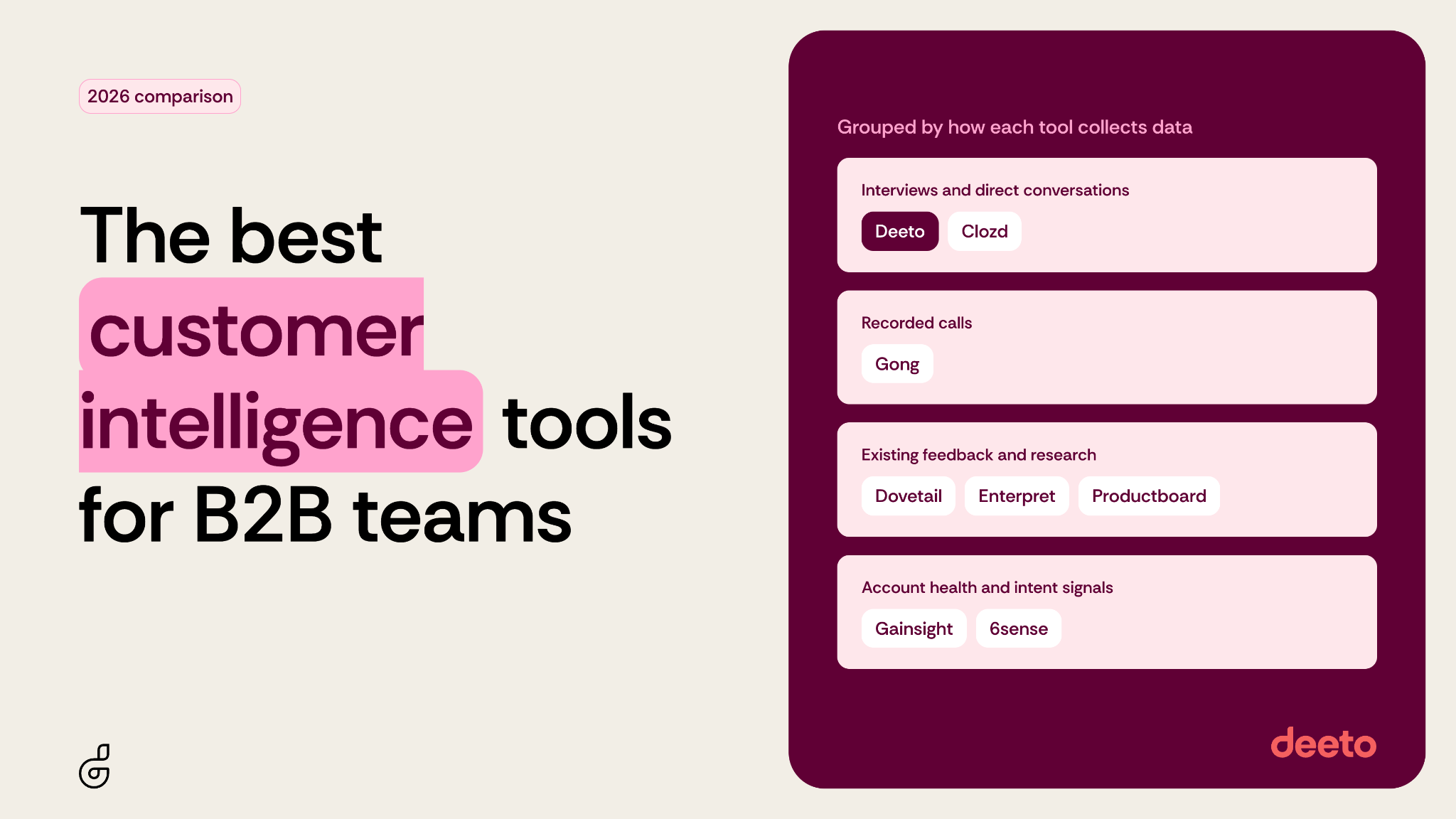
This guide compares eight tools built for B2B teams, the collection methods behind them, and how to pick the right fit.
What are customer intelligence tools?
These tools gather first-party customer data, structure it, and surface the signals that matter for decisions like positioning, pricing, roadmap priorities, and renewals. They sit between raw feedback and the people who need to act on it.
In B2B, customer intelligence includes more than survey scores. It covers the reasons a deal was lost, the objections that show up in sales calls, the feature gaps that come up in renewal conversations, and the stories your happiest customers tell when someone asks them directly.
Most systems do some mix of capture, analysis, and activation. Capture means pulling in voice and behavior data from interviews, calls, tickets, reviews, and product usage. Analysis means finding themes and sentiment across thousands of data points without someone tagging them by hand. Activation means getting a finding to the team that needs it, inside the tools that team already works in.
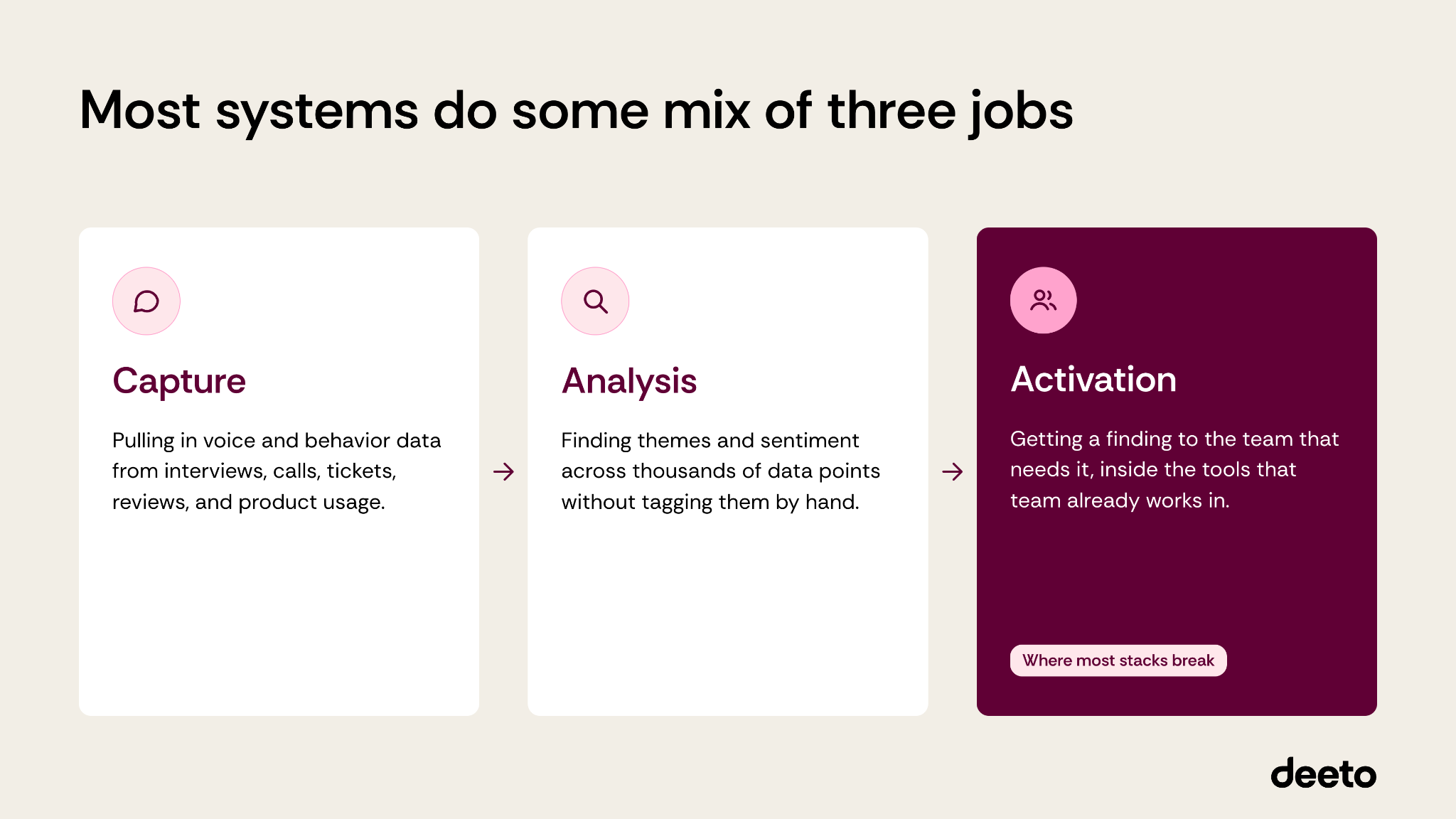
Activation is where most stacks break. A product marketer can read a beautiful theme report and still walk into a launch without a single current customer quote to back up the message. A customer marketing lead can run a strong advocacy program and still have no view into which accounts are quietly at risk.
Customer intelligence tools vs. customer insights software
The terms overlap, and vendors use them interchangeably. There is a useful distinction, though.
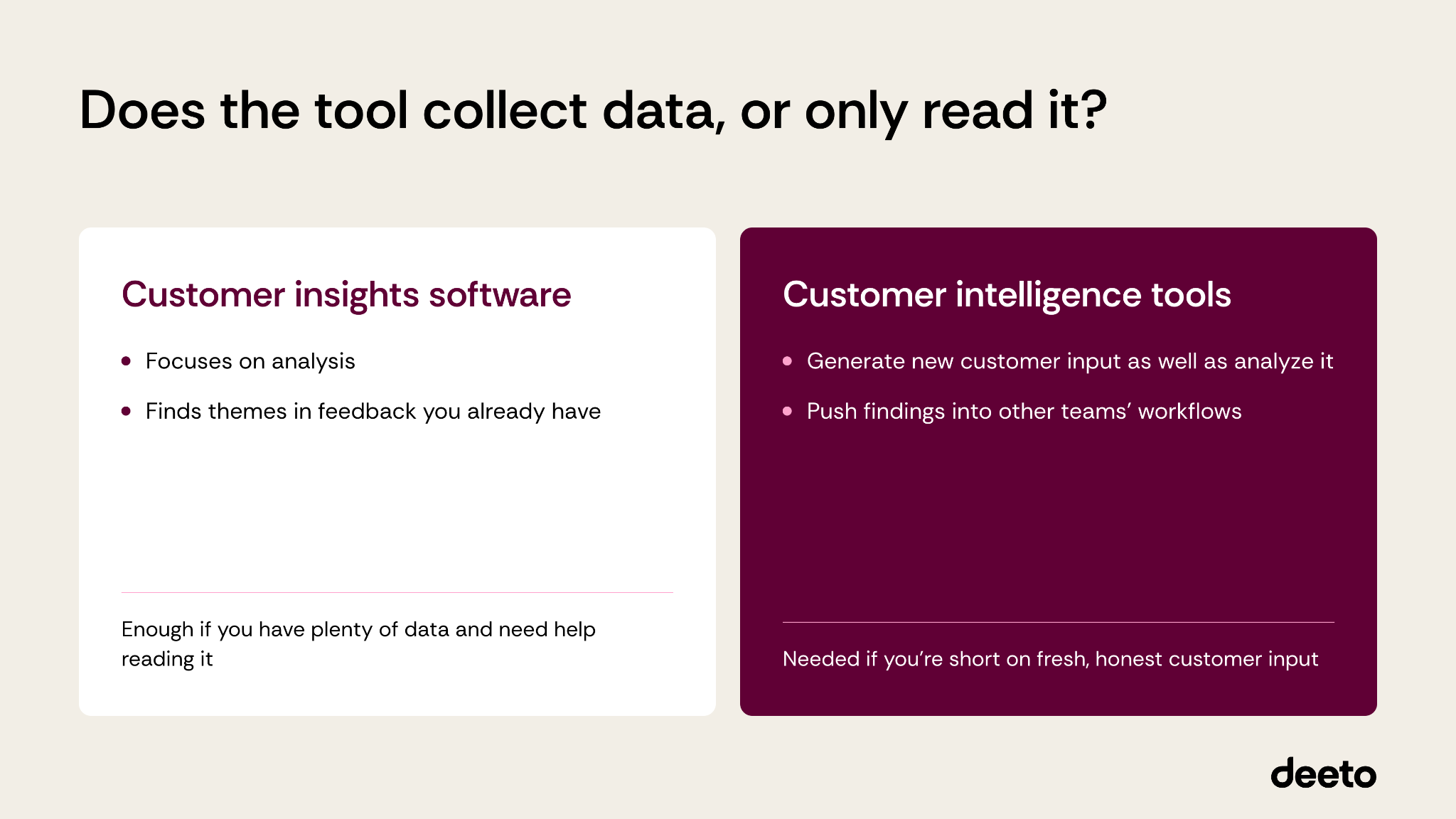
Customer insights software usually focuses on analysis. It takes feedback you already have, such as survey responses, support tickets, or research transcripts, and helps you find themes in it. Research repositories and feedback analytics platforms fall here.
Customer intelligence tools usually cover more of the loop. They generate new customer input as well as analyze it, and they push what they find into other teams' workflows. If your team already has plenty of data and needs help reading it, customer insights software may be enough. If your team is short on fresh, honest customer input in the first place, you need something that collects it, too.
For a deeper look at evaluation criteria, our guide on how to choose a customer intelligence platform walks through the platform types and the questions to ask every vendor.
What are the best methods for collecting customer intelligence?
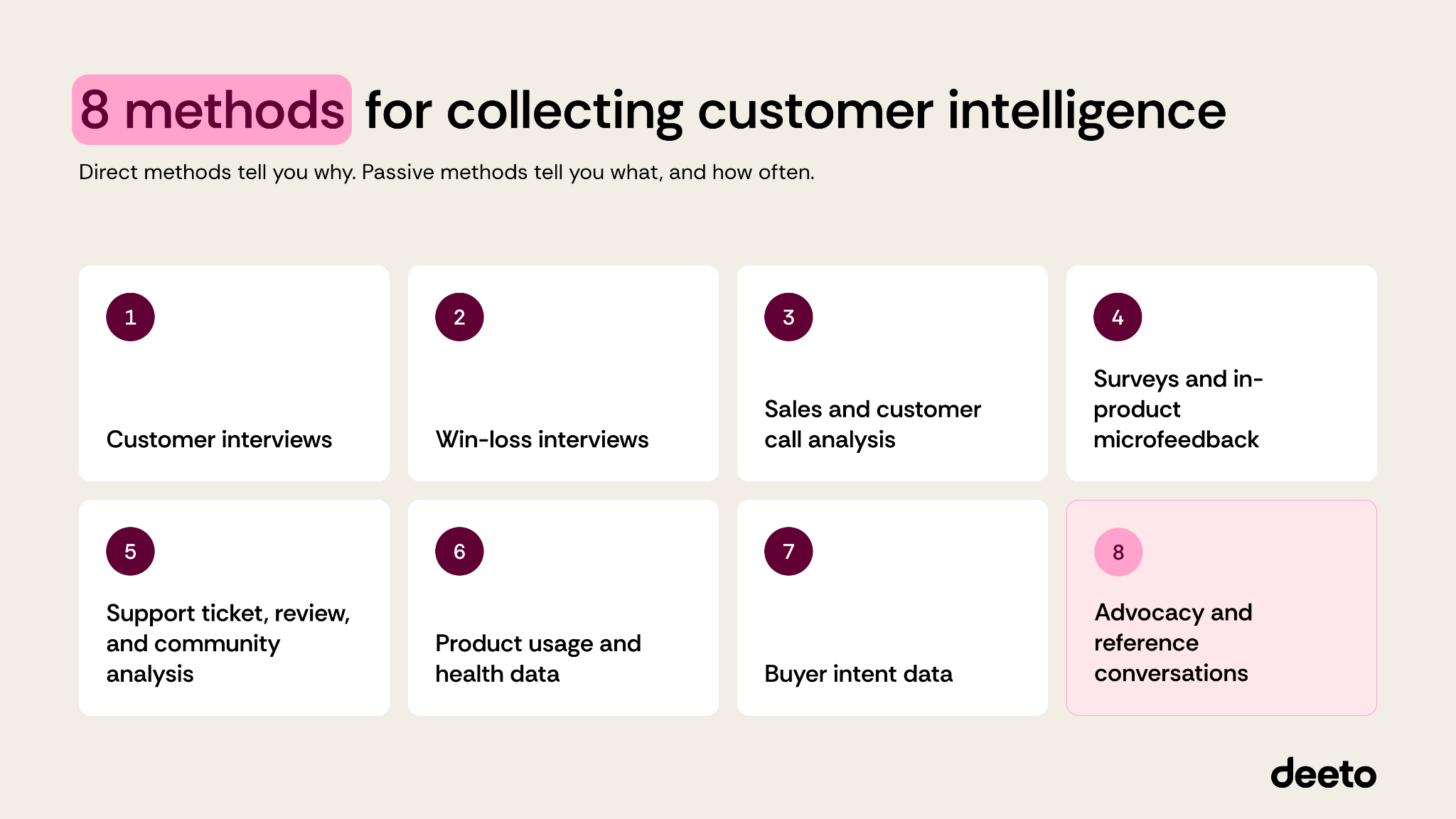
The best methods for collecting customer intelligence combine direct conversations with passive signal capture. Direct methods tell you why. Passive methods tell you what, and how often. Strong B2B programs use at least one of each.
- Customer interviews. One-on-one conversations are still the richest source of context. AI-led interviews now make it realistic to run them continuously instead of once a quarter, and dedicated customer research workflows make the process repeatable.
- Win-loss interviews. Talking to buyers after a decision shows what actually drove it. Clozd's research found that buyer and seller explanations for lost deals line up only about 15% of the time (Clozd), which is why CRM loss reasons alone are a weak foundation. Our primer on win/loss analysis covers how to set a program up.
- Sales and customer call analysis. Conversation intelligence mines recorded calls for objections, competitor mentions, and buying signals you already have.
- Surveys and in-product microfeedback. Short, well-timed questions capture sentiment at scale. They work best paired with open-text analysis, not just scores.
- Support ticket, review, and community analysis. Unstructured text from Zendesk, Intercom, G2, Reddit, and Slack communities is full of signal that rarely reaches product marketing.
- Product usage and health data. Adoption and feature usage show what customers do, which often differs from what they say.
- Buyer intent data. Third-party research signals show which accounts are in market before they fill out a form.
- Advocacy and reference conversations. Every reference call, review request, and case study interview is also a chance to learn something. Most teams never capture it.
Mining calls, chats, and tickets for customer signal is standard practice now. The harder problem is that customers are volunteering less. Qualtrics XM Institute found that only 32% of consumers share direct feedback with a company after a very poor experience, down 7.7 points since 2021, based on a study of more than 23,000 consumers. That's consumer data, not B2B, but the lesson carries over. Analyzing the conversations you already have tells you about the customers who happen to talk to you. Continuous, structured outreach tells you about the ones who don't.
Why customer intelligence matters more for B2B teams now
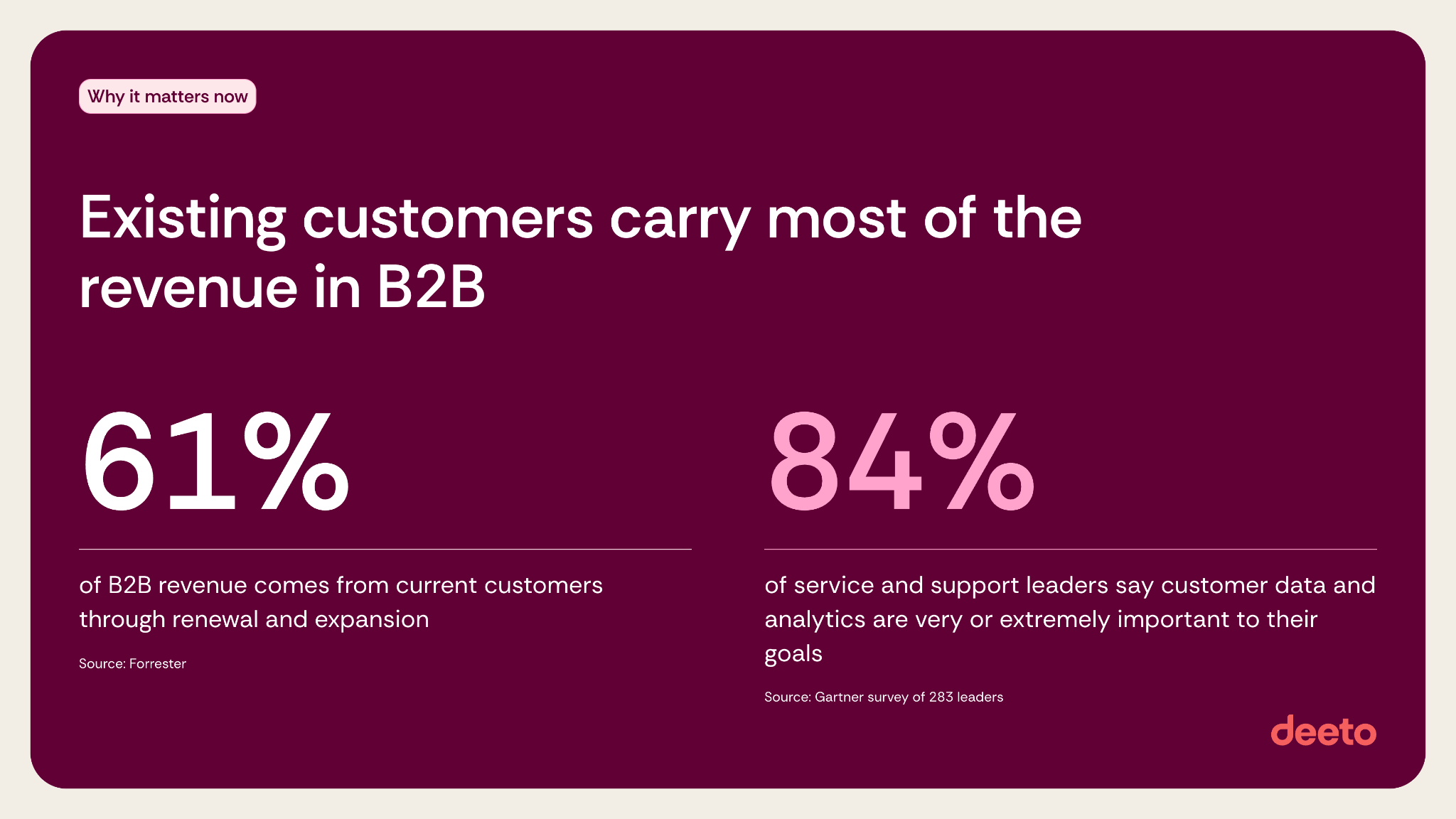
Existing customers carry most of the revenue in B2B. Forrester reports that current customers account for 61% of B2B revenue through renewal and expansion (Forrester). If most of your revenue comes from people who already bought, not understanding them gets expensive, and you usually find out late, in a renewal forecast.
Leaders know it. In a Gartner survey of 283 customer service and support leaders, 84% said customer data and analytics were very or extremely important to hitting their goals (Gartner). The gap comes from lack of communication between teams. Feedback sits with CS, call recordings sit with sales, research sits with product, and customer stories sit with marketing. Each team collects plenty, and very little of it reaches whoever is making the next decision.
The 8 best customer intelligence tools for B2B teams
Each tool below is strong at a different collection method. Very few B2B companies need all eight. Most need two or three that work together.
1. Deeto
Deeto is an AI-native voice of the customer platform built for the step most stacks skip, getting customer intelligence to the people who act on it. It runs on five connected modules: Listen, Learn, Activate, Analyze, and Orchestrate.
- Listen captures customer voice through AI-led conversational interviews, surveys, and in-product microfeedback.
- Learn keeps every conversation in one system of record, tied to the right account and contact.
- Activate delivers the right insight or customer story to sales, marketing, product, or CS inside the tools they already use.
- Analyze turns that voice into patterns, sentiment, and trends teams can track over time.
- Orchestrate runs the workflows and automations that keep it all moving without someone forwarding a report.
That's the activation layer described earlier. A theme report only pays off when it reaches the product marketer writing the launch brief or the account manager walking into a renewal call. Deeto relaunched its platform in January 2026 around this idea, treating customer voice as a system of record that teams can use in real time (Business Wire).
Analysis-only tools read input someone else gathered. Deeto generates it. The same customer conversation can produce a win-loss insight, a sentiment signal, a roadmap request, and an approved quote for a sales deck. That matters most for customer marketing teams, who run customer advocacy programs and are often closest to customers while seeing the least of the intelligence those relationships produce.
Best for B2B teams that want one connected source of customer voice across product marketing, customer marketing, sales, and CS. In published Deeto customer stories, Clarivate reported a 75% productivity gain with a two to four week time to value, and Wrike grew its reference pool by 50 to 75%.
2. Gong
Gong is a revenue AI platform built on conversation intelligence. It records and transcribes sales calls, meetings, and emails, then flags deal risk, competitor mentions, and recurring themes across conversations. Its newer AI agents handle tasks like deal reviews and CRM updates (ZoomInfo review of Gong features).
Gong is excellent at mining the conversations your reps already have. Its limit for customer intelligence is scope. It hears customers mostly during the sales cycle and on calls a rep set up, so it misses post-sale sentiment from customers who never get on a call.
Best for sales leaders and revenue operations teams that want deal visibility and coaching from recorded calls.
3. Dovetail
Dovetail started as a research repository and now positions itself as an AI-native customer intelligence platform. It pulls in interviews, calls, surveys, support tickets, and NPS data, uses AI to find themes and track sentiment, and answers questions directly in Slack or Teams.
Dovetail fits well when you have a lot of qualitative data and a research team that needs to analyze and share it. In the terms above, it's mostly customer insights software. You still need a way to generate fresh customer input.
Best for UX research, product, and insights teams managing large volumes of interviews and qualitative feedback.
4. Enterpret
Enterpret is a customer feedback analytics platform that unifies feedback from more than 50 channels, including support tools, sales calls, reviews, and communities. Its October 2025 launch added a customer knowledge graph that connects feedback to accounts and opportunities, plus agents that flag emerging issues automatically (Business Wire).
Enterpret's adaptive taxonomy removes most manual tagging, which saves real time on high-volume feedback. The customers it names publicly, including Canva, Notion, Strava, Monday.com, and Perplexity, are mostly product-led companies with large user bases, so B2B companies with lower feedback volume may get less out of it.
Best for product and CX teams at product-led companies drowning in support and in-app feedback.
5. Clozd
Clozd is a dedicated win-loss analysis platform. It runs live and AI-assisted buyer interviews after deals close, handles outreach and scheduling, and summarizes themes across interviews into Slack, Teams, and CRM (Clozd platform overview).
Clozd goes deep on one method, and that's the point. If win-loss insights are your top priority, it's a specialist worth a look. If you need intelligence from the rest of the customer lifecycle, you'll need another tool alongside it.
Best for product marketing and competitive intelligence teams running formal win-loss programs.
6. Gainsight
Gainsight is a customer success platform built around account health. It combines health scores, a Customer 360 view, renewal forecasting, and playbooks. Its Staircase AI product analyzes emails, meetings, tickets, and Slack to detect sentiment and churn risk (ZoomInfo review of Gainsight).
Gainsight is strongest at operationalizing what CS already knows, and it's a bigger project than most tools on this list. Gainsight says a core customer success framework can be up in about eight weeks, with verified outcomes arriving in roughly four months on average (Gainsight). Plan for an admin to own it after launch.
Best for mid-market and enterprise CS organizations managing renewals and expansion at the account level.
7. Productboard
Productboard is a product management platform with a strong customer feedback layer. It centralizes feedback from connected sources, uses AI to surface trending topics and summarize pain points, and links each insight to the feature ideas it supports, with importance scores by customer segment.
Productboard is the right home when the product team is the main consumer of customer intelligence. It's less useful for marketing or sales teams that need customer proof or messaging input. If roadmap decisions are your use case, our guide to using customer feedback to build a product roadmap pairs well with it.
Best for product managers who need to tie feature requests to real customer demand.
8. 6sense
6sense is a B2B account intelligence and ABM platform. It collects buying signals, including third-party intent data and anonymous website visits, to show which accounts are researching your category and when (TrustRadius).
6sense answers a different question than the rest of this list. It tells you who is likely to buy, not what your customers think. That makes it a useful complement for demand gen and sales, but it won't replace direct customer voice.
Best for demand generation and sales teams prioritizing accounts based on in-market signals.
Customer intelligence tools comparison chart
The chart compares each tool by primary collection method, best fit team, standout capability, and main limitation. Vendor capabilities change often, so confirm current features with each vendor before you buy.
How to choose the right customer intelligence tool
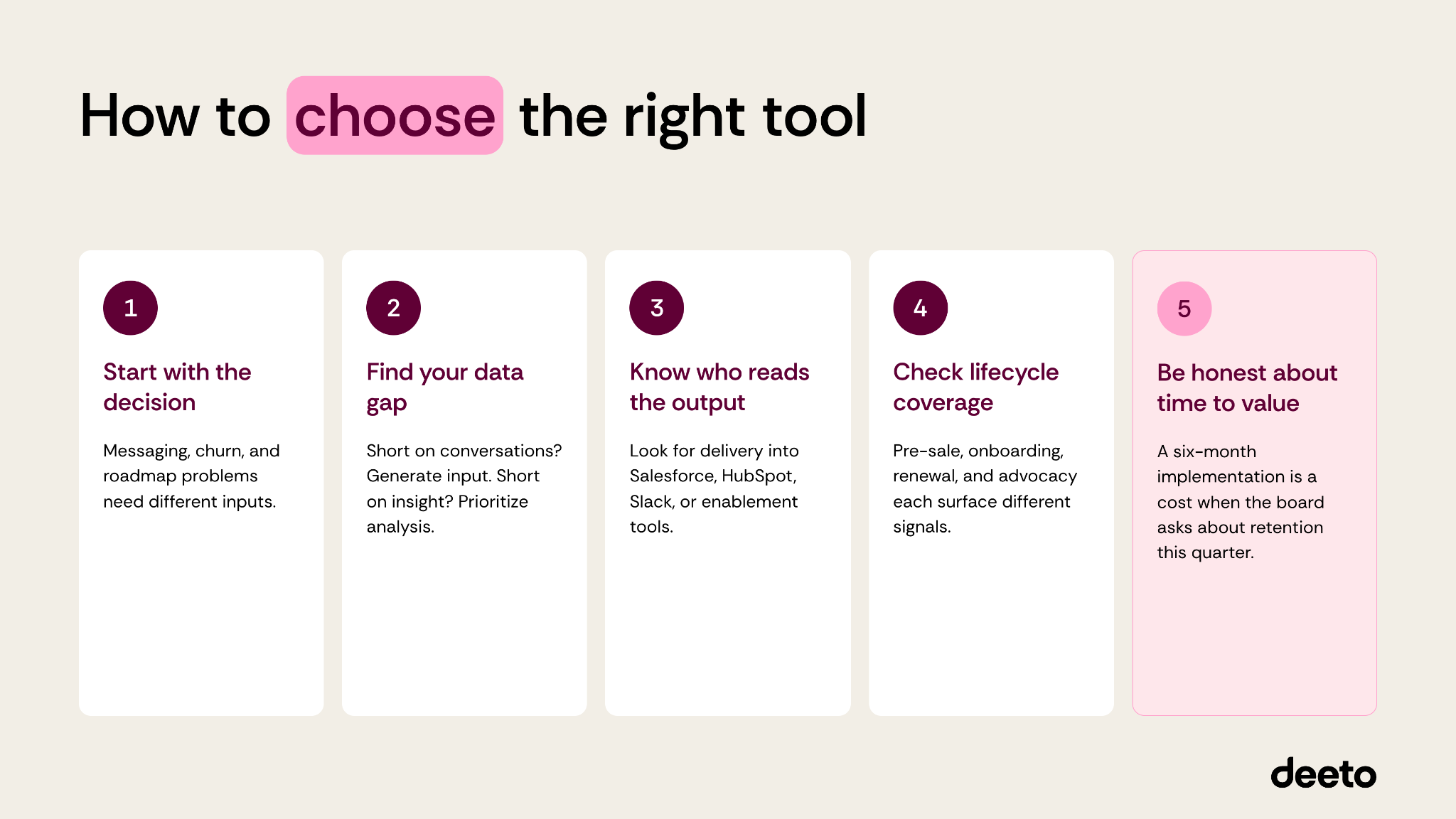
Start with the decision you're trying to improve, not the feature list. A launch messaging problem, a churn problem, and a roadmap problem need different inputs.
Then figure out where your data gap actually is. If you have plenty of calls and tickets but no structured customer conversations, prioritize a tool that generates input. If it's the other way around, prioritize analysis.
Think about who will read the output. Tools built for researchers rarely get opened by sales reps, so look for delivery into Salesforce, HubSpot, Slack, or your enablement platform. Deeto's CRM and workflow integrations push customer voice into those systems directly.
Check how much of the lifecycle a tool can see. Many see customers at only one stage, and pre-sale, onboarding, renewal, and advocacy each surface different signals. Positive and negative voice belong together, too. The customer who flags a gap this quarter may be your best reference next quarter, and splitting those conversations into separate systems loses the context.
Last, be honest about time to value. A multi-month implementation should be considered a cost when the board is asking about retention this quarter.
For product marketing teams, the bar is simple. Can you walk into a launch with current, verified customer language and know it reflects the market, not one loud account?
Key takeaways
- Customer intelligence tools collect, analyze, and activate what B2B customers say and do across the full lifecycle.
- Customer insights software focuses on analyzing data you already have. The best intelligence platforms also generate fresh input.
- The best methods for collecting customer intelligence pair direct conversations, like interviews and win-loss calls, with passive signals like call analysis, tickets, and usage data.
- Specialists like Gong, Clozd, and 6sense go deep on one method. Platforms like Deeto connect customer voice across teams.
- Choose based on your data gap and who needs to act on the output, not on feature counts.
Frequently asked questions
What are customer intelligence tools?
Customer intelligence tools are software platforms that collect customer data from sources like interviews, sales calls, surveys, support tickets, and product usage, then analyze it for themes, sentiment, and trends. The best tools also deliver findings into the systems sales, marketing, product, and customer success teams already use, so the intelligence shapes decisions instead of sitting in a report.
What are the best methods for collecting customer intelligence?
The most effective methods are customer interviews, win-loss interviews, sales call analysis, surveys and in-product microfeedback, support ticket and review analysis, product usage data, buyer intent data, and advocacy conversations. Strong B2B programs combine at least one direct method that explains why customers act with one passive method that shows patterns at volume.
What is the difference between customer intelligence tools and customer insights software?
Customer insights software usually analyzes feedback a company already has, such as survey responses, transcripts, or tickets, to find themes. Customer intelligence tools typically cover more of the loop, generating new customer input and pushing findings to other teams as well as analyzing them. Many vendors use both terms, so check whether a tool collects data or only reads it.
Which customer intelligence tool is best for B2B product marketing teams?
Product marketing teams need current customer language, competitive context, and proof they can use in messaging. A voice of the customer platform like Deeto covers interviews, sentiment, and customer evidence in one place. Teams focused heavily on competitive deals often add a win-loss specialist like Clozd or conversation intelligence like Gong for call-level detail.
Do I need more than one customer intelligence tool?
Most B2B companies use two or three tools that cover different collection methods. A common pairing is a platform that generates and connects customer voice across teams, plus a specialist such as conversation intelligence for sales calls or intent data for demand gen. Aim for the smallest stack that covers the methods you need, with one place where the results come together.
Conclusion
Every B2B company has customer intelligence. Most of it is stuck in the tool where it was collected, and the best customer intelligence tools are the ones that get it out.
If your biggest gap is analysis, a specialist will help. If your biggest gap is fresh, honest customer input that reaches marketing, sales, product, and CS at the same time, you need a connected system, which is the problem Deeto is built to solve. See how Deeto works and hear what your customers are ready to tell you.
🎉 Save your spot
Register for the event
Once your spot is secured, we’ll send your confirmation details.
Subscribe to our newsletter
Subscribe to receive the latest blog posts to your inbox every week.
By subscribing, you agree to our Privacy Policy
Subscribe to our newsletter
Get the latest news and updates from our team.
By subscribing, you agree to our Privacy Policy
Related posts

Omnichannel Customer Engagement Tools: 8 Platforms Compared

Compare 8 omnichannel engagement platforms on channels, AI, and pricing, plus the gap automation can't fill.

Voice of the Customer Strategy for SaaS Companies
What is VoC for SaaS? Learn how to capture customer voice and turn it into decisions that drive renewals.

How to Use Sentiment Analysis to Improve Customer Experience
What is sentiment analysis? Learn how it compares to NPS, where it catches churn, and how to put it to work.


