How to Choose a Customer Intelligence Platform



Thursday, July 9, 2026


How to Choose a Customer Intelligence Platform


View the podcast on Youtube

A customer intelligence platform is any system that collects, organizes, and surfaces insights from customer signals to help teams make better decisions. That definition covers a wide range of tools doing very different things. Some are built for survey-driven VoC programs. Others focus on product analytics or account health scoring. A few, like Deeto, are built to turn authentic customer voice into connected intelligence that flows to every team that needs it.
Choosing the wrong one doesn't just cost you your budget. It costs the trust of every team that was counting on it to work. This guide covers the questions you should be asking before you sign anything.
Start with the problem, not the platform
Before comparing features, get specific about what's broken. The most common pain points from B2B teams fall into three categories.
Problem 1: Feedback is scattered. It lives in Salesforce, Slack, Gong, survey tools, and someone's inbox. No single team has the full picture. Decisions get made on anecdotes rather than patterns.
Problem 2: Data doesn't reach the people who need it. Even when companies invest in research or voice-of-customer programs, the output ends up in a slide deck or a Notion doc. Sales reps still can't find a relevant customer story. Product teams still prioritize based on whoever was loudest in the last all-hands.
Problem 3: Nothing changes. Data collected. Dashboard built. The platform generated reports, not decisions.
The category of platform you need depends on which of these is costing you the most. A team drowning in unread survey data needs something different from a team that has strong data but no way to get it to the rep before a competitive deal closes.
The four platform types, and what each one actually does
Not all customer intelligence platforms are the same.
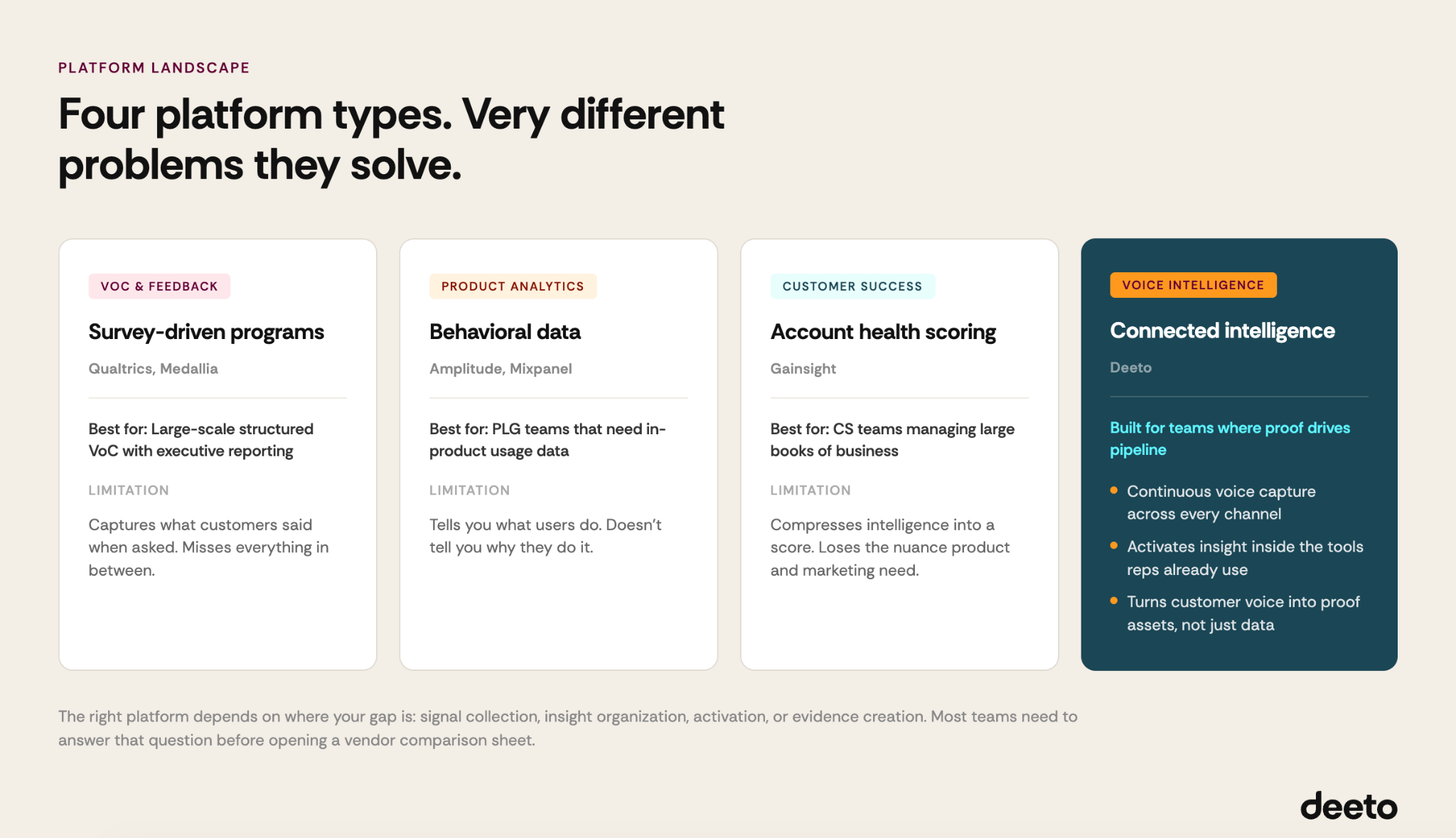
VoC and feedback platforms collect structured customer input through surveys, NPS programs, and feedback forms. Qualtrics and Medallia sit here. They're powerful for large-scale programs and executive reporting, but they're survey-anchored. They tell you what customers said when you asked. They're less useful for capturing what customers said when you weren't listening.
Product analytics platforms like Amplitude or Mixpanel track what users do inside your product. They're essential for product-led teams that need behavioral data, but they don't tell you why customers behave the way they do. Behavioral data without voice is an incomplete picture.
Customer success platforms like Gainsight aggregate signals into account health scores and renewal workflows. They're built for CS teams managing large books of business. They compress customer intelligence into a score, which helps with prioritization but loses the specifics, the exact complaint that keeps showing up in churned accounts, that product and marketing teams actually need.
Customer voice intelligence platforms like Deeto go further. They capture authentic voice continuously, organize it into a system of record, analyze patterns across the full customer base, and push that intelligence to the teams and workflows where decisions get made. The key difference: insight doesn't stay inside the platform.
Platform comparison: which tool fits which team
Five criteria that separate good platforms from expensive noise
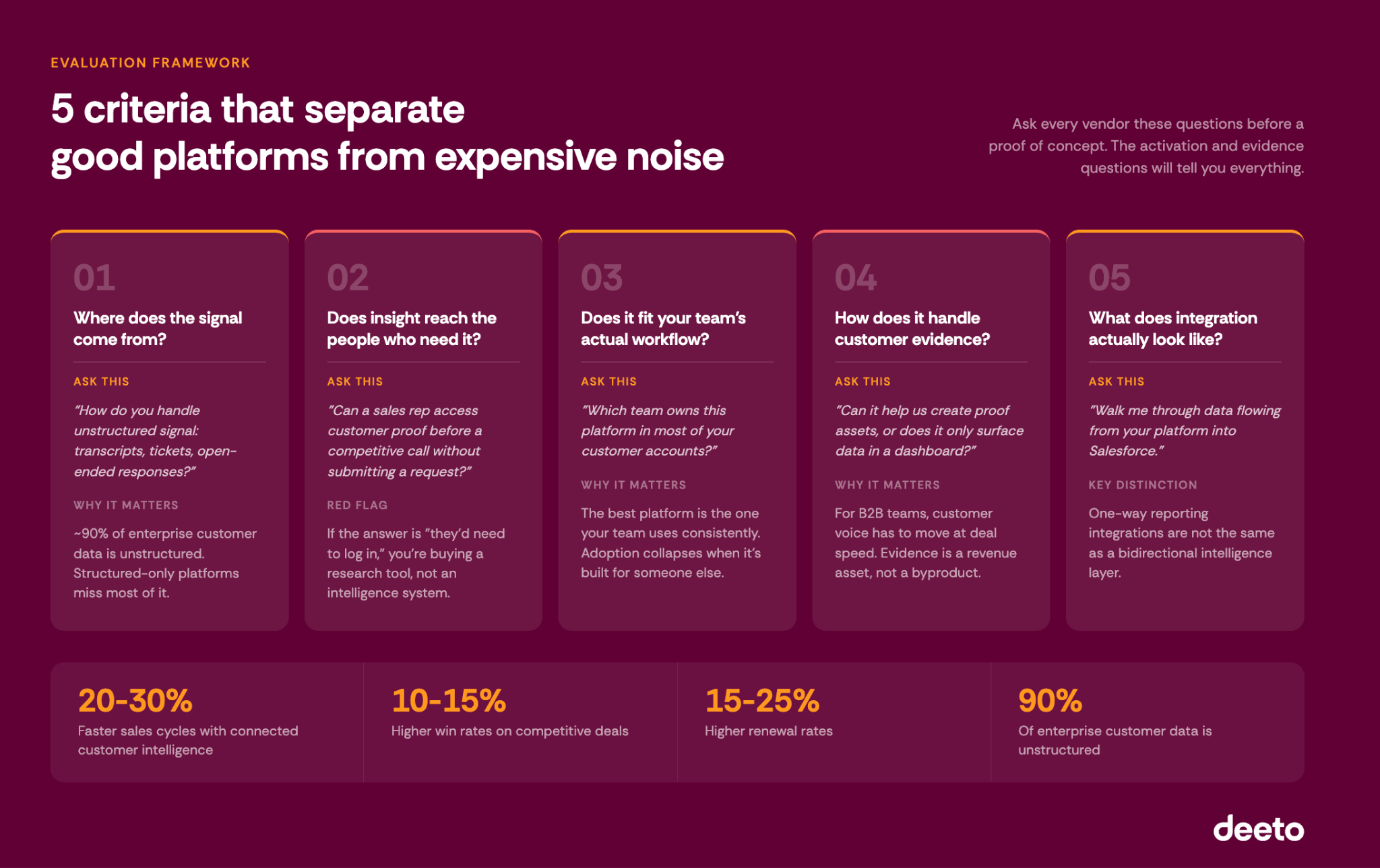
1. Where does the signal come from?
A customer intelligence platform is only as good as its inputs. Ask every vendor: what data sources does this connect to, and how does it handle unstructured signal?
Most platforms handle structured data well including surveys, NPS scores, CRM fields. The harder problem is unstructured signal: call transcripts, support tickets, open-ended responses, customer interviews. According to Nvidia's internal research, roughly 90% of enterprise customer data is unstructured. A platform that only analyzes structured fields is working with a fraction of what customers are actually saying.
Deeto captures voice across AI-powered interviews, surveys, question sets, and in-product microfeedback, then organizes everything through its Listen module. The signal going in is authentic and continuous, not just what you collected last quarter.
2. Does insight reach the people who need it?
This is where most platforms fall short. They're built for the team running the program, not for the teams that need to act on what the program uncovers.
Ask: can a sales rep access relevant customer proof before a competitive call without submitting a request to marketing? Can a product manager see which feature gaps are showing up in churned accounts without pulling a custom report? Can a CS manager get early warning signals before a renewal goes sideways?
If the answer to any of these is "they'd need to log in and look," you're evaluating a research tool. Deeto's Activate module is built to surface the right customer context to the right person at the right moment, inside the tools they already use.
3. Does it work for your team's actual workflows?
One of the most underrated evaluation questions: who owns this platform day to day, and what does their week look like?
A platform built for a CX research team running quarterly programs will feel like friction to a customer marketing manager who needs daily signals. A product analytics tool built for engineers gets ignored by a PMM who doesn't write SQL.
Map the platform against the primary user's real workflow. The best platform is the one your team will use consistently, not the one with the longest capability list.
4. How does it handle customer evidence?
For B2B teams, customer intelligence isn't just about internal decision-making. It's also about generating the proof that moves buyers. Customer stories, testimonials, case studies, and reference conversations are among the highest-converting assets in any go-to-market motion.
Most platforms treat evidence as a byproduct. Deeto treats it as a primary output, designed to turn customer voice into stories and social proof that sales and marketing can deploy, not data that sits in a dashboard.
This matters for product marketing especially. Messaging built on assumptions gets challenged in every competitive deal. Messaging grounded in real customer evidence doesn't. According to research by Clozd, buyer and seller explanations for lost deals align only 15% of the time, meaning 85% of CRM win/loss data is unreliable if it's based on rep input alone. Teams using Deeto's connected customer intelligence see 10–15% higher win rates and 20–30% faster sales cycles.
5. What does integration actually look like?
Most vendors will say they integrate with everything. Ask instead: how does data flow in both directions?
The difference between a reporting layer and a working intelligence system is stark. One-way integrations push data into a dashboard while bidirectional integrations mean customer signals update your CRM, surface in your sales tools, and feed your marketing automation in real time.
Ask for a technical walkthrough of the integration with your specific CRM before you commit. Deeto's Integrate module is built for native connectivity with Salesforce and HubSpot, so intelligence flows without manual handoffs.
The questions to ask every vendor
Before you reach a proof of concept, run every shortlisted vendor through these:
On signal quality:
- How do you capture unstructured customer voice, not just survey responses?
- How do you handle signal from customers who didn't fill out a form?
On activation:
- How does a sales rep access customer intelligence before a call?
- What does insight delivery look like for a team that doesn't log into your platform daily?
On fit:
- Which team owns this platform in most of your customer accounts?
- What does adoption look like six months in?
On evidence:
- Can the platform help us create customer proof assets, or does it only surface data?
- How do customers engage with it directly?
On integration:
- Walk me through a real example of data flowing from your platform into Salesforce.
- What happens when a customer profile changes in the CRM?
If a vendor can't answer the activation and evidence questions clearly, you're looking at a research tool that will struggle to justify its seat at the revenue table.
Which platform fits which team
There's no single best customer intelligence platform. There's a best platform for your specific problem.
If your need is to capture authentic customer voice continuously, turn it into usable intelligence, surface that intelligence across sales, marketing, and product, and generate proof that closes deals and retains customers, that's Deeto's lane. Deeto is built to connect insight to activation across every team that touches the customer.
For B2B teams where competitive insights need to move at deal speed, where the gap between "we know this" and "we can prove this" costs real revenue, Deeto closes that gap. You can also see how other teams use connected customer intelligence to build their go-to-market case in our guide to gaining a competitive advantage using customer insights.
Key takeaways
- Define the problem before comparing features. The right platform depends on whether your gap is signal collection, insight organization, activation, or evidence creation.
- Most platforms handle structured data well. Ask specifically about unstructured signal capture before shortlisting.
- Activation is the hardest problem. A platform that keeps intelligence inside a dashboard is a research tool, not a working system.
- Map the platform to the primary user's actual workflow. Adoption collapses when the platform is built for a different team than the one using it.
- Customer evidence is a primary output for B2B teams. Look for a platform that turns intelligence into proof, not just data.
- Ask for a technical walkthrough of bidirectional CRM integration. One-way reporting integrations aren't the same as a working intelligence layer.
Frequently asked questions
What is a customer intelligence platform?
A customer intelligence platform is a system that collects, organizes, and surfaces insights from customer signals to help teams make better decisions. Customer intelligence platforms vary widely in approach, from survey-based VoC tools and product analytics systems to AI-native platforms like Deeto that capture authentic customer voice and activate it across sales, marketing, and CS teams in real time.
How is a customer intelligence platform different from a CRM?
A CRM records customer interactions and manages pipeline. A customer intelligence platform analyzes what customers actually think, feel, and need, then surfaces that insight in a way that helps teams act on it. CRMs store structured data from your team's perspective. Customer intelligence platforms capture the customer's perspective and translate it into usable intelligence. For a deeper look at how this plays out in practice, see our guide on how to use customer feedback to build a product roadmap.
What is a customer insights platform?
A customer insights platform is another name for a customer intelligence platform. The terms are used interchangeably to describe tools that collect, analyze, and activate customer signal across the business. Some platforms in this category are narrower, focused on surveys or product data, while others like Deeto unify voice capture, analysis, and activation in one system.
What features should a customer intelligence platform have?
At a minimum, look for multi-channel signal capture, unstructured data analysis, integration with your CRM and core tools, and a clear activation layer that gets insight to the teams that need it. For B2B teams, the ability to generate customer evidence, manage references and testimonials, and connect insight to revenue outcomes is also critical.
How long does it take to implement a customer intelligence platform?
Implementation timelines vary by platform complexity and integration requirements. Simple survey tools can be running in days. Full platforms with CRM integration and activation workflows typically take two to six weeks. Deeto is designed for fast deployment, with most teams seeing active insights within the first few weeks of onboarding.
How do I build a business case for a customer intelligence platform?
Anchor the business case to measurable gaps: win rate on competitive deals, renewal rate, time reps spend searching for proof, and how often product prioritization is challenged for lack of customer evidence. Teams using Deeto's connected customer intelligence see 20–30% faster sales cycles, 10–15% higher win rates, and 15–25% higher renewal rates. Translate those percentages against your current pipeline and ARR to build a number your CFO can evaluate.
🎉 Save your spot
Register for the event
Once your spot is secured, we’ll send your confirmation details.
Subscribe to our newsletter
Subscribe to receive the latest blog posts to your inbox every week.
By subscribing, you agree to our Privacy Policy
Subscribe to our newsletter
Get the latest news and updates from our team.
By subscribing, you agree to our Privacy Policy
Related posts

How to Use Sentiment Analysis to Improve Customer Experience

What is sentiment analysis? Learn how it compares to NPS, where it catches churn, and how to put it to work.

4 Ways To Leverage Social Proof In Marketing
What is social proof in marketing? Learn 4 ways to use reviews, stories, and advocacy to build buyer trust.

How to Build a Customer Testimonial Strategy That Converts
What is a customer testimonial strategy? Learn how to collect, structure, and activate proof that closes deals.