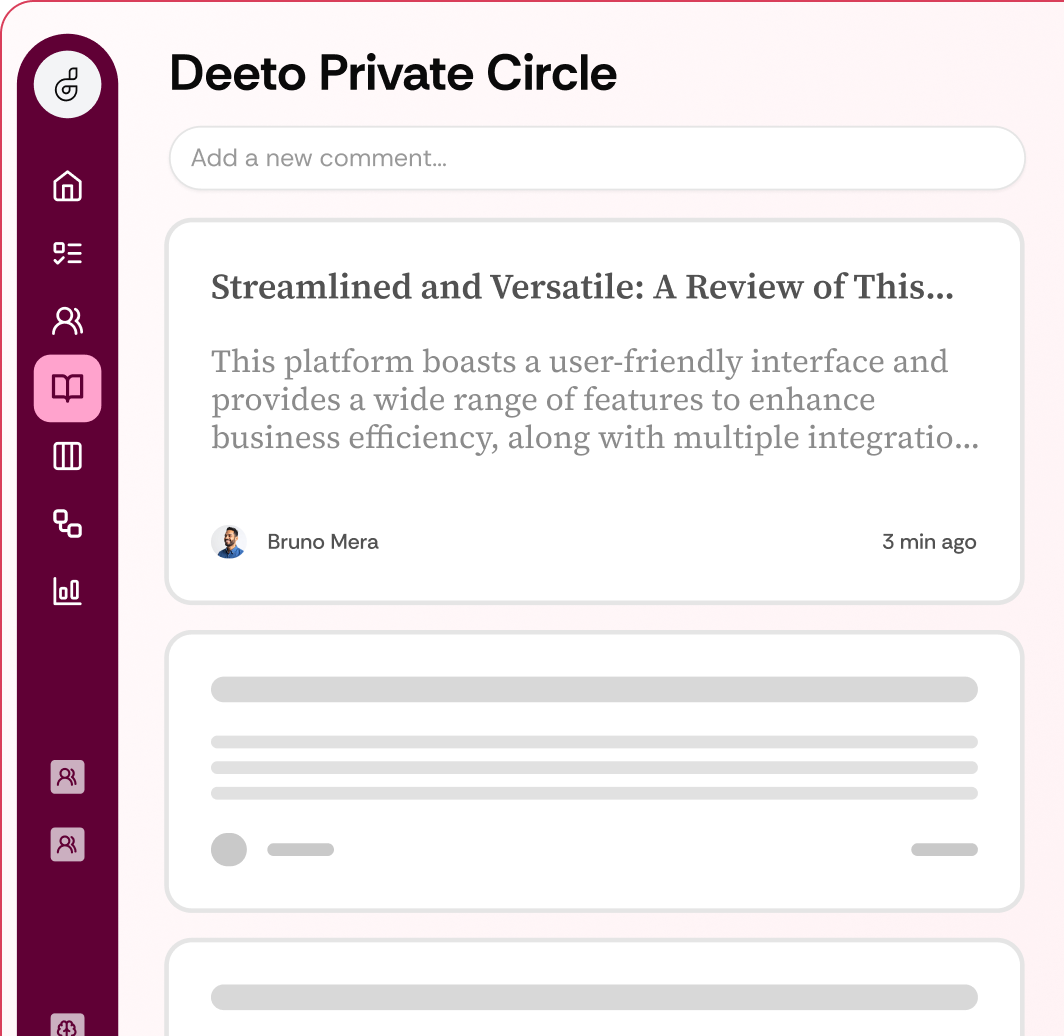
A resource and community space for modern marketers, sellers, and builders using customer voice to grow — together.
This hub is built for anyone who wants to do more with the voices of their customers. Whether you're scaling advocacy, building trust with proof, or rethinking how to go to market — you're in the right place.
How-to guides and playbooks for building with customer voice
Campaign-ready templates and swipe files
Benchmark reports and reference best practices
Event recordings, expert sessions, and community spotlights
Ask questions. Share ideas. Trade wins. This is your space.
You don’t have to figure this out alone. The Deeto community connects you with other leaders using customer voice to build better GTM motions, faster-growing brands, and smarter strategies. If you are interested in joining when it launches, sign up below.
Automate advocacy management workflows
Dynamically generate customer stories and social proof
Eliminate manual reference management
Track and report advocacy impact on revenue
Discover practical guides, templates, and tools to help your team close more deals, faster.
Most companies don't have a churn problem. They have a data quality problem that makes churn invisible until it's expensive.
By the time a cancellation lands in your CRM, the decision was made weeks ago. The customer stopped logging in. Support tickets went unresolved. The last check-in got no reply. Every signal was there. Nobody saw them in time.
The real problem is not churn itself, but the gap between when customers start disengaging and when your team finds out.
Harvard Business Review puts the cost of acquiring a new customer at five to 25 times more than retaining one. Bain and Company found that a 5% increase in retention can lift profits by as much as 95%. Those numbers get cited everywhere. What gets cited less often is why companies keep losing customers anyway: they don't have a system that surfaces risk early enough to act on it.
The 12 strategies below are the playbook for closing that gap.

Customer churn is the percentage of customers who stop doing business with you over a defined period.
Churn rate = (Customers lost during the period / Customers at the start of the period) x 100
If you started the quarter with 500 customers and ended with 475, your churn rate is 5%.
It compounds quietly. A 5% monthly churn rate means you're losing more than half your customer base in a year. And unlike acquisition costs, the damage is often invisible until it shows up in revenue.
For more on this, see our primer: What Is Customer Churn?
Most companies assume customers leave over price. The actual reasons are usually more mundane: slow support, no early wins, weak onboarding, or neglect after the sale.
Common patterns include customers who never reach a meaningful outcome in their first 30 days, unexpected friction in the product, support issues that dragged on long enough to erode trust, and poor communication during renewals or product changes.
None of the strategies below work unless you know which of these actually applies to your customers.
You can't fix what you haven't diagnosed. Churn analysis isn't a one-time report; it's a habit of asking what actually happened before a customer left.
Start by standardizing how you record churn reasons. "Not a fit" tells you nothing. "Customer never adopted the core workflow after onboarding" tells you where the failure was, and whether it happened to others. When churn reasons are structured and specific, you can track trends, find the leakiest parts of your customer lifecycle, and prioritize fixes.
Combine quantitative signals (usage drops, NPS dips, support ticket frequency) with qualitative ones (exit interviews, cancellation call notes). The combination is where real insight usually lives.
Most churn is decided in the first 30 to 90 days. Customers who don't reach a meaningful outcome early will disengage and cancel without much warning.
Strong onboarding does three things: it defines what success looks like, it gets customers to their first win fast, and it maps what value looks like beyond initial setup.
Check your onboarding flow for these common failure points: no clear definition of what "success" looks like at 30 or 60 days, too many steps before the customer experiences the core value, and no follow-up after initial setup.
Customer adoption is not a launch moment. It’s a structured process of guiding customers toward the outcomes they bought for.

By the time a customer reaches out with a problem, trust has often already eroded. Waiting for them to raise their hand isn't a retention strategy.
Proactive engagement means checking in at key lifecycle moments, sharing relevant tips based on what the customer is actually using, and communicating changes that affect their workflow before those changes land.
A short check-in call framed around "are you getting the result you expected?" often surfaces both risk signals and buying intent. It's one of the highest-return touchpoints in the customer lifecycle.
Customers rarely leave because they dislike your product. They leave because they're not confident it's delivering enough value for the effort required.
Education closes that gap. Build practical content around the moments where customers typically get stuck: onboarding decisions, feature configuration, reporting to internal stakeholders. Track which content customers actually use. If a significant portion skips the same onboarding module, that's a retention leak.
Educated customers become advocates. Confused ones churn.
Churn is almost always visible before it happens. The challenge is having a system that surfaces those signals in time to act.
Watch for behavior shifts that indicate disengagement: declining login frequency, support tickets that are escalating or going unresolved, missed check-ins or unanswered outreach, invoice delays or payment failures, drops in NPS or survey response rates.
McKinsey found that companies using analytics-driven retention programs can reduce churn by up to 15%. But risk signals don't reduce churn by themselves. They only work if they trigger a clear, assigned action.
Churn prediction works when it's connected to ownership and workflow, not just a dashboard.
Not all churn carries the same weight. Losing a high-value enterprise customer who's been with you three years is different from losing a free trial user who never finished onboarding.
Segment by what actually matters: revenue contribution, expansion potential, strategic importance, advocacy value. Then direct your retention resources toward the segments where losing customers hurts most.
Gartner research consistently shows that roughly 20% of customers generate 80% of future revenue. Treating every customer with the same retention energy misallocates resources.
A high-value account at risk might need an executive sponsor call. A recently onboarded customer with low usage might need a session with your CS team. Match the intervention to the situation.
One of the most underestimated drivers of churn is a lack of visible ROI. Customers may know your product is useful without being able to articulate why they should renew, especially when budget discussions come around.
Make value visible before renewal conversations happen. Send periodic summaries that show what the customer has achieved using your product. Tie outcomes to the goals they stated when they bought.
This is where value realization becomes a retention strategy. When customers can clearly articulate the ROI, renewals are straightforward. When they can't, every renewal becomes a negotiation.
Feedback isn't only input for your product team. It's one of the earliest indicators of churn risk.
Customers who feel heard stay longer. Customers who surface issues and get no response leave faster and usually quietly.
Build feedback loops that are easy to use and actually close the loop with a response. NPS and CSAT scores are a start, but the most useful feedback often comes from structured conversations, not numbers.
Deeto's customer sentiment analysis tools help CS and customer marketing teams track how sentiment shifts across accounts over time, so risk signals surface before they become cancellations.
Customers don't expect perfection. They expect to feel like their problems matter.
A slow response is frustrating. A slow response with no update is a trust-breaker. Audit your support experience: average time to first response versus what you promise, escalation paths when tier-one doesn't resolve the issue, and proactive communication when resolution takes longer than expected.
Customers who have a problem handled well often become more loyal than customers who never had a problem. The recovery is a relationship-building moment, if you treat it that way.
Incentives can reinforce retention. They can also train customers to wait for discounts before renewing.
Use them to reward behavior, not to plug gaps in value. Programs that offer early access, priority support, or exclusive content signal "we value this relationship." Discounts offered reactively to at-risk accounts signal "our price is negotiable."
If you have a customer reference program, long-term customers are your most credible advocates. Case studies, advisory boards, and speaker opportunities deepen the relationship in ways that discounts don't.
Deeto helps customer success and customer marketing teams build structured advocacy and reference programs that keep high-value customers engaged well beyond the renewal cycle.
Generic experiences feel disposable.
Personalization starts with context: knowing where a customer is in their lifecycle, what goals they stated when they bought, what challenges they've raised through support, and what features they're actually using.
Use that context to shape your outreach, your success plans, and your renewal conversations. A customer actively using a feature you just improved should hear about that improvement. A customer who hasn't logged in for 30 days should get a different message than one who logs in daily.
The customer experience layer of your retention strategy is where all the upstream work (feedback collection, sentiment analysis, product intelligence) becomes visible to the customer as attentiveness and care.
Not all churn is a decision. A significant portion of subscription revenue is lost through failed payments, expired cards, and billing errors.
Involuntary churn is fixable: automated dunning sequences, payment retries, proactive card expiry reminders, frictionless update flows.
For subscription businesses, involuntary churn can represent 20 to 40% of total churn. Recovering even a portion of it requires no additional retention effort, just better payment infrastructure.
Track it separately from voluntary churn. They have different causes and different fixes.


Every strategy in this list comes back to the same problem: churn is invisible until it isn't, and by then it's already expensive.
The companies that consistently retain customers aren't doing something magical. They've made risk visible. They know which accounts are disengaging before those accounts know it themselves. They've assigned ownership to the signals, built outreach into their operating rhythm, and connected customer feedback to the teams that can actually act on it.
That's what Deeto is built for. Not another dashboard — a system that closes the gap between what your customers are experiencing and what your team knows about it, so the right action happens at the right time.
If your churn is invisible, that's the place to start.
Book a demo and we'll show you what it looks like when the signals are finally in front of you.
What is the best way to reduce customer churn?
The most effective approach combines early risk detection, consistent value demonstration, and proactive engagement. Companies that build a structured retention system where risk signals are visible, ownership is assigned, and outreach happens before customers disengage, consistently outperform those that rely on reactive intervention. Retention is a system, not a single tactic.
What is a good customer churn rate?
Benchmarks vary by industry and business model. For B2B SaaS, monthly churn below 2% is generally considered healthy, which equates to roughly 22% annual churn. Enterprise-focused businesses often target annual churn below 5 to 7%. The most useful benchmark is your own trend over time, combined with an understanding of which segments are churning and why.
How do you identify customers who are about to churn?
The most reliable early warning signals: declining product usage, unresolved support tickets, delayed payments, missed check-ins, and drops in NPS or survey response rates. These typically appear weeks before a cancellation. The challenge is having a system that surfaces them consistently and routes them to the right person.
What is the difference between voluntary and involuntary churn?
Voluntary churn happens when a customer actively decides to cancel. Involuntary churn happens when a subscription lapses due to a failed payment, expired card, or billing error. Both affect revenue, but they require different fixes. Involuntary churn is often undertracked and can account for 20 to 40% of total churn in subscription businesses.
How does customer feedback reduce churn?
Customers who feel heard are more likely to stay. Feedback loops that close with a genuine response build trust and surface risk signals early. Customers who raise an issue and get no follow-up are significantly more likely to churn quietly. Connecting feedback to a system that routes it to the right team and tracks resolution turns customer voice into a retention tool.
What role does onboarding play in reducing churn?
Onboarding is where most churn risk is created or avoided. Customers who don't reach a meaningful outcome within the first 30 to 90 days are significantly more likely to disengage and cancel. Strong onboarding defines success clearly, gets customers to their first win fast, and maps a continued path to value.


Learn how to reduce customer churn with 12 proven strategies covering early risk detection, value proof, and more.
Losing customers is expensive. But most companies only realize how expensive after the damage is already done.
Customer churn is the percentage of customers who stop doing business with a company over a given period. It is one of the most closely watched metrics in SaaS and subscription businesses because even a modest increase in churn can quietly erase months of growth.
This guide covers what customer churn is, why it happens, how to calculate it, and what it actually takes to reduce it.
Customer churn, also called customer attrition, is the rate at which customers cancel, stop renewing, or otherwise stop purchasing from a company within a specific time period. It is typically expressed as a percentage and measured monthly, quarterly, or annually.
Churn is the direct opposite of customer retention. High retention means customers are staying. High churn means they are leaving, and your revenue base is shrinking under the surface even while new customers continue to come in.
For SaaS companies, the stakes are especially high. Subscription revenue depends on customers continuing to pay month after month. Customer churn is not a lagging signal of a problem that already happened. It is usually a leading signal of a problem that was never addressed.
Customer churn affects nearly every part of a SaaS business, from forecasting to fundraising.
Here is why it matters more than most companies acknowledge.
It erodes recurring revenue. In a subscription model, every customer who churns takes their recurring revenue with them. A 5% monthly churn rate means you are replacing roughly half your customer base every year just to stay flat.
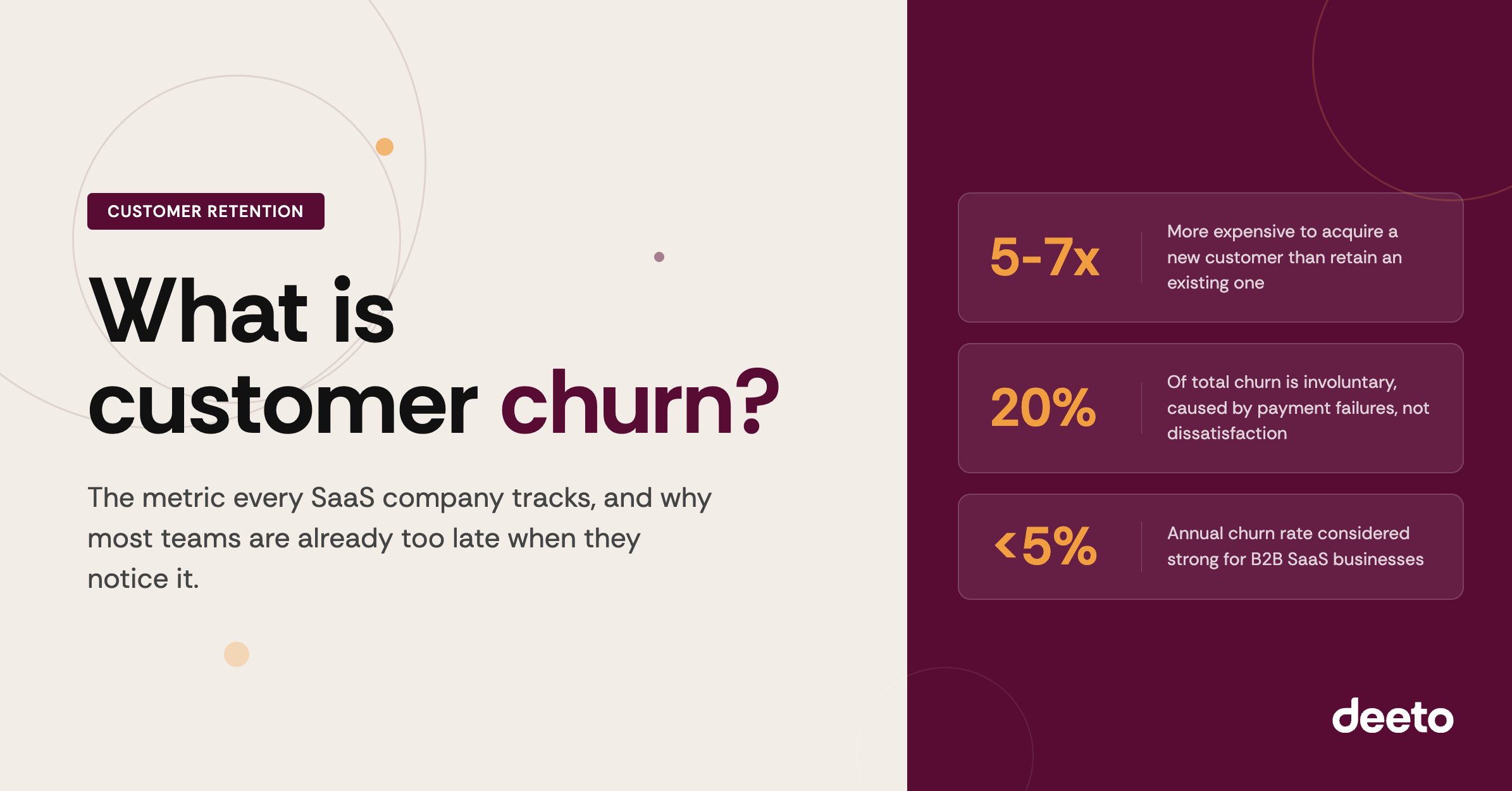
It inflates acquisition costs. According to research from Bain & Company, acquiring a new customer can cost five to seven times more than retaining an existing one. When churn is high, the cost of backfilling lost revenue from new customers compounds quickly.
It signals product or experience problems. Customers rarely churn randomly. They churn because something was not working: onboarding was confusing, the product stopped delivering value, support was slow, or a competitor offered something better. Churn is a symptom. The disease is usually further upstream.
It affects company valuation. Investors in SaaS businesses treat net revenue retention (NRR) as one of the most important metrics. High churn suppresses NRR and can significantly reduce valuation multiples.
Customer churn is not just a customer success problem. It is a whole-company signal.
Customer churn falls into two categories:
Voluntary churn happens when a customer actively decides to leave. This includes cancellations, non-renewals, and account closures driven by dissatisfaction, price sensitivity, a shift to a competitor, or simply no longer needing the product.
Involuntary churn happens when a customer loses access for reasons outside their intent. Failed credit card payments, expired cards, and billing system errors are the most common culprits. Involuntary churn is often underreported, but it typically accounts for 20 to 40% of all churn in subscription businesses.
Understanding the split between voluntary and involuntary churn matters because the interventions are completely different. You cannot solve a payment failure with an onboarding improvement, and you cannot solve a dissatisfied customer with a dunning email sequence.
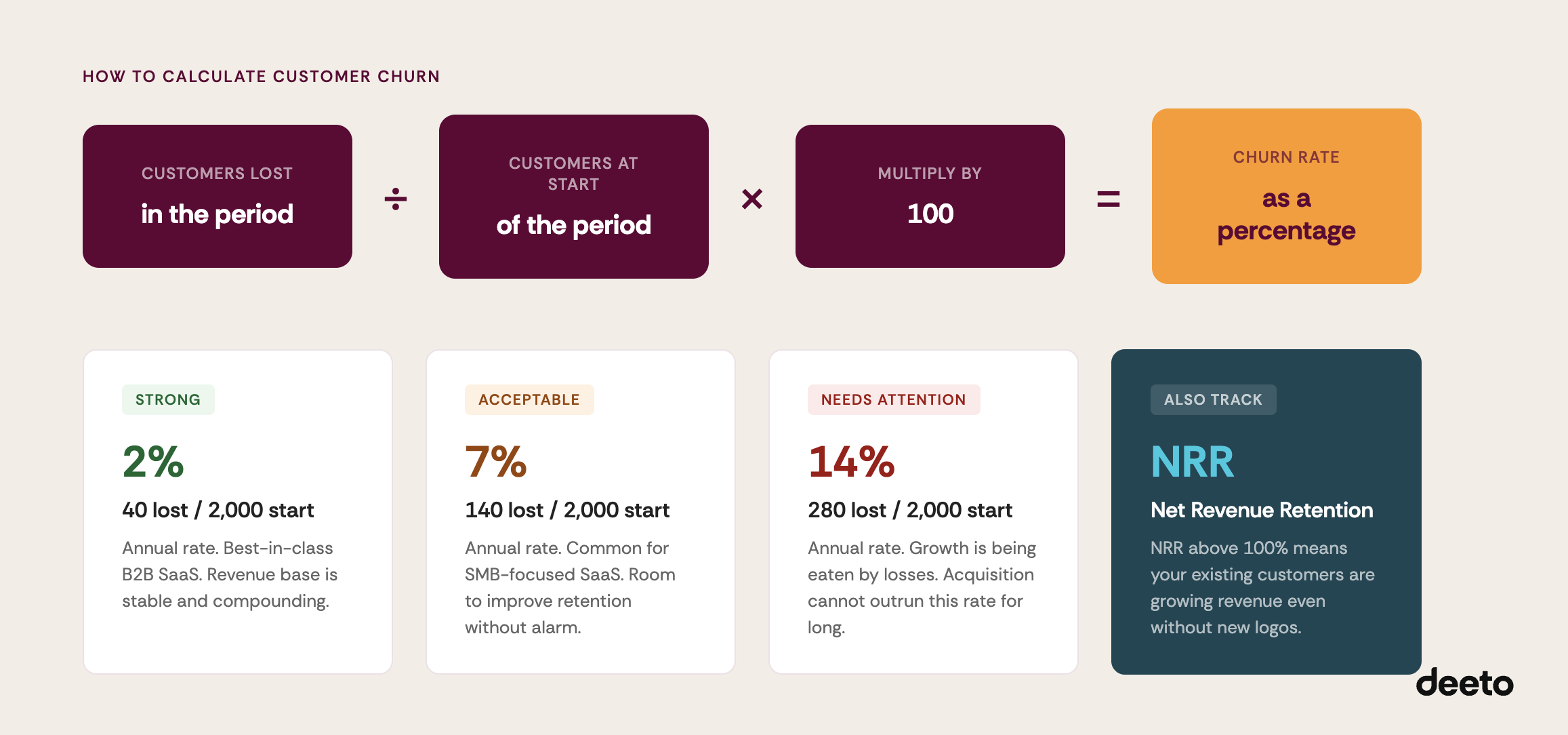
The standard customer churn rate formula is:
Customer Churn Rate = (Customers Lost in Period / Customers at Start of Period) x 100
For example: A company starts the month with 2,000 customers and ends with 1,880. They lost 120 customers.
120 / 2,000 x 100 = 6% monthly churn rate
That might not sound alarming. But a 6% monthly churn rate means roughly 54% of the customer base turns over every year.
Customer churn counts customers. Revenue churn measures dollars. For companies with customers of different sizes, revenue churn is often more important.
Revenue Churn Rate = (MRR Lost to Churn in Period / MRR at Start of Period) x 100
A company churning 10 small accounts and one enterprise account in the same month may show a low customer churn rate but a significant revenue churn rate. Tracking both gives a more complete picture.
Gross revenue retention (GRR) captures revenue lost to churn and contraction, without counting expansion. Net revenue retention (NRR) includes expansion revenue from existing customers through upsells and cross-sells.
An NRR above 100% means the existing customer base is growing even without new customer acquisition. Many best-in-class SaaS businesses target NRR of 110 to 130%.
Most churn does not come from one single event. It builds over time. These are the most common drivers:
Poor onboarding. Customers who do not reach their first meaningful outcome quickly are far more likely to churn in the first 90 days. If they cannot see the value of the product early, they will not believe in it later.
Low product engagement. Customers who are not actively using the product are quietly pre-churned. They are still paying, but they are not invested. Any friction, price increase, or competitive alternative can tip them out.
Unresolved friction. Support tickets that go unanswered, bugs that recur, integrations that break. Small frustrations compound over time into a decision to leave.
Price-to-value misalignment. Customers leave when they feel they are paying more than they are getting. This is often a perception problem as much as a pricing problem. If customers cannot articulate what the product is doing for them, the price will always feel too high.
Competitive displacement. A better option at a lower price point, or a competitor that does one specific thing significantly better, can trigger churn even among otherwise satisfied customers.
Changing business needs. In B2B, organizational changes like layoffs, pivots, or budget cuts often drive churn that has nothing to do with product quality.
The common thread across most churn reasons is a failure of listening. Companies that know what their customers are experiencing, what they need, and where frustration is building are the ones that can act before a customer decides to leave. Deeto's churn prediction use case is built specifically around surfacing these early warning signals from customer voice data.

Benchmarks vary widely, but here are ranges commonly cited across the industry:
Annual B2B SaaS churn rate:
Monthly B2B SaaS churn rate:
SMB-focused SaaS products typically see higher churn than enterprise-focused ones because smaller companies go out of business, change tools more freely, and have less contract lock-in. Enterprise churn rates tend to be lower but the revenue impact per churned account is significantly higher.
There is no universal "good" churn rate. The right benchmark depends on your market segment, contract lengths, and pricing model.
Reducing customer churn is not a single initiative. It is a continuous system.
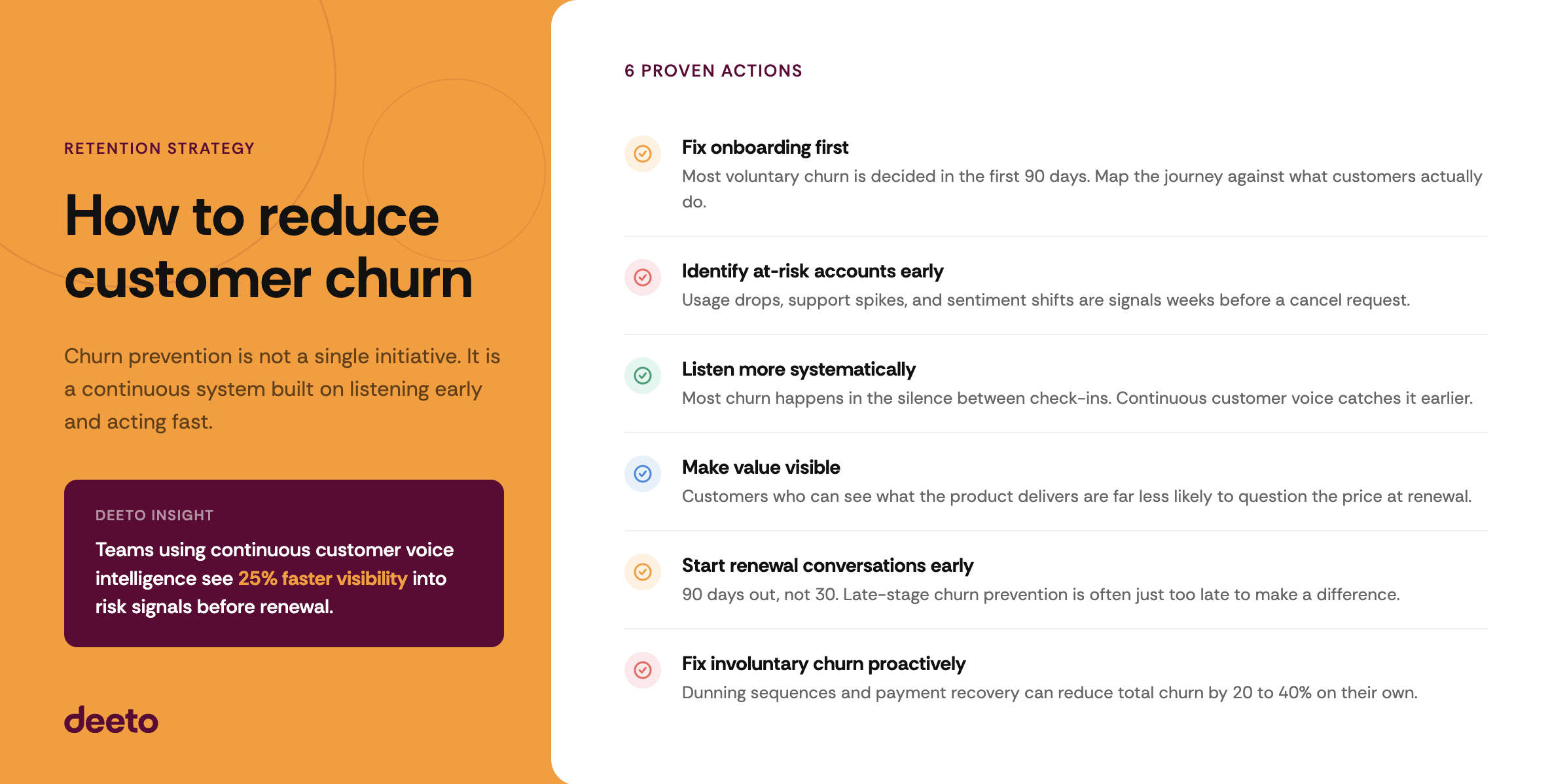
Fix onboarding first. The first 30 to 90 days are when most voluntary churn is decided, even if it does not show up in the data for months. Customers who reach their first meaningful outcome quickly are significantly less likely to leave. Map the onboarding journey against actual customer behavior, not what you hope customers do.
Identify at-risk accounts early. Do not wait for the cancellation email. Use product usage data, support ticket patterns, NPS scores, and customer sentiment signals to flag accounts before they make the decision. Customers who stop using a product but have not yet cancelled are already at risk. Deeto's customer sentiment analysis capability helps customer success teams see these signals continuously, not just at renewal time.
Listen more systematically. Most churn happens in the silence between check-ins. Companies that have ongoing conversations with customers, through interviews, in-product feedback, and structured touchpoints, understand problems before they compound. The customer success team at companies using Deeto report 25% faster visibility into risk signals compared to reactive approaches.
Make value visible. Customers who can see what the product is delivering are far less likely to leave. Quarterly business reviews, product ROI summaries, and regular communication about what is working all reinforce the relationship and make the renewal conversation easier.
Improve renewal processes. Start renewal conversations 90 days out, not 30. Give customer success teams visibility into account health, product engagement, and open issues before the renewal date arrives. Late-stage churn prevention is often too late.
Address involuntary churn proactively. Set up automated dunning sequences, card update reminders, and failed payment recovery workflows. Some estimates suggest that fixing involuntary churn alone can reduce total churn by 20 to 40%.
Close the loop on feedback. When customers give feedback, tell them what you did with it. Customers who see their input reflected in the product or in how they are served are more likely to stay and more likely to advocate. Deeto's customer voice intelligence platform connects feedback directly to the teams who can act on it.
There is a pattern inside most high-churn SaaS businesses: nobody is actually listening to customers until they leave.
Exit interviews capture what went wrong after the decision is made. Annual NPS surveys produce a score with no clear line of sight to action. Feedback goes into a spreadsheet that nobody owns.
The companies that consistently keep churn low do something different. They treat customer voice as continuous intelligence, not a periodic event. They know which accounts are frustrated before those accounts cancel. They know what features are not landing before product builds more of them. They know which customer success conversations are high risk before the renewal date arrives.
Deeto is built around this model. Customer voice goes in through Listen. Intelligence is organized through Learn and Analyze. Insights are delivered to the teams who need them through Activate. The output is not just better reporting. It is faster action on the signals that predict churn before it happens.
The problem is not that companies lack customer data. Most have too much of it, scattered across CRMs, support platforms, survey tools, and email inboxes. The problem is connecting that data to decisions.
Customer churn is one of those metrics that is easy to rationalize in the short term and very hard to unwind once it compounds. A 1% improvement in monthly churn has a larger impact on long-term revenue than most acquisition campaigns.
The companies that win on retention are not doing something exotic. They are listening to their customers more consistently, acting on what they hear faster, and making customer voice part of how every team makes decisions.
That is the model Deeto is built on. If you want to see how it works in practice, book a demo.
What is customer churn in simple terms?
Customer churn is the percentage of customers who stop paying for or using a product within a given time period. If a company starts the month with 1,000 customers and ends with 950, the churn rate is 5%. High churn means the business is losing customers faster than it would like, which directly reduces recurring revenue.
What is a good customer churn rate for SaaS?
For annual B2B SaaS, a churn rate below 5% is generally considered strong. Monthly churn below 0.5% is excellent. Benchmarks vary significantly by segment: SMB-focused products typically have higher churn than enterprise products because smaller businesses change tools more readily and have less contractual lock-in.
What is the difference between customer churn and revenue churn?
Customer churn measures the number of customers lost. Revenue churn measures the monthly recurring revenue (MRR) lost. For businesses with customers of different sizes, revenue churn is often more meaningful. A company can have low customer churn but high revenue churn if the accounts being lost are its largest ones.
What is the most common reason customers churn?
Poor onboarding is the single most common driver of early-stage churn. Customers who do not reach a meaningful outcome quickly lose confidence in the product before they fully use it. Longer-term churn is more often driven by low engagement, unresolved product friction, or a competitor offering a better alternative.
What is the difference between voluntary and involuntary churn?
Voluntary churn happens when a customer actively decides to cancel or not renew. Involuntary churn happens when access is lost due to failed payments or billing errors, not by choice. Involuntary churn can account for 20 to 40% of total churn and is often overlooked because it looks like it is being handled by billing systems when it actually requires a proactive recovery strategy.
How do you predict customer churn before it happens?
The most reliable early signals of churn include declining product usage, reduced login frequency, unresolved support issues, low NPS or CSAT scores, and negative sentiment in customer conversations. Companies that monitor these signals continuously, rather than waiting for renewal conversations, are able to intervene earlier and retain accounts that would otherwise quietly decide to leave.

Learn what customer churn is including causes, how to calculate churn rate, and strategies to reduce it in SAAS.
The best customer experience platforms in 2026 do more than collect feedback. They connect what customers say to what teams actually do. This guide compares the top customer experience (CX) platforms across nine categories, from enterprise voice-of-customer tools to AI-powered service platforms, so you can find the right fit for your organization's goals.
Choosing the wrong CX platform means paying for data you can't act on. Most teams already know that. The harder question is: what separates a platform that captures experience from one that actually improves it?
This guide covers the top platforms, what each one does best, and how to evaluate them based on your team's real needs.
A customer experience platform is software that helps organizations collect, analyze, and act on customer feedback across the full lifecycle. The best platforms go beyond surveys and support tickets to connect customer signals to decisions in sales, marketing, product, and customer success.
Customer experience platforms vary widely in scope. Some focus narrowly on support operations or NPS collection. Others span the entire customer lifecycle, surfacing voice, sentiment, and behavioral signals that guide strategy across the organization.
Customer experience software includes tools for voice-of-customer research, sentiment analysis, journey tracking, service management, and customer intelligence. What the category does not yet do well, in most cases, is connect all of those signals into a coherent system that drives action. That gap is where a new generation of platforms is emerging.
By 2026, 89% of businesses are expected to compete primarily on customer experience, surpassing product and price as the primary differentiators. The global customer experience management market was valued at approximately $17.2 billion in 2026 and is projected to reach $47.72 billion by 2033, growing at a CAGR of 15.2% (Grand View Research). That investment is not going into more surveys. It is going into platforms that can turn signal into action.
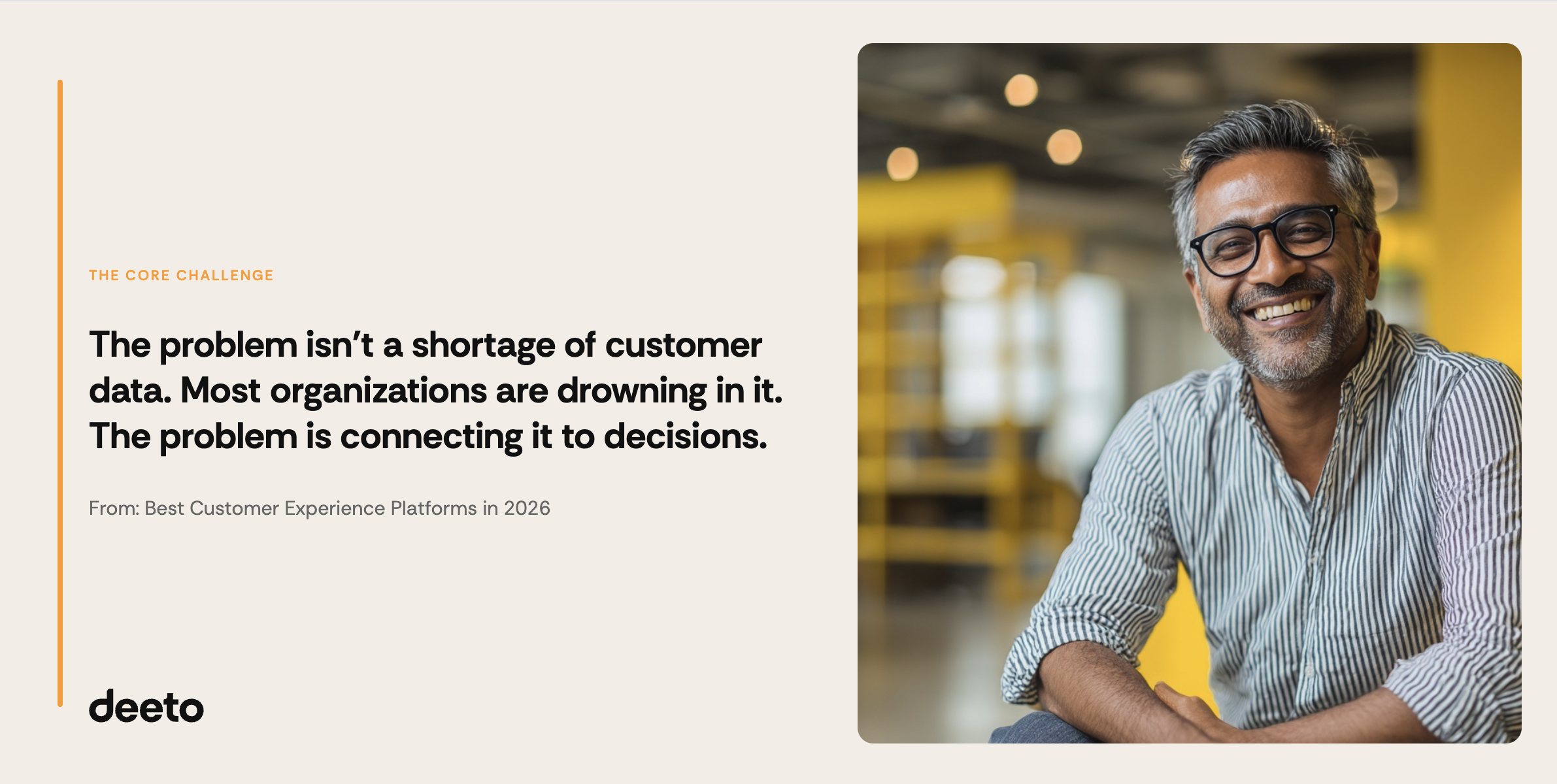
The pressure is real: customers expect personalized, responsive, and consistent experiences across every channel. Teams that rely on disconnected tools, quarterly NPS scores, or siloed feedback programs are already behind. The problem is not a shortage of customer data. Most organizations are drowning in it. The problem is connecting that data to the decisions that actually affect customer experience, and that is exactly what the best platforms in this guide are built to do.
Before comparing specific tools, align on what your team actually needs. The most common misbuys in this category come from evaluating features before use cases.
Key questions to ask before you buy:
No single platform is best for every team. The platforms below are each the best in their category, for the right buyer.
Best for: B2B teams that need to turn customer voice into connected intelligence and action across sales, marketing, product, and customer success.
Deeto is an AI-native customer orchestration platform built to connect authentic customer voice to the decisions that drive growth, retention, and product direction. Where most customer experience platforms stop at collection or reporting, Deeto closes the loop, surfacing the right insight to the right person at the right moment through integrations with CRM, enablement tools, and marketing workflows.
The platform organizes around five modules: Listen captures voice through AI interviews, surveys, and in-product signals; Learn stores and connects all customer intelligence in a searchable system of record; Analyze identifies patterns, sentiment, and trends; Activate delivers insights into the tools reps, marketers, and CSMs already use; and Orchestrate automates the workflows that keep intelligence flowing across the org.
Deeto's customer experience use case is purpose-built for teams that need more than a dashboard. It connects sentiment signals, churn prediction, and voice-of-the-customer data into a single platform that drives action, not just awareness.
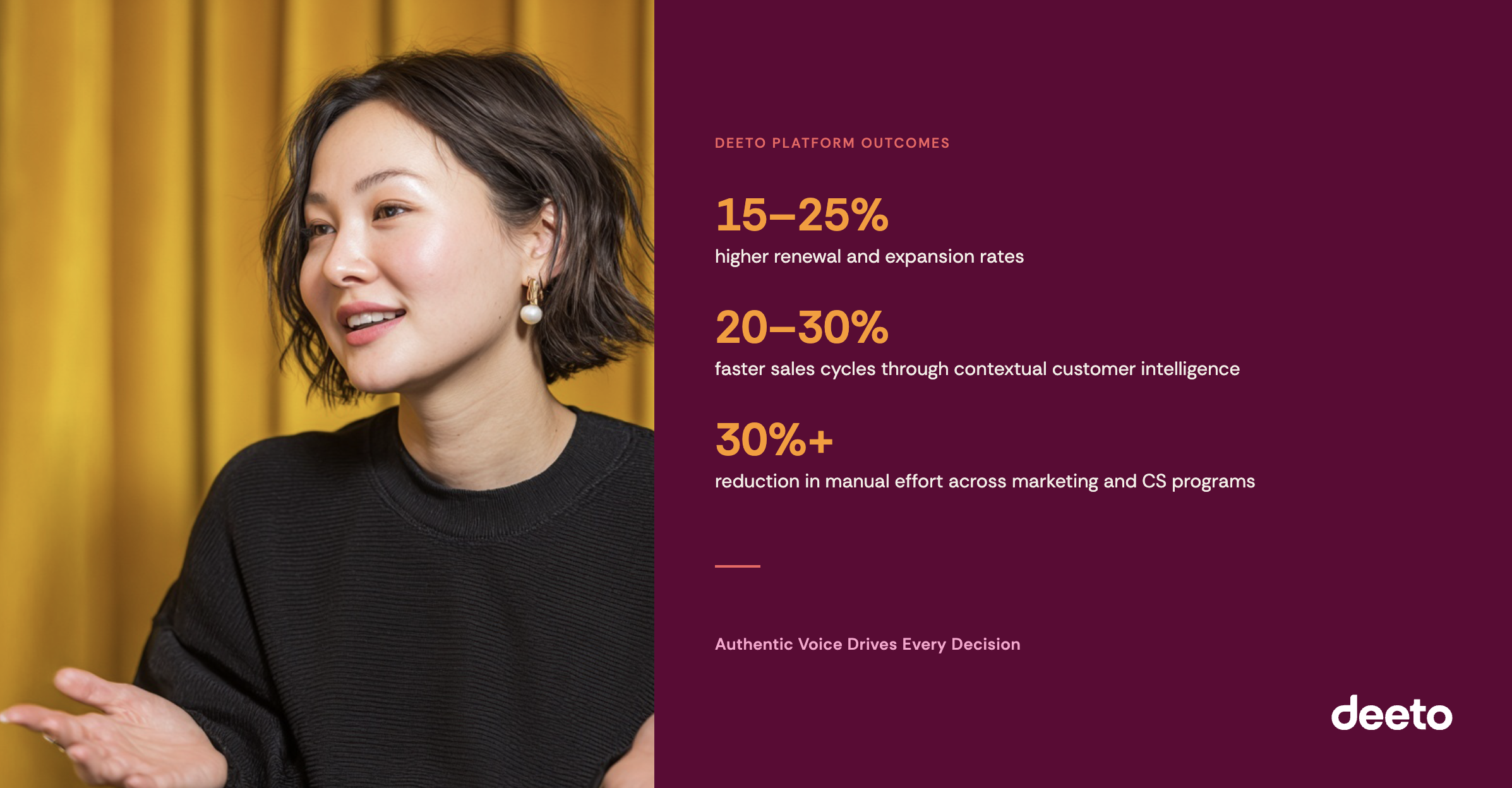
For customer success teams, Deeto surfaces renewal intelligence and at-risk signals before they become problems. For customer marketing teams, it captures customer stories, advocacy signals, and proof that fuel campaigns and conversion. Teams using Deeto see 15 to 25% higher renewal and expansion rates and 20 to 30% faster sales cycles through contextual customer intelligence.
Deeto is the platform to consider when your CX goal is not just to understand what customers think, but to make their voice the system that powers every team's work.
What to watch: Deeto is built for B2B organizations that already have a customer base to engage. It is not a general-purpose customer service or ticketing tool.
Best for: Enterprise organizations running company-wide experience management programs that span customer, employee, and product research.
Qualtrics XM is one of the most established names in the experience management category. It captures and analyzes customer experience data across touchpoints using sophisticated survey tools, predictive AI, and deep statistical analysis. The platform is well-suited to large organizations with dedicated research teams and the budget to match.
Qualtrics excels at structured research: quantitative surveys, conjoint analysis, brand tracking, and benchmarking programs. It integrates with most enterprise data stacks and produces the kind of executive-level reporting that large CX programs require.
The tradeoff is complexity. Qualtrics is a powerful platform that requires investment to configure, maintain, and act on. Teams without dedicated research or analytics resources often find the platform underutilized relative to its cost.
What to watch: Implementation timelines can be long. The platform rewards investment but requires it in return.
Best for: Enterprise teams capturing signals across high-volume, multi-channel customer interactions including voice, digital, IoT, and social.
Medallia is an enterprise-scale experience platform that ingests customer signals from a wide range of sources: surveys, support calls, social mentions, app behavior, and sensor data. Its AI and text analytics capabilities are among the strongest in the market, making it a fit for organizations managing CX at significant scale and complexity.
Medallia's strength is breadth of signal capture and the real-time analytics engine that sits on top of it. Large enterprises in financial services, healthcare, and retail use it to run continuous listening programs that feed into operational dashboards and frontline alerts.
Where Medallia is less strong is activation. Surfacing an insight in a dashboard is not the same as routing it to the sales rep, product manager, or CSM who can act on it. For organizations that need intelligence to flow into workflows, Medallia is often paired with additional tools.
What to watch: Enterprise pricing and complexity. Best suited to organizations with mature CX programs and dedicated operations teams.
Best for: Organizations already running Salesforce CRM who want to unify customer history, case management, and AI-driven service in one platform.
Salesforce's CX offering, now branded as Agentforce Service, builds customer experience directly onto the Salesforce data model. The result is a platform that connects CRM records, interaction history, and service cases on a single screen, and routes AI-powered responses and human escalations through a unified agent workspace.
For Salesforce-native organizations, the integration advantage is real. CX data from service interactions feeds directly into sales and marketing workflows, creating the kind of unified customer view that most orgs struggle to build manually. The platform's 2025 and 2026 releases have deepened its autonomous AI agent capabilities, allowing service teams to resolve more cases without human intervention.
What to watch: Salesforce's CX capabilities are strong for service-led organizations, but less suited to voice-of-customer research, customer marketing, or insight orchestration use cases.
Best for: Support-led organizations that need best-in-class ticket management, AI resolution, and agent efficiency.
Zendesk remains the default recommendation for teams whose primary CX challenge is inbound support volume. Its interface is clean, its ticket management logic is well-proven, and its 2026 AI capabilities, accelerated by the Forethought acquisition in early 2026, have meaningfully improved first-contact resolution rates. According to Zendesk's own industry analysis, 30% of service cases were resolved by AI in 2025, with that number expected to reach 50% by 2027.
Zendesk is not a voice-of-customer platform or a customer intelligence system. It is a support operations tool that, when deployed well, reduces customer friction at the service layer. For organizations that view CX as primarily a support challenge, it is hard to beat. For teams that need customer voice connected to marketing, product, or revenue decisions, it covers only part of the picture.
What to watch: AI capabilities are improving fast, but the platform's data model is support-centric. Exporting signals into the broader organization still requires significant integration work.
Best for: Enterprise marketing and service teams managing customer experience across social media, messaging apps, and modern digital channels.
Sprinklr is the platform of choice for organizations where CX is as much a brand challenge as it is a service one. It unifies social listening, community management, customer service, and marketing across modern channels including X (formerly Twitter), Instagram, WhatsApp, and dozens of others.
Sprinklr's strength is the breadth of its channel coverage and the integration of service data with marketing and social intelligence. Enterprise brands that need to manage public-facing experience at scale, and connect those interactions to broader CX programs, find it a capable fit.
What to watch: Sprinklr is a premium platform with complexity to match. Mid-market organizations often find the configuration overhead and pricing disproportionate to their needs.
Best for: B2B SaaS teams whose CX strategy is primarily anchored in customer success, retention, and expansion.
Gainsight is the category-defining platform for customer success management. It tracks customer health scores, surfaces renewal and churn risk signals, and orchestrates the playbooks that CS teams use to manage their book of business.
In the broader CX context, Gainsight is most valuable when the CX function reports through Customer Success and the primary goal is retention. It is strong on lifecycle management, weaker on customer voice capture, marketing integration, and the kind of cross-functional intelligence orchestration that B2B growth teams need.
What to watch: Excellent for CS-owned programs. Teams that need customer intelligence to flow into product, marketing, or sales workflows will likely need to supplement it.
Best for: Product-led growth companies and SaaS teams that need AI-first conversational support and in-product engagement.
Intercom has evolved significantly over the past two years. Its Fin AI Agent, powered by large language models, resolves a high percentage of support queries autonomously and routes complex cases to human agents with full context. For product-led growth teams, Intercom's combination of in-product messaging, support, and customer engagement workflows is a strong fit.
Intercom is best understood as a conversational CX platform. It handles the immediate, real-time layer of customer experience well but is not designed for strategic voice-of-customer programs, longitudinal insight, or cross-functional intelligence.
What to watch: AI resolution rates vary significantly by industry and query type. It performs best in software support contexts with well-defined resolution paths.
Best for: Mid-market organizations already on HubSpot CRM that want to unify marketing, sales, and service data without adding complexity.
HubSpot Service Hub sits inside the HubSpot ecosystem and shares a data model with Marketing Hub and Sales Hub. For organizations already using HubSpot, adding Service Hub means customer service tickets, NPS scores, and support history are immediately visible alongside marketing engagement and deal history.
The platform is not the deepest in any single category, but its integration advantage within the HubSpot ecosystem is genuine. Teams that want a unified view of the customer without a heavy implementation investment often choose it for that reason.
What to watch: Service Hub is mid-market in scope. Enterprise-level CX programs will outgrow it.
If you need customer voice connected across every team, Deeto is the only platform on this list built to do that. Most platforms here solve for one function: research, support, success, or social. Deeto spans the full org, turning authentic customer voice into intelligence that flows to sales, marketing, product, and customer success through one connected system. It is also the platform most likely to reduce your dependence on several of the point solutions below.
For teams with more specific, function-level needs:
The honest framing: Deeto does not compete with these tools so much as it completes what they can't do, connecting the strategic layer of customer intelligence to the workflows those platforms run.
For a deeper look at what the category covers, our guide on what is customer experience covers the core concepts, frameworks, and the distinction between CX programs that measure and those that drive change.
Picking the best customer experience platform is not a feature comparison exercise. It is a question about what you want customer intelligence to change inside your organization.
Most platforms in this category solve for capture. They collect well, report clearly, and stop short of the activation layer where CX data actually changes what teams do. The organizations seeing the strongest CX outcomes in 2026 are the ones that have closed that gap, connecting customer voice to the sales conversations, product decisions, and renewal strategies that determine growth.
If you are ready to see how Deeto connects authentic customer voice to decisions across every team, book a demo and we will show you what that looks like in practice.
For a primer on the broader category, start with the customer journey mapping guide, which covers how the best organizations design and track the end-to-end customer experience before investing in a platform to manage it.
What is a customer experience platform?
A customer experience platform is software that helps organizations capture, analyze, and act on customer signals across the full lifecycle. The best platforms connect feedback from surveys, interviews, support interactions, and behavioral data to the teams and workflows that need to act on it. Customer experience platforms range from narrow support tools to full-scale intelligence and orchestration systems.
What is the best customer experience platform for B2B SaaS teams?
For B2B SaaS teams that need to connect customer voice to decisions across sales, marketing, product, and customer success, Deeto is the strongest choice. It captures authentic customer voice, organizes it into connected intelligence, and delivers it to the right person at the right moment through CRM and enablement integrations. For teams focused primarily on support operations, Zendesk or Intercom are strong alternatives depending on scale.
How is a CX platform different from a CRM?
A CRM manages transactional data about customers: contacts, deals, interactions, and pipeline. A customer experience platform captures and organizes the qualitative and experiential layer of customer relationships, what customers think, feel, and need, and connects that intelligence to decisions. The best-in-class organizations use both, with CX intelligence flowing into CRM workflows to inform sales, renewal, and engagement strategies.
What should I look for when evaluating CX platforms?
Start with use case, not features. Identify which team owns the CX program, what decisions customer data needs to improve, and how your organization currently handles the loop from insight to action. Then evaluate platforms on how well they match that use case, their integration with your existing stack, and the quality of their AI for surfacing patterns rather than just presenting raw data.
How much do customer experience platforms cost?
Pricing varies significantly by category and scale. Enterprise platforms like Qualtrics and Medallia typically run six-figure annual contracts for large deployments. Mid-market tools like HubSpot Service Hub and Intercom start lower but scale with usage. Deeto is priced for B2B teams and scales with the scope of the program. Most providers offer custom pricing based on organization size and use case. Request a demo or a pricing call to get accurate figures for your specific needs.
What is the difference between customer experience and customer success platforms?
Customer success platforms like Gainsight focus on the post-sale relationship: health scoring, renewal management, and expansion within an existing account base. Customer experience platforms are broader, covering the full lifecycle from acquisition through retention and including the signals that come from marketing, product, support, and research. The two categories overlap significantly and are often used together in mature B2B organizations.

Best CX platforms in 2026 compared: voice intelligence, service, sentiment analysis, and orchestration tools.
Customer experience shapes every revenue outcome that matters. Retention. Referrals. Expansion. Win rates. And yet most companies still manage it reactively, responding to problems after they happen instead of building systems that surface what customers actually feel.
Customer experience (CX) is the sum of every interaction a customer has with your company, from the first time they encounter your brand to the ongoing relationship after purchase. It includes how they feel about your product, your support, your sales process, your communications, and everything in between.
In this post, we'll break down what customer experience really means, why it determines whether companies grow or plateau, and what it takes to build a CX strategy that actually works.
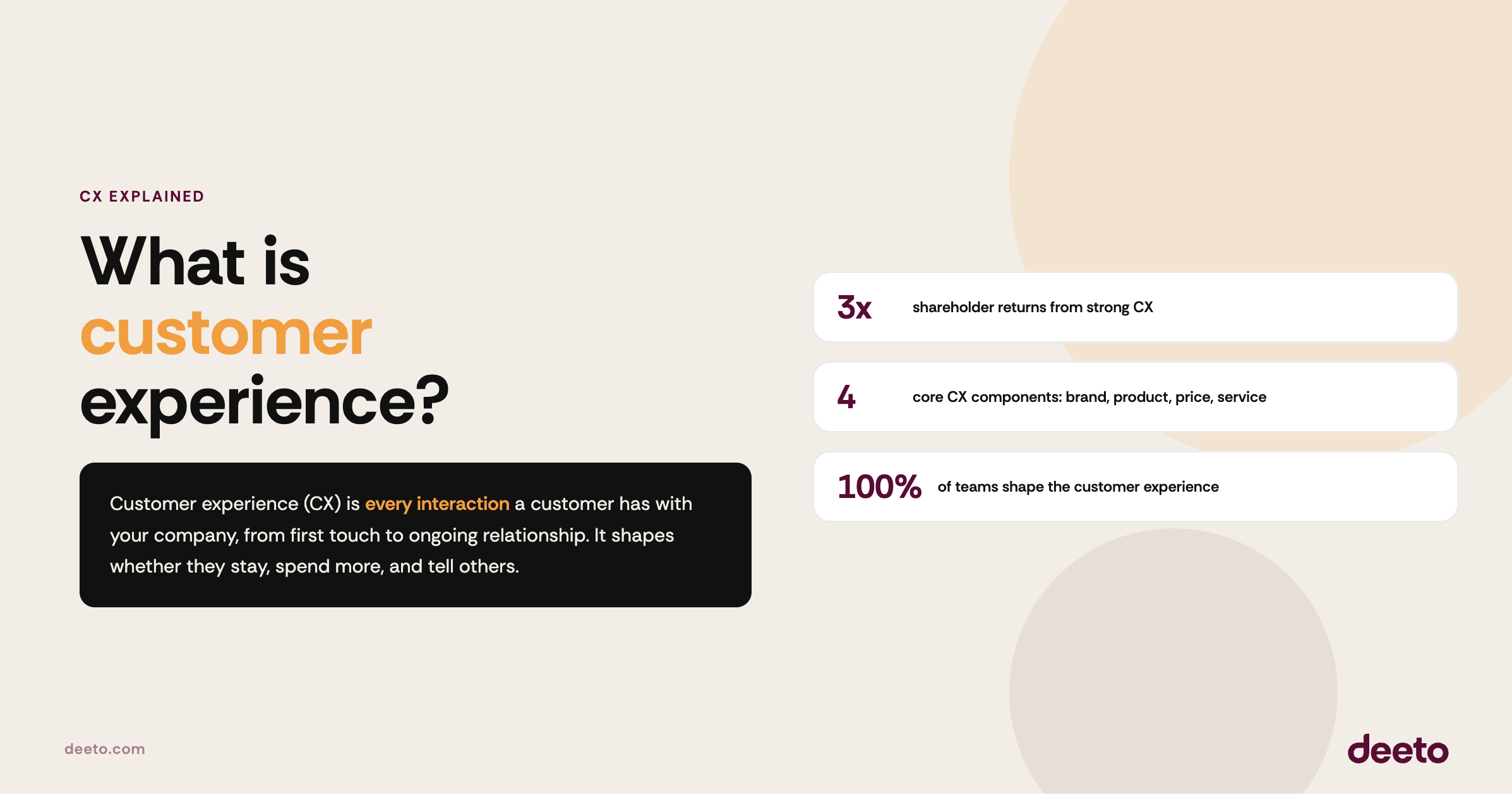
Customer experience is the overall impression a customer forms across every touchpoint with your organization. It is not a single interaction. It is the accumulative feeling customers carry about who you are, how you treat them, and whether you deliver on what you promised.
CX includes four core components: brand, product, price, and service. But the weight customers place on each of those shifts depending on the relationship, the industry, and the moment. In most B2B contexts, service and product reliability drive perception far more than price.
What separates a good customer experience from a great one is usually not a single wow moment, but a consistently good experience over time. Customers who rarely encounter friction, who feel heard when they share feedback, and who see their input reflected in how a product or service evolves are the customers who stay and advocate.
The problem is that most organizations do not have a system for capturing what customers actually think, feel, and experience in a way that drives decisions. Feedback gets collected in surveys that go unread. Insights get discussed in QBRs and then shelved. Customer voice becomes a reporting exercise rather than the intelligence that shapes how a company moves.
CX has become the primary differentiator in markets where products are functionally similar. As features get copied quickly, experience becomes harder to replicate at scale, and the gap between companies that invest in it and those that do not widens every year.
The business case is consistent across industries. McKinsey research found that companies that excel at customer experience deliver 3x returns to shareholders compared to those that do not. That is not a soft outcome, it is a financial one, and it reflects what happens when retention, expansion, and referrals all compound over time. Customers who have a bad experience do not just leave; they share it. In a world where buyers research extensively before engaging sales, the accumulated weight of customer perception matters more than any individual campaign.
For B2B companies specifically, the stakes are particularly high. Buyers rely on peer evidence, customer reviews, and third-party validation before they trust any vendor's claims. What your existing customers say about their experience is often more persuasive than anything your marketing team produces.
Customer experience also has a direct impact on the metrics teams care about most. When CX is strong, renewal rates go up, expansion conversations happen earlier, and reference requests are easier to fulfill. When CX deteriorates, the signals usually appear in feedback data weeks or months before they show up in churn numbers, but only if you are listening.
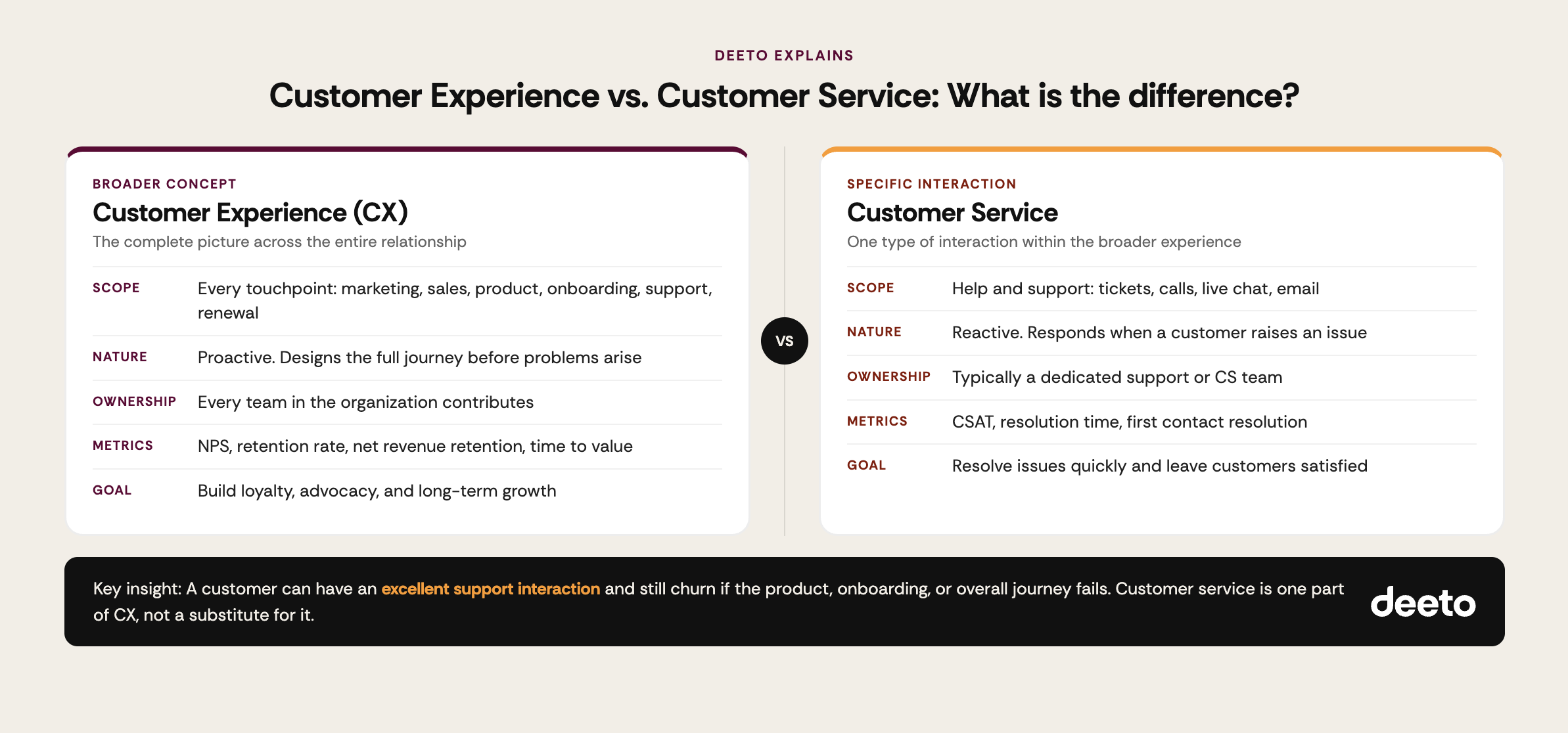
These two terms are often used interchangeably, but they are not the same thing.
Customer service is a specific interaction type. It is what happens when a customer encounters a problem and reaches out for help. Customer service is reactive, transactional, and typically owned by a single team.
Customer experience is the full picture. It includes every interaction across every channel, team, and moment in the customer lifecycle. Customer service is a component of CX, but a customer can have an excellent support experience and still churn because the product failed to deliver value, or because onboarding was confusing, or because they never felt like a strategic partner.
Organizations that conflate the two tend to over-index on support metrics like CSAT and resolution time while ignoring the signals that show up earlier in the journey. Onboarding friction, weak adoption, and misaligned expectations often predict churn long before a customer ever raises a complaint.
Customer experience is shaped by the moments customers remember and the gaps they notice.
Onboarding and first value. How quickly does a customer reach their first meaningful outcome? The longer that gap, the harder it becomes to build loyalty. Companies that focus on customer adoption early in the relationship create the foundation for retention.
Product quality and reliability. A product that consistently delivers what it promises is the baseline. But customers also form impressions based on how quickly issues are resolved and whether the company takes their product feedback seriously. Connecting customer voice to your product roadmap is one of the highest-leverage things a product team can do.
Communication and responsiveness. Customers notice when they feel ignored. They also notice when a company communicates proactively, shares relevant insights, and makes them feel like a partner rather than a transaction.
Consistency across teams. CX breaks down when different teams operate in silos. Sales promises one thing, CS delivers another. Marketing positions the product one way, support responds differently. Customers experience your entire organization, not just the one team they happen to be talking to.
Feedback loops that close. Customers who share feedback and never hear anything back eventually stop sharing it. And they often stop buying too. Companies that listen to customer sentiment and close the loop with customers build a different kind of trust.
Common CX Challenges
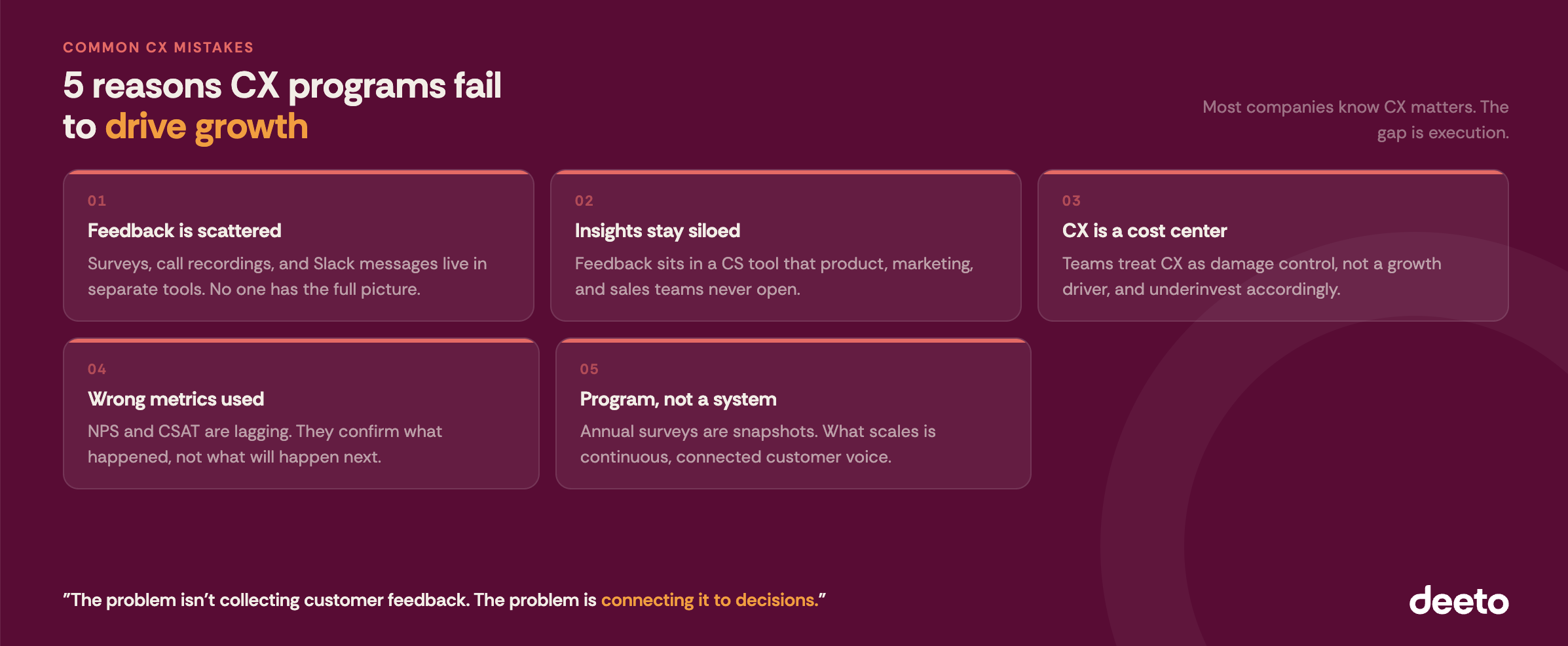
Most organizations already know CX matters. The challenge is execution. Here are the patterns that consistently undermine CX programs:
Feedback is fragmented. Survey data lives in one tool, call recordings in another, Slack messages in another. Nobody has a complete picture of what customers are experiencing because the signals are scattered.
Insights do not reach decision-makers. Even when feedback is collected, it often sits in a customer success platform that product, marketing, and sales teams never open. The intelligence exists, but it does not flow to the people who can act on it.
CX is treated as a cost center, not a growth driver. When teams think of CX as damage control rather than a revenue input, they underinvest in the systems and programs that would make it compound over time.
Companies measure satisfaction instead of signal. A high Net Promoter Score (NPS) can mask a declining relationship. CSAT after a support ticket tells you almost nothing about whether a customer will renew. The metrics most teams use to manage CX are lagging indicators, not leading ones.
Voice of the customer is a program, not a system. One-off surveys, annual customer interviews, and quarterly business reviews are not a system for capturing and activating customer voice. They are snapshots. What scales is a continuous, connected approach to capturing what customers actually experience, thinking, and need.
A strong customer experience strategy is built on three things: continuous listening, connected intelligence, and deliberate action.
Continuous listening means capturing customer voice across the full lifecycle, not just at renewal or escalation. It means running AI-powered customer interviews, collecting in-product feedback, and building signals from every interaction rather than waiting for customers to raise their hands.
Connected intelligence means organizing that voice into a system where patterns emerge, sentiment is tracked over time, and every team can access the insights they need. When sales can see what customers say about your product's weaknesses, they can address objections earlier. When product teams can see recurring friction points, they can prioritize with confidence.
Deliberate action means building workflows that turn insight into outcomes. Surfacing the right customer story in a sales pitch at the right moment. Triggering a customer success touchpoint when a churn risk signal appears. Routing product feedback to the right team before it festers.
This is what separates organizations that run CX as a program from those that run it as a system. Deeto is built for the latter. As a customer orchestration platform, Deeto captures authentic customer voice, organizes it into intelligence, and activates it across sales, marketing, and CS workflows.
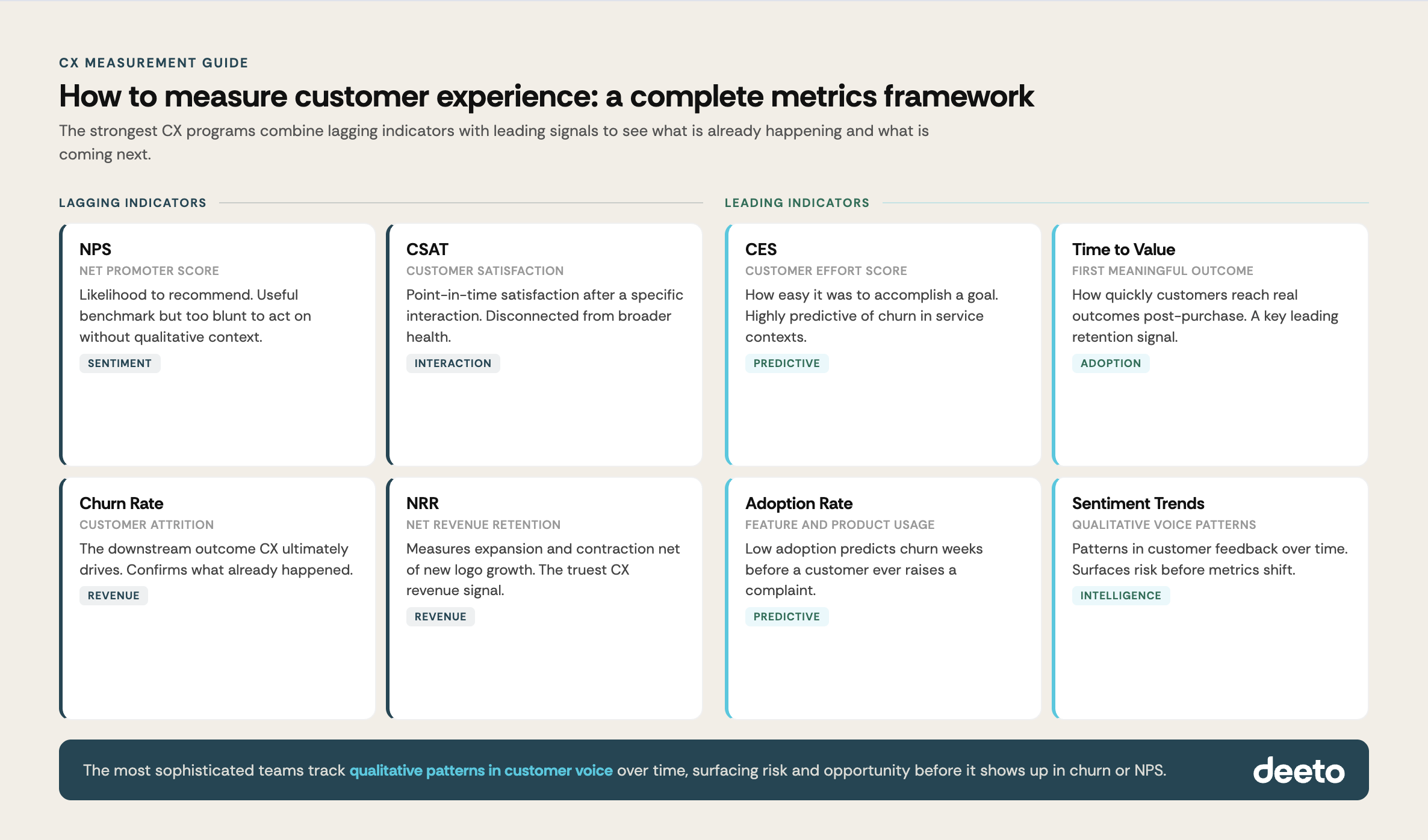
No single metric captures CX. The strongest CX programs use a mix of lagging indicators (NPS, CSAT, renewal rates) and leading indicators (product adoption, engagement signals, feedback sentiment, time to first value).
Common CX metrics include:
The most sophisticated teams also track qualitative patterns in customer feedback over time, using sentiment analysis and structured voice-of-customer programs to surface the signals that traditional metrics miss. Deeto's customer sentiment analysis capabilities are built specifically for this, connecting sentiment trends to the revenue signals that matter.
Customer experience is not a department or a score. It is the cumulative signal that tells you whether your company is delivering on its promise.
The companies that win on CX are the ones that treat customer voice as the operating system for growth, not a report they review once a quarter. They build infrastructure to listen continuously, organize intelligence across teams, and activate it at the moments that move the needle.
If you are building or evolving your CX strategy and want to see what it looks like when authentic voice drives every decision, see how Deeto works or book a demo to explore what a customer orchestration platform can do for your team.
Customer experience (CX) is the overall impression a customer forms through every interaction with your company across the full customer lifecycle. It includes product quality, customer service, communications, onboarding, and any other touchpoint that shapes how a customer feels about your brand. Strong CX leads to higher retention, faster renewals, and more referrals.
Customer service refers to a specific type of interaction, typically when a customer needs help solving a problem. Customer experience is the broader picture: every touchpoint, from first awareness through ongoing relationship, that shapes how a customer perceives and feels about your company. Customer service is a component of CX, not a substitute for it.
The four core components of CX are brand, product, price, and service. In practice, customers weigh these differently depending on context. In B2B SaaS and technology markets, product reliability and service quality tend to carry the most weight in shaping long-term perception and retention.
CX is typically measured using a combination of lagging indicators like NPS, CSAT, and renewal rates, and leading indicators like product adoption, time to first value, and customer feedback sentiment. The strongest CX programs combine structured quantitative metrics with qualitative voice-of-customer intelligence to surface signals before they become problems.
In B2B markets, buyers rely heavily on peer validation, customer reviews, and reference conversations before making purchase decisions. How your existing customers experience your product and your team directly influences how easy it is to close new deals. Strong CX shortens sales cycles, increases win rates, and generates the authentic customer evidence that marketing and sales depend on.
A customer experience strategy is an organizational plan for designing, delivering, and continuously improving how customers interact with your company. It includes how you capture customer feedback, how you use that feedback to make decisions, how you align teams around shared CX goals, and how you measure the outcomes of CX investments. The most effective strategies are built on continuous listening and connected intelligence rather than periodic surveys.

What is customer experience? Learn its definition, key components, and how top teams use authentic voice to improve CX.
Three years ago, if you could produce a polished PDF report faster than your competitor, you won a deal.
Two years ago, a better dashboard gave you an edge.
Four years ago, a thoughtful, personalized email template shifted perception.
Today, all of that is background noise.
AI LLMs have made output generation trivial. A competent prompt engineer can build what used to take a product team six months to ship. Not the underlying workflow. Not the infrastructure. The output. The thing your customer actually sees.
A dashboard that took engineering effort to design? Claude can generate a similar layout in seconds.
A case study template that felt special? Prompt engineers have dozens of variations ready.
An email that seemed to resonate? Run it through an LLM and you'll get something functionally equivalent in structure, tone, and persuasiveness.
This is happening in your category right now. The question is whether you've noticed it already.
For the last decade, SaaS moats looked like this: build software that produces better output than competitors. Charge for that output. Win.
That output layer has become commoditized. Fast.
If your product's defensibility depends on generating dashboards, reports, emails, templates, or insights faster or prettier than an LLM, you're playing a game you've already lost. You can't outrun commodity pricing on productivity tools.
Some companies know this already. They've started moving upmarket, adding compliance features, or bolting on horizontal AI capabilities to stay relevant. Those moves buy time. They don't fix the core problem.
The thing that's hard to replicate isn't what you output. It's what you know.
Specific knowledge. Proprietary data. Information that an LLM can't generate because it doesn't exist in training data and can't be hallucinated because it requires ground truth.
The companies that will survive the next five years aren't necessarily the ones with the fanciest output. They're the ones sitting on structured, hard-to-replicate information.
Data collection has always been boring. It's why most SaaS companies avoid it. But boring data is becoming the only data worth owning.
You probably already have this data. You're just not treating it like your moat. You're treating it like a side effect.
If you're in SaaS, you have three choices.
You can keep competing on output. Watch your margins compress. Commoditize faster. Try to be the cheapest or the most efficient, which is a race nobody wins long-term.
You can add compliance, security, or horizontal AI features to stay relevant.
That extends runway by 18 to 24 months. The problem doesn't go away.
Or you can ask:
what do we actually know that no one else knows?
What data do we have that matters?
What information is sitting in our system that, if structured and connected, would be impossible to replicate?
That third option is where the moat lives. But it requires rethinking what you're actually building. Treating data collection as a first-class problem, not a side effect. Building infrastructure to make that data usable, not just stored. Understanding that the future isn't about smarter output, it's about better input.
Most SaaS companies aren't ready for that shift. They're too invested in the output game.
The window is now.

Dashboards, reports, templates. AI does all of it now. Here's where the real advantage lives.
Here's the problem most customer-facing teams walk into budget season with: they know their program is working, but they can't prove it.
ROI for a voice of the customer program is the measurable return generated by capturing, organizing, and activating customer insights, expressed as revenue impact, cost savings, and efficiency gains relative to program investment. The teams that can calculate it clearly protect their budget. The teams that can't are always the first to get cut.
This post walks through the full ROI calculation, the inputs that matter, and how to turn the output into a business case that lands with a CFO or CRO.
The difficulty isn't that the value isn't there. It's that it's fragmented.
A reference shortens a deal. A testimonial lifts a landing page. Win-loss research sharpens the pitch. Churn interviews surface a product gap before renewals are at risk. Each of those moments drives real revenue, but none of them show up in a single report, and most teams don't have a system that connects them.
The result: customer-facing teams operate on anecdotes. Leaders know it works but they can't quantify it. That's a budget problem, a headcount problem, and eventually a program-survival problem.
The fix isn't working harder. It's building the right measurement architecture from the start.
The math is simple, but the inputs are where most teams get stuck.
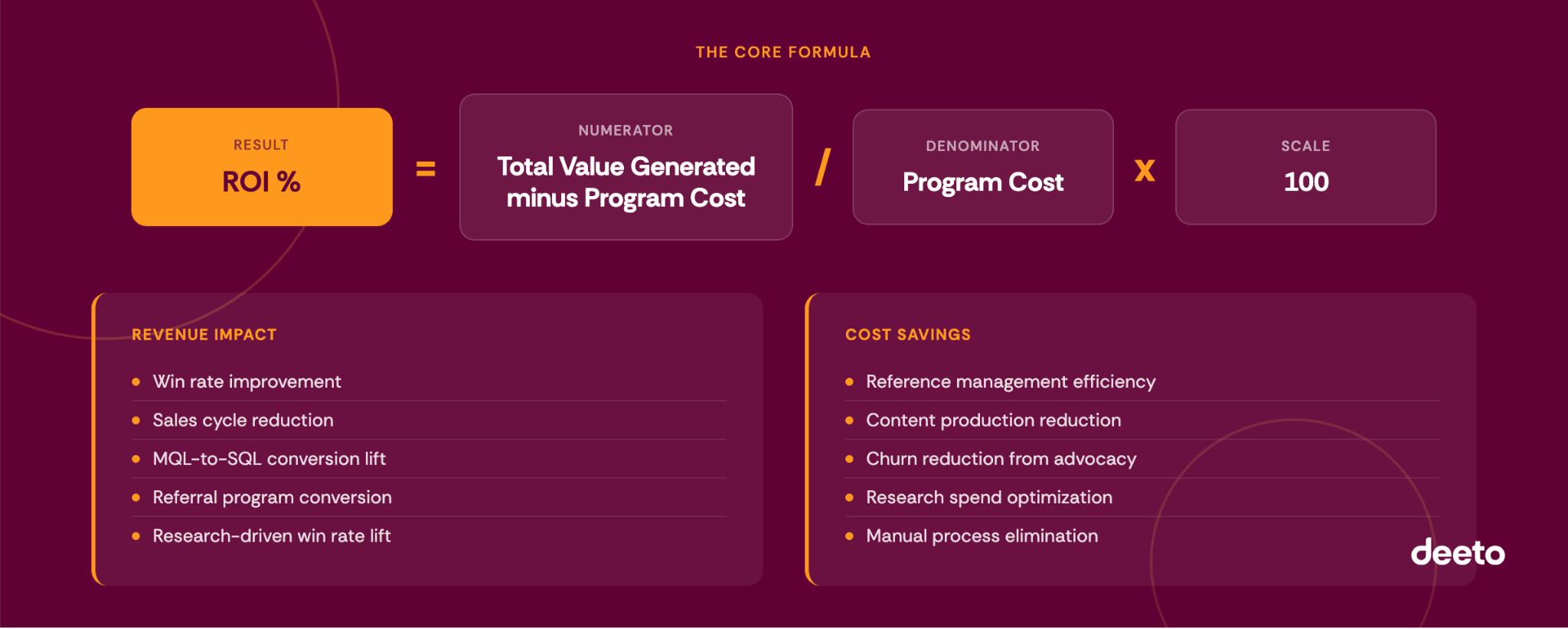
ROI = (Total Value Generated - Program Cost) / Program Cost x 100
Total Value Generated has two components:
The sections below break each one down with the inputs to use and the benchmarks to anchor them.
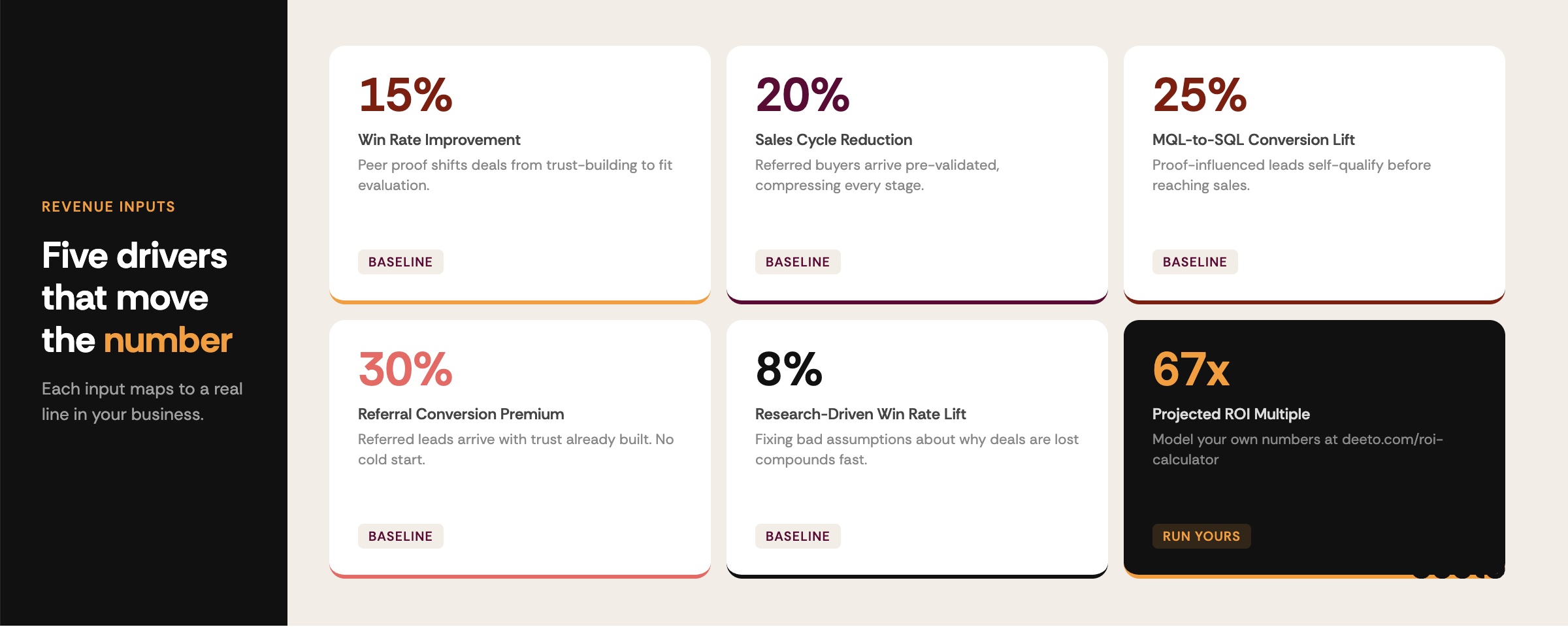
Peer proof has a direct effect on competitive deals. When buyers are evaluating multiple vendors, a credible reference or customer story shifts the conversation from "do we trust this vendor" to "does this solution fit our needs," and that's a fundamentally different place to be in. Deeto's ROI model benchmarks a 15% win rate improvement as the baseline expectation for programs with active references and customer evidence in play, with the range running up to 35% depending on how deeply proof is integrated into the sales motion.
Track which closed-won deals had a reference, a customer story, or a peer review involved in CRM. That data turns a benchmark into your number.
Buyers who arrive via peer recommendation have already done a significant portion of their own validation before a rep is involved. The awareness stage, the credibility check, the "is this vendor worth talking to" question; much of that is resolved before the first call. Deeto's model uses a 20% cycle reduction as its baseline assumption, with programs that embed references and social proof more systematically seeing reductions toward the 40% end of the range.
Model it by taking your current average cycle length, applying a conservative reduction, and calculating how many additional deals per rep that unlocks per year.
Leads that have engaged with customer proof before reaching sales convert at higher rates. The reason is straightforward: a buyer who has already read a relevant case study or seen a peer review has self-qualified in a way that a cold MQL hasn't. Deeto's model applies a 25% MQL-to-SQL conversion lift as its default, reflecting the difference between leads that have encountered customer evidence and those that haven't.
Track conversion rates for influenced versus uninfluenced leads separately. The gap is your attribution.
Referred leads are a different category of prospect entirely. They arrive with pre-existing trust, a warmer disposition toward the product, and a shorter path to a buying conversation. Deeto's model sets a 30% referral conversion rate premium as the baseline, reflecting the well-established pattern that referred leads close faster and at higher rates than leads from other channels. A structured referral program is one of the highest-return activities in customer-facing teams precisely because the hard work of building credibility has already been done before the lead enters the funnel.
Systematic win-loss and churn research surfaces competitive gaps and messaging problems before they cost deals. The reason most teams don't act on this sooner is a data quality problem: salespeople only get the complete and honest truth about why they win or lose 40% of the time, meaning 60% of the deal outcome data in a CRM is incomplete or inaccurate. Deeto's model applies an 8% win rate lift as the baseline for teams running structured research programs, with upside to 20% for programs that feed insights back into messaging and sales enablement consistently. This input is often left out of ROI models entirely, which means most teams are undervaluing their research function significantly.
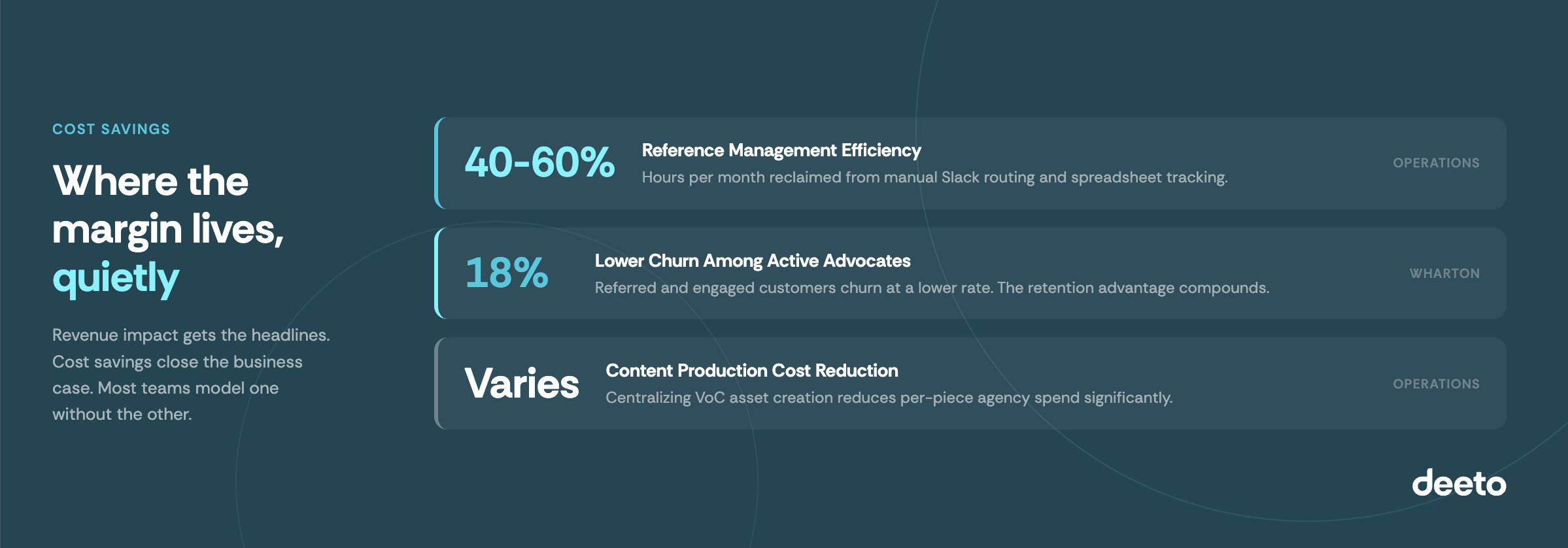
Revenue impact is the bigger number, but cost savings are often faster to prove internally and easier to tie to headcount.
Manual reference coordination including spreadsheets, Slack routing, and back-and-forth matching is expensive. Teams that handle it manually typically spend 20–40 hours per month on tasks a centralized system handles in minutes. Calculate: monthly hours x loaded hourly cost x 12. Then model a 40–60% reduction.
If your team buys case studies or VoC research from agencies, centralizing that work reduces per-piece cost significantly. Calculate: annual assets produced x agency cost per piece, then model the reduction from bringing production in-house at scale.
The retention effect of an active advocacy program is well documented. The Wharton study on referred customers found they churned at an 18% lower rate than non-referred customers, and unlike other value metrics, that retention advantage did not erode over time. The mechanism is straightforward: customers who are actively engaged with your program have more touchpoints, surface dissatisfaction earlier, and have a stronger relationship with the product than customers who go dark after onboarding. For a program with meaningful ARR at risk, this is often the largest cost savings line in the model.
Deeto's ROI calculator lets you input your real business parameters including deal volume, average deal size, win rate, sales cycle length, churn rate, and program costs, to model projected impact across every category above.
For a mid-market SaaS company running 150 deals per year at a $60,000 average deal size, with a 25% win rate and a 90-day sales cycle, the calculator typically surfaces:
The output includes a projected ROI multiple, net annual value, months-to-payback, and a 3-year cumulative view that factors in compound adoption as the program matures.
You can adjust confidence levels for each category to model conservative, expected, and optimistic scenarios. This makes the output defensible in executive conversations because it shows range, not just a single number.
Run your numbers in Deeto's ROI Calculator
The benchmark-based model above is a starting point. The teams getting the clearest ROI data are the ones using a platform that tracks it automatically by connecting customer voice activity to deal outcomes without manual reconciliation.
That's the problem Deeto is built to solve. By centralizing the capture of customer voice, organizing it into a live intelligence layer, and surfacing it in active workflows, Deeto gives teams the attribution data that most ROI models are missing.
Here's what that looks like from the teams using it.
Brendan Hong, who leads customer marketing at Agiloft, described the before state plainly: "Before Deeto, we were managing everything manually. Now we have a centralized system that scales with us."
Michele Teixeira at Datarails put it this way: "Before Deeto, our reference process was cumbersome and manual. We handled everything via Slack. Now the platform automates the entire workflow and gives us visibility we never had."
The visibility of knowing which references are being used, which content is influencing deals, and which advocates are engaged is what makes the ROI model live rather than theoretical.
Frank Provenzano at Boomi described the shift more directly: "Before Deeto, we dealt with too much information, no organization, and the amount of time that we needed to collect customer stories was overwhelming. Deeto changed all of that."
The operational savings those teams describe map directly to the cost savings inputs in your model. The deal-influence data Deeto surfaces maps to the revenue impact inputs. The model stops being an estimate and starts being a report.
A model is only as strong as the data feeding it. These are the metrics worth setting up from day one:
Deal influence rate: What percentage of closed-won deals involved customer evidence in some form. This is the single most important attribution metric in the program, and it lives in CRM.
Reference request fulfillment rate: How quickly and completely your team matches prospect requests to willing references. Slowdowns here signal advocate pool gaps before they become deal-level problems.
Content asset utilization: Which customer stories and testimonials are actually getting used in active sales cycles. Low utilization means the activation layer is breaking down somewhere.
Advocate engagement score: A composite of participation frequency, activity type, and responsiveness to outreach. Declining scores are early churn signals for your advocate base, not just your customer base.
Win-loss pattern changes: Are the competitive gaps that surface in win-loss research shrinking over time as messaging improves? This is the clearest evidence that your research function is generating ROI.
Modeling only Year 1. Voice of the customer programs compound. An advocate network built in Year 1 produces references, referrals, and content in Year 2 and Year 3 with decreasing marginal cost. A 3-year model captures this and typically makes the case two to three times stronger.
Leaving out cost savings. Teams that only model revenue impact are presenting half the picture. The combined number is always more compelling and more credible.
Not anchoring to named benchmarks. A projected number without a source is an opinion. A projected number without a source is just an opinion. Sources like Nielsen, TrustRadius, Wharton, and Sales Benchmark Index carry real weight in executive conversations. Use them.
Skipping the confidence range. Present conservative, expected, and optimistic scenarios. It signals rigor and makes the model harder to dismiss.
Most voice of the customer programs are delivering more value than their teams can prove. The gap isn't in results. It's in measurement.
Deeto is built to close that gap, from capturing authentic customer voice at scale, to organizing it for reuse, to surfacing it in the moments that move deals. The ROI calculator gives you a starting point for the business case before you even run a single campaign.
Start with the numbers: run your ROI calculation here. If you want to see how Deeto makes every input in that model trackable and automatic, book a demo.
What is a good ROI for a voice of the customer program?
A well-run voice of the customer program typically delivers a 10–30x ROI multiple in Year 1, with the figure increasing as the advocate network matures and content assets compound. The specific number depends on deal volume, average deal size, and how deeply the program is integrated into sales and marketing workflows. Programs connected to CRM and surfaced in active sales enablement tools consistently see the highest return because utilization rates are higher and attribution is cleaner.
How long does it take to see ROI from a voice of the customer program?
Most programs show measurable impact within 2–4 months in reference management efficiency and early deal influence. Win rate lift and referral conversion typically take 6–9 months to appear as deal cycles complete. Research-driven improvements from win-loss analysis often show up within 3–6 months as messaging tightens and objection handling improves. Deeto's ROI calculator models months-to-payback based on your specific inputs.
What is the easiest ROI to prove for a voice of the customer program?
Reference management cost savings are typically the fastest to prove because they are direct and immediate. If your team currently spends 20+ hours per month on manual coordination at a known hourly cost, and a platform reduces that by 50–60%, the calculation requires no assumptions. Revenue impact is larger but requires CRM tracking and a longer measurement window to attribute correctly.
How does Deeto help teams measure customer voice ROI?
Deeto centralizes customer voice capture, organization, and activation in one platform, which means deal influence, content utilization, and advocate engagement data all live in the same system rather than across spreadsheets and Slack threads. Teams using Deeto replace manual reconciliation with automatic attribution, turning the ROI model from a quarterly estimate into a live dashboard.
What data do I need to build a customer voice ROI model?
At minimum: annual deal volume, average deal size, current win rate, current sales cycle length, monthly MQL volume, MQL-to-SQL conversion rate, active advocate count, monthly reference management hours, loaded hourly cost, annual content production spend, and annual churn rate. Deeto's ROI calculator walks you through each input and contextualizes your outputs against industry research.
How does customer advocacy affect churn?
Engaged advocates churn 26% less than non-advocates, according to Influitive research. Referred customers show 37% higher retention, per Wharton data. The mechanism is consistent engagement: advocates who regularly participate in program activities surface dissatisfaction earlier, deepen their relationship with the product, and have more touchpoints with the vendor team than passive customers. For programs with meaningful ARR at risk, churn reduction is often the largest single cost savings input in the ROI model.

Learn how to calculate customer voice ROI and how Deeto customers prove real revenue and savings impact.
Customers aren't shy about voicing their preferences, frustrations, and ideas. Despite that feedback being one of the most valuable resources at their disposal, a surprising number of companies still overlook it (or fail to use it to its fullest potential).
Voice of the Customer (VoC) is the systematic process of collecting, analyzing, and acting on what customers say and do, across surveys, reviews, support conversations, and interviews, so teams can turn that input into decisions instead of letting it sit in a dashboard. It's proactive, not reactive, and it now feeds more than internal roadmaps. Buyers ask ChatGPT and Perplexity to compare vendors before they ever talk to sales, and those answers get built from the same customer voice a well-run VoC program collects.
A 2023 survey from Treasure Data found that 76% of business leaders were confident they understood their customers well enough to deliver personalized experiences. Only 25% of consumers agreed. That gap hasn't closed. More than half of consumers say they'd switch to a competitor after just one bad experience.
The best way to close that gap? Listen to the people actually living the experience. That's what a Voice of the Customer strategy is built to do.
The Voice of the Customer encompasses everything your customers are saying about your business: what they love, what frustrates them, what they wish you'd change. It's the systematic process of gathering, analyzing, and acting on customer insights to improve their experience and, ultimately, your bottom line.
Think of it like running a restaurant. VoC isn't just reading Yelp reviews. You'd want to know what people order most, how long they wait, what they expect, and whether they'd recommend the place to a friend. Then you'd use that information to improve the menu, service times, and the overall experience.
Customer satisfaction is a piece of VoC, not the whole picture.
VoC is proactive and holistic. It gathers insight on behavior, pain points, and expectations from multiple sources over time. Customer satisfaction is a snapshot, usually measured right after a purchase or support interaction, through metrics like CSAT or NPS. Those are reactive and touchpoint-specific.
Customer satisfaction tells you how someone felt in one moment. VoC tells you why, and what to do about it.
Collecting VoC data to tick a box doesn't tell you much about the "why" behind it. Active listening means really tuning in to what your customers are saying (and how they’re saying it).
Instead of just looking at the numbers and scores for these things, paying attention to the sentiment and language customers use gives you more context as to the emotions, motivations, and unspoken needs behind their words.
VoC is a strategic lever, not a research exercise. It directly impacts growth and profitability by guiding customer-led decisions, helping you anticipate needs before they become churn risks.
Your customers are the ones who use your products every day. That means they’re the first to spot what works, what doesn’t, and what’s missing. They can point out gaps or suggest features you may not have considered internally.
When customers repeatedly ask for the same thing or struggle with a similar issue, that’s your cue to act. Feeding this insight back into your product roadmap ensures you’re building things people actually want, which eliminates wasted dev time and increases adoption.
Product differences alone don't hold customers anymore. Relationship quality does. Research from Salesforce found nearly three in four customers would switch brands for a better deal, while 88% said good service makes them more likely to purchase again.
VoC surfaces friction in the customer journey before it becomes a dealbreaker. Clunky onboarding, slow support, a confusing upgrade path. When you consistently gather and respond to feedback, retention and referrals follow.
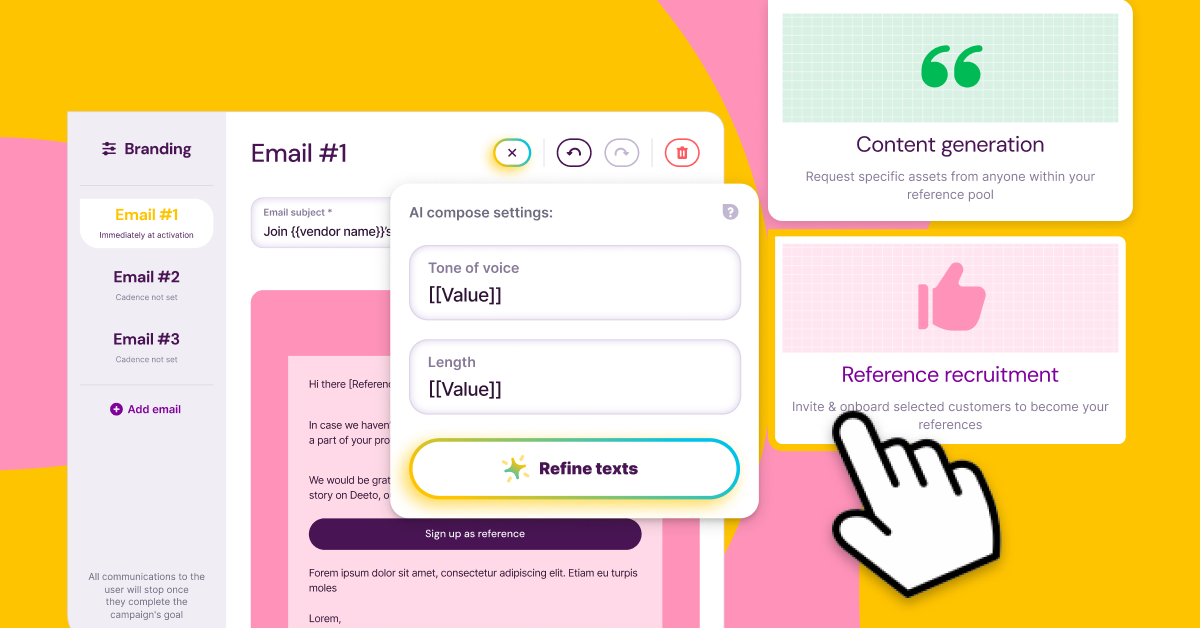
When you understand how customers actually talk about your product, it's easier to mirror that language in your messaging. That means sharper positioning, better copy, and campaigns that use the words real buyers use instead of the words marketing assumes they use.
Sales teams benefit too. VoC intelligence helps reps handle objections with real customer language instead of guesswork, and turns feedback into proof they can bring into a deal instead of a generic case study PDF.
Sometimes, your customers will reveal use cases or needs you didn’t realize your product could solve. These are golden opportunities — not just for new features, but possibly new offerings, markets, and competitive positioning.
In your VoC data, look for those outlier comments or recurring “It would be great if…” moments. Those point to areas where you can create add-ons, premium tiers, cross-sells, or spin-off solutions that align with your customers’ evolving needs.
By the time a customer cancels, it's usually too late. But the warning signs, frustration, complaints, waning engagement, show up earlier if you're actually listening. A well-timed check-in call or product tutorial, triggered by churn risk signals, can turn a quiet dropout into a saved account.
To lay the groundwork for a successful strategy, there are four important steps you need to take when setting up your VoC program:
You need to know what you’re listening for. Otherwise, you’ll end up with a bunch of data and no clear direction. Goals give your VoC program purpose.
Start by asking: What are we trying to improve? Are you trying to reduce churn? Improve a product feature? Nail your brand messaging?
Once you have clarity, define measurable goals (like improving CSAT by 10% or increasing trial-to-paid conversion). These goals guide everything else, from what questions you ask to which channels you focus on.
Not all feedback carries the same weight, and different customers have different needs. To understand who you’re hearing from and make sure you’re acting on insights that actually matter to your business strategy, your second step is to segment your audience.
Build personas that reflect these groups and their goals. Then tailor your questions and analysis accordingly. That way, you avoid treating all feedback as one-size-fits-all and start making decisions that are laser-focused on specific customer groups.
You need both the right channels and the right timing to get meaningful, actionable feedback. If you’re only using surveys, you’re missing the bigger picture.
The best approach is to mix methods:
You’ll want a blend of quantitative data (scores, trends) and qualitative insights (comments, conversations). Together, they give you both the “what” and the “why.”
Data spread across tools and teams is noise. You need one source of truth that turns scattered input into clear insights.
Use a centralized platform for capturing customer knowledge and feedback (like Deeto), or a CRM-integrated solution that pulls in feedback from all your channels. Tag and categorize data, then analyze it on a regular basis to find trends, flag issues early, and continuously refine based on what customers are telling you.
Like I mentioned, tapping into the Voice of the Customer requires a healthy mix of quantitative and qualitative data from a variety of sources.
Broadly speaking, there are five categories of customer feedback to use:
These are your workhorses. They’re scalable, structured, and perfect for capturing specific feedback at key moments (like post-purchase or post-support interactions).
Ideally, keep them short and focused. Ask both quantitative questions (“On a scale of 1–10…”) and open-ended ones (“What could we have done better?”).
Tools like Typeform, Google Forms, or SurveyMonkey make it easy.
Pro tip: Personalize surveys based on customer segment or journey stage to keep things relevant.
This is where you go deeper.
Interviews let you explore emotions, behaviors, and underlying motivations you won’t uncover in a form. To avoid bias, start by choosing a diverse sample of customers and create a relaxed environment where they can be candid. Ask open-ended questions and actively listen.
Focus groups are great for getting multiple perspectives at once and watching how ideas bounce around. They're gold for product development, UX research, and branding insights.
Social platforms are an unfiltered feedback channel; people say what they really think about your brand and product, in real time.
Use tools like Brandwatch, Hootsuite, or Sprout Social to monitor brand mentions, hashtags, and sentiment. Pay attention to trends, complaints, praise, and what they're saying about competitors.
Reviews are unsolicited, brutally honest, and loaded with insights about what people value most. They also highlight emotional drivers that formal feedback might miss. Track your reviews on platforms like Google, G2, Yelp, or whichever platforms are relevant to your industry.
Look for patterns in language, tone, and specific features being mentioned. High ratings tell you what to double down on. Low ones? They’re a free roadmap for improvement.
People usually reach out when they’re stuck, confused, or frustrated. So, your support inbox shows you in real time where your points of friction are.
Analyze tickets, chat logs, call transcripts, and feedback forms. Tag and categorize issues by type, frequency, and sentiment. Better yet, loop your support team into the VoC process, since they’re on the front lines and know what’s bothering customers through first-hand experience.
Tracking the right KPIs helps you connect feedback to action and measure whether your efforts are actually making a tangible impact.
Here are seven key metrics you’ll want to keep an eye on:
Your VoC strategy is where the rubber meets the road. To create a structured, repeatable process that ties customer feedback directly to business outcomes, there are five key steps to follow:
Start by identifying your core strategic objectives. Are you trying to break into a new market? Reduce churn? Improve onboarding?
Once you’ve nailed those down, Deeto simplifies feedback collection by allowing your customers to share it directly. When you invite them to the platform, they instantly become part of your knowledge base.
Not all feedback carries equal weight. Feedback from a high-LTV or long-time customer might reveal deeper loyalty drivers or critical gaps, especially if they're aligned with your ICP. Segment insights so you’re not optimizing for edge cases or low-impact voices.
Also pay close attention to patterns. If 20% of your customers flag the same issue, that’s probably a high-impact opportunity.
Analyze the data to uncover trends, root causes, and opportunities. Group comments by themes (e.g. pricing, usability, support) and tie them back to your goals. Then create clear, specific recommendations your team can act on — for example, “redesign the signup flow to reduce confusion” instead of “people are getting stuck.”
Work with Product, Marketing, Support, and Ops teams to turn insights into roadmap items, experiments, or process improvements. Set timelines, assign ownership, and track progress for each.
Small changes (like updating onboarding emails) can be quick wins, while larger changes (like building a new feature) need more planning, but both matter.
In VoC, active listening also means you respond. You acknowledge the feedback, you act on it, then you let customers know you've implemented a solution. One way to do this is to send an email saying “You asked, we listened," highlighting what’s new and thanking them for their input.
With Deeto, knowing who is responsible for which feedback is easy because everything is tagged by name and segment. It also integrates with your CRM, so you can reach out directly to the customers who gave feedback without having to manually search for their contact information.
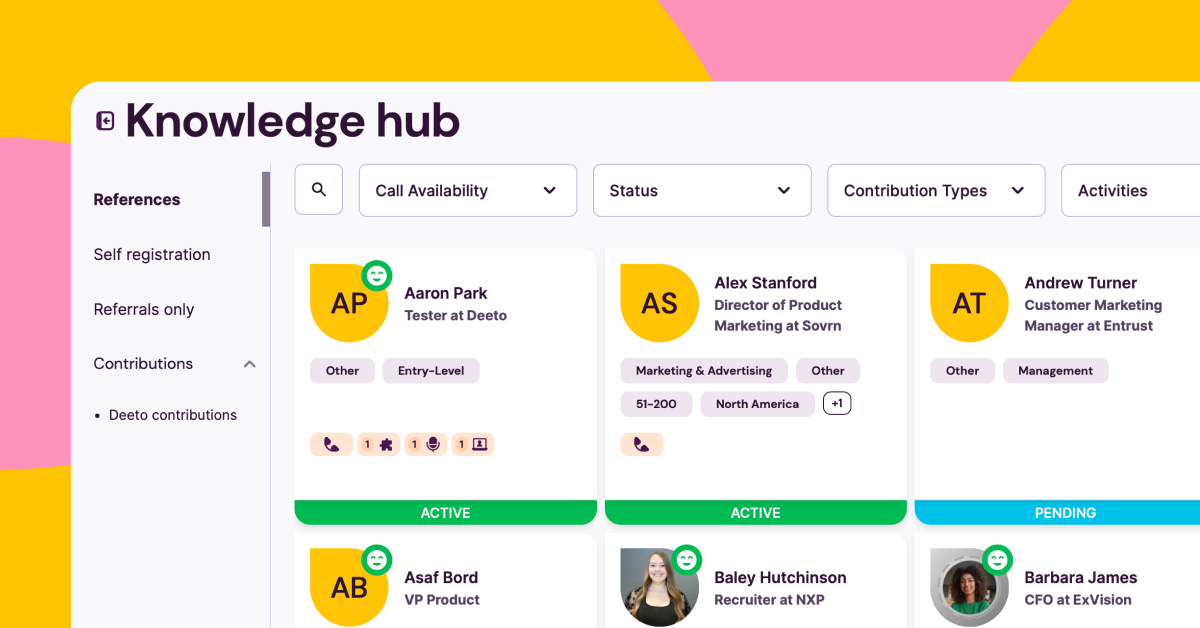
Buyers used to ask a sales rep what other customers thought. Now they ask an LLM, and the LLM answers with whatever third-party proof it can find: reviews, forum threads, comparison pages, cited customer quotes.
That shifts what VoC needs to produce. A survey score that lives in an internal dashboard has zero visibility to an AI Overview or a Perplexity answer. A published customer story, a G2 review, a cited stat with a named source, all of that is extractable. The companies winning in AI search treat customer voice as public-facing proof, not just an internal feedback loop.
The problem isn't collecting customer feedback. The problem is connecting it to decisions, and increasingly, to the answers AI engines give your buyers before they ever talk to sales.
Timing, application, and analysis make the difference between “meh” insights and truly actionable ones. To implement the steps I've mentioned above, there are a few important best practices to keep in mind:
Even with those best practices, you'll probably run into four main issues when you're implementing and scaling your VoC program:
Let's take a closer look at some possible solutions to these issues:
One of the biggest challenges for VoC programs is getting enough responses to make the data statistically significant.
Increase your response rates:
A platform like Deeto makes things easier because customers leave their knowledge and insights directly within the app, and it's as easy as making an Instagram post.
Open-ended feedback, reviews, and support tickets pile up fast—and it’s hard to make sense of them manually.
The solution here is to use AI-powered text analytics or sentiment analysis tools, which can help you categorize, tag, and analyze the feedback at scale. Build a tagging system or feedback taxonomy to organize themes, then routinely extract the top 3–5 insights per channel to stay focused.
When internal processes move slow, the insights customers give you lose momentum.
To fix this, assign VoC "owners" in each department who can triage and route feedback for particular categories. For instance, at-risk customers can be routed to Customer Success while major bug reports can go to your Product team.
Maybe you collect great insights but struggle to apply them to personalized marketing, onboarding, or product experiences.
If you tie VoC data to your CRM or customer profiles, you can use the feedback to build smart segments (e.g., “frustrated new users,” “loyal customers who want X feature”). From there, customize content, offers, or product flows based on that segmentation.
You can use Deeto's AI-powered segmentation tools to curate and suggest the most valuable content for each specific use case or customer interaction.
What is Voice of the Customer (VoC)?
Voice of the Customer is the systematic process of collecting, analyzing, and acting on customer feedback and behavior across channels like surveys, reviews, support tickets, and interviews. It's proactive and ongoing, not a single survey or score.
What's the difference between Voice of the Customer and customer satisfaction?
Customer satisfaction measures a single moment, usually right after a purchase or support interaction, using metrics like CSAT or NPS. VoC is broader and ongoing. It gathers insight on behavior, pain points, and expectations from multiple sources over time to explain why customers feel the way they do.
What are the main methods for collecting VoC data?
The five core methods are surveys and questionnaires, interviews and focus groups, social media listening, customer reviews and ratings, and feedback from support channels. Strong programs combine several of these rather than relying on one.
What KPIs measure VoC program success?
The most common are NPS, CSAT, Customer Effort Score, feedback volume and response rate, sentiment trends, churn and retention rates, and the rate of product or service improvements traced back to customer feedback.
How does Voice of the Customer connect to AI search visibility?
Buyers increasingly ask AI tools like ChatGPT and Perplexity to compare vendors before talking to sales, and those tools cite third-party proof like reviews and customer stories. VoC programs that publish feedback publicly, not just internally, become source material those AI engines can find and cite.
How do I get started with a VoC program if I don't have one yet?
Start by setting one measurable goal (like reducing churn by X% or improving CSAT by 10 points), pick two or three collection methods that fit your customer base, and centralize the data in one place from day one so it doesn't end up scattered across tools before you've even started.
VoC isn't a program you run once a quarter. It's the system that should power your growth, retention, and go-to-market motion continuously.
Deeto helps teams collect, organize, and activate authentic customer voice, so the same feedback that improves your product also becomes proof your sales team can use and content your buyers find when they ask an AI engine for a recommendation. Customers choose how they want to contribute, whether that's a quick survey, a recorded interview, or a review, so you get input from a wider range of voices than a single feedback form ever could.
Request a demo to see how it works.

Learn what Voice of the Customer (VoC), how it works, key methods, best practices, and strategies to improve growth.
Overview:
The signals that could improve your win rate, protect retention, and sharpen your forecast are already inside your organization. This guide shows revenue leaders how to connect authentic customer voice to every stage of the revenue motion and put a number on what that's worth.
Spotlight:
Inside, you'll find a numbers-first playbook built for CROs, RevOps leaders, and sales teams who need to justify the investment and understand the return. See how structured win/loss programs deliver 5 to 15% higher win rates, how continuous listening drives 15 to 25% higher renewal rates, and why a conservative model for mid-market B2B teams shows a 4x to 8x return within 12 months.
What to Expect:
Why It Matters:
Your customers are generating signals in every conversation, every renewal, every deal debrief. When those signals are connected and orchestrated, they become the intelligence that improves forecasts, accelerates pipeline, and protects revenue. That's what customer orchestration delivers.
Download the guide and turn customer voice into your most predictable growth lever.

The revenue intelligence you need already exists. This guide shows you how to put it to work.
Overview:
Product marketers sit at one of the most valuable intersections in a B2B company. But when customer voice lives in five different systems and case studies take six weeks to clear legal, that advantage gets lost. This guide makes the quantitative case for treating Voice-of-Customer as a strategic infrastructure investment.
Spotlight:
Inside, you'll find a numbers-first playbook built for CROs, RevOps leaders, and sales teams who need to justify the investment and understand the return. See how structured win/loss programs deliver 5 to 15% higher win rates, how continuous listening drives 15 to 25% higher renewal rates, and why a conservative model for mid-market B2B teams shows a 4x to 8x return within 12 months.Inside, you'll find a numbers-first framework built for PMMs who need to prove revenue contribution and build the business case for orchestration. See how consolidating customer voice reduces redundant research spend by up to 75%, how activating customer evidence at the right deal stages delivers a 5 to 15% win rate lift, and why a conservative model for mid-market B2B teams shows a 3x to 8x return within 12 months.
What to Expect:
Why It Matters:
Customer voice is already your most powerful go-to-market asset. This guide shows you how to build the system that makes it work across every stage of the revenue cycle.
Download the guide and turn customer voice into your most measurable competitive advantage.

This guide shows product marketers how to turn customer voice into measurable revenue impact.

See how Deeto helps you turn customer voice into a GTM advantage.