What is Employee Advocacy? How it Differs From Customer Advocacy



Monday, November 23, 2026


What is Employee Advocacy? How it Differs From Customer Advocacy


View the podcast on Youtube

Your sales team's LinkedIn posts can reach thousands of buyers this week. Those buyers will still want to hear from someone who doesn't work for you before they sign.
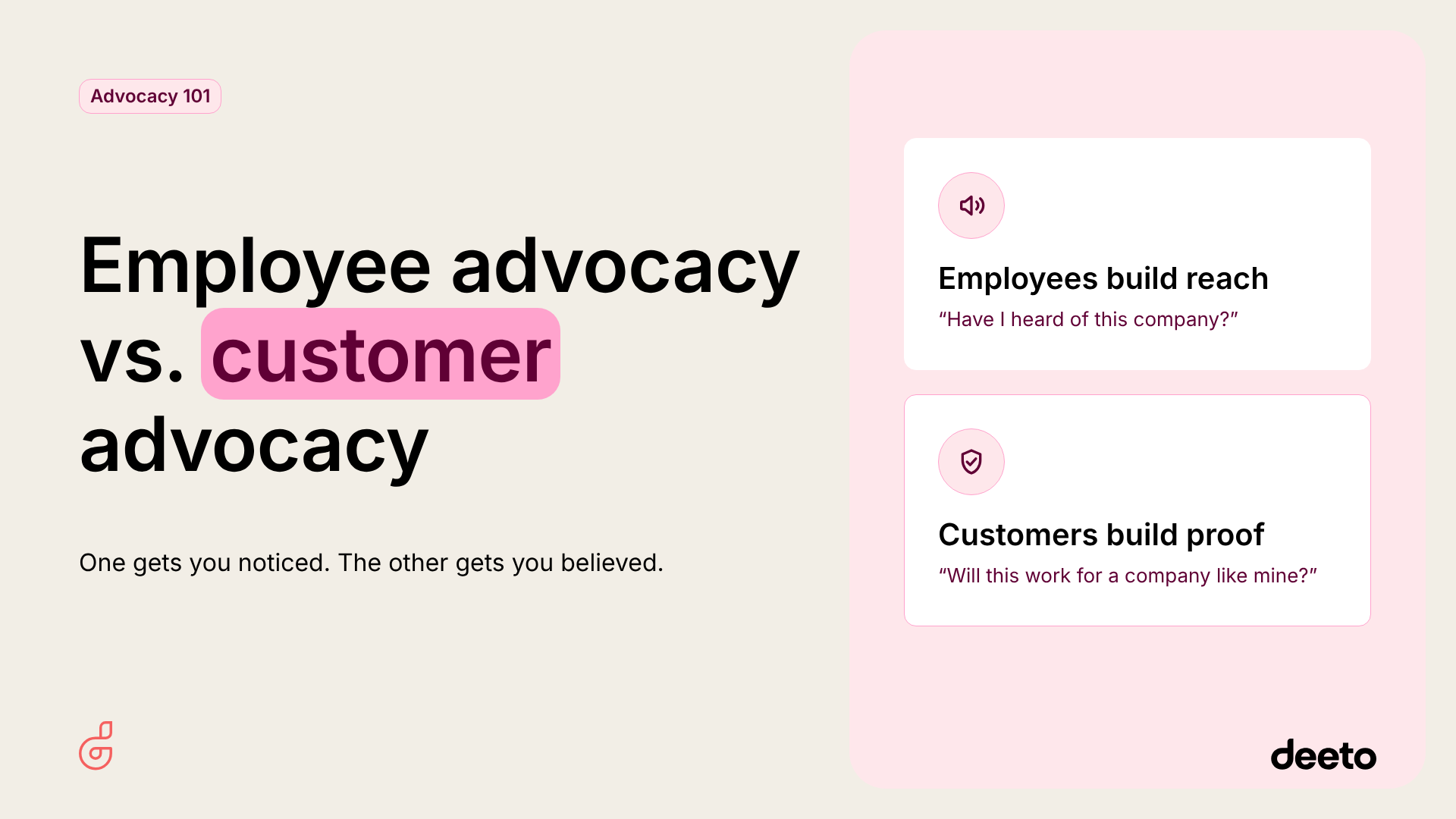
So what is employee advocacy? Employee advocacy is the practice of employees sharing their company's content, news, and expertise through their own professional networks, mostly on LinkedIn. Customer advocacy is when existing customers vouch for you through references, reviews, case studies, and peer calls. Employee advocacy grows reach, and customer advocacy supplies proof.
Here's how the two programs differ, what each kind of case study really measures, and how customer marketing teams decide where to spend.
What is employee advocacy?
Employee advocacy is a marketing program in which employees share company content, product news, and their own expertise on their personal social channels. The company supplies the material. Employees add their voice and post it to networks the brand page can't reach on its own.
Employee advocacy programs often run on LinkedIn and use a sharing tool that queues approved posts, tracks clicks, and ranks participants. Social, brand, or employer brand teams usually own them.
Employee advocacy includes:
- Employees resharing company posts, blog articles, and product launches
- Original posts from subject matter experts and executives
- Recruiting and employer brand content
- Event promotion and live commentary from conferences
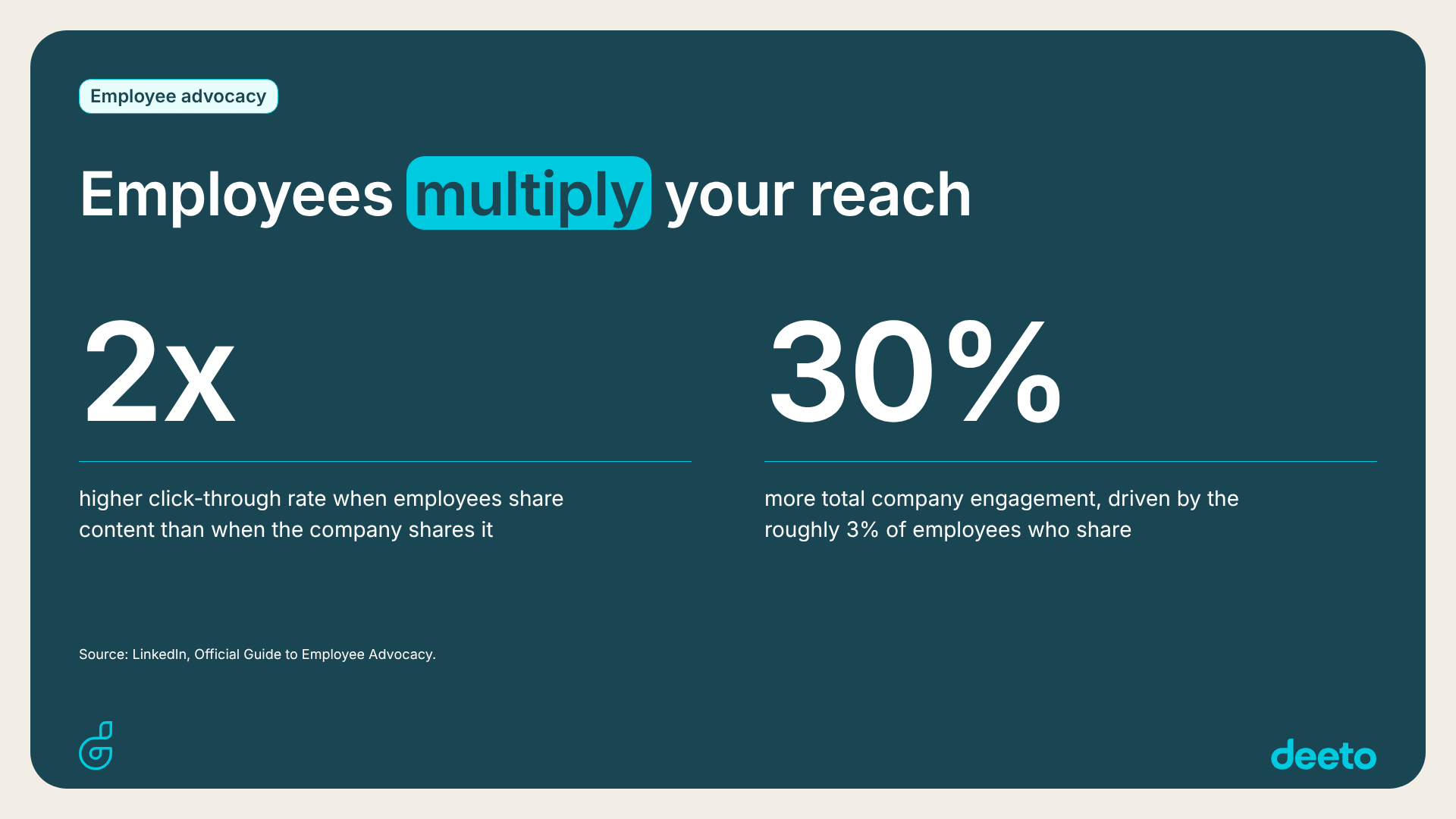
The reach math holds up. LinkedIn's Official Guide to Employee Advocacy reports that content shared by employees earns a 2x higher click-through rate than the same content shared by the company. It also found that the roughly 3% of employees who share company content drive a 30% increase in the total engagement a company sees.
That data tells you what employee advocacy is: a distribution channel. People click because they know the person posting. They also know that person gets paid by the vendor, and that's where an employee post stops carrying weight in a buying decision.
What is customer advocacy?
Customer advocacy is the practice of turning satisfied customers into public and private voices for your company. Advocates take reference calls, write reviews on G2 and TrustRadius, appear in case studies and video testimonials, speak at events, and refer peers.
A customer advocacy program includes the systems to find those customers, ask at the right moment, track what each one has done, and thank them in a way they value. In B2B, customer marketing usually owns it, and sales and customer success are the biggest consumers of what it produces.
Customer advocacy works because the speaker gains nothing from your sale. A peer at a similar company describing how their rollout actually went carries weight that no employee post can match, however good the post is.
Customer advocacy vs. employee advocacy: the key differences
Both programs ask people to speak on your behalf. The difference is who is speaking, why the audience believes them, and what that belief is worth to a deal.
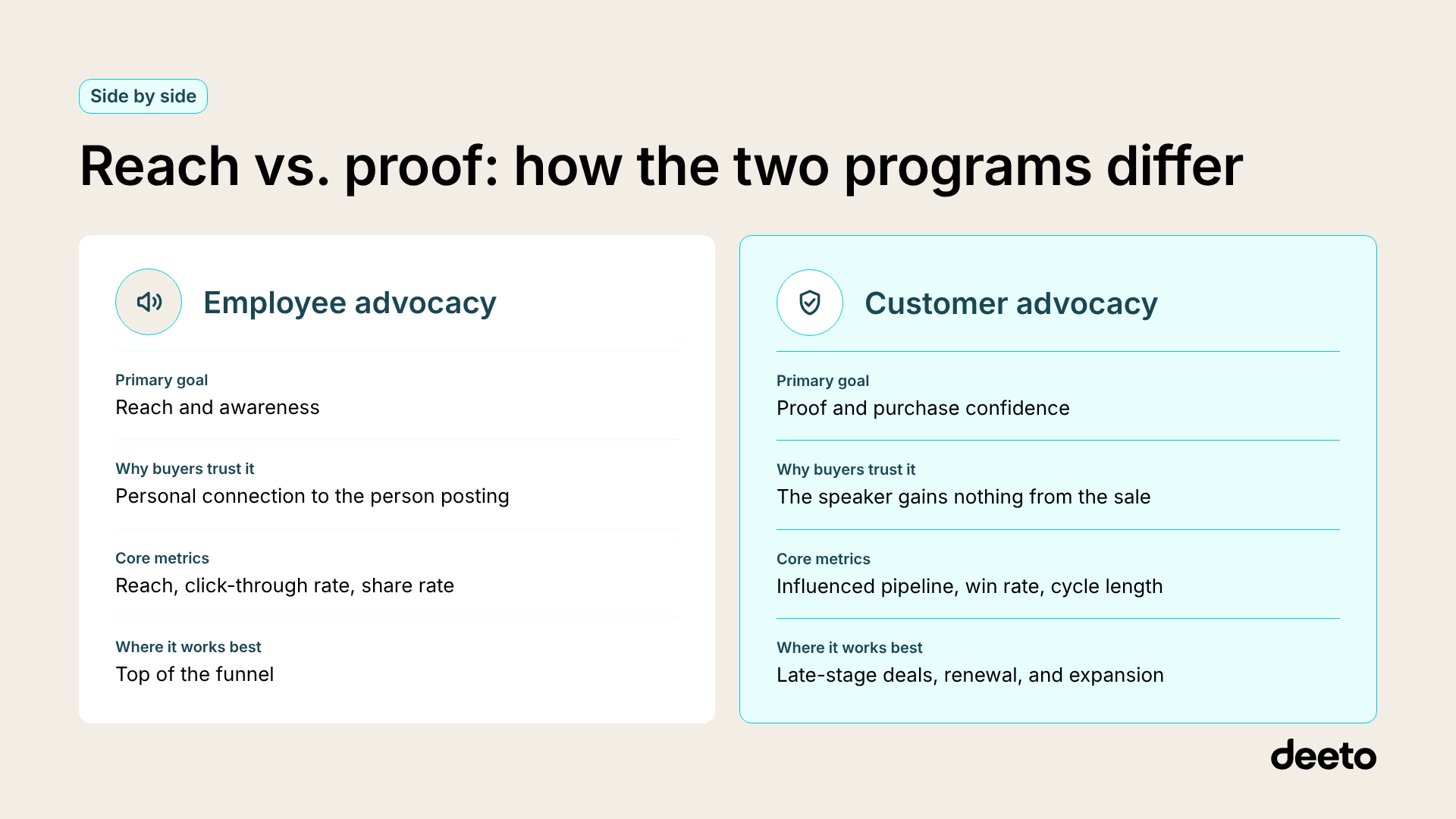
The cleanest way to separate them is by the question each one answers for a buyer. Employee advocacy answers "Have I heard of this company?" Customer advocacy answers "Will this work for a company like mine?"
A few differences matter most when you're planning budget:
- Credibility: Employee voices borrow trust from personal relationships. Customer voices earn it by having nothing to gain.
- Funnel stage: Employee advocacy does its best work at the top of the funnel. Customer advocacy shows up in late-stage deals, renewals, and expansion.
- Measurement: Employee programs report reach and engagement. Customer programs can report influenced pipeline, win rate, and cycle length when they're connected to the CRM.
What employee advocacy case studies measure, and what they leave out
If you've searched for an employee advocacy case study, you've probably noticed a pattern. Published examples report impressions, engagement rate, share counts, follower growth, and sometimes site traffic or job applicants from employee posts. Those are fair numbers for a distribution program.
Revenue tied to specific deals rarely appears. That gap reflects what employee advocacy is built to do, which is to get attention.
A customer case study works differently. The case study is itself an advocacy asset, a named customer putting their reputation behind a result. Strong customer advocacy programs track that asset after it's published: which reps sent it, which deals it touched, and whether those deals closed faster.
For a customer marketing leader, that difference shows up in every budget review. Employee advocacy reports activity, while customer advocacy can report revenue. If you're building a case study library, our guide to customer stories and social proof covers the formats sales teams actually send.
Why B2B buyers trust customers over vendors
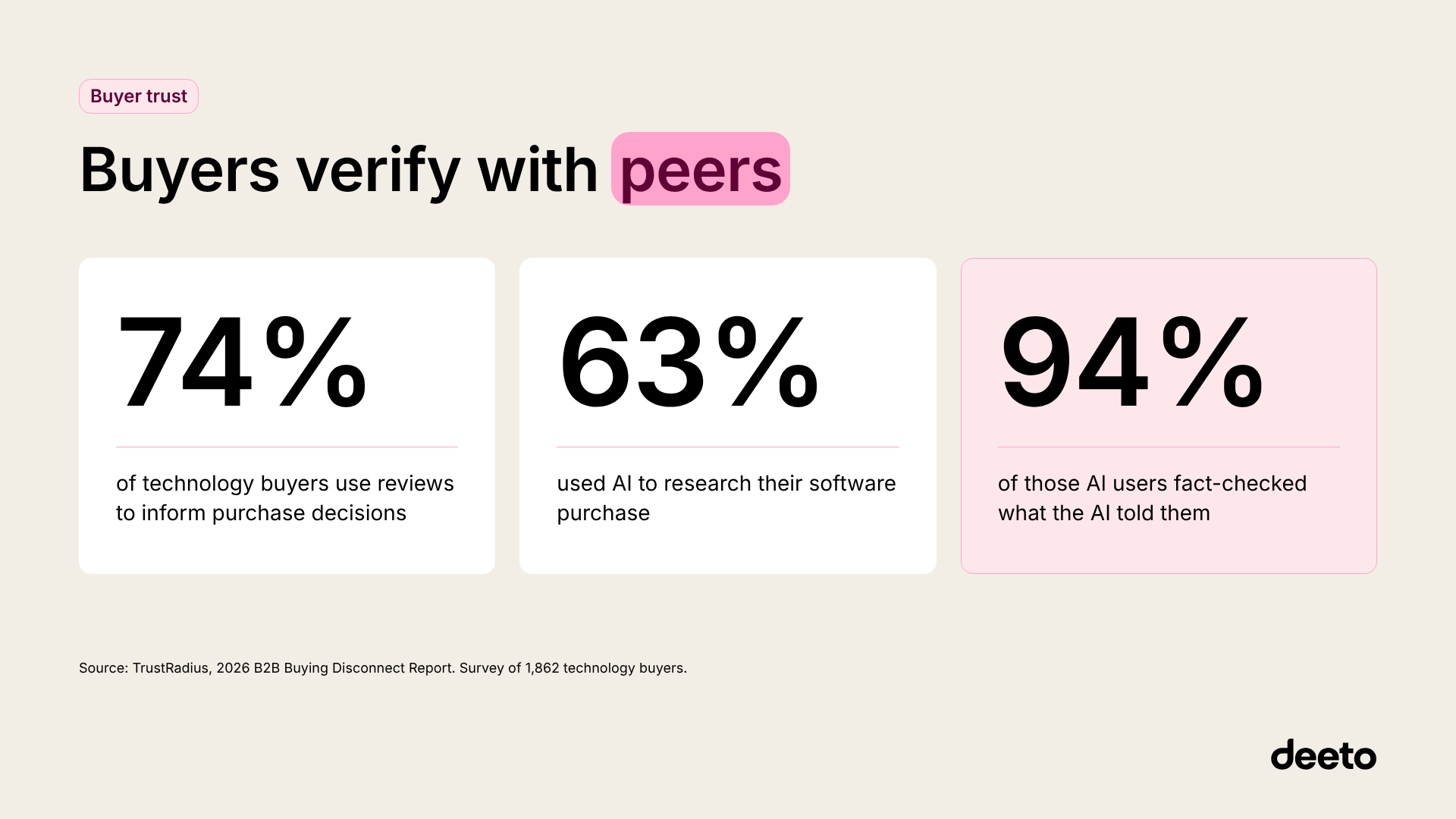
TrustRadius surveyed 1,862 technology buyers for its 2026 B2B Buying Disconnect Report. It found that 74% of buyers use reviews to inform purchase decisions. It also found that 63% used AI to research their software purchase, and 94% of them fact-checked what the AI told them.
Read those numbers together and the job of customer advocacy gets bigger. AI assistants are now an early stop in research, and buyers check those answers against reviews and peers. The customer voice you collect shows up twice, once in what the AI says and again when the buyer verifies it.
Vendor-side voices, employees included, are exactly what buyers are trying to verify. That's why a reference call or a recent review often moves a stalled deal when one more employee post won't.
Buyers already know your employees like you. What they want to know is whether your customers do.
When to invest in employee advocacy vs. customer advocacy
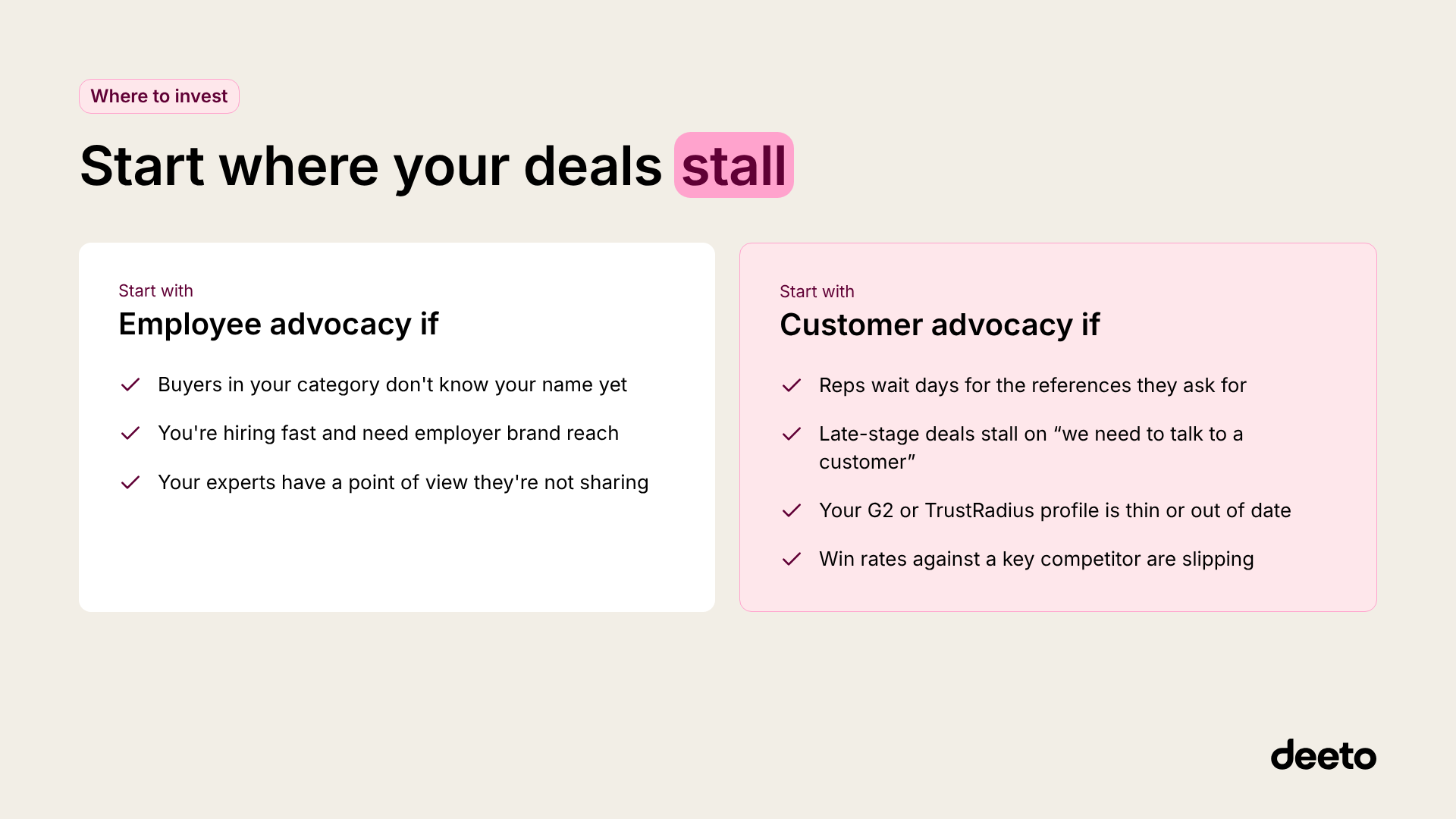
B2B teams need both eventually. The order depends on where deals are getting stuck.
Start with employee advocacy if:
- Buyers in your category don't know your name yet
- You're hiring fast and need employer brand reach
- Your executives and experts have a real point of view they're not sharing
Start with customer advocacy if:
- Reps ask for references every week and wait days to get them
- Deals stall in late stages with "we need to talk to a customer"
- Your G2 or TrustRadius profile is thin or out of date
- Win rates against a specific competitor are slipping
For a sales-led B2B company, the second list usually shows up first. Awareness problems are visible and loud. Proof problems hide inside the pipeline as longer cycles and quiet losses.
How customer and employee advocacy work together
The two programs get stronger when you connect them. When a new customer story goes live, give employees the post. They share a customer's words instead of the company's claims, so the reach comes from your team and the credibility comes from your customer. Get the customer's sign-off on social sharing when you collect the story so nobody has to chase approval later.
The connection runs the other way, too. Customer success managers and account executives know which customers are happiest. Ask them to nominate advocates, and your employee base becomes the scouting network for your customer program.
Both programs sit under the wider umbrella of brand advocacy, which also includes partners and influencers. If you're designing the full model, see how to structure brand advocacy programs that cover every group.
How to build a customer advocacy program that lasts
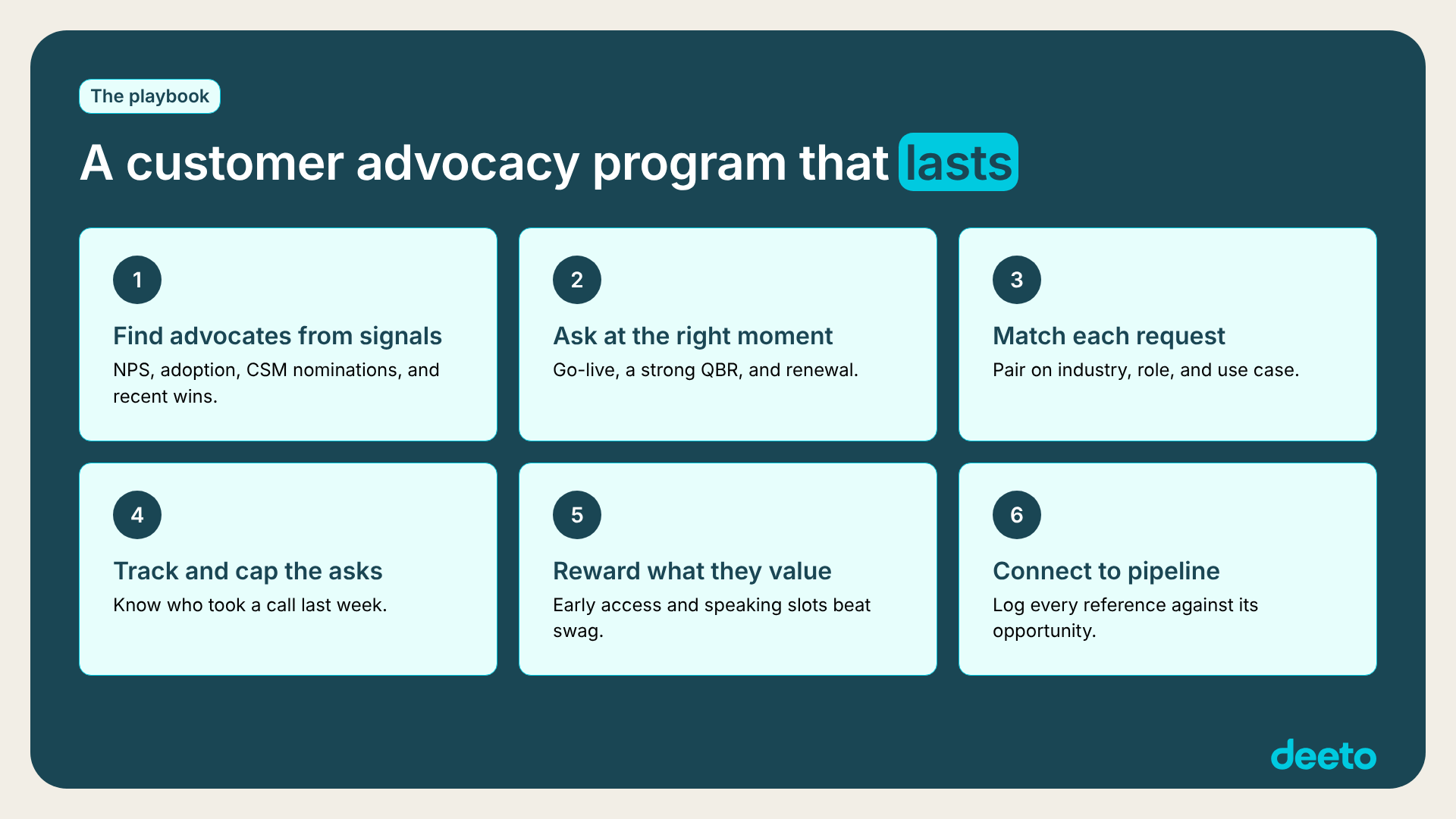
Customer advocacy programs often run into the same problems. The same five advocates get every request, and eventually they stop answering.
- Find advocates from signals. Use NPS responses, product adoption, CSM nominations, and recent wins to build the list, so you're not relying on memory.
- Ask at the right moment. Go-live, a strong quarterly business review, and renewal are natural points to ask.
- Match each request to the right advocate. A healthcare CFO wants to talk to another healthcare finance leader. Reference management should match on industry, role, and use case.
- Track every contribution and cap the asks. Know who took a call last week before you send another request.
- Reward advocates in ways they value. Early product access, speaking slots, and customer rewards all work better than generic swag.
- Connect advocacy to pipeline. Log every reference and asset against the opportunity it supported.
For a step-by-step version of the reference side, read how to build a customer reference program.
This is the work Deeto was built to take off the spreadsheet. Deeto is a voice of the customer platform that captures what customers say, organizes it in one system of record, and puts the right reference, story, or review in front of a rep when a deal needs it. Customer marketing teams use Deeto to let advocates onboard themselves, set how often they want to help, and earn rewards, while every contribution is tracked back to the deal it supported.
The payoff lands with sales teams. Deeto customers report 20–30% faster sales cycles and 10–15% higher win rates when customer proof is ready the moment a buyer asks for it.
Key takeaways
- Employee advocacy is employees sharing company content through their personal networks. It builds reach and awareness.
- Customer advocacy is customers vouching for you through references, reviews, case studies, and referrals. It builds proof and purchase confidence.
- Employee advocacy case studies measure impressions and engagement. Customer advocacy can be measured in pipeline, win rate, and cycle length.
- B2B buyers verify vendor claims with peers and reviews, so customer voice carries more weight late in the deal.
- The strongest programs connect the two, with employees amplifying customer stories and nominating new advocates.
Conclusion
If you came here asking what is employee advocacy, the short answer is reach. Employee advocacy and customer advocacy both put people between your brand and your buyer. Employees get you noticed, and customers get you believed. If you're a customer marketing leader deciding where the next dollar goes, look at where deals stall. If buyers have never heard of you, start with your team. If they've heard of you but won't commit, they're waiting to hear from someone like them.
See how Deeto puts that customer voice into every deal.
FAQs
What is employee advocacy in simple terms?
Employee advocacy is when a company's employees share its content, news, and expertise on their own social media accounts, usually LinkedIn. The company provides approved posts and material, and employees add their own voice. The goal is to reach people the brand page can't reach and to put a familiar face on company messages. It works best for awareness, recruiting, and thought leadership.
What is the difference between customer advocacy and employee advocacy?
The difference is who is speaking. In employee advocacy, your own staff promote the company, so the audience trusts the personal connection but knows the speaker is paid by you. In customer advocacy, existing customers vouch for you through references, reviews, and case studies. Customers have nothing to gain from your sale, which makes their voice more persuasive in late-stage buying decisions.
Is employee advocacy part of brand advocacy?
Yes. Brand advocacy is the umbrella term for anyone promoting a company voluntarily, and it includes employees, customers, partners, and influencers. Employee advocacy and customer advocacy are two of its most common programs. Most B2B companies run them separately because they have different owners, channels, and metrics, then connect them by having employees share customer stories.
What does an employee advocacy case study usually include?
An employee advocacy case study usually reports reach and engagement results, such as impressions, click-through rate, share rate, follower growth, and website traffic from employee posts. Some include recruiting outcomes like applicant volume. Few tie results to closed revenue, because employee advocacy is a distribution channel. Customer case studies differ, since the case study itself is customer proof that sales teams use in deals.
How do you measure a customer advocacy program?
Measure customer advocacy by its effect on revenue and by the health of your advocate base. Revenue metrics include reference-influenced pipeline, win rate on deals that used customer proof, and sales cycle length. Program metrics include active advocates, requests fulfilled, response time, review volume, and how often each advocate is asked. Connecting the program to your CRM makes the revenue side measurable.
Should a B2B company run both employee and customer advocacy?
Most B2B companies benefit from both, but not necessarily at the same time. Start with employee advocacy if awareness is the main problem. Start with customer advocacy if deals stall in late stages or reps struggle to find references. Once both exist, connect them so employees amplify customer stories and help nominate new customer advocates.
🎉 Save your spot
Register for the event
Once your spot is secured, we’ll send your confirmation details.
Subscribe to our newsletter
Subscribe to receive the latest blog posts to your inbox every week.
By subscribing, you agree to our Privacy Policy
Subscribe to our newsletter
Get the latest news and updates from our team.
By subscribing, you agree to our Privacy Policy
Related posts

Best Customer Marketing Platforms for B2B Teams

Compare 9 customer marketing platforms for B2B teams, from advocacy and references to reviews, video, and community.

Win/Loss Survey Questions: What to Ask and Why
26 win/loss survey questions to ask buyers after won, lost, and no-decision deals, and what each answer tells you.

7 Best Influitive Alternatives & Competitors in 2026
Compare 7 Influitive alternatives & competitors and see which one fits your customer advocacy program.