Brand Advocacy Programs: What They Are and How to Build One That Works



Tuesday, July 7, 2026


Brand Advocacy Programs: What They Are and How to Build One That Works


View the podcast on Youtube

A brand advocacy program is a structured system for identifying your most enthusiastic customers and giving them real ways to promote your brand. No scripts. No pressure. Just customers who genuinely believe in what you've built and want to talk about it.
Most companies rely on ad spend to create awareness. Companies with strong advocacy programs let their best customers do it instead, and those customers do it more credibly than any campaign you could run.
What Is a Brand Advocacy Program?
A brand advocacy program is a formal system that identifies customers who already love your product and activates them as ambassadors, references, and content contributors. Brand advocacy programs give advocates structured ways to share their experiences: writing reviews, taking reference calls, creating testimonials, referring prospects, and publicly endorsing your product.
The key distinction from loyalty programs: loyalty rewards purchase behavior. Advocacy rewards influence. A customer who refers ten new clients is more valuable to your pipeline than one who simply renews and stays quiet.
Why Brand Advocacy Programs Matter for B2B
Word-of-mouth has always driven buying decisions, but in B2B it carries even more weight. Buyers talk to peers before they talk to salespeople. A review from a real customer in the same industry, role, or company size carries more credibility than any copy your marketing team writes about your own product.
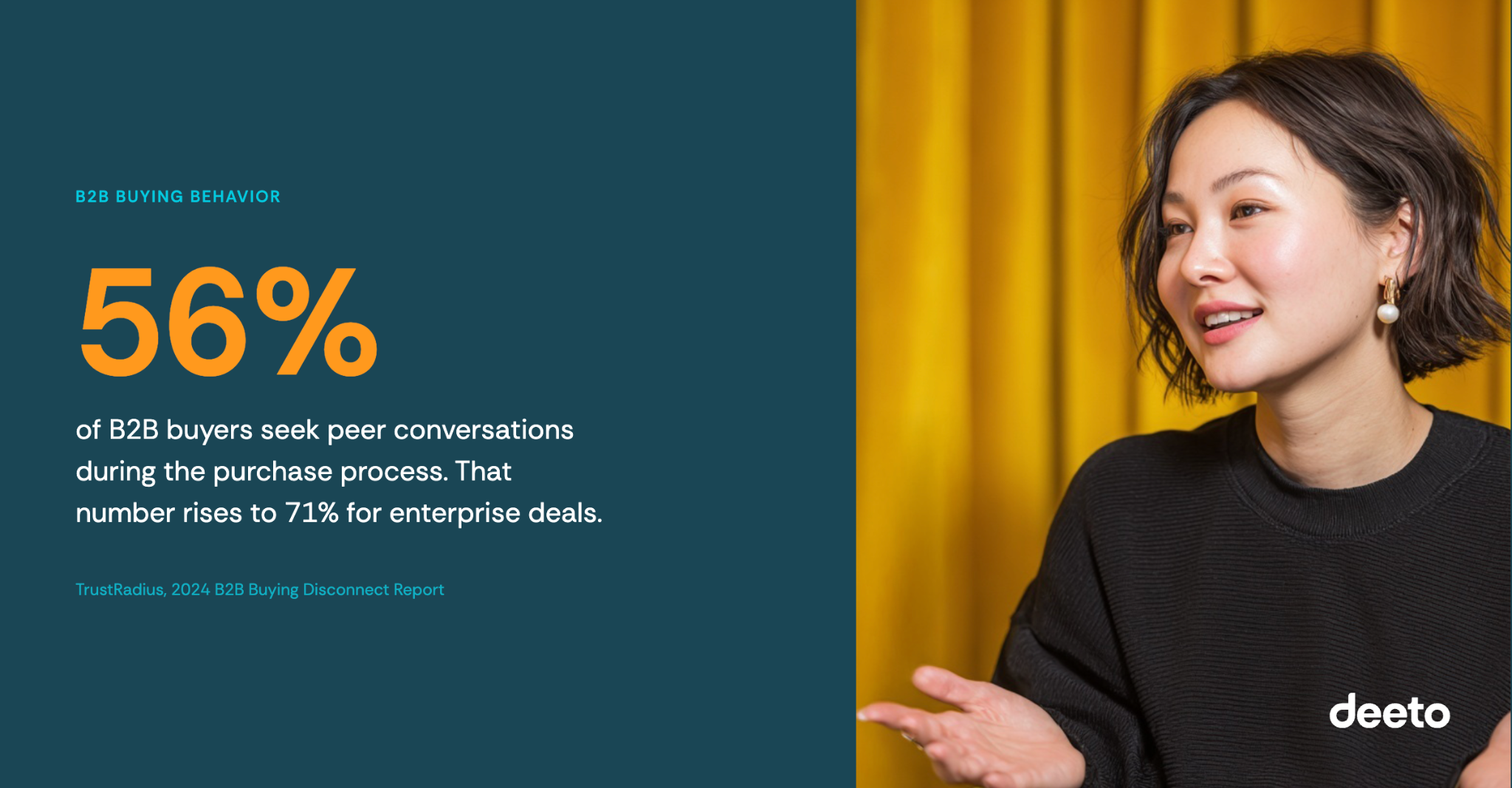
According to TrustRadius's 2024 B2B Buying Disconnect Report, 56% of B2B buyers seek peer conversations during the buying process. That figure rises to 71% among enterprise buyers, where a single reference call with a current customer can determine whether a deal closes.
The problem isn't that companies lack happy customers. It's that happy customers stay quiet while dissatisfied ones write reviews. A well-run brand advocacy program surfaces that satisfaction and puts it where buyers are looking.
What Makes Brand Advocates Different from Happy Customers
Not every satisfied customer is an advocate. Advocates share three traits.
High product affinity. They've gotten real value from your product, the kind that's hard to replicate with a competitor. Not just "it works." More like: "this changed how we run the function."
A willingness to be visible. Advocates are comfortable with their name, role, and opinion attached to a public statement. That's not everyone, and it can't be manufactured.
Alignment between their career success and your product. The best advocates are the ones whose professional outcomes are tied to results your product helped create. They don't talk about features. They talk about what changed.
Identifying these customers is the first step in any advocacy program worth running. It requires customer intelligence, not a ranked list of NPS scores. You need to understand what drove satisfaction, how deep it runs, and whether the customer has the visibility and credibility to move buyers in your target market.
That's where customer advocacy becomes a data problem as much as a relationship one.
The Core Components of a Brand Advocacy Program
Brand advocacy programs that work share a common structure. The components don't have to be complicated, but they do have to be connected.
Identification and segmentation. You need a repeatable way to find advocates, not whoever your CS team happens to have a good relationship with. That means pulling signals from NPS scores, product usage data, support ticket sentiment, and renewal patterns. Advocates are already in your customer base. The question is whether you have a system to surface them.
Activation and recruitment. Once you've identified potential advocates, give them something specific to do. "Would you be willing to talk to a prospect?" outperforms "Would you be willing to help us?" every time. Specificity moves people from interested to active.
Multiple participation options. Different customers want to contribute differently. Some will take reference calls. Some will write case studies. Some will join a community. Some will post on LinkedIn. A good advocacy program has enough tracks that advocates can choose their own level of engagement.
Recognition and reciprocity. Advocates give you something valuable. You need to give something back. That doesn't have to mean gift cards. Access to product roadmaps, direct time with your product team, early feature access, event invitations, and co-marketing opportunities are often more meaningful for B2B customers than discounts.
Matching the right advocate to the right moment. Having advocates doesn't help if you can't surface the right one at the right point in a sales cycle. A prospect asking about implementation complexity needs to hear from someone who overcame that exact challenge. That requires a searchable, segmented reference pool, not a spreadsheet that lives in someone's Google Drive.
Deeto's reference management infrastructure handles exactly this: keeping your advocate pool current, organized, and matched to the right opportunity when a deal needs it.
Brand Advocacy Program Examples Worth Learning From
The best B2B advocacy programs share one trait: they treat customer participation as a professional asset, not a favor. Here are three that do it well.
Salesforce Trailblazers is the most-cited example of advocacy done at scale in B2B. Salesforce built a community of certified power users who earn credentials, share expertise publicly, and become de facto product evangelists in their industries. The program works because participation has real career value: Trailblazer status opens doors. Advocates promote Salesforce because doing so advances their own professional standing. The lesson for any B2B advocacy program is that the best participation incentive is one that makes the advocate look good in their own market.
HubSpot's community champions program is more targeted but highly effective in revenue terms. HubSpot identifies customers who have achieved measurable inbound marketing results and activates them as speakers, case study subjects, and reference sources. The key design choice: HubSpot matches advocates to prospects by use case and company profile, not just by product tier. A prospect in professional services hears from a champion in professional services. The match specificity is what makes it convert.
What a well-run Deeto customer advocacy program looks like in practice: A customer success team identifies a customer in financial services who has significantly cut manual reporting time using Deeto's intelligence and activation workflows. That customer is added to the reference pool with tags for their industry, company size, use case, and persona. When a sales rep is working on a similar prospect and the deal stalls at the proof stage, Deeto surfaces that specific customer automatically. The rep requests a reference call. The deal moves. The whole sequence takes hours, not weeks, because the advocacy infrastructure is connected to the sales workflow rather than living in a spreadsheet someone has to manually search.
That last scenario is exactly what separates programs that generate revenue from programs that generate activity metrics.
The Deeto Advocacy Maturity Model
Most B2B companies fall into one of three stages when it comes to brand advocacy. Understanding where you are helps determine what to build next.
Stage 1: Reactive advocacy. Advocates are identified informally, usually by whoever on the CS or sales team happens to have a good relationship with them. Reference requests go through a single person. There's no searchable pool, no participation tracks, and no way to measure program ROI. Most companies start here. The problem isn't the lack of advocates, it's the lack of infrastructure to activate them consistently.
Stage 2: Structured advocacy. The company has a formal advocate identification process, a defined menu of participation options, and some kind of tracking for who has done what. Reference requests are managed centrally. There's a growing pool of case studies and reviews. The gap at this stage is activation: the advocate pool exists but isn't integrated into live sales and marketing workflows, so it gets used inconsistently and often too late in a deal cycle.
Stage 3: Integrated advocacy. Advocacy is connected to the CRM, the sales enablement stack, and the customer marketing calendar. The right reference is surfaced automatically at the right point in a sales cycle. Advocate health is tracked over time. New advocates are recruited continuously based on product signals and sentiment data. At this stage, advocacy stops being a program and becomes part of how revenue works.
Deeto is built to move companies from Stage 1 to Stage 3. The customer voice intelligence platform handles identification, activation, and integration in a single system rather than requiring five separate tools and a full-time program manager to hold it together.
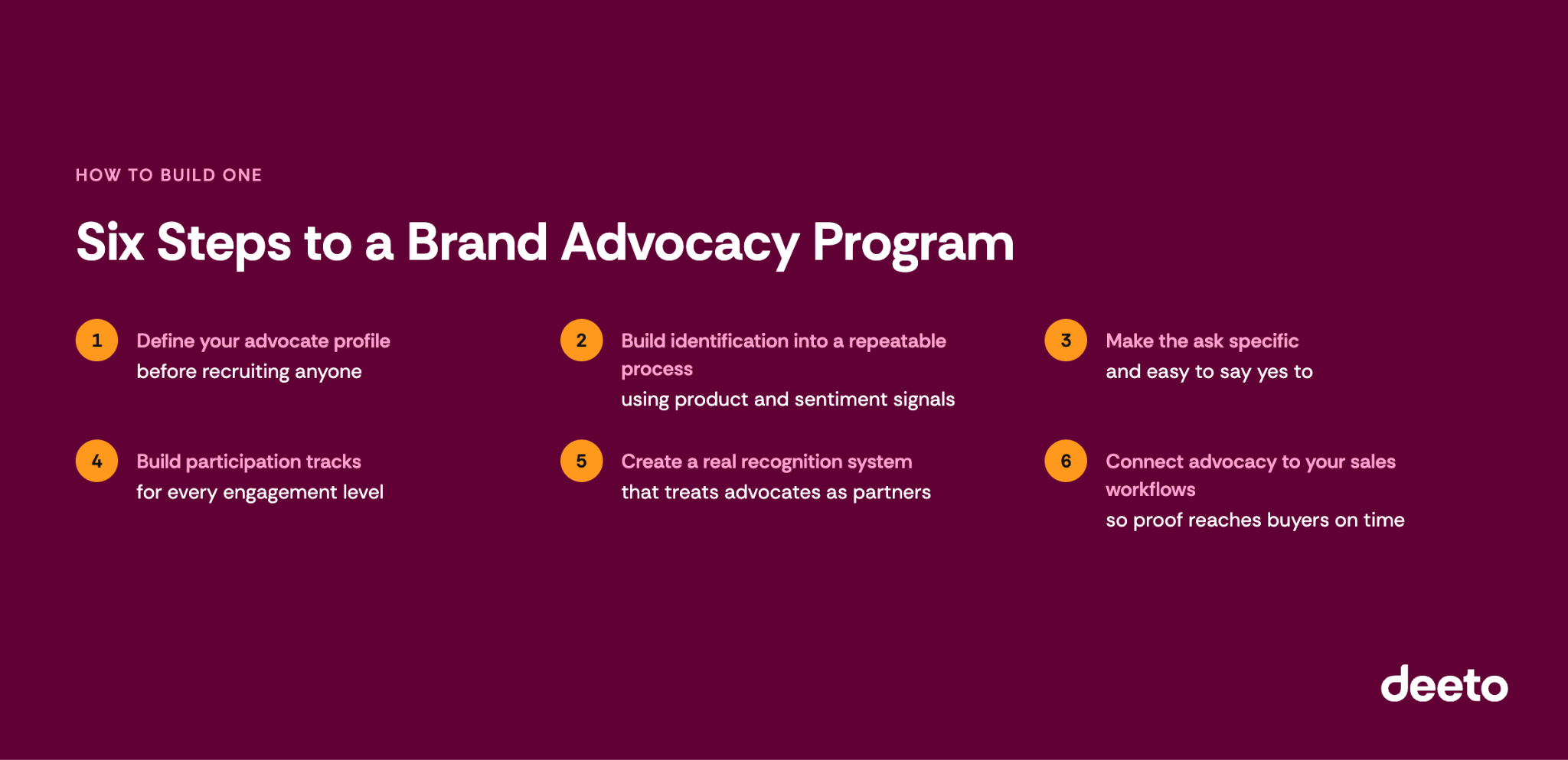
How to Build a Brand Advocacy Program: 6 Steps
1. Define what an advocate actually looks like for your business
Before recruiting anyone, define who you're looking for. Customers who've hit measurable ROI milestones? Customers in specific verticals? Customers who are active on LinkedIn or speak at industry events? The clearer your profile, the more targeted your identification becomes.
2. Build identification into a repeatable process
Set up signals that surface likely advocates on an ongoing basis. NPS scores above 8 are a starting point, but usage depth, expansion history, and renewal patterns tell a more complete story. You want a queue of warm outreach targets, not a once-a-quarter manual pull from the CRM.
Customer sentiment analysis tools can automate part of this, flagging customers whose recent interactions suggest high satisfaction before the moment passes.
3. Make the ask specific
Vague asks get ignored. "Would you be interested in joining our customer advocacy program?" lands nowhere. "Would you be willing to take a 20-minute call with a prospect evaluating a similar use case?" is something a person can say yes or no to. Start with the lowest-effort ask and build from there.
4. Build out participation tracks
Develop multiple levels of participation so advocates can choose what works for them:
- Review profiles on G2, TrustRadius, or Capterra
- One-on-one reference calls with prospects
- Case study participation, written or video
- Speaking at events or webinars
- Referral program participation
- Advisory board membership
Not every advocate wants to do all of these. A well-structured program makes it easy for them to do one or two things well and feel good about it.
5. Build a real recognition system
Track participation and acknowledge it. That doesn't mean a transactional reward for every action. It means treating advocates like partners in your business, not a resource to draw from. A thank-you from your CEO after a reference call costs nothing and lands harder than a $50 gift card. The advocates who stay in programs for years are usually the ones who feel like they're in a relationship with the company, not a vendor rewards scheme.
6. Connect advocacy to your sales and marketing workflows
An advocacy program only generates revenue when the right proof reaches the right buyer at the right time. That means integrating your advocate pool into your CRM, giving sales reps a way to request references without going through CS, and making it easy for marketing to source quotes, case studies, and testimonials on demand.
This is where most programs stall. The advocates exist. The system to activate them in live revenue workflows doesn't. Customer marketing teams that close this gap see consistent, measurable pipeline impact from their advocacy investments.
Common Mistakes That Kill Advocacy Programs
Treating advocacy as a campaign, not a function. Advocates churn like customers do. Programs that skip ongoing recruitment and relationship management lose their depth over time.
Over-indexing on reviews and ignoring reference conversations. Public reviews matter. But a live reference call at the right point in a sales cycle can close a deal that no number of G2 badges will move. Build both.
Building an advocate pool that doesn't match your buyer segments. A happy customer in a small company in the wrong vertical isn't useful if your target market is enterprise financial services. Your advocate pool should mirror the customers you're trying to win.
Burning out your best advocates. Customers who participate in a few activities a year stay engaged. Customers who get 12 requests in six months don't. Track usage and protect the advocates who carry the most weight.
Key Takeaways
- Brand advocacy programs are formal systems for identifying and activating customers who already believe in your product.
- In B2B, advocacy isn't just a marketing function. The right reference conversation at the right moment in a deal is one of the highest-ROI activities in your customer base.
- Programs that work have systematic identification, clear participation tracks, and real integration into sales workflows.
- Advocates are earned through customer experience, not incentives.
- Even a strong advocate pool generates nothing if there's no system to match the right customer to the right buyer at the right time.
Conclusion
Building a brand advocacy program is less about tactics than it is about infrastructure. The companies that do it well treat advocacy as part of how revenue works, not a CS team initiative with a Slack channel and a Google Form. They know who their advocates are, they keep that pool current, and they deploy it at exactly the moment a deal needs it.
If your customers are already generating results worth talking about, the question is whether you have the systems to capture that and activate it. Deeto is built to do exactly that. See how the customer voice intelligence platform works, or book a demo to see it in action.
Frequently Asked Questions
What is a brand advocacy program?
A brand advocacy program is a structured system that identifies your most satisfied customers and gives them clear ways to promote your brand. This includes reference calls, case study participation, review submissions, referrals, and speaking opportunities. Unlike loyalty programs that reward purchase behavior, advocacy programs are designed to activate customer influence and generate trust with prospective buyers.
How is a brand advocate different from a brand ambassador?
Brand ambassadors are typically contracted or formally hired to represent a brand, often with payment or long-term agreements. Brand advocates are genuine customers who promote a company because of real satisfaction with the product or service. In B2B, advocates are more credible with buyers precisely because their motivation is their own success, not compensation.
What types of activities do advocacy programs typically include?
Brand advocacy programs typically include: writing public reviews on platforms like G2 or TrustRadius, participating in reference calls with prospective buyers, contributing to written or video case studies, speaking at events or webinars, making referrals, and joining advisory boards or community programs. Effective programs offer multiple participation tracks so advocates can engage at a level that fits their time and comfort.
How do you identify potential brand advocates?
The most reliable signals are high NPS or CSAT scores, strong product adoption or usage depth, expansion or renewal history, positive comments in support interactions, and customer outcomes clearly tied to your product. Systematic identification, rather than relying on CS team relationships alone, produces a broader and more consistently engaged advocate pool.
How do you keep brand advocates engaged over time?
Engagement drops when advocates feel like a resource rather than a partner. The strongest programs keep advocates engaged through ongoing recognition, access to product roadmaps or executive teams, early feature previews, co-marketing opportunities, and by protecting advocates from overuse. Tracking participation and limiting requests per advocate per quarter is standard practice in high-performing programs.
What's the difference between a brand advocacy program and a customer reference program?
A customer reference program is specifically focused on connecting sales prospects with current customers who can speak to product performance in a peer conversation. Brand advocacy programs are broader, including marketing activities like reviews, testimonials, case studies, and event participation alongside reference calls. Many companies run both under the umbrella of a customer advocacy function.
🎉 Save your spot
Register for the event
Once your spot is secured, we’ll send your confirmation details.
Subscribe to our newsletter
Subscribe to receive the latest blog posts to your inbox every week.
By subscribing, you agree to our Privacy Policy
Subscribe to our newsletter
Get the latest news and updates from our team.
By subscribing, you agree to our Privacy Policy
Related posts

Call Intelligence Software That Spots Your Next Reference

What is call intelligence software? Learn how it scores every call automatically and surfaces advocacy-ready customers.

4 Ways To Leverage Social Proof In Marketing
What is social proof in marketing? Learn 4 ways to use reviews, stories, and advocacy to build buyer trust.

How to Build a Customer Testimonial Strategy That Converts
What is a customer testimonial strategy? Learn how to collect, structure, and activate proof that closes deals.