Best AI tools for customer engagement in 2026



Friday, July 3, 2026


Best AI tools for customer engagement in 2026


View the podcast on Youtube

The best AI tools for customer engagement don’t just collect information, they surface what buyers actually think, connect that thinking to decisions, and make sure the right evidence reaches the right people at the right moment.
AI-powered customer engagement tools are software platforms that use machine learning, natural language processing, and automation to capture, analyze, and activate customer voice across the full lifecycle. Done well, they replace reactive feedback programs with a continuous system that turns what customers say into what your company does.
This guide covers the top AI tools for customer engagement, what to look for when evaluating them, and how to build a stack that does more than report sentiment but actually drives decisions.
What AI tools for customer engagement actually do
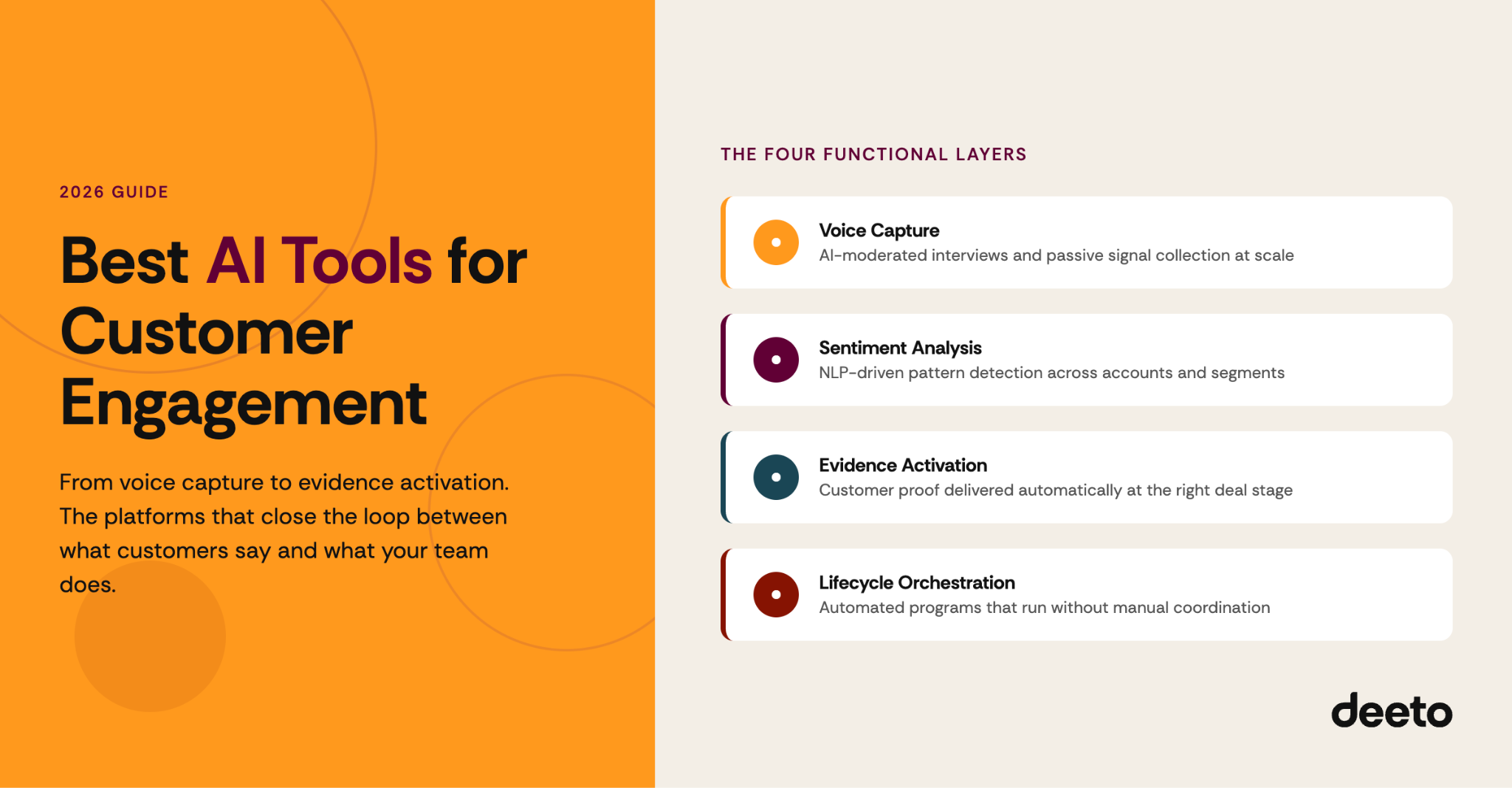
The category is broad, so it helps to be precise. AI customer engagement tools generally fall into a few functional areas.
- Voice capture
Voice capture is AI-moderated interviews, surveys, conversation analysis, and listening tools that collect qualitative and quantitative signals from customers at scale without requiring a research team to run every session.
- Sentiment and signal analysis
Sentiment and signal analysis is NLP-driven engines that classify customer language, detect patterns across accounts, flag churn risk, and surface what is changing before your team notices it manually.
- Evidence activation
Evidence activation takes what customers say and puts it to work: turning testimonials into sales proof, converting win/loss findings into messaging updates, feeding product feedback into roadmap decisions.
- Orchestration
Orchestration is the workflow layer that connects customer signals to team action, triggering reference requests, populating CRM fields, routing advocates to campaigns, or surfacing the right customer story at the right deal stage.
The strongest platforms handle more than one of these functions. The weakness of most legacy tools is that they stop at data collection and leave the activation gap open.
Why AI has changed customer engagement
A decade ago, customer engagement meant periodic surveys and a handful of reference calls managed through spreadsheets. Collecting a meaningful volume of qualitative customer input required dedicated research staff and weeks of scheduling.
AI changed the economics. Automated interview tools can run dozens of in-depth customer conversations simultaneously. NLP models can read thousands of support tickets, sales call transcripts, and review site submissions and pull out patterns in hours, not weeks. Recommendation engines can match the right customer story to the right sales conversation without a coordinator in the loop.
According to Salesforce's State of the Connected Customer (5th Edition), 88% of customers say the experience a company provides is as important as its products or services, up from 80% in 2020. That bar is hard to clear if you are working from survey results that are three months old.
The shift is not just about speed. It is about closing the loop between what customers say and what companies do. That loop has historically been broken at the activation step, where insights are collected, reports are generated, and nothing changes. AI tools that wire customer voice directly into workflows are the ones that move the needle.
The best AI tools for customer engagement by category
AI interview and voice capture tools
Deeto Listen
Deeto Listen runs AI-moderated customer conversations that capture both structured and open-ended input at scale. Rather than scheduling human-led interviews for every customer segment, teams deploy AI interviews that adapt based on customer responses, probe on notable answers, and deliver organized transcripts and synthesis in a searchable intelligence layer.
The advantage is speed and depth at the same time. You get the richness of a qualitative interview without the bottleneck of researcher bandwidth.
Gong
Built for sales call intelligence, Gong analyzes recorded conversations for objection patterns, deal risk, and buyer language. It has long since evolved into a broader revenue intelligence platform spanning forecasting, deal analytics, and coaching, and in 2026 it pushed further into agentic AI with its Revenue AI Operating System and a growing set of purpose-built AI agents. This is strong for revenue teams, but limited for post-sale or advocacy use cases where the conversation happens outside the CRM.
Chorus (ZoomInfo)
Chorus was a standalone conversation intelligence platform before ZoomInfo acquired it in 2021. As of 2026, it is sold primarily as part of ZoomInfo's enterprise bundle rather than as an independent product. Teams already using ZoomInfo get meaningful value from the native data integration. Teams evaluating standalone conversation intelligence should look at Gong, or accept that platforms like Salesloft bundle it into their broader revenue orchestration suite by design.
Qualtrics XM
Qualtrics is an enterprise-grade survey and experience management platform. It contains broad data collection capabilities, especially for structured quantitative research. However, it’s weaker on automated qualitative capture and downstream activation; the analysis gap tends to require dedicated analysts to bridge this.
AI sentiment and signal analysis tools
Deeto Analyze
Deeto's Analyze module applies sentiment analysis and pattern detection across the full body of customer voice collected through the platform. Instead of reporting averages, it surfaces shifts, which segments are trending negative, which product themes are appearing with higher frequency, and which accounts are showing churn signals before they escalate.
The distinction from standalone survey tools is that the analysis layer connects directly to the evidence and orchestration layers. A churn signal does not sit in a dashboard. It triggers a workflow.
Medallia
Strong enterprise sentiment analysis platform with broad data ingestion from surveys, call centers, digital channels, and third-party reviews. Well suited for large organizations with dedicated CX analytics teams. Implementation overhead is significant.
Sprinklr
Primarily a social and digital customer experience platform. Strong for monitoring brand sentiment at scale across social channels. Less suited for deep account-level customer intelligence or B2B advocacy use cases.
AI evidence and proof activation tools
This is where most platforms fall short. Collecting customer sentiment is one thing, but making it usable in a sales conversation, a product roadmap review, or a board presentation is another.
Customer advocacy and evidence activation require more than a content library. They require a system that knows which customers are willing to be reference calls, which testimonials are current, which case studies align to which deal types, and how to surface all of that automatically when a rep needs it.
Deeto
This is where Deeto is distinct. The platform treats customer voice as a production system, not a research exercise. Customer evidence collected through Listen and Analyze flows into an activation layer that puts proof into sales workflows, marketing campaigns, and product decisions without requiring a coordinator to manually route it.
Sales teams get the right reference for the right deal. Product teams get the voice patterns that should drive the next roadmap sprint. Marketing teams get a live evidence library they can pull from without chasing down CS or success teams for quotes. That is what stories and social proof looks like when it is wired into a system rather than managed as a program.
Influitive
Influitive is a customer advocacy platform focused on community engagement and loyalty programs. It’s strong for running structured advocacy programs, but weaker on the intelligence side because it does not natively analyze what customers are saying across touchpoints.
AI orchestration and lifecycle tools
Deeto Orchestrate
Once customer signals are captured and analyzed, lifecycle automation determines what happens next. Deeto's orchestration layer automates reference requests, advocate recruitment, reward delivery, and referral management based on customer behavior and account signals, not manual coordinator effort.
This is the difference between a customer program that runs when someone remembers to run it and one that operates continuously in the background.
Totango / Gainsight
Customer success platforms with lifecycle management and health scoring. Strong for CS teams tracking retention signals and QBR management. Not primarily built for marketing evidence activation or cross-functional customer intelligence distribution.
What to look for when evaluating AI customer engagement tools
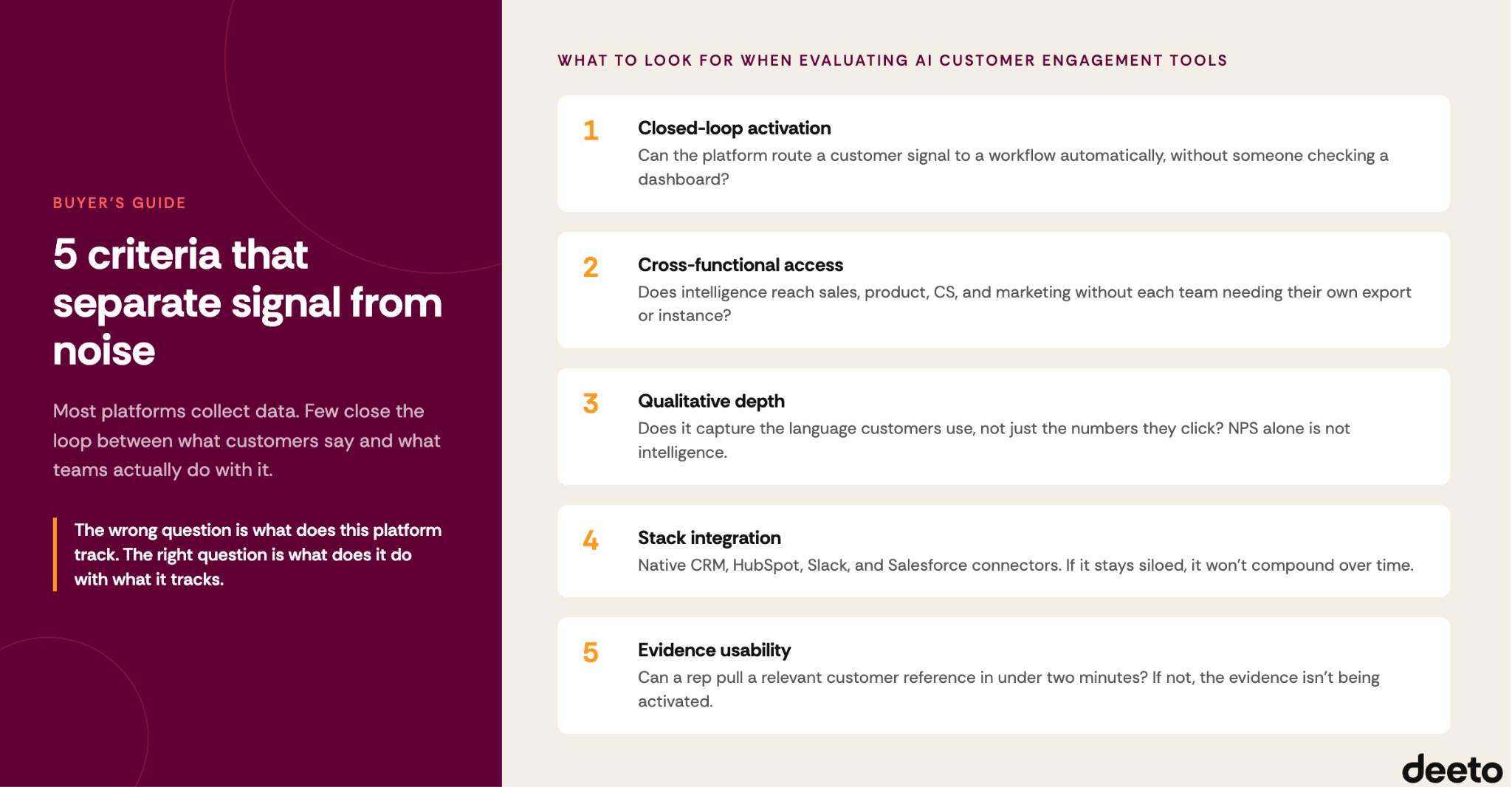
The wrong question when evaluating this category is "what does this platform track." The right question is "what does this platform do with what it tracks."
A few criteria separate tools that generate reports from tools that drive outcomes:
- Closed-loop activation: Can the platform take a customer signal and route it to a specific workflow without manual handoff? If insights live in a dashboard that someone has to check, the activation gap stays open.
- Cross-functional accessibility: Customer voice should not be owned by one team. Evaluate whether the platform distributes intelligence to sales, product, marketing, and customer success without each team needing their own instance or export.
- Qualitative depth: NPS scores and CSAT averages are not customer intelligence. They are temperature checks. Look for platforms that capture the language customers use, not just the numbers they click.
- Integration with your stack: CRM and workflow integrations with Salesforce, HubSpot, Slack, and your existing go-to-market tools determine whether the platform compounds over time or stays siloed.
- Evidence usability: Can a sales rep pull a relevant customer reference in under two minutes? Can a PMM find three testimonials that match a specific use case without emailing CS? If the answer is no, the evidence is not being activated.
How Deeto fits into an AI customer engagement stack
Deeto is built on a specific position: customer voice is not a program to manage, it is a system to run.
Most platforms approach customer engagement as a collection problem, such as “how do we gather more input from customers?” Deeto approaches it as an intelligence problem, asking “how do we turn what customers say into decisions that compound over time?”
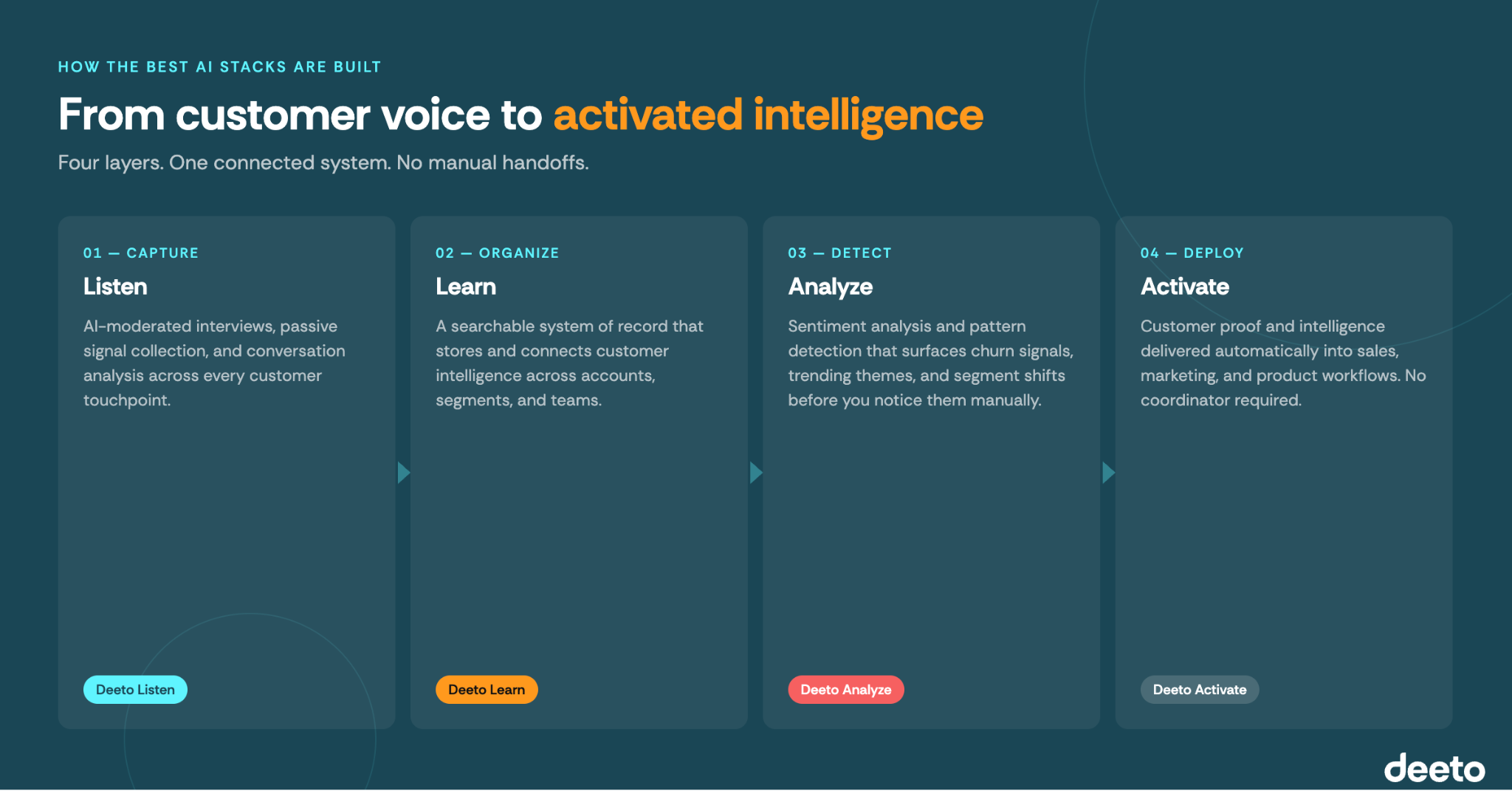
The platform runs across five connected layers: Listen captures voice through AI-moderated interviews and passive signal collection. Learn organizes that intelligence into a system of record accessible across teams. Activate puts evidence and intelligence into the workflows where teams actually work. Analyze surfaces patterns and signals. Orchestrate coordinates how teams engage customers across moments, workflows, and the lifecycle so insight leads to action.
Companies using Deeto report 20-30% faster sales cycles when customer proof is surfaced automatically at deal stages, rather than requested ad hoc. The difference is not the quality of their customer relationships. It’s the system that makes those relationships usable.
If you want to see how that system works for a product marketing team or a customer success team, booking a demo is the fastest way to make it concrete.
Key takeaways
- The best AI tools for customer engagement go beyond data collection; they activate what customers say in real decisions and workflows.
- Voice capture, sentiment analysis, evidence activation, and orchestration are four distinct functional layers. Most platforms cover one or two. Few cover all four.
- The activation gap, where insights are collected but never reach the people who need them, is the core failure mode of most customer engagement programs.
- Evaluating tools on closed-loop activation, cross-functional access, and integration depth will tell you more than feature checklists.
- Deeto connects all four layers into a single system: from AI-moderated customer interviews to automated evidence delivery in sales and marketing workflows.
Frequently asked questions
What are AI tools for customer engagement?
AI tools for customer engagement are software platforms that use machine learning and natural language processing to capture, analyze, and activate customer voice across the full customer lifecycle. They range from automated interview tools and sentiment analysis engines to advocacy platforms and lifecycle orchestration systems. The most effective platforms connect data collection to downstream activation rather than stopping at reporting.
How is AI changing customer engagement?
AI has made it possible to collect qualitative customer input at scale without large research teams, analyze thousands of customer data points in real time, and route the right customer evidence to the right workflow automatically. The result is faster access to customer intelligence and a shorter path from what customers say to what companies do with that feedback.
What is the difference between a customer engagement platform and a CRM?
A CRM tracks customer interactions and deal status. A customer engagement platform captures what customers think, analyzes voice patterns and sentiment, and activates that intelligence across sales, marketing, and product teams. The two systems are complementary. A well-integrated engagement platform feeds customer intelligence into your CRM rather than replacing it.
What should I look for in an AI customer engagement tool?
Look for closed-loop activation (not just reporting), qualitative signal capture alongside quantitative data, cross-functional accessibility across sales, marketing, and CS, and native integrations with your CRM and communication tools. The platform should reduce the time between a customer saying something and your team acting on it.
How does Deeto differ from other customer engagement tools?
Deeto runs across the full cycle: voice capture through AI-moderated interviews, intelligence organization into a searchable system of record, pattern analysis across accounts and segments, and automated activation of evidence in sales and marketing workflows. Most platforms cover one or two of these layers. Deeto connects all four, which eliminates the manual handoffs that cause customer intelligence to stall before it reaches the people who need it.
What teams benefit most from AI customer engagement tools?
Product marketing teams use them to build messaging from real buyer language. Customer success teams use them to detect churn risk and prove value at renewal. Sales teams use them to pull relevant customer references and proof at the right deal stage. Product teams use them to convert customer voice into roadmap input. The platforms with the highest ROI are the ones accessible across all of these teams, not siloed to one function.
🎉 Save your spot
Register for the event
Once your spot is secured, we’ll send your confirmation details.
Subscribe to our newsletter
Subscribe to receive the latest blog posts to your inbox every week.
By subscribing, you agree to our Privacy Policy
Subscribe to our newsletter
Get the latest news and updates from our team.
By subscribing, you agree to our Privacy Policy
Related posts

Call Intelligence Software That Spots Your Next Reference

What is call intelligence software? Learn how it scores every call automatically and surfaces advocacy-ready customers.

4 Ways To Leverage Social Proof In Marketing
What is social proof in marketing? Learn 4 ways to use reviews, stories, and advocacy to build buyer trust.

How to Build a Customer Testimonial Strategy That Converts
What is a customer testimonial strategy? Learn how to collect, structure, and activate proof that closes deals.