7 Market Research Trends You Need to Know in 2026


Thursday, August 27, 2026


7 Market Research Trends You Need to Know in 2026


View the podcast on Youtube

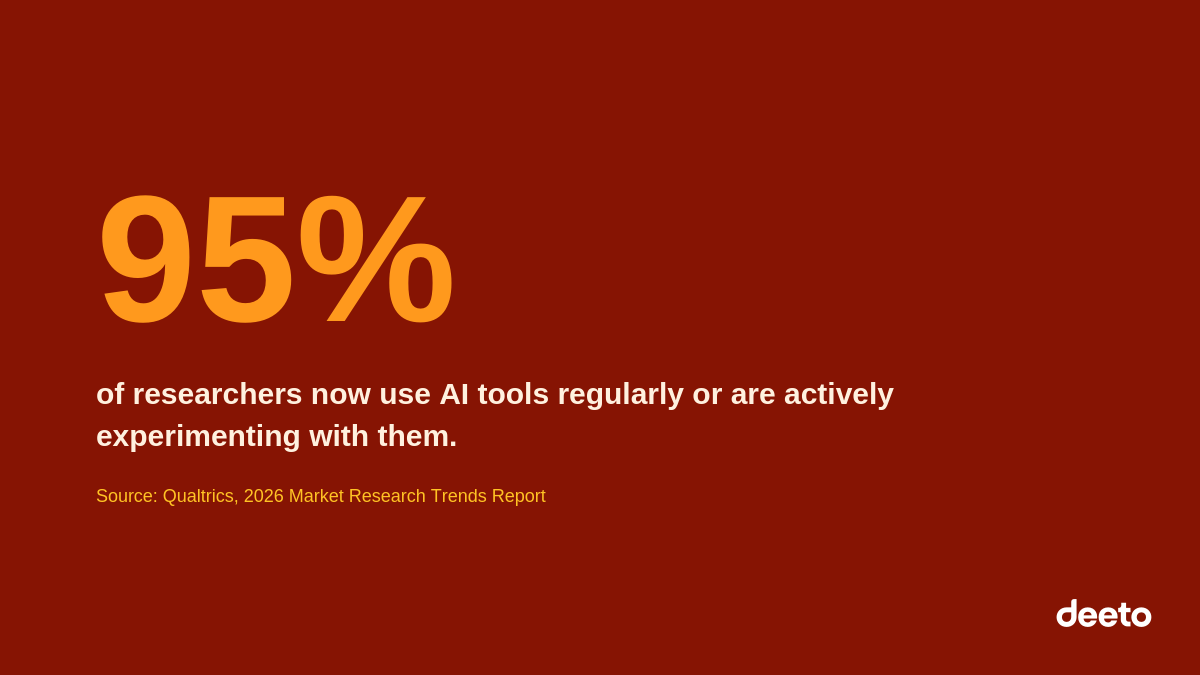
Market research is shifting faster than at any point in the last decade. Market research trends for 2026 center on one theme: AI has moved from an optional experiment to foundational infrastructure, with 95% of researchers now using AI tools regularly or experimenting with them.
But adoption alone doesn't guarantee better decisions. This article breaks down the seven shifts reshaping how teams collect, analyze, and act on market signals, from agentic AI to tightening privacy rules, so you know where to focus next.
What Are Market Research Trends, and Why Do They Matter Now
Market research trends are the shifts in how companies collect, interpret, and act on data about markets, competitors, and customer behavior. Two years ago, long survey fielding windows, static quarterly reports, and manual coding of open-ended responses were standard practice. None of that keeps pace with how fast markets move now.
For 2026, the real story isn't new tools, but the widening gap between teams that treat AI as core infrastructure and teams still treating it as a side project. The rest of this article walks through the seven trends driving that gap, and what each one means for how you plan research in the year ahead.
1. AI Adoption Has Become Foundational, Not Optional
AI in market research is no longer a differentiator. It's table stakes. According to Qualtrics' 2026 Market Research Trends Report, drawn from over 3,000 researchers across 17 countries, 95% of researchers now use AI tools regularly or are actively experimenting with them.
That number matters less than what it implies. When adoption is nearly universal, the competitive question stops being "should we use AI" and becomes "how well are we using it." Qualtrics' research frames this directly: the gap that used to separate AI users from non-users has been replaced by a gap between teams with a clear AI strategy and teams still finding their footing.
For research and insights leaders, this changes the planning conversation. Budget requests built around "piloting AI" are already behind. The more useful question in 2026 is which parts of the research workflow (fielding, analysis, synthesis, reporting) should be AI-assisted by default, and which still need a human in the loop.
2. General-Purpose AI Tools Are Losing Ground to Specialized Research Platforms
Not all AI use is created equal. Qualtrics found that general-purpose AI tool use among researchers dropped from 75% in 2024 to 67% in 2026, while use of AI features built into research platforms rose from 62% to 66% over the same period.
That's worth pausing on. Early on, teams reached for flexible, general-purpose tools because they were the fastest way to get started. As they mature, more are shifting toward platforms built for research workflows specifically, ones that understand survey logic, sampling structures, and qualitative coding instead of treating every prompt like a blank page.
It also raises the question of what counts as a real research platform. Bolting AI features onto legacy survey software isn't the same as building around continuous customer signal from the ground up.
3. Generative AI Is Moving From Experimentation Into Core Deliverables
Generative AI in market research has crossed from pilot programs into standard practice. Greenbook's GRIT Business Outlook research found that 67% of research suppliers now embed generative AI directly into client deliverables, automating tasks like survey design and cross-tab analysis rather than using it as a side tool.
This is a different milestone than raw adoption numbers. It means generative AI output is showing up inside the reports, dashboards, and summaries that executives actually read and act on. The work of writing survey instruments, summarizing open-ends, and building first-draft cross-tabs increasingly starts with AI and ends with human review, not the other way around.
The practical implication: if your research deliverables in 2026 still involve building every cross-tab and summary from scratch, you're spending time on work your competitors have already automated.
4. Synthetic Respondents Are Pushing Data Quality to the Top of the Risk List
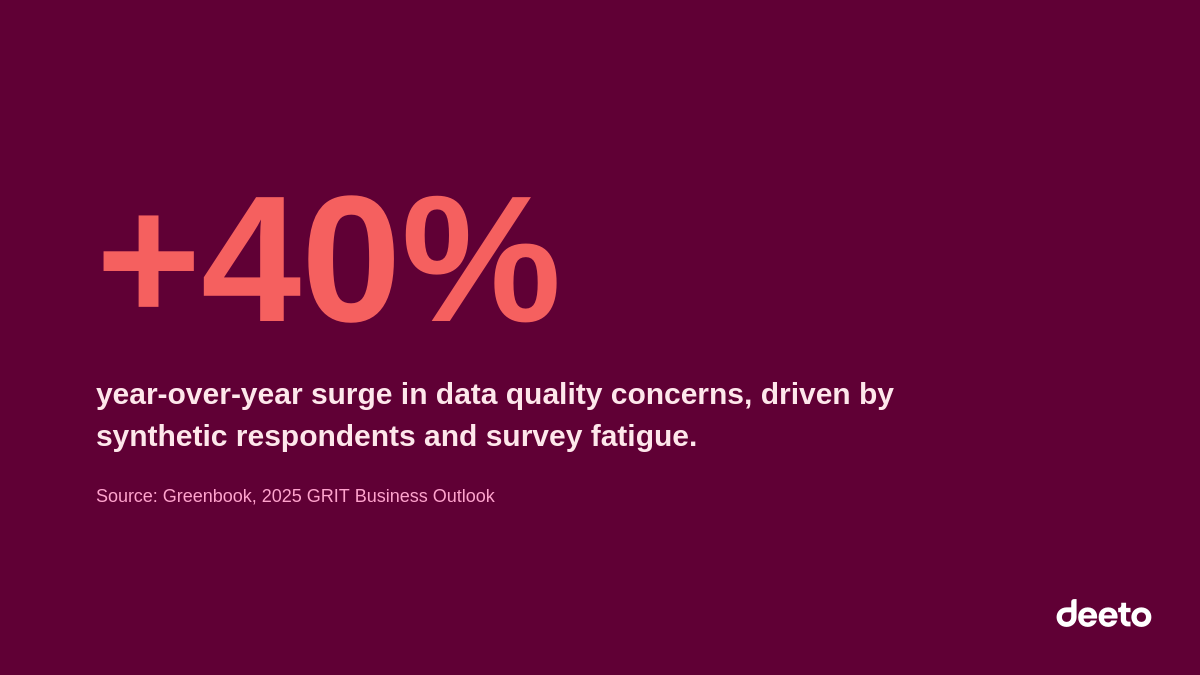
Faster AI-assisted research has a cost, and it shows up in data integrity. Greenbook's GRIT research found that data quality concerns have surged 40% year-over-year, driven in large part by synthetic respondents and rising survey fatigue among younger participants.
Synthetic respondents are AI-generated or bot-driven survey responses designed to mimic real human answers, and they're getting harder to catch with traditional fraud detection. At the same time, a separate and legitimate use of synthetic data, AI-modeled personas used deliberately to supplement real research, is gaining traction as a way to extend sample size without inflating cost. The challenge for research teams in 2026 is telling the difference: using synthetic data intentionally and transparently, while catching the synthetic responses that are quietly corrupting "real" panels.
Teams that get this wrong don't just get bad data. They make decisions on it, and the cost shows up months later in a launch or campaign that underperforms for reasons nobody can trace back to the source.
5. Agentic AI Is Starting to Run Entire Research Projects
Agentic AI in market research is moving past chat assistants into tools that can plan, execute, and report on research projects with limited human input. Qualtrics found that 13% of researchers now name democratizing insights (letting non-researchers run their own studies) as the single biggest benefit of AI. Among that group, 84% believe AI research agents will oversee more than half of research projects end to end within the next three years.
That's a significant claim about where the discipline is headed. Product managers testing concepts without filing a research ticket. Marketing teams pulling qualitative themes without waiting on a report. Executives exploring customer data directly instead of going through an analyst. Done well, this doesn't replace researchers. It multiplies what they can cover, freeing up time for the strategic work that still requires human judgment: framing the right question, spotting a flawed sample, or knowing when a "clean" result doesn't pass the smell test.
The advantage isn't having AI anymore. It's knowing how to orchestrate it. That's the idea behind Deeto's platform, which captures authentic customer voice and carries it through every stage, from Listen to Learn, Activate, Analyze, and Orchestrate, so real customer insight reaches sales, marketing, and product teams while it's still useful, instead of sitting in a report nobody reads.
6. Privacy Regulation Is Forcing a Shift to First-Party, Permissioned Data
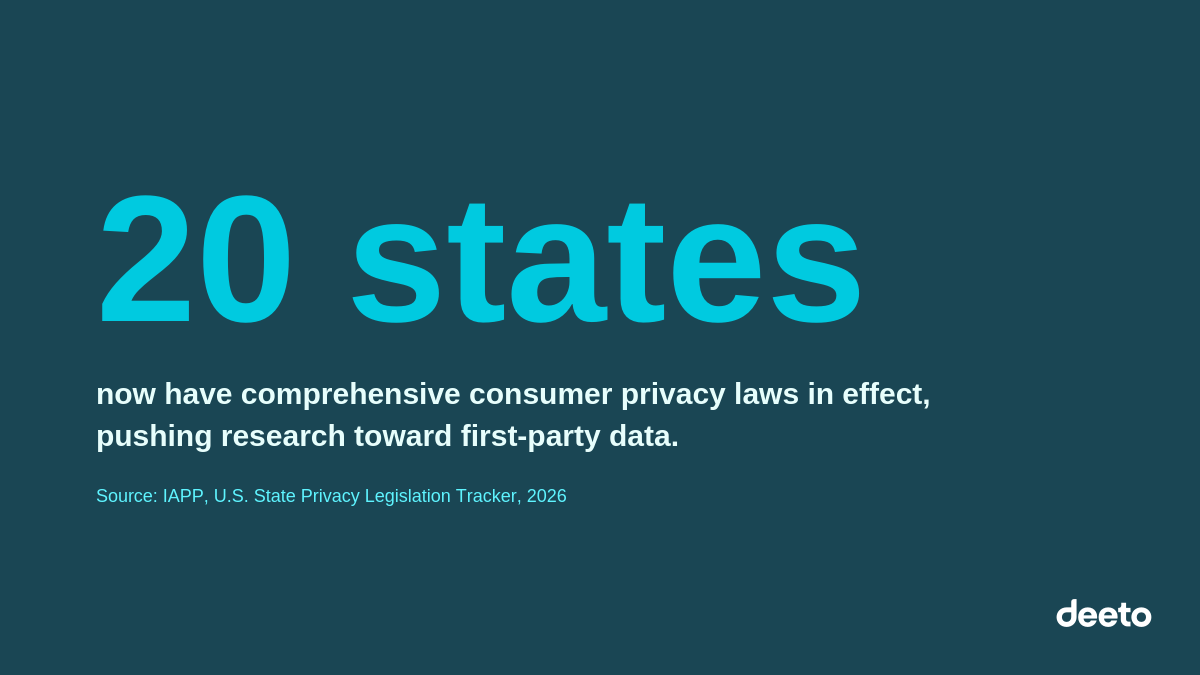
Regulatory pressure on how companies collect and use research data has intensified. As of 2026, 20 U.S. states have enacted comprehensive consumer data privacy laws, according to the International Association of Privacy Professionals, with Indiana, Kentucky, and Rhode Island the most recent additions.
That patchwork of state-level rules, layered on top of GDPR-style requirements in other markets, is pushing research teams toward first-party, permissioned data collection instead of third-party panels of uncertain origin. Respondents who opt in directly, understand what their data is used for, and trust the organization asking tend to produce higher-quality, more defensible research data. They're also the only source of research data that holds up if a state attorney general asks how it was collected.
Companies that treat privacy compliance as a legal afterthought, rather than a research design input, will keep finding out the hard way that their sample doesn't hold up to scrutiny.
7. AI-Fluent Teams Are Pulling Away From Traditional Research Teams
The gap between AI-fluent research teams and traditional ones isn't theoretical. It's showing up in budget and influence data. Qualtrics found that 37% of traditional researchers say their organization's reliance on their insights has stayed flat over the past year, while 15% say it has declined, and 32% report their budgets have stayed flat as well.
Meanwhile, teams that have embraced AI throughout the research process report gaining influence and budget. Qualtrics found that the pattern holds at the leadership level too: 72% of C-suite leaders believe their organization relies more on research than it did a year ago, but only 44% of individual contributors feel the same way. That gap between what leaders believe is happening and what practitioners are actually experiencing is its own risk. It slows adoption right when speed matters most.
The lesson for 2026 isn't just "adopt AI." It's "close the gap between leadership expectations and what your team can realistically deliver," or risk losing the strategic seat at the table to the team down the hall that already has. Closing that gap starts with giving leaders and practitioners the same customer intelligence instead of two different versions of the truth, which is the specific problem Deeto is built to solve.
Traditional vs. AI-Native Market Research: A Quick Comparison
The shift described above changes what a research process actually looks like day to day. Here's how traditional market research compares to the AI-native approach more teams are adopting in 2026.
Key Takeaways
- AI use in market research is now near-universal (95%), which means the real competitive edge is strategy and orchestration, not adoption itself.
- Researchers are consolidating around specialized, embedded AI tools and moving away from general-purpose chatbots.
- Generative AI has moved from experimentation into core research deliverables, with most suppliers now embedding it directly in client work.
- Synthetic respondents are a growing data quality threat, distinct from the legitimate use of synthetic data to extend sample size.
- Agentic AI is starting to run entire research projects end to end, multiplying researcher capacity rather than replacing it.
- Privacy regulation across 20+ U.S. states is pushing teams toward first-party, permissioned data collection.
- Teams slow to adopt AI are already losing budget and influence relative to teams that have embraced it.
FAQs
What are the biggest market research trends for 2026?
The biggest market research trends for 2026 are near-universal AI adoption, a shift from general-purpose AI tools to specialized research platforms, generative AI embedded directly in deliverables, rising concern over synthetic respondents and data quality, agentic AI running entire projects, tightening state-level privacy regulation, and a widening influence gap between AI-fluent and traditional research teams.
Is AI replacing market researchers?
No. AI is automating specific tasks like survey design, cross-tab analysis, and first-pass synthesis, but it still requires human judgment to frame the right research question, catch flawed samples, and interpret results in context. Qualtrics' 2026 data shows AI multiplying researcher capacity across an organization rather than eliminating the role itself.
What is synthetic data in market research?
Synthetic data in market research refers to AI-generated data modeled on real behavior patterns, used deliberately to supplement or extend research samples. It's different from synthetic respondents, which are bot-driven or AI-generated survey responses that fraudulently mimic real human participants and degrade data quality if left undetected.
How is agentic AI used in market research?
Agentic AI is used in market research to plan, run, and report on research projects with limited human input, such as testing a concept, summarizing qualitative themes, or pulling customer data on request. Qualtrics found that 84% of researchers who value AI for democratizing insights expect AI agents to oversee more than half of research projects end to end within three years.
Why is data quality a growing concern in market research?
Data quality is a growing concern in market research because synthetic respondents and rising survey fatigue are making it harder to distinguish real human input from AI-generated or bot-driven noise. Greenbook's GRIT research found that data quality concerns increased 40% year-over-year, largely tied to this shift.
How can companies keep market research compliant with privacy laws?
Companies can keep market research compliant with privacy laws by prioritizing first-party, permissioned data collection, where respondents know what their data is used for and opt in directly. As of 2026, 20 U.S. states have comprehensive privacy laws in effect, making third-party panel data a growing legal and reputational risk.
Conclusion
Market research trends for 2026 point to one underlying shift: AI has stopped being a tool teams experiment with and become the infrastructure research runs on. The teams pulling ahead aren't the ones with the most AI subscriptions. They're the ones who've figured out how to orchestrate authentic customer signal into decisions their organization actually trusts and acts on.
That's true whether the signal comes from a formal market research study, a customer research program, or ongoing competitive insights work. The methodology matters less than whether the insight reaches the right person in time to change a decision. If your research team is still working through what that orchestration looks like in practice, see how Deeto connects customer voice to decisions.
🎉 Save your spot
Register for the event
Once your spot is secured, we’ll send your confirmation details.
Subscribe to our newsletter
Subscribe to receive the latest blog posts to your inbox every week.
By subscribing, you agree to our Privacy Policy
Subscribe to our newsletter
Get the latest news and updates from our team.
By subscribing, you agree to our Privacy Policy
Related posts

Call Intelligence Software That Spots Your Next Reference

What is call intelligence software? Learn how it scores every call automatically and surfaces advocacy-ready customers.

4 Ways To Leverage Social Proof In Marketing
What is social proof in marketing? Learn 4 ways to use reviews, stories, and advocacy to build buyer trust.

How to Build a Customer Testimonial Strategy That Converts
What is a customer testimonial strategy? Learn how to collect, structure, and activate proof that closes deals.