What Is Market Research? A Complete Guide



Friday, June 26, 2026


What Is Market Research? A Complete Guide


View the podcast on Youtube

Most companies do market research backward. They run a survey, build a slide, present it once, and never touch the data again. Then six months later, someone asks "do we actually know what our buyers want?" and nobody can answer with confidence.
Market research is the process of gathering and analyzing information about a market, including customers, competitors, and industry trends, to guide business decisions. It covers everything from understanding buyer needs and pain points to tracking competitive positioning and forecasting demand. Good market research turns assumptions into evidence. In this guide, you'll learn the main types of market research, the methods teams use to collect it, and how to build a process that keeps the research current instead of letting it go stale.

What is market research
Market research is the systematic collection and analysis of data about a target market, the people in it, and the conditions surrounding it. It answers questions like: who are our buyers, what do they need, how do they make decisions, what are competitors doing, and where is the market headed.
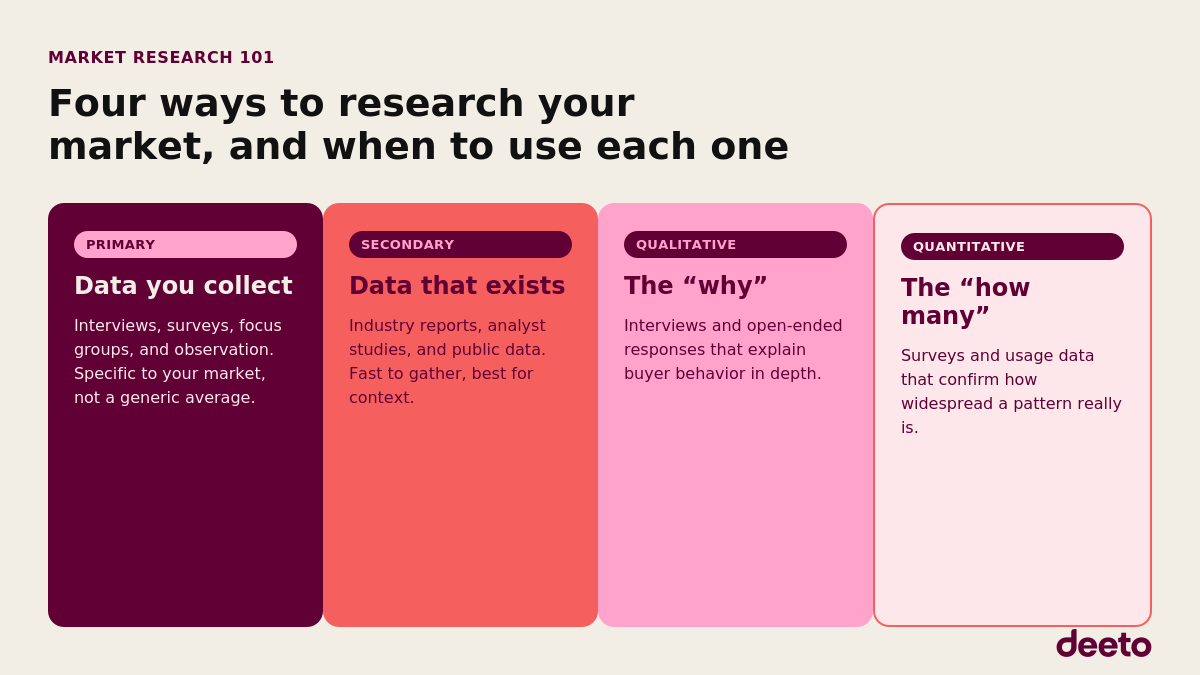
Market research includes both primary research, information you collect directly through interviews, surveys, or observation, and secondary research, information that already exists in reports, industry studies, or public data. Most strong research programs use both.
The goal isn't a one-time report. The goal is an ongoing system that feeds product, marketing, and sales decisions with current, accurate signals about the market.
Why market research matters
Companies that skip market research make decisions based on internal opinion instead of external evidence. That gap shows up everywhere: products built for problems nobody has, messaging that doesn't match how buyers actually talk, pricing set without knowing what the market will bear.
Market research swaps assumptions for evidence:
- Product decisions get grounded in real buyer needs instead of internal assumptions
- Messaging and positioning reflect the language buyers actually use, not the language a team assumes they use
- Competitive strategy accounts for what's actually happening in the market, not last year's snapshot
- Go-to-market timing is based on demand signals instead of internal deadlines
The stakes are higher than most teams assume. Gartner's research on the B2B buying journey found that buyers spend only 17% of their total purchase journey actually meeting with potential suppliers, with the rest going to independent research and internal alignment. Most of the buying decisions happen in moments a sales team never sees and can't influence directly. Market research is one of the few ways to understand what's happening in that gap.
The problem isn't a lack of market data. Most companies have more data than they can use. The problem is connecting that data to the decisions that depend on it, which is the gap market signal tracking is built to close.
Types of market research
Market research splits into several categories, and most companies need more than one to get a full picture.
Primary research
Primary research is data you collect directly from the source: customers, prospects, or market participants. It includes:
- Customer interviews: one-on-one conversations that surface needs, objections, and language
- Surveys: structured questions sent to a larger sample for quantitative signal
- Focus groups: moderated group discussions to explore reactions and preferences
- Observational research: watching how people actually use a product or make a decision, rather than asking them to describe it
Primary research is slower to collect but gives you data specific to your market and your buyers, not a generic industry average.
Secondary research
Secondary research uses data that already exists: industry reports, analyst studies, government data, competitor public filings, and published surveys. It's faster and cheaper to gather, but it wasn't built for your specific question, so it's best used to validate or contextualize primary findings rather than replace them.
Qualitative vs. quantitative research
This is a second axis that cuts across primary and secondary research:
- Qualitative research explores the "why" behind buyer behavior. Interviews, open-ended survey responses, and observational studies fall here. It's rich in detail but harder to scale.
- Quantitative research measures the "how many" and "how much." Closed-ended surveys, usage data, and market sizing studies fall here. It's easier to scale but loses nuance.
Strong research programs pair both: qualitative research to understand why something is happening, quantitative to confirm how widespread it is. For a closer look at choosing between the two in practice, see how to do customer research, which breaks down qualitative versus quantitative methods step by step.
Market research by focus area
Within those categories, research typically targets a few core areas:
- Buyer research: who the buyer is, what they need, and how they decide
- Competitive research: what competitors offer, how they position, and where they're winning or losing deals, often tracked through competitive insights
- Industry and trend research: where the broader market is moving, including regulatory, technology, or demand shifts
- Product research: how the market reacts to a specific product, feature, or pricing model
Common challenges with market research
Most teams don't fail at collecting market research. They fail at making it useful.
Research goes stale. A study from 18 months ago doesn't reflect a market that's moved. Without a refresh cadence, research becomes a historical artifact instead of a working input.
Findings stay siloed. Research run by one team, usually marketing or product, often never reaches sales, customer success, or leadership. The insight exists, but it doesn't travel.
Sample bias skews the picture. Surveying only your happiest customers, or only prospects who already said yes, produces a distorted view of the broader market.
Research and decisions live in different systems. A report sits in a shared drive while the roadmap gets built in a separate tool. Nobody connects the two.
Volume without synthesis. Teams collect interview transcripts, survey results, and call recordings, but nobody has time to turn raw data into a clear takeaway.
These aren't reasons to stop doing market research. They're reasons to fix how it's run.
Market research best practices
A few practices separate research programs that actually shape decisions from ones that just generate reports.
- Start with a specific decision, not a general topic. "Understand our market" is too broad. "Decide whether to expand into mid-market" is a research question with a clear output.
- Mix methods by pairing a quantitative survey with a handful of qualitative interviews to get both scale and depth.
- Talk to a representative sample, not just your best accounts. Include prospects who didn't buy and customers who churned, not only your happiest users.
- Build a refresh cadence such as quarterly or semi-annual check-ins to keep research current instead of letting it expire silently.
- Centralize findings somewhere visible. Research that lives in one analyst's inbox doesn't inform decisions made in other rooms.
- Connect research to the teams that need it. Product needs different findings than sales. Structure findings so each team can find what's relevant without reading the entire report.
How to implement a market research process
Building a repeatable process matters more than running one perfect study.
First, define the decision you're trying to inform. Every research effort should map to a specific question someone needs answered.
Next, choose your methods. Decide whether the question needs primary research, secondary research, or both, and whether it's qualitative, quantitative, or a mix. Then you can start collecting the data. Run interviews, send surveys, or pull existing reports, depending on what the previous step calls for.
Make sure you synthesize the data, don't just summarize. A transcript dump isn't an insight. Pull out patterns, contradictions, and the handful of findings that actually change a decision. After that, you can distribute findings to the teams that need them. Product, marketing, and sales each need a different cut of the same research.
Finally, set a refresh trigger. Decide upfront when this research needs to be revisited: a fixed timeline, a market event, or a product launch.
Teams that treat this process as a continuous loop rather than a one-time project end up with research that stays accurate as the market shifts. Customer interviews tell you what's true today, and tracked market trends tell you whether that's still true tomorrow.
FAQs
What's the difference between market research and customer research?
Market research covers the broader market, including competitors, industry trends, and overall demand. Customer research focuses specifically on existing or prospective customers and their needs, behaviors, and feedback. Customer research is typically one input into a larger market research effort.
How often should market research be updated?
Most B2B markets shift enough to warrant a refresh every two to four months for fast-moving categories, or every six to twelve months for slower ones. Major events like a competitor launch or a pricing change should trigger an off-cycle update regardless of schedule.
What's the difference between primary and secondary market research?
Primary research is data you collect directly, like interviews or surveys. Secondary research uses existing data, like industry reports or published studies. Primary research is more specific to your market; secondary is faster and cheaper to gather.
Do small companies need market research, or just enterprises?
Small companies need it more, not less. Without the budget for large sample sizes, smaller companies benefit from focused, well-targeted research, even a handful of strong customer interviews, that directly informs near-term decisions.
What tools are used for market research?
Teams typically combine survey platforms, interview tools, CRM data, and industry reports. The harder part isn't collecting the data, it's connecting findings across sources so research informs decisions instead of sitting in a folder.
Can market research replace customer feedback collected through support or sales?
No. Support tickets and sales conversations surface immediate, specific issues. Market research answers broader questions about market direction and buyer needs. The strongest programs use both.
Key takeaways
- Market research is the systematic collection and analysis of data about a market, its buyers, and its competitors, used to guide decisions.
- It splits into primary research (data you collect) and secondary research (data that already exists), and further into qualitative and quantitative methods.
- The biggest failure point isn't collection, it's connecting findings to the teams and decisions that need them.
- A repeatable process, with a clear refresh cadence, keeps research accurate instead of letting it expire.
- Strong research programs pair structured studies with continuous signal, like ongoing customer research and tracked market trends, rather than relying on a single annual report.
Conclusion
Market research isn't a report you commission once a year and file away. It's a system for staying connected to what buyers need, what competitors are doing, and where the market is headed, and is refreshed often enough to still be true when someone acts on it. The companies that get the most from market research aren't the ones running the biggest studies. They're the ones who've built a process for getting findings to the right people before the market moves again.
Deeto helps teams turn ongoing customer research and market signals into a connected system, so research doesn't sit in a slide deck while the market changes around it. If your research process feels more like an archive than a working input, see how Deeto's market research use case works.
🎉 Save your spot
Register for the event
Once your spot is secured, we’ll send your confirmation details.
Subscribe to our newsletter
Subscribe to receive the latest blog posts to your inbox every week.
By subscribing, you agree to our Privacy Policy
Subscribe to our newsletter
Get the latest news and updates from our team.
By subscribing, you agree to our Privacy Policy
Related posts

How to Build a Customer Testimonial Strategy That Converts

What is a customer testimonial strategy? Learn how to collect, structure, and activate proof that closes deals.

Customer Testimonial Software Platforms Compared
What is customer testimonial software? Compare 7 platforms, see how they stack up, and learn how to choose the right one

Customer Proof Marketing: How B2B Companies Build Trust with Buyers
What is customer proof marketing? Learn the proof types, frameworks, and software that build B2B buyer trust.