Deeto vs Base AI: Which Platform Is Right for Your Team?



Friday, January 16, 2026


Deeto vs Base AI: Which Platform Is Right for Your Team?


View the podcast on Youtube

If you're a PMM or customer marketing lead at a B2B company evaluating customer platforms, you've probably run into both Deeto and Base AI. They show up in the same searches, cover some of the same ground, and both use AI to automate the work your team used to do manually.
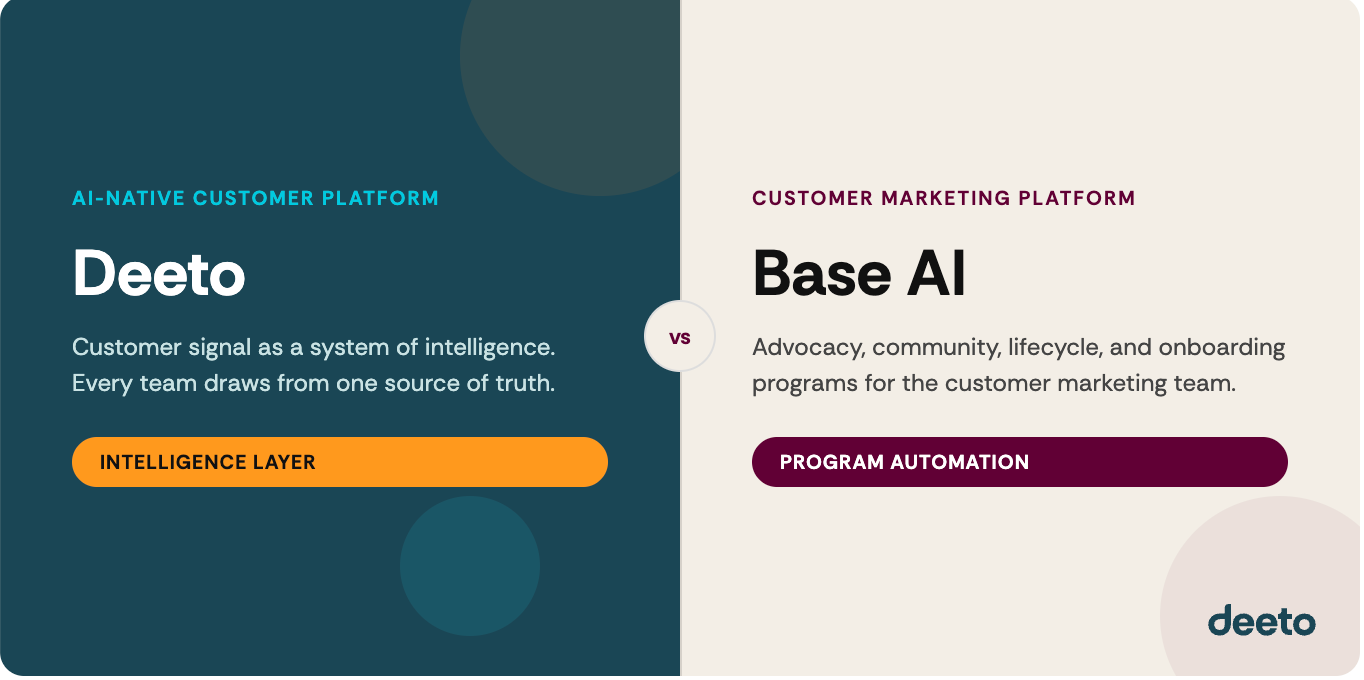
The real difference is not what each platform does. It is what the data is for.
Base is built for customer marketing teams running post-sale engagement programs. Deeto is built for the entire business that runs on customer signal including product, sales, CS, and marketing, drawing from one connected intelligence layer. If you are hiring a customer marketing platform, both are on your shortlist. If you are building customer voice as a system of intelligence that drives decisions across every team, that is a different evaluation.
Here is how each platform actually works, where they overlap, and where the difference matters.
What is Deeto?
Deeto is an AI-native customer voice platform. It captures authentic customer voice continuously, organizes it into a connected system of record, and delivers the right intelligence or proof to the right team at the right moment inside the workflows they already use.
The platform is built around five connected modules: Listen (AI-powered interviews, surveys, and in-product microfeedback), Learn (a unified knowledge hub of companies, people, and assets), Activate (proof and intelligence delivered in-flow to sales, CS, and marketing), Analyze (sentiment, competitive signals, win/loss patterns, and product feedback themes), and Orchestrate (lifecycle campaigns, reference programs, referral management, and signal-driven automations).
The architecture is built around a single idea: customer voice is not a program owned by one team. It is the system of intelligence the whole business should run on.
What is Base AI?
Base AI is a customer-led growth automation platform. It is built for customer marketing and advocacy teams running post-sale engagement programs: references, advocacy campaigns, community, onboarding journeys, lifecycle marketing, and expansion motions. Base uses AI agents to coordinate across those programs and connects to a wide range of tools.
Base describes itself as "the AI Engagement OS for customer-led growth." The framing is accurate: it is a platform for the customer marketing function, with other teams as downstream beneficiaries.
Both platforms are credible. The differentiation is not about feature gaps. It is about what each platform is fundamentally built to do.
Where Deeto and Base Overlap
A buyer doing a feature-by-feature evaluation will find real parity here:
- Reference management and advocate matching
- Advocacy programs and rewards
- Customer stories and proof asset capture
- Lifecycle and expansion campaign automation
- AI agents for content, matching, and signal detection
- Unified customer data with CRM sync
- Sentiment and engagement analytics
- ROI dashboards connecting customer programs to pipeline
If your champion's only frame of reference is "advocacy platform," Base is a credible alternative. The differentiation comes from how the work gets done and what the data is actually for.
Where Deeto is Different
Interview-first capture vs. program-first capture
This is the sharpest line between the two platforms.
Deeto leads with low-friction AI interviews. Buyers and customers have a contextual conversation, and reference status or advocacy participation is offered after, never before. The primary output is a transcript of buyer perspective that feeds intelligence workflows across the entire organization.
Base's primary motions are advocacy programs, reviews, referrals, and customer-facing journeys.
For product marketing teams running positioning work, for sales leaders who need win/loss context, and for anyone who wants to understand what customers actually think rather than what they are willing to publicly endorse, that distinction matters. Deeto produces customer intelligence as a primary input. Base produces engagement activity.
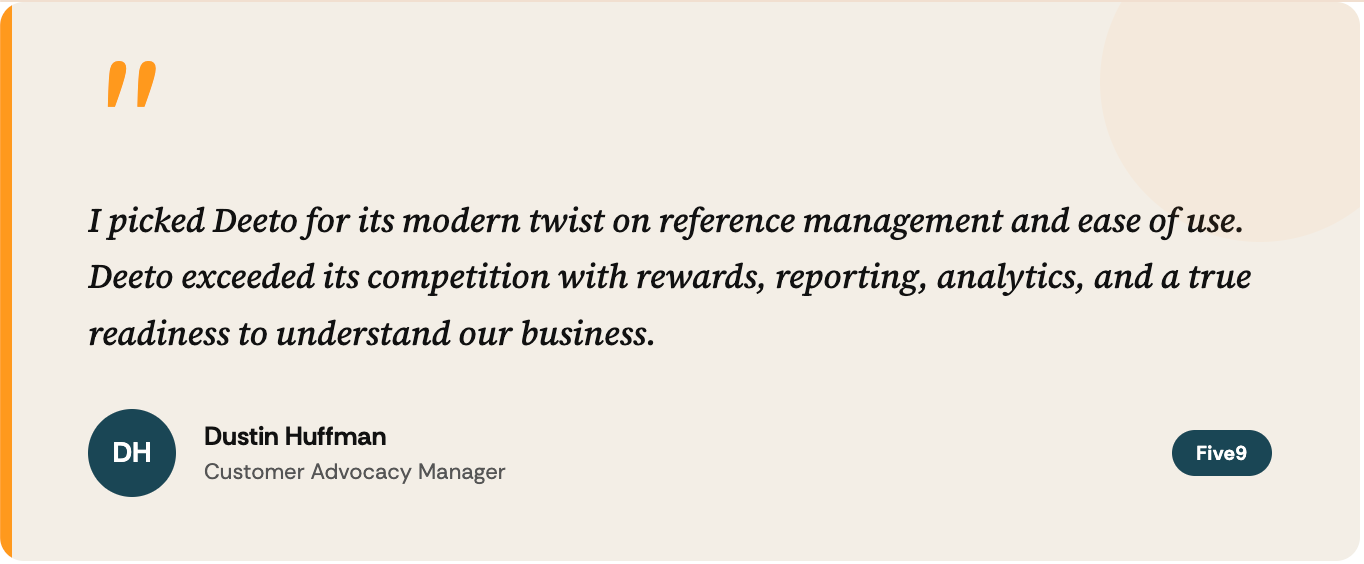
Dustin Huffman, Customer Advocacy Manager at Five9, put it this way after moving to Deeto: "I picked Deeto for its modern twist on reference management and ease of use. Deeto exceeded its competition with rewards, reporting, analytics, and a true readiness to understand our business."
Customer voice as cross-functional intelligence vs. customer marketing as the home base
Base is organized around the customer marketing function. Even the navigation reflects it: programs, advocacy, community. Other teams such as product, sales, or CS are described as beneficiaries of the programs customer marketing runs.
Deeto treats product marketing, customer marketing, CS, product, sales, and demand gen as equal first-class users of the same intelligence layer. Dashboards for win/loss, retention, NPS, product feedback, and competitive signals all live in one system. No team has to wait for another to extract and share what customers said.
Win/loss as a native capability
Base's site emphasizes advocacy and community as its primary motions. Win/loss analysis is not front and center in how the platform is positioned.
Deeto's win/loss analysis capabilities are a core pillar. Salesforce-triggered AI interviews fire automatically when deals close or are lost, capturing full deal context from buyers while the conversation is still fresh. Responses are automatically tagged by competitor, reason code, and deal characteristics. That intelligence flows directly into PMM and sales workflows in real time.
For any team that wants competitive intelligence tied to live deal data, this is a clean advantage for Deeto.
Customer marketing that drives company-wide revenue
Customer marketing is most powerful when it expands beyond the marketing team. Customer marketing may run reference programs, advocacy programs, and customer proof, but the output of that work is what sales teams, customer service, product and leadership depend on to do their jobs.
Deeto is built for exactly that scope. Customer marketing teams use Deeto to orchestrate an effort that reaches every revenue-generating function: surfacing the right reference for an open deal, feeding win/loss signal back to PMM, flagging expansion opportunities to CS, and connecting customer proof directly to pipeline. The work stays owned by customer marketing, but the impact shows up everywhere.
Deeto treats customer marketing as the team that connects customer intelligence to revenue across the entire business.
A knowledge hub built for evidence at scale
Both platforms claim a unified customer data layer. The architecture is different.
Deeto's Knowledge Hub structures the world as Companies, People, and Assets. Every quote, story, transcript, and reference is tied to a person and a company record with full participation history, approval status, and metadata. This record-of-truth model is what makes reference management scale: every piece of evidence is traceable, approvable, and findable without manual tagging or searching.
Base's unified data layer is organized around engagement data and account context and built for program management, not evidence management.
Orchestration as connective tissue, not a feature
Deeto's Orchestration layer, which includes campaigns, signal-driven workflows, automations, and the agentic framework, is the layer that makes everything else continuous. A churn signal in Analyze triggers a CS outreach in Orchestrate. A closed-won deal triggers a win interview in Listen. A reference request in sales pulls matched advocates from Learn and logs the completed call back to the CRM opportunity.
Each module feeds the next. The intelligence compounds. That is what makes Deeto a system of intelligence rather than a set of tools that happen to share a login.
Where Base may be a stronger fit
Base has a dedicated Community product and a Community Agent. If building a customer community is a primary priority, Base will feel like a more direct fit.
Base also has a productized onboarding journey solution with success plans and QBR frameworks. Deeto's CS story runs through campaigns and signal-driven workflows rather than a dedicated onboarding product.
Base has also built out a content and community presence around customer-led growth, including the CLG Playbook and related programs, that some buyers will encounter during research.
Implementation, Integrations, and Switching
Both platforms connect to Salesforce and HubSpot natively. Deeto's CRM integration is bidirectional and built into the deal workflow; reference activity, interview completions, and customer signals log back to opportunity records automatically. Base also connects to a range of tools and positions itself as a coordination layer across a broader customer marketing stack.
On implementation timeline, both platforms typically take four to eight weeks to go live depending on CRM complexity and the number of programs being configured. Deeto customers generally go live on reference management and win/loss interviews first, then layer in advocacy and feedback programs.
On review sites like G2, Deeto is rated highly for ease of use, reference program management, and the quality of the AI interview output. Base is rated well for its advocacy program depth and community features. Both have strong customer satisfaction scores in their respective primary use cases.
Not ready for a demo yet?
If you’re still in research mode, these two resources might help: the Deeto product overview walks through each module in detail, and the customer reference program guide covers how to think about the program design before you pick a platform. Both are worth reading before you get on a call.
How to think about the decision
The question is not which platform has more features. It is which job you are actually trying to do.
If the job is running advocacy, community, and lifecycle engagement programs with a dedicated customer marketing team, Base is built for that motion.
If the job is building customer signal as a system of intelligence, one that fuels product positioning, competitive intelligence, win/loss analysis, retention signals, feedback loops, and reference management from one source of truth that every team can act on, that is Deeto.
Most B2B teams evaluating in this space find that program coordination is not the bottleneck. The bottleneck is that the voice of the customer is scattered, decisions get made without it, and no single team has a clear picture of what customers actually think, need, or are at risk of doing. That is an intelligence problem which Deeto is built to solve.
Key Takeaways
- Both platforms do reference management, advocacy, and customer evidence capture. A feature checklist comparison will show real parity. The differentiation is in what the data is built for.
- Deeto leads with AI-powered interviews as its primary capture motion. Base's primary motions are advocacy programs and engagement journeys. Those produce fundamentally different outputs.
- Win/loss analysis and product feedback are native Deeto capabilities. They are not primary motions for Base.
- Deeto treats every GTM function including product, sales, CS, PMM, and customer marketing, as a first-class user of customer intelligence. Base is organized around the customer marketing function.
- Base is a stronger fit for teams whose primary need is community building or productized onboarding journeys.
Conclusion
The Deeto vs Base AI comparison comes down to one question: do you need a customer marketing platform, or do you need customer voice as a system the whole business runs on?
Base is a well-built answer to the first question. Deeto is the answer to the second.
If your PMM still has to go find their own source of truth when building a launch narrative, if your sales team is pinging marketing at 4pm on a Friday for a reference, if your product team has no real-time signal on what customers actually want next, those are not advocacy program problems. They are an intelligence gap.
Deeto closes it. The reference program capabilities are strong because they sit on top of a knowledge hub that structures every customer relationship as a record of truth, not a list of willing participants.
See how it works on a real use case. Book a demo with Deeto and bring your actual workflow to the conversation.
Frequently Asked Questions
What is the main difference between Deeto and Base AI?
Deeto is an AI-native customer voice platform that captures buyer perspective continuously, organizes it into a cross-functional system of record, and surfaces intelligence and proof across product, sales, CS, and marketing. Base AI is a customer-led growth automation platform built primarily for customer marketing teams running advocacy, community, and lifecycle engagement programs. Both do reference management and advocacy. The difference is what the data is built for and who in the organization can act on it.
Does Deeto compete with Base AI directly?
They overlap significantly on reference management, advocacy, and customer evidence capture. A feature-for-feature comparison will show real parity in those areas. The distinction is architectural: Base is organized around customer marketing programs; Deeto is organized around customer voice as cross-functional intelligence. For teams that need win/loss analysis, product feedback loops, and competitive signals alongside their advocacy and reference programs, Deeto covers that ground in one platform.
Which platform is better for product marketing teams?
Deeto is purpose-built for product marketing as a first-class user. The Analyze module surfaces competitive signals, win/loss patterns, sentiment trends, and product feedback themes from the same data layer that runs reference and advocacy programs. Product marketing teams use Deeto to ground launch messaging in real customer evidence rather than assumptions. Base surfaces some PMM-relevant data but is primarily organized around customer marketing program management.
How does Deeto handle win/loss analysis?
Deeto's win/loss capability is native and CRM-triggered. When a deal closes or is lost in Salesforce or HubSpot, Deeto automatically fires an AI-powered interview to the buyer capturing deal context while it is still fresh. Responses are tagged by competitor, reason code, and deal characteristics automatically. That intelligence flows into PMM and sales workflows in real time. This is a core platform capability, not an add-on.
Is Base AI better for community building?
Base has a dedicated Community Agent and customer hub product that Deeto does not match directly. If building and managing a customer community is a primary objective, Base is the more direct fit. Deeto is focused on customer signal capture, intelligence, and activation rather than community engagement as a standalone motion.
What does Deeto's Knowledge Hub do that Base does not?
Deeto's Knowledge Hub structures every customer relationship as a record of Companies, People, and Assets. Every quote, transcript, story, and reference is tied to a person and company record with full participation history, approval status, and metadata. This is what makes evidence management and reference matching work at scale without manual overhead. Base's unified data layer is organized around engagement activity and account context rather than an evidence record-of-truth model.
How long does it take to implement Deeto vs Base AI?
Both platforms typically take four to eight weeks to go live, depending on CRM complexity and program scope. Deeto customers generally start with reference management and win/loss interviews, then layer in advocacy and feedback. Base customers often configure multiple program types in parallel. Either way, you should expect a structured onboarding process rather than a self-serve setup.
🎉 Save your spot
Register for the event
Once your spot is secured, we’ll send your confirmation details.
Subscribe to our newsletter
Subscribe to receive the latest blog posts to your inbox every week.
By subscribing, you agree to our Privacy Policy
Subscribe to our newsletter
Get the latest news and updates from our team.
By subscribing, you agree to our Privacy Policy
Related posts

Call Intelligence Software That Spots Your Next Reference

What is call intelligence software? Learn how it scores every call automatically and surfaces advocacy-ready customers.

4 Ways To Leverage Social Proof In Marketing
What is social proof in marketing? Learn 4 ways to use reviews, stories, and advocacy to build buyer trust.

How to Build a Customer Testimonial Strategy That Converts
What is a customer testimonial strategy? Learn how to collect, structure, and activate proof that closes deals.