Customer Marketing vs Revenue Marketing: What's the Difference?



Monday, June 15, 2026


Customer Marketing vs Revenue Marketing: What's the Difference?


View the podcast on Youtube

Most B2B teams treat revenue marketing and customer marketing as two separate conversations. They're not. Understanding how each works, and where they overlap, is the difference between a growth strategy that compounds and one that churns.
Revenue marketing is a strategy that holds marketing accountable to a revenue target, not just a lead volume. Customer marketing is the discipline of building programs around your existing customers, activating them as advocates, capturing their success stories, and using that credibility to drive both retention and new pipeline.
In this post, we'll break down how each approach works, where they differ, where they intersect, and why the strongest go-to-market teams today are building both in parallel.
What is revenue marketing?
Revenue marketing is a go-to-market approach that holds marketing accountable to revenue outcomes, not just leads or impressions. It means sales and marketing operate from the same pipeline goals, share data, and co-own the funnel from first touch through closed-won.
Revenue marketing systems are built to connect every campaign to a revenue outcome. That means demand generation tied to pipeline, and attribution that closes the loop back to closed-won. Every piece of content is measured by its contribution to deals, not downloads.
The mindset shift is significant. Marketing stops asking "did we hit our MQL target?" and starts asking "did we move the number?" According to Forrester, highly aligned companies grow 19% faster and are 15% more profitable than their misaligned peers. That alignment is the foundation revenue marketing is built on.
What is customer marketing?
Customer marketing is the practice of building programs around your existing customers and turning their success into the social proof that drives retention and expansion.
Customer marketing includes advocacy programs, reference management, testimonial collection, customer community building, upsell and cross-sell campaigns, and the creation of customer evidence (case studies, ROI studies, and verified proof points) that accelerate deals across the funnel.
The core insight behind customer marketing is straightforward: your best prospects trust your customers more than they trust you. Customer marketing is the discipline that turns that trust into a growth system.
Deeto describes this as customer orchestration, the operating system that captures authentic customer voice and turns it into connected intelligence and action across every go-to-market motion.
Customer marketing vs revenue marketing: the key differences
The two strategies share a common goal of revenue growth, but they operate at different points in the customer lifecycle and use different inputs to get there.
Audience focus
Revenue marketing is primarily focused on new buyers moving through the top and middle of the funnel. It targets prospects, not customers. Customer marketing is focused on existing customers, deepening their relationship, proving continued value, and activating them as advocates who influence new buyers.
Primary inputs
Revenue marketing runs on market data, intent signals, campaign performance, and sales pipeline metrics. Customer marketing runs on customer voice: interviews, testimonials, sentiment data, advocacy activity, and customer success signals.
What they produce
Revenue marketing's primary output is net-new pipeline, qualified deals handed to sales to close. Customer marketing produces evidence, advocacy, expansion revenue, and net revenue retention. Both show up in the same P&L, but from different parts of the funnel.
Time horizon
Revenue marketing tends to optimize for short-cycle impact: this quarter's pipeline, this month's MQLs. Customer marketing compounds over time. A strong advocacy program built this year will influence deals for the next three years.
The handoff point
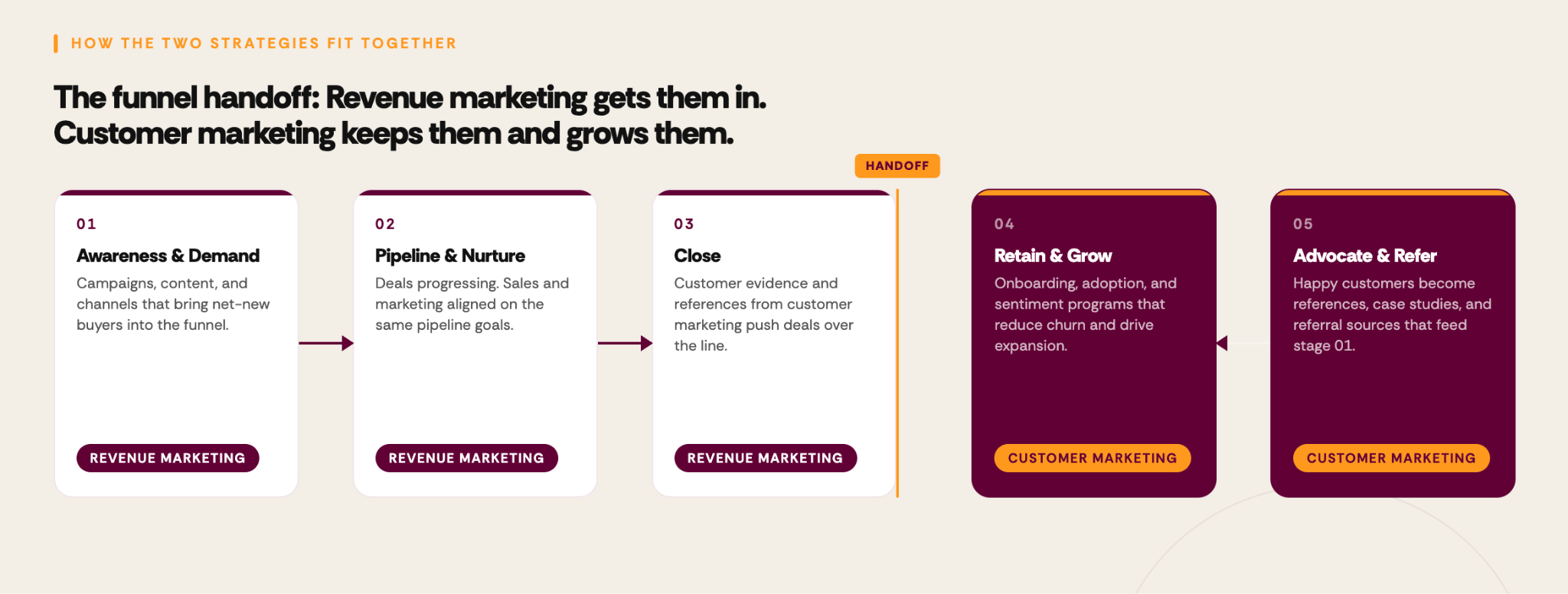
Revenue marketing typically "ends" at closed-won. Customer marketing begins the moment a deal closes, and never really stops. This is why customer success and customer marketing need to be tightly coordinated. They're co-owners of the post-sale relationship.
Where customer marketing and revenue marketing overlap
The most effective B2B go-to-market teams don't treat these as competing priorities. They're complementary. The overlap between them is where the highest-ROI activities live.
Customer evidence accelerates revenue marketing
The single biggest unlock for revenue marketing performance is better social proof. A prospect in an active deal is far more likely to convert when they can see verified stats, a relevant case study, or a video testimonial from a customer who looks like them. Stories and social proof built by customer marketing become the most effective assets in the revenue marketing toolkit.
Both strategies require personalization
Revenue marketing targets specific personas and use cases with tailored messaging. Customer marketing segments customers by industry, size, and success pattern to deliver the right evidence to the right buyer at the right moment. The shared discipline is relevance. Neither works at scale without it.
Advocacy generates new pipeline
Customer advocacy is not just a post-sale feel-good program. Done well, it's a pipeline engine. Customers who refer new buyers, participate in case studies, and speak at events create new top-of-funnel opportunities that revenue marketing can then accelerate. The handoff between the two functions is bidirectional.
Why revenue marketing alone isn't enough
A pure revenue marketing motion is expensive and fragile. It depends on paid channels that stop working the moment you stop funding them. When budgets tighten, pipeline dries up.
The missing ingredient is customer voice. The most sustainable B2B growth models layer customer marketing on top of revenue marketing because it's the only way to sustainably reduce what you spend to acquire each new customer.
When customers feel heard, recognized, and activated as advocates, they stay longer and expand faster. Deeto's platform is built around this idea. Customer voice isn't a marketing asset to be managed. It's the raw material that makes every go-to-market motion work better.
How to build both strategies in parallel
Running customer marketing and revenue marketing as parallel motions doesn't require a massive team. It requires clarity on who owns what, and a shared system for capturing and activating customer intelligence.
Here's a practical framework for building both:
Step 1: Define what "customer voice" means for your business.
This includes testimonials, interview data, NPS responses, support themes, and expansion signals. Customer marketing starts here, and so does the evidence base that revenue marketing needs.
Step 2: Build your evidence library.
Case studies, ROI data, and verified proof points should be organized by use case, industry, and persona. This is the connective tissue between your customer base and your new logo pipeline. Deeto's customer advocacy programs are designed specifically for this.
Step 3: Create a feedback loop between sales and customer marketing.
When sales loses a deal, customer marketing should know why. When customers share a compelling success stat in an interview, sales should have it in their hands within days, not months.
Step 4: Track customer marketing impact on revenue.
Advocacy participation rates, reference call conversion, evidence asset influence on deal velocity. These are the metrics that connect customer marketing to the revenue line. Without measurement, customer marketing stays a nice to have. With it, it becomes a function the business can't afford to cut.
Step 5: Share the scorecard.
Revenue marketing and customer marketing will only work together if they're rewarded for shared outcomes. This might mean both functions co-own expansion ARR, or that customer marketing has a formal contribution metric tied to new logo pipeline influenced by customer evidence.
How customer marketing generates revenue
Customer marketing is not a support function for revenue. It is a revenue function. Here is how each revenue lever works.
Retention: the revenue you keep
Churn is a revenue problem, and customer marketing is one of the most effective tools for solving it. Customers who are engaged, recognized, and connected to the company through advocacy programs or community initiatives are dramatically less likely to leave. According to Bain & Company, a 5% improvement in retention can increase profits by 25% to 95%. Customer marketing directly drives that improvement by keeping customers invested in the product they bought.
Customers who feel heard stay. Customers who feel like a number churn. Customer marketing creates the touchpoints and feedback loops that determine which one happens.
Expansion: the revenue you grow
Most SaaS growth models depend on net revenue retention above 100% to be sustainable. That means your existing customers need to spend more over time, not just renew at the same rate. Customer marketing owns this motion.
Upsell and cross-sell campaigns, triggered by customer health signals and product usage data, are a core customer marketing output. When a customer hits a milestone, customer marketing activates. When a customer's usage signals readiness for a higher tier, customer marketing surfaces it. The revenue trends that a customer orchestration platform like Deeto tracks are the exact inputs that make these campaigns targeted rather than generic.
A well-run expansion program adds meaningful ARR from the base you already paid to acquire. That is pure margin.
New pipeline: the revenue you create from credibility
This is the customer marketing revenue lever that most companies undervalue. Every case study, testimonial, ROI study, and reference call your customer marketing team produces is an asset that directly influences whether a new prospect signs. The research here is consistent: B2B buyers trust peers more than vendors, and customer evidence is the single most effective tool for closing skeptical deals.
Gartner research shows that B2B buyers spend just 17% of their total purchase journey talking to sales reps, and when multiple vendors are in the mix, any single rep gets roughly 5% of that time. The rest of the time, they're reading reviews, finding references, and looking for proof from people like them. Customer marketing builds that proof systematically.
The revenue impact is measurable. Deals that involve a customer reference call or a relevant case study close faster and at higher rates than deals that don't. When customer marketing teams start tracking evidence asset influence on deal velocity, the number almost always surprises people, and it builds the internal case for more investment.
The compound effect
Here is what makes customer marketing different from most revenue functions: the returns compound. A case study published today influences deals for years. An advocate who joins your reference program and speaks at a conference creates pipeline you didn't know to attribute. A customer community that grows every quarter becomes a retention and expansion engine that requires less incremental investment over time.
Revenue marketing stops when you stop paying for it. Customer marketing keeps paying out. The advocates you develop this year will still be influencing deals three years from now. One requires constant investment to keep running. The other compounds.

Key takeaways
- Revenue marketing aligns sales and marketing around pipeline and closed-loop attribution. Customer marketing activates existing customers to drive retention, expansion, and new pipeline through advocacy and evidence.
- The two strategies are not competing. They compound. Customer evidence built by customer marketing directly accelerates revenue marketing conversion rates.
- Revenue marketing alone is fragile. Adding customer marketing reduces CAC, improves retention, and creates a self-sustaining growth loop.
- The highest-leverage activities sit at the intersection: customer evidence, advocacy programs, and shared pipeline metrics.
- The winning operating model is one where customer voice is captured systematically and activated across every go-to-market motion, from new logo acquisition to expansion to competitive defense.
Conclusion
Revenue marketing and customer marketing operate at different points in the customer lifecycle, with different inputs and different time horizons. The mistake most B2B teams make is treating them as either identical or unrelated. They're neither. They're complementary, and the growth case for running both is straightforward. Deeto is built to connect them.
If you're ready to see how a customer orchestration platform connects customer voice to every revenue motion, book a demo and we'll show you what that looks like in practice.
Frequently asked questions
What is revenue marketing?
Revenue marketing is a strategy that aligns sales and marketing teams around shared revenue goals rather than separate activity metrics like MQLs or impressions. It treats marketing as a direct driver of pipeline and closed-won revenue, using closed-loop attribution to connect every campaign, asset, and channel to measurable business outcomes.
What is customer marketing?
Customer marketing is the discipline of engaging and activating existing customers to drive retention and growth. It includes advocacy programs, reference management, customer evidence creation (case studies, testimonials, ROI studies), and voice of the customer programs that surface insights for sales, product, and marketing teams.
Is customer marketing part of revenue marketing?
They overlap, but they're distinct disciplines. Revenue marketing primarily targets net-new acquisition. Customer marketing focuses on the post-sale relationship and existing customer base. The most effective go-to-market teams build both, connecting customer evidence and advocacy directly to the revenue marketing funnel.
How does customer marketing impact revenue?
Customer marketing drives revenue in three ways: by improving retention and reducing churn, by creating expansion opportunities through upsell and cross-sell programs, and by generating customer evidence and advocacy that accelerates new logo acquisition. Research consistently shows that customers acquired or influenced by peer recommendations convert faster and retain longer.
What does a customer marketing manager do?
A customer marketing manager builds and runs programs that deepen customer relationships and turn satisfied customers into active advocates. Day-to-day responsibilities typically include managing reference programs, producing case studies and testimonials, running advocacy or community programs, supporting customer success with expansion campaigns, and measuring the revenue impact of customer evidence on the sales cycle.
How do you measure customer marketing success?
The strongest customer marketing teams track metrics tied directly to revenue: expansion ARR influenced by advocacy, deal win rate when customer evidence is used, reference call volume and conversion, and net revenue retention. Activity metrics like testimonials collected or case studies published matter, but the real measure is impact on pipeline and retention.
🎉 Save your spot
Register for the event
Once your spot is secured, we’ll send your confirmation details.
Subscribe to our newsletter
Subscribe to receive the latest blog posts to your inbox every week.
By subscribing, you agree to our Privacy Policy
Subscribe to our newsletter
Get the latest news and updates from our team.
By subscribing, you agree to our Privacy Policy
Related posts

How to Build a Customer Churn Model: A Guide for Businesses

What is a customer churn model? Learn how to build one, spot churn early, and win back at-risk customers.

How to Adapt Business Strategy to Changing Customer Behavior
What does it take to adapt business strategy to changing customer behavior? Learn the signals, the framework, and the ne

8 Best Customer Proof Platforms for B2B Teams in 2026
What is a customer proof platform? See the top 8 options, how they differ, and how to pick the right one for your team.