The Best AI Win/Loss Analysis Software in 2026



Wednesday, July 29, 2026


The Best AI Win/Loss Analysis Software in 2026


View the podcast on Youtube

Sales leaders no longer have to choose between fast feedback and a full understanding on why deals are won or lost. AI win/loss analysis software is a category of tools that use AI-moderated interviews, call transcript analysis, or CRM signal detection to explain why deals are won or lost, replacing the batched consultant report with findings that update after every closed deal. This guide compares 8 of the leading platforms.
What Is AI Win/Loss Analysis Software?
AI win/loss analysis software is a category of revenue intelligence tools that use artificial intelligence, rather than a fully manual process, to capture and interpret why buyers chose you, chose a competitor, or walked away with no decision at all. Instead of a research firm scheduling a handful of calls each quarter, these platforms run structured interviews, mine sales conversations, or pattern-match CRM data across every deal that closes.
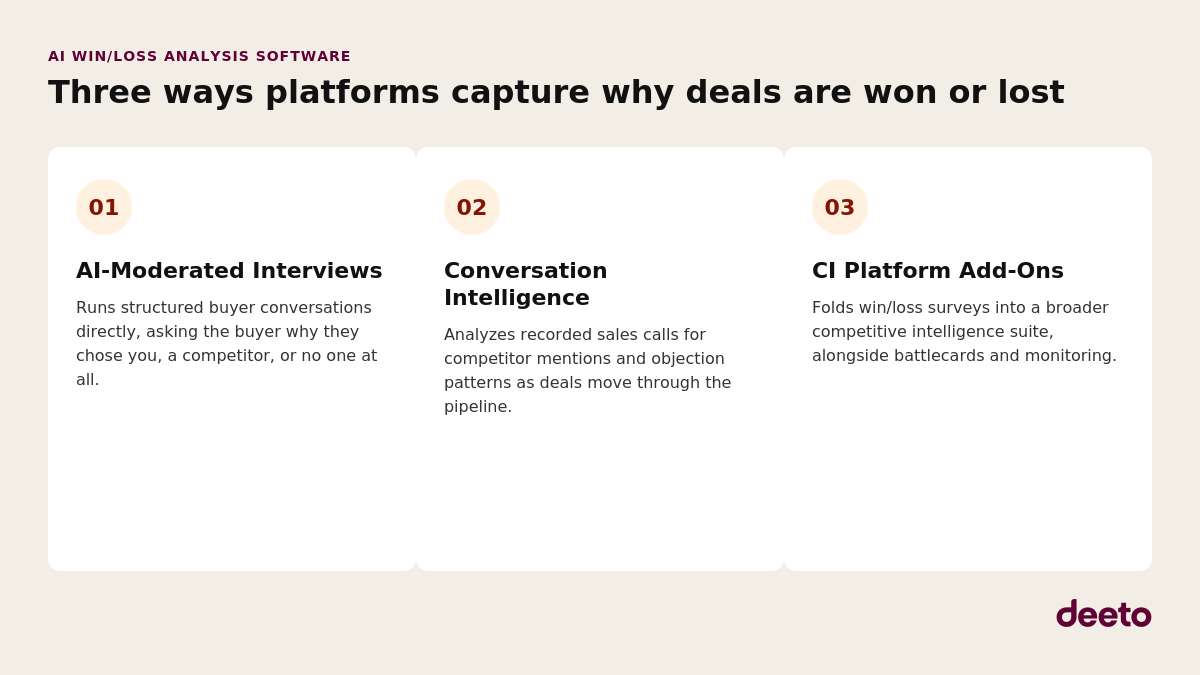
The category splits into a few distinct approaches. Some platforms run AI-moderated buyer interviews directly. Others analyze recorded sales calls for competitor mentions and objection patterns. A third group folds win/loss into a broader competitive intelligence suite. Each approach answers a slightly different question, and most revenue teams end up needing more than one.
Win/loss analysis software helps teams move past the internal guesswork that fills so many loss reason fields in the CRM. Sales reps and the buyers they lost to often disagree on what actually happened, which is exactly why direct buyer feedback matters more than internal notes.
Why AI Is Changing Win/Loss Analysis
For years, win/loss programs meant hiring a research firm, waiting six weeks for a batched report, and hoping the findings were still relevant by the time anyone acted on them. That model works, but it only covers a sample of deals and it arrives too late to change the deals already in flight.
Sales reps and buyers frequently see the same lost deal differently. Corporate Visions, based on an analysis of more than 100,000 B2B purchase decisions, found that sellers and buyers give different reasons for a deal's outcome 50 to 70 percent of the time. A CRM dropdown filled in by a rep is a guess wearing a data field's clothes. AI-moderated interviews close that gap by asking the buyer directly, at a fraction of the cost of a human-led program.
That shift also changed the economics of coverage. User Intuition, an AI interview platform, prices its win/loss conversations at roughly $20 each. Dedicated firms like Clozd and Primary Intelligence don't publish per-interview pricing, but structure programs as annual engagements instead, typically estimated at $50,000 or more a year. That structural difference, not just the sticker price, is why teams that used to sample 10 or 15 losses a quarter can now analyze every single deal that closes.
AI win/loss analysis software includes automated data capture, so no deal depends on a rep remembering to fill out a form. It includes pattern recognition across dozens or hundreds of deals instead of one-off anecdotes, and it includes a way to route findings into the tools sales, marketing, and product teams already use.
How to Evaluate AI Win/Loss Analysis Software
Before comparing specific platforms, it helps to know which criteria actually separate a good fit from an expensive mistake.
- Coverage vs. depth. AI-moderated interviews can cover every closed deal. Human-moderated research goes deeper on a handful of strategic losses. Decide which one matters more for your deal sizes.
- Where insights live after collection. A report that sits in a shared drive gets read once. Look for insights delivered directly into sales, marketing, and CS workflows instead of a static deck.
- Standalone tool vs. bundled module. Some platforms are purpose-built for win/loss. Others treat it as one feature inside a broader competitive intelligence or conversation intelligence suite. Neither is wrong, but a bundled module runs a fraction of the cost of a dedicated platform, and goes a fraction as deep.
- Turnaround time. Batch reports on a quarterly cadence versus findings that update as deals close changes how usable the data is for active pipeline.
- Cost per deal analyzed. Compare total program cost against how many deals actually get analyzed, not just the sticker price.
The 8 Best AI Win/Loss Analysis Software Platforms in 2026
Deeto
Deeto is an AI-native customer orchestration platform that runs continuous win/loss interviews on every closed deal, won or lost, and treats the resulting buyer voice as part of one connected system rather than a standalone report. Where most of the tools below live inside a single team's workflow, Deeto routes win/loss findings into the same intelligence layer that also powers customer advocacy, product feedback, and competitive insight. This is important because win/loss findings rarely stay useful to sales alone. A pricing objection that shows up in lost deals is also a product marketing problem and, often, a roadmap signal. Deeto has a 4.8 out of 5 star rating in G2.
Deeto's Listen module captures the interview, Learn organizes it alongside every other deal in one system of record, Activate pushes the relevant finding to the rep, marketer, or product manager who needs it, Analyze surfaces the patterns across all of them, and Orchestrate keeps that workflow running without anyone having to go looking for a quarterly deck.
Clozd
Clozd is the most recognized dedicated win/loss brand in the category, pairing a technology platform with a managed team of human interviewers. It holds a 4.8 out of 5 rating on G2. Clozd doesn't publish pricing, but third-party estimates place managed programs in the $50,000 to $150,000-a-year range with a 4 to 6 week turnaround per batch, which puts Clozd firmly in enterprise territory. It's the right call for large organizations that want to outsource the entire function and have the budget to do it well, but it's not built for teams that want insight the same week a deal closes.
Klue Win-Loss
Klue built its reputation in competitive enablement, then added win/loss capability by acquiring DoubleCheck Research, an established win-loss analysis provider, in January 2023. The Klue Win-Loss listing on G2 holds a 4.7 out of 5 rating. The advantage is workflow integration. Win/loss data lives next to the same battlecards reps already use for competitive deals. The tradeoff is that win/loss is one module inside a larger CI suite rather than the core product, so teams that want win/loss as their primary use case may find the depth thinner than a dedicated platform.
Crayon
Crayon is a broader competitive intelligence platform that has added win/loss capture alongside its core competitor-tracking features. It carries a 4.6 out of 5 rating on G2, with users consistently praising its ease of use and onboarding support. Crayon fits teams that want one place for competitor news, battlecards, and win/loss signals, but like Klue, win/loss is an add-on to a wider CI product rather than the primary focus.
Gong
Gong is the category-defining conversation intelligence platform, and many revenue teams already lean on it for win/loss signal even though that's not its primary purpose. It holds a 4.7 out of 5 rating on G2 and is used by companies including LinkedIn, ADP, Nasdaq, and Dropbox. Gong analyzes what happened on recorded calls, which is genuinely useful for spotting competitor mentions and objection patterns in flight. What it doesn't do is ask the buyer directly why they chose someone else, which is a different and often more candid source of truth than a transcript of the sales conversation alone.
User Intuition
User Intuition runs AI-moderated win/loss interviews at scale, drawing on a global panel of more than 4 million respondents to conduct interviews across 50-plus languages at roughly $20 per conversation. That price point is what makes it realistic to interview every closed deal instead of a sample, which is the core promise of AI-moderated win/loss in general. The tradeoff against a fully managed program like Clozd is that the depth of any single interview depends on how well the AI probes follow-up answers, rather than a trained human interviewer reading the room.
Perspective AI
Perspective AI positions itself around AI-moderated buyer interviews that aim to match the depth per conversation that traditional win/loss agencies built their reputations on, without the price tag or turnaround time. It fits teams that have outgrown a CRM dropdown but aren't ready for a five- or six-figure managed program. As with User Intuition, the category is new enough that a large, independently verified G2 review base is still building.
Primary Intelligence
Primary Intelligence is one of the longer-standing names in traditional, human-led win/loss research, and it's usually named alongside Clozd and DoubleCheck Research as one of the dedicated win/loss firms serving enterprise clients. It suits organizations that want a fully managed, consultant-style program and are comparing it directly against Clozd on service quality and account team fit rather than software features.
Key Takeaways
- AI win/loss analysis software falls into three lanes: AI-moderated interviews, competitive intelligence platforms with a win/loss module, and conversation intelligence tools repurposed for win/loss signal.
- Reps and buyers give different reasons for a deal's outcome 50 to 70 percent of the time, which is why direct buyer feedback beats a CRM dropdown.
- AI-moderated interviews make it realistic to analyze every closed deal instead of a quarterly sample, often at a fraction of the cost of human-led research.
- Dedicated win/loss firms like Clozd still make sense for high-stakes enterprise losses that benefit from a skilled human interviewer.
- The best fit depends on whether you need standalone win/loss depth, a module inside your existing CI stack, or findings connected to advocacy, product, and marketing systems across the business.
Frequently Asked Questions
What is AI win/loss analysis software?
AI win/loss analysis software uses AI-moderated interviews, transcript analysis, or CRM signal detection to explain why deals are won or lost, without requiring a fully manual, consultant-led research program. It lets revenue teams analyze every closed deal, not just a small sample, and surface patterns across dozens of deals instead of relying on a single rep's account of what happened.
How is AI win/loss analysis different from traditional win/loss consulting?
Traditional win/loss consulting relies on human interviewers and produces batched reports every quarter. AI win/loss analysis software automates data capture and interviews so every closed deal, not just a sample, generates insight in near real time.
How much does AI win/loss analysis software cost?
Pricing spans a wide range. AI-moderated interview platforms can cost roughly $20 per conversation. Dedicated human-moderated firms like Clozd and Primary Intelligence don't publish per-interview pricing, structuring programs as annual engagements instead, typically estimated at $50,000 or more per year, while CI suites with win/loss modules are usually custom-quoted.
Can AI win/loss software fully replace human-moderated interviews?
For most B2B teams, no. AI-moderated interviews are strong for coverage and speed across every deal, but high-stakes enterprise losses often still benefit from a skilled human interviewer who can probe political and relationship dynamics AI may miss.
What's the difference between win/loss software and competitive intelligence platforms?
Competitive intelligence platforms like Klue and Crayon center on tracking competitors and arming reps with battlecards, with win/loss as one input among several. Dedicated win/loss software centers on structured buyer feedback as the primary source of truth, and goes deeper on the reasoning behind each deal instead of just tracking what competitors are doing in the market.
Does Deeto offer AI win/loss analysis?
Yes. Deeto runs continuous, AI-led buyer interviews on every closed deal and connects the resulting win/loss intelligence to the same system that powers customer advocacy, product feedback, and competitive insight, so the findings reach every team that needs them.
Choosing the Right Platform for Your Team
The right AI win/loss analysis software depends less on which tool has the longest feature list and more on where win/loss fits into how your revenue and sales enablement team already works. If competitive intelligence is already the job, a module inside Klue or Crayon may be enough. If you need agency-level depth on a handful of strategic enterprise losses, Clozd or Primary Intelligence still make sense. If the goal is coverage across every closed deal, without the finding getting stuck in a slide deck sales never opens again, that's where a connected system like Deeto is built to help.
Read more on how win/loss analysis works in our complete guide to win/loss analysis, or see how to evaluate a customer intelligence platform if win/loss is one of several use cases you're solving for at once.
🎉 Save your spot
Register for the event
Once your spot is secured, we’ll send your confirmation details.
Subscribe to our newsletter
Subscribe to receive the latest blog posts to your inbox every week.
By subscribing, you agree to our Privacy Policy
Subscribe to our newsletter
Get the latest news and updates from our team.
By subscribing, you agree to our Privacy Policy
Related posts

How to Build a Customer Churn Model: A Guide for Businesses

What is a customer churn model? Learn how to build one, spot churn early, and win back at-risk customers.

How to Adapt Business Strategy to Changing Customer Behavior
What does it take to adapt business strategy to changing customer behavior? Learn the signals, the framework, and the ne

8 Best Case Study Software Tools for Customer Marketers
What is case study software? Compare 8 case study platforms for collecting, managing, and activating customer proof.