5 Benefits of Customer Marketing for Product-Led Businesses



Tuesday, June 9, 2026


5 Benefits of Customer Marketing for Product-Led Businesses


View the podcast on Youtube

Most B2B buyers read reviews before they take a sales call. They trust a peer's words over a vendor's claim. That is the core insight behind customer marketing, and it is why product-led businesses treat it as a growth engine, not just a nice-to-have.
Customer marketing is the practice of turning your existing customers' voices into A developer who talks publicly. The benefits extend well beyond social proof: when done right, customer marketing drives product improvement, accelerates sales cycles, and gives product-led teams a repeatable system for growth. This post breaks down five of those benefits and explains how to put them to work.
What is customer marketing?
Customer marketing uses the voice of existing customers to support acquisition, retention, and expansion. It includes testimonials, case studies, ROI data, advocacy programs, reference management, and voice-of-customer research.
For product-led businesses, it is especially powerful. When your product is the primary driver of growth, your customers' experiences are your most credible proof. Customer marketing systems help teams collect, organize, and activate that proof at scale, turning individual customer stories into a connected intelligence asset that works across sales, marketing, and product.
Customer marketing is frequently confused with customer success and customer experience. All three functions orbit the same customer relationship, but they have different goals, different outputs, and different owners. Blurring the lines between these is one of the most common reasons customer marketing never gets the dedicated investment it deserves.
Why customer marketing matters for product-led growth
Product-led growth (PLG) businesses rely on the product to acquire and expand users, but the product cannot do everything alone. Buyers still need proof that it works before they commit, especially at larger deal sizes or in competitive markets.
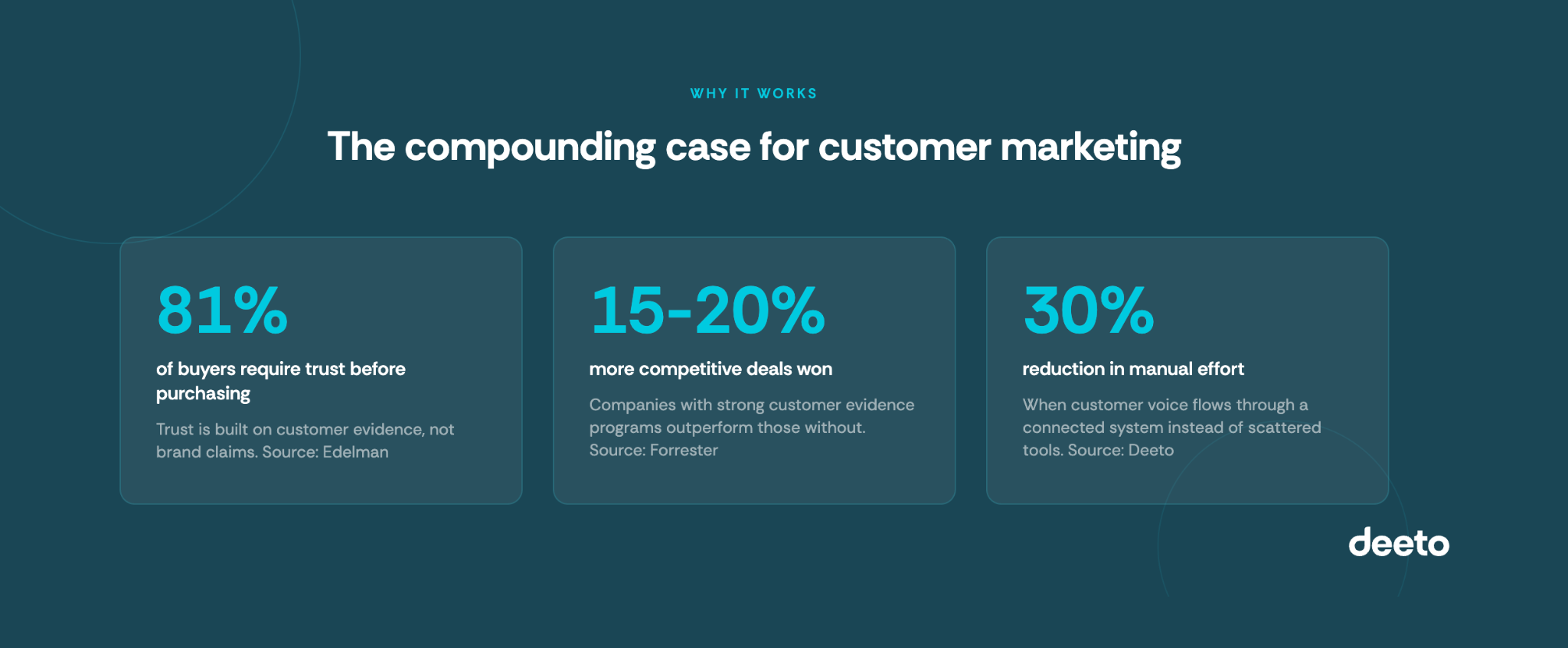
Customer marketing fills that gap. It provides the evidence layer that makes product-led motions more convincing. A well-run program gives sales teams real proof for competitive deals, gives product teams validated feedback, and gives marketing teams authentic content that outperforms anything produced in-house. Trust is built on evidence, not claims. That is exactly why the companies growing fastest in PLG are the ones with the best customer marketing infrastructure behind them.
5 benefits of customer marketing for product-led businesses
1. You get continuous, structured product feedback
Customer marketing is one of the most efficient sources of structured product intelligence for a product-led team. When your programs systematically collect feedback through surveys, interviews, advocacy interactions, and post-implementation check-ins, you build a data set product teams can actually use.
This is different from reactive feedback. Support tickets and Slack messages tell you what went wrong. A structured customer marketing program tells you what customers value most, which features drive retention, where onboarding breaks down, and what would make them renew without hesitation.
5 benefits of customer marketing for product-led businesses
Deeto's Listen module is built for exactly this, capturing authentic customer voice continuously so product teams have a real-time signal, not just an annual survey.
2. You build a proof library that scales sales
One of the most direct benefits of customer marketing is the proof it creates for sales. Testimonials, case studies, ROI data, and verified outcomes give sales reps something buyers actually trust.
Peer influence is not a soft variable in B2B buying. Buyers consult review sites, ask their networks, and look for proof that a product works in their specific context: their industry, their team size, their use case. If you cannot provide that proof when they go looking for it, you lose ground to competitors who can.
A customer proof library does not just help close new deals. It supports competitive displacement, accelerates deals in new verticals, and gives demand generation teams content that converts at a higher rate than anything written without a customer voice behind it.
Deeto's Stories and Social Proof use case collects, organizes, and activates this content across the full go-to-market motion, so the right proof reaches the right buyer at the right moment.
3. You retain customers by making them feel heard
Customer marketing is not only outward-facing. The programs you run to collect stories, conduct advocacy interviews, and gather feedback create a loop that customers notice. Being asked for their perspective, having their input shape the product, seeing their story used with care: these things build loyalty.
Retention is one of the most undervalued benefits of customer marketing. It is not just a renewals motion. It is what happens when customers feel connected to the company they chose, when they can see their feedback made a difference, and when they are treated as partners rather than data points.
For product-led businesses, this matters especially. When the product is the relationship, the moments between product interactions are where loyalty is either reinforced or lost. Customer marketing fills those gaps with intention.
Deeto's customer experience and value realization programs make customers feel heard at every lifecycle stage, not just when they are about to churn.
4. You create a faster path into new markets
Entering a new vertical or geography is one of the hardest things a product-led business does. You do not have the reference customers, the brand recognition, or the proof stories buyers in that market expect to see.
Deeto’s Listen module is built for exactly this
This compounds over time. The more diverse your customer base, the broader your proof library, and the faster you can credibly enter adjacent segments. According to TrustRadius's 2024 B2B Buying Disconnect Report, 56% of buyers had conversations with a product user before purchasing and that number rises to 71% for enterprise purchases. That gap exists because most teams collect customer stories reactively. The ones who build a system get the compounding advantage.
Win-loss analysis pairs well here. Understanding why you win in some markets and lose in others tells you exactly where to focus your customer marketing resources.
5. You turn customer advocates into a growth channel
The most advanced benefit of customer marketing is advocacy: turning satisfied customers into active participants in your growth. Advocates refer new business, join advisory boards, speak at events, write reviews, and take reference calls. Done well, advocacy becomes a channel in its own right.
For product-led businesses, advocates are particularly valuable because their credibility comes from direct product experience. According to TrustRadius That kind of proof is impossible to manufacture and hard for competitors to copy.
Advocacy programs build slowly and pay off for years. The key is a system that identifies potential advocates early, makes participation easy, and rewards engagement in ways that feel genuine rather than transactional.
Deeto's customer advocacy and reference management capabilities make advocacy a managed, measurable motion, not a side project owned by one person on the CS team.
How to get started with customer marketing
Getting started does not require a large team or a complex program. Most product-led businesses begin with three things:
- A listening system. A repeatable way to collect structured feedback from customers across the lifecycle, not just at renewal.
- A proof library. A centralized place to store and organize customer stories, testimonials, and outcome data so they can be found and activated quickly.
- An advocacy track. A lightweight program to identify customers who are ready to advocate and give them a simple way to participate.
The mistake most teams make is treating these as separate workstreams owned by different teams. Customer marketing works best when it connects customer success, product marketing, and sales enablement into a single system, one where every customer interaction generates intelligence and every piece of intelligence can be activated.
That is what customer marketing teams use Deeto for: a platform that connects listening, learning, and activation so the customer voice flows from conversation to decision without friction.
Key takeaways
- Customer marketing benefits include product improvement, faster sales cycles, higher retention, easier market entry, and a scalable advocacy channel.
- Product-led businesses benefit especially from customer marketing because their product's reputation is their primary growth asset.
- Structured customer feedback gives product teams a reliable signal for roadmap decisions, not just reactive noise.
- A proof library of customer stories and outcomes gives sales something buyers actually trust.
- Customer advocacy programs compound over time and create a growth channel competitors cannot easily replicate.
Frequently asked questions
What is customer marketing?
Customer marketing uses the voice, feedback, and success stories of existing customers to support acquisition, retention, and expansion. It includes testimonials, case studies, advocacy programs, and voice-of-customer research. For product-led businesses, it is how the product's real-world impact becomes a marketing asset.
What are the main benefits of customer marketing?
The main benefits include continuous product feedback, a scalable proof library for sales, stronger customer retention, faster entry into new markets, and a managed customer advocacy channel. Each compounds over time when supported by a consistent program and the right technology.
Why is customer marketing important for product-led businesses?
Product-led businesses rely on their product to drive growth, but buyers still need proof that it delivers results. Customer marketing provides the evidence layer: verified stories, outcome data, and peer-to-peer proof that fills the trust gap between product experience and purchase decision.
How does customer marketing improve customer retention?
Customer marketing improves retention by creating structured feedback loops that make customers feel heard. When customers see their input reflected in the product, and when their stories are used with care, they feel more connected to the company. That connection strengthens loyalty before the renewal conversation begins.
What is the difference between customer marketing and customer success?
Customer success focuses on helping customers achieve outcomes with the product, covering onboarding, adoption, and health management. Customer marketing converts those outcomes into proof, advocacy, and growth assets. The two work best when connected. Customer success identifies the stories, and customer marketing activates them.
How do you build a customer marketing program?
Start with a listening system to collect structured feedback, build a proof library to store and activate customer stories, and create a lightweight advocacy track to identify and engage potential advocates. The goal is connecting these three motions into one system so customer intelligence flows continuously from collection to activation.
🎉 Save your spot
Register for the event
Once your spot is secured, we’ll send your confirmation details.
Subscribe to our newsletter
Subscribe to receive the latest blog posts to your inbox every week.
By subscribing, you agree to our Privacy Policy
Subscribe to our newsletter
Get the latest news and updates from our team.
By subscribing, you agree to our Privacy Policy
Related posts

6 Best Customer Testimonial Software Platforms

What is customer testimonial software? Compare six platforms by price, format, and fit for B2B teams.

Best customer intelligence tools for B2B teams
What are customer intelligence tools? Compare 8 B2B options, collection methods, and how to pick the right fit.

Omnichannel Customer Engagement Tools: 8 Platforms Compared
Compare 8 omnichannel engagement platforms on channels, AI, and pricing, plus the gap automation can't fill.