Best AI Sentiment Analysis Tools for Customer Feedback



Friday, August 7, 2026


Best AI Sentiment Analysis Tools for Customer Feedback


View the podcast on Youtube

Collecting customer feedback is the easy part. Reading all of it is where teams drown. Support tickets, survey responses, reviews, call transcripts, it all piles up faster than any team can read it manually. Organizing and analyzing all of this customer feedback is the difficult part.
AI sentiment analysis tools are software platforms that use natural language processing and machine learning to automatically detect emotion, tone, and opinion in customer feedback, then classify it as positive, negative, or neutral. Instead of a person reading every review or ticket, the software scores sentiment at scale and surfaces the patterns underneath it. In this guide, you'll learn what these tools actually do, the features that separate the useful ones from the noisy ones, and how the top platforms compare.
What Is AI Sentiment Analysis
AI sentiment analysis is the process of using machine learning models to read unstructured text (or voice, once transcribed) and determine the emotional tone behind it. The output is usually a sentiment score, a category (positive, negative, neutral, or mixed), and increasingly, an emotion label like frustration, delight, or confusion.
Modern AI sentiment analysis tools go further than early keyword-matching systems. They use large language models to understand context, sarcasm, and intensity, not just individual words. A comment like "the onboarding took forever but support was incredible" gets parsed into two distinct sentiment signals instead of one flat score.
Sentiment analysis systems typically pull from a mix of sources: support tickets, NPS and CSAT surveys, product reviews, call transcripts, social mentions, and in-app feedback. The best tools connect that sentiment back to specific themes, features, or moments in the customer journey, so a team doesn't just know sentiment dropped, they know why.
Why AI Sentiment Analysis Tools Matter for Customer Feedback
Manual feedback review doesn't scale. A mid-size company can generate thousands of feedback data points a month across channels, and reading all of it consistently is not realistic for any team.
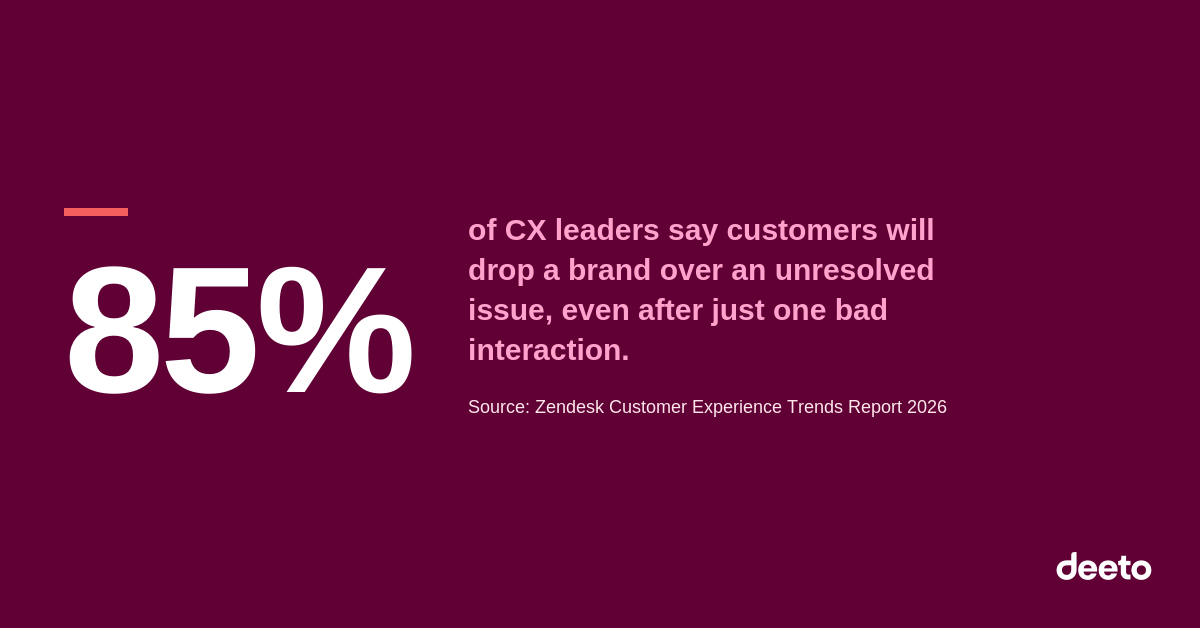
According to the Zendesk Customer Experience Trends Report 2026, 85 percent of CX leaders say customers will abandon a brand over unresolved issues, even after just one bad interaction. That is a narrow margin for error, and it only gets narrower without a system that flags negative sentiment before it becomes churn. A single dashboard number does not fix that. What closes the gap is sentiment data that is connected to the account, the rep, and the next action, so a flagged interaction turns into a follow-up instead of a missed signal.
The same report found that 61 percent of customers now expect more personalized service because AI can analyze their past interactions. Sentiment analysis is part of how that expectation gets met. It gives teams the ability to spot a shift in tone early, whether that's a champion going quiet before renewal or a spike in complaints about a specific feature, and respond before it shows up in the numbers.
Sentiment analysis tells you how customers feel. Connected to the right workflow, it tells you what to do about it.
Key Features to Look For in AI Sentiment Analysis Tools
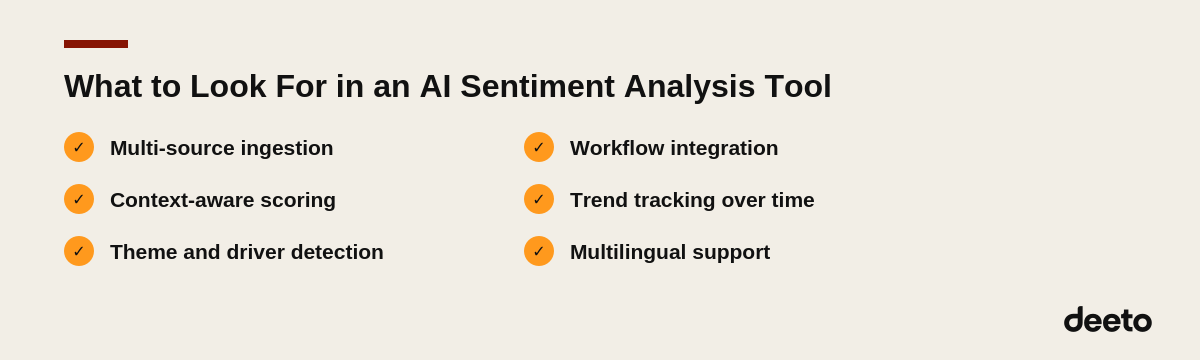
Not every sentiment analysis tool is built for the same job. Before comparing platforms, it helps to know which capabilities actually move the needle:
- Multi-source ingestion: The tool should pull from support tickets, surveys, reviews, calls, and in-product feedback, not just one channel
- Context-aware scoring: Look for models that catch sarcasm, mixed sentiment, and intensity, not just positive/negative keyword matching
- Theme and driver detection: Sentiment without a "why" is a number on a dashboard. The tool should tie sentiment to specific topics, features, or moments
- Workflow integration: Sentiment scores need to reach the people who can act on them, inside CRM, support, or CS tools, not buried in a report
- Trend tracking over time: A single sentiment score is a snapshot. Tracking sentiment across the customer lifecycle shows whether things are improving or declining
- Multilingual support: If feedback comes in from a global customer base, the tool needs to score sentiment accurately across languages, not just translate text
Best AI Sentiment Analysis Tools for Customer Feedback
Here's how the leading platforms compare on data sources, scoring approach, and where each one fits best.
Most of the tools above are built to score sentiment. Few are built to connect that score to the actual customer behind it, and fewer still route the insight to the team that can act on it. That's the gap Deeto is built to sit in, not one more sentiment tool, but the layer that ties sentiment scoring to real customer voice collected through interviews, surveys, and in-product feedback, then activates it across sales, marketing, and CS. A negative sentiment spike comes with the actual context behind it, and reaches the person who can do something about it.
Common Challenges With AI Sentiment Analysis
Even the strongest sentiment analysis tools hit the same walls.
- Sarcasm and mixed sentiment. A comment like "great, another outage" scores as positive under a basic keyword model. Context-aware models catch more of this now, but none of them get it right every time.
- A score with no reason behind it. If a dashboard says sentiment dropped 8 percent this month, that number alone doesn't tell anyone what to fix. Without theme detection tied to the score, it's just a chart nobody acts on.
- Data that doesn't talk to itself. Sentiment scored in a survey tool and sentiment scored in a support tool rarely get compared side by side, so the full picture of how one customer actually feels stays split across two systems.
- Alert fatigue. A tool that flags every negative comment as urgent teaches the team to stop reading the alerts. Prioritization has to matter as much as detection, or the system trains people to ignore it.
- Insight that's already stale. Sentiment pulled once a month misses the week a customer actually needed help. Real-time or near-real-time scoring is what closes that gap.
How to Choose the Right AI Sentiment Analysis Tool
A few questions narrow the list fast:
- What channels do you need covered? Support-only sentiment tools won't catch churn signals buried in a sales call or a product review
- Who needs to see this data? If sentiment insight stays in a CX dashboard, it won't reach product or sales. Look for tools with workflow integrations into the tools your teams already use
- Do you need sentiment or sentiment plus context? A sentiment score tells you what happened. Theme and driver detection tells you why, which is what actually informs a decision
- How fast does it need to move? Real-time alerting matters more for support and retention use cases. Trend analysis over time matters more for product and marketing use cases
- How is the customer's own voice preserved? The most credible insights come from feedback that keeps the actual language and context customers used, not just a normalized score
Teams evaluating options for customer success and retention workflows often find that the biggest gap isn't detection accuracy, it's whether sentiment data actually reaches the person who can act on it before the moment passes.
Key Takeaways
- AI sentiment analysis tools use NLP and machine learning to score customer feedback as positive, negative, or neutral, and increasingly detect specific emotions
- The best tools connect sentiment to a "why," not just a score, by tying it to themes, features, or customer journey moments
- 85 percent of CX leaders say customers will leave over unresolved issues, which makes early sentiment detection a retention tool, not just a reporting one
- Workflow integration matters as much as detection accuracy. Sentiment data that stays in a dashboard doesn't drive action
- Tools like Deeto pair sentiment scoring with authentic customer voice, so teams see the full story behind the number
FAQs
What is an AI sentiment analysis tool?
An AI sentiment analysis tool is software that uses natural language processing and machine learning to automatically detect the emotional tone in customer feedback, classifying it as positive, negative, or neutral. Modern tools also detect specific emotions and tie sentiment to themes or topics.
How accurate are AI sentiment analysis tools?
Accuracy varies by tool and data type, but modern large language model-based systems handle context, sarcasm, and mixed sentiment far better than older keyword-based systems. Accuracy typically improves when a tool is trained on domain-specific feedback rather than generic text.
What data sources can AI sentiment analysis tools use?
Most platforms can analyze support tickets, survey responses, product reviews, call transcripts, social media mentions, and in-app feedback. The strongest tools combine multiple sources into one unified sentiment view instead of scoring each channel separately.
Can AI sentiment analysis predict customer churn?
Sentiment analysis alone doesn't predict churn, but a sustained negative sentiment trend is one of the earliest and most reliable churn signals available. Tools that connect sentiment to account-level data and route alerts to CS teams turn that signal into an actionable retention workflow.
Is AI sentiment analysis different from Voice of Customer software?
Sentiment analysis is a capability, while Voice of Customer (VoC) software is a broader category that includes sentiment analysis alongside feedback collection, theme detection, and insight activation. Many VoC platforms, including Deeto, use sentiment analysis as one layer of a larger customer intelligence system.
Conclusion
Sentiment scores by themselves are just numbers. What makes AI sentiment analysis tools worth the investment is what happens after the score gets generated, whether the insight reaches the right team, comes with enough context to act on, and connects back to a real customer rather than an anonymized data point.
The right tool depends on the channels a business needs covered and how deeply sentiment needs to connect to daily workflows. For teams that want sentiment tied directly to authentic customer voice and activated across sales, marketing, and customer success, Deeto's platform is built to turn that signal into a decision, not just a dashboard. See how customer feedback becomes a product roadmap input, or book a demo to see sentiment analysis connected to real customer stories in action.
🎉 Save your spot
Register for the event
Once your spot is secured, we’ll send your confirmation details.
Subscribe to our newsletter
Subscribe to receive the latest blog posts to your inbox every week.
By subscribing, you agree to our Privacy Policy
Subscribe to our newsletter
Get the latest news and updates from our team.
By subscribing, you agree to our Privacy Policy
Related posts

Customer Proof Marketing: How B2B Companies Build Trust with Buyers

What is customer proof marketing? Learn the proof types, frameworks, and software that build B2B buyer trust.

How to Build a Customer Churn Model: A Guide for Businesses
What is a customer churn model? Learn how to build one, spot churn early, and win back at-risk customers.

How to Adapt Business Strategy to Changing Customer Behavior
What does it take to adapt business strategy to changing customer behavior? Learn the signals, the framework, and the ne