A resource and community space for modern marketers, sellers, and builders using customer voice to grow — together.
This hub is built for anyone who wants to do more with the voices of their customers. Whether you're scaling advocacy, building trust with proof, or rethinking how to go to market — you're in the right place.
How-to guides and playbooks for building with customer voice
Campaign-ready templates and swipe files
Benchmark reports and reference best practices
Event recordings, expert sessions, and community spotlights
Ask questions. Share ideas. Trade wins. This is your space.
You don’t have to figure this out alone. The Deeto community connects you with other leaders using customer voice to build better GTM motions, faster-growing brands, and smarter strategies. If you are interested in joining when it launches, sign up below.
Automate advocacy management workflows
Dynamically generate customer stories and social proof
Eliminate manual reference management
Track and report advocacy impact on revenue
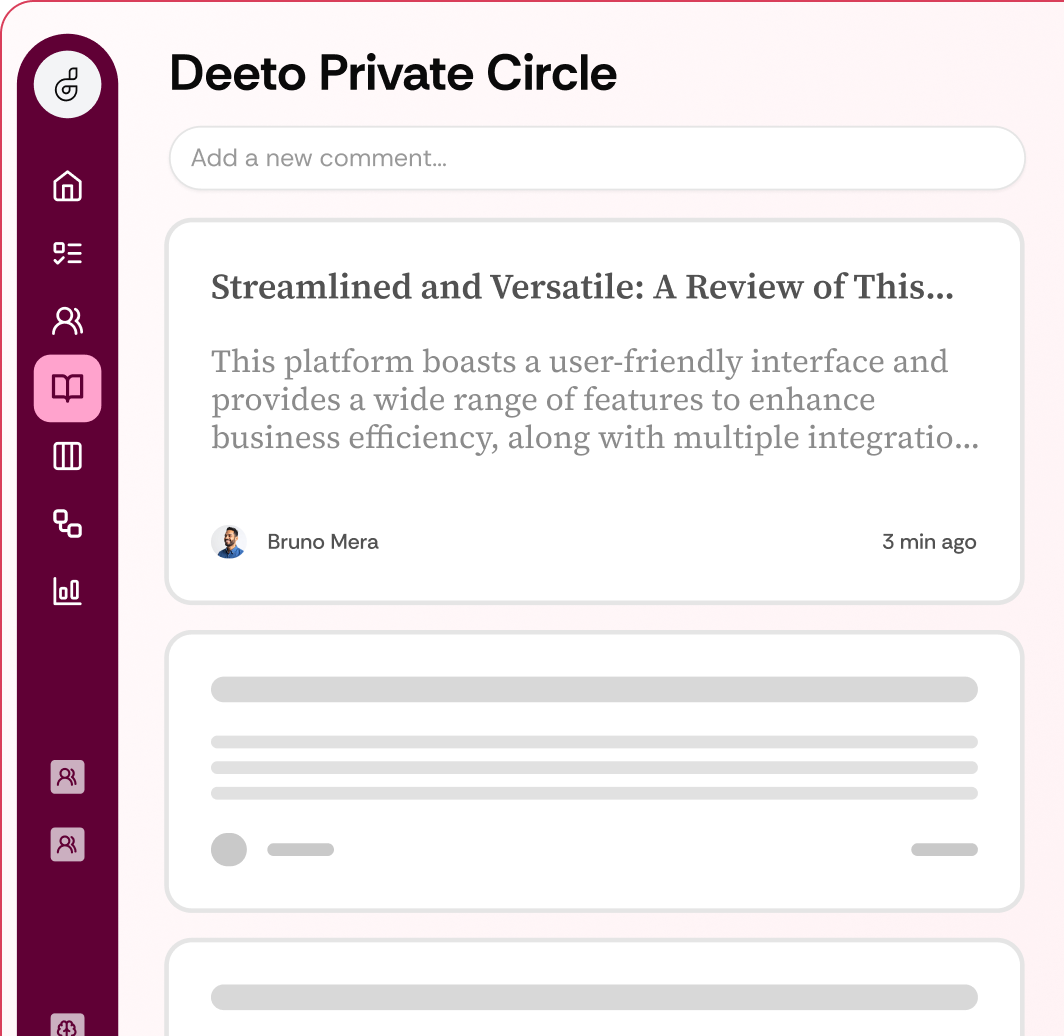
Discover practical guides, templates, and tools to help your team close more deals, faster.
Today marks an important milestone for Deeto.
We’re introducing a new evolution of the platform and a clear shift in how customer intelligence is built, shared, and acted on across modern organizations.
This is more than an update. It’s a rethinking of how customer insight should function inside the business.
Customer insight has expanded far beyond the systems originally designed to manage it.
What once came from periodic surveys or occasional reference calls now shows up everywhere: sales conversations, customer interviews, lifecycle campaigns, renewal discussions, and ongoing engagement. The challenge is no longer collecting feedback. It’s making sense of it, connecting it, and acting on it consistently.
Most teams still rely on a patchwork of tools and processes to do this work:
As a result, customer voice often informs decisions inconsistently or too late to matter.
We built the new Deeto to change that.
What this shift enables is something most teams have struggled to achieve at scale: continuous customer research.
Not research as a quarterly study or isolated initiative, but research as an always-on understanding of customer needs, sentiment, and context grounded in real interactions.
In this model, research is no longer separate from execution. It is embedded directly into how the business listens, learns, and acts.
At its core, Deeto is now an agentic platform for customer orchestration.
That means customer voice is no longer treated as static input or a collection of artifacts. Instead, it becomes a living system that continuously listens, learns, analyzes, and activates across teams.
In practice, this means Deeto actively monitors customer signals, connects context across people and accounts, and helps guide what should happen next as conditions change.
Customer orchestration ensures that:
The new Deeto experience is built around a simple operating model that reflects how insight should move through an organization.
Listen: Capture authentic customer voice continuously, not episodically, through AI-powered interviews and structured engagement that allow customers to share insights naturally and with context.
Learn: Organize customer intelligence around real entities such as accounts, contacts, and assets in a shared system of record that is structured, searchable, and accessible.
Analyze: Surface patterns, sentiment, and trends in real time so teams can answer the questions that matter now without digging through reports or tools.
Activate: Turn insight into action by orchestrating how customer intelligence flows directly into workflows across marketing, sales, customer success, and product.
This is not a linear journey. It’s a continuous loop that strengthens with every interaction.
Customer orchestration isn’t about serving one team better. It’s about aligning every team around the same source of truth.
With Deeto:
Customer intelligence is no longer a side system.
It’s becoming the operating system.
Learn more by checking out our launch event on-demand, or reach out and request a demo.


Deeto introduces a new agentic platform for customer orchestration—turning continuous customer intelligence into action
Customer voice has never been more available than it is today.
Organizations have access to more feedback, conversations, and customer signals than ever before. Sales calls are recorded. Surveys are automated. Reviews surface instantly. Customers are constantly sharing what they think, what they need, and what they value.
And yet, most companies still struggle to turn customer voice into meaningful action.
Not because they aren’t listening. But because listening alone isn’t enough.
For years, customer programs have focused on collection. More surveys. More feedback forms. More dashboards. More data.
What that has created is not clarity, but fragmentation.
Customer voice lives in too many places. Feedback sits in one system. Stories live in another. Engagement data is somewhere else entirely. Each team pulls what they need when they need it, often manually and often too late.
As a result:
The issue isn’t effort. It’s structure.
Most organizations still treat customer voice as a program owned by a single team. Customer marketing runs advocacy. Customer success manages sentiment. Product gathers feedback. Sales looks for proof when deals stall.
Each effort is well-intentioned. None of them are connected.
But customer voice doesn’t exist in silos. It spans the entire lifecycle. It shows up before a deal closes, during onboarding, throughout adoption, and at renewal. Its meaning only emerges when signals are connected across time, teams, and accounts.
This is where orchestration matters.
Customer orchestration means customer voice is not managed by one function. It is coordinated across the business through a shared system.
Orchestration connects:
Without orchestration, customer voice remains powerful but underutilized. With orchestration, it becomes a decision-making engine.
Traditional customer intelligence is static. It’s collected, stored, reviewed, and reported periodically.
Modern customer intelligence must be dynamic.
It needs to evolve as customers evolve. It needs to surface insight in real time. It needs to adapt to what each team needs in the moment they need it.
That requires moving beyond dashboards and point solutions toward a system that can:
This shift isn’t incremental. It’s foundational.
It changes customer voice from something teams check into something they operate from.
At Deeto, we’ve spent the last year rebuilding our platform around a simple belief: customer voice should be orchestrated, not managed.
Not as a campaign.
Not as a library.
But as a living system that listens, learns, and acts across the business.
In the days ahead, we’ll share more about this next chapter, including how customer orchestration changes the way teams operate and why it’s becoming a critical capability for modern organizations.
Customer voice is powerful.
Orchestration is what finally unlocks it.

Customer voice is everywhere, but action is rare. Learn why orchestration is the key to turning customer insight into re
If you're a PMM or customer marketing lead at a B2B company evaluating customer platforms, you've probably run into both Deeto and Base AI. They show up in the same searches, cover some of the same ground, and both use AI to automate the work your team used to do manually.
The real difference is not what each platform does. It is what the data is for.
Base is built for customer marketing teams running post-sale engagement programs. Deeto is built for the entire business that runs on customer signal including product, sales, CS, and marketing, drawing from one connected intelligence layer. If you are hiring a customer marketing platform, both are on your shortlist. If you are building customer voice as a system of intelligence that drives decisions across every team, that is a different evaluation.
Here is how each platform actually works, where they overlap, and where the difference matters.
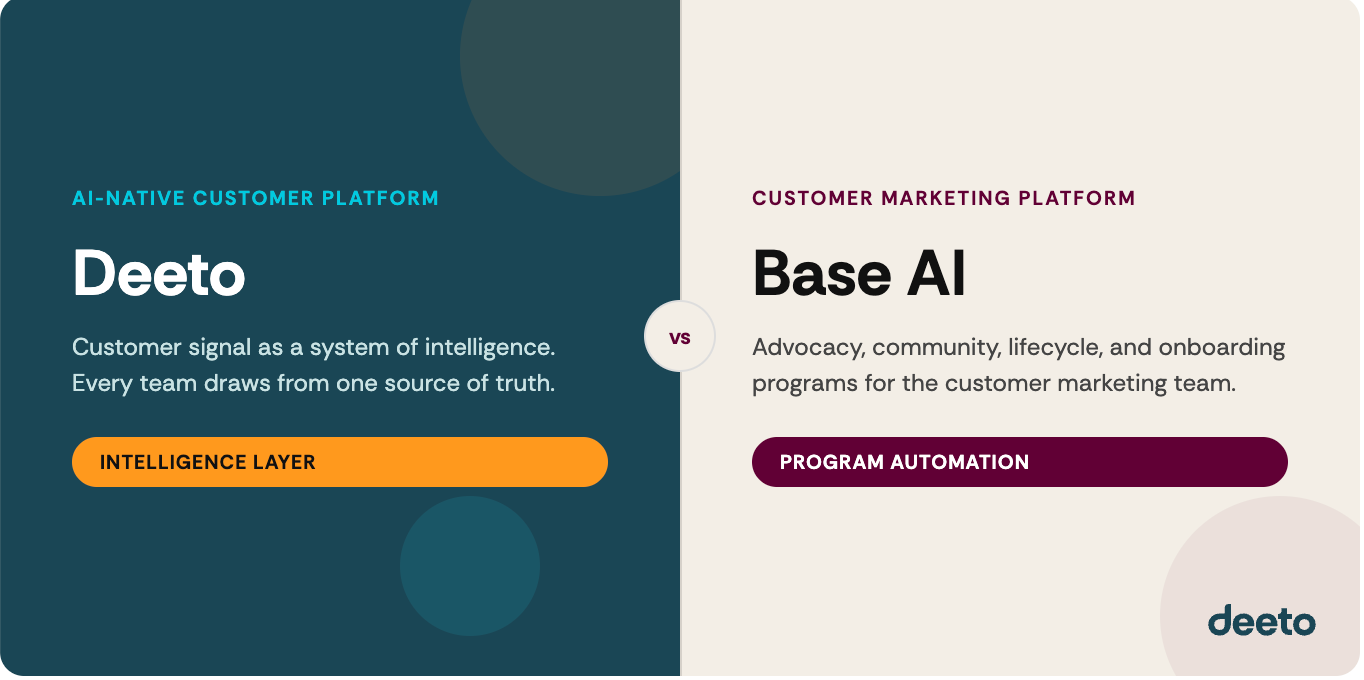
Deeto is an AI-native customer voice platform. It captures authentic customer voice continuously, organizes it into a connected system of record, and delivers the right intelligence or proof to the right team at the right moment inside the workflows they already use.
The platform is built around five connected modules: Listen (AI-powered interviews, surveys, and in-product microfeedback), Learn (a unified knowledge hub of companies, people, and assets), Activate (proof and intelligence delivered in-flow to sales, CS, and marketing), Analyze (sentiment, competitive signals, win/loss patterns, and product feedback themes), and Orchestrate (lifecycle campaigns, reference programs, referral management, and signal-driven automations).
The architecture is built around a single idea: customer voice is not a program owned by one team. It is the system of intelligence the whole business should run on.
Base AI is a customer-led growth automation platform. It is built for customer marketing and advocacy teams running post-sale engagement programs: references, advocacy campaigns, community, onboarding journeys, lifecycle marketing, and expansion motions. Base uses AI agents to coordinate across those programs and connects to a wide range of tools.
Base describes itself as "the AI Engagement OS for customer-led growth." The framing is accurate: it is a platform for the customer marketing function, with other teams as downstream beneficiaries.
Both platforms are credible. The differentiation is not about feature gaps. It is about what each platform is fundamentally built to do.
A buyer doing a feature-by-feature evaluation will find real parity here:
If your champion's only frame of reference is "advocacy platform," Base is a credible alternative. The differentiation comes from how the work gets done and what the data is actually for.
This is the sharpest line between the two platforms.
Deeto leads with low-friction AI interviews. Buyers and customers have a contextual conversation, and reference status or advocacy participation is offered after, never before. The primary output is a transcript of buyer perspective that feeds intelligence workflows across the entire organization.
Base's primary motions are advocacy programs, reviews, referrals, and customer-facing journeys.
For product marketing teams running positioning work, for sales leaders who need win/loss context, and for anyone who wants to understand what customers actually think rather than what they are willing to publicly endorse, that distinction matters. Deeto produces customer intelligence as a primary input. Base produces engagement activity.
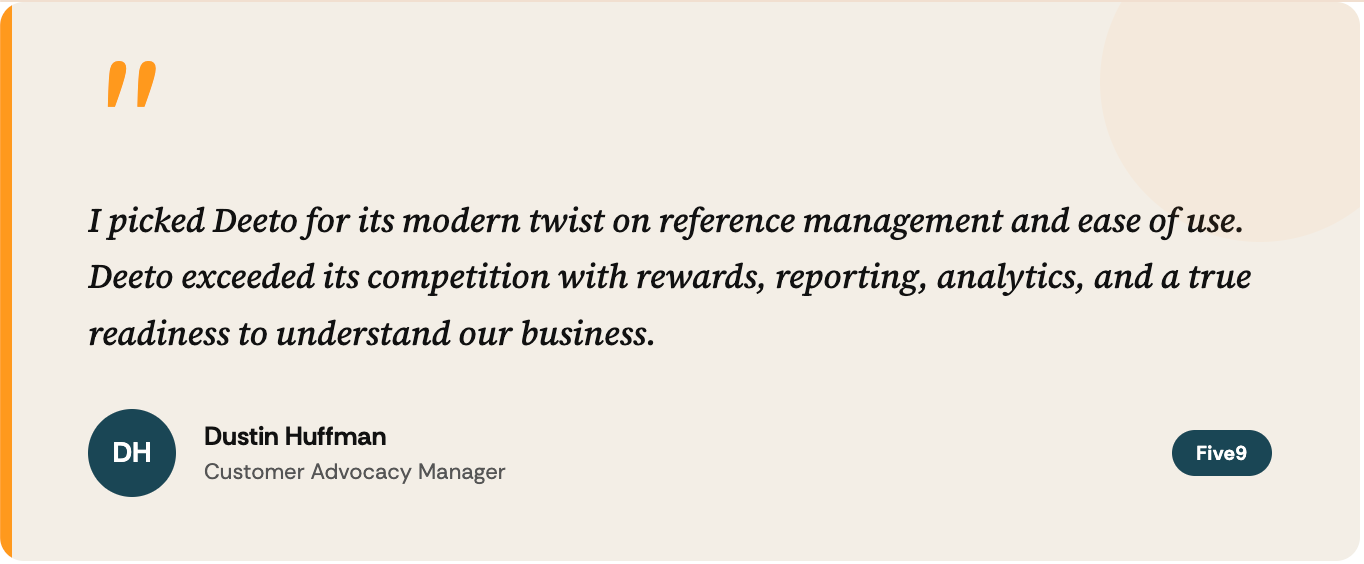
Dustin Huffman, Customer Advocacy Manager at Five9, put it this way after moving to Deeto: "I picked Deeto for its modern twist on reference management and ease of use. Deeto exceeded its competition with rewards, reporting, analytics, and a true readiness to understand our business."
Base is organized around the customer marketing function. Even the navigation reflects it: programs, advocacy, community. Other teams such as product, sales, or CS are described as beneficiaries of the programs customer marketing runs.
Deeto treats product marketing, customer marketing, CS, product, sales, and demand gen as equal first-class users of the same intelligence layer. Dashboards for win/loss, retention, NPS, product feedback, and competitive signals all live in one system. No team has to wait for another to extract and share what customers said.
Base's site emphasizes advocacy and community as its primary motions. Win/loss analysis is not front and center in how the platform is positioned.
Deeto's win/loss analysis capabilities are a core pillar. Salesforce-triggered AI interviews fire automatically when deals close or are lost, capturing full deal context from buyers while the conversation is still fresh. Responses are automatically tagged by competitor, reason code, and deal characteristics. That intelligence flows directly into PMM and sales workflows in real time.
For any team that wants competitive intelligence tied to live deal data, this is a clean advantage for Deeto.
Customer marketing is most powerful when it expands beyond the marketing team. Customer marketing may run reference programs, advocacy programs, and customer proof, but the output of that work is what sales teams, customer service, product and leadership depend on to do their jobs.
Deeto is built for exactly that scope. Customer marketing teams use Deeto to orchestrate an effort that reaches every revenue-generating function: surfacing the right reference for an open deal, feeding win/loss signal back to PMM, flagging expansion opportunities to CS, and connecting customer proof directly to pipeline. The work stays owned by customer marketing, but the impact shows up everywhere.
Deeto treats customer marketing as the team that connects customer intelligence to revenue across the entire business.
Both platforms claim a unified customer data layer. The architecture is different.
Deeto's Knowledge Hub structures the world as Companies, People, and Assets. Every quote, story, transcript, and reference is tied to a person and a company record with full participation history, approval status, and metadata. This record-of-truth model is what makes reference management scale: every piece of evidence is traceable, approvable, and findable without manual tagging or searching.
Base's unified data layer is organized around engagement data and account context and built for program management, not evidence management.
Deeto's Orchestration layer, which includes campaigns, signal-driven workflows, automations, and the agentic framework, is the layer that makes everything else continuous. A churn signal in Analyze triggers a CS outreach in Orchestrate. A closed-won deal triggers a win interview in Listen. A reference request in sales pulls matched advocates from Learn and logs the completed call back to the CRM opportunity.
Each module feeds the next. The intelligence compounds. That is what makes Deeto a system of intelligence rather than a set of tools that happen to share a login.
Base has a dedicated Community product and a Community Agent. If building a customer community is a primary priority, Base will feel like a more direct fit.
Base also has a productized onboarding journey solution with success plans and QBR frameworks. Deeto's CS story runs through campaigns and signal-driven workflows rather than a dedicated onboarding product.
Base has also built out a content and community presence around customer-led growth, including the CLG Playbook and related programs, that some buyers will encounter during research.
Both platforms connect to Salesforce and HubSpot natively. Deeto's CRM integration is bidirectional and built into the deal workflow; reference activity, interview completions, and customer signals log back to opportunity records automatically. Base also connects to a range of tools and positions itself as a coordination layer across a broader customer marketing stack.
On implementation timeline, both platforms typically take four to eight weeks to go live depending on CRM complexity and the number of programs being configured. Deeto customers generally go live on reference management and win/loss interviews first, then layer in advocacy and feedback programs.
On review sites like G2, Deeto is rated highly for ease of use, reference program management, and the quality of the AI interview output. Base is rated well for its advocacy program depth and community features. Both have strong customer satisfaction scores in their respective primary use cases.
If you’re still in research mode, these two resources might help: the Deeto product overview walks through each module in detail, and the customer reference program guide covers how to think about the program design before you pick a platform. Both are worth reading before you get on a call.
The question is not which platform has more features. It is which job you are actually trying to do.
If the job is running advocacy, community, and lifecycle engagement programs with a dedicated customer marketing team, Base is built for that motion.
If the job is building customer signal as a system of intelligence, one that fuels product positioning, competitive intelligence, win/loss analysis, retention signals, feedback loops, and reference management from one source of truth that every team can act on, that is Deeto.
Most B2B teams evaluating in this space find that program coordination is not the bottleneck. The bottleneck is that the voice of the customer is scattered, decisions get made without it, and no single team has a clear picture of what customers actually think, need, or are at risk of doing. That is an intelligence problem which Deeto is built to solve.
The Deeto vs Base AI comparison comes down to one question: do you need a customer marketing platform, or do you need customer voice as a system the whole business runs on?
Base is a well-built answer to the first question. Deeto is the answer to the second.
If your PMM still has to go find their own source of truth when building a launch narrative, if your sales team is pinging marketing at 4pm on a Friday for a reference, if your product team has no real-time signal on what customers actually want next, those are not advocacy program problems. They are an intelligence gap.
Deeto closes it. The reference program capabilities are strong because they sit on top of a knowledge hub that structures every customer relationship as a record of truth, not a list of willing participants.
See how it works on a real use case. Book a demo with Deeto and bring your actual workflow to the conversation.
What is the main difference between Deeto and Base AI?
Deeto is an AI-native customer voice platform that captures buyer perspective continuously, organizes it into a cross-functional system of record, and surfaces intelligence and proof across product, sales, CS, and marketing. Base AI is a customer-led growth automation platform built primarily for customer marketing teams running advocacy, community, and lifecycle engagement programs. Both do reference management and advocacy. The difference is what the data is built for and who in the organization can act on it.
Does Deeto compete with Base AI directly?
They overlap significantly on reference management, advocacy, and customer evidence capture. A feature-for-feature comparison will show real parity in those areas. The distinction is architectural: Base is organized around customer marketing programs; Deeto is organized around customer voice as cross-functional intelligence. For teams that need win/loss analysis, product feedback loops, and competitive signals alongside their advocacy and reference programs, Deeto covers that ground in one platform.
Which platform is better for product marketing teams?
Deeto is purpose-built for product marketing as a first-class user. The Analyze module surfaces competitive signals, win/loss patterns, sentiment trends, and product feedback themes from the same data layer that runs reference and advocacy programs. Product marketing teams use Deeto to ground launch messaging in real customer evidence rather than assumptions. Base surfaces some PMM-relevant data but is primarily organized around customer marketing program management.
How does Deeto handle win/loss analysis?
Deeto's win/loss capability is native and CRM-triggered. When a deal closes or is lost in Salesforce or HubSpot, Deeto automatically fires an AI-powered interview to the buyer capturing deal context while it is still fresh. Responses are tagged by competitor, reason code, and deal characteristics automatically. That intelligence flows into PMM and sales workflows in real time. This is a core platform capability, not an add-on.
Is Base AI better for community building?
Base has a dedicated Community Agent and customer hub product that Deeto does not match directly. If building and managing a customer community is a primary objective, Base is the more direct fit. Deeto is focused on customer signal capture, intelligence, and activation rather than community engagement as a standalone motion.
What does Deeto's Knowledge Hub do that Base does not?
Deeto's Knowledge Hub structures every customer relationship as a record of Companies, People, and Assets. Every quote, transcript, story, and reference is tied to a person and company record with full participation history, approval status, and metadata. This is what makes evidence management and reference matching work at scale without manual overhead. Base's unified data layer is organized around engagement activity and account context rather than an evidence record-of-truth model.
How long does it take to implement Deeto vs Base AI?
Both platforms typically take four to eight weeks to go live, depending on CRM complexity and program scope. Deeto customers generally start with reference management and win/loss interviews, then layer in advocacy and feedback. Base customers often configure multiple program types in parallel. Either way, you should expect a structured onboarding process rather than a self-serve setup.

Deeto vs Base AI: two different bets on what customer voice is for. Here's how they compare across intelligence, advocac
Most tools in the customer evidence space will tell you they help you "turn customers into advocates." The pitch sounds the same. The demos look similar. And then you get six months in and realize the tool was built for a different job than the one you're actually doing.
That's what makes evaluating tools in this space harder than it looks. It's not a feature checklist problem. It's a philosophy problem. UserEvidence was built around a specific thesis: that the gap between having happy customers and using them in sales cycles is fundamentally an evidence distribution problem. Surveys, verification, enablement sync. That model works well for certain teams.
But a lot of B2B marketing and CS teams don't just need proof distributed. They need customer voice understood. They need it connected to product decisions, renewal conversations, messaging strategy, and competitive positioning, not just pushed into Seismic before a deal closes.
This post covers six UserEvidence alternatives and is direct about what each one actually does well, and where each one falls short.
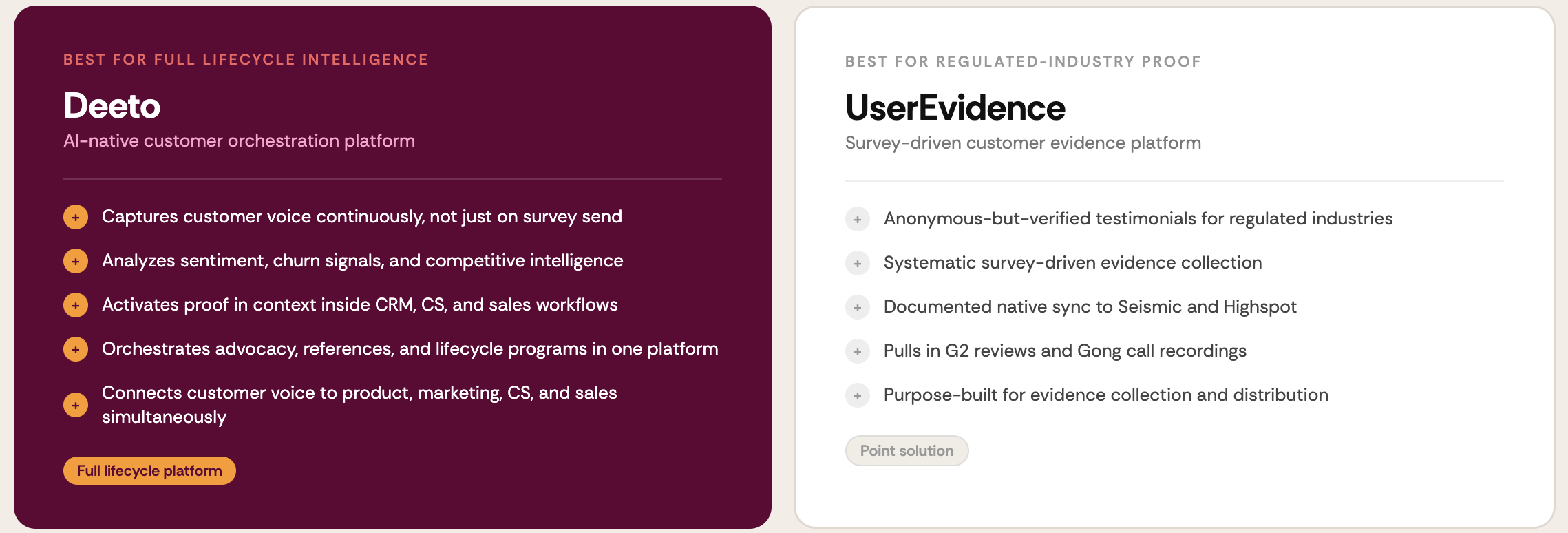
UserEvidence is a customer evidence platform. It collects proof through surveys, pulls in G2 reviews and Gong call recordings, organizes that content by segment and use case, and syncs it into sales enablement tools like Seismic and Highspot. Its strongest differentiator is anonymous-but-verified testimonials for regulated industries, where customers won't go on record but buyers still need credible social proof.
For a product marketer at a cybersecurity company trying to build a proof library that sales can actually use, UserEvidence is a solid fit. The survey-driven collection model is systematic, the enablement integrations are documented, and the verification methodology gives enterprise buyers something to trust.
Where it stops: UserEvidence is a collection and distribution system. It doesn't capture voice continuously. It doesn't analyze signal across the customer lifecycle. It doesn't connect what customers say to what your product team prioritizes or what your CS team sees in a renewal risk conversation. If those are the jobs on your list, you're going to outgrow it.
Deeto is built around a different premise than UserEvidence. Where UserEvidence starts with the question "how do we collect and distribute proof," Deeto starts with "what does customer voice actually tell us, and how do we connect that intelligence to every team that acts on it."
That difference shapes everything about how the platform works.
Deeto's Listen module captures customer voice continuously, through AI-powered interviews, surveys, in-product microfeedback, and structured question sets. Not as a one-time survey campaign. As a live feed of signal that flows into everything else.
From there, the platform's Learn module organizes that intelligence into a connected system of record, tied to companies, contacts, and assets, so the knowledge compounds over time instead of sitting in a spreadsheet someone exports once a quarter.
The Analyze module turns that voice into intelligence. Sentiment patterns, competitive signals, churn indicators, product feedback clusters. The kind of output that changes how a PMM builds a launch narrative or how a CS team approaches a QBR, not just which case study gets attached to a deal.
Activate delivers the right customer insight to the right person at the right moment, inside the workflows they're already using. And Orchestrate ties it together: lifecycle automations, reference management, advocacy programs, referral coordination, all running without manual overhead.
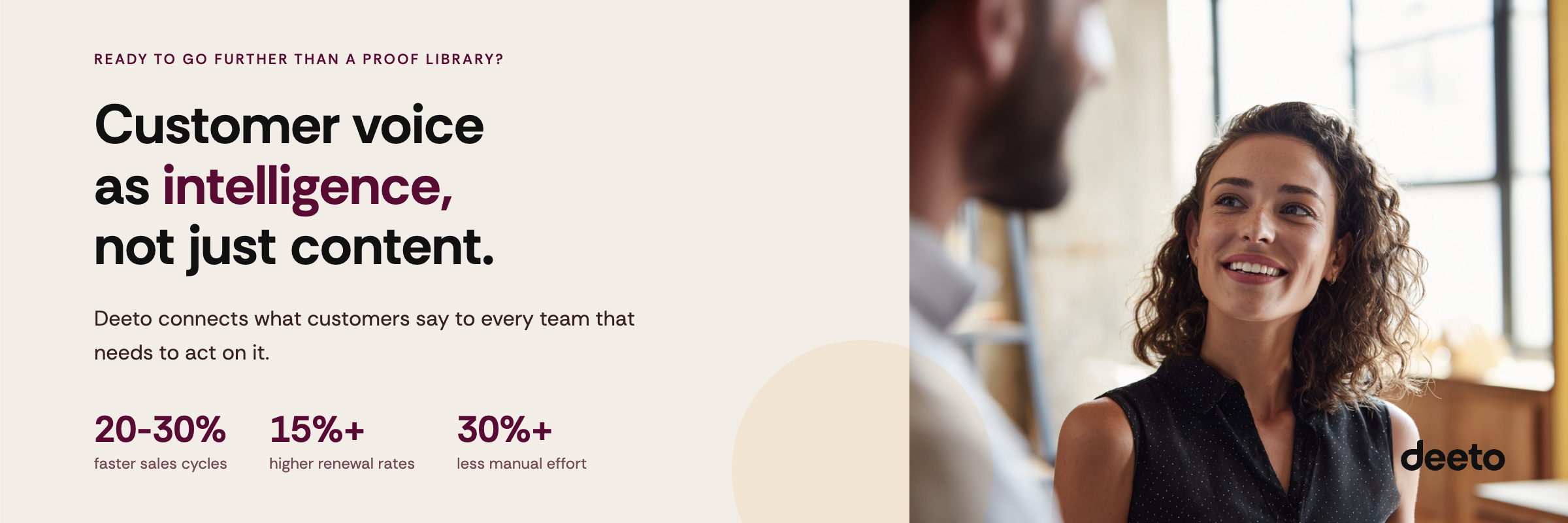
The practical result: teams using Deeto report 20-30% faster sales cycles, 10-15% higher renewal rates, and 30%+ reduction in manual effort across customer marketing and sales workflows. Those numbers come from having intelligence connected to action, not just evidence available somewhere.
Deeto makes sense when your team has moved past "we need a proof library" and into "we need a system that makes every team smarter about customers." See the platform.
Best for: Product marketers building messaging grounded in real customer signal. Customer marketers running lifecycle advocacy programs. CS teams that want early visibility into risk and expansion before it becomes a fire drill. Sales teams that need proof in context, not proof in a folder.
Where UserEvidence has an edge: If anonymous-but-verified testimonials for regulated industries are the primary requirement, UserEvidence's verification methodology is purpose-built for that problem.
Influitive builds gamified customer communities where advocates complete challenges, earn badges, and stay engaged over time through reward mechanics. It's a program-depth play: multi-tier advocacy journeys, user-generated content campaigns, community spaces where customers interact with each other and your team.
The honest assessment is that Influitive works well when you have a dedicated advocacy manager, a large enough customer base to keep a community active, and the appetite for a heavy implementation. When those conditions are met, the engagement depth is real.
When they're not: reviews consistently flag an interface that feels dated, login friction for customers in multiple programs, and content repository limitations that make proof distribution harder than it should be.
Best for: Enterprise teams with a dedicated program manager and a long-horizon community strategy.
Not the right fit if: Your team is lean, your primary job is connecting customer voice to pipeline, or you need fast time to value.
ReferenceEdge is a Salesforce-native reference management app. The pitch is simple: if your team lives in Salesforce and needs reference operations to live there too, ReferenceEdge puts request routing, fulfillment tracking, and revenue influence reporting directly inside your CRM without requiring anyone to context-switch.
The Salesforce integration is genuine and well-built, and for teams whose workflows live entirely in CRM, that focus is a feature rather than a limitation. Teams that rely on Seismic or Highspot as primary distribution channels may find the content-sharing features less developed, and reviews note that setup takes meaningful time to get right.
Best for: Sales operations and revenue teams where Salesforce is the single system of record and reference tracking needs to live there.
Not the right fit if: You need broader evidence distribution, customer voice capture, or lifecycle advocacy alongside reference coordination.
SlapFive combines reference management with customer story organization and Salesforce integration. The platform lets you build content hubs organized by segment, track how customer stories influence pipeline, and run reference programs with bi-directional CRM sync.
The AI automation layer is built on an underlying workflow framework that's powerful but not self-serve. Configuring new automations typically requires SlapFive team involvement rather than in-platform customization, which is a meaningful constraint for teams that want to iterate quickly on their own.
User reviews from the 2025 Customer Marketing Technology Landscape Report scored technical support at 3.5/5 and product reliability at 3.8/5. A small vendor team means focused attention, but also limited bandwidth as your needs grow.
Best for: Teams that want Salesforce-centric reference management with customer story organization and are comfortable co-building workflows with the vendor.
Not the right fit if: You need self-serve workflow configuration or a platform that scales without close vendor involvement.
Zuberance is built for referral programs and advocate activation with rewards mechanics. The Shopify integration makes it a reasonable fit for e-commerce use cases. For B2C brands that want customers to share content and refer new buyers through lightweight advocacy programs, the activation and reward mechanics are straightforward.
In B2B contexts, the lack of CRM integrations is a hard constraint. If your reference coordination, advocacy tracking, or proof distribution needs to connect to Salesforce or tie into a sales workflow, Zuberance creates friction at exactly the point where you need the system to be seamless.
Best for: B2C or e-commerce teams running referral campaigns where CRM connectivity isn't a requirement.
Not the right fit if: You operate in enterprise B2B, need to track advocacy influence in Salesforce, or want reference coordination as part of the program.
Peerbound ingests call recordings from tools like Gong, Chorus, and Clari, plus CRM data, and uses AI to identify potential advocates, generate testimonial content from those conversations, and distribute it to sales via Slack and email. It's the most lightweight option in the category, and usually the least expensive.
The ceiling shows up quickly. Reviews note ongoing maintenance requirements, limited integrations beyond the core workflow, and complexity with Salesforce parent-child account structures. It's a reasonable entry point for a customer marketer with a small budget who needs to capture testimonials from calls without standing up a full platform.
Best for: Small teams with tight budgets who need basic testimonial capture from existing calls and can live without governance, attribution, or deep enablement integrations.
Not the right fit if: You need lifecycle intelligence, reference coordination, or any reporting that connects advocacy activity to revenue.
The honest frame for this category: most of these tools solve one specific problem reasonably well. UserEvidence solves evidence distribution. ReferenceEdge solves Salesforce-native reference tracking. Influitive solves long-horizon community engagement. Peerbound solves lightweight testimonial capture from calls.
Deeto is the only platform in this list that treats customer voice as an input to a connected intelligence system rather than content to be collected and distributed. That difference matters when your team's job is bigger than building a proof library. It matters when customer advocacy, competitive intelligence, product feedback, churn prediction, and sales enablement all need to draw from the same source of truth about what customers actually think and need.
If you're evaluating UserEvidence alternatives because your current setup doesn't connect those dots, that's the question worth centering your evaluation on. Not which tool has the longest feature list, but which one is built around the same job you're actually trying to do.
What is UserEvidence used for?
UserEvidence is used to collect, organize, and distribute customer evidence in B2B sales and marketing contexts. Teams use it to gather verified testimonials through surveys, pull in G2 reviews and Gong recordings, and sync proof into sales enablement tools like Seismic and Highspot. Its strongest use case is building proof libraries for sales teams and generating anonymous-but-verified testimonials for regulated industries where customers can't go on record publicly.
What's the difference between a customer evidence platform and a customer orchestration platform?
A customer evidence platform collects proof and makes it accessible in sales workflows. A customer orchestration platform like Deeto does that, and also captures voice continuously, analyzes it into intelligence, surfaces it across product, CS, and marketing, and runs the programs and automations that keep customers engaged over time. The evidence platform answers "what proof do we have." The orchestration platform answers "what do customers actually think and what should we do about it."
Which UserEvidence alternative is best for small teams?
For small teams that need more than just testimonials, Deeto's orchestration layer is specifically designed to reduce manual effort across customer marketing and CS workflows, making it viable without a large headcount. The tradeoff is scope: Deeto delivers more value the more of the customer lifecycle you connect.
What should I evaluate before switching from UserEvidence?
Start with the job that isn't getting done. If the gap is that customer voice isn't connected to product decisions or renewal conversations, a different distribution tool won't close it. If the gap is that your sales team can't find the right proof fast enough, look closely at how each platform handles activation inside existing workflows. And if the gap is advocate burnout from over-asking, look at how each platform tracks reference usage and manages engagement over time. Map the actual problem before evaluating features. Book a demo with Deeto to walk through a real use case side by side.

Exploring UserEvidence alternatives? See 6 platforms for customer evidence, advocacy, and voice intelligence compared.
Searching for Deeto alternatives usually starts the same way. A team needs to justify budget, a stakeholder wants a comparison, or someone saw a competitor tool mentioned in a Slack thread. So you open a few tabs, scan a few listicles, and try to figure out whether you're looking at the right tool for the job.
Here's what most of those comparisons miss: the question is rarely "which tool is cheapest" or "which has the most features." The real question is whether your platform can turn customer voice into connected intelligence and action, not just collect it.
Deeto alternatives exist. Some of them do specific things well. But if what you need is a full platform that listens to customers, learns from them, activates that intelligence across sales and marketing, and orchestrates the entire customer voice lifecycle, the comparison gets short fast.
This article gives you an honest look at the tools that come up most when teams search for Deeto alternatives, what each one is actually built for, and where Deeto covers all of it in one place.
Deeto is an AI-native customer orchestration platform that turns authentic customer voice into connected intelligence and action. It is not a testimonial widget or a reference ticketing system. It is a full operating layer for how companies understand customers, activate their stories, and use that intelligence to grow.
The platform runs across five modules: Listen (AI-powered interviews, surveys, and in-product feedback), Learn (a searchable system of record for all customer intelligence), Analyze (sentiment, trends, and patterns across the entire customer base), Activate (delivering the right proof or insight to the right person at the right moment), and Orchestrate (the automations and workflows that keep it all running).
Being honest here: teams search for alternatives because they want to pressure-test the decision or explore whether a cheaper point tool can get the job done. That's a fair thing to explore.
The honest answer is that most point tools solve one problem and create three more. A reference management tool gives you reference routing but no voice capture. A testimonial platform gives you quotes but no intelligence layer. A community platform keeps advocates busy but doesn't connect any of that to pipeline.
The teams that stay with Deeto do so because they need the whole system, not just a piece of it.
That said, here are the platforms that come up most in comparison conversations, with a clear breakdown of what they actually do best.
Influitive is a gamified advocacy platform. It runs engagement programs through badges, leaderboards, challenges, and community spaces where customers interact with each other and your team over time.
Where it fits: Teams that have a dedicated customer marketing manager, a large enough customer base to sustain community dynamics, and a budget for ongoing program management often find Influitive useful for structured advocacy engagement.
Where it falls short: Influitive's strength is the hub experience. But it does not capture customer voice for product or competitive intelligence, it does not connect advocate activity to pipeline in meaningful ways, and its user interface has drawn consistent criticism for feeling dated. Managing the program is a significant operational commitment.
Deeto covers this and more. Deeto's customer advocacy module runs structured advocacy programs without requiring a separate community platform. Advocates can be segmented, activated for specific campaigns, and connected to reference and referral workflows, all within the same system where you are listening to and learning from those same customers. You get the engagement without the overhead.
Base is a customer marketing platform built around advocacy programs, reference management, lifecycle campaigns, and community engagement. It covers a broad scope of customer marketing activities and positions itself as a platform for customer-led growth, with AI layered across its workflows to surface insights, recommend advocates, and automate campaign creation.
Where it fits: Customer marketing teams that need a broad platform for running advocacy campaigns, managing references, tracking engagement, and connecting customer activity to revenue influence will find Base covers a lot of ground. It integrates with Salesforce and other CRM tools, and its 400-plus connector ecosystem gives it flexibility across many tech stacks.
Where it falls short: Base is built around customer marketing execution, not continuous customer intelligence. It can run campaigns and track advocacy activity, but it does not deeply analyze customer sentiment at scale, identify churn signals from voice data, or give your product and CS teams a living intelligence layer drawn from authentic customer interactions. The focus is on activating customers, not on systematically learning from them across the entire organization.
Deeto covers this and more. Where Base runs customer marketing programs, Deeto runs the full customer voice lifecycle. Deeto's Listen module captures ongoing voice from interviews, surveys, and in-product feedback, while the Analyze module turns that voice into patterns and intelligence your product, CS, and marketing teams can act on. Advocacy, reference management, and lifecycle campaigns are all available in Deeto too, but connected to a deeper intelligence layer that Base does not offer. The result is a platform where the same customer voice that fuels your advocacy programs also informs your roadmap and sharpens your competitive positioning. That connection is what separates an orchestration platform from a campaign tool.
ReferenceEdge is a Salesforce-native app built specifically for reference request routing, fulfillment tracking, and reporting inside your CRM. If Salesforce is your system of record and you want reference operations to live there without a separate tool, ReferenceEdge does that job.
Where it fits: Enterprise teams that live in Salesforce and need structured reference workflows that surface inside opportunity records.
Where it falls short: ReferenceEdge is reference management only. It does not capture customer voice, generate content, run advocacy programs, or do anything outside of Salesforce. Implementation is known to be complex, and teams that also use Seismic or Highspot often find limited overlap with their enablement stack.
Deeto covers this and more. Deeto's reference management module handles the entire reference lifecycle, from identifying the right reference based on deal parameters, to protecting against customer burnout through usage controls, to tracking revenue influence. It also integrates with Salesforce. The difference is that your reference pool in Deeto is constantly refreshed by active listening and engagement, not just managed manually.
Deeto: Full customer voice lifecycle, AI-native platform, all five modules (Listen, Learn, Analyze, Activate, Orchestrate). Best fit for teams that need a connected system, not a collection of point tools.
Influitive: Gamified advocacy hub and community engagement. Best fit for teams with a larger budget for dedicated advocacy program management.
Base: Broad customer marketing platform covering advocacy, references, lifecycle campaigns, and community. Best fit for teams whose primary job is running customer marketing programs and connecting that activity to revenue reporting.
ReferenceEdge: Salesforce-native reference routing and fulfillment. Best fit for enterprise teams where all workflows must live inside Salesforce.
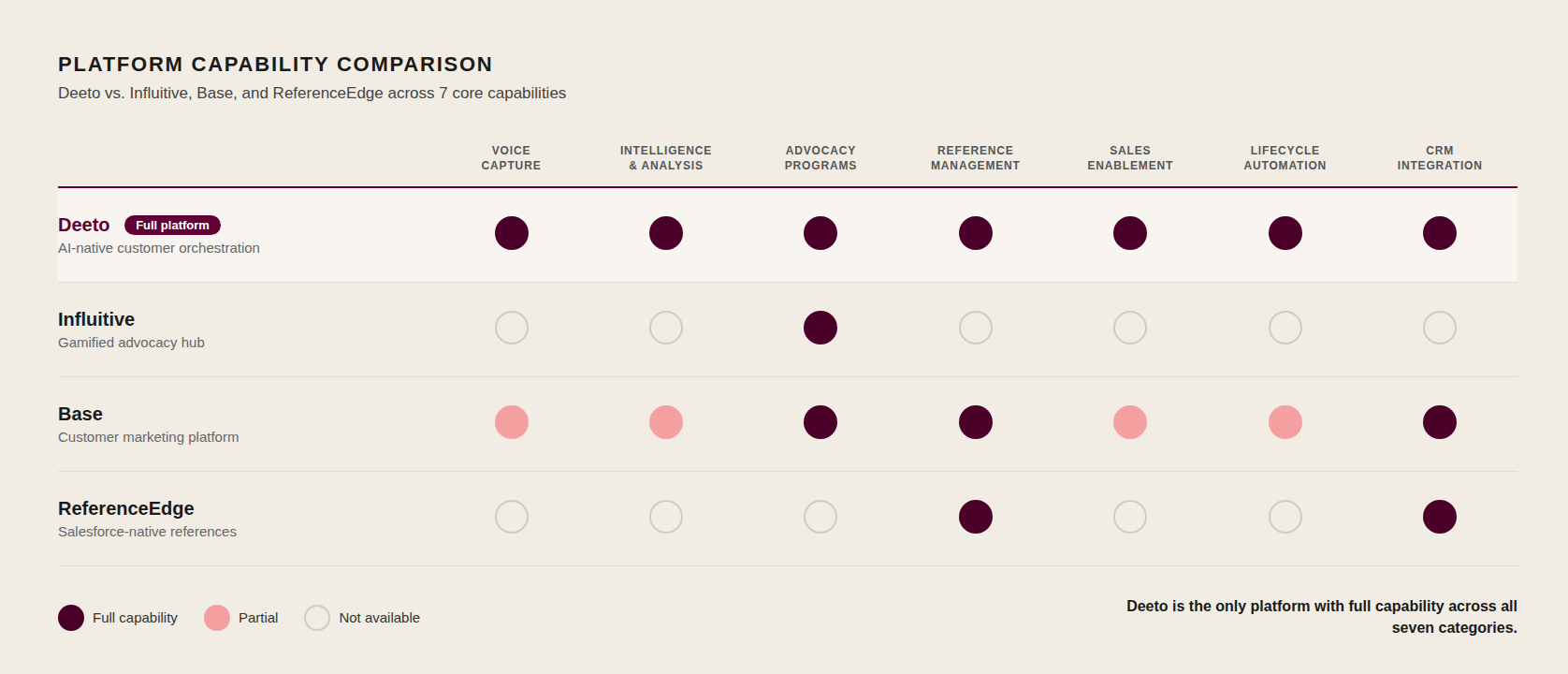
Most teams searching for Deeto alternatives are not actually looking to replace the platform. They are trying to understand the landscape. That is a smart thing to do.
The question worth asking is not "which of these tools is cheaper" but "which of these tools connects customer voice to the decisions that actually move the business." That includes your product marketing team building messaging from real evidence, your sales team getting proof at the moment they need it, and your customer success team seeing risk signals before they become churn.
If you want to see how it works for your team, book a demo and we will show you what a connected customer intelligence system actually looks like in practice.
What is the best Deeto alternative for running advocacy programs?
Influitive and Base are both built around advocacy program management. Influitive focuses on gamified community engagement, while Base covers a broader set of customer marketing activities including advocacy, references, and lifecycle campaigns. That said, Deeto includes advocacy program capabilities as part of a full customer voice platform, which means your advocacy activity connects directly to customer intelligence, reference management, and sales enablement in one system.
How does Base compare to Deeto?
Base and Deeto both cover advocacy, reference management, and customer engagement, but they are built around different philosophies. Base is a customer marketing execution platform: it runs programs, tracks engagement, and connects activity to revenue reporting. Deeto is a customer voice intelligence platform: it captures authentic customer voice continuously, learns from it at scale, and activates that intelligence across every team. Teams that need a campaign tool may find Base sufficient. Teams that need connected customer intelligence choose Deeto.
Does Deeto integrate with Salesforce and HubSpot?
Yes. Deeto integrates with Salesforce, HubSpot, Slack, and other tools in your GTM stack. For a full list of integrations, visit Deeto's integrations page.
What makes Deeto different from reference management tools like ReferenceEdge?
ReferenceEdge manages reference requests inside Salesforce. Deeto does that and also captures the customer voice that creates a pipeline of willing, well-matched references in the first place. The difference is between managing a static list and continuously growing an engaged, intelligent advocate community. Deeto also connects reference activity to broader customer intelligence, so the same customers fueling your references are contributing to your product insights, competitive positioning, and advocacy programs.
Can Deeto replace multiple point tools?
For most B2B SaaS and technology companies, yes. Teams that previously used separate tools for voice capture, reference management, advocacy programs, and content distribution typically consolidate onto Deeto once they need those workflows to connect. Deeto's five modules are built to work together, which eliminates the integration overhead and data silos that come with managing multiple vendors.
How long does it take to see ROI from Deeto?
Most teams begin seeing measurable outcomes within the first few months of activation, particularly in reduced manual effort on reference and content requests and faster access to proof during active deals. For a specific picture of what ROI looks like for your team size and use case, talk to the Deeto team.

See how Deeto stacks up against competitors and which tool fits specific use cases in 2026.
For years, companies have said they were customer-led. But the voice of most customers still sit in silos, trapped in surveys, dashboards, or advocacy tools that never reach the people making decisions. That changes now.
Join us for the public debut of AI-native Customer Orchestration, the next evolution of Deeto.
You will see how Deeto brings customer intelligence and activation together, connecting every authentic voice, signal, and story into one system that helps businesses act faster, make smarter decisions, and build stronger relationships.
This is where customer voice becomes operational.
This is where companies finally build every decision on customer truth.

How AI transforms authentic customer voice into action
The Agentic Singularity Summit brought together respected CMOs and revenue leaders to explore how AI is reshaping go to market models at a pace that most organizations are struggling to match. The conversations made it clear that 2026 will require a different operating rhythm for marketing and sales. Teams will need connected intelligence, continuous orchestration, and a deeper understanding of customer reality.
Across the full discussion several consistent predictions emerged. Each one signals not only where the market is headed but also what capabilities organizations need to begin building now.
The panel repeatedly emphasized the rise of GTM engineering. This is the blending of creative marketing, systems thinking, and the ability to understand and design technical workflows. For years, marketing teams relied on RevOps or specialized counterparts to operationalize ideas. In 2026, that separation will no longer work.
Marketing leaders will need to understand how AI agents operate, how data moves across systems, and how to translate customer signals into structured intelligence that can drive action.
This shift does not require every marketer to learn traditional engineering skills. Instead, it requires marketing teams to understand enough about AI and workflow design to turn insights into execution.
Platforms that unify customer understanding, including voice, sentiment, and direct lived experience, will shorten the distance between strategy and action. This type of customer intelligence foundation gives teams the clarity needed to build effective GTM workflows at speed.
Panelists agreed that buyer side AI agents will soon perform much of the early evaluation work that humans used to handle. Before a prospect reaches a sales team, the agent will already have reviewed the company’s website, evaluated claims against public proof, scanned customer sentiment, and aligned all of this against internal buyer criteria.
This shift means the early stage influence that once came from top of funnel marketing will instead come from the truth of the business itself.
To succeed in this environment, organizations will need structured, machine readable evidence of customer experience. Not simply testimonials, but real insight into outcomes, patterns, and sentiment. Businesses that already invest in systems that gather and unify authentic customer voice will be far better positioned for this agent mediated buying landscape.
Another major shift expected in 2026 is the introduction of ad placements within ChatGPT and similar environments. This will create a new paid channel and a new form of organic discoverability known as Answer Engine Optimization.
Marketing teams will need content that is engineered for both human readers and AI interpreters. This content must be factual, structured, authoritative, and consistent.
This shift reinforces the growing importance of high quality customer intelligence. AI systems will prioritize clarity, accuracy, and information that reflects real customer outcomes. Organizations that already capture structured customer insight will be able to supply the depth of information that AI systems look for when evaluating vendors or surfacing answers.
The panel spent considerable time discussing trust. The greatest barrier to AI adoption is not tool availability. It is employee confidence in the accuracy, quality, and privacy of the underlying data. With most employees expressing concerns in these areas, organizations must first create clarity and alignment around data before AI can operate effectively.
Connected data is also essential. Most customer knowledge lives across surveys, call recordings, CRM notes, advocacy programs, review sites, and product usage systems. If AI agents operate from fragmented information, they cannot act with confidence or accuracy.
Organizations that succeed in 2026 will be those that create a shared customer intelligence foundation. This type of structure increases internal trust, reduces shadow AI usage, and allows teams to adopt AI responsibly. Platforms that consolidate and structure customer insight play an important supporting role in creating this foundation.
A recurring theme was the recognition that the traditional funnel is no longer a reliable operating model. Buyer journeys are nonlinear. New signals appear constantly. Team behaviors shift as quickly as market behavior. AI makes it possible to move away from episodic GTM models and toward a continuous customer orchestration loop.
In this model, organizations treat customer signals as a living stream. These signals include conversations, sentiment, feedback, product usage patterns, objections, preferences, and outcomes.
Instead of marketing performing its part and passing the baton to sales, and then sales passing it to customer success, organizations will operate from a unified understanding of the customer.
Customer voice becomes a type of infrastructure. It flows throughout the business and informs sales, marketing, product, and executive decisions in real time. Platforms that enable continuous insight capture and distribution will support this shift by ensuring that the entire GTM engine works from the same source of truth.
The panel was clear that authenticity will gain value as AI generated content becomes commonplace. When everything sounds polished, buyers begin searching for what feels real. Trust is increasingly built around actual customer experience and the consistency with which a company delivers value.
This reality means organizations will need more than generic messaging. They will need credible evidence. Authentic customer voice, captured in natural language and grounded in lived experience, will carry more influence than synthetic content.
Companies that already have systems for capturing real customer insight in a structured way will be better equipped to stand out in a crowded digital market where polished messaging is no longer a differentiator.
Organizations are preparing for a future in which teams will operate with hundreds of AI agents rather than dozens of tools. Each agent will take on small tasks related to research, personalization, sequencing, analysis, customer feedback, or deal support.
The true challenge is not volume. It is alignment. Agents only operate effectively when they share context and guardrails. If they work from inconsistent or incomplete data, the risk of misaligned actions increases quickly.
Organizations will need shared semantic layers, business guardrails, unified customer intelligence, and careful orchestration. Platforms that supply high quality customer context will play an important role in grounding these agents so they can support marketing and sales without creating unintended outcomes.
Every panelist emphasized that CMOs cannot hire for stable AI skills because the field changes too quickly. Instead, organizations should focus on qualities that support adaptability. These include curiosity, systems thinking, the ability to work across functions, and comfort with change.
Tools will continue to evolve at a rapid pace. What will matter most is whether teams can learn quickly and whether organizations have systems that make customer insight available in a way that accelerates decision making and alignment.
Despite the rapid evolution ahead, several fundamentals remain constant.
Human connection still matters.
Customer experience still defines brand strength.
Real stories still outperform synthetic claims.
Teams still need a clear understanding of the end user.
Marketing still requires listening, curiosity, and truth.
AI accelerates the work but does not replace the core responsibility of marketing which is to understand people and communicate value in a way that builds trust.
The organizations that lead in 2026 will not be the ones with the most technology. They will be the ones that can integrate intelligence across teams, operate with shared clarity, and build trust through authentic customer understanding.

How AI is reshaping marketing and why customer intelligence will guide the most successful teams in 2026.
Every company says they are customer-led, but at Deeto, our customers show us what that truly means. They help shape our strategy, challenge our ideas, and inspire the next generation of innovation. Each partnership deepens our understanding of what it means to listen, to learn, and to lead with authenticity. This Thanksgiving, we are celebrating them—the voices that make our community extraordinary.
The customers we highlight here remind us that advocacy is not a single act or department. It is a shared language built on trust and collaboration. When customers share their experiences, they create confidence for others and drive progress for everyone. The companies featured below represent how far advocacy has come and how much more powerful it becomes when it is connected to feedback, intelligence, and measurable impact. These are the voices that inspire us every day to build technology worthy of their belief.
The customers in this category have redefined what advocacy means in modern marketing. They have built communities that celebrate authentic experiences and turned their customers into teachers, mentors, and champions for others. Their programs prove that advocacy is not only about recognition but about empowerment—the ability to share success in a way that fuels connection and creativity. These organizations have shown that when advocacy is treated as a living, breathing system of engagement, it can inspire entire industries to move forward together.
Knak
“Building Knak Nation has been an incredible journey for our team. We started from the ground up and, within 90 days, created a customer-knowledge program that connects and celebrates our most passionate users. In the first month alone, we generated dozens of authentic stories and quotes that highlight the creativity and success of our community.”
Jeff Coveney, Brand Evangelist, Knak
6sense
“Most teams treat customer marketing as an advocacy program. Those are great outcomes, but they are byproducts of realized value, not the mechanism that creates it. Customer marketing is far more powerful when it is treated as a usage engine, a system designed to drive adoption, expansion, and long-term growth.”
Latane Conant, Chief Marketing Officer, 6sense
Wrike
“Revamping our customer program has been a complete game changer. We went from managing everything in one chaotic spreadsheet to a streamlined, organized system where customer advocates are easy to find and ready to support at any moment. It’s created efficiency, clarity, and a stronger connection between our teams and our customers.”
Karilla Dyer, Senior Customer Advocacy and References Manager, Wrike
Atlassian
“Our focus has always been on empowering customers to tell their own stories in their own words. We believe the best proof of value comes directly from their experiences, and our role is to make sure those voices are heard, celebrated, and shared in ways that inspire others.”
Kristen Smith, Head of Global Customer Marketing, Atlassian
Sales Assembly
“Customer voice is everything to us. Our entire community is built on the idea that people learn best from the experiences of their peers. By elevating those voices, we create resources that educate, influence, and inspire the next generation of revenue leaders.”
Matt Green, Chief Revenue Officer, Sales Assembly
Beekeeper
“Our process for collecting and sharing customer stories has come a long way. We’re now able to spotlight the incredible success our customers are seeing, make those stories easily accessible to sales, and recognize our advocates for the impact they’ve made. It’s created a stronger connection between our teams and the customers who inspire us.”
Sid Khaitan, Senior Product Marketing Manager, Beekeeper
The companies in this group believe that growth is built through listening. They view feedback not as a checkbox but as a catalyst for innovation. Each has designed processes that bring customers into the center of their decision-making. They use insights to refine products, improve experiences, and strengthen relationships across teams. Their stories show that when feedback and data are combined with empathy, the result is progress that lasts. These are the builders who treat customer voice as a shared foundation for collaboration and continuous improvement.
Vimeo
“Our customers shape everything we create. Their feedback, ideas, and experiences influence how we innovate, how we communicate, and how we grow. By capturing and sharing those insights across our teams, we can build stronger relationships and tell even more authentic stories.”
Sheryn Anthes, Director of Customer Marketing, Vimeo
ParentSquare
“Bringing everything together in one place has completely changed how we work. Our teams can collaborate more easily, share insights faster, and stay focused on what really matters—supporting our customers and the communities they serve. It’s helped us strengthen relationships and create more meaningful impact every day.”
Amber Heffner, Director of Customer Advocacy, ParentSquare
Acumatica
“Customer proof is one of the most important ways we learn, evolve, and communicate our value. By capturing real outcomes and connecting those insights across teams, we can align product, marketing, and sales around a shared goal—helping our customers succeed. Every launch, every story, and every conversation starts with their voice.”
David De Rego, VP of Product Marketing, Acumatica
Pigment
“Customer feedback is one of our most valuable growth signals. By capturing and sharing customer stories across our teams, we can highlight their success, learn from their experiences, and make smarter decisions together. It allows us to continuously evolve and showcase the real value our customers achieve in partnership with Pigment.”
Karin O’Grady, Global Customer Marketing Manager, Pigment
Cymulate
“Listening to our customers and understanding their experiences is at the heart of how we grow. By gathering feedback and turning it into meaningful insights, we can highlight their success and the impact they’ve achieved. Sharing those stories across our teams helps us engage prospects authentically, and ensure our customers’ voices guide how we communicate.”
Aviva Spotts, Customer Marketing Manager, Cymulate
Datarails
“Customer proof has become a powerful driver of our sales motion. Our teams can identify references, activate referrals, and connect the right stories to the right opportunities faster than ever. What once took days now happens in minutes, creating real momentum and visibility across the business.”
Aviv Canaani, Chief Revenue Officer, Datarails
Trust has always been the foundation of strong brands, but today it has become a measurable advantage. The organizations in this category understand that proof is not a static asset but a living, evolving story. They use Deeto to capture authentic evidence of customer success and make it visible to everyone who needs to see it—marketers, sellers, and decision-makers alike. They show how advocacy becomes even more powerful when it is paired with data and automation that help the right proof reach the right audience at the right moment. Their work reminds us that credibility is not given; it is earned through the consistent, authentic voices of satisfied customers.
Drata
“Customer proof has become a key part of how our revenue team builds trust with prospects. Our sellers can access verified references instantly, giving them the ability to answer questions with evidence instead of promises. That level of visibility saves time, strengthens credibility, and helps us close business faster.”
Kristen Howard, Director, Customer and Community Marketing, Drata
Made4Net
“Our customers are at the center of how we grow. By building a structured advocacy program, we’ve been able to connect their success directly to our brand and sales efforts. Their stories strengthen credibility with new buyers, accelerate deals, and remind our teams every day why customer partnerships matter.”
Renee Truttmann, Chief Marketing Officer, Made4Net
Dropbox
“Our customers’ experiences are the most powerful proof of our impact. We’ve built greater visibility into where advocacy lives and how those relationships can help others make informed decisions. What was once a manual process is now a thoughtful, connected way to highlight customer success and empower every seller to lead with authenticity.”
Mariah Lincoln, Head of Integrated Campaigns, Dropbox
Klaviyo
“Customer marketers are constantly navigating new tools, shifting priorities, and competing metrics of success. What matters most is staying focused on impact—creating programs that genuinely help customers succeed and amplify their stories in ways that drive growth. The noise will always change, but the voice of the customer remains the signal.”
Ciana Abdollahian, Head of Customer Marketing, Klaviyo
DailyPay
“The best partnerships are built on understanding. Working with a team that truly anticipates our needs and supports our vision has made all the difference. It’s helped us strengthen relationships with our customers and turn every interaction into an opportunity to build trust.”
Maria Braune, Director of Client Advocacy, DailyPay
Every success story has a beginning, and these customers represent the next generation of organizations investing in customer voice as a core growth strategy. They are building their advocacy and feedback systems with intention, ensuring that intelligence, insight, and authenticity are connected from day one. These early adopters remind us that customer marketing is no longer a supporting role; it is a growth function that links value creation with storytelling. Their journeys mark the start of a new chapter for their companies and for the Deeto community.
HP
“Our customers are our strongest proof of innovation. We are creating a more intelligent, scalable way to connect those customer experiences directly to our go-to-market teams. It gives us real visibility into where advocacy lives, and helps us turn that trust into momentum for the business.”
Richa Pande, Global Head of Marketing, Industrial Print
G-P (Globalization Partners)
“At G-P, our customers are the foundation of our global story. We want to bring those voices together across markets and languages, making it easier for every region to share proof of value in a consistent and authentic way. It’s how we scale trust globally.”
Jen Anderson, Director of Customer and Lifecycle Marketing
Bizzabo
“Bizzabo has always believed that customer insight is the foundation of meaningful innovation. We are building programs that connect real customer experiences to how we position, launch, and evolve our products. It reflects our commitment to staying ahead of the market, listening with intention, and creating value that grows with our customers.”
Gabrielle Scott, Director of Product Marketing, Bizzabo
Qualys
“Our customers are at the center of everything we do. We want to showcase their success in the most authentic and transparent way possible. By capturing real proof of value from across our portfolio and sharing it thoughtfully with prospects and partners, we help others see how our customers achieve meaningful outcomes with Qualys.”
Tami Casey, Senior Director, Global Corporate Communications
Five9
“Deeto gives us visibility into the customer relationships that drive our business forward. It helps our teams identify strong advocates, connect them with sellers who need proof, and recognize the customers who make our success possible. It’s bringing our advocacy strategy to life.”
Jennifer Edwards, VP of Customer Experience
Webflow
“Our customers are creators by nature, and their success stories are what inspire others to build. We want to make it easy for those stories to be seen and celebrated, connecting them to new opportunities and inspiring even more creativity across our community.”
Veronica Hsiao, Director, Customer Marketing & Community
Every organization featured here shares one belief: that customers are the truest reflection of growth. Advocacy, feedback, and proof all begin with real experiences and genuine partnership. These customers have shown what it looks like when companies turn that belief into action, treating customer voice as the foundation of how they build, sell, and grow.
To our customers, thank you for your partnership, your creativity, and your trust. You are the proof that authenticity works. You are the inspiration behind every innovation we make. Here’s to the voices that continue to inspire, build, prove, and begin the next chapter of customer-led growth.

Meet the customers who inspire, build, prove, and begin—each redefining how authentic stories drive connection and trust
The insurance and InsurTech landscape is transforming at record speed. From AI-driven underwriting to automated claims and digital customer experiences, new technology vendors are reshaping one of the world’s oldest industries. But as innovation accelerates, so does skepticism.
Insurance buyers are cautious, risk-sensitive, and highly regulated, which means new vendors must earn trust long before they earn business. In this world, one factor consistently drives confidence and conversion: the authentic voice of the customer.
At InsureTech Connect (ITC) Vegas 2025, Deeto sat down with leaders from Egnyte, Infosys, Smart Communications, Carpe Data, Neutrinos, Optimity, GhostDraft, Proof, Retarus, and Canidium to ask three simple questions:
Their answers reveal a universal truth: in insurance, proof is the product.
The first insight was unanimous. In InsurTech, buyers don’t believe marketing; they believe other insurers.
Matt Sodnicar, Product Marketing Manager at Canidium, explained:
“It’s absolutely huge because it’s social proof. The customer wants to feel like you know their industry. You’ve got experience in their industry, and it helps accelerate the sales process because nobody wants to be your test pilot.”
Chris Schmitt, Senior Director of Industry Marketing at Egnyte, agreed:
“The people we talk to demand social proof. They don’t want to hear from us; they want to hear from our customers about what they solved for and why we’re important to their business.”
In a regulated, risk-averse space, this dynamic carries even greater weight. Insurance executives aren’t buying software; they’re buying proof that a partner can deliver securely, compliantly, and with measurable business results.
Jose Suarez, Marketing Manager at Retarus, described the impact clearly:
“There’s no better way to tell your story than the stories you’ve already completed. Customer stories and success stories are some of our most visited pages. They hit SEO-quality keywords and show proof of the problems we’ve solved.”
In InsurTech, the most effective marketing asset isn’t your demo. It’s the real outcomes your customers have achieved.
If customer proof is so powerful, why is it so rare?
Capturing and publishing stories in insurance is uniquely difficult. Legal, regulatory, and competitive constraints make advocacy programs slow and complex, even for the happiest clients.
Ben Offringa, VP of Marketing at Carpe Data, summarized the challenge:
“You have insurers that view your solution as a strategic advantage. They don’t want competitors to know what they’re using, so they won’t always come forward publicly as customers.”
Anshul Agarwal, VP Marketing at Infosys, described the internal bottlenecks:
“Once we get an advocacy piece, it has to be vetted through legal, marketing, sales, and project teams. The entire company reviews it first. The timelines are long, and even a single tweak can take a week.”
Ashish Jha, Chief Marketing & Strategy Officer at Neutrinos, pointed to another barrier:
“When you go back later to find the data, teams say, ‘We never captured it.’ Getting delivery and customer success teams to track the right metrics early on is the hardest part.”
Even when approvals are granted, motivation can fade. Matt Sodnicar noted that many customers see little reason to participate once their project is live:
“They’ve already gone live and moved on. There’s nothing in it for them, and strict NDAs mean some amazing success stories never see the light of day.”
Despite the challenges, InsurTech marketers shared clear, practical strategies for capturing and activating customer voice while respecting industry constraints.
Brenly McCulloch, Head of Demand Generation at Smart Communications, said timing is everything:
“As soon as that deal closes, that’s when everyone’s most excited. That’s the perfect time to get a customer testimonial—right there, before the moment passes.”
Holly Monroe, Content Marketing Manager at AgentSync, emphasized collaboration:
“You need a strong relationship with your customer success team. Marketing, CS, and the customer have to move together. And don’t just publish proof once. Repurpose it into different formats and share it everywhere.”
Customer success teams are closest to the stories. Working together ensures valuable feedback is never lost.
Jane Wang, CEO of Optimity, shared a simple approach:
“We make it easy. We prep reports with real metrics and business results, and let customers put it in their own words. It’s faster, more authentic, and brings the case study to life.”
Kelley Pidhirsky, VP of Solutions Consulting at Proof, offered a collaborative idea:
“Pull your best customers together under NDA to talk openly about challenges. It’s valuable for everyone because they’re in the same industry and facing the same problems.”
Private advocacy groups allow for candid discussion while still giving vendors a powerful, compliant way to collect insight and social proof.
The conversations ended with a shared truth: in insurance, proof isn’t a campaign. It’s a measure of trust.
Every customer story, testimonial, or quote represents a relationship built on results. When companies make it easy for customers to share their experiences authentically and safely, they do more than generate leads—they strengthen credibility across the industry.
As the closing statement of the video reminds us:
In insurance tech, proof isn’t just about marketing. It’s about building trust in a competitive, regulated space.
For InsurTech leaders, the implications are clear:
At Deeto, we believe the future of InsurTech growth depends on authentic, scalable proof.
Our platform helps insurance and InsurTech companies:
With Deeto, customer voice becomes a continuous signal that drives confidence and measurable growth.
Insurance has always been an industry built on trust. Today, that trust extends beyond policies and premiums. It lives in every customer story.
By investing in authentic advocacy, empowering customers to speak safely, and using AI to scale the process, InsurTech companies can turn proof into their strongest competitive advantage.
Because in insurance—just like in every trust-driven industry—proof doesn’t just beat promises. It is the promise.

Unlock the power of word-of-mouth marketing to build trust, grow your brand, and drive better conversions.

See how Deeto helps you turn customer voice into a GTM advantage.