A resource and community space for modern marketers, sellers, and builders using customer voice to grow — together.
This hub is built for anyone who wants to do more with the voices of their customers. Whether you're scaling advocacy, building trust with proof, or rethinking how to go to market — you're in the right place.
How-to guides and playbooks for building with customer voice
Campaign-ready templates and swipe files
Benchmark reports and reference best practices
Event recordings, expert sessions, and community spotlights
Ask questions. Share ideas. Trade wins. This is your space.
You don’t have to figure this out alone. The Deeto community connects you with other leaders using customer voice to build better GTM motions, faster-growing brands, and smarter strategies. If you are interested in joining when it launches, sign up below.
Automate advocacy management workflows
Dynamically generate customer stories and social proof
Eliminate manual reference management
Track and report advocacy impact on revenue
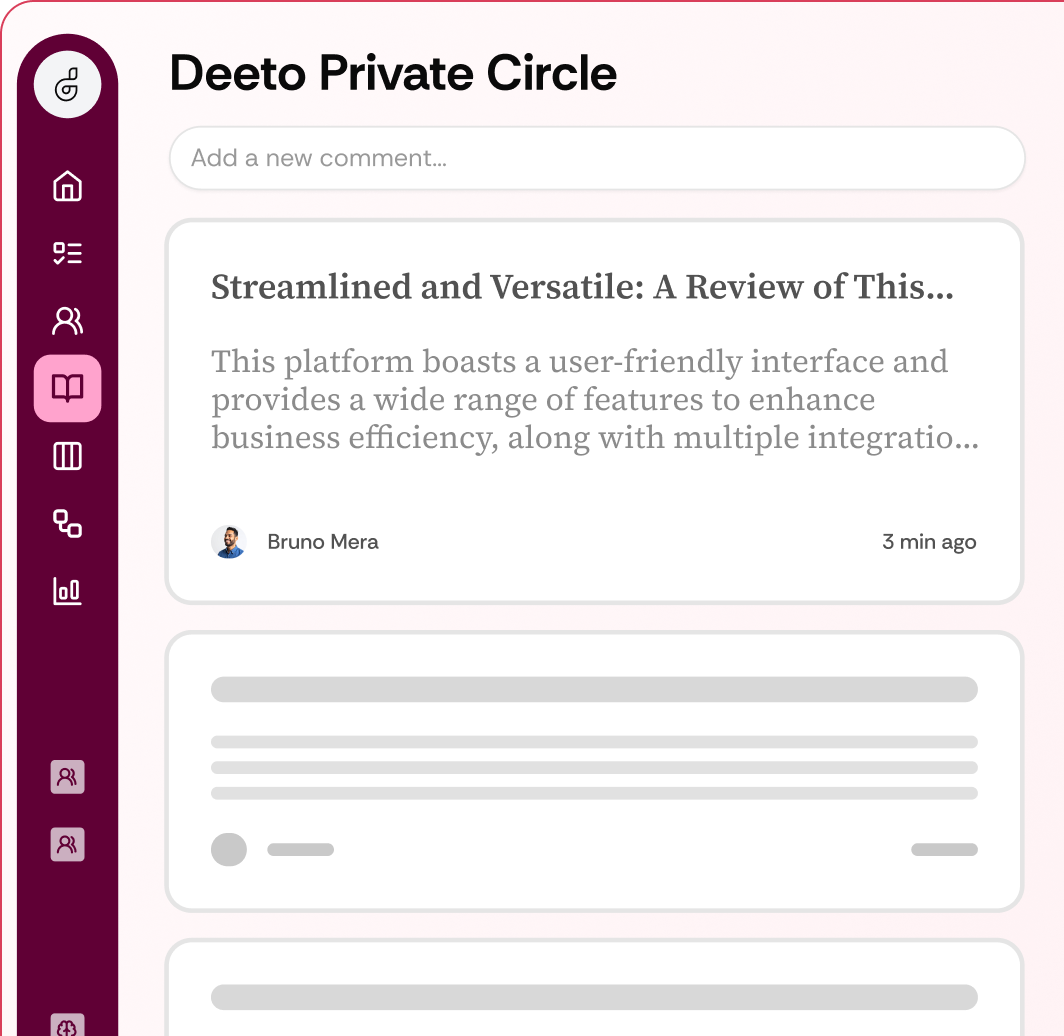
Discover practical guides, templates, and tools to help your team close more deals, faster.
Social proof is the concept that people are more likely to trust and follow the actions of others, especially when it comes to decision making. And it's your most valuable marketing asset — adding a few reviews to your site can double your sales and increase your conversion rate by up to 270%.
These 3 companies have got the whole “social proof” thing down.
Faddom does everything right. From the logo displays in the hero section to the embedded customer reviews, everything is done with purpose and style.
Placing logos of your clients/customers on a carousel is one of the fastest ways to validate your product or service. It's also one of the easiest changes you can make, and it can increase web sales by 400%.

They also do a phenomenal job of highlighting reviews from third-party sites like G2 and Capterra — something you can set up with a simple website integration.

But Faddom takes it a step further. The IT migration software vendor integrates customer quotes directly into their copy (in multiple different formats).

Plenty of companies are already doing these things. Faddom takes their social proof to the next level with Deeto's AI-powered social proof widget, which they use to dynamically display customers' testimonials across every page of their site.
When someone lands on a new page, they're met with a popup widget that showcases a relevant customer review.

They can click on the review to read the whole thing.

The site visitor can even check out the user story — a quick, digestible case study on how Faddom made such a positive impact on their business.

The best part about this is, Faddom didn’t have to spend any time collecting the feedback or building the case study. Deeto's generative AI created it for them in seconds using results, statistics, and feedback their customer submitted through the system.
The most scalable, hands-off way to do social proof. A+, Faddom.
Ashby is an ATS (applicant tracking system) software that helps companies streamline their hiring process.
What we love most about their approach to social proof is how their customers' testimonials go beyond "this product is great" or "we're so happy we made the switch". They highlight specific features and benefits in their reviews.
For example:

When a customer reads this, they understand features in a real-world context, which is far more relevant.
Getting these types of responses from your customers is simple. When getting feedback from your customers, ask them questions that warrant these responses.
For example:
Ashby also uses customers' voices to reinforce the points they're making in their blog articles.

Their argument here is that the first of three pillars of hiring excellence is "continuous improvement." So, they pulled a customer who uses Asby to exemplify that pillar and featured them in that article section.
Warmly is an AI tool that aggregates hundreds of buying signals to identify warm leads. They simplify contextualized sales outreach.
On their product pages, the hero section includes a customer testimonial and an option to watch its corresponding video. Customers see proof as soon as they land on the page.

They've also embedded positive reviews from third-party review sites, social media platforms, and internal feedback via Slack directly into their website on what they call their "Wall of Love." Each link takes the reader to the respective post, so everything is 100% verifiable.

What's also great about their website is it highlights tangible results (like "282% ROI in 6 months"), linked to full-fledged case studies.

Oh, yeah. And they've got dozens of excellent case studies.

They also feature customer testimonials prominently throughout their site. And just like Ashby, they're passionate, well-written, and chock-full of use-case-oriented language.

Deeto makes it easy to collect, curate, and distribute social proof across your website. Request a demo to see how it works.


See how 3 brands use social proof software to boost web conversions and learn how to use social proof effectively.
It's impossible to have a conversation these days without "AI" coming up. And, in 2025, its applications are only growing.
Through 2030, AI will see a projected annual growth rate of 37.3%. And according to the latest data from Exploding Topics, 82% of businesses have either fully implemented AI or are exploring its use. Nearly three-quarters are using it in at least one business function.
In today's article, we're taking a look at how B2B companies are using AI, and what's on the horizon in 2025.
According to one global study across 35 countries, 90% of marketers use AI tools to automate customer interactions. And 61% of sales teams exceeding their revenue targets are already on board with AI for sales automation.
Let's dive into some of the most exciting innovations in AI technology, and how you can leverage them to generate, nurture, close, retain, and activate more customers.
The business use cases for predictive analytics are far-reaching — fraud detection, sales forecasting, risk management, you name it. Lead scoring is one of the newest ways to use it.
Modern lead scoring tools use machine learning to analyze and evaluate leads based on firmographic information, past interactions, and engagement levels. From there, they automatically assign scores that indicate conversion likelihood and potential value.
Your sales reps can prioritize leads based on these scores, focusing their efforts on the most promising prospects.
In a similar vein, your marketing team can use these analytics to plan follow-up activities and marketing campaigns. For example, if a high-value lead suddenly stops engaging with your brand, you might trigger a retargeting campaign after a certain time threshold.
Conversational AI combines natural language processing (NLP) and machine learning to understand and respond to human language. While it's a lot more common in retail, chatbots and virtual assistants are no strangers to the B2B world.
You can use them to:
Nearly half (45%) of end-users say chatbots are their preferred method of communication with businesses.
That makes them the perfect solution to a glaring problem with B2B sales: the vast majority of buyers want to limit their time talking to sales as much as possible.
AI-powered analytics platforms can crunch data from different sources to reveal patterns, trends, and insights on customer behavior. They offer a granular, more conclusive view of customer interactions and preferences that goes beyond traditional data analysis.
You can use that data to:
With certain CMS and marketing automation platforms, AI can even trigger certain content, product suggestions, or email campaigns based on real-time behavior.
Thanks to AI, team collaboration is possible in ways that were hard to imagine just a few years back.
Real-time collaboration tools, for example, use AI to automatically translate voice and text into different languages — a huge advantage for companies working with global partners or clients.
For sales teams, meeting transcription is another big one. Whenever one of your reps gets on a sales call or product demo, a notetaking tool like Fireflies or Fathom automatically transcribes it.
Afterwards, reps can search the transcript for specific keywords, notes, or actions to verify they've logged and shared everything they needed to.
Of course, plenty of businesses use ChatGPT. But the generative AI space is so much more than that. Tons of B2B software platforms are now incorporating generative AI into their products.
Take Deeto, for instance. By curating user-generated content with the help of AI, our social proof widget makes it remarkably easy to distribute quotes, feedback, and testimonials across your website.
It works by taking authentic customer quotes, reviews, and testimonials from your Deeto content pool and turns them into visually appealing widgets. You can embed these on any page of your website. And it's all done in seconds.
You can also use Deeto to generate case studies from customer feedback and data. Then, you can use those case studies to create dynamic content for your lead generation campaigns, website content, and more.
Deeto is a customer marketing and advocacy platform that helps B2B companies activate their customers to drive sales growth. Request a demo to see how it works.

Explore key 2025 trends in B2B marketing and how AI in B2B marketing is reshaping strategy and engagement.
Before buying from you, nearly every prospect will look for referrals, reviews, and recommendations. For major purchases, they'll need a current customer to provide a reference.
If your customers talk about you on social media and review sites, the buzz around your products might even be the way prospects find you in the first place.
TL;DR: Customers who advocate for you play a crucial role in every stage of the funnel — from discovery to the purchase decision.
But how can you turn customers into advocates and use them to grow revenue?
I'm glad you asked...
Social proof content is far and away your most valuable marketing asset. 84% of people say they trust it as if it's a friend's or family member's recommendation. And sales pages with testimonials convert 34% more.
So, displaying social proof throughout your website will significantly increase the number of demos and free trials you drive.
There are plenty of ways to do so:
Deeto's AI-powered social proof widget makes things easy. It sits in the bottom-left corner of your website (you can also have an embedded version nestled within the page itself), and automatically shows relevant testimonials that your customers left in the platform.

Or, you can embed it directly into the page.

Clutch found that 94% of B2B buyers use review sites when making purchase decisions. And, on average, buyers trust reviews around 25% more than they trust sales reps.
Soliciting reviews on third-party sites like G2, Trustpilot, or Capterra helps you capture new leads and push existing ones toward the final “Yes.”
It's also one of the easiest and most scalable ways to gather and distribute customer feedback. All you have to do is set up automated review requests through your live chat software or email marketing tool.

Reference calls are one of the best B2B sales tools because they give prospects a chance to ask current customers about their experience with your product.
Your reps might be able to answer questions and alleviate concerns, but hearing it from someone who's actively using your product gives them more context and assurance. It makes the seller more authentic and trustworthy.
Plus, the act of asking for a reference call solidifies a prospect's intent to purchase.
You can also use Deeto's smart-matching feature to connect prospects and references. It's based on relevancy — your sales team automatically sees customers who match the prospect's industry, company size, or use case. You can weigh the importance of each category, so Deeto can give you more accurate matches based on what characteristics matter most to your ICP.
It also considers factors like the reference’s call availability, which they set within the Deeto platform.

RELATED: Building a Strong Reference Pool: 4 Best Practices for B2B Tech Companies Using Deeto
Nielsen surveyed 40,000 buyers across 56 countries in its 2021 Trust in Advertising Study. The results: 88% of buyers trust and act on recommendations from people they know, above all other forms of marketing and advertising.
Not to mention, referral leads convert at a 30% higher rate.
The best way to facilitate word-of-mouth marketing is through a referral program.
Offer incentives for customers to refer friends and colleagues, and use Deeto's platform to facilitate, track, and reward successful referrals.
Whenever a customer talks positively about your brand on social media, their audience sees it. Encouraging UGC on social media makes customers more engaged with your brand while giving you a free boost in reach.
Depending on the type of product you're selling, you have a lot of creativity here:
When it comes to incorporating users' content into the sales cycle, you also have plenty of options. You could run paid social ads featuring your customers, repost their content on your own profiles, respond to them on the platform, or incorporate their content into your email campaigns.
Getting your advocacy channels and content sorted is just Step 1. When you're building your customer advocacy program, you have to keep three other things in mind:
Deeto's self-onboarding and smart-matching features take care of these considerations for you. Book a demo to see how it works.

Learn how to turn social proof into sales revenue with proven strategies that boost trust and drive conversions.
While customer activation and engagement are predominantly CS functions, they shouldn't operate independently of your sales and marketing processes.
Customer advocacy software handles the logistics of your program, like onboarding, creating and publishing content, incentives, rewards, and metrics.
Integrating it (and the overarching processes tied to advocacy initiatives) with your CRM keeps your sales, marketing, and CS team in the loop on customer sentiments, activities, and interactions. And it maximizes your opportunities for leveraging customer advocates in both pre-sales and post-sales efforts.
Let's look at five reasons to integrate your customer advocacy program into your CRM.
There are dozens of ways to use your existing customers to flourish. It's all about how you utilize their power, the trust they place in your brand and how you can leverage that for higher conversions, cross-sell/upsell opportunities, and retention.
For your sales team, that could be customer reference calls, testimonials, and case studies. For your marketing team, that could mean user-generated content, reviews, and social media advocacy.
Using CRM allows you to seamlessly incorporate these initiatives into your sales and marketing processes. Since both teams will have access to the same customer data and interactions, it's easy to identify specific content and potential advocates for a campaign.
For instance, your marketing team can use Deeto's dynamic social proof website widget to source specific UGC (reviews, testimonials) from within their content pool. They can dynamically display it on your website, based on the products/services a potential customer is viewing.
When you integrate customer advocacy with your CRM, the system can easily pull a prospect's firmographic data and current sales pipeline stage.
From there, you'll get a list of customers with similar attributes, use cases, and experiences, plus the stories and testimonials they've left in the system.
Without integration, sellers would have to spend significant time pulling data from multiple systems and prepping content for calls, without certainty they're using the most relevant information for their buyer.
Advocacy is one of the best ways to activate your customers. Meaningful advocacy increases their engagement with your brand and product.
With engagement data within your advocacy software, you'll know:
Your CRM will give you broader context into their behavior and potential issues with your product. Using that information, you can...
In B2B sales, attribution is remarkably complicated. You can't just rely on top-of-the-funnel metrics like 'leads generated' or 'deals closed.'
This is particularly important when it comes to your referral program, and when you're assessing the overall impact of advocates and their content. With access to pipeline data in CRM, you'll know which customers and content touchpoints played a role in each deal, and how.
You can compare this with insights into who did what activity how many times to determine the impact an advocate has on the journey, and the overall ROI of your program.
By integrating your CRM and customer advocacy program, you'll maximize customer engagement by delivering a more cohesive and satisfying experience.
Deeto integrates with your CRM to create a seamless workflow between sales, marketing, and the customers that help them sell. And you can set it up in minutes, not months.
For your customers, leaving a review or testimonial is as easy as posting a story on Instagram. For your team, end-to-end content, reference call, and referral management makes it easy to integrate social proof into every stage of the sales cycle.
Request a demo to see how it works.

See how your CRM supports a strong customer activation strategy to boost engagement and advocacy at scale.
When a customer tells someone else about your product, the inbound lead you'll get is one of the easiest to qualify, fastest to close, and cheapest to acquire.
As many as 84% of B2B purchases start with a referral. And referral leads have a ~30% higher conversion rate compared to leads from other sources.
Most businesses get referrals from time to time. But, if you're just waiting for them to happen organically, you're leaving a valuable source of leads untapped.
Mastering your referral program is a lot easier than it looks. It's all about creating a system and process that encourages and rewards your satisfied customers for sharing their positive experiences with others, without making it a chore to participate.
Finding the right customers for advocacy is usually the #1 pain point when running an advocacy program. Most fall short because they're too focused on targeting top influencers, rather than a broader segment of their customer base.
Referring a new lead to your company should be as easy for them as sending a social media post. Use a customer advocacy platform to...
Show the value they will receive if their referrals convert. Instead of sending them a generic thank-you message, communicate the specific reward they'll get.
Incentives that work best:
The point is, your rewards system should be clear and simple. Designate a specific reward for each referral category so every customer knows that when they do X, they get $Y.
When a customer refers someone to your business, make sure to keep them updated on the progress of their referral. This (a) shows appreciation for their effort and (b) keeps them engaged and motivated to continue referring others.
During the sales process, send them updates on the status of their referral (e.g. lead contacted, demo scheduled). Once the deal closes, personally email or message them, thanking them for their referral.
The most powerful form of marketing is word-of-mouth. The reason is simple: it's authentic.
When you build your referral program, your goal is to maintain that authenticity while intentionally amplifying the volume and impact of your satisfied customers' voices.
A few best practices to keep in mind:
Building a strong referral program is critical, but not all your customers will be willing or able to refer others. And some are willing to do a lot more.
A well-rounded customer advocacy program is flexible, so each customer can contribute their feedback and actions in ways that suit their time, motivation, and comfort level.
It has to incorporate:
With Deeto, you can build your whole customer advocacy program on one platform and manage all your customer advocacy initiatives from a single dashboard.
Request a demo to see it in action.

Explore creative ways to get referrals and top customer reference program best practices for more leads.
In today’s competitive digital market, social proof is a powerful tool, especially for B2B tech companies seeking to build higher trust with their potential customers. The Deeto Social Proof widget can significantly enhance your website's credibility and conversion rates if used correctly. Here are three best practices to ensure you're getting the most out of this widget:
A robust foundation of social proof content is essential for leveraging the Deeto widget effectively. Without a well-curated library of testimonials, case studies, and reviews, the widget won't have the impactful content it needs to convince potential customers. Here are some tips to build a strong reference pool:
- Collect Diverse Testimonials: Reach out to a variety of customers for testimonials. Aim for diversity in company size, industry, and use case to ensure your social proof appeals to a broad audience.
- Highlight Specific Benefits: Encourage customers to highlight specific benefits and results they have experienced. Quantifiable results are particularly compelling.
- Update Regularly: Keep your content fresh by regularly updating it with new testimonials and success stories. This shows that your product is continuously delivering value.
For more detailed guidance on building a strong reference pool, refer to our blog post, "Building a Strong Reference Pool: 4 Best Practices for B2B Tech Companies Using Deeto"(link to blog post).
Most companies today still use dedicated testimonial pages to showcase customer testimonials - this is not an effective approach. Deeto’s social proof widget allows social proof and authenticity to lead the way throughout your website in a seamless way, without requiring the visitor to take any additional steps.
One of the keys to effective social proof is relevance. The content displayed by the Deeto widget should match the context of the page it’s on. Here's how to do it:
- Product Pages: On product pages, use testimonials and case studies that specifically mention the product. Highlight how it has solved problems or improved outcomes for other customers.
- Feature Pages: If a page focuses on a particular feature, choose social proof that discusses the benefits of that feature. This reinforces the feature’s value and relevance.
-Homepage: For your homepage, use a mix of high-level testimonials and success stories that speak to your company's overall value proposition.
By tailoring your social proof content to match the context of each page, you increase its relevance and impact, making it more likely to resonate with your visitors.
One of the major advantages of the Deeto widget is its flexibility and ease of use. Take full advantage of this by experimenting with different content and placements. Here’s how:
- Launch Multiple Variations: Create at least two versions of the widget with different testimonials and place them on different pages. This helps you understand which content resonates best with your audience.
- A/B Test: Use A/B testing to compare the performance of different widgets. Test variations in terms of the content, layout, and placement on your website.
- Analyze and Optimize: Gather data on conversion rates and engagement metrics for each variation. Use this data to refine your social proof strategy, focusing on the types of content and placements that perform best.
Regularly mixing up your social proof content and testing different approaches ensures that you are continuously optimizing for the best possible results.
By following these best practices, you'll be well on your way to maximizing the effectiveness of the Deeto Social Proof widget. Remember, the goal is to build trust and credibility with your audience, and relevant, well-placed social proof is one of the most powerful tools to achieve that.

Learn 3 expert tips for maximizing testimonials using Deeto widgets and social proof best practices.
As a B2B tech company, building a robust and reliable reference pool is crucial for validating your products and services. Deeto offers a powerful platform to streamline this process, ensuring that you can efficiently gather and manage customer references. Here are the four best ways to build your reference pool using Deeto:
1. Bulk Invites: Cast a Wide Net
When starting to build your reference pool, it's essential to invite a large number of potential references. Deeto's bulk invite feature allows you to do just that. Here’s why this method is effective:
- Efficiency: With bulk invites, you can reach out to a large audience quickly, maximizing your chances of getting a substantial number of responses.
- Selective Approval: You maintain control over which content gets approved and shared. This means there's no need to be overly selective when sending out initial invites. Focus on volume first, and then curate the best responses.
By leveraging bulk invites, you set the stage for a broad and diverse pool of references, which you can refine over time to highlight the most compelling testimonials.
In essence, our message is: Don’t be afraid to cast a wide net. If anything, you will be pleasantly surprised by the conversion rate.
We recommend starting with a wide list of all of your highly active customers - focus on the contact who have daily/weekly interactions with your product or service.
Please note: Bulk invites don’t equal “self-registration”. You will be able to share with us a list of customers that you would like to invite - and we will automatically send them a personalized invitation.
2. Personalized Email: Make It Personal, Short, and Rewarding
The initial invitation email is your first point of contact, so it needs to make a strong impression. Here are some tips for crafting an effective email:
- Personalization: Tailor the email to reflect your brand’s voice and values. A personalized touch makes the recipient feel valued and increases the likelihood of a positive response.
- Brevity: Keep the email concise and to the point. Busy professionals are more likely to engage with a short, clear message.
- Incentives: If you have a reward program, mention it upfront. Offering a small reward, such as $5-$10 for clicking the call-to-action (CTA), can significantly boost engagement rates.
Example Email Template:
Subject: We Value Your Experience – Join Our Reference Pool!
Hi [Recipient's Name],
We hope you’re enjoying [Your Product/Service]. We’re building a pool of trusted references and would love for you to be a part of it!
As a token of our appreciation, we’re offering a $10 reward just for clicking the link below and sharing your feedback.
[CTA Link]
Thank you for being a valued customer!
Best regards,
[Your Name]
[Your Position]
[Your Company]
3. Choose the Best Sender: Leverage Personal Connections
The success of your invitation campaign can hinge on who sends the email. Deeto allows invites to be sent from a personal company email, which you should strategically select:
- Personal Relationship: Choose a sender who has a close relationship with the recipient. This could be an account manager or a customer success representative who has directly interacted with the customer.
- Recognition and Trust: When the recipient recognizes the sender and feels a personal connection, they are more likely to feel obligated to respond positively.
By thoughtfully selecting the sender, you can increase the likelihood of your invites being opened and acted upon.
4. Utilize Deeto Self-Registration: Keep It Accessible and Informative
Once you have an active pool of references, it’s crucial to keep the momentum going. Deeto’s self-registration capability can help with this:
- Personalized Landing Page: Create a landing page that can be shared across various channels, such as customer correspondence, social media posts, and email communications. With Deeto you are able to customize and launch a self-registration landing pages that fits perfectly into your brand’s look and feel.
- Reward Breakdown: Ensure the landing page includes details about the rewards program to entice more customers to register and participate.
Example Landing Page Content:
Welcome to Our Reference Program!
We’re excited to invite you to join our reference pool. By sharing your experiences with [Your Product/Service], you can earn rewards and help others make informed decisions.
What’s in it for you?
- Earn $10 for your initial participation
- Additional rewards for ongoing involvement
Join us today and start earning while sharing your valuable insights.
[Register Now Button]
Thank you for being a valued part of our community!
[Your Company Logo and Contact Information]
By providing an easily accessible and informative landing page, you can continuously grow your reference pool and maintain an engaged community of advocates.
Conclusion
Building a strong reference pool is a strategic process that can significantly enhance your credibility and sales efforts. By using Deeto’s bulk invites, crafting personalized and rewarding emails, choosing the best sender, and utilizing the self-registration feature, you can efficiently gather and manage valuable customer references. Our team at Deeto is deeply committed to your success - These best practices combined with our tailored 1-on-1 guidance will provide a fertile ground for maximizing the effectiveness of your strategy.

Learn 4 customer reference program tips for B2B tech and improve client reference management with Deeto.
Referral programs have long been known as one of the most effective strategies for acquiring high-quality leads and expanding customer networks in B2B marketing:
With the advancement of technology, platforms like Deeto have revolutionized how businesses implement and manage their referral initiatives. However, launching a successful referral program requires more than just setting it up—it demands strategic planning and execution.
Here are six best practices for leveraging Deeto to maximize the effectiveness of your referral program:
1. Customization is Key
Customizing your referral program's landing page is crucial for making it appealing and intuitive for your customers. When utilizing Deeto, take advantage of its customization features to tailor the landing page to match your brand identity and resonate with your target audience. Ensure that the copy:
By making the process familiar and transparent, you encourage greater participation and engagement from your customers.
2. Experiment with Campaigns
In Deeto, the ability to launch unlimited campaigns provides a unique opportunity to cater to diverse customer segments. Different individuals may respond to varying triggers, so leverage A/B testing to experiment with different colors, copy variations, and incentives.
For instance, consider adjusting the initial incentive based on customer personas:
By tailoring campaigns to specific segments, you can optimize engagement and drive more referrals.
3. Strategic Program Placement
The frequency and visibility of your referral program play a pivotal role in its success. Integrate your program across multiple channels, ensuring it is prominently featured in:
Consistent exposure reinforces awareness and encourages participation. Consider including it as a footer in all outgoing communications to keep it top-of-mind for customers. The more your customers hear about the program, the more likely they are to participate, leading to increased submissions and conversions.
4. Value-driven Rewards
People are motivated by incentives, and a well-structured reward system can significantly boost engagement in your referral program.
When determining rewards, consider the value of a qualified lead and the effort required for referral. Aim to offer rewards that demonstrate appreciation for the referral while aligning with your budget and objectives.
For qualified leads, offering a percentage of the regular Cost Per Lead (CPL) as a reward is recommended, with the exact percentage varying based on deal size and company preferences.
Additionally, for won opportunities, industry standards suggest offering rewards ranging from 3% to 20%, depending on the specific circumstances.
Remember - leads are never free, and referrals should be no different; Especially considering that leads that come from a referral are ~30% more likely to convert than any other lead.
5. Timing is Everything
The timing of your referral requests can greatly impact their success.
Approach customers for referrals when they are at their peak satisfaction—perhaps following positive feedback or a successful interaction with your product or service.
By reaching out when customers are in a "giving" state (usually comes right after they have “received” something from you), you increase the likelihood of a favorable response.
Timing your requests strategically ensures that customers are more receptive and likely to advocate for your brand.
6. Keep Track & Grow
It is easy to fall into the trap of setting up your referral programs and letting them go with the hope of catching something.
Don’t do that.
Instead, use feedback and analytics to review the performance of your campaigns, and learn which ones are performing better and which ones aren’t.
Tweak them, and improve them constantly to maximize your resources and their potential.
In conclusion, launching a successful referral program using Deeto requires a strategic approach that emphasizes customization, experimentation, strategic placement, value-driven rewards, and impeccable timing. By implementing these best practices, businesses can harness the full potential of their referral programs to drive growth, expand their customer base, and foster strong relationships with advocates. With Deeto's powerful features and these proven strategies, you can elevate your referral program to new heights of success.
Need more information? Reach out through our chat and we’ll be happy to help!

Discover 6 referral program best practices to boost engagement, drive growth, and get more qualified leads.
From customer reviews to video testimonials, there are several ways to incorporate social proof into your website.
It's far and away your most valuable marketing asset. And if you aren't prioritizing it in 2024, you're behind.
Problem is, manually sourcing, curating, and uploading this content to every product, service, and feature page is time-consuming and tedious.
Deeto's dynamic social proof site widget empowers businesses to curate and showcase user-generated content directly on their websites, without the messy middle.
B2B buyers don't immediately trust companies or sales reps, but they do trust reviews, proven results, and recommendations from their peers.
Not to mention, feature- and situation-specific written and video testimonials help you reinforce your product's value and differentiation strategy.
When someone reads or watches an honest testimonial, they have the opportunity to see its most important benefits through someone else's eyes.
Apart from reinforcing your brand's credibility, activating your current customers keeps them engaged with your product. They'll be more likely to remain loyal, try new features, products, and services, and refer others to your business.
When you showcase their authentic, unbiased feedback on your website, it also motivates them to keep providing valuable insights and suggestions.
With Deeto, you can automate the process of collecting, curating, and displaying social proof across your web pages.
Here's an overview of the four-step process:
Within the Deeto platform, you can invite customers via email to leave feedback and submit reviews.
When a customer receives the invite, they'll be guided through the process of setting up their profile, setting their contribution preferences, and making their first submission.
Compared to your average customer advocacy program, which has users write reviews for anything and everything, Deeto's guided flow helps you target specific aspects of your product and members of your customer base. Ask questions like, "What feature have you found most helpful in X situation?" to get detailed, situational feedback you can use to guide others through the buyer journey.
Plus, it's all personalized to the customer. Some may want to leave a video testimonial. Others would rather leave a written review than show their face to the world. Both will have the opportunity to do so with Deeto.
Deeto takes your authentic quotes, feedback, and video testimonials and turns them into social proof assets for your website. In seconds, you'll have a library of reviews and testimonials, specific to features and situations, that you can add to your website.
As more customers participate and your content pool grows, you'll always have access to it through the platform.
The widget helps you source reviews, testimonials, and other UGC from within your Deeto content pool. From there, you can easily add that content to different landing pages (or change it) based on their context and target audience.
Every social proof widget is beautifully designed, featuring customer headshots and snippets of their feedback.
The best part is, Deeto easily integrates with your website. It matches your brand and displays seamlessly alongside your existing content, without anyone having to write a single line of code.
The result: Your site visitors see timely, relevant social proof that speaks directly to their needs, pain points, and use cases, helping to build trust and drive conversions.
Request a demo to see the social proof widget in action.

Deeto's dynamic social proof site widget empowers businesses to curate and showcase user-generated content directly

See how Deeto helps you turn customer voice into a GTM advantage.