
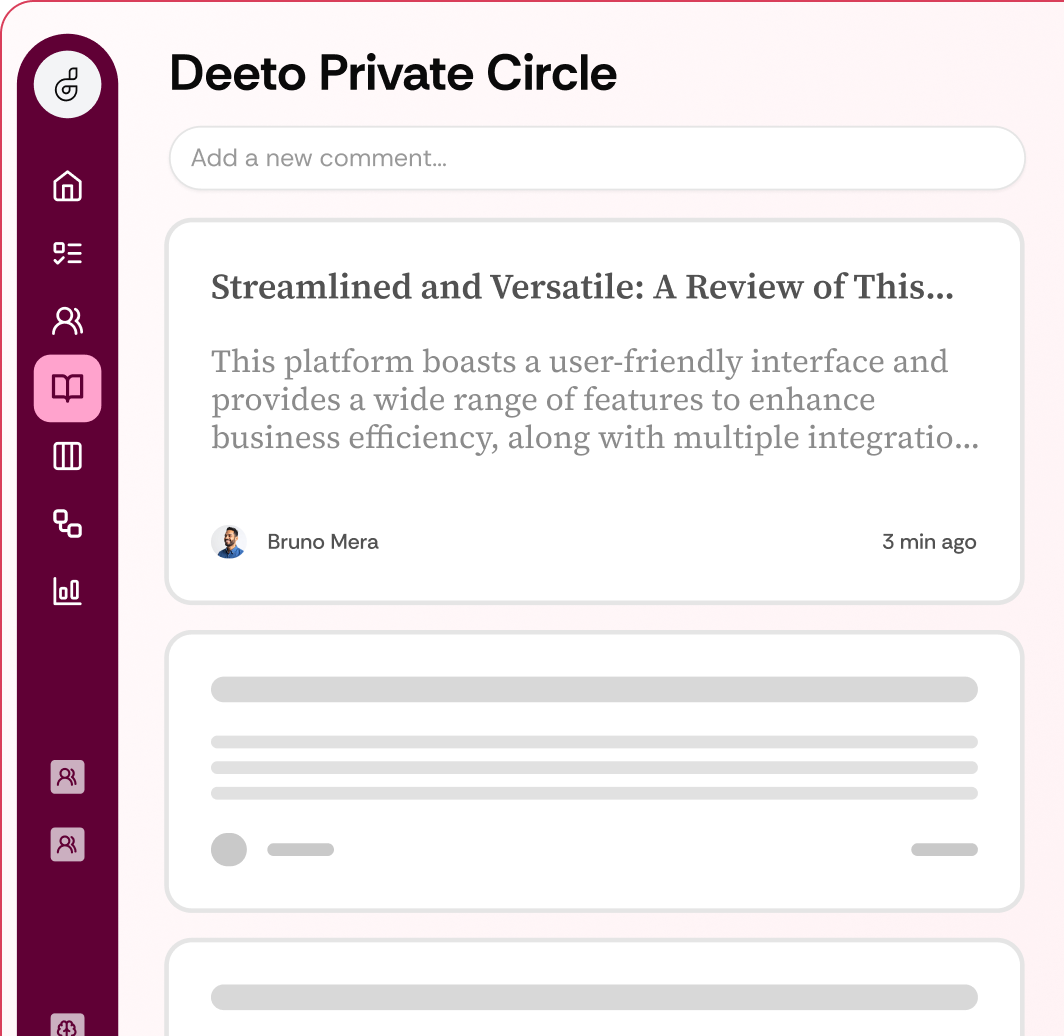
A resource and community space for modern marketers, sellers, and builders using customer voice to grow — together.
This hub is built for anyone who wants to do more with the voices of their customers. Whether you're scaling advocacy, building trust with proof, or rethinking how to go to market — you're in the right place.
How-to guides and playbooks for building with customer voice
Campaign-ready templates and swipe files
Benchmark reports and reference best practices
Event recordings, expert sessions, and community spotlights
Ask questions. Share ideas. Trade wins. This is your space.
You don’t have to figure this out alone. The Deeto community connects you with other leaders using customer voice to build better GTM motions, faster-growing brands, and smarter strategies. If you are interested in joining when it launches, sign up below.
Automate advocacy management workflows
Dynamically generate customer stories and social proof
Eliminate manual reference management
Track and report advocacy impact on revenue
Discover practical guides, templates, and tools to help your team close more deals, faster.
Overview
AI has reshaped how teams communicate, but it has not replaced the one thing that drives real buyer action: trust. While automation allows you to scale messages with speed, buyers still want proof from people who have lived the experience. This guide shows how leading teams use AI for efficiency while using authentic customer voice to create conversations that convert.Inside, you will learn why automation alone is not enough, where trust breaks down in modern outreach, and how to pair real customer stories with AI powered timing and targeting to improve reply rates, quality of engagement, and overall pipeline performance.
What You Will Learn
• Why buyers ignore outreach that feels automated and how to fix it with customer proof
• Five practical ways to blend AI with authenticity to increase engagement
• How Deeto and Samplead use each other’s platforms to create trust and precision
• A checklist you can use to improve your outbound programs this quarter
All insights come directly from the teams at Deeto and Samplead and are grounded in real results from real customers.
Why This Matters
Buyers trust people, not generic messages. Teams that combine AI and authentic customer voice build stronger relationships, see faster movement in pipeline, and achieve more consistent performance across channels. This guide gives you the structure you need to do the same.
Featuring



A guide to pairing AI with real customer voice to create outreach buyers trust.
Overview:
Product launches move fast. But without customer proof, even the strongest messaging can fall flat. Join Deeto and Sid Khaitan from Beekeeper for a live session on how product marketers can launch faster, smarter, and with proof that actually closes deals.
Why Attend:
Learn how Beekeeper’s product marketing team cut manual content lift by 30–40%, built a centralized library of launch-ready proof, and equipped Sales with the validation they needed from day one. Walk away with actionable strategies you can use to embed customer voice into every launch.
What to Expect:
Date: Thursday, October 2, 2025
Time: 9:00 AM PT / 12:00 PM ET
Location: On-Demand Virtual Event (link sent upon registration)

Product launches move fast. But without customer proof, even the strongest messaging can fall flat.
Overview:
Customer advocacy is evolving — and the old, manual way of managing references and stories no longer scales. Join Deeto and Amber Heffner from ParentSquare for a live session that unpacks how to turn scattered stories into a powerful growth engine.
Why Attend:
In this webinar, you’ll learn how ParentSquare grew their advocate base 4x in just 90 days, cut manual effort by 30%, and made advocacy measurable across sales and marketing. Discover practical plays you can use immediately, plus get a behind-the-scenes look at what’s next for AI-powered advocacy.
What to Expect:
Date: Thursday, September 18, 2025
Time: 9:00 AM PT / 12:00 PM ET
Location: On-Demand Virtual Event (Link sent upon registration)

Customer advocacy is evolving — and the old, manual way of managing references and stories no longer scales.
Overview:
Raise a glass with EMEA’s top customer marketing leaders. Join Deeto for an exclusive happy hour during the Customer Marketing Alliance event in London — a relaxed, high-value networking session designed to connect the brightest minds in customer-led growth.
Why Attend:
Network with customer marketing peers, share strategies that work, and uncover new ideas for scaling advocacy and proof. This is a chance to meet the people shaping the future of customer-led growth in EMEA — in a private, informal setting.
What to Expect:
Date: Wednesday, December 3, 2025
Time: 5:00 PM – 7:00 PM PT
Location: InterContinental London, The O2 – Private Suite

Join Deeto for an exclusive happy hour during the Customer Marketing Alliance event in London.
Overview:
Unwind, connect, and trade insights with the best in customer marketing. Join Deeto for an exclusive happy hour during the Customer Marketing Alliance event in San Francisco, designed for the leaders shaping the future of customer-led growth.
Why Attend:
This is your chance to network with industry peers, share best practices, and swap real-world strategies in a relaxed, informal setting. Whether you’re scaling advocacy, building community, or driving revenue impact, you’ll meet the people who are solving the same challenges.
What to Expect:
Date: Wednesday, September 10, 2025
Time: 5:00 PM – 7:00 PM PT
Location: Hyatt Regency San Francisco – 3SIXTY - TopGolf Swing Suite

Join Deeto for an exclusive happy hour during the Customer Marketing Alliance event in San Francisco.
Overview:
Your campaigns are optimized, your traffic is targeted — but conversions are stalling. Why? Because buyers don’t trust what they see. This guide shows you how to fix the trust gap on your site and turn high-intent visitors into qualified pipeline.
Spotlight:
This is a practical playbook for Demand Gen and Growth teams who need more than personalization and CTAs. Inside, you’ll learn exactly where to place customer proof, how to make it relevant to every visitor, and why embedding trust at the right moments can transform your website into a true revenue engine.
What to Expect:
Why It Matters:
92% of B2B buyers trust their peers more than your brand copy. This guide helps you stop relying on claims and start showing proof — everywhere it counts.
Download the guide and start turning your website into the highest-converting asset in your funnel.

This guide shows you how to fix the trust gap on your site and turn high-intent visitors into pipeline.
Overview:
Great product launches need more than messaging and a roadmap — they need proof. In this guide, you’ll learn how top product marketing teams embed real customer voice into every launch, eliminate the last-minute scramble for quotes, and equip Sales with proof that actually wins deals.
Spotlight:
This isn’t theory. It’s a field-tested playbook built for PMMs who want faster launches, stronger validation, and better alignment across Sales and GTM. Learn from real-world examples, including how Beekeeper cut manual content lift by 30–40% while creating a scalable proof engine.
What to Expect:
Why It Matters:
Stop launching on assumptions. Start launching with customer-backed proof that accelerates revenue impact and strengthens every part of your go-to-market.
Download the guide now and make your next launch your most credible one yet.

In this guide, you’ll learn how top product marketing teams embed real customer voice.
Overview:
Customer advocacy builds trust, accelerates deals, and fuels growth — but most teams are stuck running it on spreadsheets. This guide shows you how to scale advocacy without adding headcount, manual effort, or duct-taped processes.
Spotlight:
Inside, you’ll find a practical, step-by-step playbook designed for customer marketers who want more advocates, better stories, and measurable impact. See how companies like ParentSquare 4x’d their referenceable advocates in 90 days while cutting manual lift by 30%.
What to Expect:
Why It Matters:
Stop chasing stories and start scaling them. Build an always-on advocacy engine that drives trust, proof, and growth at every stage of your buyer journey.
Download the guide and turn customer advocacy into your most powerful growth lever.

This guide shows you how to scale advocacy without adding headcount.
In the rush to “AI everything,” it is tempting to focus only on whether AI can write case studies, summarize interviews, or generate testimonial copy.
At Deeto, we believe the real opportunity in AI-powered customer advocacy is not just about what gets written. It is about when, how, and why that proof gets delivered at the speed of the sales cycle and with the confidence of knowing it is trusted and compliant.
We want to share how we are thinking about the future of advocacy and why scaling customer proof means more than generating content. It is about reducing lag, removing guesswork, and unlocking the full potential of your happiest customers.
Most marketing and CS teams already have customer wins happening every day. You do not need more satisfaction surveys or “tell us your story” forms.
The problem is lag, the delay between a great customer moment happening and anyone being able to use it.
It sounds like this:
By the time that proof is ready, the buyer has moved on or the opportunity has gone cold.
This lag kills momentum. It also creates burnout because reference management and content creation become a never-ending game of chase.
Yes, AI can help draft summaries, reword testimonials, and even assemble lightweight case studies. And yes, Deeto does that.
But we are building for something bigger. Because the real power of AI in advocacy is not just generating the story. It is making sure the right story reaches the right buyer at the right time with the right controls in place.
That means using AI not as a copywriter, but as an orchestrator.
It means helping teams:
That is what moves the needle, not just volume, but precision and timing.
When this orchestration works, everything starts to click:
No digging through folders. No bottlenecks. No burnout.
Just real voices, matched and shared with purpose.
Buyers are skeptical. They are trained to ignore vendor pitches and polished PDFs. What they want is proof, real stories shared by real people who have solved the same problems they are facing.
At the same time, marketers and CS teams are under pressure. Headcount is tight. Content requests are up. Everyone is expected to do more with less.
That is why this next wave of advocacy cannot just be about scaling output. It has to be about scaling impact.
It is not about having more stories. It is about having the right proof ready before the ask is even made.
Teams using Deeto are already seeing the difference:
And most importantly, marketing and CS teams finally feel like they can stay ahead of demand instead of playing catch-up.
We believe the future of advocacy will not be defined by how quickly you can write a case study. It will be defined by how intelligently and confidently you can activate your customer’s voice.
AI should make that easier, smarter, safer, and faster.
That is the future we are building toward at Deeto, where proof is not just created. It is connected, trusted, and ready when it matters most.
If you are rethinking your advocacy strategy or just tired of the backlog, we would love to show you what this can look like. Let’s talk.

The future of advocacy is not content or even customer volume. It's connecting the right customer to every right moment.

See how Deeto helps you turn customer voice into a GTM advantage.